Naples is wild and rough, cheerful and fun at the same time. Perhaps it is also due to its proximity to Mount Vesuvius, the still active volcano, that Naples is literally bubbling with life. In this article, I’ll show you the best things to do in Naples, attractions you shouldn’t miss and I’ll give you insider tips for this delightfully chaotic city in Italy.
The best attraction in and around Naples
Not even two hours by plane from Germany, you’ll land in Naples in another world: Naples is perfect for a short city trip! But also the region around the Gulf of Naples has a lot to offer: If you have time, you should definitely visit the Amalfi Coast as well! If possible, be sure to stay longer than just a few days or a weekend in and around Naples! From Naples you can explore the famous Amalfi Coast, impressive islands like Capri or Ischia, ancient Pompeii or Mount Vesuvius!
The Centro Storico, the old town, is where many of the sights in Naples are located. The name “Old Town” is actually misleading – also the rest of the city is quite historic. Because Naples is, to put it mildly, a very rustic city.
Even in tourist areas like the old town, the alleys are still authentically dim and that the garbage all around might be something you should get used to when visiting Naples. Waste disposal is said to be firmly in mafia hands in Naples, and the fact that actual cleaning is not at the top of the government’s to do list is unfortunately noticeable. But it is exactly this patina that makes the charm of Naples!
#2 Spaccanapoli: The main street of Naples
The Spaccanapoli is the heart of Naples. On this shopping street you will experience the real Naples. Corner stores, old-established businesses, touristy souvenir shops or ice cream parlors, here, you’ll find it all. You won’t find Spaccanapoli under this name on most maps, because it actually consists of three streets: Via Maddaloni, Via Benedetto Croce and Via San Biaggio dei Librai.
The Spaccanapoli is the heart of Naples.
Along the Spaccanapoli are also many Naples attractions! In addition, it is always worthwhile to take a look at the small side streets and immerse yourself in real Neapolitan lifestyle. Definitely a good starting point to get to know Naples.
Typical: Laundry is simply dried on the wildest constructions between the houses.
At theCappella Sansevero you get a taste of how much history and culture Naples has in store. The Cappella Sansevero is a former private chapel of a rich nobleman, the Prince of Sansevero, converted into a museum. He was a Freemason and an alchemist, so the small chapel looks more like a cabinet of curiosities of that time.
The main attraction is the veiled Christ(Cristo velato), a marble statue laid out in the center of the main room – and crafted deceptively real! In the cellar there are still two anatomical models, which are just as intricate for the 18th century.
The entrance fee of 8 euros for the small chapel is quite expensive (by the way, photos are also prohibited and are immediately prevented by the museum guards!). Therefore, if you are on a tight budget, I would rather recommend a visit to the other museums of Naples if you are in the mood for culture.
#4 Museums in Naples
Other museums worth visiting in Naples:
Museo Archeologico Nazionale di Napoli (MANN)
The Archaeological Museum of Naples is one of the most important museums in all of Italy and one of Naples’ top sights. Here you can find many treasures of antiquity, including from Pompeii. (But since we went to Pompeii later, we didn’t visit the Archaeological Museum this time).
Museo di Capodimonte
The summer residence of the then King of Naples and Sicily now houses the Museo di Capodimonte with a huge collection of paintings from the Middle Ages to the Renaissance. Located a bit out of town, but definitely worth seeing for the surrounding park with views of downtown and Vesuvius.
My personal tip is always to visit churches anyway, if you want to get to know more about the cultural history of Europe, but don’t necessarily have the budget or time for extensive museum tours. And in the exceedingly pious south of Italy, churches can be found almost on every corner. In Naples you should not skip the Duomo.
Other churches worth seeing in Naples
Complesso Monumentale di Santa Chiara
Church with adjoining monastery. You have to pay an admission fee, but the cloister is a true oasis in the otherwise bustling old town of Naples.
Chiesa del Gesù Nuovo
The facade of this church alone is extraordinary! Inside, things continue pompous again.
Modernist facade of the Chiesa del Gesù Nuovo.
#6 Via San Gregorio Armeno: The Nativity Street
The Via San Gregorio Armeno is one of the most extraordinary streets in Naples. Even if you are not religious you will enjoy the not necessarily always Christian nativity figures sold here on this street, some of which are still handcrafted. In between, there are all kinds of satirical things, such as toilet paper rolls with Italian and international politicians. The italian humor is one of a kind!
Via San Gregorio.
#7 Vomero and the Castel Sant’Elmo
If you want to experience Naples away from the touristy old town, I recommend a trip to the Vomero district. Vomero is a somewhat calmer district, many well-kept old buildings in tree-lined avenues and a pleasant street life – it almost seems a bit like being in Paris. We also had a fantastic lunch here, by the way, at a tiny family-run osteria. No menu, no one speaks English, but instead there is real homemade Neapolitan cuisine, della Nonna, of course.
By the way, if you want to know where to find the most famous pizza in Naples, click here in my article: The best pizza in Naples
Osteria Donna Teresa in Vomero
Situated on a hill, Castel Sant’Elmo has the best view over the city. If you don’t want to pay the entrance fee, there is a viewpoint below the castle with a fantastic view over the old town, the harbor of Naples and the Vesuvius. The best way to get to Vomero is by metro (a sight in itself in Naples, by the way!) to Vanvitelli station, or by funicolare from Augusteo.
Best view over NaplesBy Funicolare to Castel Sant’Elmo
#8 Metro dell’Arte: Line 1 & Toledo Station
The metro in Naples is still quite new, the first line was opened only in 1986. Some downtown stations were even added just a few years ago. Line 1 is nicknamed Metro dell’Arte because many of its stations are particularly artistic. Most worth seeing is the Toledo station – if you ride down the extra-long escalator here, you feel like you’re diving down into an aquarium. To get there, you need a valid metro ticket (single trip 1,10€). But I recommend you to buy a day ticket for your stay in Naples. It costs only 4,50€ and you can use ALL public transport like metro, bus and cable car!
The most beautiful of all metro stations in Naples: Toledo.
#9 Via Toledo & Galleria Umberto I
Shopping enthusiasts will have a great time on Via Toledo. I still think Italy is a teeny bit ahead in terms of fashion. Here you can still get the most beautiful clothes, from cheap to high-end, and just watching the Italians with their unique fashion sense gives you enough inspiration for your own closet. Those who are not so fashion-savvy may be pleased to see the many small snack stands, the friggitorias, with the typical deep-fried Neapolitan delicacies.
Impressive: The Galleria Umberto I
At the end of Via Toledo, almost somewhat hidden, is the Galleria Umberto I, a shopping gallery in the style of Galleria Vittorio Emmanuele II in Milan. Whenever I enter such shopping galleries, I’ll always enjoy the particular Italian style. The architecture is so impressive!
#10 Piazza Plebiscito to Castel dell’Ovo
Naples can be beautiful, but it can also be exhausting: The many small streets, uphill, downhill, the noise everywhere, the bustling traffic and daring scooter riders make the old town of Naples an experience. From Piazza Plebiscito you can take a short walk that will take you to a more relaxed area. Piazza Plebiscito is a real huge square, quite a contrast to the narrow old town. From here you can walk down to the water and enjoy the view of the Gulf of Naples and Mount Vesuvius with an Aperol Spritz in one of the simple beach bars on Via Nazario Sauro. For me one of the most beautiful places in Naples!
A little further on you will come to Castel dell’Ovo, a really impressive castle. Many rooms of the castle are not open to the public, but the entrance is free and from the top you also have a beautiful view.
Tips & hacks for your trip to Naples
Safety in Naples
Naples is one of the European capitals of pickpockets, along with Barcelona. I have been to both cities several times and personally, I think Barcelona is much more dangerous in terms of petty crime. Naples never seemed to me as critical as people say, except perhaps the area around the main train station. Nevertheless, you should be just as careful in Naples as in other big cities: Stow your cell phone and wallet away well and always be a little careful.
Tip for photographers
I always had my bigcamera * with me and haven’t been only for ergonomic reasons grateful for my cross body strap* . It also makes the camera less interesting for potential thieves, because you can’t tear the camera off the body. Cars should be parked in monitored parking lots or parking garages and do not leave valuables in them.
In my opinion, spring or fall is the best time to visit Naples. Under no circumstances would I recommend August (as for all other Italian cities). It gets very hot, besides August is general vacation month in Italy. Many stores are closed and the city is full of tourists.
Accommodation in Naples
In Naples, there are numerous small Bed & Breakfasts or apartments. We stayed at Tutt’e Sant Luxury Rooms, a small B&B consisting of only two very individually and tastefully furnished accommodations – with an authentic Neapolitan view. Particularly amusing was the elevator with absolute vintage flair, which ran right through the huge stairwell – and was equipped with a coin machine where you had to insert 5 cents before each ride. Quirky!
How to get to Naples
There are now many direct flights from different European cities to Naples, but unfortunately the airport is far too small for all the crowds that land there every day. It’s quite messy. You really need a good set of nerves there.
Reached by plane in two hours from Germany: Naples is perfect for a short trip.
From the airport you can get to the city by cab or public bus. If you go by cab, you will be asked whether you want to pay the flat rate (to the city about 18 euros, price list is displayed in the cab) or by taximeter. We thought we were particularly smart to choose the taximeter, but then had to pay 5 euros more. So don’t be shy to choose the flat rate.
If you want to travel from another city in Italy, I can also recommend the Italian train.
Driving through Naples by car, by the way, is adventurous (but doable if you follow Italian traffic rules: they are basically non-existent). In addition, car theft is not uncommon. We booked a rental car for our further trip to the Amalfi Coast, but at the rental office we were told to park the car in Naples in guarded parking lots only. I therefore advise you to book a rental car only when you continue your journey from Naples to the surrounding area. Many car rental companies also have stations in the city center around Garibaldi Central Station.
Copacabana, Sugarloaf Mountain, beaches —these are probably the first images that come to mind when you think of Rio de Janeiro. And rightly so, because no trip to Rio is complete without visiting these places! However, Rio de Janeiro is so much more than that: the artistic neighborhood of Santa Teresa, for example. Perched on a hill, Santa Teresa feels almost like a completely different world. Santa Teresa has always been a magnet for artists and creative types in Rio de Janeiro. In this article, I’ll tell you what else makes Santa Teresa so interesting.
View from Santa Teresa
Santa Teresa: The creative hotspot in Rio de Janeiro
Santa Teresa is one of the older districts of Rio de Janeiro. The European immigrants who settled here at the beginning of the last century also brought their different architectural styles: There are impressive city villas in all kinds of styles all over the place. Santa Teresa is also located on one of the many hills in Rio. Therefore, from many houses, you have a great view over the city. For a long time, Santa Teresa was a neglected part of Rio de Janeiro – until it was rediscovered by many creative people and artists in the last years! Today I consider Santa Teresa to be one of the most exciting parts of Rio de Janeiro!
Santa Teresa’s historical streetcar: O bonde de Santa Teresa
The nostalgic tram is the landmark of Santa Teresa (called “bonde” in Portuguese). You can ride up and down through Santa Teresa to the famous Arcos da Lapa. The Arcos da Lapa are a narrow aqueduct and the tram runs on top! A true experience! After there was a serious accident some years ago, the tramways are however not that crowded anymore: In former times, you could take the train for free if you just jumped up and held on outside.
One ride costs 20 Reais (about 5€), but it’s worth it! It is best to get on at the beginning of the line at the Estaçao Carioca. From there, the train goes up the Arcos da Lapa to Santa Teresa. Unfortunately, there is no day ticket, so either you have to buy a new ticket every time you want to get off the tram and on again. Or you can change to Uber or Bus. Therefore, I recommend to drive up to the terminal station first and then to work your way down again.
The Santa Teresa tram is one of Rio’s landmarks. You can find out more about even more famous sights, such as the Christ the Redeemer statue and Sugarloaf Mountain, in this article: The Most Beautiful Sights in Rio de Janeiro
Tips for Santa Teresa in Rio de Janeiro
The Largo dos Guimaraes is the heart of Santa Teresa! Especially on weekends, restaurants and bars are well filled! Here you can enjoy typical Brazilian cuisine, even Cariocas come here to the traditional Feijoada lunch (bean stew with rice) on Saturday. Some nice addresses:
Bars, Restaurants und Cafés
Explorer Bar
A small bar near Largo dos Guimaraes with fantastic cocktails (the caipirinha is great here, but the rest of the menu is highly recommended!) serving Israeli-Brazilian cuisine with many original vegetarian and vegan dishes. There’s also a small boutique hotel attached to the bar. Click here for prices and info*
Livraria Largo das Letras
Bookstore with café in a romantic courtyard directly at Largo dos Guimaraes! Good for a short break from sightseeing!
Adega do Pimenta
German cuisine may not be your first choice when in Brazil, but the atmosphere at the Adega do Pimenta is so bizarre that you might change your mind. One of the institutions in Santa Teresa which has been around forever!
Bar do Mineiro
Another classic in Santa Teresa: The perfect address for a Brazilian feijoada, Brazil’s national dish. If you aren’t that hungry will also find typical snacks like Salgadinhos, which are traditionally served with an ice-cold beer.
Accomodation
Santa Teresa has a lot of great airbnbs. Especially if you are into cool design and a creative environment! I stayed in a small house that belongs to an artist collective; very nice and definitely an unusual place to stay.
If you prefer more hotel-like accommodations, this is perfectly situated with the Explorer Bar on the first floor and close to Largo dos Guimaraes: Discovery Suites Rio*
If you want to spoil yourself a little bit I’ll recommend this place: MGallery Santa Teresa*
Safety in Santa Teresa und Rio de Janeiro in general
Santa Teresa is not a super unsafe part of the city due to the many tourist attractions. But you have to be very careful here as well. In the evenings, it can get a little more deserted here and not all streets are so busy that you might feel uncomfortable. As a solo traveller (and half-Brazilian, who is familiar with local habits), I didn’t always consider Santa Teresa the best place to stay overnight.
I had booked a nice Airbnb, which was centrally located, but in a quieter street. In the evening, I always took an Uber, when I left my place. But I’ve heard from many drivers that Santa Teresa isn’t a popular destination for some drivers due to its remote location and because there are some shady people around, especially at night.
During the day, I felt safe in Santa Teresa. Just be cautious and don’t talk longer walks around the neighbourhood at night.
Rio de Janeiro is one of the most impressive cities in the country and should not be missed on any trip to Brazil, even as a half-Brazilian, the beauty of Rio knocks me off my feet every time. And I’m not alone in this. Everyone knows the famous sights in Rio de Janeiro, such as Sugar Loaf Mountain and the Christ the Redeemer statue! In this article, I’ll tell you what you shouldn’t miss in Rio. So off to the best Rio sights! By the way: At the end of the article you will find some very helpful tips for your stay in Rio, read them carefully!
#1 Cristo Redentor / Christ the Redeemer
From here you have the perfect view of the Cidade Maravilhosa, the great city, as Rio de Janeiro is often called. You can get to the Corcovado by car (or coach), the Corcovado train or even on foot via a hiking trail.
An excursion to the Cristo Redentor is only worthwhile in good weather, in Rio the weather can change quickly and on cloudy days you really can’t see anything. But when the sun shines, you have the complete Rio panorama: breathtaking! It’s worth coming early as it’s a little emptier then.
It’s worth arriving early to avoid the crowds on the Cristo Redentor viewing platform.The world-famous Rio landmark: Jesus with outstretched arms.
#2 Tijuca National Park / Floresta da Tijuca
Rio de Janeiro is surrounded by lush nature, vast forests, and green mountains. Right in the heart of the city lies Tijuca National Park, known as the Floresta da Tijuca. Corcovado, home to the Cristo Redentor statue, is also part of the national park. In the past, almost the entire area was cleared by coffee farmers; in the mid-18th century, the clearing was halted and the land was reforested. Today, it is home to dense forest with many waterfalls and beautiful hiking trails. It’s hard to believe you’re in the middle of a major city!
In the middle of Rio: pure nature in the Tijuca National Park.
Unfortunately, I had a bit of bad luck with the weather this time: In the pouring rain, it’s not worth taking the cable car up to Pão de Açúcar (Sugar Loaf). However, I’ve already been up there twice on previous visits. The best time to go up is at sunset! Down below, at the foot of Pão de Açúcar, in the Urca neighborhood, is Praia Vermelha, a beautiful little city beach.
Easy to see from Cristo Redentor: The Sugar Loaf Mountain with cable car.
#4 Escadaria Selarón
Jorge Seláron, a Chilean artist, began renovating the dilapidated staircase in front of his house in the 1990s. Not just like that, he covered them with thousands of pieces of tile, mainly in the colors yellow, green, red, white and blue, the national colors of Brazil and Chile. His small work of art grew in size and popularity, and many tourists brought back tiles with motifs from their hometowns, which Selarón then also used.
Selarón died a few years ago, but his staircase is now one of Rio de Janeiro’s visitor magnets. Incidentally, the Escadaria Selarón can also be seen in a fairly well-known music video: “Beautiful” by Pharell Williams feat. Snoop Dogg.
#5 Arcos da Lapa
Near the Escadaria Selarón are the Arcos da Lapa, an imposing white aqueduct. At the top of the narrow Arcos da Lapa, after a long period of restoration (there was a serious accident years ago), the old streetcar, “o bonde”, is running again, and you shouldn’t miss a ride on it! It’s best to take it straight up to Santa Teresa!
Ad / *affiliate links
#6 Santa Teresa
Santa Teresa is the neighborhood of creatives and bohemians in Rio de Janeiro! The historic streetcar (called bonde or bondinho) also runs along this route. In Santa Teresa, you can stroll through the streets around Largo do Guimarães, discover small stores and studios and enjoy a pleasant meal in the surrounding restaurants and bars.
The old streetcar is the landmark of Santa Teresa.
#7 Rocinha, Vidigal, Complexo do Alemão & Co.
Rocinha, Vidigal, Complexo do Alemao—you’ll come across these names of favelas from time to time. However, never, ever go into a favela on your own! If you’re interested in what life is like there, join a favela tour*. You’ll be safe there. Some people may see this as “poverty tourism,” but the favelas are part of Rio’s cityscape, and a tour like this can also help you understand the lives of the local people a little better.
Many favelas also showcase the ingenuity and improvisational skills of Brazilians. Since these are illegal settlements, the entire infrastructure is maintained by the residents themselves. Electricity, water, cable TV, internet access, trash collection, streets, and paths: everything is organized by the residents themselves. And all of this on the steepest slopes!
Part of everyday life in Rio de Janeiro: the many favelas on the hillsides.
#8 Copacabana, Ipanema, Leblon: the beaches of Rio
Rio is also mega famous for its wonderful beaches in the middle of the city! Copacabana and Ipanema are the top addresses for swimming. The hip Cariocas meet at Posto 9 in Ipanema. Unfortunately, for once it wasn’t beach weather when I visited. Beach life in Rio is definitely something special: the whole city meets here, the beach belongs to everyone! Be careful with the strong currents: They are not without! Tip: It’s best to go to the beach with just a towel and a few reais for a guaraná (Brazilian soda), a coconut or a caipirinha and enjoy the hustle and bustle!
No beach weather this time: Posto 9 in Ipanema is usually the meeting place for Rio de Janeiro’s It crowd.
#9 Catedral Metropolitana
Not particularly beautiful, but special: Rio’s cathedral, which was only built in 1979, can hold 20,000 people standing up. If you don’t have that much time and aren’t particularly religious, this is a location that you can skip if necessary. Nearby, however, is the Confeitaria Colombo!
Standing fit into the cathedral of Rio 20,000 people.
#10 Confeitaria Colombo
The Confeitaria Colombo is the oldest coffee house in Rio de Janeiro! Founded in 1894, it is reminiscent of European coffee houses – a total contrast to tropical Rio. Cariocas find the prices overpriced, but as Europeans they are okay – the ambience is worth it. It’s also a great opportunity to sample Brazilian specialties! In addition to sweet pastries and cakes, there is also typically a large selection of salgadinhos (small balls, croquettes or pastry pockets – salty, hence the name), which are also eaten in Brazil with coffee or as a snack between meals.
The café institution in Rio de Janeiro: the Confeitaria Colombo in the city center.
You can explore the locations mentioned above on your own (except for the favelas, of course, which only require a tour! You can easily get around the city with Uber, buses and the metro. However, I wanted to take carefree photos with my flashy camera, so this time I decided to go on a day trip.
The downside, of course, is that you often end up at a location at the same time as other tour groups, which can be a bit stressful. However, everything is planned out, so you can completely relax when it comes to safety and organization.
One-Day Sightseeing Tour of Rio*(Full itinerary—the expensive tickets for Sugarloaf Mountain and Christ the Redeemer are included!)
Safety in Rio de Janeiro
Unfortunately, crime is always an issue in Rio de Janeiro and one that does not go unnoticed by tourists. Increased caution is required! However, the Cariocas are always very nice and helpful, often giving you spontaneous tips on where you should pay a little more attention. Even if no danger is immediately visible, take all the advice from the locals to heart, it’s no coincidence.
Rio de Janeiro has two airports: Galeão, which is farther away, primarily handles international flights, while Santos Dumont Airport, located closer to the city, is reserved for domestic flights within Brazil. Many European airlines offer direct flights to Rio de Janeiro. Tip: Take an Uber into the city (there’s a separate Uber pickup area where you can meet your driver) or a regular taxi. Although there is a bus service, I wouldn’t recommend taking public transportation with luggage for safety reasons.
Best time to visit Rio de Janeiro
During the Brazilian summer, from December through March/April, Rio de Janeiro is a hive of activity. Weather-wise, you might experience summer downpours, but they usually pass quickly. It can get very hot! But on the other hand, you get to experience Rio in full summer mode! The other months are just as great, though: It can be a bit cooler in the winter, but in Rio that still means 25 degrees—perfect for sightseeing and hiking. Unfortunately, I happened to visit in September when it rained a few days.
Perfect for colder temperatures: hiking in the Tijuca National Park.
Accommodation in Rio de Janeiro
Rio de Janeiro has some of the highest accommodation prices in Brazil! Prices rise dramatically, especially during the Brazilian high summer from December through March/April. Not to mention events like New Year’s Eve and Carnival: You’ll need to book well in advance for those dates!
In addition, many accommodations require a minimum stay during these times. The Copacabana neighborhood is the most popular among tourists; this is where most of the hotels are located. It’s very touristy there, but you’re also staying in a very central location. Recently, however, locations like the artistic neighborhood of Santa Teresa and some accommodations in pacified favelas have also become trendy. In both cases, though, I wouldn’t necessarily recommend these places to every visitor to Rio. I’ve written more about my experiences in Santa Teresa in my article on safety in Rio.
Among other places, I stayed at the B+B Copacabana Hotel: It’s in a perfect location near the beach and right between Copacabana and Ipanema!
Excursions from Rio de Janeiro
From Rio, you can also take a number of great day trips to the surrounding areas of Rio de Janeiro! Beaches, islands, nature, culture—you could actually spend two weeks in Rio and still have things left to see. If you’re planning a longer trip, you can, of course, travel directly to places like Paraty or Búzios instead of taking day trips. Many intercity buses depart from the bus station in Rio to all parts of the country.
“Take good care of yourself! Rio de Janeiro is so dangerous!” My otherwise always cheerful mother and the rest of my family were really concerned who I told them that I would travel to Rio on my own. I tried not to laugh too much. After all, I’m living in Berlin-Neukölln, according to the media reports one of the worst corners in all of Germany!
How unsafe is Rio de Janeiro?
I’ve traveled halfway around the world, often alone, sometimes arriving in strange cities at night, without a plan, but also fearless, because hey, some cab will get me to my destination – but Rio de Janeiro? Rio, that’s apparently too dangerous. Dark favelas, drug gangs, shootouts and an eternal war between special forces of the military, police and gangsters, where good and evil are not necessarily always who they seem to be. Rising crime everywhere. Safety? A foreign word in Rio de Janeiro. Every day the news are full of muggings, flash kidnappings in the open street and tourists being robbed blind.
View from the Cristo Redentor: The Sugar Loaf with cable car.
Rio de Janeiro and Safety: Is it all scaremongering?
At the same time, it seems to me that a certain carelessness in Rio de Janeiro with regards to crime is out of place. I remembered the story of some fellow crew member in Mexico City. (Can’t really say if this story is true, but you’ll get the point.) The aforementioned colleague was sitting in a sidewalk café in a chic district of Mexico City, and poof… the Rolex was gone. Just like that someone pulled it of his wrist. May be one of our legends in aviation, but still: You get the advice all the time to wear as little jewelry as possible or better, no jewelry at all.
That’s also one of the reasons why I prefer to travel alone in Southeast Asia; where—as long as you take the usual precautions (like not walking around in the middle of the night in a train station district waving a wad of cash and the latest Chanel handbag—a fake one, of course)—you’re largely free from street crime and shady characters.
Crime in Rio de Janeiro: Should we be afraid?
I wish I could write here that there is nothing at all to worry about in Rio, and that everything is pure exaggeration if you are not wandering the favelas on your own. However, I can remember a moment when I was walking in the evening through Santa Teresa, the new in district for creative people in Rio de Janeiro.
Santa Teresa by day: An artists’ quarter with many studios, restaurants and small stores – and quiet.
I had booked an Airbnb there, right next to the German consulate, which is guarded around the clock—that did put my mind at ease a bit in this situation. A few Uber drivers had already warned me that I might have to wait longer for a ride—Santa Teresa isn’t exactly a popular spot, since it’s outside the typical tourist areas like Copacabana and Ipanema. Not many drivers were eager to crawl up and down the winding mountain roads, and besides, well, it could get a little weird there from time to time…
Dangerous places in Rio de Janeiro (examples)
Copacabana: Centrally located, many hotels and the famous beach are here. Copacabana looks relatively safe, especially during the day, due to everyday city life. Nevertheless, you should beware of pickpockets here around the clock. In the evening, as everywhere else, don’t walk along the beach even if it’s tempting. Stay on the promenade, have a drink in one of the bars and enjoy the night. Don’t be tempted to dip your feet in the water at night: Beaches aren’t illuminated and you might get robbed.
Corcovado: At Corcovado there is a hiking trail up to the statue of Christ the Redeemer. Attention: Tourists are often being assaulted here. At the bottom of the climb, the police is present from time to time, but along the trail you are on your own. Better take alternative means of transportation up here.
Favelas: Do not enter favelas on your own! As a non-resident, you’ll immediately stand out here. Join a guided tour if you are interested in life in a favela: for example, there are tours in Rocinha*, Vidigal* or Santa Marta*.
Centro: After business hours, it gets shady pretty quickly in the center of Rio! Avoid the centro after the shop are closed or on Sundays at all costs! The streets are empty and there are some shady characters on the road.
An evening in Santa Teresa – and an incisive experience
Santa Teresa is a very nice district at first sight. Once upon a time it was gloomier here, but now many artists and creatives have settled here, a pleasant vibe runs through the neighborhood, and somehow during the day it looks like the post-reunification Prenzlauer Berg under palm trees. The streets are lined with old villas of various types; the European immigrants who came here in the early 20th century brought a diverse range of architectural styles.
And yet, the short five minutes I had to walk from my accommodation to the bar where I had an appointment had a certain tension in it. It was eight o’clock, already dark, in the middle of the week, and the streets were mostly deserted. I was on my to the Explorer Bar and suddenly two boys walked towards me. Just walking! I didn’t know if maybe they weren’t just on their way home or something.
So my panic level raised and I wasn’t even able to control myself anymore. I got sacred and suddenly I was running as fast as I could up the street on the other side. With slippery sneakers! It must have been a bizarre picture. Me, stumbling up the hill in panic, even though there was no danger all around. No question I took an Uber for the five minute walk at the end of the evening. And the driver was remarkably understanding: “Of course I’ll take you even if it’s just the few meters!” Better be safe than sorry.
Precautions are important
I definitelylost my nerves that evening. But it wasn’t that unreasonable. In my opinion, the only reason why there aren’t even more robberies and assaults happening in Brazil, but also especially in Rio, is because the population is used to take precautions all the time. You will see massive metal fences around apartment building entrances, hotel lobbies locked after dark or police checkpoints at tourist hotspots. Often, however, they are also corresponding behaviors; a certain caution that has crept into all areas of everyday life.
My Airbnb hostess, for example, said that the area in Santa Teresa wasn’t dangerous on one hand, but on the other she also advised me to only carry a copy of my ID (in Brazil, ID is mandatory at all times) and just little money, in case I get mugged. Or when I left the house with two pieces of luggage and left one suitcase briefly for a few minutes at the leaning gate in the middle of broad daylight, a neighbor warned me: “I’d better close it up, not that anyone gets any stupid ideas.” By the way, only hundred meters away and in sight was the German consulate, heavily guarded with security and everything.
4a0b7f5cff0b55481aaa085c85afa485
Evenings in Copacabana: Watch out!
Copacabana, the neighborhood where most tourists end up—because of the beach, Rio, and all that—isn’t any better, by the way. Here, too, you have to exercise a certain amount of caution after dark. It’s not for nothing that the concierge at my hotel in Copacabana* quickly locked the door every time a guest went in or out. Once, I was still chatting with a German acquaintance outside the door (which made me a little uncomfortable—my “Rio panic” kicked in again)—two female tourists in the bright glow of a hotel on an otherwise dimly lit street—oh-oh, he didn’t unlock the door until I made a move to go inside. As if, in an emergency, he’d just stand by and watch from the safety of his post. Because, well, who stands around in the dark in front of the door for that long? It’s not exactly safe around here.
Nevertheless, there are certain rules in Brazil as well, and Brazilians are by no means as open and liberal as you might think. For example, topless bathing is frowned or sometimes even forbidden in Brazil, depending on the location? Also, Brazilian men can be very flirtacious. My simple advice: be alert, but also relaxed, maybe your counterpart really just wants to have a nice conversation or flirt a bit. If it gets too much for you or you can’t assess the situation, however, you’d better be careful and follow your instincts!
Rio de Janeiro is incredibly green: In Rio’s national parks you can go for endless hikes
Rio de Janeiro is an experience in itself, I’ve been there several times and the city always gets me. I don’t want to scare anyone into going, but a few safety tips are worth their weight in gold. As a woman alone, I think it is feasible, but I always advise not to choose Brazil or even Rio if you have never traveled alone before.
Personally, I don’t see much difference between traveling to Rio solo as a woman or as a man. Probably the only thing you are more likely to encounter as a woman are numerous flirting attempts – which I personally don’t mind that much. Brazilians are very communicative by nature, and Brazilian men just like to try their luck. Still, no means no, and there are other places in the world where I have felt much worse than in Brazil (e.g. in Marrakech). In general, just be aware that Brazilians might seem a bit more touchy than people in other cultures, but also in a non-sexual way.
Safety tips for a trip to Rio de Janeiro (not only for solo travelers)
Here are a few golden rules for your stay in Rio: (Much of this goes without saying and isn’t anything new, but in Rio, it’s best to just err on the side of caution!)
Don’t wear flashy jewelry (think about the Rolex story!), clothing or accessories.
If you’re going to the beach take only with a cheap towel with you and at most a few Reais for a drink. Nothing else. Leave everything else like cell phone, camera, etc. in your accommodation. Even if you are traveling with several people and one person always stays with your stuff. You will quickly notice: no one, but really no Brazilian goes to the beach with huge luggage. Food and drinks are usually purchased on site at booths, beach bars or from passing vendors.
Especially with flashy camera equipment: pay attention to where you are! I actually used my camera, a Canon 5D Mark IV, in Rio, which gave me a lot of bellyache, since it is very expensive after all. However, I had already prepared it for travel anyway, so that it wouldn’t look conspicuous: I never use the enclosed camera strap, which, at least for Canon and Nikon, not only indicates the brand, but also the exact model. These straps are really noticeable. Most of the time I’ll put the camera on my cross-body strap, or I use old straps from analog cameras. I also cover model numbers etc. on the camera and lenses with black masking tape. Especially the red ring of Canon’s L lenses is quite eye-catching and immediately gives away professional equipment.
I finally booked a tour, so I was able to use my camera without any worries. By the way, these kinds of bus tours in small vans are also very popular with Brazilian tourists—a great atmosphere is guaranteed! I always recommend them to solo travelers, too—you can easily strike up conversations, and you can really relax when it comes to safety.
Always keep an eye on your purse! Stow away your wallet that no one can easily access it! Avoid backpacks or carry them mainly in front of the body.
Always take only one copy of your ID with you (ID is mandatory in Brazil) and leave your passport at your accommodation.
Only ever withdraw money during the day and in monitored bank vestibules. Keep an eye out for strange characters in the vicinity. Tip: You can safely withdraw money in shopping malls.
If you’re arriving in the city with luggage, you should definitely take an Uber instead of public transportation. If you want to be on the safe side—perhaps because it’s your first time in Rio or you’re tired from a long-haul flight—make sure to arrange for a ride in advance.
Always make sure you get into the right car when you call an Uber. Check the license plate!
When you go out in the evening: always watch your drink. Be careful with Caipirinha: It’s tasty, but it’s also pure alcohol and you’re likely to pay less attention when tipsy.
Avoid public transportation in the evening! Uber is cheap and safer.
Avoid the center of Rio after business or office hours and on weekends: This part of Rio is then completely deserted and there are many shady characters on the streets! Even in daylight, it’s very dangerous here on sundays!
Also be careful on lonely hiking trails in Rio’s national parks and up to Corcovado. Walk in groups and ask locals about the current situation.
Don’t even think about exploring a favela on your own! If you’re interested in life in the favela, you can book a favela tour*, for example. I’ve never been on one myself, but they’re supposed to be very interesting and often benefit the community as well.
If the worst should happen to you: In the event of a assault, no resistance, no discussion, give up everything, then go to the police.
Conclusion: In general, I wouldn’t discourage anyone from traveling to Rio. However, especially as a Central European, you should be aware that you need to be more vigilant when traveling in Rio. In any case, you’ll love Rio!
Chicago is a truly impressive city: a huge skyline, pure city life, but also lots of greenery and long beaches on the shores of the huge Lake Michigan. Unlike its big sister New York, the people here are incredibly open-minded and friendly: Chicago is known for its positive attitude to life! Although I’ve never been a big fan of the USA, I was immediately taken with Chicago. I’ll tell you my favorite Chicago sights here!
Sightseeing in Chicago: My budget tip!
Chicago is not exactly cheap! As in all major American cities, accommodation and meals are a big hole in the wallet. But you shouldn’t skimp on good food in the foodie mecca of Chicago! And you shouldn’t miss out on some of the paid attractions such as the Willis Tower (or 360 Chicago) or the Art Institute.
Sir Anish Kapoor’s sculpture in Millennium Park is actually called Cloud Gate, but because it looks like a bean, the nickname stuck: The Bean. This is probably the most popular must-see photo spot in the whole of Chicago. Not only because of the crowds of people who make a pilgrimage here every day, but also because of The Bean itself: The reflections in the stainless steel sculpture are simply fascinating.
But The Bean is not the only work of art worth seeing here: next door is the Crown Fountain, a water-spouting video installation that provides refreshment, especially for children, during Chicago’s scorching hot summers.
#2 Willis Tower
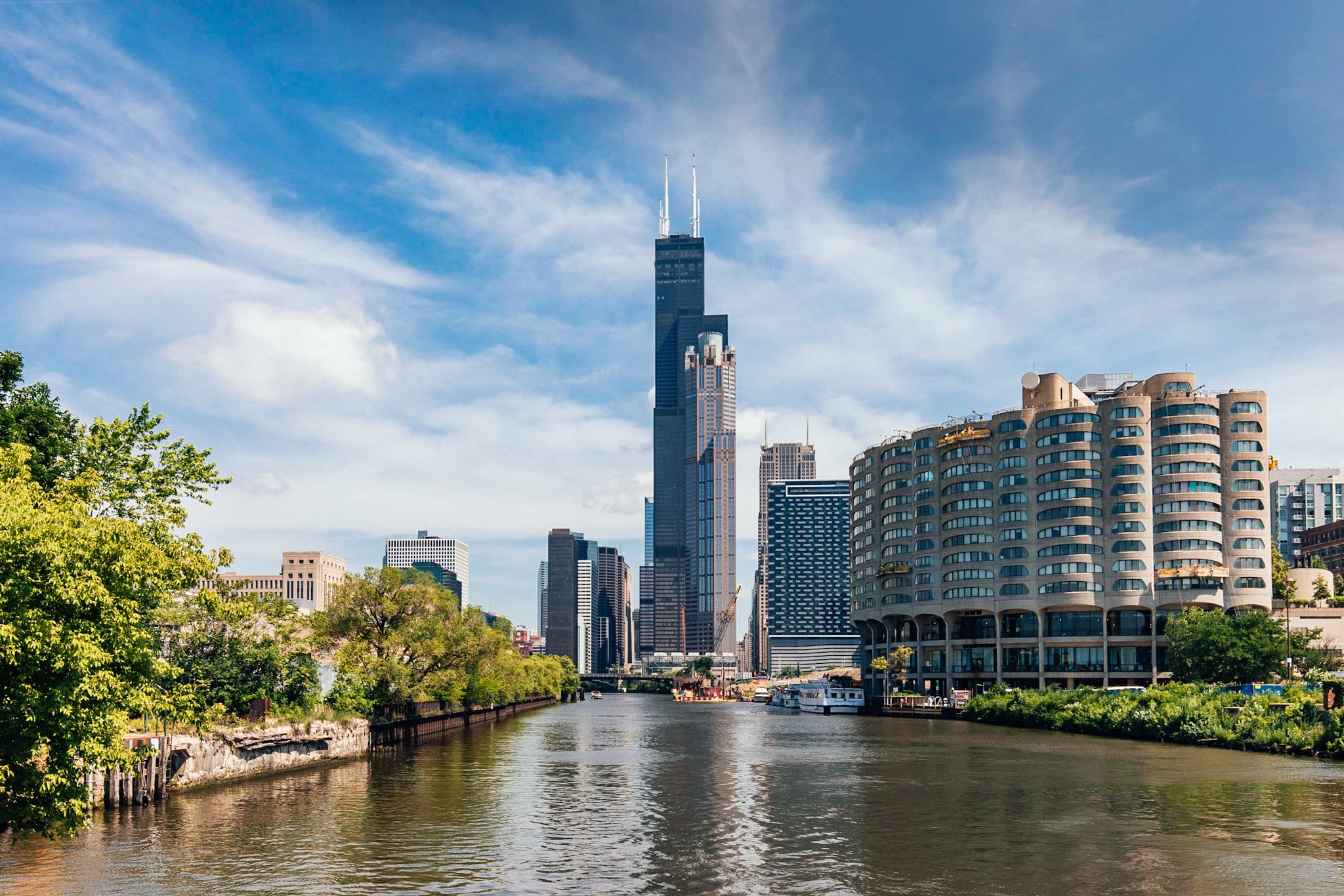
The Willis Tower used to be called the Sears Tower and was the tallest building in the world. That is ancient history, but the view from Skydeck Chicago is still impressive. The four glass balconies (“The Ledge”) are a particular highlight: Even the floor is made of glass. Not for those afraid of heights.
Do you also want to travel to the USA? There are lots of helpful tips and travel reports on my USA blog.
#3 360 Chicago at the John Hancock Center
If you want to see Chicago from a different perspective than from the Willis Tower, you should go to 360 Chicago. On the Tilt extra attraction, you can lie down on glass panes that tilt forwards.
By the way: admission to attractions such as the Skydeck or 360 Chicago is quite expensive. With the Chicago City Pass* you can save up to 50%, so it’s best to work out in advance whether you want to pay for admission individually or whether you’d rather take the pass.
Michigan Avenue in the center of Chicago is lined with one huge store after another: All the big stores are represented here. Quite ostentatious – which is why this stretch of Michigan Avenue is also known as the “Magnificent Mile”.
Incidentally, you can stay here in style at the Warwick Allerton, one of Chicago’s most historic hotels. Recently renovated, you live here in one of those old skyscrapers like in the movies: large rooms, high ceilings. And everything at its finest.
The formerly derelict banks of the Chicago River have been given a real facelift: now you can stroll along them or simply take a short lunch break at one of the beach bars. The more sporty get into a kayak, the more comfortable take one of the water cabs and explore Chicago by water. By the way, water cabs are part of Chicago’s public transportation system!
The leisure area directly on the lake is almost in the middle of the city. Almost a hundred years old, it was given quite a facelift in the nineties and now offers all kinds of leisure activities, from a Ferris wheel to a musical theater and art exhibitions.
The numerous cafés and restaurants are a great place to take a break from sightseeing and enjoy the view of Lake Michigan – in the beer garden, for example, with a beer and a traditional Chicago hot dog. There are always free fireworks on Wednesday and Saturday evenings. Many other free events such as concerts and festivals can also be found in the event calendar.
#7 Chicago Elevated, Loop, “L”
It is actually called Chicago Elevated, but Chicago’s elevated train is also known simply by the letter “L”. Particularly striking is the Loop, the ring that cuts through the street canyons in the middle of Downtown.
#8 Lake Michigan and Lakefront Trail by Segway
The Lakefront Trail runs along the entire length of the city, perfect for jogging, cycling – and Segway riding! The distances are huge, so a vehicle is pretty handy.
With a Segway you can see a lot more of Chicago’s long waterfront promenade. The lakefront is definitely one of Chicago’s great leisure attractions: An absolute must when the weather is nice!
If you really want to see all the exhibitions, you’re guaranteed to be busy for a whole day. But a visit just for the highlights is also worthwhile! Numerous American classics such as Edward Hopper’s Nighthawks hang in the Art Institute of Chicago .
Admission is quite steep at 25 dollars, but with city passes such as the Chicago City Pass* you can save a lot of money here too if you are sightseeing through Chicago anyway.
Even if you don’t attend a show at the Chicago Theatre, a photo in front of the legendary neon sign is a must! At lunchtime, you can take a guided tour of the inside of the venerable Chicago Theatre, and in the evening, superstars from Jerry Seinfeld to Madonna perform here. Or you can visit the Chicago Theatre during the day with a guided tour*.
#11 Jazz clubs & live music
Jazz and blues are the leading musical genres in Chicago. And if you don’t feel like dancing after a long day of sightseeing, a jazz club is the perfect choice to round off a day in Chicago. Andy’s Jazz Club, for example, offers live music from all jazz genres every evening with good cocktails.
#12 Chicago’s Deep Pan Pizza
Chicago is famous for its deep dish pizza or deep pan pizza, which was invented here in the 1940s. The original is said to have originated at Pizzeria Uno – but Gino’s East and Lou Malnati’s can also look back on a long deep pan pizza tradition. Unlike traditional pizza, Chicago pizza is served in a pan, with the cheese underneath the other toppings on a cornmeal crust. It may not have much to do with an original Italian pizza, but the Chicago pizza is still delicious.
Gino’s East is worth a visit for the interior design alone: the entire(!) restaurant is scribbled on from top to bottom. Every guest can immortalize themselves here with a sharpie!
#13 Route 66
The legendary Route 66 actually starts here in Chicago! Route 66 is no longer an official road, but the old sign on Adams Boulevard marking the beginning is still there. By the way: A road trip along Route 66 from Chicago, as I did, is also highly recommended! You can read more about my road trip through Illinois here:
#14 West Loop, Randolph Street & Fulton Market Street
The new restaurant mile in Chicago’s gastronomic heaven: Chicago is known for its fantastic restaurants. In West Loop, a new generation of eateries has established itself along Randolph Street and Fulton Market. There’s always something going on here in the evening.
Once a year, in the summer, there’s the “Taste of Randolph,” a street festival featuring events and live music, in which many of the neighborhood’s restaurants participate and where you can sample all their specialties at affordable prices. My tip: breakfast at Soho House.
#15 Wicker Park
In Berlin you would say: Wicker Park is really cool. In big cities, I always like to take a look at the small, neighborhoods because you simply get to see more of real life here. If I hadn’t opted for accommodation in the middle of the city, I would probably have ended up in Wicker Park, one of Chicago’s hipster neighborhoods, so to speak. Street art, cool bars, individual stores – my creative heart was happy!
My tips for Wicker Park:
Dove’s Luncheonette Really, really cool location: Tex-Mex cuisine is reinterpreted here in retro luncheonette style under the elevated railway bridge. Could have tasted my way through the entire menu.
Milwaukee Avenue If the Magnificent Mile is too busy with huge chain stores, you’ll feel much more at home shopping on Milwaukee Avenue. Here you can still find small stores between larger indie chains like Urban Outfitters, and you can stroll around much more comfortably than on the sometimes hectic Mag Mile.
#16 The 606 / Bloomingdale Trail and Park
Relatively unknown, as it is located just outside the city center between Logan Square and Humboldt Park: The 606 is a disused elevated railway line that has now been converted into an amusement park. Above the rooftops of Chicago, you can jog, cycle and do whatever else you can think of over a length of more than 4 kilometers. A great detour when visiting Wicker Park!
#17 Humboldt Park
A melting pot of cultures – that’s always a hackneyed phrase when talking about life in big cities. In Chicago, however, it really hits the nail on the head. People from so many nations live here that you sometimes feel like you’re on a little trip around the world. Humboldt Park is a district where many Puerto Ricans live: In summer, there is a big street carnival here with lots of salsa, bachata, reggaeton and merengue and my Brazilian genes were jumping in triangles!
#18 Buckingham Fountain
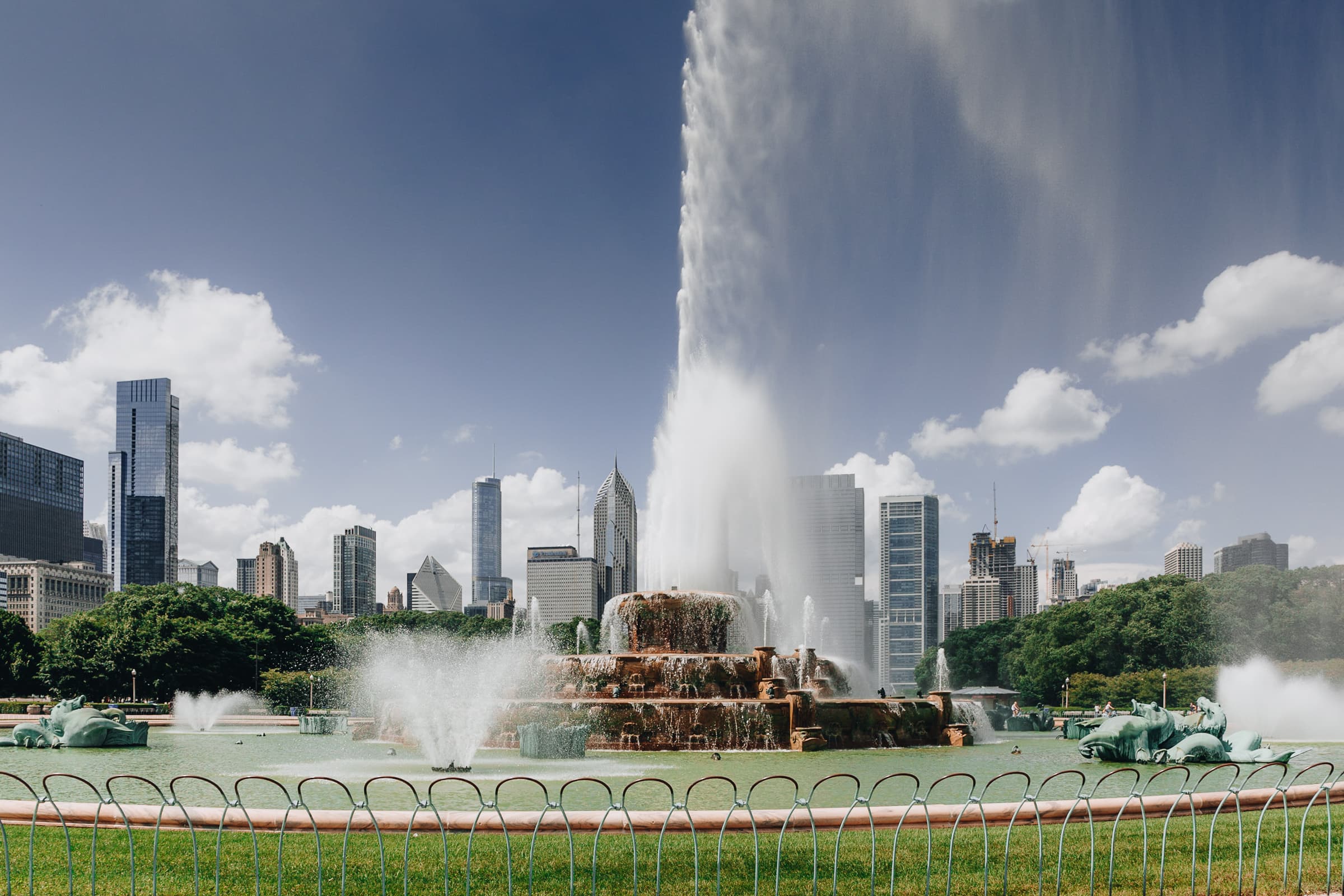
Children of the 90s will immediately recognize it and revel in TV memories: When I saw the Buckingham Fountain in Grant Park, I immediately thought of the opening credits of “A terribly nice family”. The best thing for everyone else to do is simply marvel at one of the largest fountains in the world. The Buckingham Fountain is really huge!
#19 Oak Street Beach & Co.
Chicago simply has it all: vibrant city life, lots of greenery, the great Lake Michigan – and even great city beaches! Oak Street Beach is one of the most popular, but you wouldn’t expect to find beaches like 12th Street Beach next to the Adler Planetarium in a big city like Chicago.
#20 Chicago for gourmets and foodies
Chicago lives up to its name as a gourmet destination. Food is generally a tricky subject in the USA – while you can find burgers and deep-fried convenience products on every corner, other dishes can sometimes be a bit hit and miss. In Chicago, however, everyone should be able to find what they are looking for.
Can you really save money with the Chicago City Pass? Chicago is a popular destination for city breaks in the U.S. But if you try to see every single attraction, sightseeing in Chicago can quickly get expensive. The Chicago City Pass is often promoted as a great way to save money. But is it really worth it? In this article, I’ll compare which Chicago attractions let you save money.
With the Chicago City Pass, admission to both of Chicago’s top observation decks is included! The Willis Tower is THE must-see attraction in Chicago! From the Skydeck at the very top, you’ll have a fantastic view of Chicago and Lake Michigan!
By the way, the Willis Tower used to be called the Sears Tower, after the company that had the building constructed, and was actually the tallest skyscraper in the world when it opened in 1974. These days, it’s “only” the second-tallest building in the U.S. after One World Trade Center in New York, but hey, I can tell you, that’s still high enough!
On a clear day, you can see four states at once, and Chicago, with its 2 million residents, looks absolutely tiny.
By the way, the Skydeck Chicago features four glass balconies—the “Ledges”—made entirely of glass: walls, ceiling, and floor! The area measures about 2 by 3 meters. So when you step forward, you’re standing entirely on glass. Below you: over 90 stories! By the way, I thought I wouldn’t dare—but the idea of standing on nothing but a glass floor hundreds of meters above the street is so bizarre and unbelievable that my reservations vanished immediately.
Advantage with the ChicagoCityPass: The CityPass entitles you not just to one, but to TWO visits to the Skydeck on the same day. In addition to the regular daytime admission, you also get an evening admission starting at 6 p.m., so you can see Chicago at night, too! Highly recommended for taking photos.
#2 Art Institute of Chicago / Adler Planetarium
With the Chicago City Pass, you have to choose: art or science? The Chicago City Pass grants you admission to either the Art Institute of Chicago or the Adler Planetarium.
Art Institute Chicago
The Art Institute of Chicago is exceptional in the scope of its collection: From Byzantine art to contemporary photography, you’ll find everything here. It’s guaranteed to take a full day to see the entire exhibition. So it makes sense to think about what you’d like to see beforehand, before you get overwhelmed by so much art. I really wanted to see “Nighthawks” by Edward Hopper, and even if the name doesn’t ring a bell—everyone knows the painting. And there’s hardly any other painting that’s perceived as so quintessentially American.
At $25, admission is very expensive, but it’s well worth it—the collection is fantastic, and the temporary exhibitions are always interesting and varied. The helpful audio guide costs extra as well!
Regular price $25 + $7 audio guide = $32
Adler Planetarium
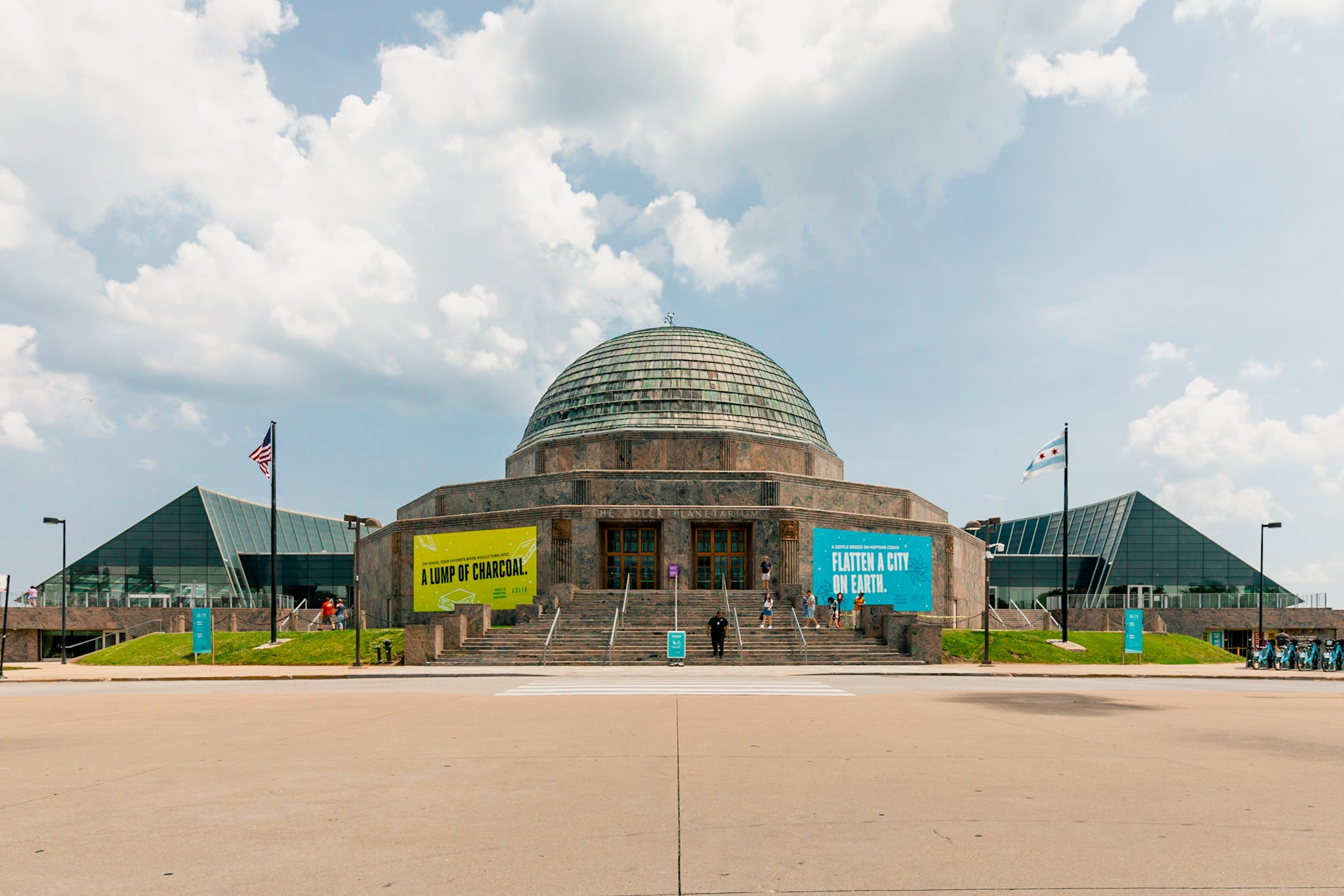
The Adler Planetarium is the must-see attraction in Chicago for all space enthusiasts. Here, you can see an old space capsule and many other interesting exhibits related to space exploration.
The film screenings (Sky Shows) are also highly recommended! Without them, the planetarium is only half as exciting!
Regular price for admission + 2 Sky Shows: $35
Ad / *affiliate links
#3 Field Museum
The Field Museum of Natural History is one of the most visited museums in the United States! It is known worldwide as a natural history museum and houses one of the largest collections of natural history and anthropological artifacts. Here, you can marvel at the best-preserved Tyrannosaurus rex ever found!
Regular Price for All-Access Pass: $40
#4 Shedd Aquarium
The Shedd Aquarium is the world’s largest indoor aquarium and has been around since 1929! Here, you can truly immerse yourself in the underwater world and see all kinds of marine life, amphibians, and insects—from seahorses to beluga whales—up close!
#5 360 Chicago Observation Deck / Museum of Science and Industry
If you don’t want to go up to another observation deck, here’s your option: As an alternative to 360 Chicago, you can also visit the Museum of Science and Industry!
360 Chicago Observation Deck
The 360 Chicago Observation Deck is located in the John Hancock Center right in the heart of the Magnificent Mile—so it’s right in the thick of things!
In addition to the naturally fantastic view, TILT stands out for its floor-to-ceiling panoramic windows that you can lean against and tilt forward along with the window!
TILT costs an additional $8; for Chicago City Pass holders, it’s an extra $7. There’s also a Day/Night package available, but it’s not included in the Chicago City Pass.
Regular price: 360 Chicago $25
Museum of Science and Industry
The Museum of Science and Industry is the largest science museum in the U.S. It features exciting and interactive exhibits on the topic of science. It’s not just kids and science buffs who’ll enjoy this elaborately designed museum! Downside: The Museum of Science and Industry is quite far from all the other attractions south of downtown. So if you don’t have much time, you’re better off choosing 360 Chicago.
Regular price $19.95
Pros and Cons of the Chicago City Pass:
Advantages:
Long Validity Period: The Chicago City Pass is valid for up to one year after purchase. This means you can plan well in advance while still maintaining flexibility.
Long Validity Period: The Chicago City Pass is valid for 9 days starting from the first day of use—that’s longer than most people even stay in the city! So you can take your time exploring everything without rushing!
Instantly printable or mobile tickets: You don’t necessarily need the coupon booklet—you can print out the Chicago City Pass right after purchase or save it to your phone. At the attractions, all you have to do is show your smartphone.
All the Major Attractions The Chicago City Pass covers Chicago’s major attractions—in other words, everything you’ll probably want to see anyway!
Fast Entry: At some attractions, you can get in faster with the Chicago City Pass
Disadvantages:
Unnecessary Options: The Chicago City Pass includes some options that you might not necessarily choose to add if you were buying them individually, such as the Sky Shows at the Adler Planetarium or the audio guide at the Art Institute
Fast Track Isn’t Available Everywhere: Where it would really be worth it—namely, on the ride up to the Skydeck—the Chicago City Pass doesn’t grant fast access through the Fast Track entrance. The Fast Track pass costs $30 with the Chicago City Pass (regular price: $75). If you’re in a hurry, you should factor this additional cost into your budget.
Conclusion: Is the Chicago City Pass worth it?
I recommend the Chicago City Pass to anyone visiting Chicago for the first time and staying for several days! For example, the Skydeck, the Art Institute, and 360 Chicago were already on my Chicago bucket list! Without the pass, I would have paid $105 just for those three attractions—the Chicago City Pass costs $108.
The Chicago City Pass is a great value for first-time visitors and trips lasting several days!
So with 3 out of 5 attractions, you’ve already gotten your money’s worth (give or take $3). Since you have a full 9 days to redeem the other two vouchers and explore two more great (and otherwise expensive!) attractions, the Chicago City Pass is definitely worth it!
In Nuremberg, I didn’t have time for sights like the Kaiserburg – because I got lost in the picturesque old town. It is also a sight in itself! I haven’t been there for years – and somehow not much has changed: I still quite like the city. And since I’ve decided to share more of my travels (business and private) here, I’ll start with my very personal Nuremberg sights!
I discovered this beautiful little corner not far from our hotel by chance. It’s funny how you can be in a city so often and simply overlook the most obvious spots. The Handwerkerhof is not particularly large. In the 1970s, small half-timbered houses were built in a small courtyard area next to the original town wall and turned into a small tourist attraction. Sounds like a tourist trap, and it kind of is – but it’s also super cute and cozy! (And it also looks very authentic: If I hadn’t found out afterwards that the half-timbered houses had been rebuilt – I would never have guessed!)
The Handwerkerhof in Nuremberg: Favorite place.
Food: The famous Nürnberger Rostbratwürstchen
There are a few small stores with arts and crafts, workshops and studios in the Handwerkerhof. And really, really cozy pubs! In the middle of the city center, you immediately feel a rustic medieval flair. And in the Bratwurstglöcklein you can get the most delicious grilled sausages in a bell-shaped plate ever! A little overpriced, of course – but the ambience and sausages are worth it.
Art in the Neues Museum Nuremberg
Nuremberg also has some interesting museums, and although this is something I’d rather do in the colder winter months, I decided to take an arty detour. Mainly because I had seen that the exhibition at the Neues Museum in Nuremberg also included paintings by Gerhard Richter – who I really like. But the permanent and temporary exhibitions at the Neues Museum are also well worth seeing if you like modern art and design. The architecture of the Neues Museum alone, with its huge white spiral staircase, is impressive!
Impressive: Gerhard Richter at the Neues Museum Nuremberg.
Art in Nuremberg: More museums in Nuremberg
If you are more interested in the Middle Ages and the history of Nuremberg, the Germanisches Nationalmuseum is the place to go.
Otherwise, a visit to the following museums in Nuremberg is also worthwhile, depending on your interests:
Nuremberg and its past: Nuremberg Nazi Party Rally Grounds and Documentation Center
Nuremberg not only played an important role in the Middle Ages as a trading center and center of craftsmanship – unfortunately, Nuremberg was also the scene of events during the Nazi era. From 1933 to 1938, the National Socialists held their annual Reich Party Rally here on a huge site. It’s scary how many people allowed themselves to be mobilized back then and marched and waved flags at these events, which were staged like folk festivals.
Oppressive exhibition at the Documentation Center Nazi Party Rally Grounds.
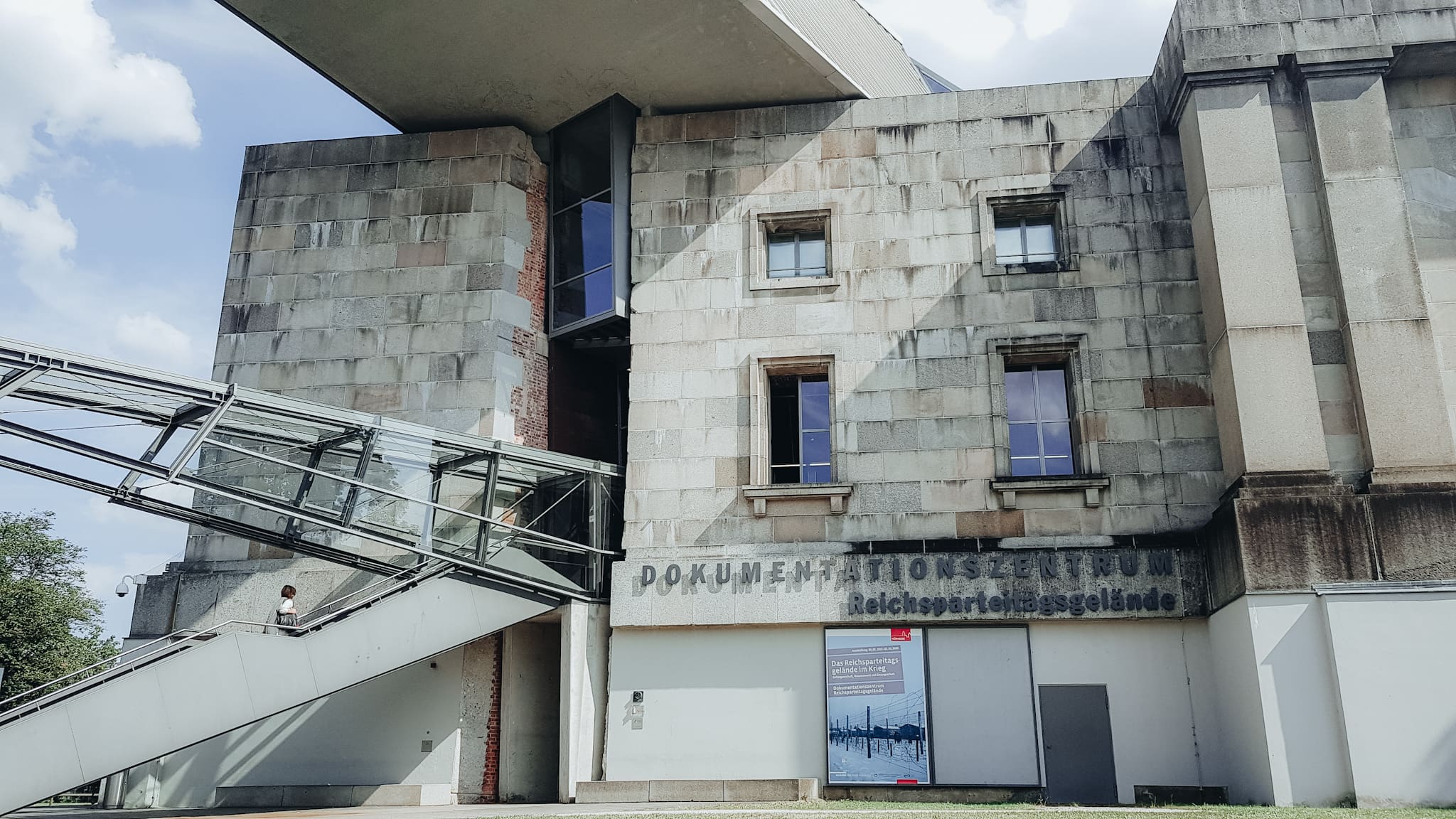
The former Congress Hall, which was never completed, is now home to the Reichsparteigelände Documentation Center, which not only covers Nuremberg and the Nazi Party Rallies, but also contains a very good exhibition on the entire National Socialist era. You should definitely watch the film at the end of the exhibition, in which contemporary witnesses from Nuremberg talk about how they experienced this time in the city. Not a light subject – but it is always important to remember this dark chapter of German history so that something similar never happens again!
Converted into the Documentation Center Nazi Party Rally Grounds: the former Congress Hall.The Documentation Center Nazi Party Rally Grounds is located in the old Congress Hall, which was never completed.
Near the documentation center you’ll find the Zeppelin field with the associated Zeppelin main grandstand, which can also be visited, as well as the Große Straße, the central axis of the site. The area is very extensive, so you should bring time with you to take in the oppressive history of the place.
After the end of the Second World War, the Nuremberg Trials, in which leading National Socialists were put on trial, also took place in Nuremberg. The jury courtroom can be visited on trial-free days (usually Friday to Monday) together with the permanent exhibition “Memorium Nuremberg Trials” in the Nuremberg Palace of Justice.
I hope to come back to Nuremberg in the near future, there is so much more to discover! (Not to mention the romantic Christmas market in December!)
***
You can also find more inspiration for short trips within Germany here:
Suzhou in eastern China, very close to Shanghai, is known for its picturesque gardens and picturesque old town with its many waterways. Suzhou is over 2500 years old and is known throughout the country as a place of poets and thinkers. But above all, Suzhou is one thing for me on this China trip: quite a surprise. I’ll tell you here which great sights in Suzhou are waiting for you!
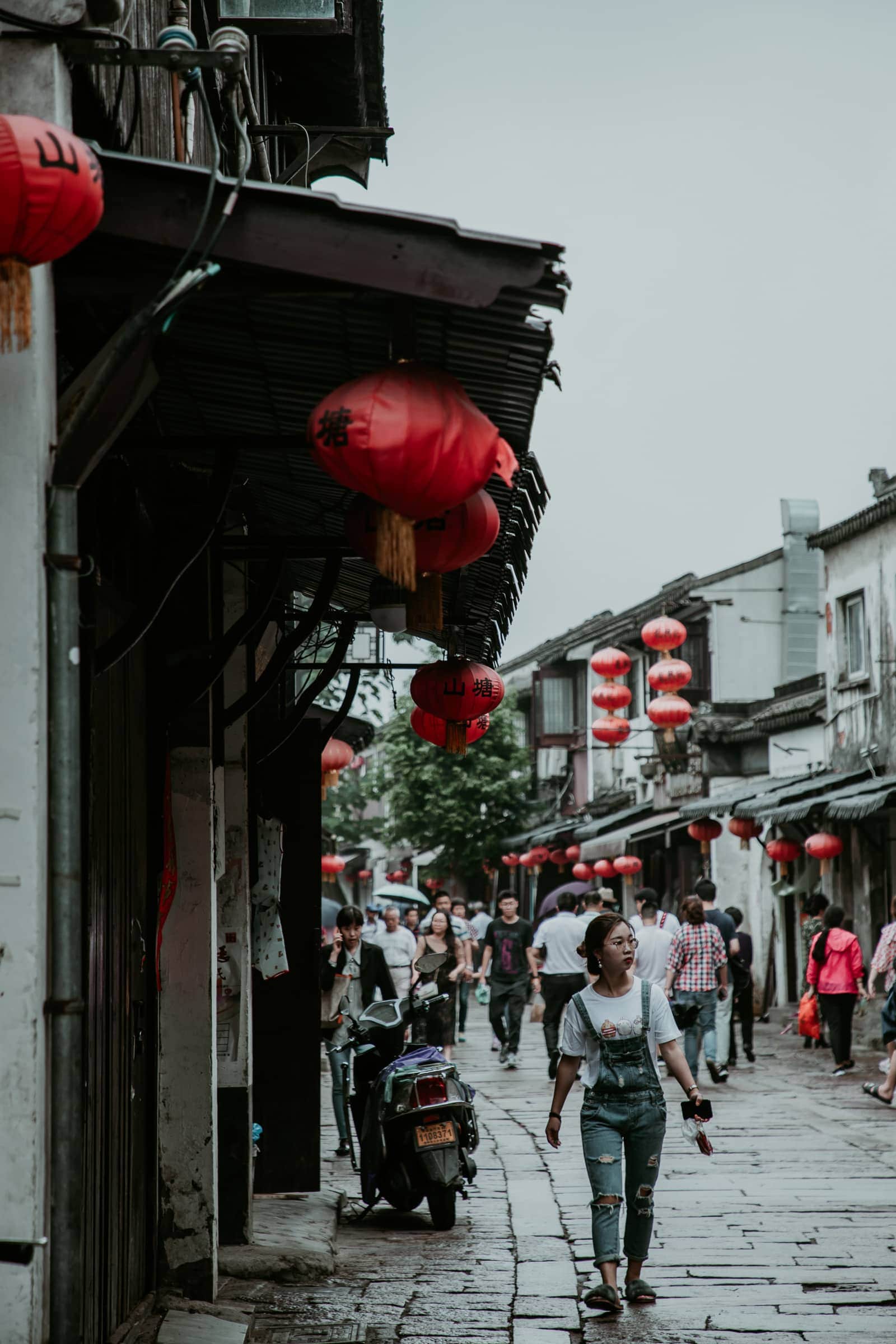
Many houses along the canals in Suzhou are decorated with red lanterns: pure China.
The most beautiful sights in Suzhou
Because of its many small canals that run through the rather large old town center, Suzhou is also often and gladly referred to as the Venice of the East. And I shudder at this expression at the latest.
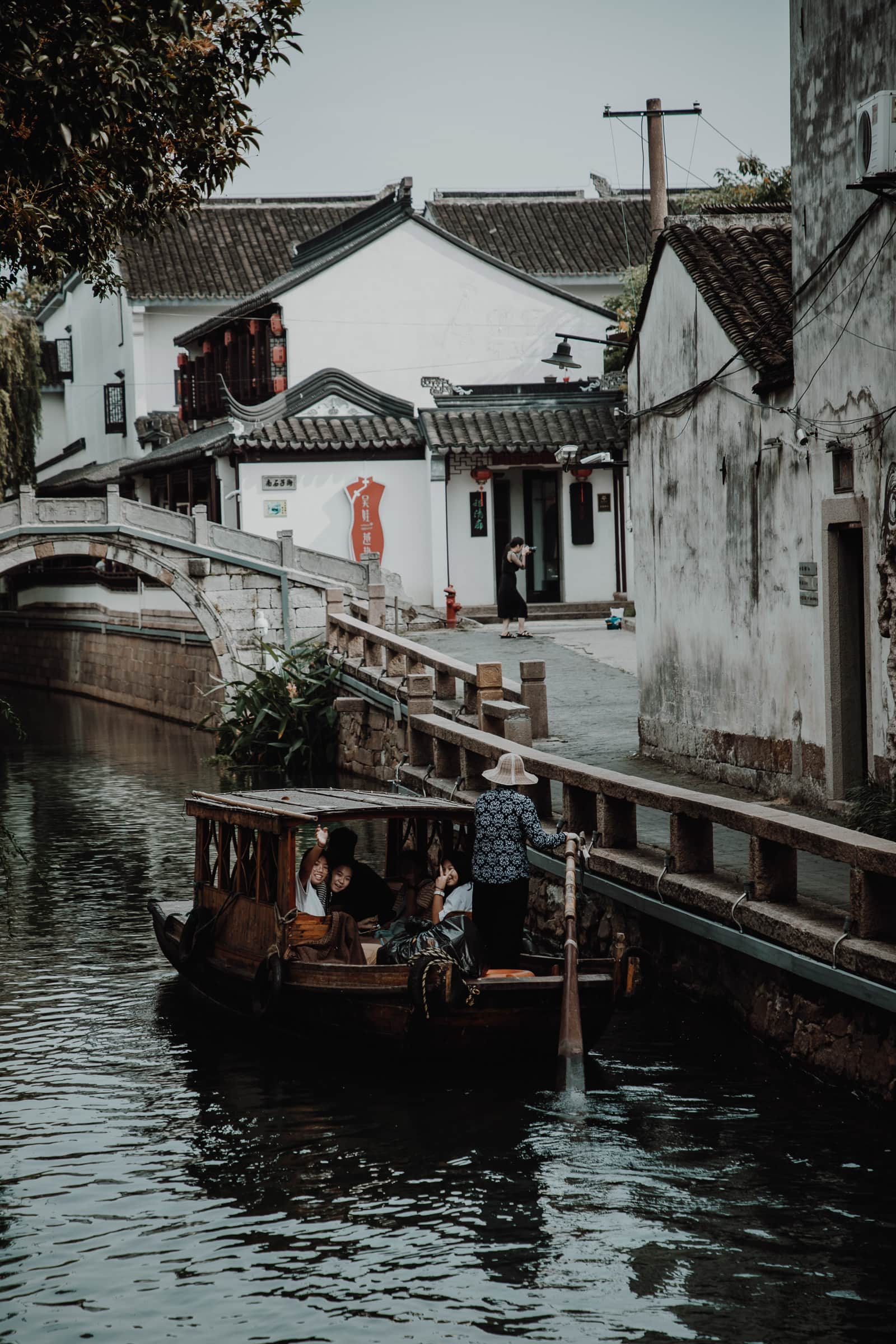
Suzhou: A boat trip through the romantic canals is a must.
Tip: In Suzhou you will find numerous large hotels of western chains with corresponding comfort. Unfortunately, these are often housed in uninspired high-rises or large complexes. For an authentic atmosphere, it’s best to look for accommodation near the old town, such as the Garden Hotel*.
“Venice of…” (as well as “Mecca of…” and “Paris of…”) – as an author or copywriter, you only ever write this when you really can’t think of any better comparisons. The main thing is a few boats, a few canals, and the analogy with Venice can be formed. As with the waterways in Suzhou in the Yangtze River Delta in eastern China near Shanghai.
All Venice, although nothing really compares to Venice, not even Suzhou. But anyone who has been there will wonder why Suzhou needs any comparison at all – because Suzhou is a true gold treasure.
By the way, Suzhou is easy to reach from Shanghai. And you don’t even need a visa for China. The trick: German citizens can enter China without a visa for stays of less than 72 hours in Shanghai and the surrounding area. And from Shanghai, you can reach Suzhou and the surrounding water towns worth seeing, such as Zhouzhuang and Tongli, in no time at all.
The nearby water town of Zhouzhuang is also well worth seeing. Read more in this article:
Suzhou and its gardens: The garden of the humble official
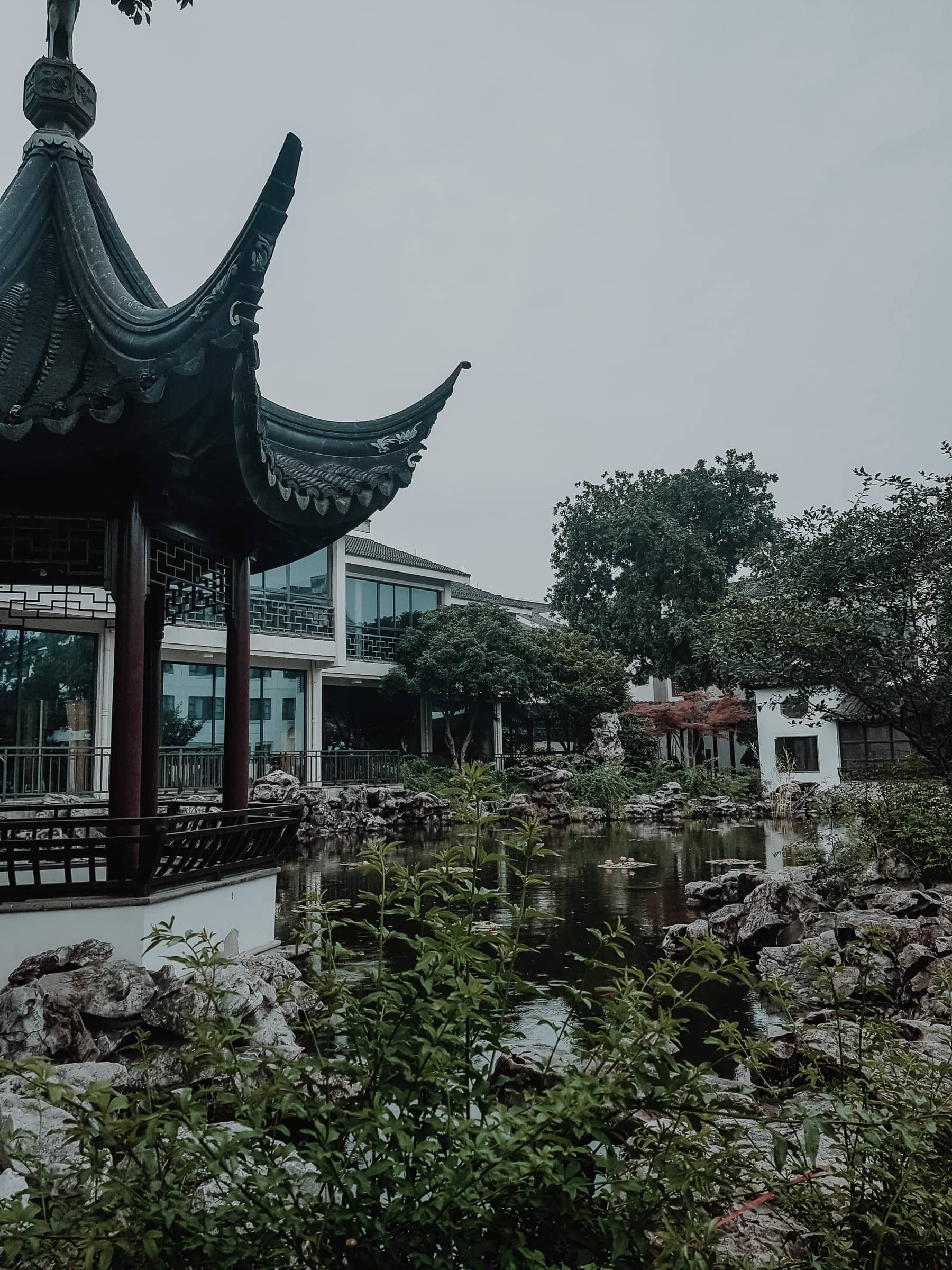
The garden of the humble official has a rather misleading name. Modesty is the last thing that comes to mind when you see what is probably the most famous garden in Suzhou. The garden is actually a huge park with secluded pavilions and thoughtfully landscaped lakes and trees.
One of the most popular gardens in Suzhou: the garden of the humble official.
According to Chinese horticulture, the main focus is not so much on flowers and colors, but on the harmonious interaction of the so-called “seven elements”: earth, sky, water, stones, buildings, living creatures and plants, although here rather trees and green plants are meant.
Otherwise, just a lot of green: lotus blossoms are among the few splashes of color in the garden of this modest official in Suzhou.
And it soon becomes clear how harmonious the garden of the modest civil servant is: although hopelessly overrun by tourists, an aura of peace and relaxation nevertheless shines over the garden. Very impressive. In many corners you can meet painters and draftsmen who give free rein to their creativity and are inspired by the atmosphere of the garden. I was briefly annoyed that I didn’t have my watercolor stuff with me – I would have loved to just sit next to it and paint along. But there was much more to see in Suzhou anyway, that time was short anyway.
Painters and draftsmen like to be inspired in the garden of the modest official.
How much history there is in Suzhou can also be seen here: For almost 900 years, a garden has existed on this site, which passed through many hands until a high-ranking official chose it as his retirement home in the 16th century and gave the garden its name. Today, the garden of the humble official is state-owned, a UNESCO World Heritage Site and one of the most beautiful gardens in China.
The garden of the humble official in Suzhou is also a real Instagram hotspot: Very instagrammable!
Shantang Street: Immersion in Ancient China
With temperatures around 35 degrees (yes, it can get very, very hot!) and what feels like 100 percent humidity, a boat trip is always a welcome change, especially in Suzhou with its picturesque canals. Clotheslines fluttering in the wind, children waving enthusiastically at the foreign tourists (as a Western visitor in Suzhou you are still something special) or sneak peeks into foreign kitchens: My eyes did not even know where to look first.
Suzhou’s canals can also be explored by boat.Some bridges are particularly ornate in the old city of Suzhou.Concentrated, our captain steers the boat through the canals of Suzhou.
Even on foot, Shantang Street (Shāntáng Jiē) was the China I was looking for: red lanterns, small houses with old wooden beams – and relaxed, friendly faces everywhere. On 7 miles you can find everything at once: tourist stuff, culture, history, snack bars and cafes with all kinds of exotic delicacies and actually real street life. If you turn into the more deserted alleys, you will quickly find yourself in local hustle and bustle, without any touristy stuff. A real experience.
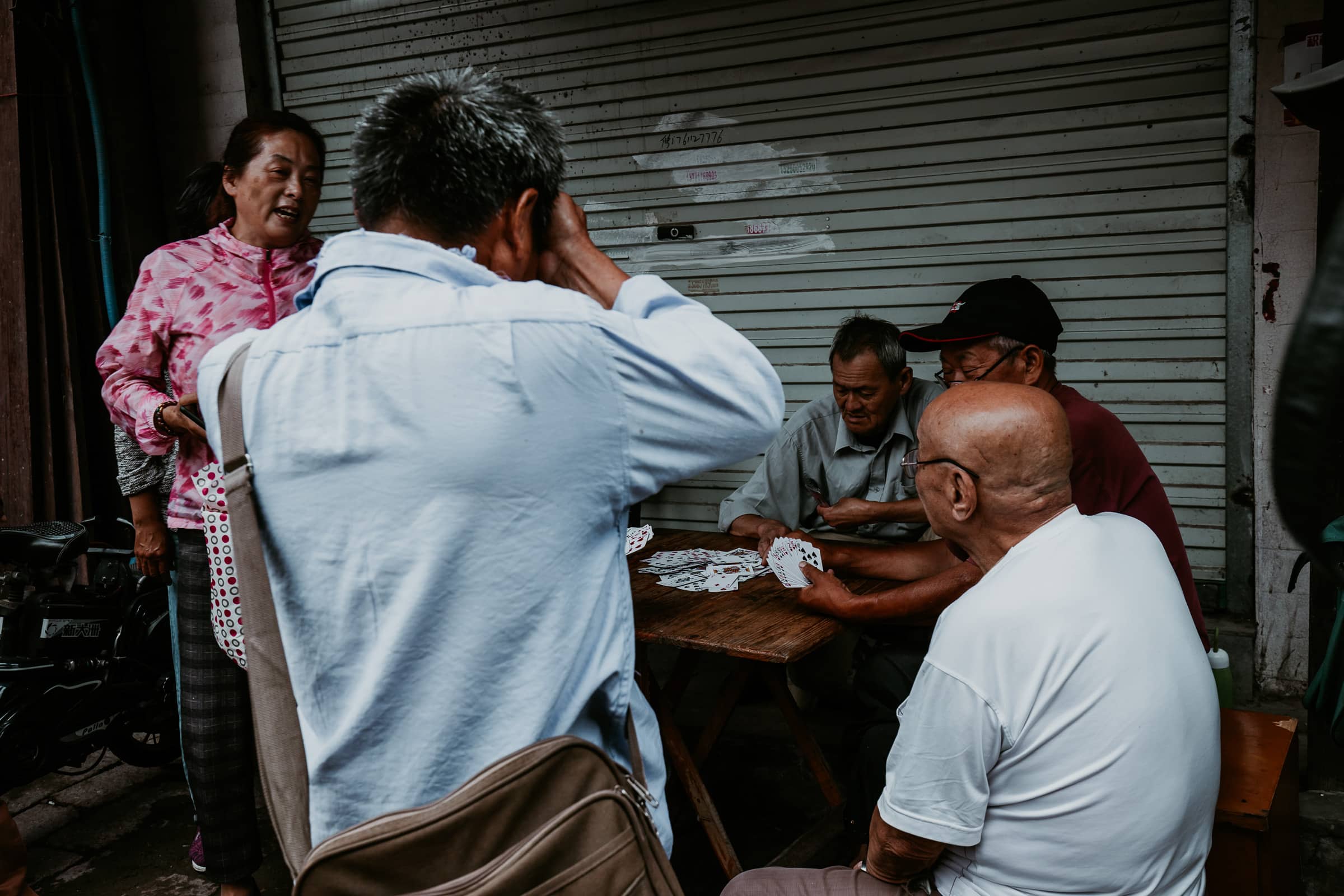
Shopping mile: Shantang Street in Suzhou.Colorful souvenirs in the tourist part of Shantang Street.In the middle of the street: Concentrated card game.
Street Food in Suzhou: No inhibitions, it’s worth trying!Fruit and vegetable vendors can also be found on Shantang Street.In the side streets of Shantang Street you can find authentic everyday life: a small cookshop is cooking breadcrumbs.
Pingjiang Road: tea houses, canal boats and nightlife
Even more authentic Chinese flair can be found on Pingjiang Road (Píngjiāng Lù), similar to Shantang Street a street with many stores and restaurants. Here it is even a little bit more cozy than on Shantang Street. The boats are smaller, the bridges even a little prettier.
Happy tourists on Pingjiang Road: a boat trip here is even more idyllic.
My highlight was the tea house, a small café by the canal, more wooden shack than house, where we listened to 80 year old(!) Mr. Wang playing original Pingtan music to us over a cup of tea. It could hardly get more Chinese! By the way, Pingjiang Road is also very busy in the evening and a nice nightlife spot in Suzhou.
Unusual creations: The many small cafés along Pingjiang Road serve the most curious drinks.
Suzhou Opera in the Garden of the Master of the Nets
In general, music, like all other arts, plays a major role in Suzhou. Somehow creativity and appreciation of art and culture are in the air here, so I wasn’t surprised to learn that Suzhou is considered a “very elegant” city in China. Found it apt – and I never thought before that I could find a place in China elegant. For me, China was big, crowded and rough at times – but this trip showed me once again how unfair prejudices can be. Suddenly China was small, picturesque and warm (oh, the people!).
I would even recommend an evening at the opera to anyone here, even if you are one of those people for whom operas are more likely to trigger flight impulses. Or where else do you watch an opera in one of the most beautiful gardens?
Colorfully illuminated at night: The garden of the Master of Nets in Suzhou.
In the garden of the Master of the Nets there is a performance of a Kunqu opera every evening. The opera consists of several parts: Comedy, song, music and dance. The special thing: Each part is performed in a different place within the garden, so you walk along the garden between each performance.
The performance in the garden of the Master of Nets consists of several parts: Drama, song, dance, music.
Real Chinese Silk: A Visit to the Silk Factory
Suzhou is famous for its silk – and the region has always formed one end of the Silk Road, from where the beautiful fabric found its way to the world. The silk factory, modestly named No.1, is therefore on the agenda of many tours of Suzhou. You should think about this carefully beforehand – because what many people don’t consider is that here you can observe the production process (at least part of it). That also means watching caterpillars crawl. And later it becomes even less something for the faint of heart, because the silk thread is obtained from the cocoon of silkworms. In order not to damage it, the cocoons including caterpillars are thrown into boiling water. Not for everybody.
Nicely draped in a basket: silkworms for silk production.From caterpillars to cocoons: the next phase of silk production at the silk factory in Suzhou.The cocoons later become silk.
Personally, I have an affinity for fabrics anyway (I actually used to have a fabric store in Berlin) and silk anyway (I always like to block out the boiled caterpillar part), so I found the visit interesting in itself. Unfortunately, the production process is shown only abbreviated (there is no weaving or dyeing here), and shortly after watching the spinning of the threads, you will find yourself standing in a huge sales hall with clothing made of silk for (almost) every taste. I didn’t like the clothes that much, but I was a bit sad afterwards not to have bought some fabric. So for all people who love to sew: In Suzhou, do not forget to buy silk!
On this machine the silk threads are spun.
The Suzhou Museum
The Suzhou Museum is particularly striking because of its architecture – somehow angular and not at all traditional Chinese. It was designed by Chinese star architect Ieoh Ming Pei, who also planned the famous glass pyramid in the courtyard of the Louvre in Paris and the Museum of Islamic Art in Qatar – and he was born and raised in Suzhou.
Here you will find an overview of Suzhou’s long history in the form of works of art and artifacts, from calligraphy to porcelain to handicrafts. Worth seeing, but perhaps not necessarily interesting for everyone. But what is really fascinating is the way the mostly Chinese visitors interact with the exhibition: I have never seen so many young people in German museums who are so intensely interested in history and who press their noses against the display cases out of sheer thirst for knowledge.
Marvelled at: exhibits in the Suzhou Museum.
The modern part of Suzhou
Gate of the Orient & Jinji Lake
Outside the sprawling old city, Suzhou looks a bit more like how you’d imagine big Chinese cities to look. The city currently has over 10 million inhabitants and as well as Suzhou is developing, there is no end in sight. Large companies produce and conduct research here. The good transport links and proximity to Shanghai ensure that Suzhou is one of China’s up-and-coming cities. The spirit of optimism is also reflected in the bold architecture in the modern part: the landmark of the new Suzhou is the Gate of the Orient (Dongfang Zhimen) or Gate of the East, the second tallest skyscraper in Suzhou. Located on Lake Jinji, it is supposed to act as a gateway to the East – but locals affectionately nicknamed the building “the pants” due to its unusual shape.
Looks like a pair of pants: The Gate of the Orient in Suzhou.
Suzhou Supertower
The “pants” are topped by the Suzhou Supertower, 450 meters high – and that’s where it really starts to look futuristic. Every time we passed it, I could hardly believe that just a few kilometers away we were sailing on small wooden boats along romantic canals. The way the old and the futuristic are combined here is breathtaking.
Suzhou Industrial Park & Suzhou Culture and Arts Center
In the Suzhou Industrial Park there are further examples of modern Suzhou: The Suzhou Culture and Arts Centre is a gigantic cultural center with a (free) museum of modern art, various exhibition rooms, a musical theater and a small amusement park with a Ferris wheel, cafés and restaurants. In good weather, there is a fantastic view from here across Lake Jinji to the Suzhou skyline.
Shopping in Suzhou – shopping from silk to designer clothes
In Suzhou you can shop till you drop. I’ve long imposed a strict no-shopping policy on myself, which I usually stick to, because otherwise I’d be impoverished by now with all the traveling I do. My souvenirs are my photos – but in places like Suzhou, it’s pretty hard to contain yourself.
Popular souvenirs from Suzhou
Popular souvenirs from Suzhou are silk in all variations, green tea (Bi Leo Chun), fans in all shapes, and lots of handicrafts like embroidery and fruit core carvings. On Shantang Street and around Pingjiang Road there are also a lot of small stores selling pretty hip handicrafts – no more boring tourist stuff!
Tip for design lovers
I could have shopped myself to death in Chengpin Eslite, which is actually a huge bookshop. I have a thing for beautiful bookstores anyway, and this one is embedded in a state-of-the-art shopping center with countless small designer stores. I’m usually put off by shopping malls, but the Eslite reminded me a lot of trendy temples like Terminal 21 in Bangkok! Between the stores, there are always small snack bars and cafés, so you can sample all the delicacies of the region here if you don’t dare try street food.
Not only a huge bookstore, but also a shopping center with many innovative designer stores: Chengpin Eslite.
Food & Drink in Suzhou
Exotic dishes: What is one in Suzhou?
Food in general can be quite exotic in China. And it has nothing whatsoever to do with the Chinese restaurant from the German provinces. Vegetarians often have a hard time, somewhere there is meat in it or seasoned with fish sauce. Meat eaters like me have to deal with the most off-the-wall dishes like duck tongues or braised offal. Basically, Western tourists are already careful not to offer the most unusual dishes, but due to communication difficulties, you should be prepared for anything.
Jiangsu cuisine
However, Jiangsu cuisine (the name of the province in which Suzhou is located) is so sophisticated and varied that I often wished I could jump over my shadow even more and try dishes such as pork snouts or chicken feet – but unfortunately I’m really mean about it, as they say here in the Ruhrpott. After all, if you’re going to eat meat, it’s only logical to use every piece of it. Especially the cuisine in Suzhou is a true paradise for gourmets!
Vegetarian cuisine
Vegetarians don’t have to starve though, there are plenty of exotic ingredients to try like water asparagus, lotus roots or purple sweet potatoes. Not everything is spicy, but a lot is greasy and due to the foreign spices and the different climate, one or the other stomach needs some time to get used to the new cuisine. However, I have tried so many new and delicious things in the whole days that I can not even remember everything!
Dishes are always shared, which means if you sit in a big group, you can try a lot more!
Specialties of Suzhou cuisine
Mandarin fish
Sooner or later you will get it served in Suzhou, this specially prepared fish is THE dish in Suzhou. The fish is completely deboned, cleverly draped in the shape of a squirrel and then deep fried. Finally, a sweet and sour sauce is added on top, which took sweet and sour to another level for me!
Suzhou noodles
Noodle soup is noodle soup you could say. But the fresh noodles at Zhuhongxing in homemade broth with tender beef were so divine that I still think about them sometimes. Tip: Don’t spend too long marveling at the food and enjoying it, because the noodles soak up so much broth in the bowl that the mountain of noodles gets bigger and bigger instead of smaller. The professional slurps quickly! (Don’t be afraid of table manners: Hanging over the bowl and slurping loudly is not seen as closely in China as it is here).
Tangbao
Dumplings in all varieties can not be missing! The Tangbao are again a special variety, filled with broth in addition to the mostly meat content. This is slurped out beforehand with a straw, similar to the xiaolongbao that exists in neighboring Shanghai.
Street food in Suzhou
Always dare to try street food! Sometimes it can also be surprising, like the particle on the right, which I bought in a bakery. It looked delicious, so hairy breaded – but what I imagined was sweet ended up being a breading of finely ground pork. Wasn’t mine – but I still like to try strange things. The dumplings, however, were divine!
Accommodation in Suzhou
Our accommodation in Suzhou could not have been better. Centrally located, equipped with all the bells and whistles like a pool and tennis court, and with a breakfast buffet to die for, the Garden Hotel* was perfect. The hotel consists of several smaller guest houses and two main houses, nestled – it couldn’t be more fitting in the City of Gardens – in a beautiful, tranquil garden setting. If you want to treat yourself and stay in Suzhou in style: Absolutely recommended!
In the middle of a garden and yet central: The Garden Hotel in Suzhou.
Travel & Getting around Suzhou: How to plan your trip!
Location & Arrival
Suzhou is located only 80 kilometers from Shanghai, and is directly on the express train line that runs from Shanghai to Beijing. So if you are in Shanghai for a few days, Suzhou is definitely a good choice for a multi-day trip: by train you can be in Suzhou within 90 minutes.
Shanghai is very beautiful, but I personally find Suzhou much more appealing from a historical and cultural point of view – and always only mega big cities can also be very exhausting. By the way, train travel in China is a thousand times more organized than I thought. However, there may be communication problems here as well, since English is not widely spoken.
It takes 10 minutes to get down to the tracks, the tickets are personalized and the identity is checked at the access control: In China, everything is in order when riding a train.
Individual travel vs. group travel
We were traveling in a small tour group. Although I usually travel independently in Asia and plan everything myself, I was glad to have a tour guide with us who could explain many things and translate when necessary. Precisely because the region around Suzhou is not yet particularly familiar with Western tourists, not much English is spoken and most attractions do not provide information in English, meaning that you would otherwise miss out on a lot of interesting information.
Individual travel modules instead of a complete round trip
Complete China tours are often very expensive, and honestly, you can book a flight to Shanghai and spend a few days there on your own. For more “exotic” destinations like Suzhou, however, you can book individual modules with China Tours, which I can really only recommend.
We wore out three guides during our trip through several places around Shanghai, all of whom were highly professional, even spoke very good German (!) and had absolutely in-depth knowledge on every topic. Especially with such a complex destination as China with so much culture and history, about which I admittedly didn’t know very much beforehand, professional guidance was worth its weight in gold.
Getting around in Suzhou
If you prefer to travel independently, you can cover longer distances in Suzhou by taxi or take one of the tourist bus routes. There are rental bikes in many places. The subway network is being expanded.
Is Suzhou worth visiting?
I really liked Suzhou and often wondered why it is almost unknown among Western tourists. Especially when you visit Shanghai, a trip (sporty people can do it in one day) to Suzhou is a must. Shanghai is fascinating, but I always missed a little patina there. A detour to Suzhou is a great way to complement this. Also, the city is much more relaxed and everywhere you are warmly welcomed as an exotic tourist from the West, which showed me again a whole new side of China.
Disclaimer: I was invited on this trip by the Tourist Offices of Suzhou and Nanjing and China Tours.
Jerusalem is a fascinating city and, alongside Tel Aviv, the top destination on any trip to Israel! But what are the must-sees in Jerusalem? Here I’ll tell you which sights you should definitely see and give you some valuable tips!
Places of interest in Jerusalem
Most of the sights in Jerusalem can be found in the Old City. Everything is within walking distance here, and you can easily visit the most important locations such as the Wailing Wall or the Church of the Holy Sepulchre in one day. You will also find the very picturesque narrow streets here. But the newer part of Jerusalem is also well worth seeing and a little more secular.
#1 The Wailing Wall / Western Wall
The Wailing Wall is actually the back of a protective wall of the Second Temple of Jerusalem, built by King Herod and almost completely destroyed in 70 AD during the battle between Jews and Romans for supremacy in Jerusalem. Seventy years after Christ – that’s how early people were already arguing and fighting in Jerusalem! And there are still remains from this period to this day – Jerusalem is a treasure trove of antiquity. Over the centuries, this section of the Western Wall (hence the English name“Western Wall“) became a place of Jewish pilgrimage, today’s Wailing Wall – and a symbol of Jerusalem.
The Wailing Wall is THE landmark of Jerusalem.
Helpful tips for visiting the Wailing Wall:
Access to the Wailing Wall is blocked off by security gates. Bringing cameras is not a problem – but photography is not permitted at the Wailing Wall during the Sabbath.
A visit to the Wailing Wall itself is free of charge,
Women and men pray strictly separate at the Western Wall. The men’s side usually seems emptier because 1. it is larger and 2. the men also use a covered part under an archway.
Men have to wear a kippah right next to the wall, women should cover their shoulders and knees, but somehow it’s not particularly noticeable in warm weather, if not.
There are small benches on the partition wall to the men’s section, which you can climb on to look over to the men’s section.
At the entrance in front of the wall you can get a pen and paper to write your prayers/wishes/thanksgiving/etc. on. The paper is then inserted into one of the cracks in the wall.
You move away from the wall in reverse – so as not to turn your back on it
The Wailing Wall is open 24 hours a day
Some of the roof terraces opposite are open to the public. From there you have the world-famous postcard view of the Dome of the Rock and the Wailing Wall.
The Church of the Holy Sepulchre is THE hotspot of Christianity, no other church in the world is as significant, as important. This is where Jesus is said to have been crucified and buried, then resurrected. Whether this is true or not is still disputed by historians to this day, as it is at many sites in Jerusalem – much of what is assumed today is biblical tradition that has not always been scientifically proven beyond doubt. This is also one of the reasons that can be so confusing in Jerusalem. What is true, what is not? What is scientifically proven? The stories in individual places change depending on the faith and world view. In any case, I was very impressed by the Church of the Holy Sepulchre, a veritable labyrinth of chapels for all possible Christian faiths and so very different from other classic large sacred buildings. The first church was built on this site between 326 and 335 and was extended, destroyed and rebuilt several times over the following centuries.
The Church of the Holy Sepulchre is one of the holiest sites in Christianity.
What you should look at here:
The anointing stone right at the entrance: This stone commemorates the anointing of the body of Christ, where believers wipe the stone with cloths and towels and pray
The tomb of Jesus, THE pilgrimage destination for devout Christians all over the world: another small building stands in the huge, mystical-looking rotunda. Inside is the place where Jesus is said to have been buried. You can enter the shrine, but you have to queue – sometimes for up to an hour! (I have to admit, I then gave it to myself)
The Rock of Golgotha: Under the altar in the Greek Orthodox chapel is the rock on which Jesus is said to have been crucified – you can even touch it!
The sacred interior of the Church of the Holy Sepulchre: this is where Jesus’ tomb is said to be located.
Fun fact (or not so fun, as the case may be): The Church of the Holy Sepulchre is used by six different Christian denominations. However, as they were never able to agree on certain issues, two Muslim families hold the key to the Church of the Holy Sepulchre and open the church in the morning and lock it again in the evening. The key is passed down from generation to generation within the family.
#3 Jewish, Armenian, Muslim and Christian quarter
The Old City of Jerusalem is divided into four different neighborhoods; Jewish, Armenian, Muslim and Christian. In the old town itself, you mainly get around on foot – and this is the best way to explore the individual districts.
The bazaar atmosphere in the Old City of Jerusalem is a wonderful place to browse.
My tip is: just start walking, the most important sights are well signposted for orientation on the way anyway, let yourself drift and find out for yourself which part you are currently in. In the Muslim quarter you will find a colorful market in the alleys of the old town, the Church of the Holy Sepulchre is the center of the Christian quarter, where you will also find many souvenir stores with religious articles.
Orthodox Jews in their black clothing and black hats are part of everyday life in Jerusalem.
The Jewish quarter was badly damaged during the Palestine War in 1948 and is therefore largely rebuilt in the old style – which is also well worth seeing. In the Armenian quarter, people tend to keep to themselves and there is less street life here.
Razzouk Tattoo in Jerusalem is the oldest tattoo parlor in the world. Tattooing has been going on here for over 700 years: A family business in its 27th(!) generation.
The Via Dolorosa is a pilgrimage route that follows the traditional path of Jesus through the city to his crucifixion. There are a total of 14 stations, and if you are interested you can take part in the Franciscan procession of the cross on the Via Dolorosa every Friday. The starting point is at the Stephanstor (St. Stephen’s Gate), but beware: the cross procession is a huge event, even among religious tourists – it gets crowded in the Old Town.
#4 Temple Mount with Dome of the Rock and Al-Aqsa Mosque
The golden dome of the Dome of the Rock is probably one of Jerusalem’s most famous landmarks. The Al-Aqsa Mosque is less magnificent from the outside, but together with the Dome of the Rock it is one of the most important shrines of Islam.
Impressive: the golden dome of the Dome of the Rock on the Temple Mount.
Access to the Dome of the Rock for non-Muslims is only possible via the covered wooden structure at the Wailing Wall and under the following conditions:
A passport/ID document must be presented.
A security check must be passed upon entry and, in addition to dangerous objects, non-Muslim religious objects may not be brought onto the Temple Mount
Observe the dress code: Shoulders and knees must be covered
Non-Muslims are not allowed to enter the Dome of the Rock and the Al-Aqsa Mosque
Visiting times for the Temple Mount: Sunday to Thursday 7.30-11.30, 13.30-14.30 (summer), Sunday to Thursday 7.00-10.30, 12.30-13.30 (winter)
The crowds are very large, the controls very high – it is advisable to arrive early. However, access may also be blocked at short notice due to the political situation. It is best to obtain the latest information on the day in advance.
The Al Aqsa Mosque looks rather inconspicuous.
All too much history? Especially in Jerusalem, it is a good idea to take part in a tour to find out more about Jerusalem! It’s worth it, because you can’t get that much background knowledge!
Located right next to the Jaffa Gate, the citadel offers an absolute panoramic view of the old town. In addition to the impressive building itself, you can also visit the museum with exhibits on the history of Jerusalem and interesting temporary exhibitions (I was very impressed by the expressive photo exhibition!).
Magnificent views during the day, beautifully illuminated at night: The Citadel of David in Jerusalem.
After dark, there’s a light show on the history of Jerusalem, and if you think it’s boring, it’s best to see it for yourself – there’s almost no better and more light-footed way to be guided through the history of the city.
The Dome of the Rock in private photos throughout history.
#6 City of David
The City of David is an archaeological site near the old town, which I have already written about in this post in this post. A particular highlight is the Hiskija Tunnel, a 2700-year-old water supply canal that still carries water today and can be forded with the appropriate equipment.
#7 Israel Museum & Yad Vashem
If you still have time for art and culture after all the sightseeing in the Old City, you should also visit the Israel Museum, one of the top museums in Israel. Everything from archaeology to modern art is represented here. The main attraction are the Dead Sea Scrolls, the Qumran scrolls, named after the Qumran caves in which they were found. The scrolls are around 2000 years old and provide important information about the time of ancient Judaism. The scrolls are displayed in a specially constructed building, the “Shrine of the Book”, which looks like a white onion cut in half from the outside.
Yad Vashem is probably the world’s most important memorial to the victims of the Holocaust. The architecture and exhibition should be very moving – and I think it is always important to remember what happened so that such a memorial never has to be built again. Unfortunately, I was no longer able to visit Yad Vashem. Which I very much regret. If you have the opportunity: definitely go. With time, because this is not a program item that you should tick off in a hurry.
Admission is free, and the nearby “Mount Herzl” streetcar stop is only a 15-minute ride from the city center. A free shuttle bus runs from the bus stop to Yad Vashem.
#8 Montefiore windmill
A windmill? That’s right, the world’s most visited windmill is in Jerusalem! Holland my ass. (They have thousands for that, too.) This windmill was built in 1857 to enable the surrounding new settlements to become self-sufficient.
Holland, my ass: this smart windmill stands in the middle of Jerusalem.
There wasn’t much wind after all, but a pretty little residential area, Mishkenot Sha’ananim, grew up around the windmill. The mill has recently been extensively restored and flour is still ground here for special events, albeit now motorized.
Wine tastings are also organized in the Montefiore windmill. My untrained palate can only ever distinguish between “I like” and “I don’t like” – but the wines I tasted mostly fell into the “I like” category. So Israeli wines can’t be all that bad. A clear recommendation for a wine tasting in a somewhat different ambience.
In front of the windmill is a large viewing terrace, according to our tour guides the most popular place in Jerusalem for marriage proposals! The view of the surrounding hills is truly fantastic. However, I couldn’t help but stare at the towering concrete wall on the opposite ridge, which reminded me so much of the remains of the wall at home in Berlin – and couldn’t follow our guide’s stories about the history of this and the surrounding neighborhoods. “We have our problems, you know,” he commented curtly, and I wondered whether this human need to always have to build walls would ever stop.
We went up to the Montefiore windmill as part of a Segway tour. I’ve only ever ridden a Segway on the flat promenade along Lake Michigan in Chicago – that was quite nice. The hilly Jerusalem then gives a Segway tour a completely different adventurous twist!
#9 Mahane Yehuda Market
You shouldn’t miss the hustle and bustle at the Mahane Yehuda market – and it’s best to come twice: once during the day and once at night. Because during the day, normal market life takes place here: Fruit, vegetables, sweets, spices – you can find tasty delicacies on every corner. For example, at the stand that only sells halva, a sesame sweet.
In between there are always small cafés, but also bars and pubs – and when the fruit and vegetable vendors close for the day, the Mahane Yehuda market mutates into a hip pub mile!
#10 First Station
Formerly the station from which trains to Tel Aviv departed, the First Station stood empty for a long time until it was reopened as an event space a few years ago. There are cafés, bars, restaurants, coworking spaces and various events from time to time – here as part of the Pride Parade that takes place in the city in June. The remarkable thing is that, on the one hand, Jerusalem is a strictly religious city, but on the other hand, despite many dissenting voices from religious camps, it is slowly opening up towards more diversity.
Recommended: The DIY market, every Thursday in summer, from 4 pm.
Food tips: Cafés and restaurants in Jerusalem
This list can only remain incomplete – the range of great restaurants, bars and cafés is simply huge. You can eat well in Jerusalem, as in the rest of Israel, on every corner – unfortunately the price level is often very high. That means: Close your eyes and go for it if you don’t want to miss out on the truly fantastic cuisine!
Incidentally, in my experience, the portions are very large in return – it often makes sense to share a dish before you have to go back for half due to an acute food coma. (Dishes are often served in several bowls anyway, which makes it easier). Alternatively, there is always a falafel store somewhere that also serves good food on a budget.
Pergamon Vegetarian cuisine, very nice to sit outside in the evening!
At first glance, Mori’s Grill Bar looks like a simple chip shop, but it has the best grilled meat!
Grill Bar the Grill Bar without a name! Tip: The starters alone are so varied – there’s no need for a main course.
Café Rimon good cocktails, but the best thing is the location: sit here in the evening in the pedestrian zone and watch the nightlife!
Acrmavi – the best hummus in town, so they say. The store has existed at Damascus Gate since the 1950s and somehow you get the feeling that not much has fundamentally changed since then. Except for the hummus! This is prepared fresh every day according to an old family recipe, early in the morning, as the store opens at 5.30am. Hummus is still considered the daily bread of the little man and is eaten for breakfast as well as on all other occasions. Everyone comes here: construction workers, students, office workers. You should come by by early afternoon before the hummus runs out and you have to wait until the next day’s production. Because what’s gone is gone!
Hummus is a typical Israeli dish and is super filling.
Hummus recipe:
Ingredients: 140g dried chickpeas 50g tahini (sesame butter) 1 large clove of garlic 3 tbsp olive oil 3 tbsp lemon juice Salt and pepper to taste
Soak the chickpeas in water overnight. Cook for approx. 3 hours. (Yes, it takes time! And cheating with canned chickpeas is not an option!) Drain and collect the pea water. Crush the garlic clove and mix with the other ingredients. Add the peas and mash until creamy. If the mixture becomes too firm, add pea water until the desired texture is achieved.
Hotels in Jerusalem – accommodation for every budget
Luxury hotels in Jerusalem – high-end, but worth a look even without an overnight stay!
King David Hotel – The King David Hotel has a storied past: This monumental building served as the seat of the British Mandate government in the 1930s and 1940s, survived a bomb attack during that time, and later became one of Israel’s most luxurious hotels. Heads of state and everyone who’s anyone stay here. YMCA Three Arches —The YMCA Three Arches, located directly across the street, is part of the Jerusalem YMCA (Young Men’s Christian Association), and even if you can’t afford to stay the night here, you should still come by: The unmissable bell tower is the tallest building in Jerusalem, and from the top you’ll have the best view of the city!
Medium budget – Middle class hotels in Jerusalem
Ibis Styles – A solid, clean hotel in a prime location—and brand-new! Right in the heart of Jerusalem’s new city center, with restaurants, bars, and a shopping district just steps away—it doesn’t get any better than this. The Old City is within walking distance.
And best of all: the breakfast buffet on the top floor with a view of the city is amazing. Typically Israeli, typically abundant, typically delicious. Be sure to book.
Low budget hostels in Jerusalem
The Post – Super central location, relaxed atmosphere. Private rooms are also available. Abraham Hostel*– Probably the best-known hostel in Jerusalem: Not quite as party-like as the offshoot in Tel Aviv, but still a good option for those who are on a budget and love communicative accommodation. There are also private rooms.
Journey to Jerusalem
If you are traveling to Israel from Germany or Europe, you will almost certainly land in Tel Aviv (and will certainly want to see Tel Aviv!). Ben Gurion Airport is outside on the way from Tel Aviv to Jerusalem and both cities are very easy to reach directly from the airport.
From Ben Gurion/ From Tel Aviv Airport to Jerusalem
The train connection from Tel Aviv airport to the train station in Jerusalem is brand new and takes just under half an hour. From the station, it is only a few stops by streetcar to the city center. Alternatively, there is a bus – but it takes a good hour and only goes as far as the station. I would generally advise against taking a cab – taking a cab in Israel is sometimes adventurous anyway and the train connection is unbeatable in terms of comfort.
With the Jerusalem City Pass, travel by train or bus to Jerusalem and back to the airport is free! The pass is available in three versions, the cheapest of which costs 35 euros.
From Tel Aviv (city center) to Jerusalem
There are plenty of bus connections from Tel Aviv to Jerusalem, the journey takes about 1 1/4 hours. On the website of Egged (the state bus company) you can find current timetables. Alternatively, you can also see if you can book a day trip from Jerusalem or Tel Aviv, e.g. to the Dead Sea*, and be dropped off in the other city on the way back (some tour providers offer this), saving you a trip.
Or you can book a day trip to Jerusalem from Tel Aviv, the journey doesn’t take long. However, I would say that a single day is far too short for Jerusalem – if you have the time, it’s better to stay overnight or longer.
I will probably write a separate post about entering Israel in general, as it is a bit more extensive. Please note: Traveling within Israel by public transport is generally difficult on Shabbat . From late Friday afternoon until Saturday evening there is no public transportation! Especially in Jerusalem, the rules of Shabbat are strictly adhered to, restaurants, cafés, stores, everything is closed – if possible, it is better to travel to Jerusalem on one day.
Security in Jerusalem
Basically, I wasn ‘t at all afraid of minor crimes like purse snatching or trick theft, which often occur at tourist hotspots, in Jerusalem. There are no official warnings about this, nor was I personally approached – that tends to happen to me when I’m traveling, as I’m often out and about with a camera that isn’t exactly inconspicuous. In this respect, Jerusalem seemed very safe to me.
However, this may also be due to the enormous police and military presence, which suggests that a machine gun is quickly at hand in an emergency. As a pickpocket, you’d probably be better off looking for another field of activity. Weapons can be seen everywhere, even individual young soldiers carry their machine guns outside of their duty time, both in military uniform and in private clothing, as they are only allowed to keep their weapons out of sight under certain conditions for security reasons. What at first seems disturbing for us Central Europeans is everyday life for Israelis and – in contrast to us – has an extremely calming effect on the locals. Most Israelis have also completed basic military training (men three years, women two years) and are well equipped for emergencies of any kind. Someone told me, not without a little pride, that there are always very few casualties in attacks on Israeli soil, because everyone knows what to do at the crucial moment thanks to their basic training and this may save more lives.
I got a taste of this speed of reaction one evening when we were standing in front of our hotel and a commotion suddenly broke out about 200 meters away in one of the busy street cafés: shouting, plastic chairs falling over. It was impossible to tell from a distance exactly what had happened, perhaps just a quarrel between guests, a scuffle, nothing more serious – but nevertheless the crowd around them suddenly jumped apart as if choreographed and soldiers ran off in a star shape in different directions. However, our Israeli escort had immediately analyzed the situation in no time at all and determined that there was no immediate danger to us and remained relaxed – while I, with my jaw dropped, was still busy trying to assess what was happening.
We were warned just once: we shouldn’t go to the Damascus Gate. (Buses to East Jerusalem and the Palestinian territories stop in front of this gate). Unfortunately, we did not receive an answer to our question about the reason for this very firm warning.
Later, however, I remembered that on my last visit in 2017, I strolled along there without a care in the world, ate hummus at Acrmavi and couldn’t remember feeling uncomfortable.
My personal assessment? It is ambivalent. Personally, I wouldn’t let the current overall situation stop me from traveling to Jerusalem; I didn’t feel in any danger. However, I don’t want to make a general statement on safety issues in particular, as everyone has a different perception of safety and is responsible for their own well-being.
I therefore recommend that you carefully follow the news from the region before traveling (there’s nothing like the Tagesschau and heute-journal!) and check the information page of the Federal Foreign Office for the current situation.
Conclusion: Is a trip to Jerusalem worthwhile?
After so much information and my very subjective opinion, you may be wondering whether a trip to Jerusalem is worthwhile at all. If you want to go on a city break other than Paris, Milan, London or Lisbon for a longer weekend – why not? Jerusalem it is. It’s also something a little more exotic to make your friends jealous of. The old town is very pretty, the narrow alleyways make for excellent posing pictures for your Instagram feed and it’s even more picturesque when one of the many Orthodox Jews with their big black hats scurry through the picture in the background while you’re walking around in your Sunday best.
Jerusalem is a very well developed tourist destination, there are great hotels with pools to relax in after sightseeing and good food everywhere (provided you have the necessary change, because Israel is expensive and Jerusalem as the number one Israeli tourist attraction even more so),
You don’t really have to fear handbag thieves due to the high police presence, despite religion everywhere you can still run around in a mini dress and in general you can have a really nice time here, even if you’re not at all interested in religion, history, politics, art and culture. A few pictures in front of the Church of the Holy Sepulchre, leaning dreamily against the Wailing Wall, trying hummus at the Mahane Yehuda market in between, enjoying the balmy summer breeze with a glass of wine in the evening (Jerusalem is always a winner in terms of weather with its mild to hot climate!
You can even go on a pub crawl* here with the people from Abraham Hostel* if you’re in the mood for nightlife – also a good tip for accommodation if you like it more budget-friendly but also more communicative. Jerusalem wants to become a bit hipper, and there’s nothing wrong with jumping on this bandwagon too.
But if, after reading this article, you have come across some details that have made you feel insecure, I would like to say to you: Then travel to Jerusalem all the more! If you have the feeling that you would have similar thoughts to mine, then I highly recommend a trip to Jerusalem!
It will not be easy, many things will keep you busy for a long time, you will be confused and doubt your perception. But that’s exactly what this city is all about! Feel the intensity of the city for yourself, talk to the local people, educate yourself as you pass by and learn about the history, culture and religion of a region that has influenced world events for thousands of years, ask questions, seek answers and form your own opinion – and you will be rewarded with a travel experience that you will remember for the rest of your life!
More about Israel:
Disclaimer: I was invited on this trip by iTravelJerusalem and the Jerusalem Development Authority.
Last month I had a somewhat unusual invitation in my mailbox. Wouldn’t I like to participate in the International Travel Bloggers’ Summit in Jerusalem, which would take place for the first time this year. 40 bloggers and Instagrammers from 6 nations, plus lots of expert talks, workshops, lectures and many new tips for Jerusalem.
The Old City of Jerusalem: picturesque and exciting
I already knew that the Old City of Jerusalem is picturesque and photogenic – and this time I was even more determined to capture my impressions in pictures.
Jerusalem is simply full of interesting sights: The Church of the Holy Sepulchre, the Wailing Wall, the Dome of the Rock with its striking golden dome in the background, the Tower of David, the Cardo, the shopping street from Roman times; and oh yes, there were plenty of them, the Orthodox Jews with their black hats, who always look good in photos as they scurry through the winding alleyways.
But somehow questions still remained open in me. I usually get a good feel for a city pretty quickly; that’s no wonder, after almost two decades of flying and various spontaneous and less spontaneous overnight stays in cities that were sometimes foreign to me until then, you develop your own routine when it comes to exploring and feeling out a city. Besides, I consider myself to be the uncrowned queen of speed sightseeing (well, some of my crewmates, who already incited me to the craziest speed sightseeing actions shortly before pickup, could dispute the title) and Jerusalem should not be a problem in just four days. But it did.
Jerusalem and its history: the center of three great world religions
Jerusalem is the center of three major world religions: Christianity, Judaism and Islam. Which has always held a potential for conflict, because as it is in the history of mankind: Sharing usually doesn’t work out so well. I’m not religious, but sometimes I think I have a penchant for the spiritual that I rarely bring up publicly because, let’s face it, that sounds more like barefoot dancing, spiritually entranced cult disciples in self-batiked robes than anything else.
Nevertheless, in Jerusalem I again felt the special energy of this place in my own body – whether it was due to the place itself, its history or the importance that millions of believers attach to Jerusalem and go there in droves? As I landed at the airport in Tel Aviv, a fervently chanting group of 40 cheerful pilgrims sheered in right in front of me on the way to passport control; judging by the inscription on their printed shirts, they had come from the Ivory Coast for a Pentecostal trip, and this trip seem to be an extraordinary event in their lives. This religious devotion of the many pilgrims and pilgrimages is also clearly felt in the city itself.
Excursion to the City of David – a morning on the trail of Indiana Jones
Then one morning we went to the City of David. A rather less touristy spot in Jerusalem, most people want to see the Wailing Wall and explore the Old City. The City of David is an archaeological site that has been opened to the public and features finds from the time when King David (who made David and Goliath – it’s getting biblical!) made Jerusalem a thriving city 3000 years ago. Secretly, I hoped that this program item would quickly pass me by – looking at excavations, that didn’t sound very tempting. I mean, half the city is old, there’s no need to look at that separately, is there?
Archaeology in Jerusalem: Exciting finds and insights
I was proven wrong. We descended into an underground cave, got a little refresher course in the Old Testament (which I sorely needed) as we stood in the middle of its setting, so to speak, watched a very realistic multimedia presentation of ancient Jerusalem and marveled at the incredibly ingenious irrigation system: We wound our way through narrow crevices in the rock, which were carved into the rock at the time as a water supply for the surrounding fields, and couldn’t believe that this was supposed to be several thousand years old.
The Hezekiah Tunnel from the 8th century BC, an underground canal for water supply, has also been opened up and can be visited along almost its entire length. The special treat: to this day, the tunnel is at least knee-high with water and must be waded through! Waterproof shoes and a flashlight (compulsory!) can be purchased on site.
The entrance to the Hezekiah tunnel: It gets wet and dark
Archaeology live: the latest discovery in the City of David
At present, another great discovery is being uncovered: In an excavation not previously open to the public, the pilgrimage route several hundred meters long from the Shiloah Basin (where the faithful underwent ritual ablution) up to the temple of the city is being excavated. What is today an underground tunnel, for which we had to descend quite a bit, was 2000 years ago an open-air road – so much has been built over it in the centuries that followed! Live and in color, we were allowed to see the ongoing excavation work – and suddenly archaeology seemed quite exciting. Soon, by the way, this tunnel will be open to the public – and that will be great!
Outside again, we enjoyed the view of the valley, behind us a slope on which the residential buildings of the surrounding neighborhood were piled up. The different layers of rock also revealed that there was a lot of history in this slope. “You know, the ground on which Jerusalem stands is made up of countless layers of building fabric. Nothing was removed. It’s been thousands of years of just building on top of each other, layer by layer,” said our Israeli escort, Maria. “The big archaeological question in Jerusalem is never whether you’ll find anything – because you always find something, that’s for sure. The only question is whether it’s worth destroying what you’ve discovered so far in order to dig even deeper.”
My indefinable feeling about Jerusalem melted away and I made my peace with the fact that I would probably never be able to solve my question marks about Jerusalem. How could one ever classify a city under whose surface the history of mankind from millennia is buried?
Practical tips for the City of David
The City of David is located not far from the Old City, behind the Wailing Wall as you pass through the Dung Gate. I would allow half a day to explore the whole area at your leisure – it’s probably hard to do that on a day trip. But anyway, in my opinion, a single day for Jerusalem is far too little. And the City of David is really a location I would highly recommend to you, preferably with a guided tour – it helped me a lot to understand Jerusalem a bit better.
Saigon Street Food – this has become a household name even back home in Berlin. So a street food tour in Saigon* or Ho Chi Minh City seemed pretty obvious! Vietnamese cuisine is so diverse, so fresh, so full of new flavors, and within Southeast Asia, it’s a flavor all its own. In Saigon in particular, the choice of street food stalls, small snack restaurants and roadside food stalls is almost endless.
Vietnamese are sociable and love food, people are constantly chewing on something somewhere, (unfortunately disposable) bowls filled with goodies change hands and you really wonder how the majority of the population here can still be so slim. Because Vietnamese cuisine is not always easy! In Vietnam, too, people fry for all they’re worth, and sugar is consumed just as excessively.
Street Food in Vietnam – a culinary adventure
One thing in advance: you might not want to try many dishes served in the streets of Saigon in general. Unless you’re really into experimenting. Vietnamese cuisine is often praised for its French influences and thus exciting combinations – and at the Vietnamese at home in Germany it is always delicious. But what is often overlooked: In Vietnam, people really do eat everything.
Advertising / *affiliate link
Vietnamese love meat, so much so that vegetarians sometimes have a hard time finding a vegetarian dish. Vegans even more so. And on the one hand very commendable, but for the European (or at least my) palate quite unusual, here really everything is eaten from beef, pork, chicken, fish, seafood, and even frog or snake: From fillet to the most bizarre offal.
At the really authentic stalls you don’t get far with English, there is no map even in Vietnamese. Often you don’t dare to try something – you never know… For this reason and because I still really wanted to try some (but not quite so) exotic street food in Saigon, I went on a street food tour in Saigon*– and it was great! Sam, who was traveling with me, showed me the wackiest corners of Saigon and let me sample fantastic food (with no unpleasant surprises).
What is the difference between summer rolls and spring rolls?
While in this country spring rolls are deep-fried rolls and called summer rolls rolled in soft, light rice paper, for Vietnamese everything is simply spring rolls! Summer rolls seem probably rather an invention of the West. So we started off with one of the freshest spring summer rolls to roll yourself that I have ever eaten. Fresh herbs and lettuce that it just cracked.
Bánh Tráng Nướng: Vietnamese pizza
Vietnamese have invented their very own version of pizza. It doesn’t really have anything to do with an Italian pizza except for the shape, but it’s still a popular snack. Rice paper, a cream that is supposed to represent cheese, various sauces and mayonnaises, sliced sausages – somehow all sorts of things end up on the Bánh Tráng Nướng Pizza. Which amazingly then even tastes! In addition, there was then Nem nướng, grilled sausages – garnished with the obligatory fresh herbs, which must not be missing anywhere.
Trứng Cút Nướng Phô Mai: Grilled quail eggs with cheese
Why quail eggs are so popular in Vietnam is for a very simple reason, Sam revealed to me. A whole hen’s egg would be far too much as a portion for a small cupcake like the ones in the mini bowls – and would be too filling. Slowly, I discovered the secret of the Vietnamese diet, which seemed to eat all the time: Always small portions instead of huge dishes.
In the pale glow of streetlights, we were now sitting somewhere in the middle of Saigon on the side of the road on our kindergarten stools, like those used in abundance at street food stalls in Vietnam, eating our quail egg muffins called Trứng Cút Nướng Phô Mai and Bánh Xèo, stuffed pancakes. And here again lots of fresh herbs, which Sam explained to me individually (and whose names I also immediately forgot again, because I was only busy with amazement).
Chè Bưởi: Dessert in Vietnamese
I have no idea what Sam was handing me – it was called Chè Bưởi and she translated it as “sweet grapefruit soup.” Somehow it was sweet, creamy, fruity and fresh at the same time; just the right thing at night 30 degrees air temperature.
Book Street Food Tour in Saigon
Street food tours like this take you to very remote corners of the city that I probably never would have gotten to see without Sam. They are usually advertised as “Students show you street food in Saigon” and in fact Sam was a student who knows a lot about street food mainly because she only lives in a small room and actually eats out all the time – just like many students in Ho Chi Minh City.
The spots are spread all over the city and you are driven from spot to spot on a scooter. Helmets are provided. A great opportunity to experience the crazy traffic in Ho Chi Minh City first hand! In addition, the tours are very individual and personal, because there is a guide or driver for every guest.
Are you planning a stopover in Ho Chi Minh City or Saigon during your trip to Vietnam? You’ve come to the right place: in this article, I’ll reveal my best Saigon tips and which Saigon sights you shouldn’t miss! Whether it’s the best street food, the coolest restaurants or the best accommodation: In this guide to Ho Chi Minh City (official name of Saigon!) you will find what you are looking for.
How to enjoy your stay in Saigon
Saigon may be the largest city in Vietnam, but it’s nowhere near as overwhelming as Bangkok or Hong Kong. The only thing that really takes some getting used to (and this applies to the whole of Vietnam in general) is the traffic with trillions of scooters, of which every Vietnamese seems to own at least one. Honking is a way of making yourself noticed in traffic, but you don’t flash your lights – so the traffic in a city like Saigon is simply a huge, loud wave of honking scooters.
Mototaxis, scooters that you simply hop on, are also popular. Grab, a cab service similar to Uber where you can choose between a scooter or a normal cab, is also popular. However, when it was 40 degrees I usually took the car – and enjoyed the air conditioning. In general, Grab is an ideal way to get from sight to sight, it is cheap and much easier than traveling by public transport.
Why Saigon should be on your bucket list for your trip to Vietnam
It has now been four years since I was last in Vietnam. I left the country feeling very ambivalent at the time – somehow I didn’t get the full enthusiasm. I had previously only known Thailand in Southeast Asia, a country that makes it very easy for Western tourists to feel at home straight away. I had a slightly different experience in Vietnam. But more on that later. As I had visited the most important places in northern Vietnam such as Halong Bay, Hanoi, Hoi An, Hue and Da Nang last time and didn’t have time for the south, this time I wanted to get to know Saigon, the Mekong Delta and a few other places and try Vietnam again.
Saigon has few really spectacular sights, but many places are still interesting. The main post office, for example, was built during the French colonial era, and the steel structure inside was designed by Gustave Eiffel. A portrait of Ho Chi Minh hangs large at the head of the main hall. Quirky: Souvenir shops are located in the side wings and in the center of the hall, and the entire post office is filled with groups of tourists, while business as usual continues at the post office counters all around—with people buying stamps and picking up packages.
The main post office in Saigon dates back to the French colonial era.Regular operations in Saigon’s main post office under the oversized portrait of revolutionary leader Ho Chi Minh.French traces can be found everywhere in Saigon.
The great architectural influence of the French can also be seen in another of Saigon’s sights, Notre-Dame Cathedral (yes, there’s one here too!), just opposite the main post office. It is currently being renovated.
The Notre Dame Cathedral is also a relic from the French colonial era in Saigon.
2. Ho Chi Minh City People’s Committee and Saigon Opera House
Two other landmarks from the French colonial era are the Ho Chi Minh City People’s Committee—Saigon City Hall—and the Saigon Opera House. While City Hall is not open to the public, the Opera House can be visited during performances: the acrobatic show with South Vietnamese influences is said to be well worth seeing!
Could also be in California: Saigon City Hall.…except for the huge Ho Chi Minh statue in front of it, of course.Sometimes even with a red carpet: the Saigon Opera House.
3. Viewing platforms on the Bitexco Financial Tower Landmark 81
The Bitexco Financial Tower is Saigon’s second tallest skyscraper after the brand new Landmark 81 just outside the city. The large, protruding platform at the top of the tower is striking. However, this is not the viewing platform, but a helipad. It doesn’t seem to be used much – and it looks more like a prestige object. The Skydeck slightly below on the 49th floor is the publicly accessible viewing platform, where you can enjoy a view over Saigon for the equivalent of around 8 euros. Further up there is a restaurant/bar, which is free of charge, but understandably you have to consume something here.
The architectural contrast could hardly be greater. You can see the Bitexco Tower directly from an old backyard.
Landmark 81 also has an observation deck. However, I skipped the views from both locations because I was running out of time—and I’d already had a fantastic view of the city from the plane. The view of Saigon from the opposite bank is also spectacular!
The Saigon skyline at night: a bit like Shanghai.
Tip: In the evening, this is where the locals hang out. There are the usual street food stalls and makeshift cocktail bars, and it’s the perfect way to wind down the day here on one of the folding chairs with the best view of the Saigon skyline! And best of all: no tourist crowds!
4. Ben Thanh Market
I always love checking out markets in unfamiliar cities—getting lost in the hustle and bustle and discovering exotic things, especially in faraway countries; that’s right up my alley. The Ben Thanh Market is right in the heart of the city—a large, covered market hall with fruit, vegetables, clothes, souvenirs, and street food stalls. However, it’s also a huge tourist magnet; if you prefer a more local experience, you should check out a market like Tan Dinh Market or An Dong Market.
The Ben Thanh market has everything: food, handbags, tailor-made suits, false eyelashes in economy packs.Tailor-made suits in one day: no problem in Vietnam.
Right next to Ben Thanh Market, there’s also a well-known pho restaurant called Pho 2000. Pho is one of Vietnam’s national dishes—you absolutely have to try it! Pho is a noodle soup to which fresh herbs, chili, and lime juice are added at the table. It’s traditionally served with chicken or beef, and often with tofu as a vegetarian option. Pho 2000, a simple restaurant, became famous above all after Bill Clinton slurped down a bowl of pho here in 2000 during a state visit.
Pho 2000: Bill Clinton was here.Vietnamese pho: noodle soup with lots of fresh herbs. A specialty!
5. Reunification palace
Before the Vietnam War, the Reunification Palace was the seat of the South Vietnamese president. The Vietnam War came to an end with the fall of Saigon on April 30, 1975, at the hands of the Vietnam People’s Army and its tanks, which rolled over the fences here. Today, the grounds and some of the rooms are open to the public.
The end of the war is celebrated in a big way every year. There are posters everywhere in the city, as if from another era.
Ad / *affiliate links
6. War Remnants Museum
The War Museum was probably my biggest disappointment in Saigon. Many tourists I had spoken with beforehand were absolutely thrilled by the War Museum, which is considered one of the largest and best of its kind in Asia. I really took a thorough look at everything from top to bottom (the museum spans three floors), hoping to learn a little more about the historical context and background of the Vietnam War.
I found the possibility that the depictions might be biased quite intriguing, and in a way, I had actually expected it. Even though I’d heard many times that the exhibition was supposed to be completely neutral. In my experience, however, it’s anything but neutral! On top of that, the exhibition is very poorly designed from a technical standpoint. I was particularly interested in the photo exhibition featuring famous war photographers—but the images, which are actually quite impressive, are so poorly lit that you’re better off picking up a good photo book.
As expected, the exhibition is anti-American and completely omits the background of the opposing side. To a certain extent, this is understandable. But to pretend to be neutral in this context is very risky. Historical context is also only touched upon briefly, so that when I left the museum, I didn’t feel any wiser about the history of Vietnam.
I also found the matter-of-fact display of American military equipment—such as machine guns, bazookas, and bombs—at every turn to be very bellicose and unsettling. It’s part of the theme, but the way it was presented and the sheer volume of it were somehow too much.
My personal low point, however, was two other things: First, the gift shop, which sells completely out-of-place souvenirs ranging from card games to American Hollywood movie posters to a biography of Michelle Obama (even though everything else here is anti-American) —and second, the fact that visitors were beaming with joy as they had their pictures taken with the tanks in front of the museum. When I saw the two girls—obviously tourists from the West—having a friend film them as they performed a cheerful cheerleading dance routine among tanks and military helicopters, my jaw finally dropped.
7. Ho Thy Ky Flower Market
Vietnamese people love flowers. Flowers are often used as decorations at the numerous festivals held throughout the year or as religious offerings. At the Ho Thy Ky Flower Market, you can immerse yourself in a sea of flowers while sampling delicious street food. Most of the flowers here come from the mountainous region further north around Dalat or from the Mekong Delta. By the way, I tried in vain to figure out exactly what’s added to the flower water to keep them so incredibly fresh. Especially with air temperatures just shy of 40 degrees… I guess the chemicals are at work here. By the way, I read that you should stay away from apples in Vietnam because they’re sprayed with such incredibly strong pesticides there—so be careful.
8. Tan Dinh Church / Pink Church
What makes this church special—as the name suggests—is its color. Painted pink from top to bottom, even on the inside, this church is a sacred spot for all Asian Instagrammers. At least, that’s how it seems when you see the hordes of young girls posing in front of the church, all searching for the best photo spot. (Try searching for #pinkchurch on Instagram!) I would have liked to see the inside of the church, too—but unfortunately, a service was in progress.
The pink church in Saigon: quite beautiful.Selfie alert in front of the pink church in Saigon.
9. Sri Mariamman Temple
The Hindu community in Vietnam isn’t particularly large, so the Sri Mariamman Temple near Ben Thanh Market isn’t all that spectacular either. But if you’re in the area anyway, it’s worth a visit. Note: Take off your shoes!
10. Pham Ngu Lao – Backpacker Street with night market
Once darkness falls, the nightlife here really comes alive. Thumping bass, street food vendors with their little carts, local girls, Western tourists—from backpackers to those on Neckermann tours—and locals too— Pham Ngu Lao is a must-see.
During the Vietnam War, bars and lodging options—ranging from expensive to inexpensive—sprang up along this street. Here, American troops could stock up on everything they needed. In some ways, the Western influence has lingered to this day, and you can still find numerous bars and lodging options around Pham Ngu Lao.
Party every day: Pham Ngu Lao is quite reminiscent of Khao San Road in Bangkok.
Excursions from Saigon: What else can you see?
There are a number of excursions you can take from Saigon. A visit to the Cu Chi Tunnels is a popular choice. During the Vietnam War, the Viet Cong expanded the tunnel system—which had already existed since the colonial era—to create a complete infrastructure that included living quarters, hospitals, and schools.
What makes the connecting tunnels particularly remarkable is their size: 80 centimeters high and 60 centimeters wide. One section of the tunnel has been preserved to this day (and has even been slightly enlarged to accommodate the towering tourists from abroad) and is open to visitors.
Another popular excursion is a day trip to the Mekong Delta to visit the floating markets on the Mekong River. However, a day trip is really quite rushed, and there’s a high chance you’ll end up on a mass-market tour that feels like a sales pitch. I think it’s advisable to book a trip for several days.
Aside from the typical sights you’ll find in any Saigon travel guide, I discovered plenty more exciting things in Saigon! I found the many truly great and unique cafés and restaurants particularly interesting—they even impressed me, a Berliner who’s quite spoiled in this regard. And the delicious street food—which I probably would never have discovered without a fantastic street food tour.
But the best thing of all was the great locals, who immediately made me forget my bad experience last time and gave me lots of great tips. I often think that you should definitely visit a country a second time, even if the first time wasn’t particularly nice. Sometimes a country only reveals itself to you on a second visit.
There are countless cafés in Saigon – each one more beautiful than the next.
Practical tips for Saigon – information for your trip
From the airport to the city
When you arrive at the airport by plane, you can take either a regular taxi, Grab, or the public airport bus into the city. The airport is only 7 kilometers from downtown, so a taxi won’t be too expensive. I used Grab the whole time, since I’d read quite a bit about rigged taximeters and fake taxis. I preferred Grab because, like with Uber, the price is fixed from the start. From the city to the airport, I once paid about 90,000 dong, which is about €4.50. The only cheaper option is the airport bus, which goes via Ben Thanh Market to the bus station near Pham Ngu Lao: 20,000 dong, just under 1 euro.
Continue by bus
If you want to continue your journey by bus from Saigon, any hotel or travel agency can usually help you. The intercity buses operated by FUTA Travel—which are usually orange—are popular and reliable. They have offices throughout the city, including near Pham Ngu Lao. There, you can buy a ticket and will be taken by minibus to the bus station, which is located outside the city center. Fares are very affordable, and the comfort is decent—the sleeper buses, with their semi-reclining seats on two (!) decks, were perfectly adequate for me at 1.60 m tall. Full-grown European men might find it a bit more cramped.
Moving around the city
Within Saigon, I highly recommend Grab! Although there’s good Wi-Fi everywhere and you can use the app, I’d highly recommend buying a local SIM card, which you can pick up right at the airport. Or you can buy an eSIM in advance; I like to use eSIMs from Saily or Holafly.
Advertising / *affiliate link
Safety in Saigon: Is it dangerous?
I’ve been warned several times by locals about pickpocketing and cell phone theft. Apparently, pickpockets riding by on scooters often snatch cell phones right out of people’s hands. The same thing seems to happen with handbags or backpacks that are carried over just one shoulder. If you carry them on both shoulders, you’re probably safe. However, as a solo traveler, I’ve always felt relatively safe, even at night. That’s also one of the reasons why I always buy a local SIM card and keep my cell phone handy—if I start to feel uncomfortable, a Grab taxi will be there in a few minutes.
Best time to travel to Saigon: When is the best time to travel to South Vietnam?
Basically, the seasons in Vietnam are divided into a dry season (November through April) and a rainy season (May through October). For Europeans, this coincides with the European winter. Just before the rainy season begins, it gets really hot and humid again. From my own experience, I can say: This is only for the truly hardy! You’ll have to scale back on hardcore sightseeing itineraries—otherwise, frequent breaks are a must.
Accommodation in Saigon
Most tourist hotels are located around Pham Ngu Lao (which has many backpacker accommodations) or right in the city center. However, it can get very noisy around Pham Ngu Lao, so if you’re hoping for a peaceful night’s sleep, you might be better off choosing a different place to stay.
I chose a place to stay a little outside the hustle and bustle, but still very centrally located. The Common Room Project* is more of a housing project than a hotel—the staff are really nice, and all in all, it has a very warm and welcoming atmosphere. They offer both dorms and private rooms.
Once, when I came back very late, the receptionist jumped up from his chair, looking both relieved and excited—he had been worried about me because he hadn’t seen me the whole time. I’ve never experienced anything like that before.
The roof terrace is also legendary and is a popular venue for movie nights. And what made me even happier as a Brazilian: the caipirinha bar probably makes the best caipirinhas in Vietnam!
Do you say Saigon or Ho Chi Minh City?
The first question I asked myself was: Do I say Ho Chi Minh City or Saigon? After all, I don’t want to put my foot in my mouth. The last time I was in Vietnam, I noticed that political topics are often avoided (at least with tourists). Vietnam is a communist country, but as in China, the boundaries to capitalism are very blurred on the surface and with a Starbucks or H&M in front of your nose, you are quite confused as to what is supposed to be communist here.
After the end of the Vietnam War and the communist Viet Cong’s takeover of South Vietnam, Saigon lost its name—which dated back to the French colonial era—and was renamed in 1976 after the (communist) revolutionary leader Ho Chi Minh, who had already passed away by that time. So a tremendous piece of history is associated with that name.
I then asked around cautiously several times, but the locals still always say “Saigon”—“Ho Chi Minh City” is only used on official occasions. (Incidentally, Vietnam’s political history is very complex. I’m doing my best to present the facts here truthfully and accurately. After all, even a travel blogger who only visits places superficially should be mindful of historical context. But if anyone knows more about this or wants to point out corrections—please feel free to leave a comment. I’d really appreciate it.)
This site is registered on wpml.org as a development site. Switch to a production site key to remove this banner.


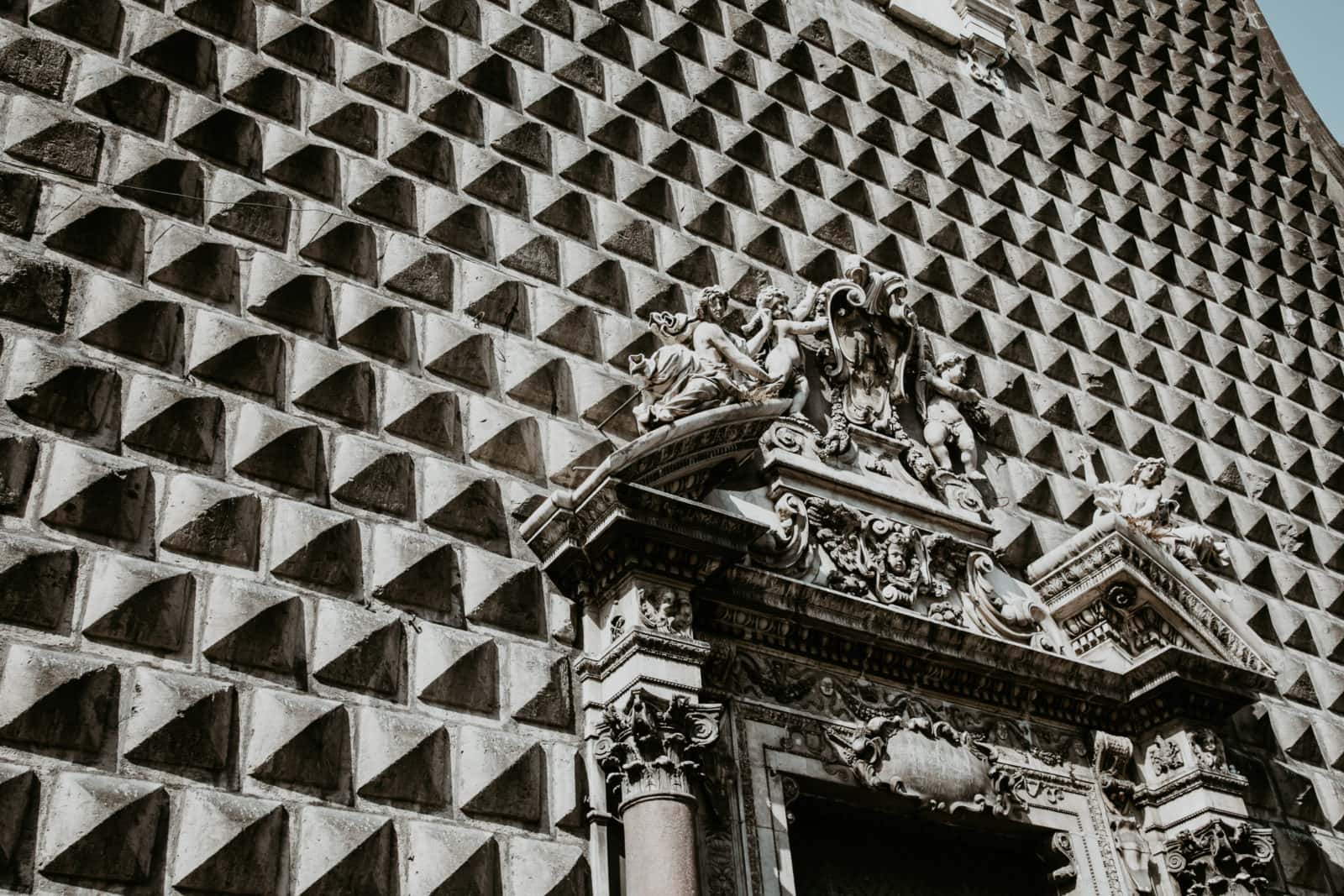
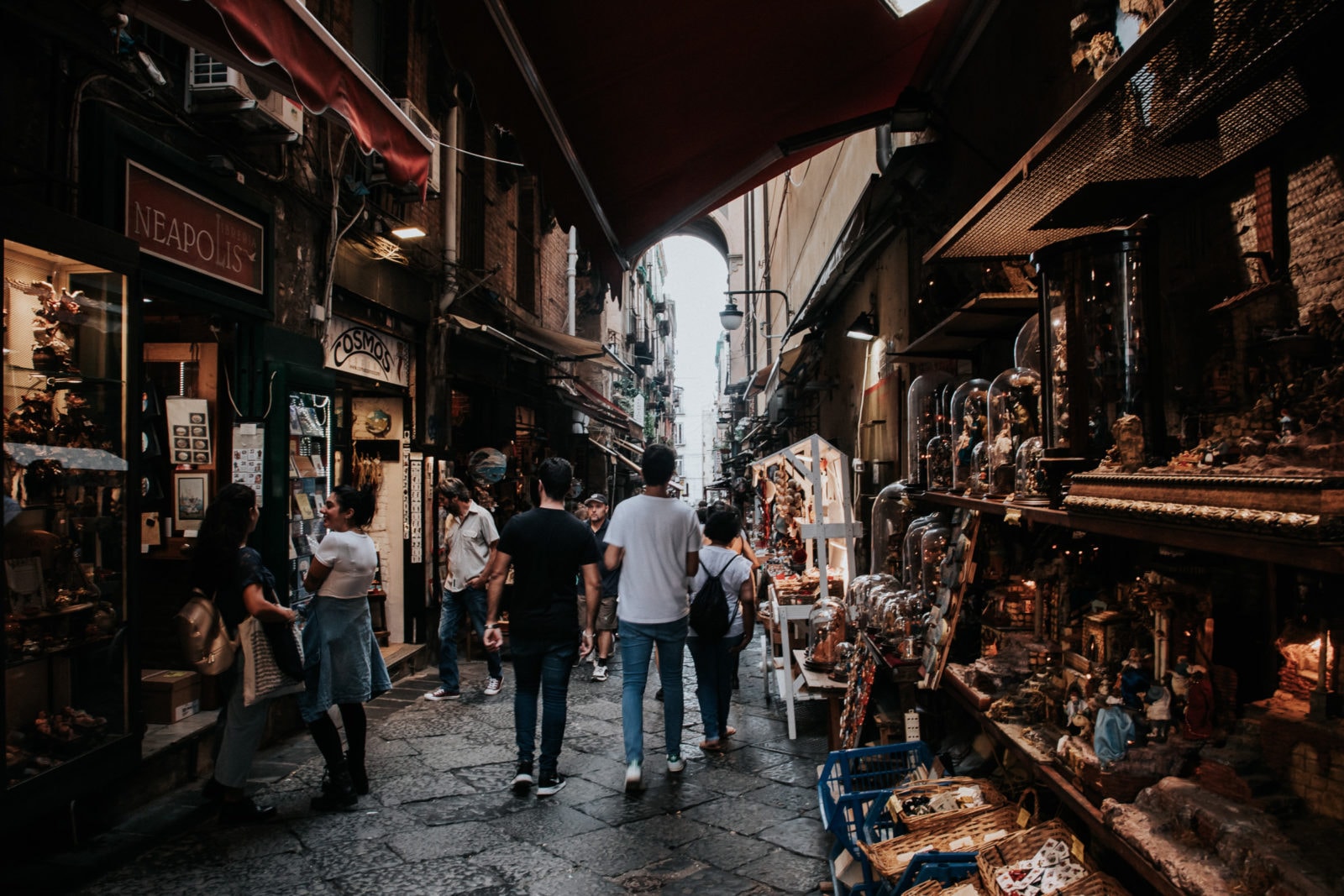


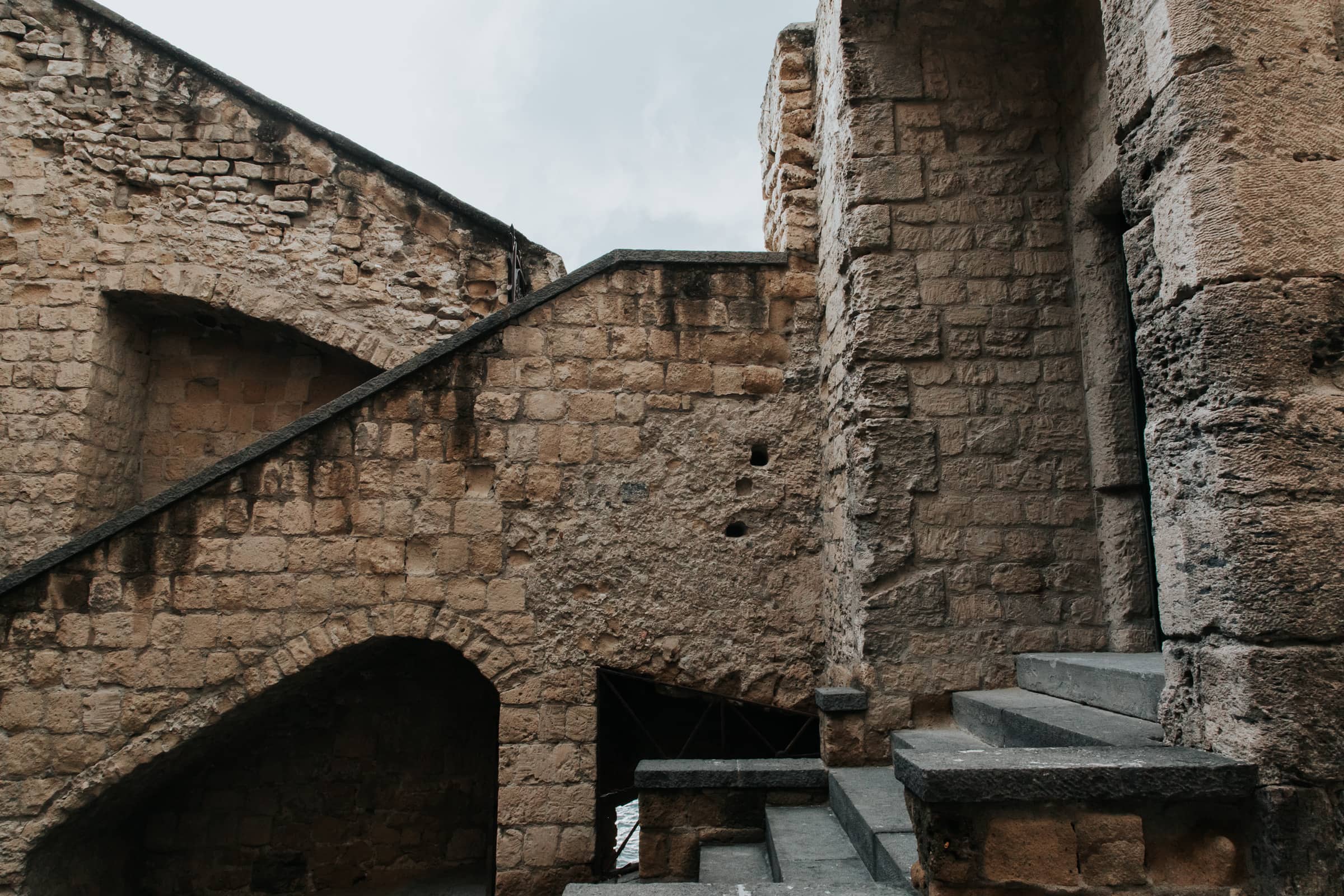


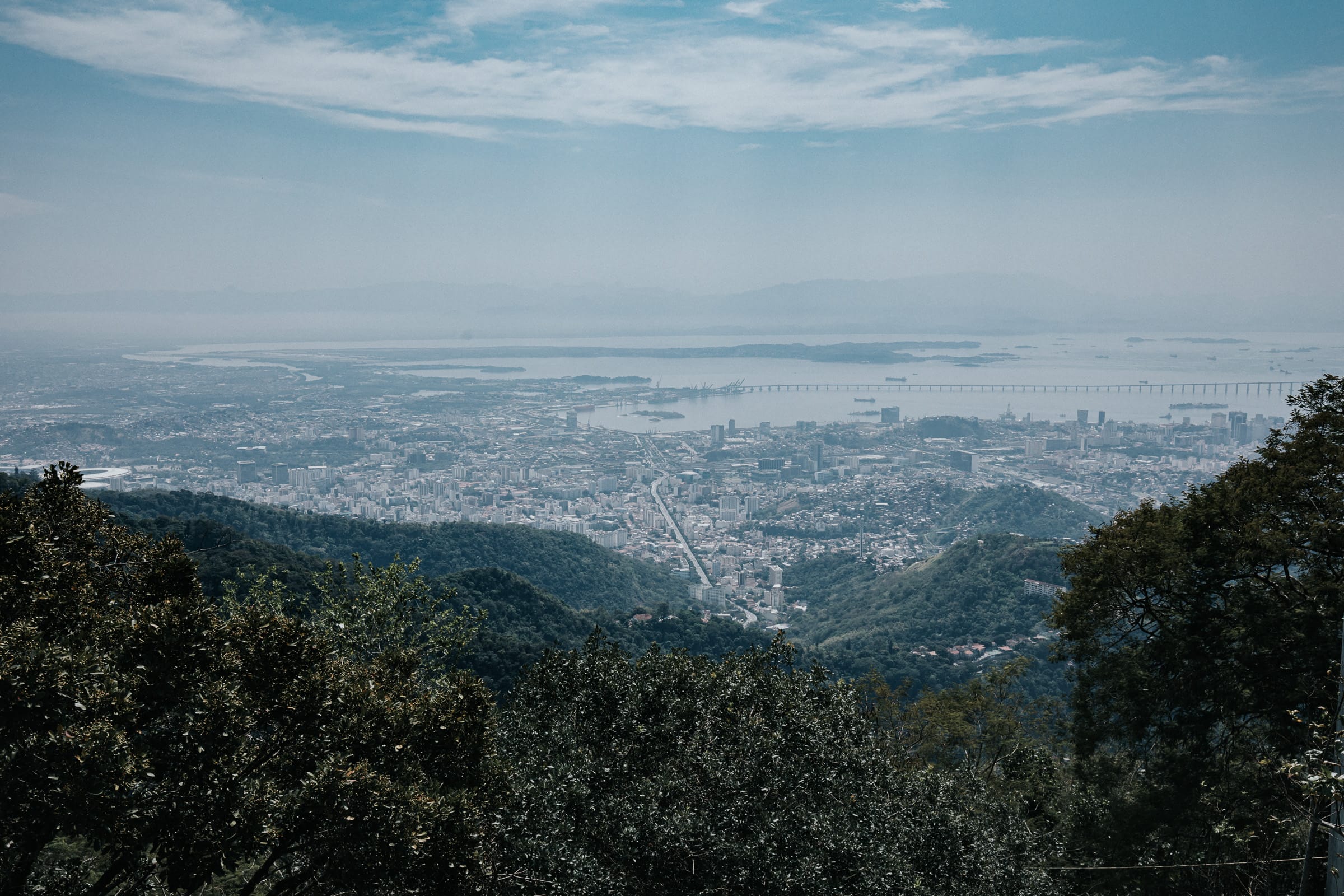


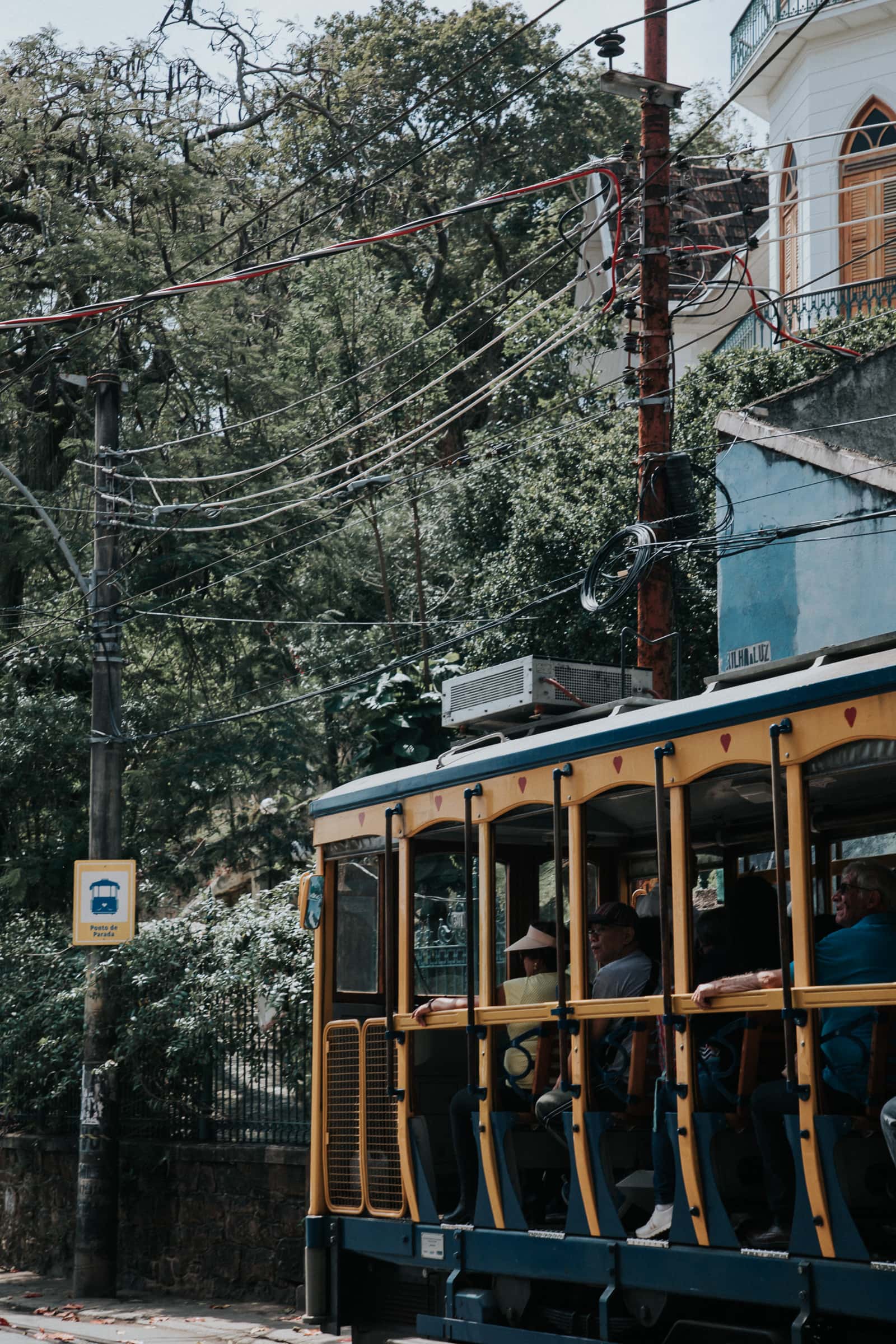
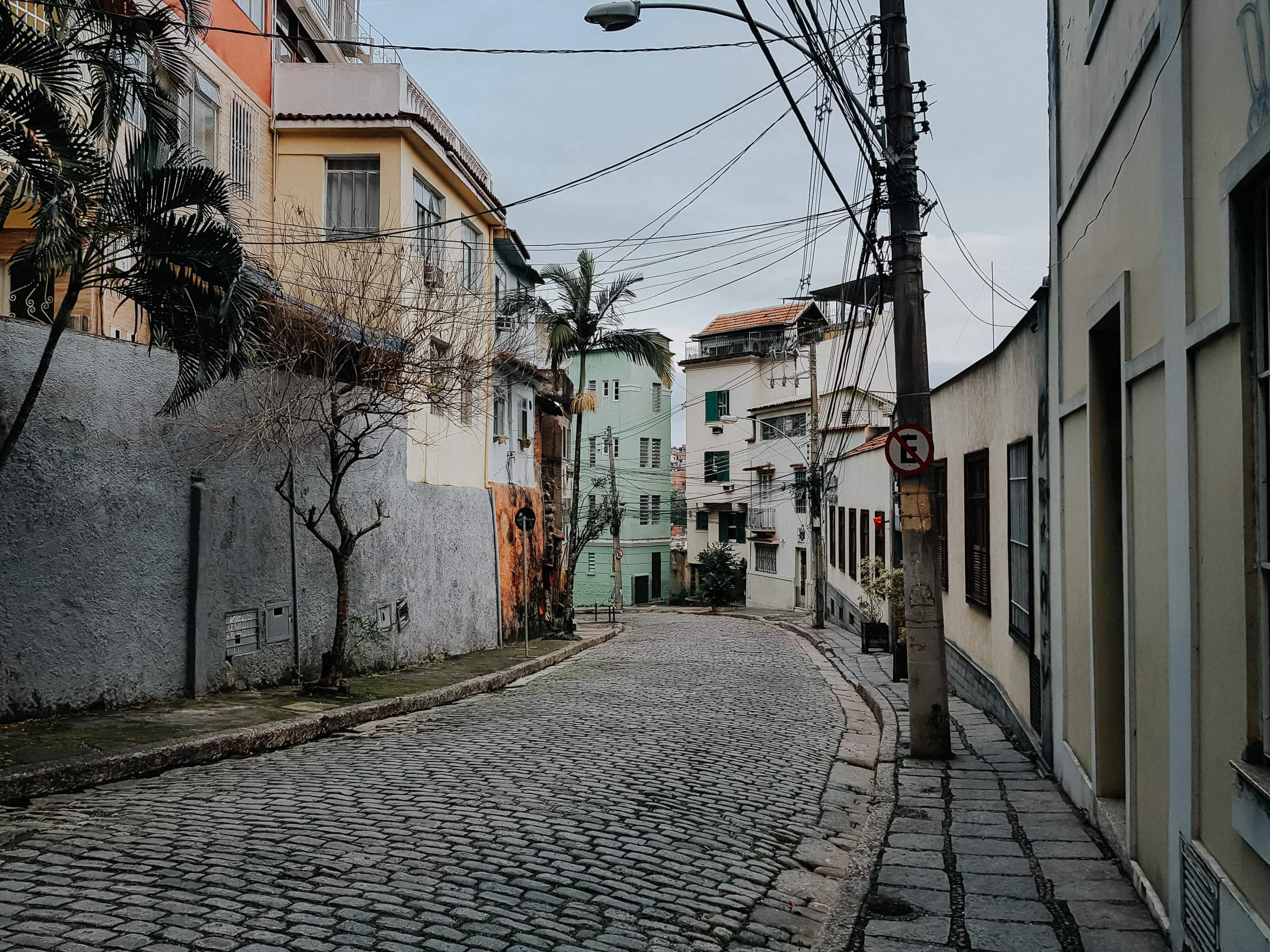


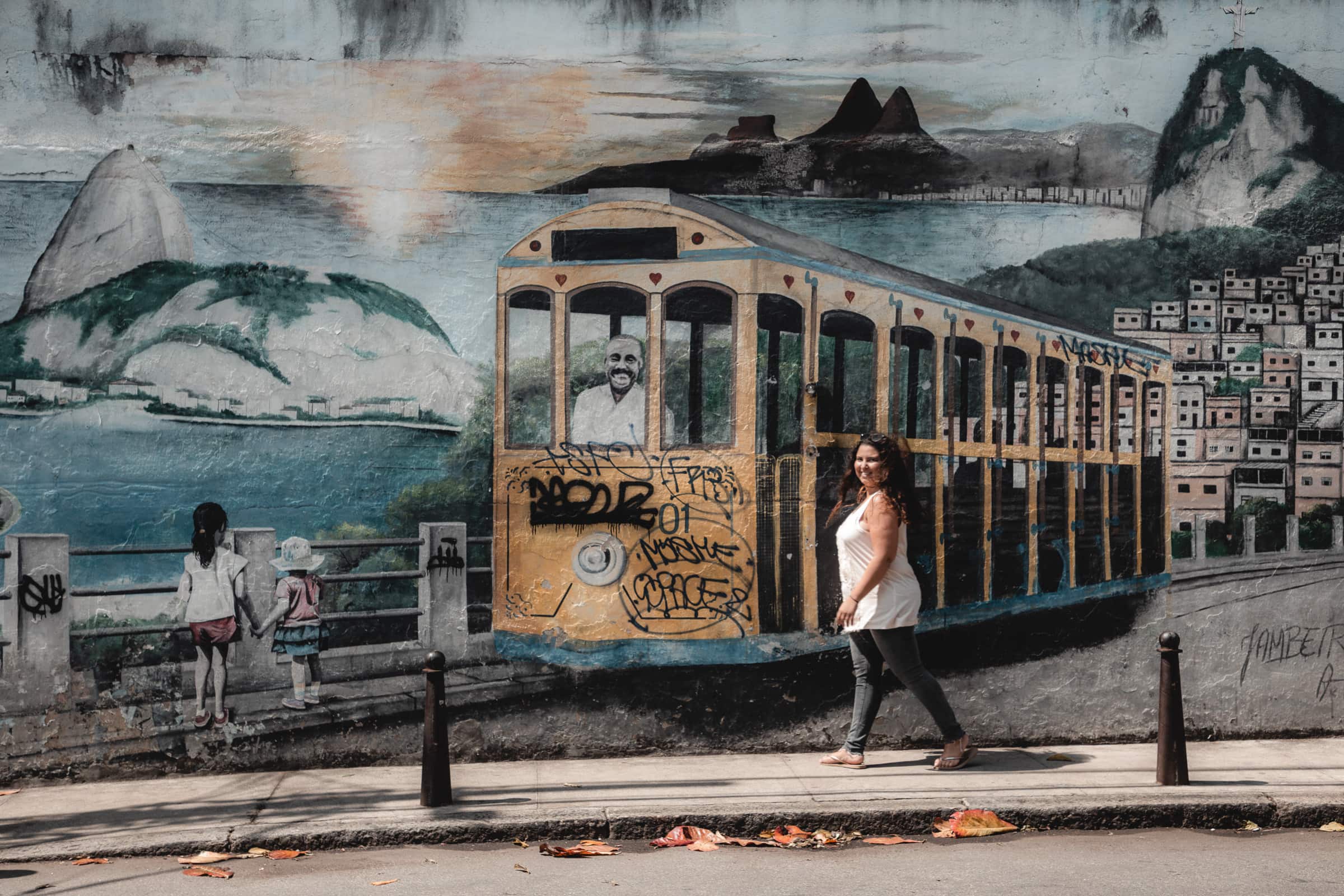
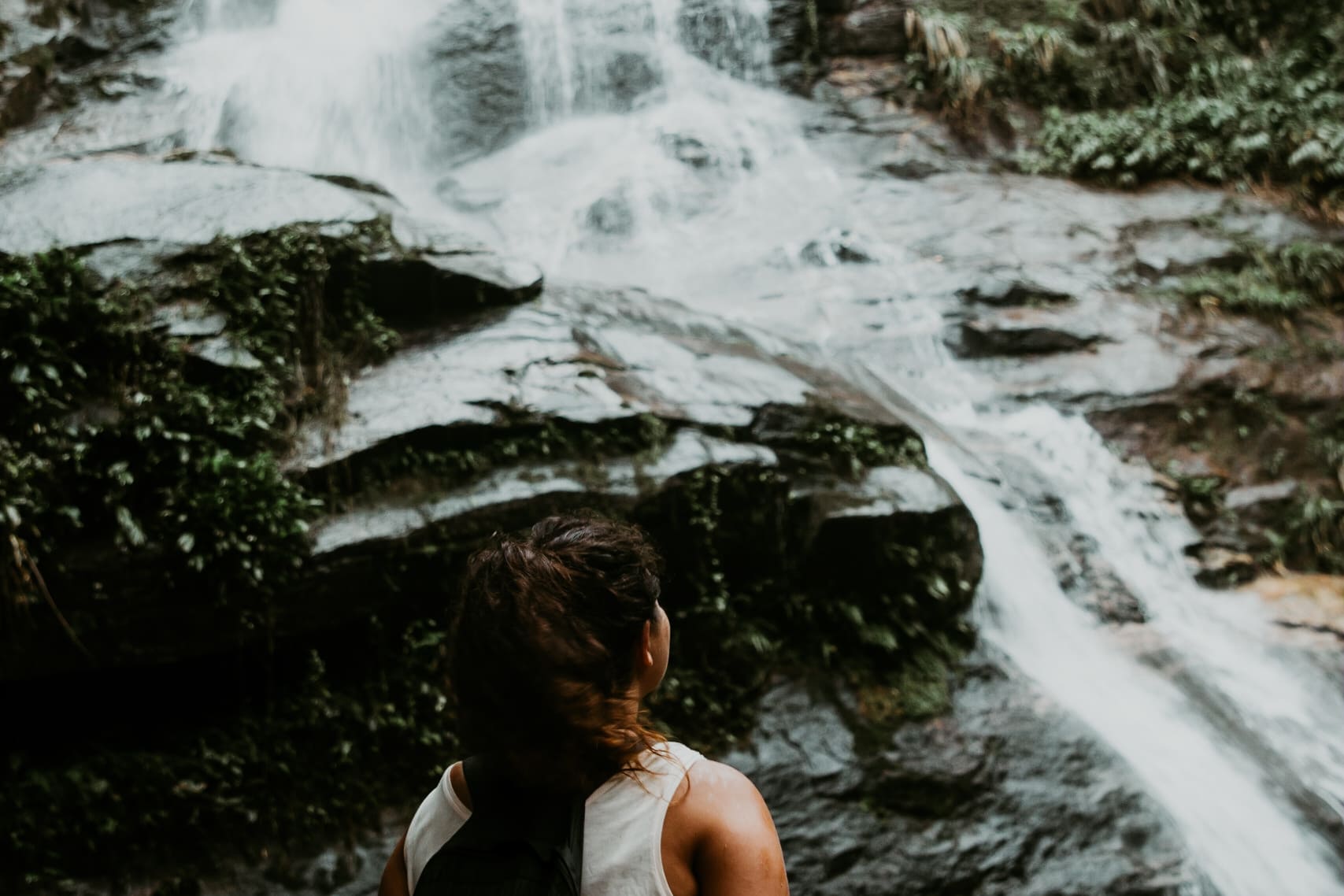 Rio de Janeiro is incredibly green: In Rio’s national parks you can go for endless hikes