The Patuxai Monument in Vientiane is one of the central landmarks in the capital of Laos. Built in the 1950s and 1960s, it is meant to resemble the Arc de Triomphe in Paris. But if you look closely, you’ll notice Laotian influences—a unique building that you definitely shouldn’t miss while in Vientiane.
For a few kip (really not much), you can walk up the Patuxai Monument—all the way to the top.
Sightseeing in Vientiane: The Patuxai Monument
As you walk up, you can stop on two floors. Souvenir vendors have set up their stalls there, and you can find all kinds of knickknacks.
One floor reminded me very much of old Russian department stores with high ceilings and their saleswomen behind glass counters. One of the few times in Laos where I felt reminded that I was actually in a communist country.
Once you reach the very top, you’ll come to this romantic spiral staircase—isn’t it pretty? And just look at those ornate window grilles!
Some of the busiest main roads in Vientiane lead to the traffic circle around Patuxai Monument. One of the most central transport hubs, in other words. And here is already noticeable: Vientiane is so very different from most Southeast Asian capitals: No traffic collapse, no constant honking – everything very quiet.
Patuxai Monument: Best at sunset
It is most beautiful up here at sunset. No more crowds, and the setting sun bathes everything in a very special light. The architecture is really very unusual, everything is decorated in great detail.
How do you get there?
Patuxai Monument is located just outside the city center. From the old town (where most of the accommodations are located), it takes about 20 minutes by bike. Bikes can be rented everywhere in the old town. Or you can just take a tuktuk.
Have you ever heard of Vientiane? Neither had I, really, until I planned my trip to Laos. Probably for good reason: Vientiane is simply less spectacular than other major cities in Southeast Asia, like Bangkok or Hanoi. On the other hand, that’s exactly what makes Vientiane so special: it just feels like a big village.
The skyline of Vientiane: The Don Chan Palace
Vientiane lacks true skyscrapers, which is unusual for an Asian city. The only exception is the Don Chan Palace, a 14-story hotel that stands out as an architectural misfit in this peaceful city. Interestingly, it is also the tallest building in Laos, although it’s hard to imagine given the city’s skyline. No building in Vientiane can surpass the Patuxai Monument, one of the few prominent landmarks in the city.
Vientiane’s must-see attractions
Vientiane is a small city, which makes it easy to get around. Most of the main sights are close to each other, so you can explore at your own pace and see a lot in just a short time. You’ll still have time to relax with a great Laotian coffee at one of the cozy cafés in the Old Town or try different foods at the night market along the river.
The Patuxai Monument resembles the Laotian version of the iconic Arc de Triomphe in Paris, though it was only built in the 1960s. When you reach the top, you’ll enjoy the most incredible view of the city, and the monument itself is quite charming with its many intricate details. Visiting in the afternoon is lovely, especially when the weather is clear and the sunlight makes everything glow beautifully. Just remember to arrive early, as the monument closes at 5 p.m., so you don’t miss out on the experience.
That Luang: The Golden Landmark
The huge stupa of That Luang is Laos’s most important religious landmark. It’s big, golden, and truly impressive. Though you can’t get very close, it’s definitely worth seeing. The complex is expansive and features some beautiful temples and buildings. The best way to explore the area is by bike, which you can rent easily anywhere in the city. Biking is a fantastic way to enjoy the whole site comfortably.
That Dam: The Forgotten Stupa
That Dam is a large, old stupa located in the middle of a residential neighborhood, now abandoned. Surrounding the square are a few restaurants, making it a pleasant spot to enjoy a quick break from sightseeing.
How to Get to Vientiane
By Bus
Intercity buses stop at either the northern or southern bus station, both of which are quite far from the city. Afterward, depending on traffic, you’ll need about 45 minutes in a tuk-tuk to reach the city center. Private tourist buses are more convenient; they typically go directly to the Old Town, where most of the city’s hotels are located. City buses operate from and return to the central bus station near Talat Sao, right in the city center.
Heading north, the bus has become less significant since the railway opened; few people now opt for the winding road to Vang Vieng or Luang Prabang. However, for trips south to Thakhek and Pakse, and for long-distance routes to Hanoi or Hue, it remains the primary choice. Schedules and prices are available on 12Go Asia.
By Train
This is the area that has seen the most change since my last visit. Vientiane now features two train stations, each part of a different rail network.
The China-Laos Railway has been operational since December 2021, starting from Vientiane Station in Don Noun, about 15 kilometers northeast of the city center. From there, you can reach Vang Vieng in just over an hour and Luang Prabang in approximately two hours. Previously, the bus journey to these destinations took about eight to ten hours. The northernmost border station is Boten, where once daily, a through train connects directly to Kunming in China. Tickets are in high demand, especially on weekends and holidays, and can be purchased at the station, through the LCR Ticket app, or at various travel agencies. Note that tickets for departures from Laos are only sold within Laos and are not available for advance purchase in China.
Since July 2024, there has also been a direct overnight train from Bangkok. It departs in the evening from Krung Thep Aphiwat Station and arrives in Vientiane the next morning—the trip takes about eleven hours and includes border checks handled directly at the stations—you don’t have to change trains. The train arrives at Khamsavath Station, about seven to nine kilometers southeast of the city center.
A sleeper car typically costs around 30 euros, varying with the class, while a standard seat is much cheaper. Trains operate multiple times daily between Udon Thani or Nong Khai and Khamsavath, making travel especially convenient if you’re catching one of the modern Thai night trains to the border.
Tip: If you’re arriving by train from Bangkok and plan to continue on to Luang Prabang, you’ll need to arrange an additional taxi or bus ride from Khamsavath Station to the China-Laos Railway station. Allow at least an hour for this trip. Also, you cannot book a through ticket.
By plane
The small Wattay Airport (VTE) is located just about three kilometers from the city center; a taxi ride to the Old Town takes ten to fifteen minutes.
Thai Airways and Thai AirAsia fly from Bangkok; Vietnam Airlines and VietJet fly from Hanoi and Ho Chi Minh City; and Scoot flies from Singapore to Vientiane. In addition, numerous flights to China are operated by China Eastern, China Southern, and other airlines. Within Laos, Lao Airlines, Lao Skyway, and Lanexang Airways operate flights. There are no direct flights from Europe.
Gdańsk’s Old Town is arguably one of the most beautiful medieval-style city centers in Poland—and it has undergone extensive restoration in recent years. The narrow patrician houses lining the Old Town’s main street, Langgasse or Lange Gasse (Ulica Dluga), bear witness to Gdańsk’s former splendor.
Is Gdansk worth a visit in winter?
In winter, the old town of Gdansk is often deserted. This is in stark contrast to summer, when crowds of tourists push their way through the streets. In addition, it is usually freezing cold – not for the faint-hearted. But the atmosphere is unique. You just need to wrap up well.
Winter in Gdansk: beautiful even in cold temperatures
Everything lies dormant in winter slumber, and a chill is in the air everywhere—a very special atmosphere takes hold. After all, Gdańsk lies almost on the Baltic Sea, in the very north of Poland; the cold wind whistles past your ears everywhere you go. If you walk a bit outside the Old Town, the surroundings become even rougher, but also more interesting. From old warships in the harbor basin to gray tenement buildings—Gdańsk has its beautiful sides even in winter.
There are numerous flight connections to Gdansk. The airport is also close to the city center and well connected by public transport.
Depending on which part of Germany you’re coming from, you might also want to consider taking a long-distance bus like Flixbus (though I personally find that too tiring for such long trips) or traveling by train. From Berlin, for example, there’s a direct train connection to Gdańsk that takes just 6 hours.
➜ Flights to Gdańsk are available from airlines such as Eurowings, Lufthansa, LOT, Wizz Air, and Ryanair
Where to stay in Gdansk
The city center of Gdansk isn’t that huge, and most of the sights are in the Main City or on the nearby island Wyspa Spichrzów. There you will also find accommodations for every budget.
You’ve probably seen them before: the magnificently decorated temples for which Bangkok is so famous. The Thai capital is home to over 400 Buddhist temples, many of which are absolute architectural masterpieces. Whether magnificent royal temples with golden towers or small hidden sanctuaries in quiet side streets: Each temple gives you fascinating insights into Buddhist culture and Thailand’s long history.
Bangkok and its impressive temples
The most famous temples such as Wat Phra Kaew with the Emerald Buddha, Wat Pho with the giant reclining Buddha or Wat Arun on the Chao Phraya should not be missed on any trip to Bangkok. But even lesser-known temples have their very own charm and are often less crowded.
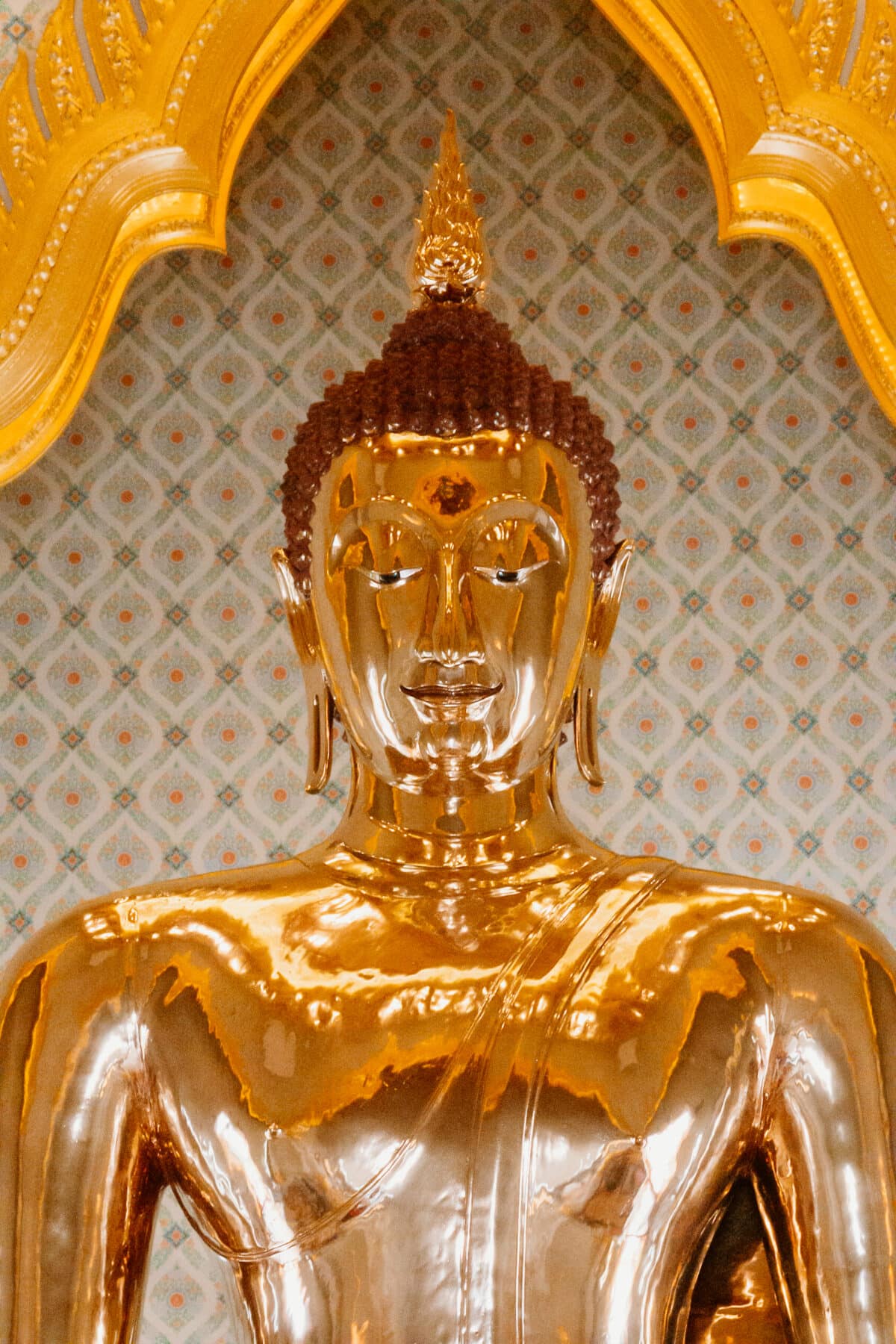
A particular highlight is Wat Traimit with its legendary Golden Buddha. This temple may appear more inconspicuous from the outside than the large magnificent buildings, but inside it holds an absolutely unique treasure – the world’s largest solid gold statue of a seated Buddha.
Where to find the Golden Buddha in Bangkok
The Golden Buddha in Bangkok is housed in the Wat Traimit temple, which can easily be combined with a visit to nearby Chinatown. If you’re looking for a little exercise while sightseeing, there are a few steep steps to climb up to Wat Traimit. Once inside, you’ll find the stunning Golden Buddha, made entirely of pure gold, shimmering and gleaming beautifully.
The Golden Buddha in Bangkok: made entirely of gold!
Facts about the Golden Buddha at Wat Traimit in Bangkok
The Buddha is not only called the “Golden Buddha” – it is actually made almost entirely of gold! Weighing over 5 tons and worth around 250 million US dollars, it stands in the open, without any special safety precautions, in the small temple at the top of the building. Fascinating. Once more, your first impression might be right: first, Thais hold their religion in high regard, and second, theft is heavily disapproved of — making people feel much safer here compared to many other countries.
Important rules for visiting the temple
As in all temples, if you want to see the Golden Buddha up close at Wat Traimit, take off your shoes and cover your shoulders and knees. After all, temples are religious sites that should be respected. Even though the weather in Thailand often calls for light clothing, you should refrain from wearing shorts and tank tops when visiting temples.
You can find more inspiration for your trip in my Thailand blog
However, in Wat Traimit – as in most temples popular with tourists – there is a small clothes stall with scarves and shawls, which you can help yourself to for a small donation. The stall is located right at the top of the temple.
Chinatown in Bangkok
From Wat Traimit you also have a great view of the gateway to Bangkok’s Chinatown, an exciting district that you should definitely visit in conjunction with the Golden Buddha.
Chinatown is one of Bangkok’s oldest and liveliest districts. The streets are lined with traditional stores, cookshops and gold stores, which are particularly lively and brightly lit in the evenings. Here you can sample authentic street food and get to know the life of Bangkok’s Chinese community.
Other temples worth seeing in Bangkok
If a Golden Buddha is not enough, perhaps a private temple tour through Bangkok is something for you! There you will not only visit the temples, but also get a lot of background information:
In addition to Wat Traimit, there are many other impressive temples in Bangkok that you should not miss. Wat Pho is home to the famous reclining Buddha, which is one of the most impressive Buddha statues in the world, measuring 46 meters in length.
Wat Arun, also known as the Temple of Dawn, stands out with its striking prang (tower) on the banks of the Chao Phraya River and is a magical sight, especially at sunset.
This site is registered on wpml.org as a development site. Switch to a production site key to remove this banner.