Salto do Itiquira in Brazil? As a half-Brazilian, I travel through Brazil differently. Sometimes I come to corners that are not touristy at all or only for Brazilian tourists. While Brasília itself admittedly loses its charm after a few days, the surrounding area is all the more exciting for it. Brasília and the Distrito Federal are located in the state of Goiás, a very rural region with many destinations, especially for nature lovers. The Salto do Itiquira waterfall near Formosa is one of them.
186 meters high: The Salto do Itiquira waterfall near Formosa in the Brazilian state of Goiás.
Salto do Itiquira in Brazil: 168 meters of free fall
The Salto do Itiquira is “only” the eighth highest waterfall in all of Brazil, but that should not dampen the joy in the country where the gigantic waterfalls of Iguaçu are located. Because the Salto do Itiquira near the small town of Formosa is also quite impressive. The water plunges 168 meters steeply into the depths and comes up so hard at the bottom that bathing is prohibited directly at the waterfall. You get very close to the waterfall and it gets pretty wet pretty quickly! Further down, however, there are small pools where swimming is allowed, and the Brazilians who like to swim don’t miss out on that.
You can even swim in the small pools below the waterfall.A lot of untouched nature: Around the Salto do Itiquira you can hike wonderfully and enjoy the nature.
An experience just to bathe in the wilderness. Basically, the Salto do Itiquira is a popular destination for the Brazilses, but completely unknown among foreign tourists. Perfect, then, if you ever want to mingle with Brazilians: it’s guaranteed not to take long to get invited to a family picnic and hook up. Brazilians are always warm and hospitable, especially with tourists from outside!
Pure nature around the Salto do Itiquira in Brazil
Around the waterfall you can also walk through the dense tropical forest and enjoy nature. Attention: For the path directly around the waterfall to the top you need sturdy shoes, otherwise it is very slippery.
The Salto do Itiquira is located in Parque Municipal do Itiquira, about 38 kilometers from Formosa and 115 kilometers from Brasília. Admission to the waterfall is free. If you want to stay longer than just one day, you can stay at the nearby Itiquira Park, an amusement park with small chalets and a large pool complex. If you prefer a quieter setting, it’s best to look for one of the many options to stay at a chácara (farmhouse). Online booking is difficult; the nearest option is the Fazenda Hotel Bem Ecologico. There are more options on site; for example, you can book additional accommodations at travel agencies in Brasília, though you should have some knowledge of the language, as these accommodations are really geared toward Brazilians only.
At the moment I am in Brasíliaa very difficult visit, for many reasons. As a half-Brazilian, I have not found the atmosphere here beautiful for a long time. Much is changing, and in a way that scares me more than it gives me hope. And this disorganization! In Brazil, I always realize how much I have been influenced by life in Germany and Central Europe.
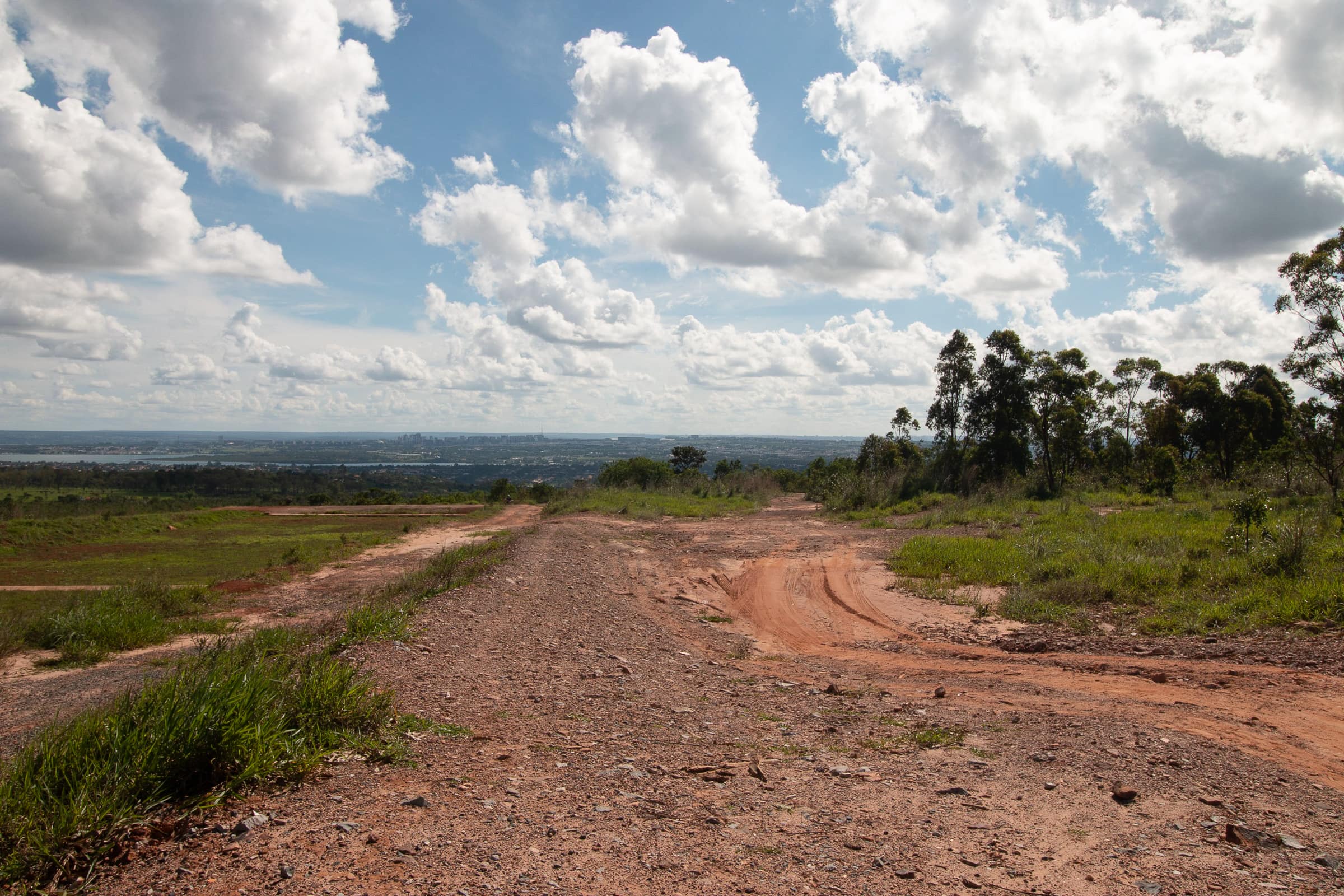
With the Torre Digital in Brasília, for example, it’s the same as with many other things in Brazil. The structure is there, but somehow no one cares. No one really cares about this architectural gem. Three times now I’ve been up here on the hill, outside the city, in the middle of nowhere, traveling three quarters of an hour by car. In joyful anticipation of finally climbing up the tower. From the viewing platforms of the Torre Digital you are supposed to have an amazing view over Brasilia. And the futuristic glass domes, under which there are two platforms, even provide a bit of Star Trek atmosphere. Brazil’s architecture has always been futuristic.
The glass domes of the Torre Digital in Brasília can be walked on.
Reading tip
The Torre Digital was the last project by the great Oscar Niemeyer, Brasília’s main architect, who died in 2012 at the ripe old age of 104. His buildings are legendary and his visions were groundbreaking.
Also called Flor do Cerrado (Flower of the Cerrado) because of its shape: The Torre Digital in Brasília.Already from the hill you have a good view of the center of Brasília, the Plano Piloto.
Torre Digital Brasília: opening hours & bad prospects.
Opened only a few years ago, the Torre Digital was intended not only to be an antenna tower, but also a new attraction for the city, both for tourists and locals. This worked quite well at first, but at some point the opening hours became more and more bizarre. First open to visitors only during the week, then only every other weekend, then different again, strikes intervened, then there were security problems – Brazilian chaos, after all.
Only a few guards are now guarding the tower, but when it will be open, yes, sometime, but when exactly, no idea. On the internet, the official site of the tourism authority never gives any further info except for a fancy little picture. So the visit remains a gamble – and I think I’m slowly giving up both the hope of ever coming up here and the hope that fundamentally some things will change here in the country. Too bad actually. For me, for Brazil, for the rainforest, for the world.
When you visit Palma de Mallorca, the Passeig del Born will probably be this one special street you will remember when you come to the city. Starting at the beach promenade and the cathedral La Seu it’s like a big, inviting entrance to the city centre with more sights like the Plaza Mayor and the old town. A perfect starting point for a day visit to Palma. But maybe you want to explore something different and avoid the touristy crowds? Then be smart and explore the neighbourhood of Santa Catalina in Palma de Mallorca!
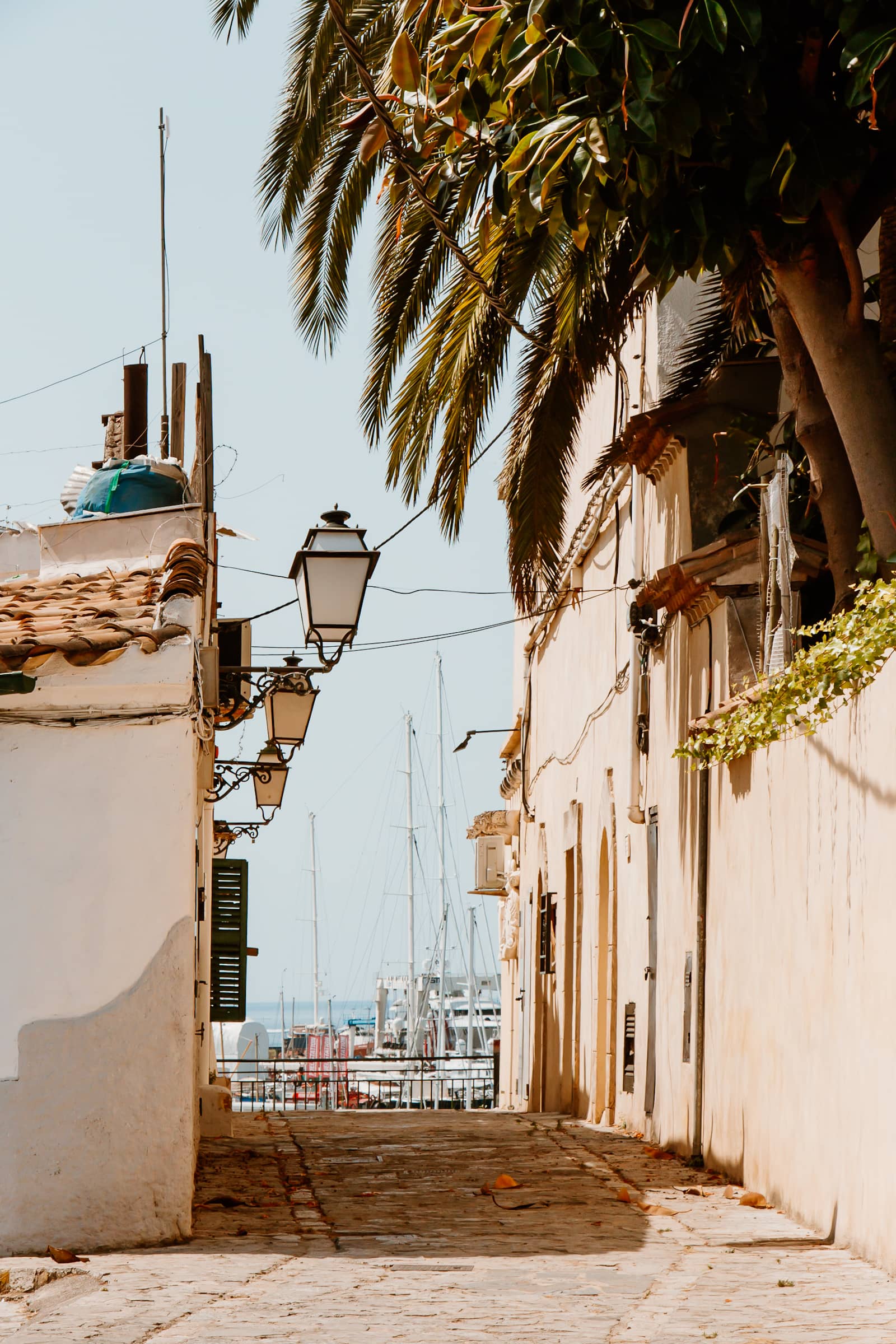
From Santa Catalina you have an excellent view over the harbour of Palma de Mallorca and the cathedral La Seu.
Sometimes it seems that the Passeig del Born divides the city – on one side there is the spectacular cathedral which resides like a castle over the beach promenade and which is constantly surrounded with visitors and on the other there is this special little gem, an old charming village which I’m certain you will love.
Santa Catalina: The trendiest neighborhood of Palma de Mallorca
Sure, it’s no longer a secret that Santa Catalina became a hotspot in the last few years – the main street is filled with scandinavian real estate offices selling apartments in the area for tremendous prices to their fellow countrymen – but it still has this laid-back mediterranean flair mixed with modern bars and innovative restaurants.
Santa Catalina has a vibrant restaurant scene: A foodie’s heaven!
Nightlife in Santa Catalina
And when it gets dark, Santa Catalina turns into the nightlife hotspot of Palma de Mallorca! Don’t worry about drunk tourists on pub crawls: This is where the locals go to have a good time! You will find a broad selection on restaurants, bars and clubs here, all very different from the usual tourist traps.
Walking through Santa Catalina: The old fisherman’s village of Palma de Mallorca
By day, you take the opportunity and explore the area by foot: Until a few years ago, Santa Catalina was a rather neglected part of town, dark streets, abandoned houses. Almost all houses were restored and now there are parts where it’s like the calm mallorquin village it was decades ago before tourism hit the island.
Do you need more inspiration for your vacation in Mallorca? On my blog you find much more information and ressources for this beautiful island! Click here
Wandering around in the narrow streets of Santa Catalina.
Wander around the small curvy streets and get lost in the quiet village! You won’t believe you are less than a 20 minute walk away from the busy cathedral!
On top of Santa Catalina you get to see an original old mill – and you have the most wonderful view over the harbor.
The old windmill is the landmark of Santa Catalina.
On your return, take a coffee in one of the tiny cafés around the Mercat de Santa Catalina.
The Mercat de Santa Catalina
Many city guides mention the Mercat de Santa Catalina as a sight worth seeing. Unfortunately, it’s not THE authentic mallorquin market you might expect. After a big renovation years ago it’s more of a gourmet market and in my opinion, it lost a lot of its authenticity. And besides, almost everything is overpriced! If you want a better market experience, check out Mercat de Olivar in the city centre or one of the local farmers’ markets all over the island.
Less touristy and catering to customers who value high quality: The mercat of Santa Catalina.Don’t forget to try Sobrasada, the Mallorquinian sausage!
How to get to Santa Catalina in Palma
To get to Santa Catalina just turn left at the Bar Cuba at the Passeig del Born and go straight ahead – you are already there! By the way, the Bar Cuba is now part of an excellent hotel: Click here for the best room rate!
Chicago is a truly impressive city: a huge skyline, pure city life, but also lots of greenery and long beaches on the shores of the huge Lake Michigan. Unlike its big sister New York, the people here are incredibly open-minded and friendly: Chicago is known for its positive attitude to life! Although I’ve never been a big fan of the USA, I was immediately taken with Chicago. I’ll tell you my favorite Chicago sights here!
Sightseeing in Chicago: My budget tip!
Chicago is not exactly cheap! As in all major American cities, accommodation and meals are a big hole in the wallet. But you shouldn’t skimp on good food in the foodie mecca of Chicago! And you shouldn’t miss out on some of the paid attractions such as the Willis Tower (or 360 Chicago) or the Art Institute.
Sir Anish Kapoor’s sculpture in Millennium Park is actually called Cloud Gate, but because it looks like a bean, the nickname stuck: The Bean. This is probably the most popular must-see photo spot in the whole of Chicago. Not only because of the crowds of people who make a pilgrimage here every day, but also because of The Bean itself: The reflections in the stainless steel sculpture are simply fascinating.
But The Bean is not the only work of art worth seeing here: next door is the Crown Fountain, a water-spouting video installation that provides refreshment, especially for children, during Chicago’s scorching hot summers.
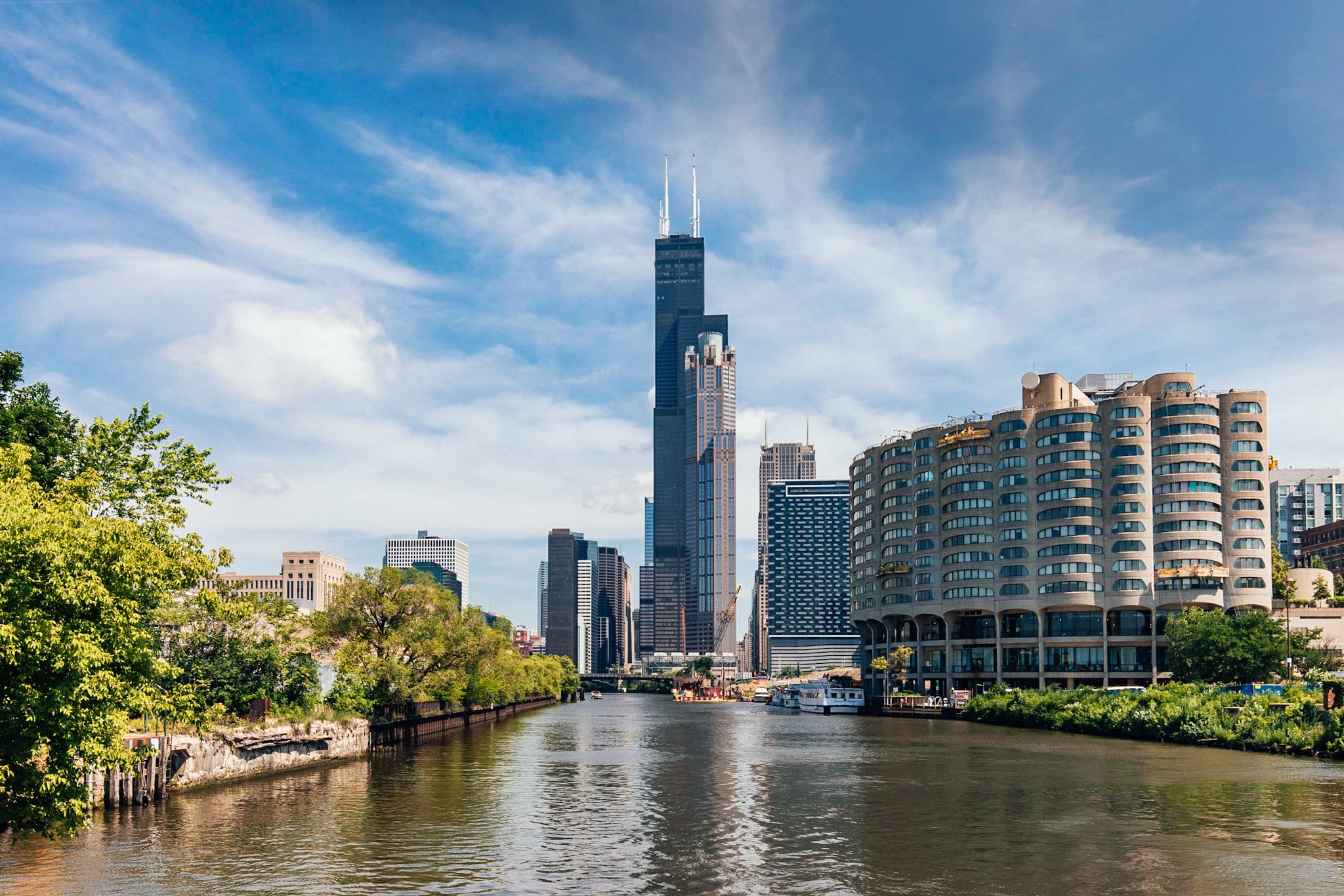
#2 Willis Tower
The Willis Tower used to be called the Sears Tower and was the tallest building in the world. That is ancient history, but the view from Skydeck Chicago is still impressive. The four glass balconies (“The Ledge”) are a particular highlight: Even the floor is made of glass. Not for those afraid of heights.
Do you also want to travel to the USA? There are lots of helpful tips and travel reports on my USA blog.
#3 360 Chicago at the John Hancock Center
If you want to see Chicago from a different perspective than from the Willis Tower, you should go to 360 Chicago. On the Tilt extra attraction, you can lie down on glass panes that tilt forwards.
By the way: admission to attractions such as the Skydeck or 360 Chicago is quite expensive. With the Chicago City Pass* you can save up to 50%, so it’s best to work out in advance whether you want to pay for admission individually or whether you’d rather take the pass.
Michigan Avenue in the center of Chicago is lined with one huge store after another: All the big stores are represented here. Quite ostentatious – which is why this stretch of Michigan Avenue is also known as the “Magnificent Mile”.
Incidentally, you can stay here in style at the Warwick Allerton, one of Chicago’s most historic hotels. Recently renovated, you live here in one of those old skyscrapers like in the movies: large rooms, high ceilings. And everything at its finest.
The formerly derelict banks of the Chicago River have been given a real facelift: now you can stroll along them or simply take a short lunch break at one of the beach bars. The more sporty get into a kayak, the more comfortable take one of the water cabs and explore Chicago by water. By the way, water cabs are part of Chicago’s public transportation system!
The leisure area directly on the lake is almost in the middle of the city. Almost a hundred years old, it was given quite a facelift in the nineties and now offers all kinds of leisure activities, from a Ferris wheel to a musical theater and art exhibitions.
The numerous cafés and restaurants are a great place to take a break from sightseeing and enjoy the view of Lake Michigan – in the beer garden, for example, with a beer and a traditional Chicago hot dog. There are always free fireworks on Wednesday and Saturday evenings. Many other free events such as concerts and festivals can also be found in the event calendar.
#7 Chicago Elevated, Loop, “L”
It is actually called Chicago Elevated, but Chicago’s elevated train is also known simply by the letter “L”. Particularly striking is the Loop, the ring that cuts through the street canyons in the middle of Downtown.
#8 Lake Michigan and Lakefront Trail by Segway
The Lakefront Trail runs along the entire length of the city, perfect for jogging, cycling – and Segway riding! The distances are huge, so a vehicle is pretty handy.
With a Segway you can see a lot more of Chicago’s long waterfront promenade. The lakefront is definitely one of Chicago’s great leisure attractions: An absolute must when the weather is nice!
If you really want to see all the exhibitions, you’re guaranteed to be busy for a whole day. But a visit just for the highlights is also worthwhile! Numerous American classics such as Edward Hopper’s Nighthawks hang in the Art Institute of Chicago .
Admission is quite steep at 25 dollars, but with city passes such as the Chicago City Pass* you can save a lot of money here too if you are sightseeing through Chicago anyway.
Even if you don’t attend a show at the Chicago Theatre, a photo in front of the legendary neon sign is a must! At lunchtime, you can take a guided tour of the inside of the venerable Chicago Theatre, and in the evening, superstars from Jerry Seinfeld to Madonna perform here. Or you can visit the Chicago Theatre during the day with a guided tour*.
#11 Jazz clubs & live music
Jazz and blues are the leading musical genres in Chicago. And if you don’t feel like dancing after a long day of sightseeing, a jazz club is the perfect choice to round off a day in Chicago. Andy’s Jazz Club, for example, offers live music from all jazz genres every evening with good cocktails.
#12 Chicago’s Deep Pan Pizza
Chicago is famous for its deep dish pizza or deep pan pizza, which was invented here in the 1940s. The original is said to have originated at Pizzeria Uno – but Gino’s East and Lou Malnati’s can also look back on a long deep pan pizza tradition. Unlike traditional pizza, Chicago pizza is served in a pan, with the cheese underneath the other toppings on a cornmeal crust. It may not have much to do with an original Italian pizza, but the Chicago pizza is still delicious.
Gino’s East is worth a visit for the interior design alone: the entire(!) restaurant is scribbled on from top to bottom. Every guest can immortalize themselves here with a sharpie!
#13 Route 66
The legendary Route 66 actually starts here in Chicago! Route 66 is no longer an official road, but the old sign on Adams Boulevard marking the beginning is still there. By the way: A road trip along Route 66 from Chicago, as I did, is also highly recommended! You can read more about my road trip through Illinois here:
#14 West Loop, Randolph Street & Fulton Market Street
The new restaurant mile in Chicago’s gastronomic heaven: Chicago is known for its fantastic restaurants. In West Loop, a new generation of eateries has established itself along Randolph Street and Fulton Market. There’s always something going on here in the evening.
Once a year, in the summer, there’s the “Taste of Randolph,” a street festival featuring events and live music, in which many of the neighborhood’s restaurants participate and where you can sample all their specialties at affordable prices. My tip: breakfast at Soho House.
#15 Wicker Park
In Berlin you would say: Wicker Park is really cool. In big cities, I always like to take a look at the small, neighborhoods because you simply get to see more of real life here. If I hadn’t opted for accommodation in the middle of the city, I would probably have ended up in Wicker Park, one of Chicago’s hipster neighborhoods, so to speak. Street art, cool bars, individual stores – my creative heart was happy!
My tips for Wicker Park:
Dove’s Luncheonette Really, really cool location: Tex-Mex cuisine is reinterpreted here in retro luncheonette style under the elevated railway bridge. Could have tasted my way through the entire menu.
Milwaukee Avenue If the Magnificent Mile is too busy with huge chain stores, you’ll feel much more at home shopping on Milwaukee Avenue. Here you can still find small stores between larger indie chains like Urban Outfitters, and you can stroll around much more comfortably than on the sometimes hectic Mag Mile.
#16 The 606 / Bloomingdale Trail and Park
Relatively unknown, as it is located just outside the city center between Logan Square and Humboldt Park: The 606 is a disused elevated railway line that has now been converted into an amusement park. Above the rooftops of Chicago, you can jog, cycle and do whatever else you can think of over a length of more than 4 kilometers. A great detour when visiting Wicker Park!
#17 Humboldt Park
A melting pot of cultures – that’s always a hackneyed phrase when talking about life in big cities. In Chicago, however, it really hits the nail on the head. People from so many nations live here that you sometimes feel like you’re on a little trip around the world. Humboldt Park is a district where many Puerto Ricans live: In summer, there is a big street carnival here with lots of salsa, bachata, reggaeton and merengue and my Brazilian genes were jumping in triangles!
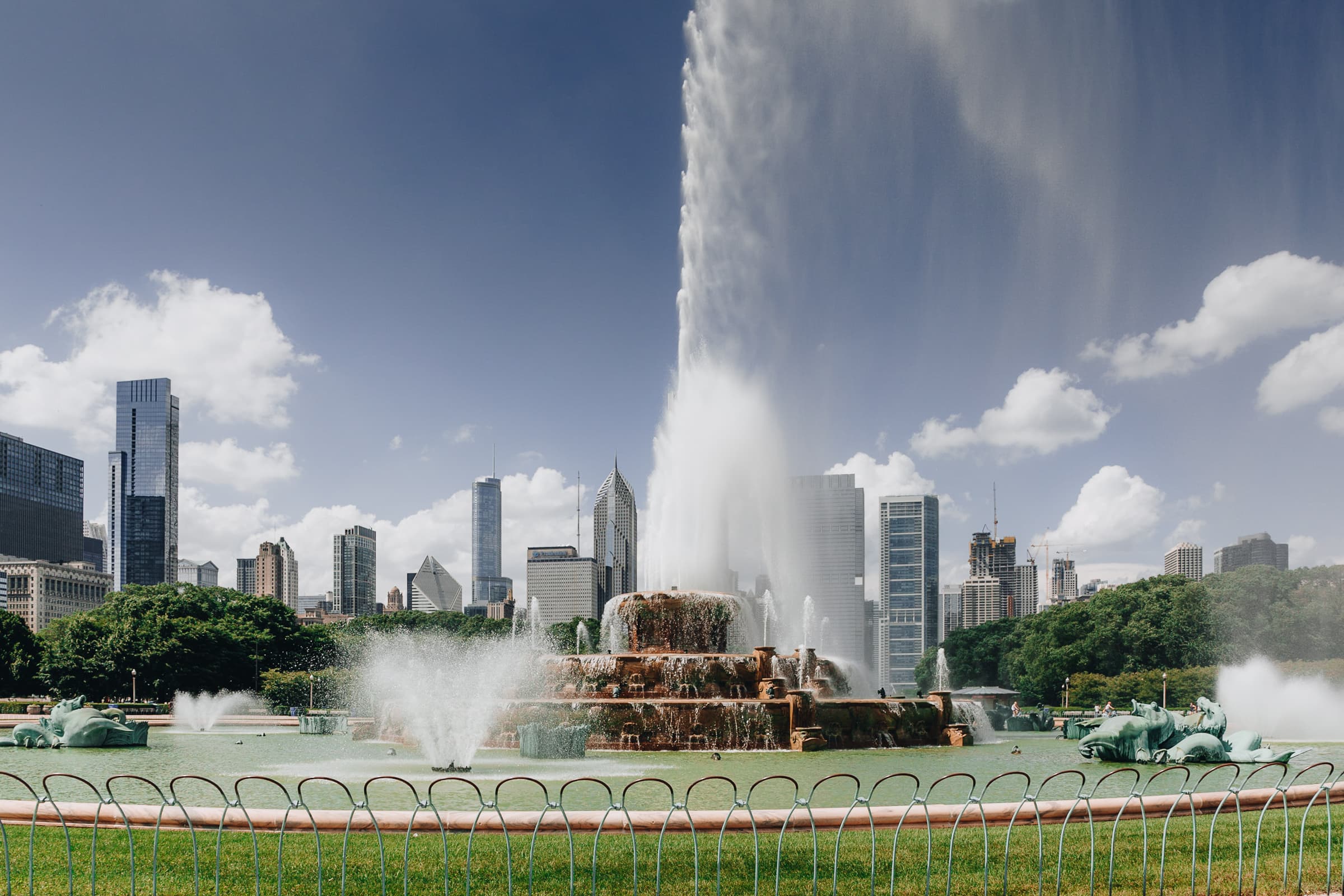
#18 Buckingham Fountain
Children of the 90s will immediately recognize it and revel in TV memories: When I saw the Buckingham Fountain in Grant Park, I immediately thought of the opening credits of “A terribly nice family”. The best thing for everyone else to do is simply marvel at one of the largest fountains in the world. The Buckingham Fountain is really huge!
#19 Oak Street Beach & Co.
Chicago simply has it all: vibrant city life, lots of greenery, the great Lake Michigan – and even great city beaches! Oak Street Beach is one of the most popular, but you wouldn’t expect to find beaches like 12th Street Beach next to the Adler Planetarium in a big city like Chicago.
#20 Chicago for gourmets and foodies
Chicago lives up to its name as a gourmet destination. Food is generally a tricky subject in the USA – while you can find burgers and deep-fried convenience products on every corner, other dishes can sometimes be a bit hit and miss. In Chicago, however, everyone should be able to find what they are looking for.
Pontiac was another stop on our road trip along the legendary Route 66 through Illinois. At first glance, it’s a quiet little American town, but in Pontiac you can soak up the full Route 66 atmosphere. At the local Route 66 Museum, you can learn just about everything there is to know about the famous highway.
But even better are the conversations with the local people: everyone has their own personal Route 66 story and tells it with pride. And this despite the fact that Route 66 has long since been replaced as an official highway by modern interstate highways. Find out what you can experience in the small town of Pontiac in Illinois here!
Pontiac: Route 66 Association Hall of Fame & Museum
The Route 66 Museum is the must-see attraction in Pontiac on a Route 66 road trip in Illinois. So many memorabilia, photos and exhibits about life on Route 66 have been collected here that you could be forgiven for thinking you were in a time machine. I could have browsed here for hours!
Walldogs: Street art artists from the very beginning
Special highlight: The inner courtyard of the Route 66 Museum is home to impressive murals! These are reminiscent of the Walldogs, the artists who creatively painted stores, billboards and walls with advertising messages before the advent of mass media. Today, Pontiac is trying to revive this tradition, and the most beautiful Route 66 murals can be found all over the city.
Looking for more inspiration? You can find even more travel reports from the land of opportunity on my USA blog.
The most beautiful (and totally Instagram-worthy) mural is located at the back of the Route 66 Museum! The artistic Route 66 emblem is legendary!
Even before the terms “digital nomads” and “van life” existed, Bob Waldmire (1945–2009) was drawn to the open road: He spent half his life traveling up and down Route 66 in his converted van, writing stories, drawing, and illustrating. His yellow VW Bus, which now stands in the center of the museum, even served as the inspiration for Fillmore from the Pixar movie “Cars”! Bob Waldmire drove this van across the U.S., always along Route 66. His artistic Route 66 maps are still relevant today and definitely make a great souvenir—available for purchase in the museum shop.
An even better souvenir, however, is the attitude toward life that defines the fascination surrounding Bob Waldmire: His passion for living life on his own terms, away from the mainstream and in complete freedom, really impressed me.
When he wasn’t traveling, he lived in a converted school bus, which was usually parked somewhere in his hometown of Springfield. The school bus is on display in the courtyard of the Route 66 Museum, fully furnished just as Bob Waldmire lived in it: a cozy collection of mementos and souvenirs from several decades on Route 66.
Fun Fact: Bob Waldmire was the son of Ed Waldmire Jr., founder of the legendary Cozy Dog Drive-In in Springfield, Illinois! In addition to the famous Cozy Dogs, Bob Waldmire’s works can also be purchased here.
Museum of the Gilding Arts & Pontiac-Oakland Automobile Museum
Although Pontiac is named after a Native American chief and not after the well-known U.S. car brand, there are still plenty of vintage Pontiacs on display next door at the Pontiac-Oakland Automobile Museum.
Not far away is the Museum of the Gilding Arts —at the end of the 19th century, the production and application of gold leaf were very popular. Here at the museum, you can learn more about this technique. Neither museum is an absolute must-see—but if you happen to be in Pontiac, it’s worth stopping by to take a look.
Admission to all three museums (Route 66, Gilding Arts and Automobile Museum) is free, but donations are welcome.
Where to Eat & Drink in Pontiac
Italian cuisine in huge portions is served at Bernardi’s, probably the best Italian restaurant in the city. The dishes were okay, but the ambience was much more interesting.
Coffee shop, which is also a meeting place in the town: At The Cup and The Scone, you can make friends right away.
All locations are within walking distance in the small Pontiac, so simply park your rental car and explore the city on foot!
Route 66 has an irresistible charm that touches everyone. Its promise of freedom, open spaces, and classic Americana is truly captivating. I remember feeling this myself when we started our road trip from Chicago along Route 66 through Illinois. It’s interesting to note—despite its fame as the oldest east-west highway in the U.S., Route 66 doesn’t begin on the East Coast as I had always assumed. Instead, it starts right in Chicago, Illinois, and winds through states like Missouri and Texas all the way to California.
In this article I take you on our USA road trip on Route 66 in Illinois – and I can reveal in advance: After so many wonderful encounters on our way through Illinois, I would have loved to just drive on endlessly like Bob Waldmire, my secret hero of Route 66!
#1 Chicago: The Beginning of Route 66 in Illinois
Route 66 actually begins in the middle of Chicago opposite the Art Institute Chicago, not far from the famous sculpture The Bean. On East Adams Street between Wabash Avenue and Michigan Avenue is the beginning of Route 66.
If you don’t know, you’ll walk right past the small street sign, in the skyscraper canyons of Chicago! Nearby, by the way, is already the first mandatory stop on Route 66:
At the legendary Lou Mitchell’s, the oldest diner in town, you can get in the mood for a road trip in an authentic vintage diner atmosphere. The food is typical American diner fare: hearty and plentiful. The taste didn’t exactly blow me away, but the rustic atmosphere made up for it.
Chicago, by the way, is one of the American cities that have taken my heart by storm!
For more on Chicago, check out the following posts:
#2 Joliet: Blues Brothers & Old State Prison on Route 66 in Illinois
The authentic road trip feeling kicks in within minutes of leaving the city as the expansive Midwest begins to reveal itself. Illinois’s Route 66 is rich with sights, making the first stop only 77km from Chicago. Joliet, Illinois, offers a charming preview of a journey filled with surprises and friendly encounters: Route 66 is alive with stories!
Like many stories, the Old State Prison in Joliet has a tale to tell. You can’t miss this historic prison, over 150 years old and operational until 2002. For many years, access was restricted, leading to the large complex falling into disrepair.
Facts About Route 66
opened in 1926
Length: just under 4000km
Start: Chicago, Illinois – End: Santa Monica, California
runs through Illinois, Missouri, Kansas, Oklahoma, Texas, New Mexico, Arizona, California
today completely replaced by interstate highways that run parallel to the old Route 66
many parts are abandoned today
in Illinois a lot of restoration has been done around Route 66
Today, events and guided tours are held there. Fun Fact: The prison has appeared in many series, such as Prison Break, and movies like Blues Brothers. Visitors can even see the cell from Blues Brothers.
More about our visit to Joliet Prison shortly before it was opened to the public: Lost Place on Route 66
The Rialto Square Theatre built in 1926, is a magnificent theater that can also be visited during the day.
Where to Eat & Drink in Joliet
For a midday snack, we visited MyGrain Brewery (a pun in the name!), situated in the recently renovated old Joliet train station. Beer enthusiasts will enjoy the house-brewed beers. The small brewing facility can be explored more up close by request, with a personal tour included. Like much of Illinois, the people are exceptionally friendly and welcoming!
Are you planning a trip to the U.S.? You’ll find lots of tips and inspiration on my USA blog
#3 Wilmington: Gemini Giant & The Launching Pad
Just beyond Joliet, in Wilmington, you’ll find the well-known Gemini Giant! This statue is part of the iconic “Muffler Men,” large figures used to promote stores, gas stations, and restaurants along Route 66. Nearby is the Launching Pad, a former Route 66 restaurant.
After standing empty for a long time, the new owners have opened a very charming Route 66 Welcome Center there, where you can reminisce about good old Route 66 with many original photos and exhibits.
As with everywhere else, the locals here are proud and eager to share stories about their lives on Route 66, including Tully, owner of the Launching Pad. For an authentic tourist photo, even the local sheriff arrived at the end, happily allowing us to take a picture with him—showcasing the warm-hearted American friendliness that is truly special.
#4 Pontiac: Route 66 Sights, Street Art & My Hero Bob Waldmire
Although Pontiac is associated with Route 66 and cars, its name actually comes from an Indian chief, not the car brand. It might seem like a quiet, sleepy town at first, but there’s so much to explore that we ended up spending nearly a whole day here! Highlights in Pontiac include:
Route 66 Hall of Fame Museum
At the Route 66 Hall of Fame Museum, I learned about Bob Waldmire’s story—someone who, in today’s Instagram era, might be summed up with the hashtag #vanlife.
Bob Waldmire’s van: an entirely unique piece!Also inside, it remains in its original condition: a creative chaos filled with Route 66 souvenirs.Bob Waldmire’s older VW Bulli, which can also be seen in the museum, even appeared in a Pixar movie.
In his van, displayed in the museum courtyard, he traveled the full length of Route 66 from Illinois to California over his lifetime. He led a simple life, living in harmony with nature, and earned a living through his art. He carefully wrote travel guides for Route 66, among other projects, until he passed away from cancer at an advanced age. His motto was:
I didn’t want to learn anything, so I became a traveling artist.
Bob Waldmire
International Walldog Mural & Sign Art Exhibit
Murals by the Walldogs, a group of street artists, can be seen throughout Pontiac. An interesting exhibition is integrated into the Route 66 Museum. The most famous mural is located at the back of the Route 66 Museum: don’t miss it!
Pontiac-Oakland Automobile Museum
Mainly beautiful classic cars from the golden age of Route 66, but also lots of vintage flair. If you still have some time, you should also take a look at the Pontiac Automobile Museum!
Dongbai International Airbrush Art School
A few years ago, Dong Bai, a Chinese artist, came to Pontiac from Beijing—and stayed because he liked it so much. Today, he teaches airbrush classes in his studio, sells his paintings, and also paints portraits, such as that of the mayor, who—full of pride at so much international flair—showed us around Dong’s studio after closing time—he has the key, after all; the two are friends.
Where to Eat & Drink in Pontiac
Bernardi’s, located across from the Livingston County Courthouse, serves Italian cuisine with an American twist. The spacious aisles are intentional, accommodating a large folding table used for main courses for several people, where large plates are set and organized. The portions are generous.
The Cup and the Scone offers coffee with a twist: the owners are incredibly cordial, and anyone who likes is always welcome to join the regular game nights.
#5 Springfield, Illinois: Abraham Lincoln & The Original Route 66
For Americans, Springfield is like a pilgrimage site of modernity: Abraham Lincoln, one of the most beloved US presidents and the father of modern America, worked here. Slavery was abolished during his presidency! Springfield is not only home to Lincoln landmarks, but it also serves as the capital of Illinois (not Chicago!) and boasts plenty of Route 66 and Midwest charm.
What to See in Springfield
Don’t miss Abraham Lincoln’s house and the mausoleum (rubbing the nose of the Lincoln statue in front of it is said to bring good luck!). The Abraham Lincoln Presidential Museum offers an excellent overview of history (be sure to check out the movie theater—it’s fascinating!).
Original Route 66: Historic Brick Road Near Springfield
Just outside Springfield (Snell Road and Curran Road, Auburn, IL), nestled among cornfields, there’s still an original, preserved section of Route 66. It’s hard to believe that Route 66 was originally paved with nothing but thick bricks. By the way, this section is open to traffic. A must-see for that authentic Route 66 vibe!
Where to Eat in Springfield
Leave room in your stomach for Springfield’s famous specialties: Cozy Dogs and Horseshoe Sandwiches are classic Route 66 fare.
#6 Pink Elephant Antique Mall in Livingston, IL: Vintage Shopping on Route 66
By now, you’re definitely caught up in Route 66 fever —and that’s when a shopping paradise like the Pink Elephant Antique Mall comes in handy! Here, you’ll find every kind of vintage item and Route 66 memorabilia you could ever dream of. Old advertising signs, LPs, furniture……the list is endless. I picked up a working, pastel-colored typewriter there for a bargain price, and the surprised looks from the security staff at the airport when I placed my typewriter next to my MacBook on the conveyor belt were priceless.
Tip: Are you fascinated by the Route 66 vibe? Then you’ll really enjoy this article about Amarillo, Texas—because the historic Route 66 runs through there, too!
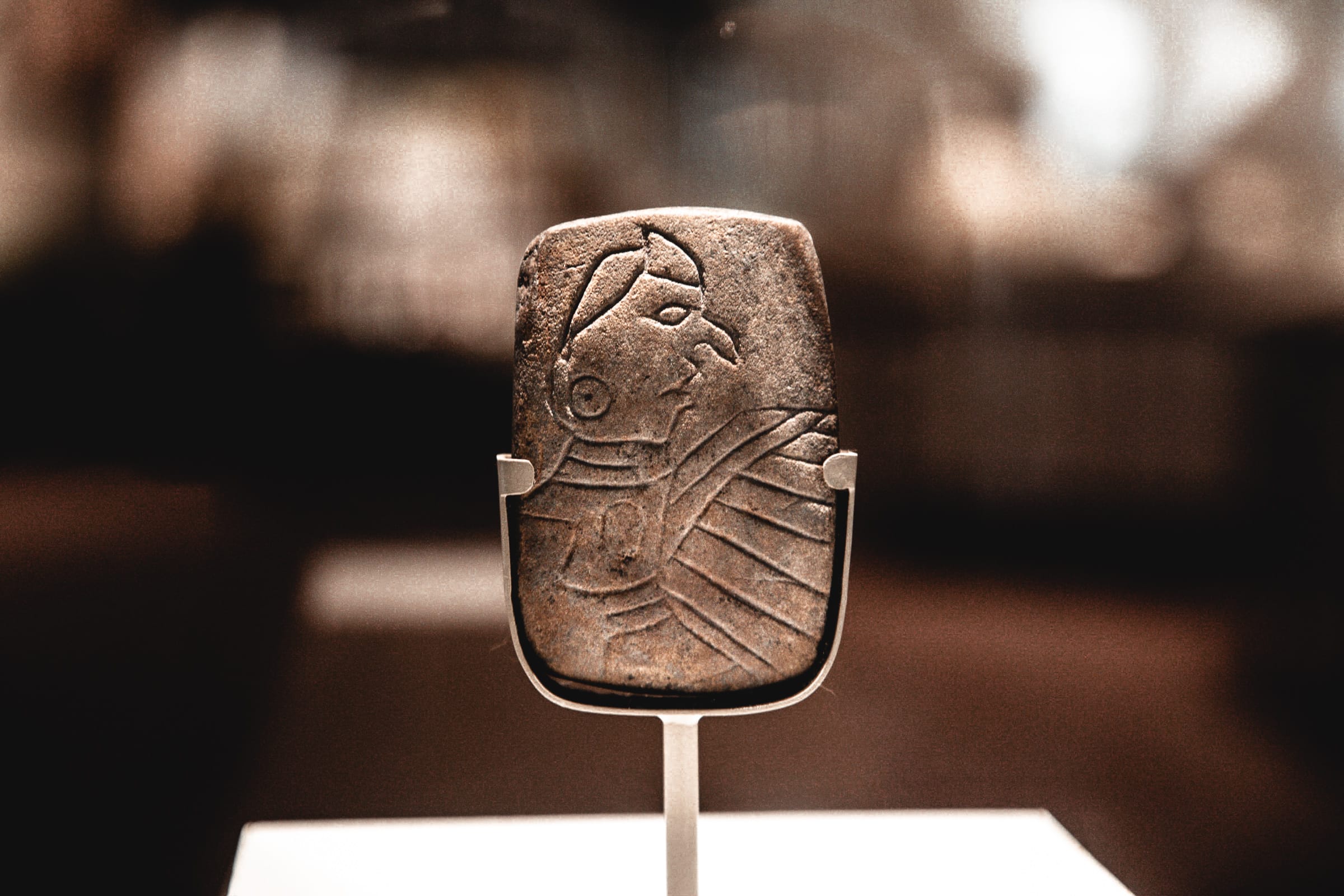
#7 Cahokia Mounds: A Pre-Columbian Mystery
For a long time, the Cahokia Mounds remained undiscovered. People simply didn’t wonder about the uniform, tall mounds in the otherwise flat landscape—after all, they had always been there. That is, until archaeologists discovered one of the largest pre-Columbian cities north of Mexico here in the 1960s: Thousands of people lived in Cahokia at that time. The significance of the mounds, the Cahokia Mounds, remains unclear to this day. In part, the flat mounds served as building sites for more stately dwellings, but also as burial sites.
#8 Alton: Famous Men & The World’s Biggest Ketchup Bottle
Alton is the last stop on Route 66 in Illinois. For a town of its size, little Alton on the Mississippi (yes, it really feels like the South here, with its Mississippi River cruises on paddlewheelers) has produced quite a few famous sons: One of them, Miles Davis, was quite short, but he was one of the world’s greatest jazz trumpeters, and the other, Robert Wadlow, at 2.72 meters, was actually the tallest person ever to live. Even bigger, however, is the world’s largest ketchup bottle (or, as they say here, “catsup”)! Water towers are typical of the U.S. Midwest, and a former ketchup factory in Collinsville simply built theirs in the shape of a ketchup bottle!
By the way, Alton is considered by many to be a spritual place. Mark Twain once referred to Alton as a gritty little town on the Mississippi. High crime rates and the turmoil of the Civil War (the border between the northern and southern states ran through the region) did the rest.
There’s no trace of that gloomy atmosphere left today—but you can still follow in the footsteps of “Haunted Alton”on a guided tour. The McPike Mansion offers guided tours and séances—it sounds a bit bizarre, but once I stepped into the atmospheric vaulted cellar, I realized you can’t deny the house’s unique energy.
Food & Drink in Alton
Fast Eddie’s Bon Air Whether for steamy bachelor parties or a lazy afternoon beer, Fast Eddie’s Bon Air is an institution! The food is good value and the beer selection is huge.
Gentelin’s on Broadway The perfect change of pace for the evening: Gentelin’s on Broadway offers fine dining and the best cocktails, served at your table in a mini shaker.
Where To Stay in Alton
Here’s a unique tip for Alton: stay at the Beall Mansion, where you’ll experience an elegant city villa that’s thoughtfully furnished and offers exquisite dining. You can also opt for a personalized spa package including a massage. I truly suggest it for its romantic ambiance and as an ideal way to conclude a memorable road trip.
One of my lasting memories from my first trip to Vietnam is probably the train journey through North Vietnam. An experience that shouldn’t be missing from any big Vietnam trip! From Hanoi, I wanted to continue on to Hue to visit the Imperial City there. Rolling through Vietnam by train seemed like a lovely idea to explore the country along the way. The best option for that was the night train, which runs all the way from the north of Vietnam down to the south, from Hanoi to Saigon.
But as I was getting so lost in the noisy and scooter-crowded streets of Hanoi, a glance down a supposedly quiet side street caught my eye with this curious railroad track in the middle of the city:
Probably from a small funicular, an old mini streetcar or something similar, I thought. Strange – this track cut its path through the middle of a densely populated city, without regard for residents. I wonder which train was still running here? Or maybe the line had been shut down years ago. It had to be. But in fact, long-distance trains pass along here every day. Residents have come to terms with the train, there are no safety precautions, you just pay a little more attention once the train passes. In the meantime, the curious track has also become a permanent tourist attraction in Hanoi – there are now also cafés and stores with seating right next to the track (where there is still some space).
Train travel in Vietnam: an experience in itself on the route from Hanoi to Hue!
In the evening, I boarded the big night train to Hue (SE3) at Hanoi station. The train rolled off, picked up speed, I looked out the window – and right into various living rooms. The train was speeding over exactly that railroad track in Hanoi that I had marveled at the day before. A special experience.
No rush, no stress: In the evening in Hanoi, the night train departs for the south – all the way down to Saigon.
I can’t remember ever riding a night train in my life – why, really? Because the train ride through half of Vietnam was really great. One compartment consists of four beds, two up, two down, bunk bed style. Well, the beds upstairs could only be reached by means of an acrobatic performance – luckily my travel consultant from my hostel in Hanoi had organized a bed downstairs for me. Apparently, she didn’t quite trust me with the necessary flexibility for an upstairs bed. She was right.
Sleeping on the night train in Vietnam
Pillows and blankets were laid out for each guest, though I wrapped myself up in my own sleeping gear of pillow and sleeping bag anyway. (And which I highly recommend – when traveling, the combination has served me as an picky hotel guest extremely well 😉 ) There still on-board catering with instant soup and coffee from the service cart of the train attendant, who charmingly drove up and down the narrow aisle at the compartments – no one had to starve or die of thirst.
There is even a Vietnamese newspaper and water for free: You can get pretty cozy in the couchette car with four beds.
From Hanoi to Hue by train at night
So the train rolled through Vietnam and I slept like a baby. I liked train travel and made a mental note to switch to the train more. Quite contrary to my expectations, the slight, rhythmic rocking of the train was not so disturbing at all, but rather soothing. (And I’m really quite a picky sleeper by now after years of hotel nights). In Hue I finally left the train – and Vietnam had me again. For despite my firm resolution not to fall for dodgy cab drivers at the station who were lying in wait for naive fresh meat from the night train, that’s exactly what happened. And bang, I sat with luggage for expensive money in an unlicensed, torn“cab“. Now and then into a tourist trap is just part of traveling.
Info about train travel in Vietnam: tickets & tips
Many tourists travel in Vietnam from north to south or vice versa – once from Hanoi to Saigon or vice versa. Transportation options in Vietnam include a well-developed long-distance bus network, or even cheap flights to larger cities such as Da Nang, to get from A to B easily.
On the Cloud Pass, the train runs along the sea – gorgeous views included.
Is a train ride in Vietnam worth it?
The train ride was really comfortable (be sure to book 1st class) and relaxing. There was something about letting the landscape pass you by in the morning. For those traveling on a tight budget, there is also the advantage of saving a hostel/hotel night when traveling by overnight train.
Certainly there are night buses. Personally, I always try to avoid them, as night buses seem fundamentally more unsafe to me in terms of potential bag/luggage theft, etc. On the train, on the other hand, I didn’t worry about it, it doesn’t stop often on the way, and the luggage always stays close by in the compartment.
Can you really save money with the Chicago City Pass? Chicago is a popular destination for city breaks in the U.S. But if you try to see every single attraction, sightseeing in Chicago can quickly get expensive. The Chicago City Pass is often promoted as a great way to save money. But is it really worth it? In this article, I’ll compare which Chicago attractions let you save money.
With the Chicago City Pass, admission to both of Chicago’s top observation decks is included! The Willis Tower is THE must-see attraction in Chicago! From the Skydeck at the very top, you’ll have a fantastic view of Chicago and Lake Michigan!
By the way, the Willis Tower used to be called the Sears Tower, after the company that had the building constructed, and was actually the tallest skyscraper in the world when it opened in 1974. These days, it’s “only” the second-tallest building in the U.S. after One World Trade Center in New York, but hey, I can tell you, that’s still high enough!
On a clear day, you can see four states at once, and Chicago, with its 2 million residents, looks absolutely tiny.
By the way, the Skydeck Chicago features four glass balconies—the “Ledges”—made entirely of glass: walls, ceiling, and floor! The area measures about 2 by 3 meters. So when you step forward, you’re standing entirely on glass. Below you: over 90 stories! By the way, I thought I wouldn’t dare—but the idea of standing on nothing but a glass floor hundreds of meters above the street is so bizarre and unbelievable that my reservations vanished immediately.
Advantage with the ChicagoCityPass: The CityPass entitles you not just to one, but to TWO visits to the Skydeck on the same day. In addition to the regular daytime admission, you also get an evening admission starting at 6 p.m., so you can see Chicago at night, too! Highly recommended for taking photos.
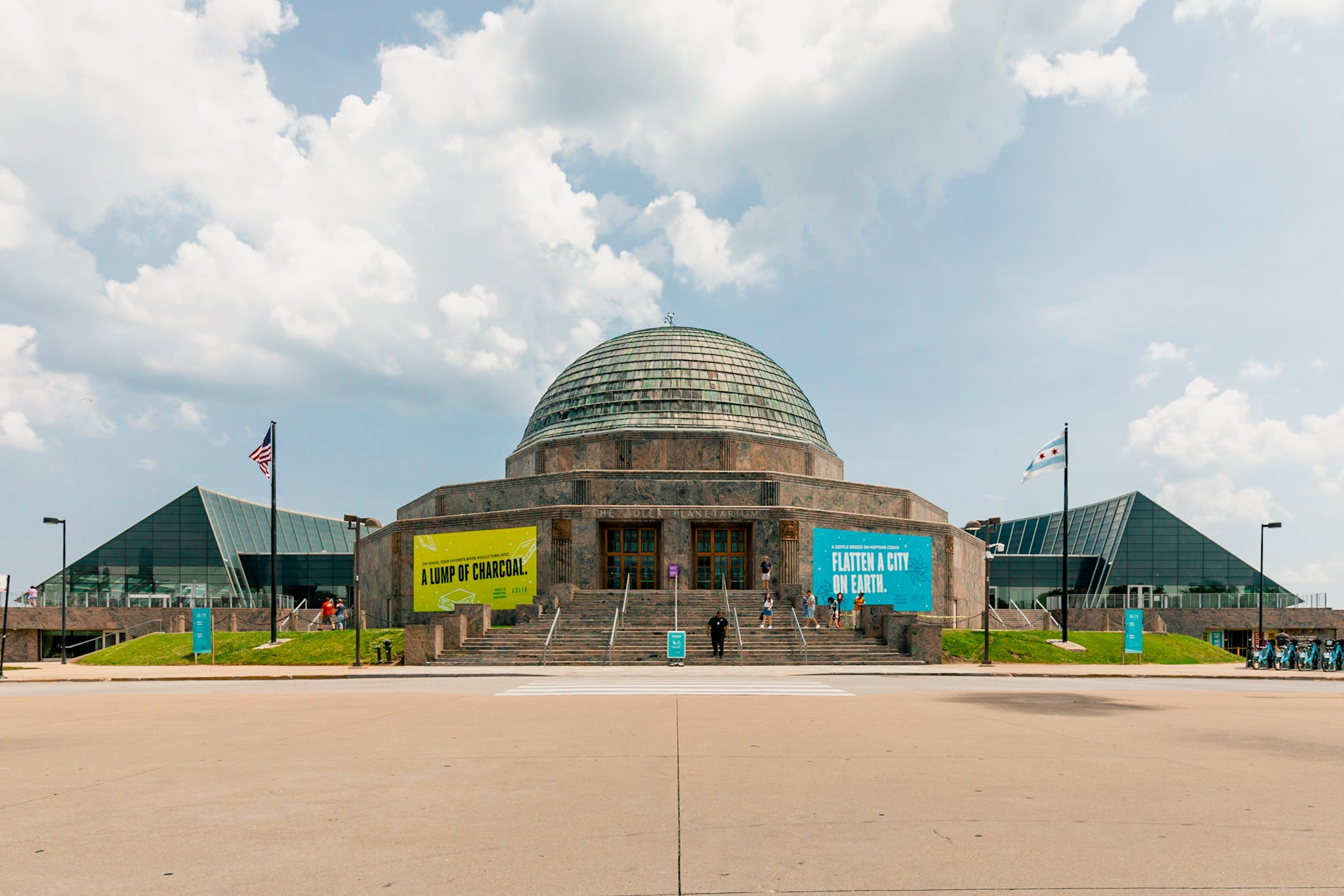
#2 Art Institute of Chicago / Adler Planetarium
With the Chicago City Pass, you have to choose: art or science? The Chicago City Pass grants you admission to either the Art Institute of Chicago or the Adler Planetarium.
Art Institute Chicago
The Art Institute of Chicago is exceptional in the scope of its collection: From Byzantine art to contemporary photography, you’ll find everything here. It’s guaranteed to take a full day to see the entire exhibition. So it makes sense to think about what you’d like to see beforehand, before you get overwhelmed by so much art. I really wanted to see “Nighthawks” by Edward Hopper, and even if the name doesn’t ring a bell—everyone knows the painting. And there’s hardly any other painting that’s perceived as so quintessentially American.
At $25, admission is very expensive, but it’s well worth it—the collection is fantastic, and the temporary exhibitions are always interesting and varied. The helpful audio guide costs extra as well!
Regular price $25 + $7 audio guide = $32
Adler Planetarium
The Adler Planetarium is the must-see attraction in Chicago for all space enthusiasts. Here, you can see an old space capsule and many other interesting exhibits related to space exploration.
The film screenings (Sky Shows) are also highly recommended! Without them, the planetarium is only half as exciting!
Regular price for admission + 2 Sky Shows: $35
Ad / *affiliate links
#3 Field Museum
The Field Museum of Natural History is one of the most visited museums in the United States! It is known worldwide as a natural history museum and houses one of the largest collections of natural history and anthropological artifacts. Here, you can marvel at the best-preserved Tyrannosaurus rex ever found!
Regular Price for All-Access Pass: $40
#4 Shedd Aquarium
The Shedd Aquarium is the world’s largest indoor aquarium and has been around since 1929! Here, you can truly immerse yourself in the underwater world and see all kinds of marine life, amphibians, and insects—from seahorses to beluga whales—up close!
#5 360 Chicago Observation Deck / Museum of Science and Industry
If you don’t want to go up to another observation deck, here’s your option: As an alternative to 360 Chicago, you can also visit the Museum of Science and Industry!
360 Chicago Observation Deck
The 360 Chicago Observation Deck is located in the John Hancock Center right in the heart of the Magnificent Mile—so it’s right in the thick of things!
In addition to the naturally fantastic view, TILT stands out for its floor-to-ceiling panoramic windows that you can lean against and tilt forward along with the window!
TILT costs an additional $8; for Chicago City Pass holders, it’s an extra $7. There’s also a Day/Night package available, but it’s not included in the Chicago City Pass.
Regular price: 360 Chicago $25
Museum of Science and Industry
The Museum of Science and Industry is the largest science museum in the U.S. It features exciting and interactive exhibits on the topic of science. It’s not just kids and science buffs who’ll enjoy this elaborately designed museum! Downside: The Museum of Science and Industry is quite far from all the other attractions south of downtown. So if you don’t have much time, you’re better off choosing 360 Chicago.
Regular price $19.95
Pros and Cons of the Chicago City Pass:
Advantages:
Long Validity Period: The Chicago City Pass is valid for up to one year after purchase. This means you can plan well in advance while still maintaining flexibility.
Long Validity Period: The Chicago City Pass is valid for 9 days starting from the first day of use—that’s longer than most people even stay in the city! So you can take your time exploring everything without rushing!
Instantly printable or mobile tickets: You don’t necessarily need the coupon booklet—you can print out the Chicago City Pass right after purchase or save it to your phone. At the attractions, all you have to do is show your smartphone.
All the Major Attractions The Chicago City Pass covers Chicago’s major attractions—in other words, everything you’ll probably want to see anyway!
Fast Entry: At some attractions, you can get in faster with the Chicago City Pass
Disadvantages:
Unnecessary Options: The Chicago City Pass includes some options that you might not necessarily choose to add if you were buying them individually, such as the Sky Shows at the Adler Planetarium or the audio guide at the Art Institute
Fast Track Isn’t Available Everywhere: Where it would really be worth it—namely, on the ride up to the Skydeck—the Chicago City Pass doesn’t grant fast access through the Fast Track entrance. The Fast Track pass costs $30 with the Chicago City Pass (regular price: $75). If you’re in a hurry, you should factor this additional cost into your budget.
Conclusion: Is the Chicago City Pass worth it?
I recommend the Chicago City Pass to anyone visiting Chicago for the first time and staying for several days! For example, the Skydeck, the Art Institute, and 360 Chicago were already on my Chicago bucket list! Without the pass, I would have paid $105 just for those three attractions—the Chicago City Pass costs $108.
The Chicago City Pass is a great value for first-time visitors and trips lasting several days!
So with 3 out of 5 attractions, you’ve already gotten your money’s worth (give or take $3). Since you have a full 9 days to redeem the other two vouchers and explore two more great (and otherwise expensive!) attractions, the Chicago City Pass is definitely worth it!
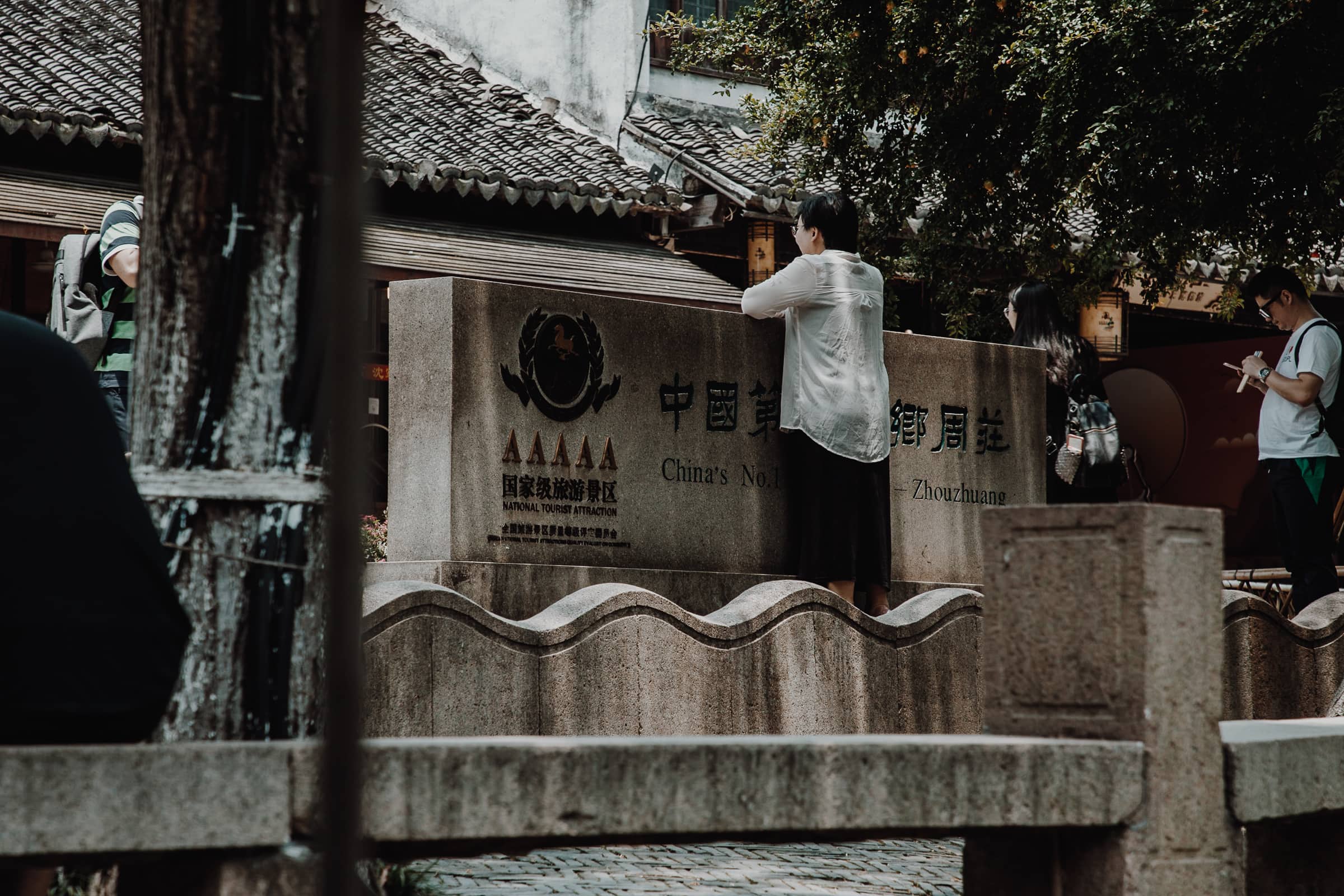
Zhouzhuang is located in eastern China and modestly calls itself China’s number one water city. Not far from Shanghai and Suzhou, Zhouzhuang is a popular excursion destination: with its many canals and waterways as well as a pretty little old town, Zhouzhuang (pronounced: chuu-chuang) is definitely worth a visit. The small water town is considered one of the cultural centers of the region and offers not only Chinese tourists but also foreign visitors like me fascinating insights into China’s extensive culture and history.
Zhouzhuang: Back to ancient China
The term China’s number one water city is no coincidence: in 1985, the two now best-known Zhouzhuang bridges adorned the first issue of the United Nations stamp. Shuangqiao (key bridges) is the name given to the two bridges standing at right angles to each other because they look like a Chinese key. Chen Yifei, a Chinese artist, was exhibiting in a gallery in New York at the time, including a painting of the same key bridges. In short, the paintings were a success, the bridges made it onto the stamp, the stamp into the world and Zhouzhuang (and China’s water towns) onto the international stage.
Popular motif: the two key bridges directly at the main entrance to the number one water city: Zhouzhang.
But Zhouzhuang has been around for much longer, of course – just like Suzhou Zhouzhuang can look back on over 2000 years of history. Like the entire region, the city experienced its heyday during the Ming dynasty and some remnants of this can still be admired in the city today.
Boat trip in Zhouzhuang: China’s romantic waterways
Don’t miss out on a boat trip on the numerous small wooden boats that sail along the small canals. The tour starts collectively at a departure point, where tickets are purchased at the same time. A 20-minute trip costs 150 yuan per boat, and up to 6 people can go on it. The trip was a bit short for my taste, but that could also be because it was just too nice to glide through the atmospheric canals on this traditional wooden boat! On request (and a small tip), the boatwomen will also sing classical Chinese folk songs – it doesn’t get much more idyllic than that.
Female power: gondoliers in Zhouzhuang are also female.
Places of interest in Zhouzhuang: Shen House
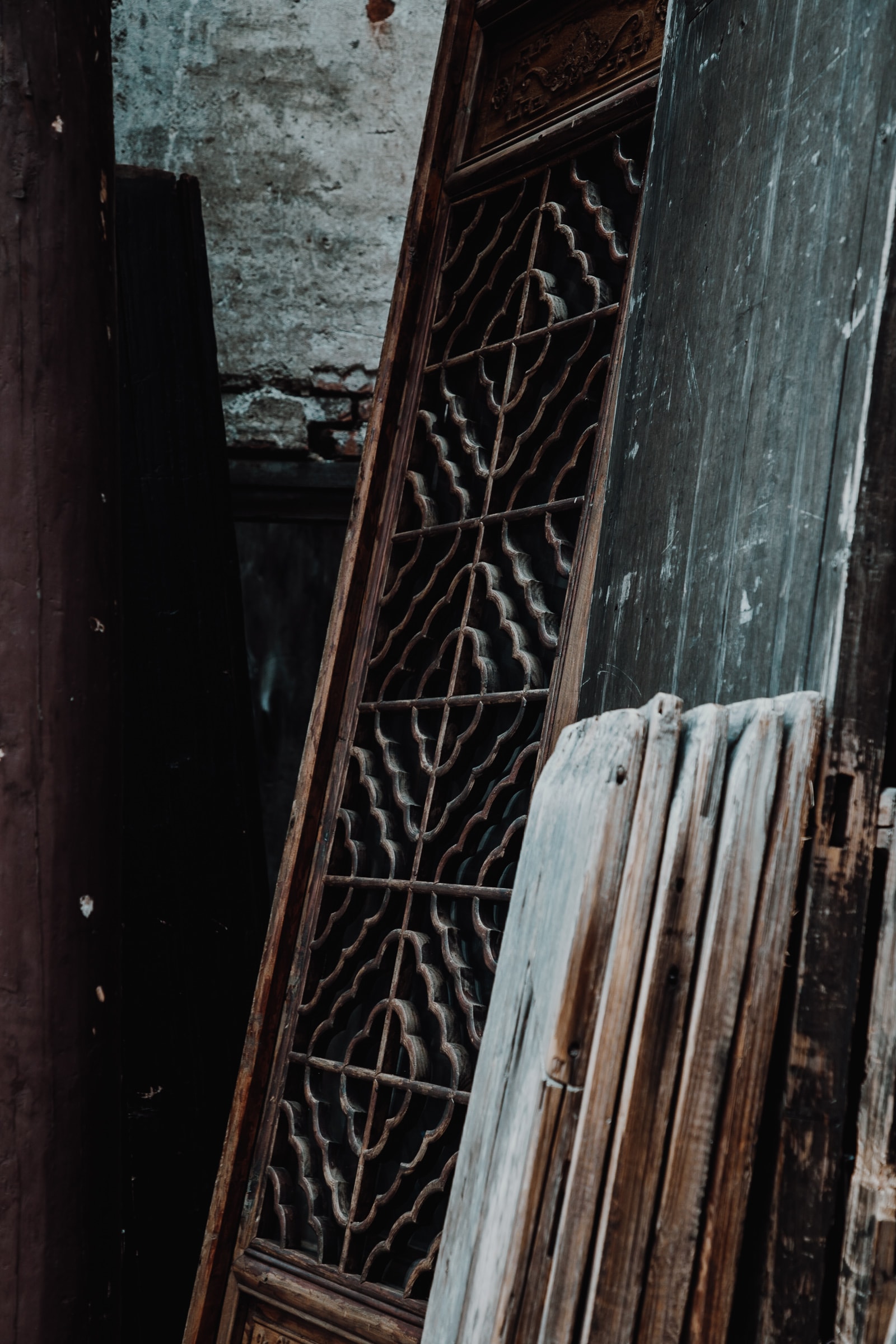
One of the main attractions in Zhouzhuang is the Shen House. Shen Wansan was a wealthy businessman who left his mark on Zhouzhuang – and he was so rich that even his descendants benefited from it for a long time. In 1742, they built Shen House – and “house” is a slight understatement! The entrance to the building, inconspicuous from the outside, leads into a complex with over 100(!) rooms that extends over 6 blocks. I could have spent hours wandering through the many detailed rooms and courtyards: The Shen House is an absolute experience, you immediately feel transported back to ancient China.
Proud tourists in Shen House: Zhouzhuang is one of the most famous water towns in the whole of China.
Would you like to spend the night in a traditional Chinese house? Right in the heart of Zhouzhuang’s Old Town, there are great places to stay like this one: Click here for more info*
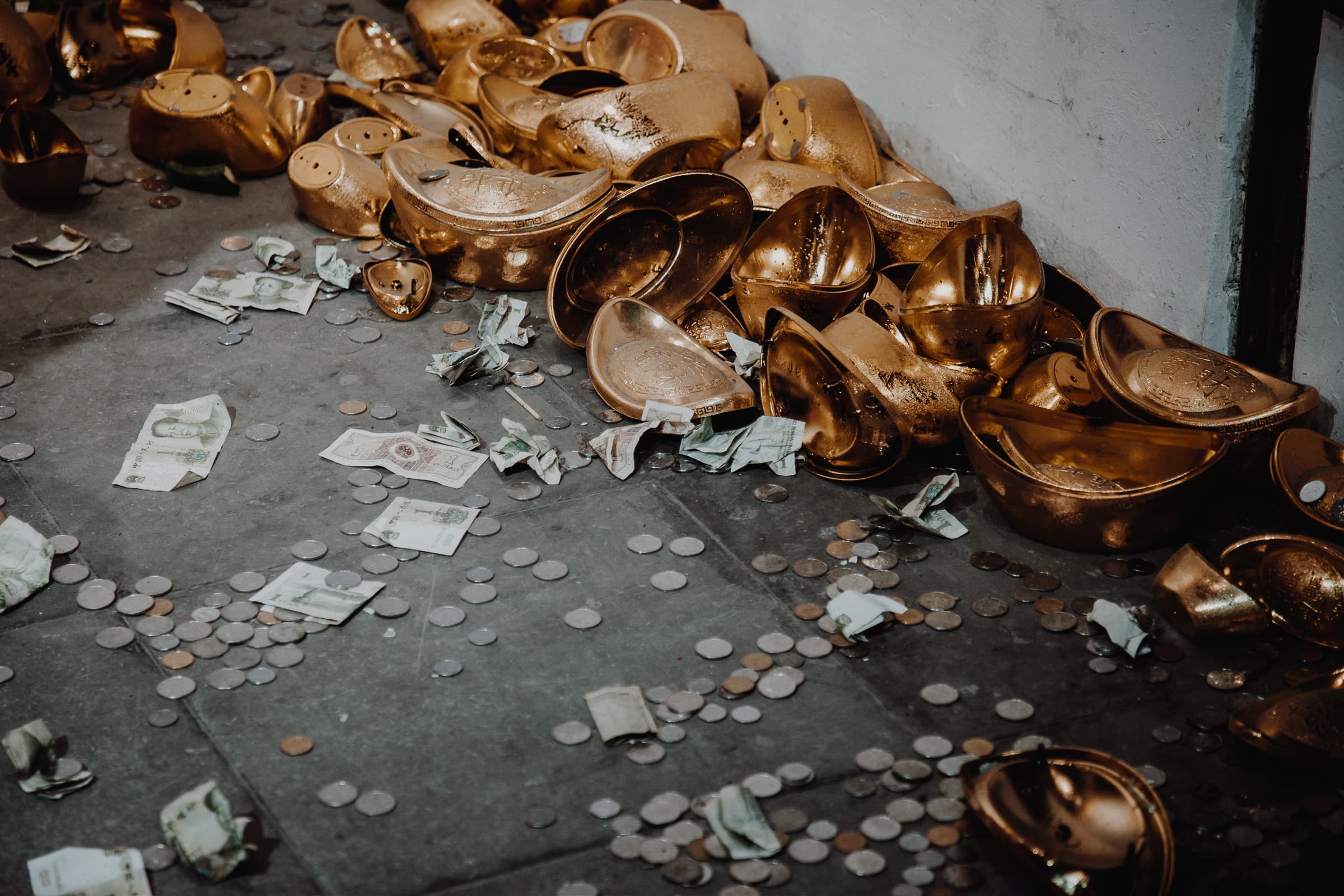
There is a golden Buddha in one of the many rooms of the Shen House – placing money under the Buddha is said to bring good luck.
Quang Fu Temple: relaxation from sightseeing
There is also a huge temple complex in the middle of Zhouzhang. If the narrow streets of the old town have become too narrow and you need some space, you should definitely take a short break around the Buddhist Quang Fu Temple in Zhouzhuang. The temple is located in the huge Nanhu Garden and the grounds are a great contrast to the bustling old town. Zhouzhuang is a popular destination for Chinese tourists – and not without reason, as it is beautiful! It can sometimes get crowded and a little more air is not a bad thing, especially in hot tropical temperatures.
The Nanhu Garden is located around the Quanfu Temple.
The old town of Zhouzhuang: stroll, store, enjoy
Zhouzhuang is not only steeped in history, the small alleyways are also great for a stroll. There is certainly a lot of tourist kitsch, but for me as a European, everything here is so exotic that I can even enjoy the banal trinkets. The small souvenir stores blend in surprisingly harmoniously with the historic streets, so that I was once again amazed at how well cultural assets are maintained here in the region – despite the hordes of tourists. You can even still find real street life, and the best moments can be captured in the small side streets.
Local life in the side streets.Stores are still traditionally closed with large wooden boards after closing time.Tea store in the old town of Zhouzhang.I completely forgot what it was because of all the exotic food. Even the vegetables are prettier in Zhouzhuang.
How to get to Zhouzhuang
Visiting Zhouzhang is surprisingly well regulated: Access is limited! There is a huge parking lot for cars and coaches, with a large visitor center where you can also buy tickets. That’s right: Zhouzhang charges admission. What has long been discussed in crowded tourist attractions such as Venice and is now slowly gaining acceptance there at least, is simply done in Zhouzhang. Once again, I was struck by the well thought-out management of tourist flows and sophisticated infrastructure.
However, so much organization is probably necessary, as we were advised not to come to Zhouzhuang during Golden Week. Golden Week is the name given to three different weeks in China: The Chinese New Year or Spring Festival (January or February), the week around May 1st (Labor Day Golden Week) and the week around October 1st (National Day Golden Week). Then Zhouzhuang, like many other popular destinations in China, will be bursting at the seams.
Zhouzhang is only about 30 kilometers away from Suzhou, which I also liked very much. But Zhouzhuang is also easily accessible from Shanghai by public transport or with tour operators.
In Nuremberg, I didn’t have time for sights like the Kaiserburg – because I got lost in the picturesque old town. It is also a sight in itself! I haven’t been there for years – and somehow not much has changed: I still quite like the city. And since I’ve decided to share more of my travels (business and private) here, I’ll start with my very personal Nuremberg sights!
I discovered this beautiful little corner not far from our hotel by chance. It’s funny how you can be in a city so often and simply overlook the most obvious spots. The Handwerkerhof is not particularly large. In the 1970s, small half-timbered houses were built in a small courtyard area next to the original town wall and turned into a small tourist attraction. Sounds like a tourist trap, and it kind of is – but it’s also super cute and cozy! (And it also looks very authentic: If I hadn’t found out afterwards that the half-timbered houses had been rebuilt – I would never have guessed!)
The Handwerkerhof in Nuremberg: Favorite place.
Food: The famous Nürnberger Rostbratwürstchen
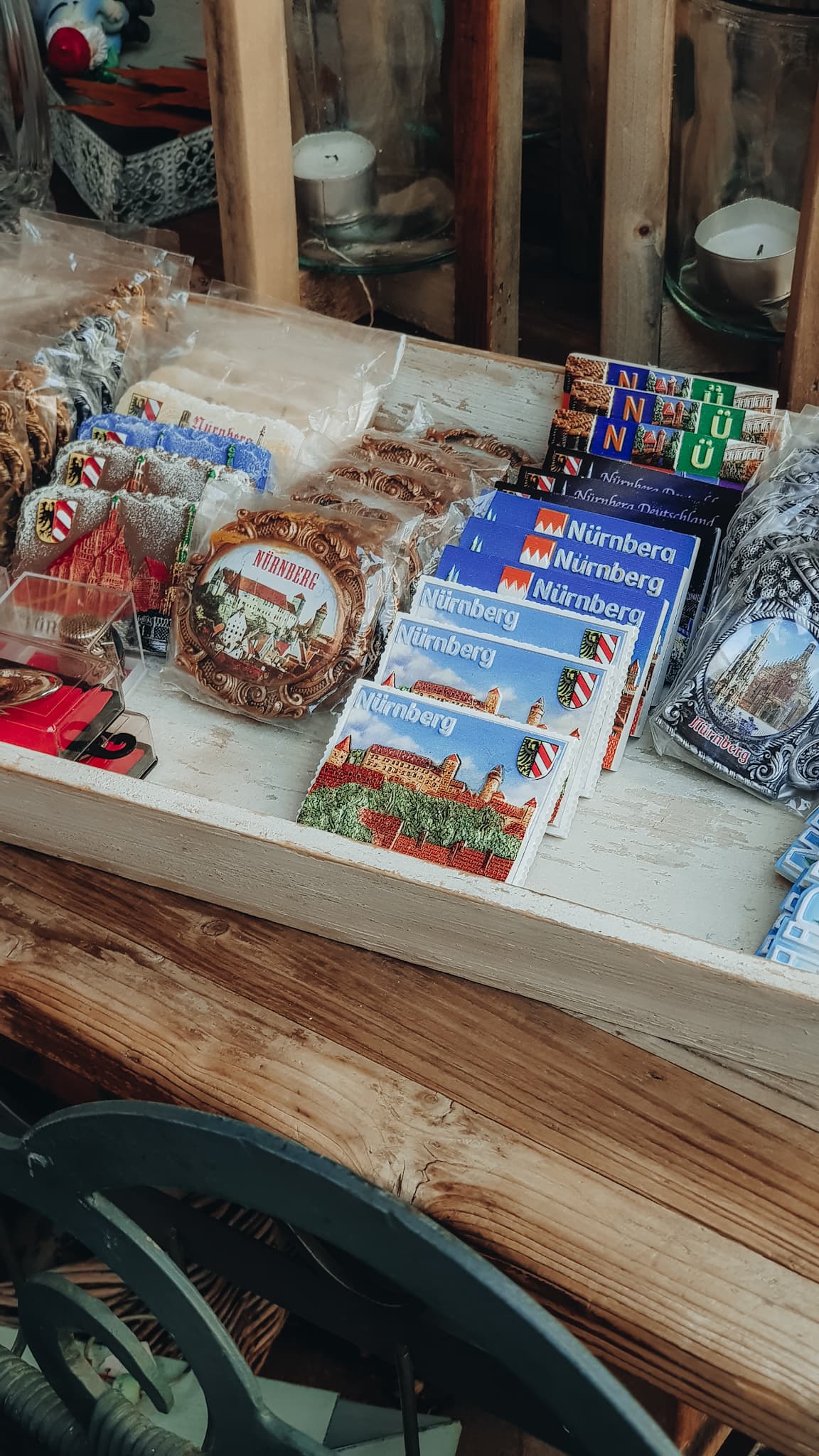
There are a few small stores with arts and crafts, workshops and studios in the Handwerkerhof. And really, really cozy pubs! In the middle of the city center, you immediately feel a rustic medieval flair. And in the Bratwurstglöcklein you can get the most delicious grilled sausages in a bell-shaped plate ever! A little overpriced, of course – but the ambience and sausages are worth it.
Art in the Neues Museum Nuremberg
Nuremberg also has some interesting museums, and although this is something I’d rather do in the colder winter months, I decided to take an arty detour. Mainly because I had seen that the exhibition at the Neues Museum in Nuremberg also included paintings by Gerhard Richter – who I really like. But the permanent and temporary exhibitions at the Neues Museum are also well worth seeing if you like modern art and design. The architecture of the Neues Museum alone, with its huge white spiral staircase, is impressive!
Impressive: Gerhard Richter at the Neues Museum Nuremberg.
Art in Nuremberg: More museums in Nuremberg
If you are more interested in the Middle Ages and the history of Nuremberg, the Germanisches Nationalmuseum is the place to go.
Otherwise, a visit to the following museums in Nuremberg is also worthwhile, depending on your interests:
Nuremberg and its past: Nuremberg Nazi Party Rally Grounds and Documentation Center
Nuremberg not only played an important role in the Middle Ages as a trading center and center of craftsmanship – unfortunately, Nuremberg was also the scene of events during the Nazi era. From 1933 to 1938, the National Socialists held their annual Reich Party Rally here on a huge site. It’s scary how many people allowed themselves to be mobilized back then and marched and waved flags at these events, which were staged like folk festivals.
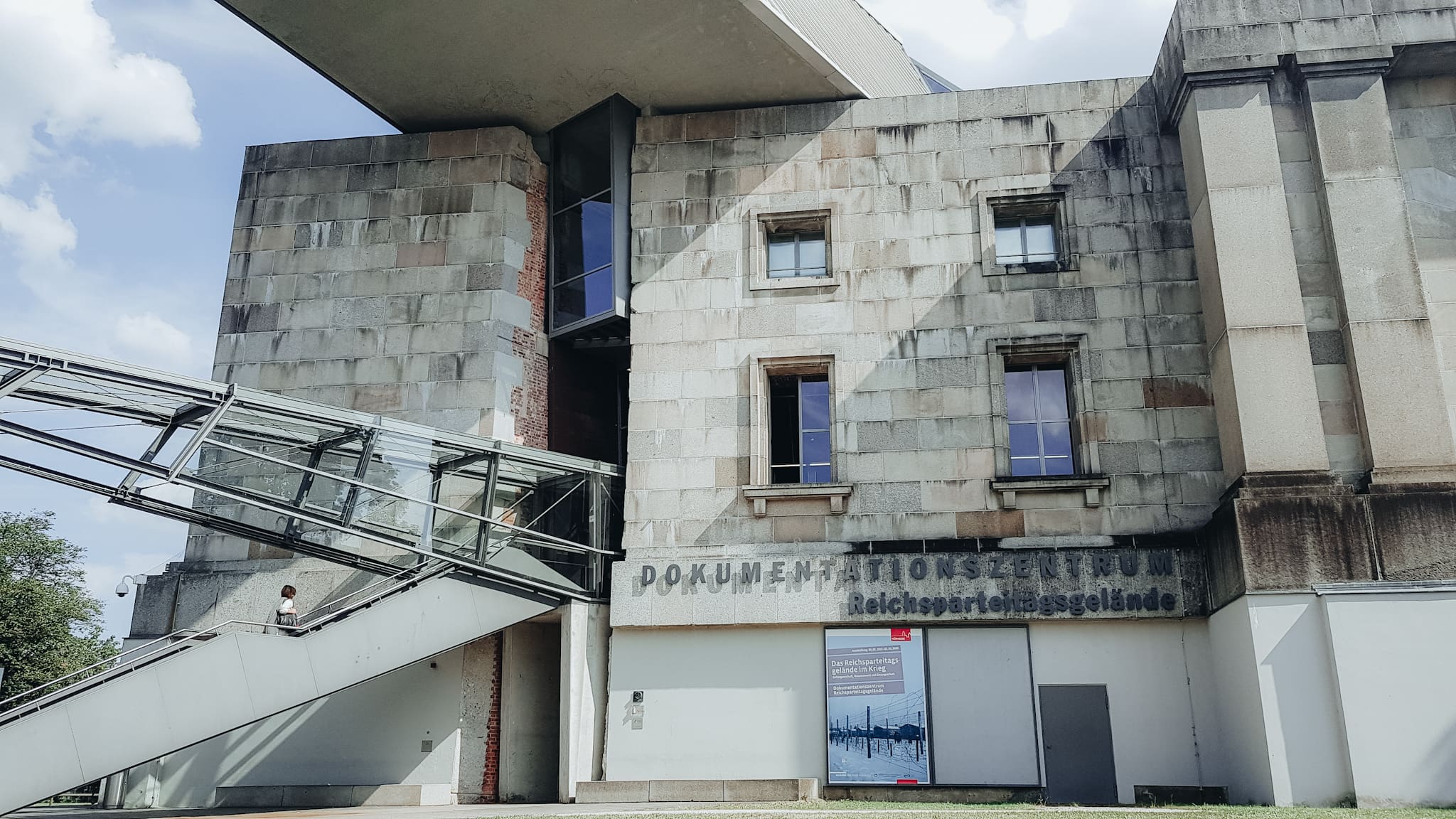
Oppressive exhibition at the Documentation Center Nazi Party Rally Grounds.
The former Congress Hall, which was never completed, is now home to the Reichsparteigelände Documentation Center, which not only covers Nuremberg and the Nazi Party Rallies, but also contains a very good exhibition on the entire National Socialist era. You should definitely watch the film at the end of the exhibition, in which contemporary witnesses from Nuremberg talk about how they experienced this time in the city. Not a light subject – but it is always important to remember this dark chapter of German history so that something similar never happens again!
Converted into the Documentation Center Nazi Party Rally Grounds: the former Congress Hall.The Documentation Center Nazi Party Rally Grounds is located in the old Congress Hall, which was never completed.
Near the documentation center you’ll find the Zeppelin field with the associated Zeppelin main grandstand, which can also be visited, as well as the Große Straße, the central axis of the site. The area is very extensive, so you should bring time with you to take in the oppressive history of the place.
After the end of the Second World War, the Nuremberg Trials, in which leading National Socialists were put on trial, also took place in Nuremberg. The jury courtroom can be visited on trial-free days (usually Friday to Monday) together with the permanent exhibition “Memorium Nuremberg Trials” in the Nuremberg Palace of Justice.
I hope to come back to Nuremberg in the near future, there is so much more to discover! (Not to mention the romantic Christmas market in December!)
***
You can also find more inspiration for short trips within Germany here:
Suzhou in eastern China, very close to Shanghai, is known for its picturesque gardens and picturesque old town with its many waterways. Suzhou is over 2500 years old and is known throughout the country as a place of poets and thinkers. But above all, Suzhou is one thing for me on this China trip: quite a surprise. I’ll tell you here which great sights in Suzhou are waiting for you!
Many houses along the canals in Suzhou are decorated with red lanterns: pure China.
The most beautiful sights in Suzhou
Because of its many small canals that run through the rather large old town center, Suzhou is also often and gladly referred to as the Venice of the East. And I shudder at this expression at the latest.
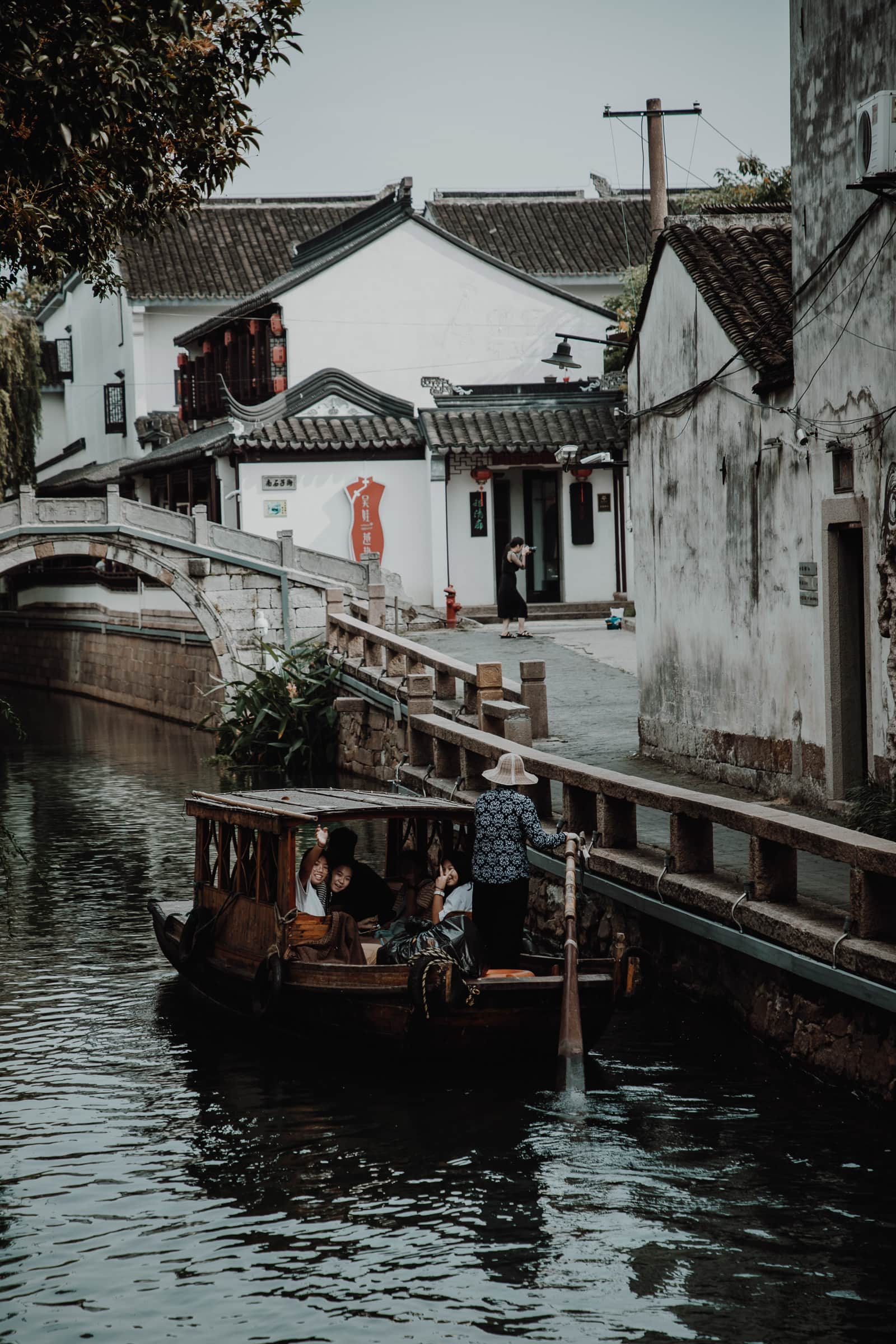
Suzhou: A boat trip through the romantic canals is a must.
Tip: In Suzhou you will find numerous large hotels of western chains with corresponding comfort. Unfortunately, these are often housed in uninspired high-rises or large complexes. For an authentic atmosphere, it’s best to look for accommodation near the old town, such as the Garden Hotel*.
“Venice of…” (as well as “Mecca of…” and “Paris of…”) – as an author or copywriter, you only ever write this when you really can’t think of any better comparisons. The main thing is a few boats, a few canals, and the analogy with Venice can be formed. As with the waterways in Suzhou in the Yangtze River Delta in eastern China near Shanghai.
All Venice, although nothing really compares to Venice, not even Suzhou. But anyone who has been there will wonder why Suzhou needs any comparison at all – because Suzhou is a true gold treasure.
By the way, Suzhou is easy to reach from Shanghai. And you don’t even need a visa for China. The trick: German citizens can enter China without a visa for stays of less than 72 hours in Shanghai and the surrounding area. And from Shanghai, you can reach Suzhou and the surrounding water towns worth seeing, such as Zhouzhuang and Tongli, in no time at all.
The nearby water town of Zhouzhuang is also well worth seeing. Read more in this article:
Suzhou and its gardens: The garden of the humble official
The garden of the humble official has a rather misleading name. Modesty is the last thing that comes to mind when you see what is probably the most famous garden in Suzhou. The garden is actually a huge park with secluded pavilions and thoughtfully landscaped lakes and trees.
One of the most popular gardens in Suzhou: the garden of the humble official.
According to Chinese horticulture, the main focus is not so much on flowers and colors, but on the harmonious interaction of the so-called “seven elements”: earth, sky, water, stones, buildings, living creatures and plants, although here rather trees and green plants are meant.
Otherwise, just a lot of green: lotus blossoms are among the few splashes of color in the garden of this modest official in Suzhou.
And it soon becomes clear how harmonious the garden of the modest civil servant is: although hopelessly overrun by tourists, an aura of peace and relaxation nevertheless shines over the garden. Very impressive. In many corners you can meet painters and draftsmen who give free rein to their creativity and are inspired by the atmosphere of the garden. I was briefly annoyed that I didn’t have my watercolor stuff with me – I would have loved to just sit next to it and paint along. But there was much more to see in Suzhou anyway, that time was short anyway.
Painters and draftsmen like to be inspired in the garden of the modest official.
How much history there is in Suzhou can also be seen here: For almost 900 years, a garden has existed on this site, which passed through many hands until a high-ranking official chose it as his retirement home in the 16th century and gave the garden its name. Today, the garden of the humble official is state-owned, a UNESCO World Heritage Site and one of the most beautiful gardens in China.
The garden of the humble official in Suzhou is also a real Instagram hotspot: Very instagrammable!
Shantang Street: Immersion in Ancient China
With temperatures around 35 degrees (yes, it can get very, very hot!) and what feels like 100 percent humidity, a boat trip is always a welcome change, especially in Suzhou with its picturesque canals. Clotheslines fluttering in the wind, children waving enthusiastically at the foreign tourists (as a Western visitor in Suzhou you are still something special) or sneak peeks into foreign kitchens: My eyes did not even know where to look first.
Suzhou’s canals can also be explored by boat.Some bridges are particularly ornate in the old city of Suzhou.Concentrated, our captain steers the boat through the canals of Suzhou.
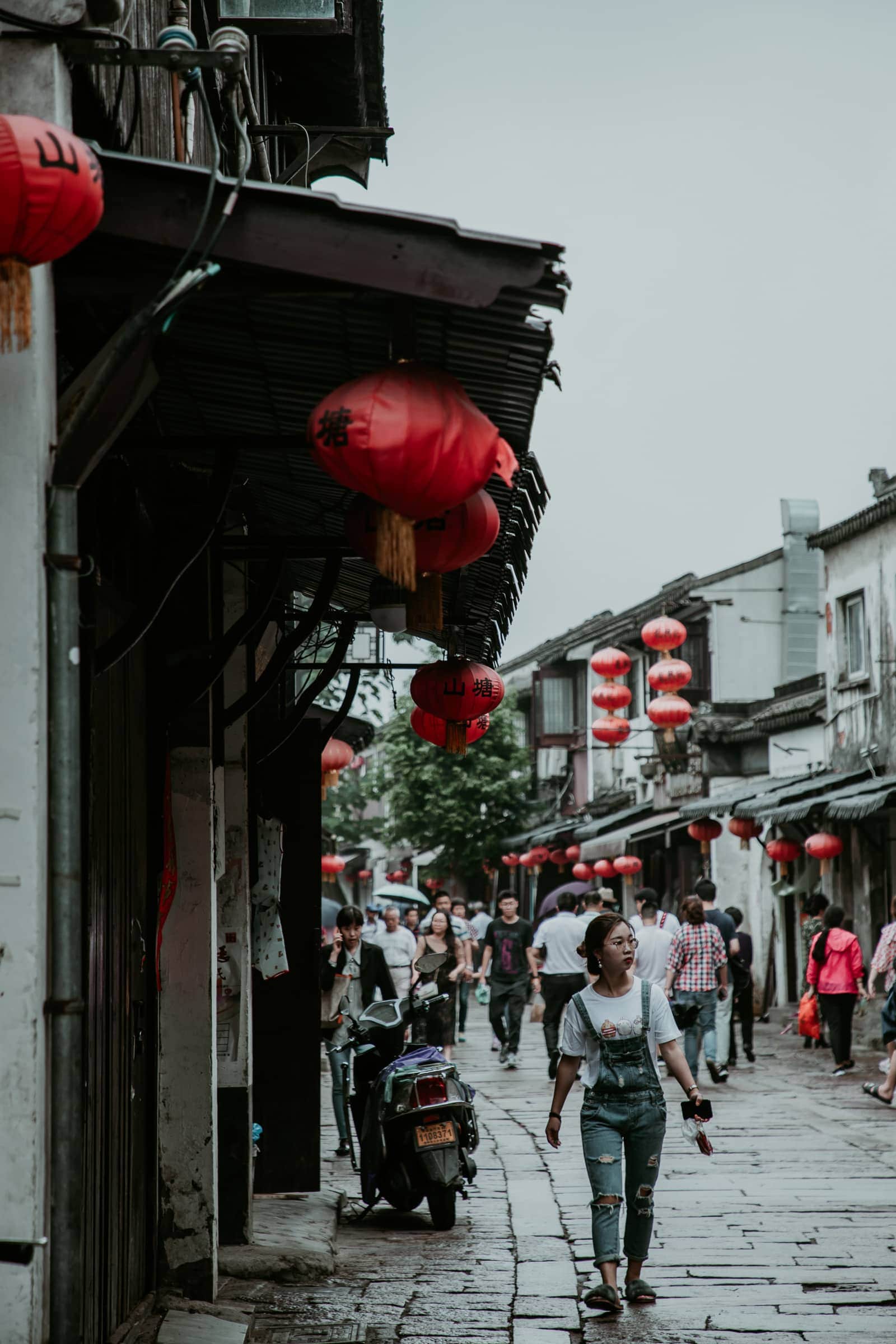
Even on foot, Shantang Street (Shāntáng Jiē) was the China I was looking for: red lanterns, small houses with old wooden beams – and relaxed, friendly faces everywhere. On 7 miles you can find everything at once: tourist stuff, culture, history, snack bars and cafes with all kinds of exotic delicacies and actually real street life. If you turn into the more deserted alleys, you will quickly find yourself in local hustle and bustle, without any touristy stuff. A real experience.
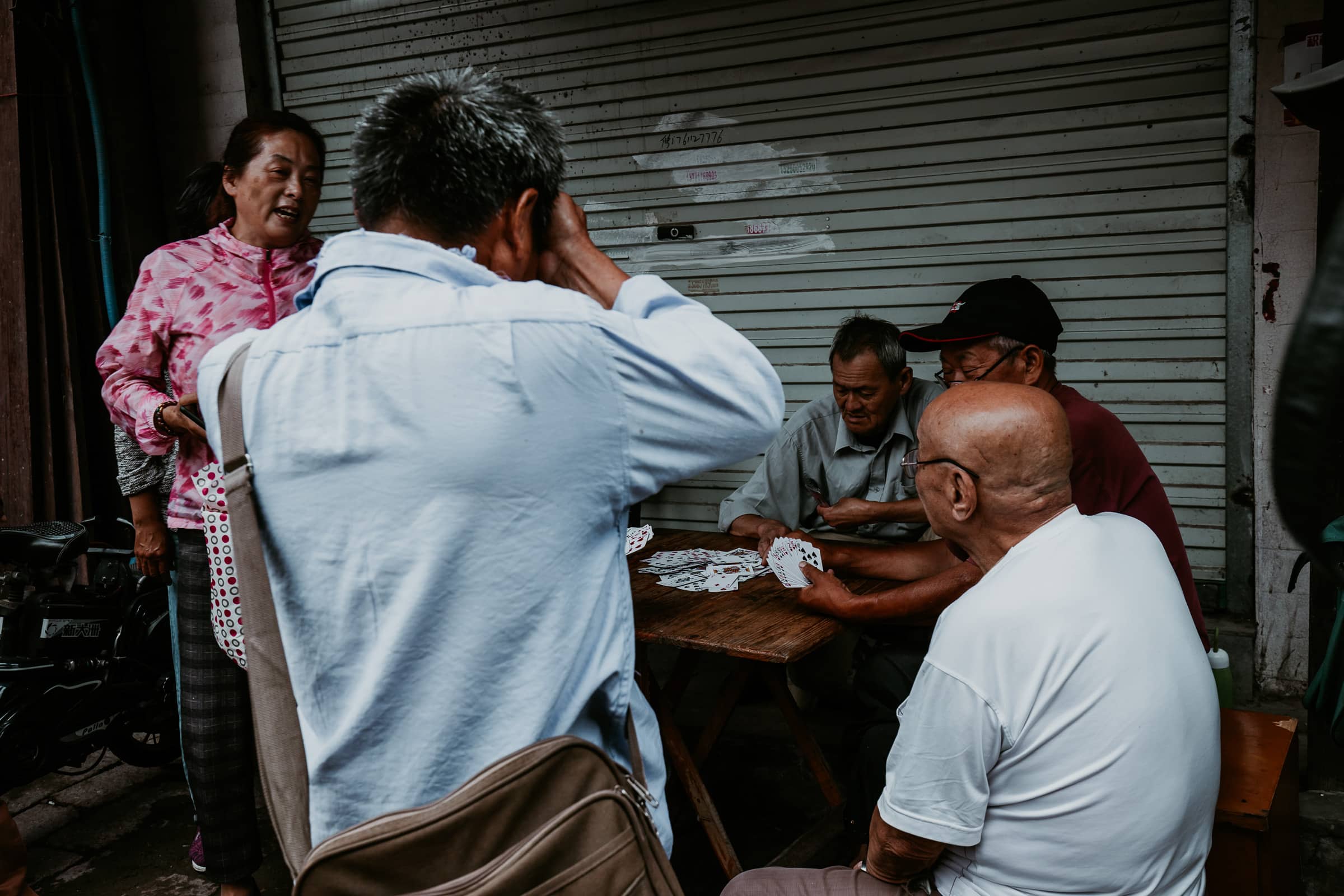
Shopping mile: Shantang Street in Suzhou.Colorful souvenirs in the tourist part of Shantang Street.In the middle of the street: Concentrated card game.
Street Food in Suzhou: No inhibitions, it’s worth trying!Fruit and vegetable vendors can also be found on Shantang Street.In the side streets of Shantang Street you can find authentic everyday life: a small cookshop is cooking breadcrumbs.
Pingjiang Road: tea houses, canal boats and nightlife
Even more authentic Chinese flair can be found on Pingjiang Road (Píngjiāng Lù), similar to Shantang Street a street with many stores and restaurants. Here it is even a little bit more cozy than on Shantang Street. The boats are smaller, the bridges even a little prettier.
Happy tourists on Pingjiang Road: a boat trip here is even more idyllic.
My highlight was the tea house, a small café by the canal, more wooden shack than house, where we listened to 80 year old(!) Mr. Wang playing original Pingtan music to us over a cup of tea. It could hardly get more Chinese! By the way, Pingjiang Road is also very busy in the evening and a nice nightlife spot in Suzhou.
Unusual creations: The many small cafés along Pingjiang Road serve the most curious drinks.
Suzhou Opera in the Garden of the Master of the Nets
In general, music, like all other arts, plays a major role in Suzhou. Somehow creativity and appreciation of art and culture are in the air here, so I wasn’t surprised to learn that Suzhou is considered a “very elegant” city in China. Found it apt – and I never thought before that I could find a place in China elegant. For me, China was big, crowded and rough at times – but this trip showed me once again how unfair prejudices can be. Suddenly China was small, picturesque and warm (oh, the people!).
I would even recommend an evening at the opera to anyone here, even if you are one of those people for whom operas are more likely to trigger flight impulses. Or where else do you watch an opera in one of the most beautiful gardens?
Colorfully illuminated at night: The garden of the Master of Nets in Suzhou.
In the garden of the Master of the Nets there is a performance of a Kunqu opera every evening. The opera consists of several parts: Comedy, song, music and dance. The special thing: Each part is performed in a different place within the garden, so you walk along the garden between each performance.
The performance in the garden of the Master of Nets consists of several parts: Drama, song, dance, music.
Real Chinese Silk: A Visit to the Silk Factory
Suzhou is famous for its silk – and the region has always formed one end of the Silk Road, from where the beautiful fabric found its way to the world. The silk factory, modestly named No.1, is therefore on the agenda of many tours of Suzhou. You should think about this carefully beforehand – because what many people don’t consider is that here you can observe the production process (at least part of it). That also means watching caterpillars crawl. And later it becomes even less something for the faint of heart, because the silk thread is obtained from the cocoon of silkworms. In order not to damage it, the cocoons including caterpillars are thrown into boiling water. Not for everybody.
Nicely draped in a basket: silkworms for silk production.From caterpillars to cocoons: the next phase of silk production at the silk factory in Suzhou.The cocoons later become silk.
Personally, I have an affinity for fabrics anyway (I actually used to have a fabric store in Berlin) and silk anyway (I always like to block out the boiled caterpillar part), so I found the visit interesting in itself. Unfortunately, the production process is shown only abbreviated (there is no weaving or dyeing here), and shortly after watching the spinning of the threads, you will find yourself standing in a huge sales hall with clothing made of silk for (almost) every taste. I didn’t like the clothes that much, but I was a bit sad afterwards not to have bought some fabric. So for all people who love to sew: In Suzhou, do not forget to buy silk!
On this machine the silk threads are spun.
The Suzhou Museum
The Suzhou Museum is particularly striking because of its architecture – somehow angular and not at all traditional Chinese. It was designed by Chinese star architect Ieoh Ming Pei, who also planned the famous glass pyramid in the courtyard of the Louvre in Paris and the Museum of Islamic Art in Qatar – and he was born and raised in Suzhou.
Here you will find an overview of Suzhou’s long history in the form of works of art and artifacts, from calligraphy to porcelain to handicrafts. Worth seeing, but perhaps not necessarily interesting for everyone. But what is really fascinating is the way the mostly Chinese visitors interact with the exhibition: I have never seen so many young people in German museums who are so intensely interested in history and who press their noses against the display cases out of sheer thirst for knowledge.
Marvelled at: exhibits in the Suzhou Museum.
The modern part of Suzhou
Gate of the Orient & Jinji Lake
Outside the sprawling old city, Suzhou looks a bit more like how you’d imagine big Chinese cities to look. The city currently has over 10 million inhabitants and as well as Suzhou is developing, there is no end in sight. Large companies produce and conduct research here. The good transport links and proximity to Shanghai ensure that Suzhou is one of China’s up-and-coming cities. The spirit of optimism is also reflected in the bold architecture in the modern part: the landmark of the new Suzhou is the Gate of the Orient (Dongfang Zhimen) or Gate of the East, the second tallest skyscraper in Suzhou. Located on Lake Jinji, it is supposed to act as a gateway to the East – but locals affectionately nicknamed the building “the pants” due to its unusual shape.
Looks like a pair of pants: The Gate of the Orient in Suzhou.
Suzhou Supertower
The “pants” are topped by the Suzhou Supertower, 450 meters high – and that’s where it really starts to look futuristic. Every time we passed it, I could hardly believe that just a few kilometers away we were sailing on small wooden boats along romantic canals. The way the old and the futuristic are combined here is breathtaking.
Suzhou Industrial Park & Suzhou Culture and Arts Center
In the Suzhou Industrial Park there are further examples of modern Suzhou: The Suzhou Culture and Arts Centre is a gigantic cultural center with a (free) museum of modern art, various exhibition rooms, a musical theater and a small amusement park with a Ferris wheel, cafés and restaurants. In good weather, there is a fantastic view from here across Lake Jinji to the Suzhou skyline.
Shopping in Suzhou – shopping from silk to designer clothes
In Suzhou you can shop till you drop. I’ve long imposed a strict no-shopping policy on myself, which I usually stick to, because otherwise I’d be impoverished by now with all the traveling I do. My souvenirs are my photos – but in places like Suzhou, it’s pretty hard to contain yourself.
Popular souvenirs from Suzhou
Popular souvenirs from Suzhou are silk in all variations, green tea (Bi Leo Chun), fans in all shapes, and lots of handicrafts like embroidery and fruit core carvings. On Shantang Street and around Pingjiang Road there are also a lot of small stores selling pretty hip handicrafts – no more boring tourist stuff!
Tip for design lovers
I could have shopped myself to death in Chengpin Eslite, which is actually a huge bookshop. I have a thing for beautiful bookstores anyway, and this one is embedded in a state-of-the-art shopping center with countless small designer stores. I’m usually put off by shopping malls, but the Eslite reminded me a lot of trendy temples like Terminal 21 in Bangkok! Between the stores, there are always small snack bars and cafés, so you can sample all the delicacies of the region here if you don’t dare try street food.
Not only a huge bookstore, but also a shopping center with many innovative designer stores: Chengpin Eslite.
Food & Drink in Suzhou
Exotic dishes: What is one in Suzhou?
Food in general can be quite exotic in China. And it has nothing whatsoever to do with the Chinese restaurant from the German provinces. Vegetarians often have a hard time, somewhere there is meat in it or seasoned with fish sauce. Meat eaters like me have to deal with the most off-the-wall dishes like duck tongues or braised offal. Basically, Western tourists are already careful not to offer the most unusual dishes, but due to communication difficulties, you should be prepared for anything.
Jiangsu cuisine
However, Jiangsu cuisine (the name of the province in which Suzhou is located) is so sophisticated and varied that I often wished I could jump over my shadow even more and try dishes such as pork snouts or chicken feet – but unfortunately I’m really mean about it, as they say here in the Ruhrpott. After all, if you’re going to eat meat, it’s only logical to use every piece of it. Especially the cuisine in Suzhou is a true paradise for gourmets!
Vegetarian cuisine
Vegetarians don’t have to starve though, there are plenty of exotic ingredients to try like water asparagus, lotus roots or purple sweet potatoes. Not everything is spicy, but a lot is greasy and due to the foreign spices and the different climate, one or the other stomach needs some time to get used to the new cuisine. However, I have tried so many new and delicious things in the whole days that I can not even remember everything!
Dishes are always shared, which means if you sit in a big group, you can try a lot more!
Specialties of Suzhou cuisine
Mandarin fish
Sooner or later you will get it served in Suzhou, this specially prepared fish is THE dish in Suzhou. The fish is completely deboned, cleverly draped in the shape of a squirrel and then deep fried. Finally, a sweet and sour sauce is added on top, which took sweet and sour to another level for me!
Suzhou noodles
Noodle soup is noodle soup you could say. But the fresh noodles at Zhuhongxing in homemade broth with tender beef were so divine that I still think about them sometimes. Tip: Don’t spend too long marveling at the food and enjoying it, because the noodles soak up so much broth in the bowl that the mountain of noodles gets bigger and bigger instead of smaller. The professional slurps quickly! (Don’t be afraid of table manners: Hanging over the bowl and slurping loudly is not seen as closely in China as it is here).
Tangbao
Dumplings in all varieties can not be missing! The Tangbao are again a special variety, filled with broth in addition to the mostly meat content. This is slurped out beforehand with a straw, similar to the xiaolongbao that exists in neighboring Shanghai.
Street food in Suzhou
Always dare to try street food! Sometimes it can also be surprising, like the particle on the right, which I bought in a bakery. It looked delicious, so hairy breaded – but what I imagined was sweet ended up being a breading of finely ground pork. Wasn’t mine – but I still like to try strange things. The dumplings, however, were divine!
Accommodation in Suzhou
Our accommodation in Suzhou could not have been better. Centrally located, equipped with all the bells and whistles like a pool and tennis court, and with a breakfast buffet to die for, the Garden Hotel* was perfect. The hotel consists of several smaller guest houses and two main houses, nestled – it couldn’t be more fitting in the City of Gardens – in a beautiful, tranquil garden setting. If you want to treat yourself and stay in Suzhou in style: Absolutely recommended!
In the middle of a garden and yet central: The Garden Hotel in Suzhou.
Travel & Getting around Suzhou: How to plan your trip!
Location & Arrival
Suzhou is located only 80 kilometers from Shanghai, and is directly on the express train line that runs from Shanghai to Beijing. So if you are in Shanghai for a few days, Suzhou is definitely a good choice for a multi-day trip: by train you can be in Suzhou within 90 minutes.
Shanghai is very beautiful, but I personally find Suzhou much more appealing from a historical and cultural point of view – and always only mega big cities can also be very exhausting. By the way, train travel in China is a thousand times more organized than I thought. However, there may be communication problems here as well, since English is not widely spoken.
It takes 10 minutes to get down to the tracks, the tickets are personalized and the identity is checked at the access control: In China, everything is in order when riding a train.
Individual travel vs. group travel
We were traveling in a small tour group. Although I usually travel independently in Asia and plan everything myself, I was glad to have a tour guide with us who could explain many things and translate when necessary. Precisely because the region around Suzhou is not yet particularly familiar with Western tourists, not much English is spoken and most attractions do not provide information in English, meaning that you would otherwise miss out on a lot of interesting information.
Individual travel modules instead of a complete round trip
Complete China tours are often very expensive, and honestly, you can book a flight to Shanghai and spend a few days there on your own. For more “exotic” destinations like Suzhou, however, you can book individual modules with China Tours, which I can really only recommend.
We wore out three guides during our trip through several places around Shanghai, all of whom were highly professional, even spoke very good German (!) and had absolutely in-depth knowledge on every topic. Especially with such a complex destination as China with so much culture and history, about which I admittedly didn’t know very much beforehand, professional guidance was worth its weight in gold.
Getting around in Suzhou
If you prefer to travel independently, you can cover longer distances in Suzhou by taxi or take one of the tourist bus routes. There are rental bikes in many places. The subway network is being expanded.
Is Suzhou worth visiting?
I really liked Suzhou and often wondered why it is almost unknown among Western tourists. Especially when you visit Shanghai, a trip (sporty people can do it in one day) to Suzhou is a must. Shanghai is fascinating, but I always missed a little patina there. A detour to Suzhou is a great way to complement this. Also, the city is much more relaxed and everywhere you are warmly welcomed as an exotic tourist from the West, which showed me again a whole new side of China.
Disclaimer: I was invited on this trip by the Tourist Offices of Suzhou and Nanjing and China Tours.
“You want to watch the sunrise in Masada see?” I didn’t want to miss a single highlight on my trip to Israel. “Don’t be surprised, the road there is completely unlit, but that’s okay. Just keep driving, even if it’s dark.” It’s a good thing that the nice receptionist in Arad gave me this tip when I asked her for directions to the Masada fortress in the Judean Desert. Otherwise I would probably have turned back immediately after the first signs warning of “extremely dangerous bends”. Driving all alone at half past four in the morning in the pitch dark along winding desert roads with not a soul around – that was an adventure.
The road from Arad to Masada: great views during the day, pitch black at night.
Sunrise in Masada: an experience for every trip to Israel
There are places in the world that are particularly famous for their spectacular sunrises or sunsets – and Masada in Israel is undoubtedly one of them. After the long drive through the middle of nowhere, I was skeptical whether the whole ordeal of getting up early would really be worth it. Especially as I was expecting busloads of tourists who were also heading for “Sunrise Masada”. But apart from a handful of rental cars parked in the parking lot, there were few tourists to be seen on the east side of the fortress.
From the fortress you can see far across the Dead Sea.
It already looked different at the top of the fortress, most of the visitors had probably taken the route via the other ascent on the west side. Nevertheless, the site was not overcrowded. An impressive silence fell over the area as everyone waited for the one moment when the sun slowly rose from behind the mountain range opposite, glowing bright red.
Incredibly beautiful: sunrise in Masada.
All around us was nothing but a barren desert mountain range, deep below us the Dead Sea, mirror-smooth and still – and suddenly everything was illuminated by the rising, warm sun: One of the most impressive moments of my trip to Israel!
Impressive lunar landscape: the Judean Desert by the Dead Sea.
History of Masada, Israel – Historical significance
The fortress of Masada has a turbulent history behind it. In 73/74 AD, during the Jewish War, the fortress was besieged by the Romans. As the capture by the Romans drew ever closer, over 900 inhabitants of the fortress killed themselves to avoid being taken prisoner by the Romans. Since then, Masada has been a symbol of Jewish aspirations for religious freedom and self-determination. Masada has been a UNESCO World Heritage Site since 2001.
Archaeological finds at Masada
Various parts of the fortress are still preserved and were made accessible as part of an archaeological excavation. Today, for example, you can see the remains of the huge storage rooms or the bathhouses. In addition, replicas show what King Herod ‘s residential palace must have looked like: Front Row on a slope! The inhospitable surroundings make you wonder once again how much effort it must have taken to build such a structure here on this mountain plateau under the conditions of the time.
Below: The foundations of the palace.Front Row and unobstructed view: King Herod’s palace with a view of the Dead Sea.
How do you get to Masada?
There are essentially two approaches to Masada, one from the west and one from the east. The route from the east seemed much more popular to me. There is also a cable car on this side that takes you up to the summit. At sunrise, however, you have to walk up the so-called Snake Path, which takes about 45 minutes. There will also be a visitor center with stores and a small museum on this site. This access road is closer to the Ein Gedi Oasis and the Dead Sea.
The Roman siege ramp before sunrise.
I came from the west side, the road from Arad is adventurous in the dark. But the way up to the fortress is shorter. The Roman siege ramp (yes, this access is that old!) is steep, but it only takes 15 minutes to get up to the fortress. On the way back to Arad, you have unforgettable views of the Judean Desert – and can pet cute camels on the way (warning: lots of heart-warming camel content to follow!), with which you can go on a desert tour. From Arad (the next town) Masada is signposted, so you just have to follow the road.
Excursions to Masada from Jerusalem and Tel Aviv
Masada is one of the most popular day trips from Jerusalem and Tel Aviv! You can book both daytime tours and sunset tours. There are also providers who combine a tour to Masada with a visit to the Dead Sea (also highly recommended!):
Basically, I wasn’t particularly fascinated by the archaeological excavation, and it also got hot quite quickly, so sun protection and headgear are recommended. After all, it is a mountain plateau in the middle of the desert and the sun shines mercilessly. I would therefore always recommend visiting at sunrise – it’s a truly unforgettable experience! You can find my tips for a great visit here:
If you’re traveling by rental car and don’t like getting up in the middle of the night like I do, you can look for accommodation nearby the night before. Then the alarm clock doesn’t ring quite so early. I picked up my rental car in Tel Aviv and then dropped it off at the airport for my return flight.
I spent the night in Arad at the Inbar Hotel*. Not a highlight, but decent – and contrary to the reviews I had skimmed beforehand, I was greeted warmly by the lovely receptionist, who provided me with lots of tips straight away. (Nice service is unfortunately not always a matter of course in Israel). Without being asked, we were given a plate of fruit in our room as a breakfast substitute.
If you would prefer to stay on the east side and access the fortress from there, perhaps because it is more on the way, there is the affordable HI Massada Hostel*, where many Masada visitors stay overnight.
***
You can also find out more about Israel in the following articles:


 Reading tip