Two cities that couldn’t be more different: While in Jerusalem the world’s religions watch over their heritage, in Tel Aviv life and love are celebrated. Israel is a country full of contradictions, often difficult and intense. A trip to Israel has to be well prepared! Here you will find a lot of information and first-hand experience.
The Dead Sea was one of my stops on my trip to Israel. After Jerusalem, Tel Aviv and Masada, Ein Bokek was my last stop of the Israel trip. Here you can find my tips for a visit to the Dead Sea in Israel!
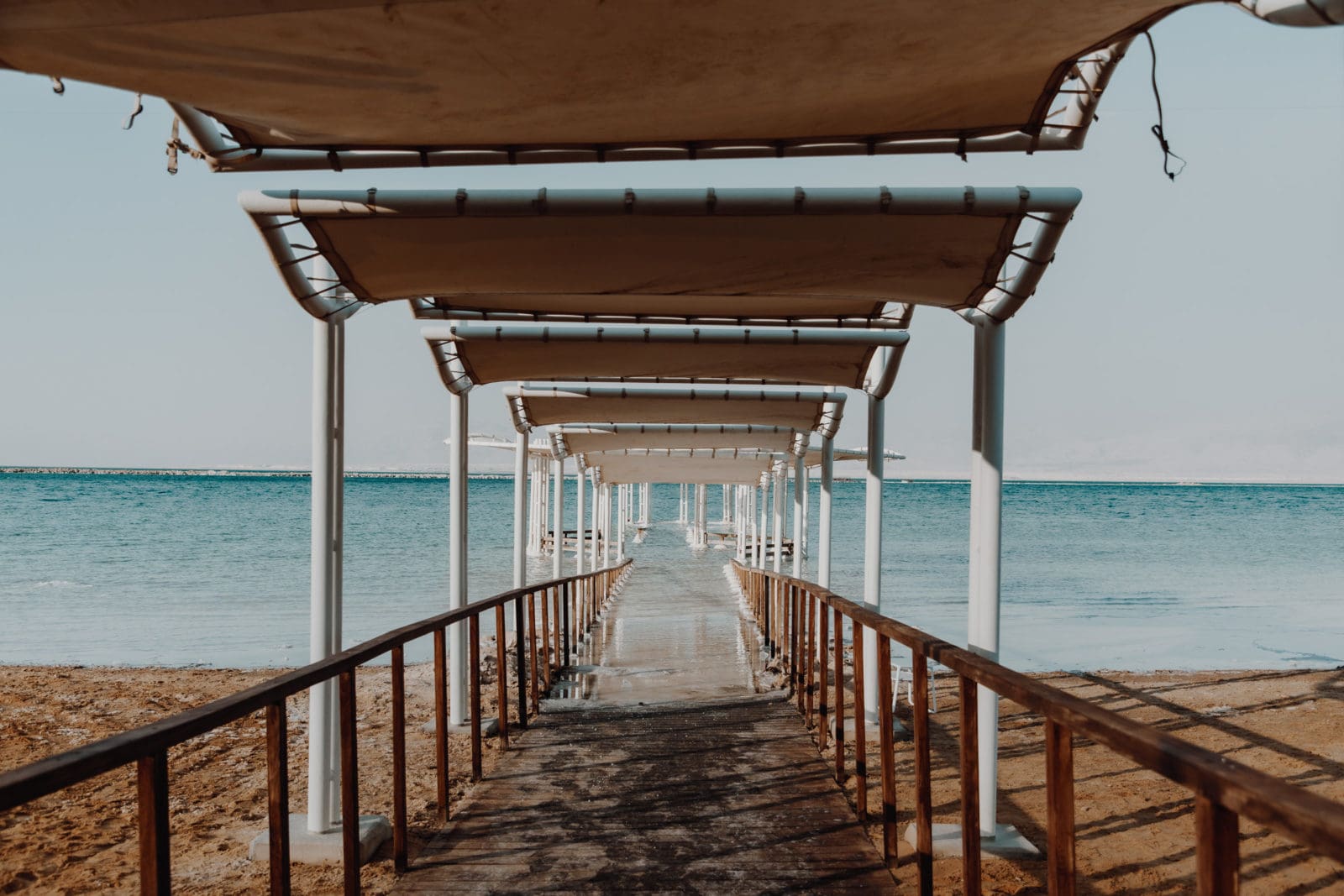
Already my arrival has been truly special. The Dead Sea is the deepest point on earth and it’s located in the middle of a desert landscape. Shimmering air over the asphalt announced that it wouldn’t be quite so cool outside my air-conditioned rental car. As if in an elongated valley, I slowly approached the Dead Sea, further and further down. The barren landscape and the great heat gives an idea why the Dead Sea is called Dead Sea.
The place Ein Bokek
It’s hot, there’s no a single soul on the streets, and although Ein Bokek seems like a place built exclusively for tourists, city life keeps to a minimum. The center of the village consists mostly of huge hotels, sometimes more, sometimes less chic. My accommodation is right on the beach with direct access, but actually, it doesn’t matter. All beaches are open to the public. I treated myself and stayed for two days with lots of relaxation, lying around on the beach and of course bathing in the Dead Sea. Although I’d rather call it floating than swimming.
Is it possible to swim in the Dead Sea? My test in Ein Bokek
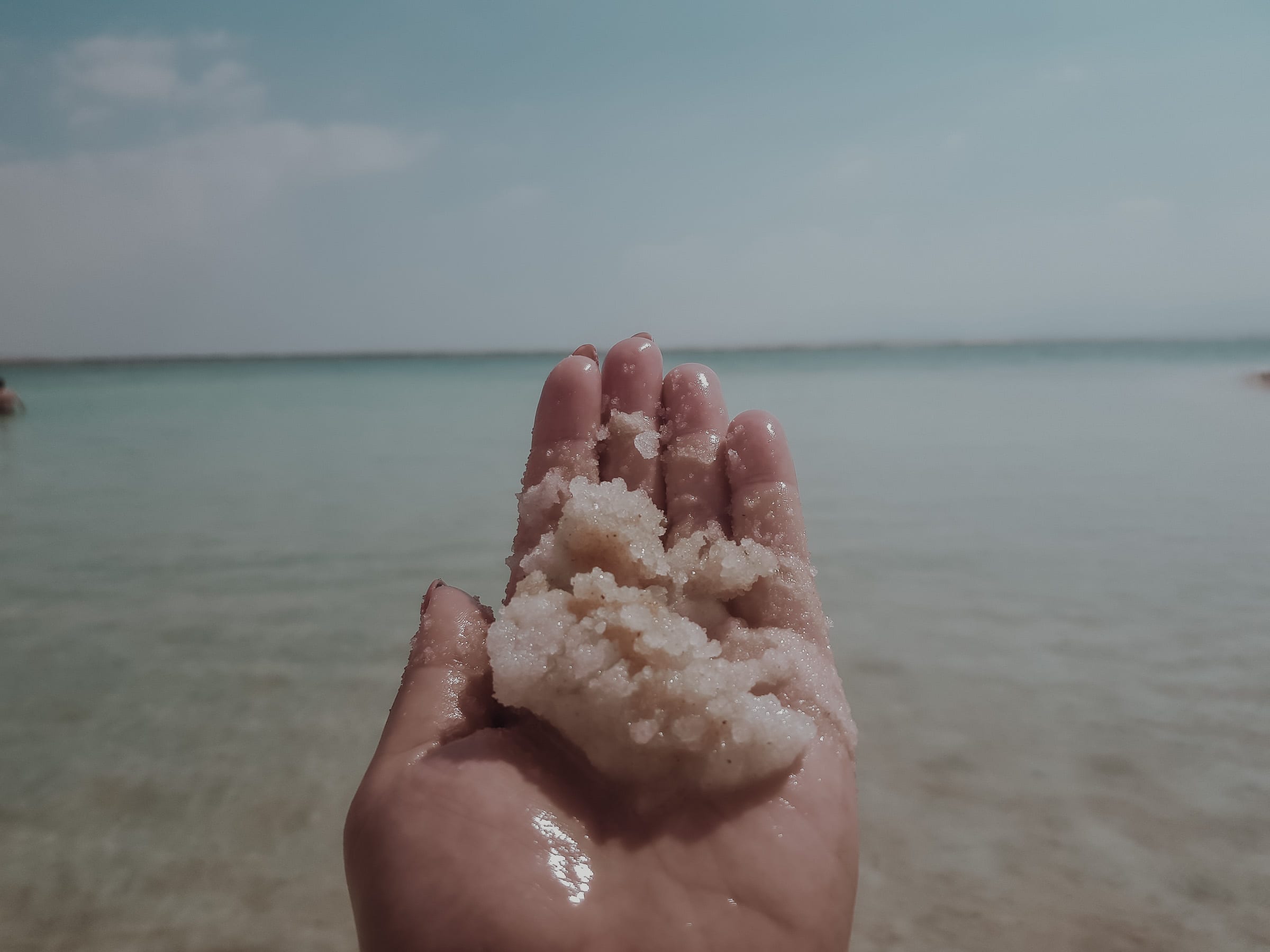
Bathing in the Dead Sea is not as easy as it sounds. You’ll be more floating than swimming! You’ve probably seen those pictures of people floating in the turquoise waters of the Dead Sea while reading a newspaper. The Dead Sea is actually a salt lake and extremely salty, with one part salt for every two parts of water.
This makes swimming in the Dead Sea almost impossible, because even a tiny hint of a splash in the eye can have nasty consequences. No comparison to conventional seawater. Curious as I am, and defying all warnings, I minimally touched my skin with the tip of my tongue, and I had the caustic, poisonous taste on my tongue for hours. Don’t try it yourself! In general, there are more accidents in the Dead Sea than you might think: Swallowed water can even lead to chemical burns.
Dead Sea Mud, Bath Salts & Masks: The Beauty Hype
After tasting the water, I was questioning myself: This water is supposed to be healthy? Many tourists travel to the Dead Sea precisely because of the health aspects: for skin diseases such as neurodermatitis, the water of the Dead Sea with its many minerals is a real blessing. The Dead Sea itself is so inhospitable due to the salt content that only very few organisms survive in it, plants and animals are searched for in vain.
Except for stubborn little miniature flies, which can ruin all the fun of swimming because they prefer to pick at human skin. They do not leave stings, but a stay at the water is still unpleasant. Also the sharp-edged salt crusts are not always pleasant when you’re barefoot. Therefore, you have to be very careful at bathing places outside hotel environments like Ein Bokek. Most people then find relaxation rather at the hotel pools, which are filled with conventional chlorinated water.
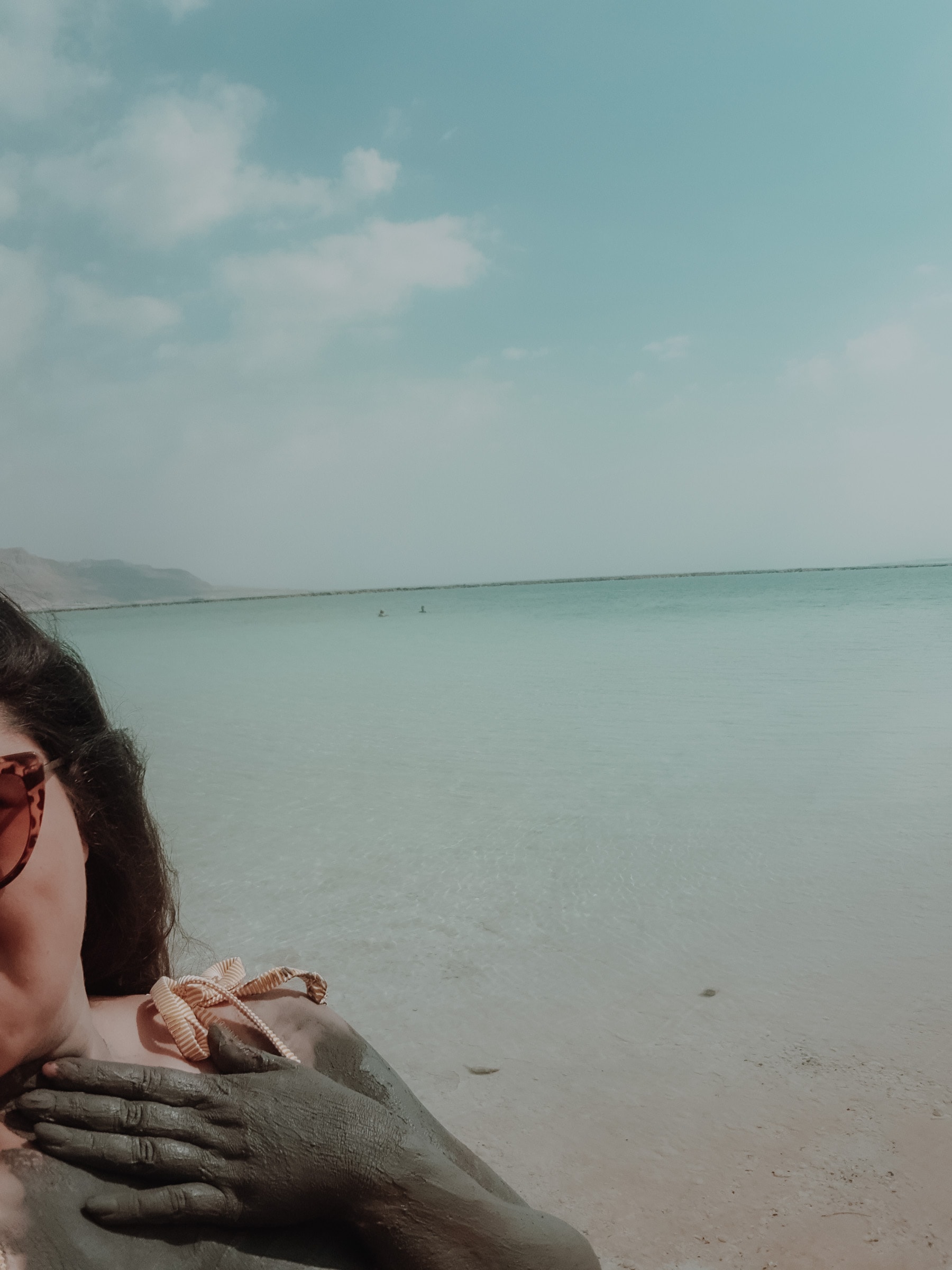
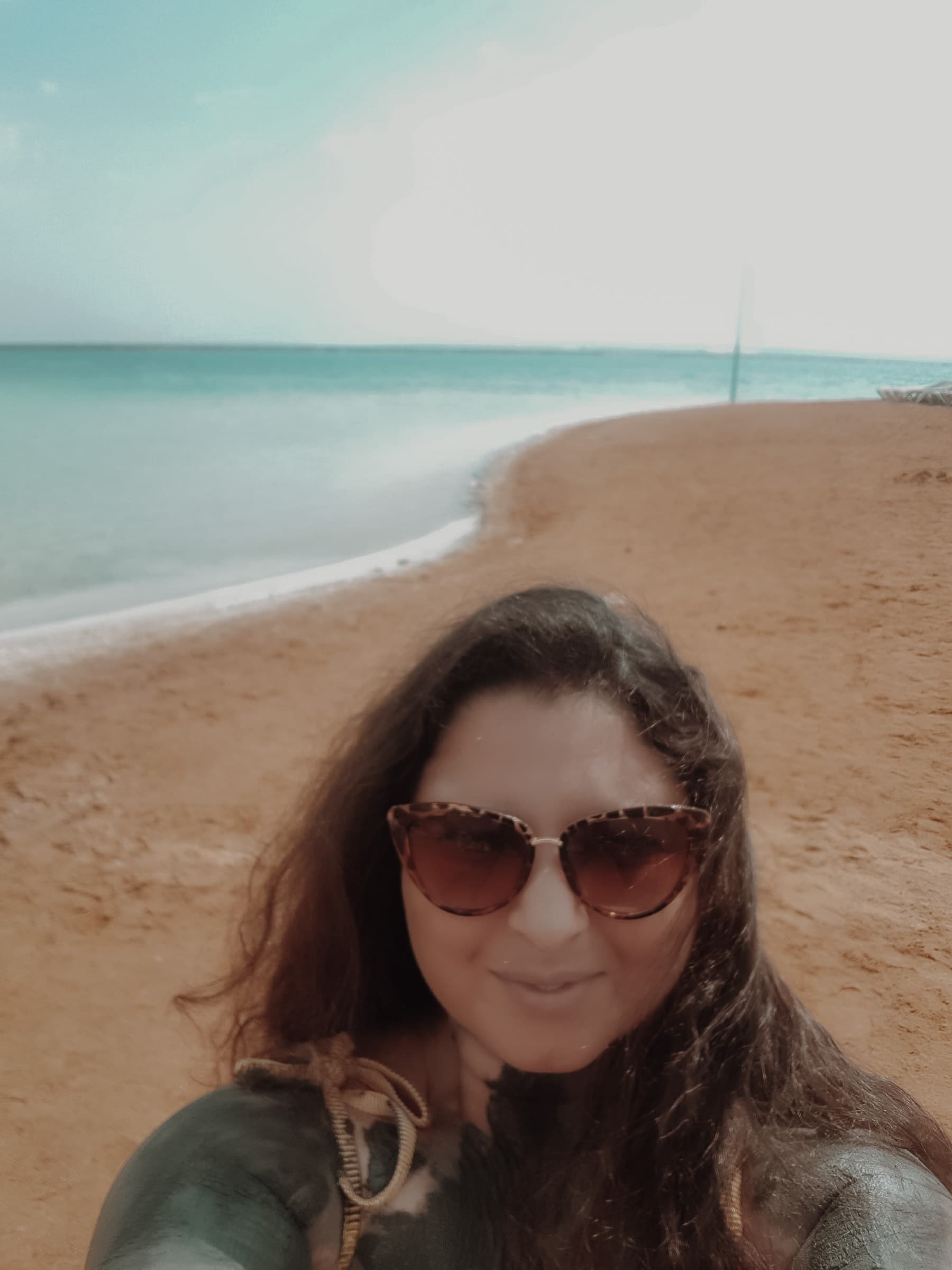
For the obligatory beauty program, however, you have to go back to the beach: on every corner, packs with real Dead Sea mud are offered, which was scraped from the ground somewhere in the vastness of the lake. With the mud mask you rub yourself from head to toe, wait until everything dries and wash it down again in the lake. The mud made my skin so soft, it was amazing!
Among the many big hotels it almost makes no difference: They all are lacking a bit of charme. I have stayed at the Herbert Samuel Hod Dead Sea Hotel* with pool and private spa. I thought it was better to opt for a hotel with a few amenities due to the lack of entertainment factor in Ein Bokek itself. The pool is small, everything is somehow grubby due to the mass of people and the service, as usual in Israel, is almost non-existent. Service wasn’t the best, but I think that’s probably an issue in general. Other hotels might be a bit better, but they are also astromically expensive.
Practical tips for your visit to the Dead Sea
I have heard from many travelers and Israelis that the price-performance ratio on the Jordanian side is supposed to be much better. So if you are also planning a trip to Jordan, you can also swim in the Dead Sea there for less money. By the way, popular souvenirs are the Dead Sea mud and Dead Sea bath salts. In the two mini shopping centers of the village you can buy all kinds of beauty products with minerals from the Dead Sea.
How to get there
Bokek is a good two-hour drive from Tel Aviv. You can find affordable rental cars here. Generally speaking, a few days at the Dead Sea are more than enough. However, there are also many tour operators that offer day trips from Tel Aviv or Jerusalem to the Dead Sea, which is also a good alternative.
In this ultimate article, I reveal my highlights in Tel Aviv: the best locations, tips and sights in Tel Aviv! And what you have to see in the party capital of Israel. Plus practical tips, because you’ll need them: Tel Aviv is an expensive place! Every budget tip is worth its weight in gold!
Can I find the right words to describe the energy of Tel Aviv? Tel Aviv is bursting with life. No wonder Israel’s party stronghold is a popular travel destination. In addition to sightseeing, good food and a lively club scene, you can relax on the long beaches here, including the most beautiful sunshine.
1. Beaches of Tel Aviv: Alma Beach to Gordon Beach
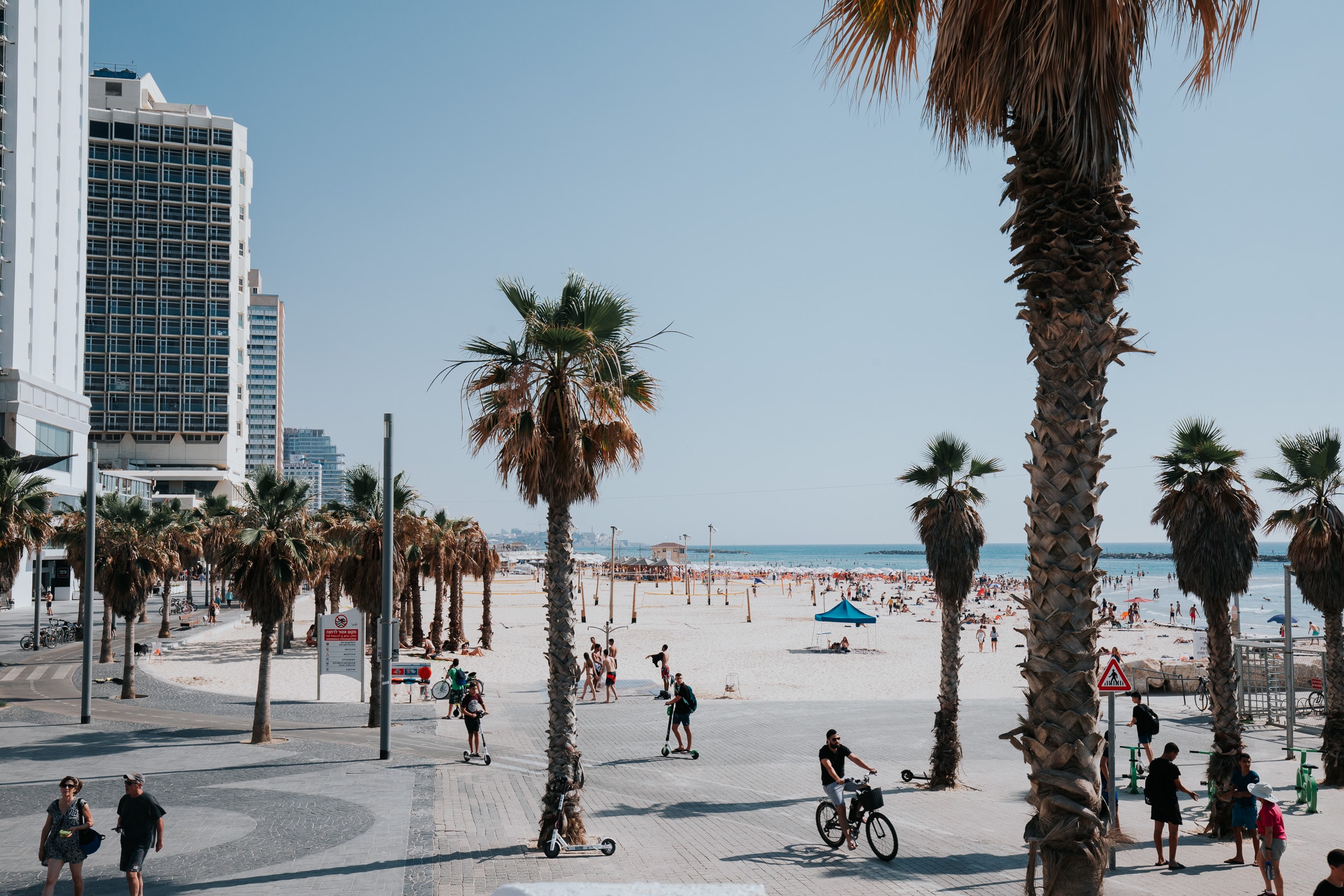
The beaches in Tel Aviv blew me away: I didn’t expect such fine sandy beaches! Even in spring, the temperatures were perfect for swimming or at least sunbathing. And the beach life in Tel Aviv is unique. As if the whole life of Tel Avivis takes place on the city’s beaches. Beautiful people everywhere, active, sporty, cheerful – you’d think you were in Miami Beach. Each individual beach attracts its own audience, from families to LGBT to water sports enthusiasts.
Gordon Beach
At Gordon Beach there is even a 50-meter saltwater pool next to the beach, where you can swim a few lengths for a fee if the sea is too wild for you.
From Gordon Beach southwards: endless beach.
Frishman Beach & Bograshov Beach
The central beaches are Frishman Beach (the one with the brightly painted lifeguard bungalow) and Bograshov Beach: it’s busy here from morning until late at night.
Beautiful people, lots of sun: Frishman Beach in the center of Tel Aviv.Striking: The brightly painted lifeguard house is the landmark of Frishman Beach.Beach volleyball at sunset: the end of a day at the beach in Tel Aviv.
There are always great beach bars on every beach where you can spend hours simply enjoying the beach life with a cocktail. Or you can come towards evening and watch the sun as it slowly sets into the sea.
My tips for the best beach bar in Tel Aviv
Gazoz Once you’ve sat in the almost-as-cool deckchairs in the sand and have your first drink in your hand, you won’t be leaving here in a hurry: it’s better to stop here at the end of the day!
2. Jaffa: Romantic alleyways and a fresh sea breeze
Jaffa (Yafo in Hebrew), a coastal town over 4000 years old, is located south of Tel Aviv. You should allow at least half a day for Jaffa! Here you will find the small stone alleyways and not forgetting the famous flea market. The small boutiques in Jaffa are a wonderful place to browse, the warm sea air wafts through the streets and in general I found the atmosphere here much more relaxed than in busy Tel Aviv. While Tel Aviv is a bit like Miami, Jaffa is Ibiza in hippie style: the clocks seem to tick more slowly here – and for me, the romantic alleyways in the old town are among the absolute must-see sights in Tel Aviv!
Alley in the old town of Jaffa.From Jaffa you have a fantastic view of the Tel Aviv beaches.You can find all kinds of treasures at Jaffa’s famous flea market.Alternative: There is a lot of graffiti in the streets of Jaffa.Popular in Israel: small plates with salads and sauces that are served with every dish.
Tour of Old Jaffa
It’s best to start your tour at the Jaffa flea market and then head towards St. Peter’s Church. On the way, you have the best view of Tel Aviv and its endless beaches from the hill! Don’t miss it!
The clock tower of St. Peter’s Church in Jaffa can be seen from afar.
Then let yourself drift from Kikar Kedumin Square through the narrow streets of the old town down to Jaffa Port, Jaffa’s old harbor. There are many restaurants and cafés on the promenade, perfect for a short break.
This installation with paper boats hangs between old port buildings in Jaffa. Pretty, isn’t it?
Tip: The archaeological excavation in the middle of a store in the old town of Jaffa at AdinaPlastelina, lunch at Abouelafia (grill restaurant, but also bakery) or the hyped Dr. Shakshuka.
3. Carmel Market
Markets are always a good tip in foreign cities, especially for trying out culinary delights. Especially in Tel Aviv, where there is so much to discover in terms of food thanks to the different cultural influences!
Tip for budget travelers: At the Carmel Market there are many stalls with cheap and delicious street food!
At the Carmel Market you will find everything your heart desires, from underpants to fruit and the hippest coffee stalls. And as usual in Israel, the hustle and bustle is lively and spirited! Here you can try dishes from all over the world at one of the many street food beaches– or simply eat some falafel and hummus.
Insta tip: Colorful umbrellas are set up at the entrance to the Carmel Market on Magen David Square – a beautiful photo location!
Instagrammable: The entrance to Carmel Market in Tel Aviv.
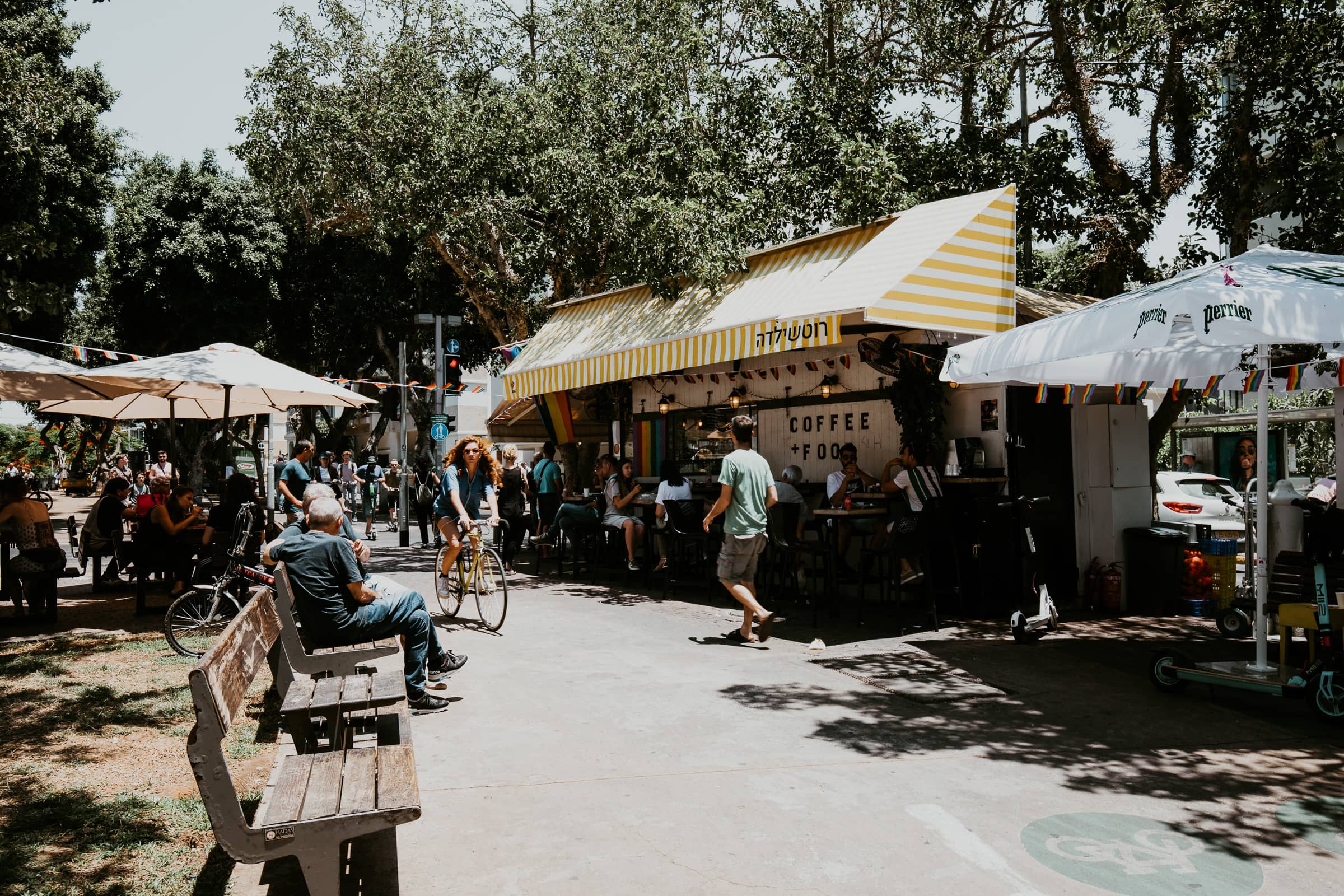
See and be seen could be the motto on Rothschild Boulevard in the middle of the city center. A large boulevard with space for pedestrians, cyclists and scooters. There are always little stalls here that once sold gazoz (flavored soda water) and are now mostly home to hip little cafés. Unfortunately, the buildings along the boulevard are suffering from the ravages of time, as is often the case in the center of Tel Aviv: I was surprised at how neglected many of the neighborhoods appear.
Refreshment on hot days: the kiosks on Rothschild Boulevard in Tel Aviv.
5. Dizengoff Square
One of the best locations to experience Bauhaus architecture in Tel Aviv is Dizengoff Square. When the glistening sunlight typical of Tel Aviv falls on the snow-white façades, it is impressive.
Snow-white: The Bauhaus-style buildings around Dizengoff Square.
Dizengoff Square with its traffic circle is one of the central points of the city. Tel Aviv’s first shopping center is located along Dizengoff Street – you can forget about it, it’s just like everywhere else. Instead, the rest of the street is lined with small boutiques and inviting cafés.
Tips around the Dizengoff Square: Yashka (stylish snack bar, I could have laid down in the shawarma! Attention: huge portions!), Bauhaus Center Tel Aviv, Ben Gurion House
Yashka serves falafel and shawarma galore: delicious Israeli street food.Even the dogs wear rainbows at Gay Pride: Tel Aviv is one of the most popular cities for the LGBT community.
6. Ben Gurion House
Not far away is the house of Israel’s first Prime Minister David Ben-Gurion, the Ben-Gurion House. He proclaimed Israel’s independence in 1948 and is still revered in the country today. His home near Dizengoff Street can be visited and is one of the lesser-known sights in Tel Aviv. Nevertheless, I found it very interesting, also to learn something about the history of Israel. The strikingly modest furnishings are still in their original condition. Very informative. And: Admission is free!
Modest conditions: The kitchen in the house of Israel’s first prime minister, Ben Gurion.
7. Tel Aviv, Bauhaus and the White City
Tel Aviv has the highest density of Bauhaus buildings in the world. As many of these buildings are white, this group of buildings is also known as the White City. You can get an overview of Bauhaus in Tel Aviv at the Bauhaus Center Tel Aviv.
Where can you find Bauhaus in Tel Aviv?
Unfortunately, many of the buildings are not quite as well preserved as they once were, but the Bauhaus influences can be seen quite clearly in certain corners, such as the impressive Dizengoff Square in the center of Tel Aviv.
Tel Aviv is actually a very young city. At the beginning of the 20th century, Tel Aviv was just a tiny suburb of the historic city of Jaffa. Curious: today it works the other way around! Following persecution by the National Socialists, many Jews of German descent came to Tel Aviv in the 1930s and 1940s, bringing with them the modern architectural trends of the time.
In the Bauhaus Center you can learn all about Bauhaus and the White City in Tel Aviv.
8. Sarona Market: A foodies’ paradise
The Sarona Market is completely different, but still worth a visit. Situated a little further away, the Sarona Market is the finer counter-program to the Carmel Market. As a newly opened indoor market, it lacks a little of the patina and bustling market life, but you will find all kinds of culinary delights! They don’t shy away from experimental offerings either: there is even a stand with Bavarian street food. Freely interpreted, though, because Bavarian hot dogs? Anyway, somehow this is also typical of Tel Aviv: Tel Avivis seem to have little fear of trying out new things!
Tip: Shakshuka at Benedict! (Benedict is a small chain of breakfast restaurants, some of which are open around the clock and serve breakfast throughout the day).
Sarona Market is located in the middle of a high-rise district in Tel Aviv.The Sarona Market is modeled on a real market: Many small stalls with delicacies from all over the market.Bavarian specialties are also represented in the Sarona market. However, the dishes themselves are interpreted very creatively. Be sure to try it: Shakshuka is an oven dish made from poached eggs in a spicy tomato and bell pepper sauce. Typically Israeli and an absolute taste sensation!
9. Florentin: Tel Aviv’s alternative neighbourhood
While many parts of Tel Aviv are already modern and hip, Florentin tops them all. This district is probably the most alternative in Tel Aviv. Colorful street art adorns the walls, the cafés are full of digital nomads sitting behind their laptops. Florentin seems like a free island in an already detached Tel Aviv.
Tip: Levinsky spice market (neighborhood market with many small stalls)
By the way: Florentin is also a nice district to stay in! The atmosphere is relaxed and you can always find some nice accommodation here!
It’s hard to escape the dynamism of Tel Aviv. Sometimes it seems as if everyone is out of control. Determined to enjoy life with all its ups and downs as intensively as possible. The mild climate means that people spend a lot of time outdoors – and Israelis are sociable anyway. As a matter of course, I was invited to private Shabbat dinners, yacht parties and other events – without much fanfare. Israelis value the community, and it’s easy to make friends. If you don’t have to worry about high walls and deep graves elsewhere in Israel, you are always welcome as a visitor in Israel. (Provided you get through the entry procedure unscathed; I was hit so badly on both trips to Israel that Israel will probably not see me again any time soon).
Many Israelis originally come from other countries. Tel Aviv attracts young people from all over the world, and if you can prove your Jewish faith, the path to Israeli citizenship is short. I was warmly welcomed everywhere, which made up for the lack of service culture in many places, and I was very touched on more than one occasion.
Indulgence is a top priority, so it is not surprising that Tel Aviv has an almost endless gastronomic offering. There is also no fear of alternative concepts: Bicicletta, for example, is a club/café/restaurant/plant store in the Nachalat Benjamin district.
Tip: Go out for a good meal in the evening, turn night into day at Kuli Alma, an alternative club, and hang out on the beach the next day: Enjoy life in Tel Aviv to the full!
Practical tips for Tel Aviv
Money & Currency
In Israel, you pay in Israeli shekels. But you can also pay by credit card in many places, which is rarely a problem in technologically advanced Israel.
But: Tel Aviv, like the whole of Israel, is very, very expensive! The cost of living is also very high for Israelis, with low wages. I have no idea how the largely young population will cope with this. As a visitor, you simply have to go through it. You can spend a lot of money on food in particular, as many goods are imported. Which is a shame, because there is so much to discover in Tel Aviv, especially when it comes to food!
Arrival & Visa
With a German passport you do not need a visa for Israel. There are direct flights to Tel Aviv from many German airports, e.g. Easyjet and El Al fly directly from Berlin-Schönefeld. However, the journey itself can be adventurous, depending on which airline you choose. El Al, for example, has very strict safety regulations. Unfortunately, I didn’t have such good experiences and could write half a novel about my arrival and entry. However, as complications on arrival/departure also depend heavily on individual factors, I may prefer to go into this topic in more detail in another blog post.
However, on my two trips to Israel, I had the strong feeling that if you have a southern European/slightly Arab appearance and a German passport, it is easier to fall into a group of people who are subject to more intensive checks. I personally found the security checks very stressful and degrading. This is currently preventing me from traveling to Israel again. However, other travelers from Germany had few to no problems with the security check.
Accommodation in Tel Aviv
Budget hotels and hostels in Tel Aviv
Hostels such as the Abraham Hostel* or The Spot Hostel* are popular with budget travelers. The Abraham Hostel also has a rooftop bar, which is not only popular with guests, and offers many tours of Tel Aviv and the whole of Israel. However, I didn’t find the location particularly appealing.
If you have a higher budget, you will be hard pressed to find designer accommodation in Tel Aviv. The Brown Hotels, of which there are a total of nine spread across the city, are particularly individually furnished: Brown TLV, Brown Beach House, Dave Gordon, Dave Levinsky, Poli House, Lighthouse, Theodor, Town House and Hôtel Bobo.
I ended up at Jojo TLV*, a small boutique hotel located in an old factory floor. Absolutely inconspicuous from the outside, the operators have created an inspiring place here. Due to its small size (there are only a few rooms), the Jojo TLV is more of a stylish shared flat than a hotel. In the shared lounge/kitchen there is the best coffee and nice conversation for free. Very communicative – and I found the close location to Jaffa and the beach perfect. The price-performance ratio is absolutely right.
The military/police presence in Tel Aviv is quite high, but not as massive as in Jerusalem, where I was before. Nevertheless, conscripts in full uniform with machine guns are part of everyday life. Irritating, but overall I found the atmosphere in Tel Aviv more relaxed than in Jerusalem. I never felt unsafe, even when I was out alone in the evening. Due to the constantly changing political situation, I recommend that you take another look at the information page of the Federal Foreign Office on Israel, which is constantly updated.
Transportation & public transport
On foot in Tel Aviv
The actual center of Tel Aviv is not as big as you might think: You can get to many places on foot. I have explored most of Tel Aviv on foot myself.
Rent bikes & e-scooters in Tel Aviv
For example, I always wanted to rent one of the many rental bikes (there are several providers in Tel Aviv), but in the end I mainly got around on foot. Scooters are also very popular in Tel Aviv (and very fast – watch out!).
Public transportation: Bus & Train
There is also a well-developed bus network and, more recently, a streetcar line. However, I didn’t try any of this, as I was in Tel Aviv on one of the highest Jewish holidays (Shavuot), and there is no public transportation at all! This also applies to every Shabbat/Saturday! Cabs also run less on these days.
Cab & Uber
Instead of Uber, Gett is used in Tel Aviv, unfortunately the app is mostly in Hebrew and it is not always possible to pay by app. On one trip I had to pay the driver at the end, who then promptly and loudly demanded double. It was only thanks to my spirited Israeli companion, who showed the driver just as loudly where the frog’s curls were, that we got away again: People like to argue loudly and aggressively in traffic, and Israel is a service desert in my eyes anyway. So keep your eyes open when traveling with Gett.
Excursions & onward journey from Tel Aviv
Israel is a small country, and Tel Aviv is right in the middle. From Tel Aviv you can book day trips or tours lasting several days, or travel on your own. So it’s worth taking a little more time and discovering more of Israel!
With long-distance buses through Israel
The state-owned bus company Egged will take you to every corner of the country, including Jerusalem, for little money.
Car rental in Israel
I spent most of my time in Israel traveling by rental car. This gave me more flexibility, especially for the route to Masada and the Dead Sea, and I was able to return the rental car directly to the airport for my return flight. Despite the reckless driving skills of some Israelis outside Tel Aviv, driving in Israel is relatively relaxed and the roads are well developed. Like everything else, however, rental cars in Israel are quite expensive, so it’s worth comparing prices early on!
I really recommend a trip to Jerusalem! It’s a completely different world to Tel Aviv and hard to digest, but if you’re ever in Israel, you shouldn’t miss this place. From Tel Aviv you can easily travel to Jerusalem on your own, there are good train and bus connections. Or you can join a guided tour that travels to Jerusalem in the morning and back again in the afternoon.
“You want to watch the sunrise in Masada see?” I didn’t want to miss a single highlight on my trip to Israel. “Don’t be surprised, the road there is completely unlit, but that’s okay. Just keep driving, even if it’s dark.” It’s a good thing that the nice receptionist in Arad gave me this tip when I asked her for directions to the Masada fortress in the Judean Desert. Otherwise I would probably have turned back immediately after the first signs warning of “extremely dangerous bends”. Driving all alone at half past four in the morning in the pitch dark along winding desert roads with not a soul around – that was an adventure.
The road from Arad to Masada: great views during the day, pitch black at night.
Sunrise in Masada: an experience for every trip to Israel
There are places in the world that are particularly famous for their spectacular sunrises or sunsets – and Masada in Israel is undoubtedly one of them. After the long drive through the middle of nowhere, I was skeptical whether the whole ordeal of getting up early would really be worth it. Especially as I was expecting busloads of tourists who were also heading for “Sunrise Masada”. But apart from a handful of rental cars parked in the parking lot, there were few tourists to be seen on the east side of the fortress.
From the fortress you can see far across the Dead Sea.
It already looked different at the top of the fortress, most of the visitors had probably taken the route via the other ascent on the west side. Nevertheless, the site was not overcrowded. An impressive silence fell over the area as everyone waited for the one moment when the sun slowly rose from behind the mountain range opposite, glowing bright red.
Incredibly beautiful: sunrise in Masada.
All around us was nothing but a barren desert mountain range, deep below us the Dead Sea, mirror-smooth and still – and suddenly everything was illuminated by the rising, warm sun: One of the most impressive moments of my trip to Israel!
Impressive lunar landscape: the Judean Desert by the Dead Sea.
History of Masada, Israel – Historical significance
The fortress of Masada has a turbulent history behind it. In 73/74 AD, during the Jewish War, the fortress was besieged by the Romans. As the capture by the Romans drew ever closer, over 900 inhabitants of the fortress killed themselves to avoid being taken prisoner by the Romans. Since then, Masada has been a symbol of Jewish aspirations for religious freedom and self-determination. Masada has been a UNESCO World Heritage Site since 2001.
Archaeological finds at Masada
Various parts of the fortress are still preserved and were made accessible as part of an archaeological excavation. Today, for example, you can see the remains of the huge storage rooms or the bathhouses. In addition, replicas show what King Herod ‘s residential palace must have looked like: Front Row on a slope! The inhospitable surroundings make you wonder once again how much effort it must have taken to build such a structure here on this mountain plateau under the conditions of the time.
Below: The foundations of the palace.Front Row and unobstructed view: King Herod’s palace with a view of the Dead Sea.
How do you get to Masada?
There are essentially two approaches to Masada, one from the west and one from the east. The route from the east seemed much more popular to me. There is also a cable car on this side that takes you up to the summit. At sunrise, however, you have to walk up the so-called Snake Path, which takes about 45 minutes. There will also be a visitor center with stores and a small museum on this site. This access road is closer to the Ein Gedi Oasis and the Dead Sea.
The Roman siege ramp before sunrise.
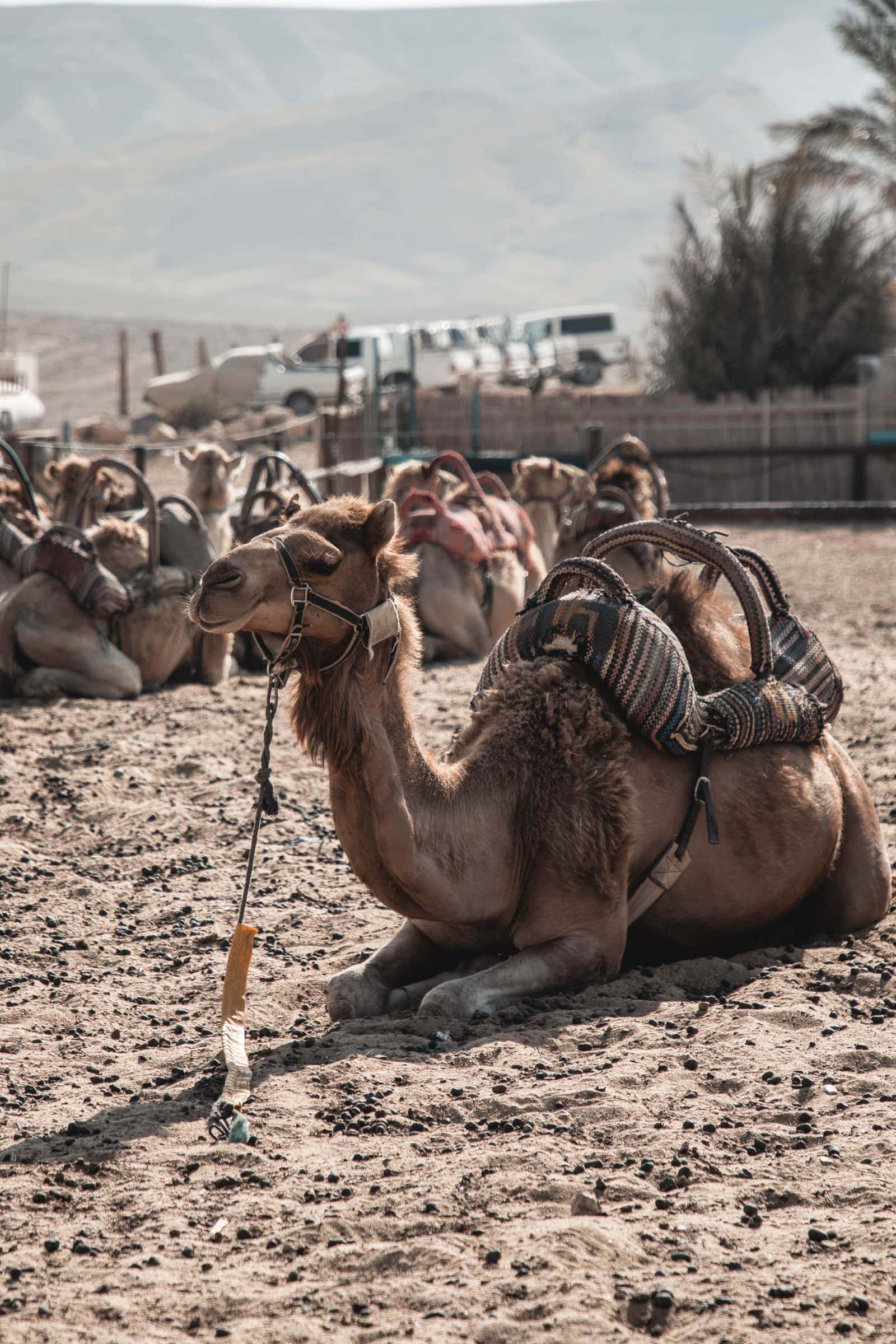
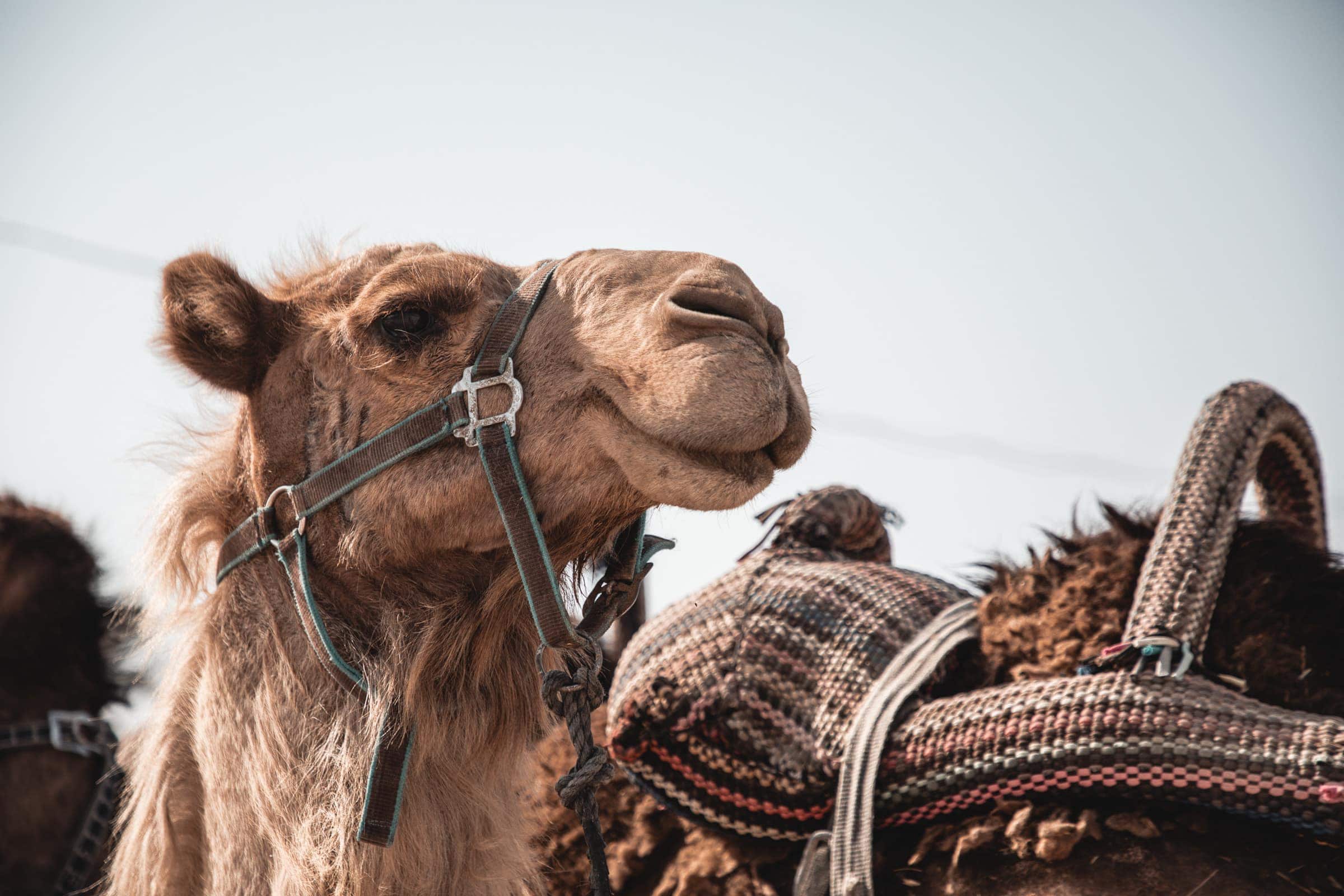
I came from the west side, the road from Arad is adventurous in the dark. But the way up to the fortress is shorter. The Roman siege ramp (yes, this access is that old!) is steep, but it only takes 15 minutes to get up to the fortress. On the way back to Arad, you have unforgettable views of the Judean Desert – and can pet cute camels on the way (warning: lots of heart-warming camel content to follow!), with which you can go on a desert tour. From Arad (the next town) Masada is signposted, so you just have to follow the road.
Excursions to Masada from Jerusalem and Tel Aviv
Masada is one of the most popular day trips from Jerusalem and Tel Aviv! You can book both daytime tours and sunset tours. There are also providers who combine a tour to Masada with a visit to the Dead Sea (also highly recommended!):
Basically, I wasn’t particularly fascinated by the archaeological excavation, and it also got hot quite quickly, so sun protection and headgear are recommended. After all, it is a mountain plateau in the middle of the desert and the sun shines mercilessly. I would therefore always recommend visiting at sunrise – it’s a truly unforgettable experience! You can find my tips for a great visit here:
If you’re traveling by rental car and don’t like getting up in the middle of the night like I do, you can look for accommodation nearby the night before. Then the alarm clock doesn’t ring quite so early. I picked up my rental car in Tel Aviv and then dropped it off at the airport for my return flight.
I spent the night in Arad at the Inbar Hotel*. Not a highlight, but decent – and contrary to the reviews I had skimmed beforehand, I was greeted warmly by the lovely receptionist, who provided me with lots of tips straight away. (Nice service is unfortunately not always a matter of course in Israel). Without being asked, we were given a plate of fruit in our room as a breakfast substitute.
If you would prefer to stay on the east side and access the fortress from there, perhaps because it is more on the way, there is the affordable HI Massada Hostel*, where many Masada visitors stay overnight.
***
You can also find out more about Israel in the following articles:
Jerusalem is a fascinating city and, alongside Tel Aviv, the top destination on any trip to Israel! But what are the must-sees in Jerusalem? Here I’ll tell you which sights you should definitely see and give you some valuable tips!
Places of interest in Jerusalem
Most of the sights in Jerusalem can be found in the Old City. Everything is within walking distance here, and you can easily visit the most important locations such as the Wailing Wall or the Church of the Holy Sepulchre in one day. You will also find the very picturesque narrow streets here. But the newer part of Jerusalem is also well worth seeing and a little more secular.
#1 The Wailing Wall / Western Wall
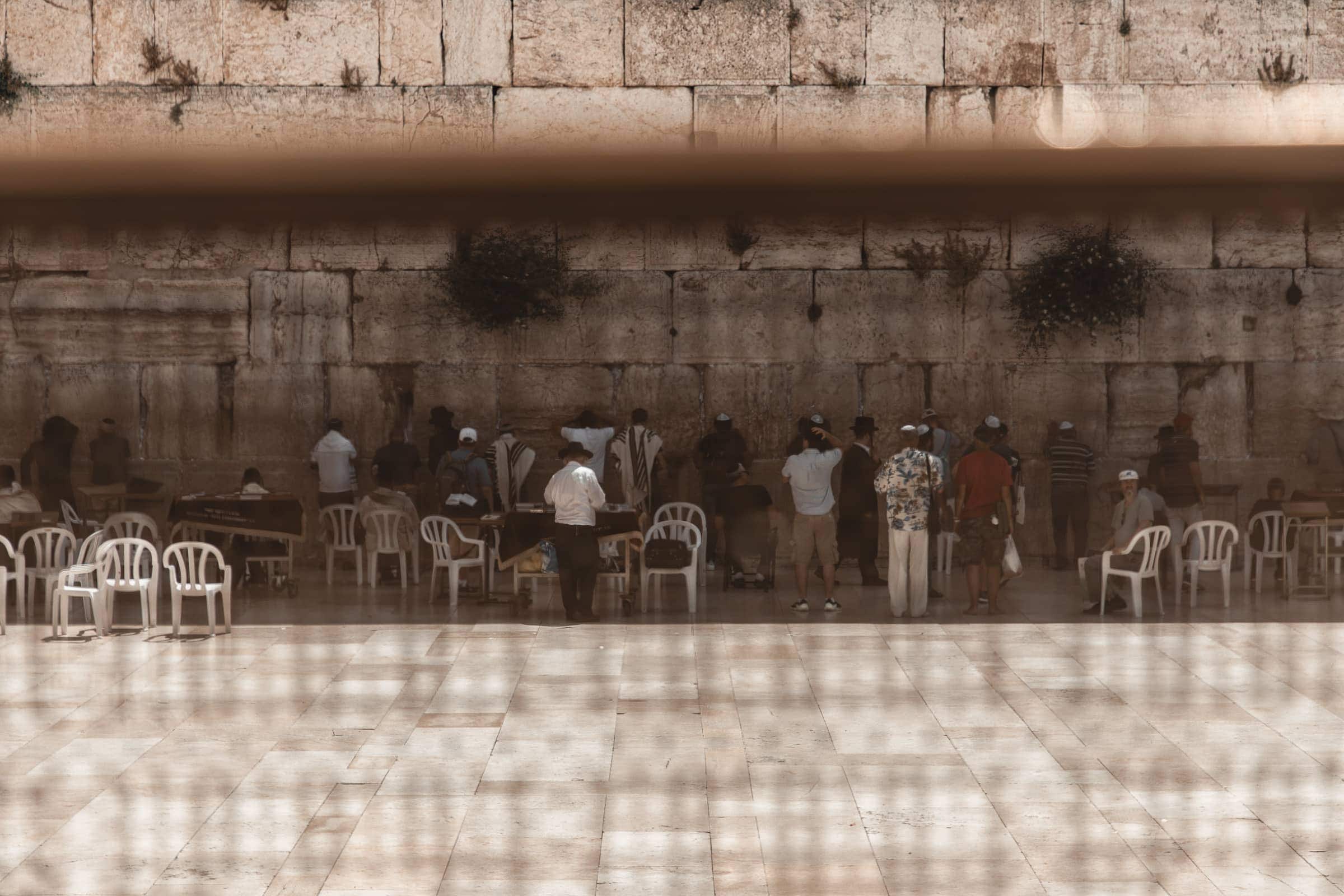
The Wailing Wall is actually the back of a protective wall of the Second Temple of Jerusalem, built by King Herod and almost completely destroyed in 70 AD during the battle between Jews and Romans for supremacy in Jerusalem. Seventy years after Christ – that’s how early people were already arguing and fighting in Jerusalem! And there are still remains from this period to this day – Jerusalem is a treasure trove of antiquity. Over the centuries, this section of the Western Wall (hence the English name“Western Wall“) became a place of Jewish pilgrimage, today’s Wailing Wall – and a symbol of Jerusalem.
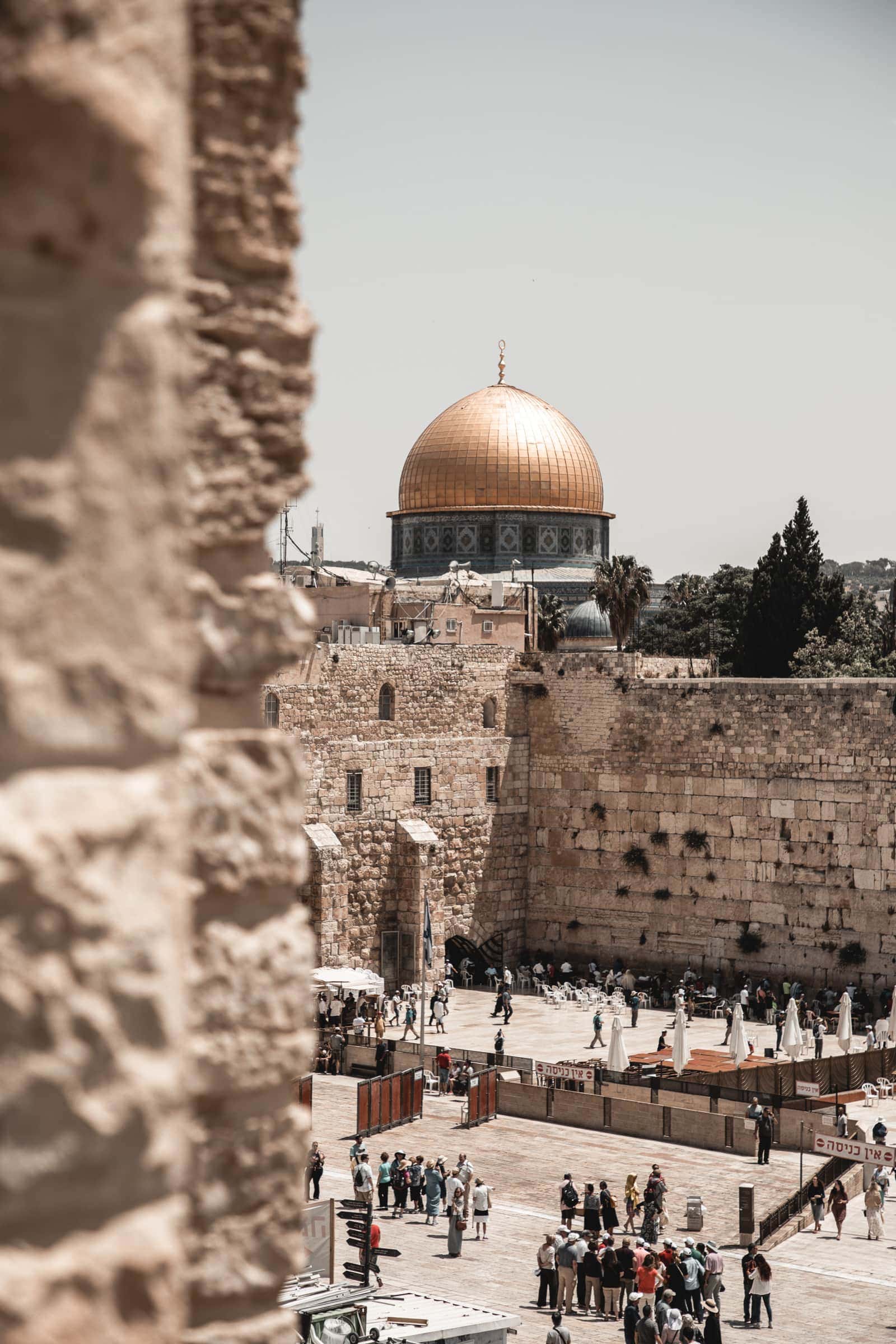
The Wailing Wall is THE landmark of Jerusalem.
Helpful tips for visiting the Wailing Wall:
Access to the Wailing Wall is blocked off by security gates. Bringing cameras is not a problem – but photography is not permitted at the Wailing Wall during the Sabbath.
A visit to the Wailing Wall itself is free of charge,
Women and men pray strictly separate at the Western Wall. The men’s side usually seems emptier because 1. it is larger and 2. the men also use a covered part under an archway.
Men have to wear a kippah right next to the wall, women should cover their shoulders and knees, but somehow it’s not particularly noticeable in warm weather, if not.
There are small benches on the partition wall to the men’s section, which you can climb on to look over to the men’s section.
At the entrance in front of the wall you can get a pen and paper to write your prayers/wishes/thanksgiving/etc. on. The paper is then inserted into one of the cracks in the wall.
You move away from the wall in reverse – so as not to turn your back on it
The Wailing Wall is open 24 hours a day
Some of the roof terraces opposite are open to the public. From there you have the world-famous postcard view of the Dome of the Rock and the Wailing Wall.
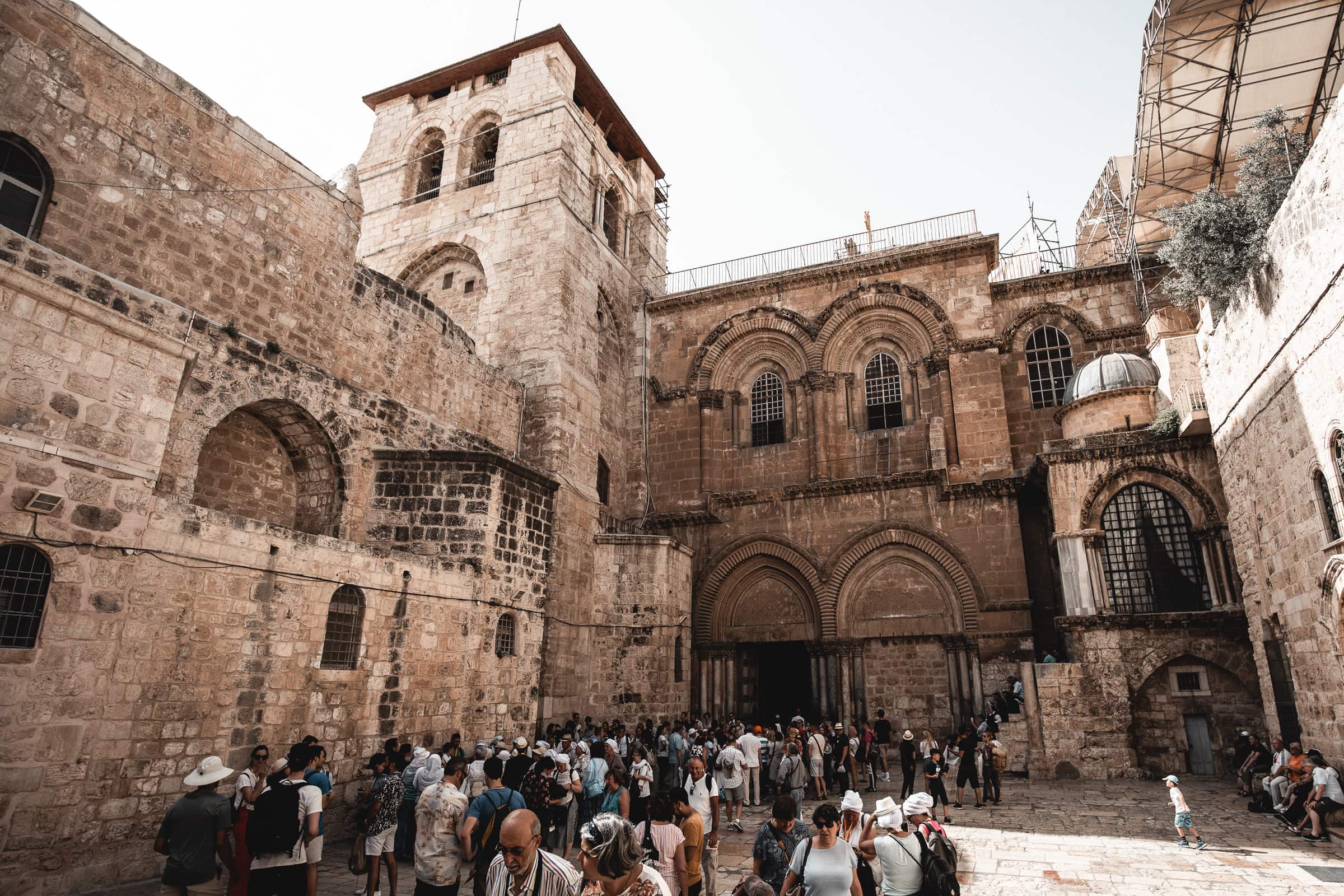
The Church of the Holy Sepulchre is THE hotspot of Christianity, no other church in the world is as significant, as important. This is where Jesus is said to have been crucified and buried, then resurrected. Whether this is true or not is still disputed by historians to this day, as it is at many sites in Jerusalem – much of what is assumed today is biblical tradition that has not always been scientifically proven beyond doubt. This is also one of the reasons that can be so confusing in Jerusalem. What is true, what is not? What is scientifically proven? The stories in individual places change depending on the faith and world view. In any case, I was very impressed by the Church of the Holy Sepulchre, a veritable labyrinth of chapels for all possible Christian faiths and so very different from other classic large sacred buildings. The first church was built on this site between 326 and 335 and was extended, destroyed and rebuilt several times over the following centuries.
The Church of the Holy Sepulchre is one of the holiest sites in Christianity.
What you should look at here:
The anointing stone right at the entrance: This stone commemorates the anointing of the body of Christ, where believers wipe the stone with cloths and towels and pray
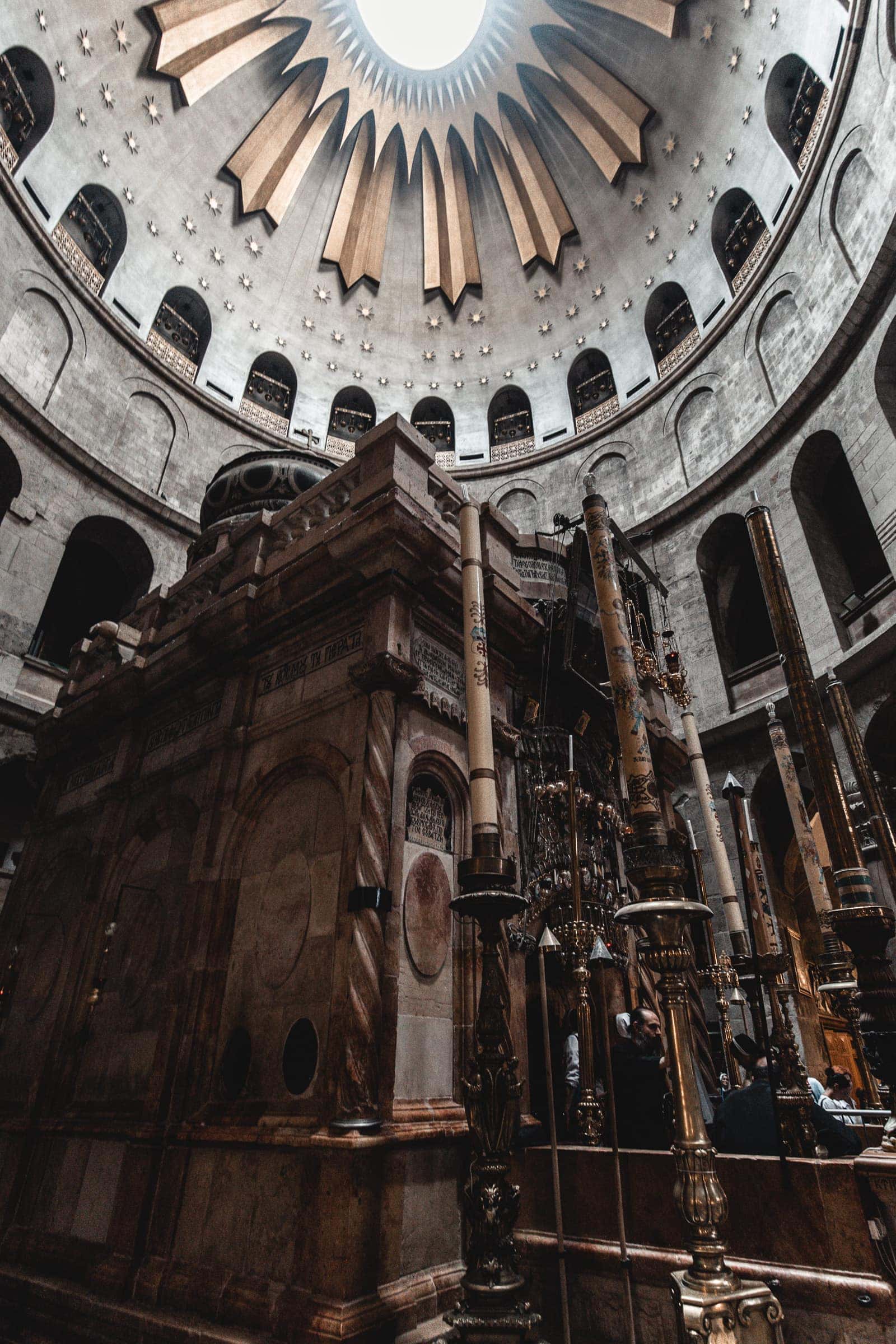
The tomb of Jesus, THE pilgrimage destination for devout Christians all over the world: another small building stands in the huge, mystical-looking rotunda. Inside is the place where Jesus is said to have been buried. You can enter the shrine, but you have to queue – sometimes for up to an hour! (I have to admit, I then gave it to myself)
The Rock of Golgotha: Under the altar in the Greek Orthodox chapel is the rock on which Jesus is said to have been crucified – you can even touch it!
The sacred interior of the Church of the Holy Sepulchre: this is where Jesus’ tomb is said to be located.
Fun fact (or not so fun, as the case may be): The Church of the Holy Sepulchre is used by six different Christian denominations. However, as they were never able to agree on certain issues, two Muslim families hold the key to the Church of the Holy Sepulchre and open the church in the morning and lock it again in the evening. The key is passed down from generation to generation within the family.
#3 Jewish, Armenian, Muslim and Christian quarter
The Old City of Jerusalem is divided into four different neighborhoods; Jewish, Armenian, Muslim and Christian. In the old town itself, you mainly get around on foot – and this is the best way to explore the individual districts.
The bazaar atmosphere in the Old City of Jerusalem is a wonderful place to browse.
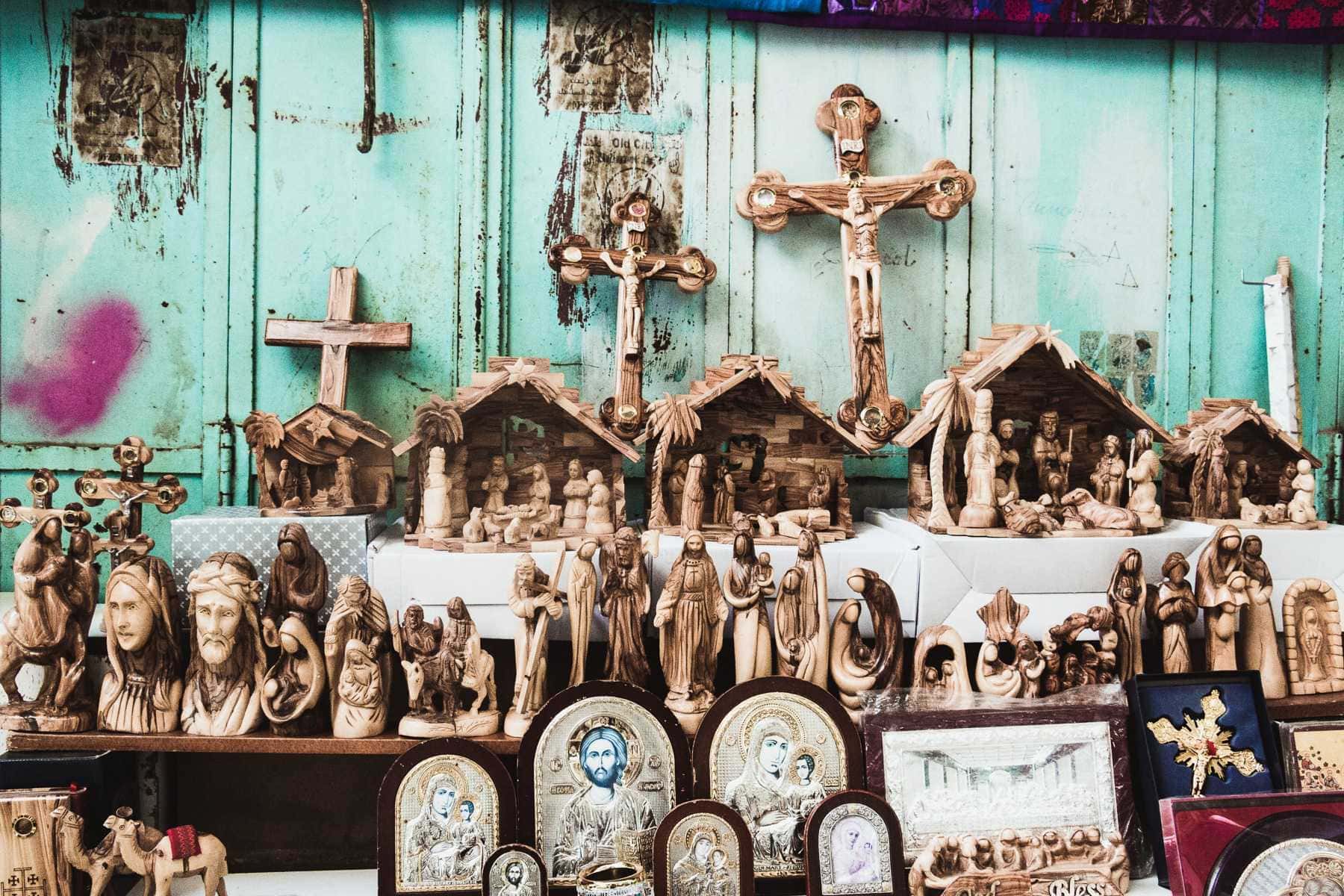
My tip is: just start walking, the most important sights are well signposted for orientation on the way anyway, let yourself drift and find out for yourself which part you are currently in. In the Muslim quarter you will find a colorful market in the alleys of the old town, the Church of the Holy Sepulchre is the center of the Christian quarter, where you will also find many souvenir stores with religious articles.
Orthodox Jews in their black clothing and black hats are part of everyday life in Jerusalem.
The Jewish quarter was badly damaged during the Palestine War in 1948 and is therefore largely rebuilt in the old style – which is also well worth seeing. In the Armenian quarter, people tend to keep to themselves and there is less street life here.
Razzouk Tattoo in Jerusalem is the oldest tattoo parlor in the world. Tattooing has been going on here for over 700 years: A family business in its 27th(!) generation.
The Via Dolorosa is a pilgrimage route that follows the traditional path of Jesus through the city to his crucifixion. There are a total of 14 stations, and if you are interested you can take part in the Franciscan procession of the cross on the Via Dolorosa every Friday. The starting point is at the Stephanstor (St. Stephen’s Gate), but beware: the cross procession is a huge event, even among religious tourists – it gets crowded in the Old Town.
#4 Temple Mount with Dome of the Rock and Al-Aqsa Mosque
The golden dome of the Dome of the Rock is probably one of Jerusalem’s most famous landmarks. The Al-Aqsa Mosque is less magnificent from the outside, but together with the Dome of the Rock it is one of the most important shrines of Islam.
Impressive: the golden dome of the Dome of the Rock on the Temple Mount.
Access to the Dome of the Rock for non-Muslims is only possible via the covered wooden structure at the Wailing Wall and under the following conditions:
A passport/ID document must be presented.
A security check must be passed upon entry and, in addition to dangerous objects, non-Muslim religious objects may not be brought onto the Temple Mount
Observe the dress code: Shoulders and knees must be covered
Non-Muslims are not allowed to enter the Dome of the Rock and the Al-Aqsa Mosque
Visiting times for the Temple Mount: Sunday to Thursday 7.30-11.30, 13.30-14.30 (summer), Sunday to Thursday 7.00-10.30, 12.30-13.30 (winter)
The crowds are very large, the controls very high – it is advisable to arrive early. However, access may also be blocked at short notice due to the political situation. It is best to obtain the latest information on the day in advance.
The Al Aqsa Mosque looks rather inconspicuous.
All too much history? Especially in Jerusalem, it is a good idea to take part in a tour to find out more about Jerusalem! It’s worth it, because you can’t get that much background knowledge!
Located right next to the Jaffa Gate, the citadel offers an absolute panoramic view of the old town. In addition to the impressive building itself, you can also visit the museum with exhibits on the history of Jerusalem and interesting temporary exhibitions (I was very impressed by the expressive photo exhibition!).
Magnificent views during the day, beautifully illuminated at night: The Citadel of David in Jerusalem.
After dark, there’s a light show on the history of Jerusalem, and if you think it’s boring, it’s best to see it for yourself – there’s almost no better and more light-footed way to be guided through the history of the city.
The Dome of the Rock in private photos throughout history.
#6 City of David
The City of David is an archaeological site near the old town, which I have already written about in this post in this post. A particular highlight is the Hiskija Tunnel, a 2700-year-old water supply canal that still carries water today and can be forded with the appropriate equipment.
#7 Israel Museum & Yad Vashem
If you still have time for art and culture after all the sightseeing in the Old City, you should also visit the Israel Museum, one of the top museums in Israel. Everything from archaeology to modern art is represented here. The main attraction are the Dead Sea Scrolls, the Qumran scrolls, named after the Qumran caves in which they were found. The scrolls are around 2000 years old and provide important information about the time of ancient Judaism. The scrolls are displayed in a specially constructed building, the “Shrine of the Book”, which looks like a white onion cut in half from the outside.
Yad Vashem is probably the world’s most important memorial to the victims of the Holocaust. The architecture and exhibition should be very moving – and I think it is always important to remember what happened so that such a memorial never has to be built again. Unfortunately, I was no longer able to visit Yad Vashem. Which I very much regret. If you have the opportunity: definitely go. With time, because this is not a program item that you should tick off in a hurry.
Admission is free, and the nearby “Mount Herzl” streetcar stop is only a 15-minute ride from the city center. A free shuttle bus runs from the bus stop to Yad Vashem.
#8 Montefiore windmill
A windmill? That’s right, the world’s most visited windmill is in Jerusalem! Holland my ass. (They have thousands for that, too.) This windmill was built in 1857 to enable the surrounding new settlements to become self-sufficient.
Holland, my ass: this smart windmill stands in the middle of Jerusalem.
There wasn’t much wind after all, but a pretty little residential area, Mishkenot Sha’ananim, grew up around the windmill. The mill has recently been extensively restored and flour is still ground here for special events, albeit now motorized.
Wine tastings are also organized in the Montefiore windmill. My untrained palate can only ever distinguish between “I like” and “I don’t like” – but the wines I tasted mostly fell into the “I like” category. So Israeli wines can’t be all that bad. A clear recommendation for a wine tasting in a somewhat different ambience.
In front of the windmill is a large viewing terrace, according to our tour guides the most popular place in Jerusalem for marriage proposals! The view of the surrounding hills is truly fantastic. However, I couldn’t help but stare at the towering concrete wall on the opposite ridge, which reminded me so much of the remains of the wall at home in Berlin – and couldn’t follow our guide’s stories about the history of this and the surrounding neighborhoods. “We have our problems, you know,” he commented curtly, and I wondered whether this human need to always have to build walls would ever stop.
We went up to the Montefiore windmill as part of a Segway tour. I’ve only ever ridden a Segway on the flat promenade along Lake Michigan in Chicago – that was quite nice. The hilly Jerusalem then gives a Segway tour a completely different adventurous twist!
#9 Mahane Yehuda Market
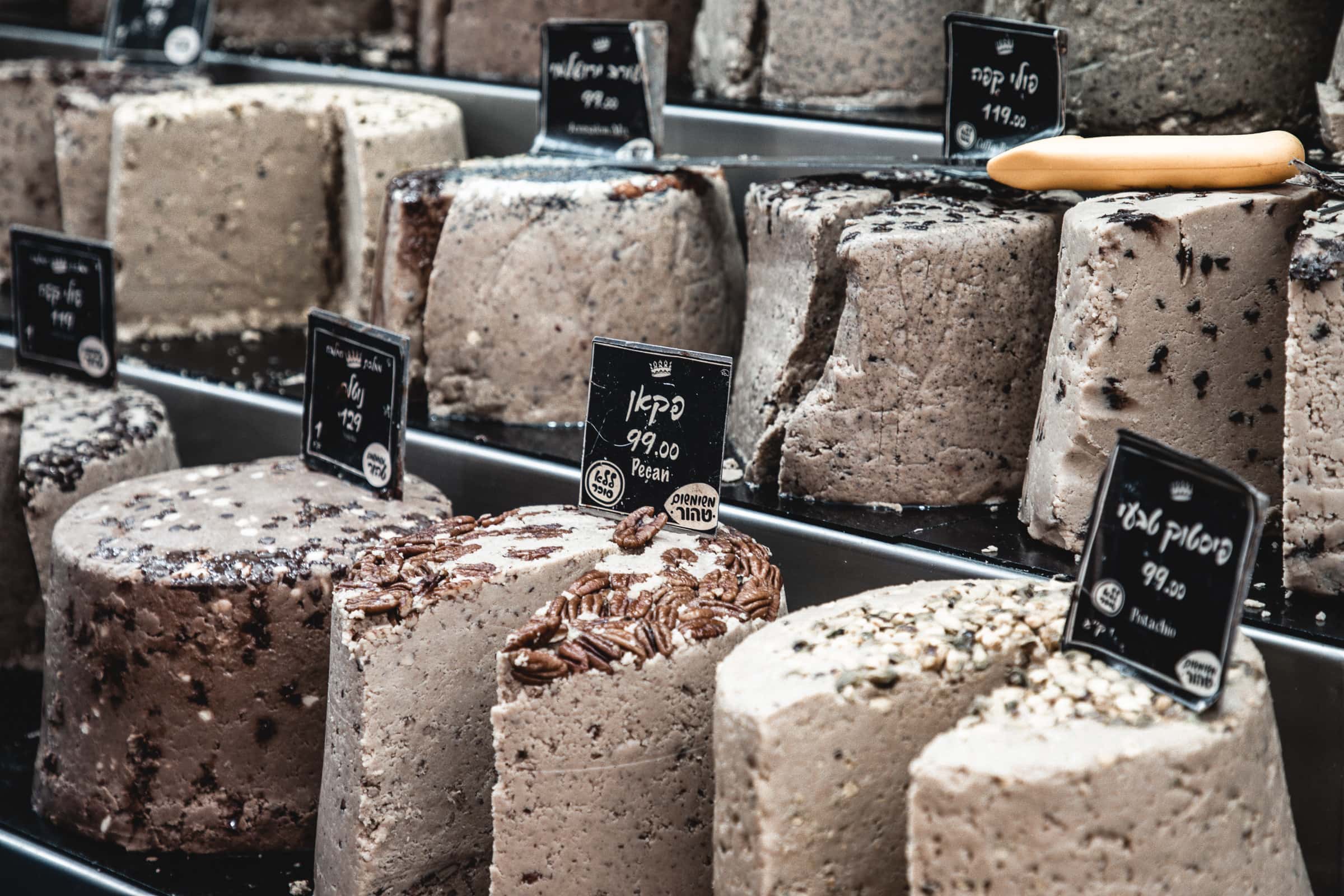
You shouldn’t miss the hustle and bustle at the Mahane Yehuda market – and it’s best to come twice: once during the day and once at night. Because during the day, normal market life takes place here: Fruit, vegetables, sweets, spices – you can find tasty delicacies on every corner. For example, at the stand that only sells halva, a sesame sweet.
In between there are always small cafés, but also bars and pubs – and when the fruit and vegetable vendors close for the day, the Mahane Yehuda market mutates into a hip pub mile!
#10 First Station
Formerly the station from which trains to Tel Aviv departed, the First Station stood empty for a long time until it was reopened as an event space a few years ago. There are cafés, bars, restaurants, coworking spaces and various events from time to time – here as part of the Pride Parade that takes place in the city in June. The remarkable thing is that, on the one hand, Jerusalem is a strictly religious city, but on the other hand, despite many dissenting voices from religious camps, it is slowly opening up towards more diversity.
Recommended: The DIY market, every Thursday in summer, from 4 pm.
Food tips: Cafés and restaurants in Jerusalem
This list can only remain incomplete – the range of great restaurants, bars and cafés is simply huge. You can eat well in Jerusalem, as in the rest of Israel, on every corner – unfortunately the price level is often very high. That means: Close your eyes and go for it if you don’t want to miss out on the truly fantastic cuisine!
Incidentally, in my experience, the portions are very large in return – it often makes sense to share a dish before you have to go back for half due to an acute food coma. (Dishes are often served in several bowls anyway, which makes it easier). Alternatively, there is always a falafel store somewhere that also serves good food on a budget.
Pergamon Vegetarian cuisine, very nice to sit outside in the evening!
At first glance, Mori’s Grill Bar looks like a simple chip shop, but it has the best grilled meat!
Grill Bar the Grill Bar without a name! Tip: The starters alone are so varied – there’s no need for a main course.
Café Rimon good cocktails, but the best thing is the location: sit here in the evening in the pedestrian zone and watch the nightlife!
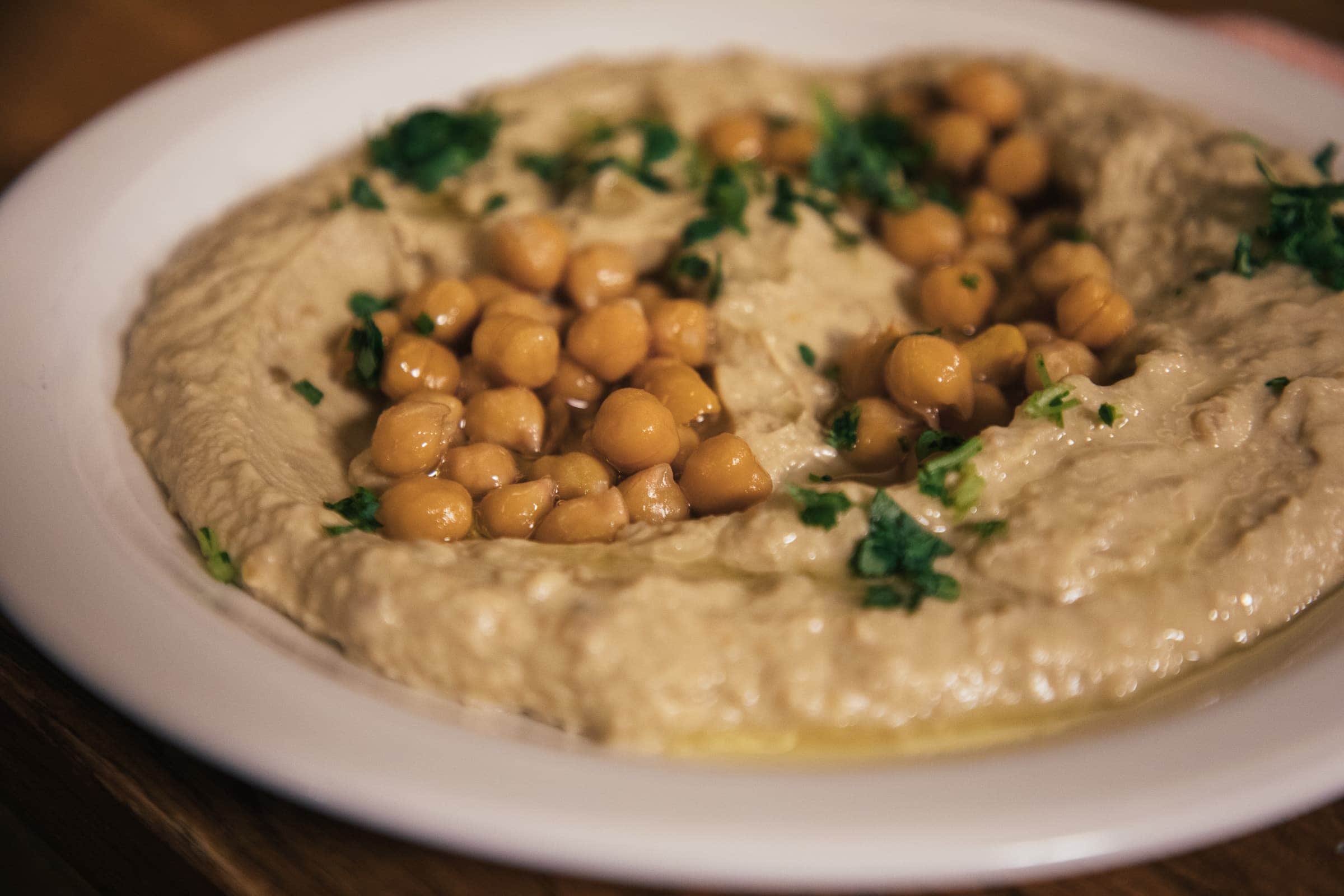
Acrmavi – the best hummus in town, so they say. The store has existed at Damascus Gate since the 1950s and somehow you get the feeling that not much has fundamentally changed since then. Except for the hummus! This is prepared fresh every day according to an old family recipe, early in the morning, as the store opens at 5.30am. Hummus is still considered the daily bread of the little man and is eaten for breakfast as well as on all other occasions. Everyone comes here: construction workers, students, office workers. You should come by by early afternoon before the hummus runs out and you have to wait until the next day’s production. Because what’s gone is gone!
Hummus is a typical Israeli dish and is super filling.
Hummus recipe:
Ingredients: 140g dried chickpeas 50g tahini (sesame butter) 1 large clove of garlic 3 tbsp olive oil 3 tbsp lemon juice Salt and pepper to taste
Soak the chickpeas in water overnight. Cook for approx. 3 hours. (Yes, it takes time! And cheating with canned chickpeas is not an option!) Drain and collect the pea water. Crush the garlic clove and mix with the other ingredients. Add the peas and mash until creamy. If the mixture becomes too firm, add pea water until the desired texture is achieved.
Hotels in Jerusalem – accommodation for every budget
Luxury hotels in Jerusalem – high-end, but worth a look even without an overnight stay!
King David Hotel – The King David Hotel has a storied past: This monumental building served as the seat of the British Mandate government in the 1930s and 1940s, survived a bomb attack during that time, and later became one of Israel’s most luxurious hotels. Heads of state and everyone who’s anyone stay here. YMCA Three Arches —The YMCA Three Arches, located directly across the street, is part of the Jerusalem YMCA (Young Men’s Christian Association), and even if you can’t afford to stay the night here, you should still come by: The unmissable bell tower is the tallest building in Jerusalem, and from the top you’ll have the best view of the city!
Medium budget – Middle class hotels in Jerusalem
Ibis Styles – A solid, clean hotel in a prime location—and brand-new! Right in the heart of Jerusalem’s new city center, with restaurants, bars, and a shopping district just steps away—it doesn’t get any better than this. The Old City is within walking distance.
And best of all: the breakfast buffet on the top floor with a view of the city is amazing. Typically Israeli, typically abundant, typically delicious. Be sure to book.
Low budget hostels in Jerusalem
The Post – Super central location, relaxed atmosphere. Private rooms are also available. Abraham Hostel*– Probably the best-known hostel in Jerusalem: Not quite as party-like as the offshoot in Tel Aviv, but still a good option for those who are on a budget and love communicative accommodation. There are also private rooms.
Journey to Jerusalem
If you are traveling to Israel from Germany or Europe, you will almost certainly land in Tel Aviv (and will certainly want to see Tel Aviv!). Ben Gurion Airport is outside on the way from Tel Aviv to Jerusalem and both cities are very easy to reach directly from the airport.
From Ben Gurion/ From Tel Aviv Airport to Jerusalem
The train connection from Tel Aviv airport to the train station in Jerusalem is brand new and takes just under half an hour. From the station, it is only a few stops by streetcar to the city center. Alternatively, there is a bus – but it takes a good hour and only goes as far as the station. I would generally advise against taking a cab – taking a cab in Israel is sometimes adventurous anyway and the train connection is unbeatable in terms of comfort.
With the Jerusalem City Pass, travel by train or bus to Jerusalem and back to the airport is free! The pass is available in three versions, the cheapest of which costs 35 euros.
From Tel Aviv (city center) to Jerusalem
There are plenty of bus connections from Tel Aviv to Jerusalem, the journey takes about 1 1/4 hours. On the website of Egged (the state bus company) you can find current timetables. Alternatively, you can also see if you can book a day trip from Jerusalem or Tel Aviv, e.g. to the Dead Sea*, and be dropped off in the other city on the way back (some tour providers offer this), saving you a trip.
Or you can book a day trip to Jerusalem from Tel Aviv, the journey doesn’t take long. However, I would say that a single day is far too short for Jerusalem – if you have the time, it’s better to stay overnight or longer.
I will probably write a separate post about entering Israel in general, as it is a bit more extensive. Please note: Traveling within Israel by public transport is generally difficult on Shabbat . From late Friday afternoon until Saturday evening there is no public transportation! Especially in Jerusalem, the rules of Shabbat are strictly adhered to, restaurants, cafés, stores, everything is closed – if possible, it is better to travel to Jerusalem on one day.
Security in Jerusalem
Basically, I wasn ‘t at all afraid of minor crimes like purse snatching or trick theft, which often occur at tourist hotspots, in Jerusalem. There are no official warnings about this, nor was I personally approached – that tends to happen to me when I’m traveling, as I’m often out and about with a camera that isn’t exactly inconspicuous. In this respect, Jerusalem seemed very safe to me.
However, this may also be due to the enormous police and military presence, which suggests that a machine gun is quickly at hand in an emergency. As a pickpocket, you’d probably be better off looking for another field of activity. Weapons can be seen everywhere, even individual young soldiers carry their machine guns outside of their duty time, both in military uniform and in private clothing, as they are only allowed to keep their weapons out of sight under certain conditions for security reasons. What at first seems disturbing for us Central Europeans is everyday life for Israelis and – in contrast to us – has an extremely calming effect on the locals. Most Israelis have also completed basic military training (men three years, women two years) and are well equipped for emergencies of any kind. Someone told me, not without a little pride, that there are always very few casualties in attacks on Israeli soil, because everyone knows what to do at the crucial moment thanks to their basic training and this may save more lives.
I got a taste of this speed of reaction one evening when we were standing in front of our hotel and a commotion suddenly broke out about 200 meters away in one of the busy street cafés: shouting, plastic chairs falling over. It was impossible to tell from a distance exactly what had happened, perhaps just a quarrel between guests, a scuffle, nothing more serious – but nevertheless the crowd around them suddenly jumped apart as if choreographed and soldiers ran off in a star shape in different directions. However, our Israeli escort had immediately analyzed the situation in no time at all and determined that there was no immediate danger to us and remained relaxed – while I, with my jaw dropped, was still busy trying to assess what was happening.
We were warned just once: we shouldn’t go to the Damascus Gate. (Buses to East Jerusalem and the Palestinian territories stop in front of this gate). Unfortunately, we did not receive an answer to our question about the reason for this very firm warning.
Later, however, I remembered that on my last visit in 2017, I strolled along there without a care in the world, ate hummus at Acrmavi and couldn’t remember feeling uncomfortable.
My personal assessment? It is ambivalent. Personally, I wouldn’t let the current overall situation stop me from traveling to Jerusalem; I didn’t feel in any danger. However, I don’t want to make a general statement on safety issues in particular, as everyone has a different perception of safety and is responsible for their own well-being.
I therefore recommend that you carefully follow the news from the region before traveling (there’s nothing like the Tagesschau and heute-journal!) and check the information page of the Federal Foreign Office for the current situation.
Conclusion: Is a trip to Jerusalem worthwhile?
After so much information and my very subjective opinion, you may be wondering whether a trip to Jerusalem is worthwhile at all. If you want to go on a city break other than Paris, Milan, London or Lisbon for a longer weekend – why not? Jerusalem it is. It’s also something a little more exotic to make your friends jealous of. The old town is very pretty, the narrow alleyways make for excellent posing pictures for your Instagram feed and it’s even more picturesque when one of the many Orthodox Jews with their big black hats scurry through the picture in the background while you’re walking around in your Sunday best.
Jerusalem is a very well developed tourist destination, there are great hotels with pools to relax in after sightseeing and good food everywhere (provided you have the necessary change, because Israel is expensive and Jerusalem as the number one Israeli tourist attraction even more so),
You don’t really have to fear handbag thieves due to the high police presence, despite religion everywhere you can still run around in a mini dress and in general you can have a really nice time here, even if you’re not at all interested in religion, history, politics, art and culture. A few pictures in front of the Church of the Holy Sepulchre, leaning dreamily against the Wailing Wall, trying hummus at the Mahane Yehuda market in between, enjoying the balmy summer breeze with a glass of wine in the evening (Jerusalem is always a winner in terms of weather with its mild to hot climate!
You can even go on a pub crawl* here with the people from Abraham Hostel* if you’re in the mood for nightlife – also a good tip for accommodation if you like it more budget-friendly but also more communicative. Jerusalem wants to become a bit hipper, and there’s nothing wrong with jumping on this bandwagon too.
But if, after reading this article, you have come across some details that have made you feel insecure, I would like to say to you: Then travel to Jerusalem all the more! If you have the feeling that you would have similar thoughts to mine, then I highly recommend a trip to Jerusalem!
It will not be easy, many things will keep you busy for a long time, you will be confused and doubt your perception. But that’s exactly what this city is all about! Feel the intensity of the city for yourself, talk to the local people, educate yourself as you pass by and learn about the history, culture and religion of a region that has influenced world events for thousands of years, ask questions, seek answers and form your own opinion – and you will be rewarded with a travel experience that you will remember for the rest of your life!
More about Israel:
Disclaimer: I was invited on this trip by iTravelJerusalem and the Jerusalem Development Authority.
Last month I had a somewhat unusual invitation in my mailbox. Wouldn’t I like to participate in the International Travel Bloggers’ Summit in Jerusalem, which would take place for the first time this year. 40 bloggers and Instagrammers from 6 nations, plus lots of expert talks, workshops, lectures and many new tips for Jerusalem.
The Old City of Jerusalem: picturesque and exciting
I already knew that the Old City of Jerusalem is picturesque and photogenic – and this time I was even more determined to capture my impressions in pictures.
Jerusalem is simply full of interesting sights: The Church of the Holy Sepulchre, the Wailing Wall, the Dome of the Rock with its striking golden dome in the background, the Tower of David, the Cardo, the shopping street from Roman times; and oh yes, there were plenty of them, the Orthodox Jews with their black hats, who always look good in photos as they scurry through the winding alleyways.
But somehow questions still remained open in me. I usually get a good feel for a city pretty quickly; that’s no wonder, after almost two decades of flying and various spontaneous and less spontaneous overnight stays in cities that were sometimes foreign to me until then, you develop your own routine when it comes to exploring and feeling out a city. Besides, I consider myself to be the uncrowned queen of speed sightseeing (well, some of my crewmates, who already incited me to the craziest speed sightseeing actions shortly before pickup, could dispute the title) and Jerusalem should not be a problem in just four days. But it did.
Jerusalem and its history: the center of three great world religions
Jerusalem is the center of three major world religions: Christianity, Judaism and Islam. Which has always held a potential for conflict, because as it is in the history of mankind: Sharing usually doesn’t work out so well. I’m not religious, but sometimes I think I have a penchant for the spiritual that I rarely bring up publicly because, let’s face it, that sounds more like barefoot dancing, spiritually entranced cult disciples in self-batiked robes than anything else.
Nevertheless, in Jerusalem I again felt the special energy of this place in my own body – whether it was due to the place itself, its history or the importance that millions of believers attach to Jerusalem and go there in droves? As I landed at the airport in Tel Aviv, a fervently chanting group of 40 cheerful pilgrims sheered in right in front of me on the way to passport control; judging by the inscription on their printed shirts, they had come from the Ivory Coast for a Pentecostal trip, and this trip seem to be an extraordinary event in their lives. This religious devotion of the many pilgrims and pilgrimages is also clearly felt in the city itself.
Excursion to the City of David – a morning on the trail of Indiana Jones
Then one morning we went to the City of David. A rather less touristy spot in Jerusalem, most people want to see the Wailing Wall and explore the Old City. The City of David is an archaeological site that has been opened to the public and features finds from the time when King David (who made David and Goliath – it’s getting biblical!) made Jerusalem a thriving city 3000 years ago. Secretly, I hoped that this program item would quickly pass me by – looking at excavations, that didn’t sound very tempting. I mean, half the city is old, there’s no need to look at that separately, is there?
Archaeology in Jerusalem: Exciting finds and insights
I was proven wrong. We descended into an underground cave, got a little refresher course in the Old Testament (which I sorely needed) as we stood in the middle of its setting, so to speak, watched a very realistic multimedia presentation of ancient Jerusalem and marveled at the incredibly ingenious irrigation system: We wound our way through narrow crevices in the rock, which were carved into the rock at the time as a water supply for the surrounding fields, and couldn’t believe that this was supposed to be several thousand years old.
The Hezekiah Tunnel from the 8th century BC, an underground canal for water supply, has also been opened up and can be visited along almost its entire length. The special treat: to this day, the tunnel is at least knee-high with water and must be waded through! Waterproof shoes and a flashlight (compulsory!) can be purchased on site.
The entrance to the Hezekiah tunnel: It gets wet and dark
Archaeology live: the latest discovery in the City of David
At present, another great discovery is being uncovered: In an excavation not previously open to the public, the pilgrimage route several hundred meters long from the Shiloah Basin (where the faithful underwent ritual ablution) up to the temple of the city is being excavated. What is today an underground tunnel, for which we had to descend quite a bit, was 2000 years ago an open-air road – so much has been built over it in the centuries that followed! Live and in color, we were allowed to see the ongoing excavation work – and suddenly archaeology seemed quite exciting. Soon, by the way, this tunnel will be open to the public – and that will be great!
Outside again, we enjoyed the view of the valley, behind us a slope on which the residential buildings of the surrounding neighborhood were piled up. The different layers of rock also revealed that there was a lot of history in this slope. “You know, the ground on which Jerusalem stands is made up of countless layers of building fabric. Nothing was removed. It’s been thousands of years of just building on top of each other, layer by layer,” said our Israeli escort, Maria. “The big archaeological question in Jerusalem is never whether you’ll find anything – because you always find something, that’s for sure. The only question is whether it’s worth destroying what you’ve discovered so far in order to dig even deeper.”
My indefinable feeling about Jerusalem melted away and I made my peace with the fact that I would probably never be able to solve my question marks about Jerusalem. How could one ever classify a city under whose surface the history of mankind from millennia is buried?
Practical tips for the City of David
The City of David is located not far from the Old City, behind the Wailing Wall as you pass through the Dung Gate. I would allow half a day to explore the whole area at your leisure – it’s probably hard to do that on a day trip. But anyway, in my opinion, a single day for Jerusalem is far too little. And the City of David is really a location I would highly recommend to you, preferably with a guided tour – it helped me a lot to understand Jerusalem a bit better.
My trip to Jerusalem had nothing to do with religion, even though most tourists make the pilgrimage there for religious reasons. I have absolutely nothing to do with that. Especially since a large part of my Brazilian family has been engaging with the subject more and more intensely, and their own religion has become ever-present.
That bothers me a lot and is increasingly becoming a breeding ground for conflict, because everyone secretly thinks their faith is the only true one. It’s a trend that’s currently taking place in many areas of Brazil—and sometimes I worry that this religious fervor might eventually take a turn for the worse. Perhaps that’s why the trip to Jerusalem was so intense for me. So, just to be clear: This travelogue about Jerusalem is very personal; some people may experience it differently—but that’s just part of traveling.
Travel to Tel Aviv: Adventure Israel
My trip just wasn’t off to a good start. I flew directly from Germany to Tel Aviv, and—probably just because I wanted to find out—I chose Israel’s national airline. Were the security measures there really that different? Indeed they were. Completely unprepared as always, I found myself just before the check-in counter being subjected to an intense interrogation about my travel plans and my living situation in Berlin.
That intense conversation felt so much like an interrogation to me that I feared my interlocutor would throw me into a secret airport dungeon at any moment and let me rot there. For whatever reason. But he didn’t, after all. Drenched in sweat, I then had to have my luggage subjected to a thorough security check, and eventually I was deemed worthy of checking in. But my mood was at rock bottom, and I would have loved nothing more than to go home crying. What a great start.
Read even more tips and travel stories about Israel on my Israel blog
I had never really given Jerusalem a second thought before. It was actually just a coincidence that led to this trip. So I arrived there early in the morning, relatively unprepared. And quite surprised. Jerusalem is THE center of three world religions that, as we know, don’t always get along. But I could feel that tension throughout the city, all the time. It’s quite curious, considering that all these religions preach love and peace.
What not to miss in the old town
Jerusalem’s Old City is peppered with world-famous sights that you must see. You can find the most important ones here, but I also recommend my great Jerusalem Guide. There you will find more sights outside the Old City and many practical tips for your trip to Jerusalem.
#1 The Church of the Holy Sepulchre
The Church of the Holy Sepulcher is tucked away, almost in the heart of the Old City, and if it weren’t for the trails left by thousands of tour groups pointing the way, one would hardly suspect that one of Christianity’s greatest shrines lies behind its unassuming facade.
Jesus is said to have been crucified at the spot where the church was later built. And his tomb is said to be located here. Because the Church of the Holy Sepulcher is therefore significant to just about every Christian denomination, a corresponding number of interest groups have been squabbling over it since time immemorial. At some point, this led to the keys to the church being passed down within a certain Muslim family—every morning and evening, someone comes with the key to unlock or lock the church. Crazy.
#2 The Wailing Wall
The Western Wall, along with the Temple Mount and the golden dome of the Dome of the Rock, is arguably one of the most famous postcard views of Jerusalem—and, indeed, probably of Israel as well. It is a pilgrimage site for (Orthodox) Judaism. For this reason, men and women pray separately here.
Access is restricted: You have to pass through one of the security checkpoints first. The scene couldn’t have been more fitting when a group of teenagers suddenly appeared, all cheerfully singing “Hava Nagila” and dancing in a circle.
#3 The David’s Citadel
The Citadel of David, next to the Jaffa Gate, not only features an informative museum on the city’s history but also offers a great view of the Old City. In the evening, there’s also an open-air light show at the citadel. It might sound like tourist kitsch, but it’s actually quite impressive against the unique backdrop of the fortress. (Admission prices and opening hours are available on the museum’s website.)
#4 The labyrinth of alleys in the old town
Jerusalem’s Old City consists largely of small, narrow alleys, and at every turn in this labyrinth of alleys, you feel as though you can experience the history of the city—oh, what am I saying, of all humanity!—firsthand. If only these massive walls could speak. You can easily spend a whole day in the Old City, just letting yourself wander. You almost have no other choice, because sooner or later your sense of direction will fail you anyway in the maze of alleys.
Here’s the great thing: Anyone who thinks the Old City is just a place full of tourist trinkets is mistaken. Sure, there are plenty of souvenir shops—which is no surprise, given the number of tourists who stream through Jerusalem’s Old City every day. But there’s also real, local life going on there!
The Jerusalem Syndrome and Me
In fact, I felt more and more uncomfortable with every passing hour during my stay in Jerusalem. Rarely has a place unsettled me so much. Is it an overdose of religion? I rushed back home because I just wanted to get away. And that’s even though I would actually have liked to see more of the city to get a better picture of it. I was there for an event sponsored by the local tourism office, which tended to take us to places that left us with a rather incomplete picture of Jerusalem—I think you know what I mean.
In any case, behind closed doors, I was repeatedly advised in whispers to go check out the Palestinian side as well—they said it was completely different. Be that as it may, I found the atmosphere in Jerusalem so oppressive—or rather, my own personal mood—that I could only stand it for a few days. However, as a colleague who knows Israel well later assured me, strong reactions among visitors to Jerusalem are not uncommon.
Some people have miraculous visions, receive all kinds of spiritual messages, or simply have a meltdown because of all the religion—just like me. The Jerusalem Syndrome actually refers to a mental disorder in which those affected suffer from religious delusions—it sounds amusing, but somehow Jerusalem does give off a strange energy, so it’s no wonder that some people are so strongly drawn to this city.
This site is registered on wpml.org as a development site. Switch to a production site key to remove this banner.