Category: Vietnam

Vietnam won me over with its stunning landscapes and incredible food. If you really want to get to know the country, take your time and travel slowly from north to south.

If you’re looking for a great destination in Southeast Asia, Vietnam should be at the top of your list. On my blog, you’ll find plenty of practical tips and my favorite places across the country.

Saigon | Hoi An | Hanoi | Hue | Mekong Delta

  • Best eSIM for Vietnam: How To Stay Connected While Traveling

    Best eSIM for Vietnam: How To Stay Connected While Traveling

    Advertisement: This article is sponsored by Sim Local.

    Vietnam is one of my favorite destinations in Southeast Asia, but the first moments after landing can be a little overwhelming. The warm, heavy air hits you as soon as you step off the plane, you’re tired from a long flight and everything feels different. Still, I’ve always been the type of traveler though who likes to walk out of the terminal as if I know exactly where I’m going, no matter if I already know the airport or not: The less you look like a clueless tourist on your first day, the smaller the chance that someone takes advantage of it. That’s why I always want to be online the moment I get off the plane, and why an eSIM is one of the first things I sort out before any trip.

    However, there are so many providers by now that it’s genuinely hard to choose one. If you’re looking for the best eSIM for Vietnam, Sim Local is well worth a closer look, and in this guide I’ll show you why.

    Planning your trip right now?
    Get your Sim Local eSIM for Vietnam and save 5% with my code HAPPYJETLAGGER

    Ha Long Bay is one of the must-sees in Vietnam

    Why Mobile Data Matters So Much in Vietnam

    Being online right away makes the first hours at a new destination so much easier, especially if you’re traveling alone and have to sort everything out yourself. I can check where my hotel actually is, and instead of jumping into the first taxi and relying on the meter, I order a Grab and see the price before I’ve even left the airport. During the ride, I can follow the route on the map, and if I spot a market or a café I’d like to come back to, I simply save the location for later. Being connected right away gives me a sense of control, and a good bit of safety too.

    Cloud Pass
    Knowing I’m always just a tap away from a map or a translation makes me a lot braver on my travels

    In general, your phone can make your trip so much easier. Hanoi’s Old Quarter, for example, is a maze of streets that change names every few hundred meters. In Ho Chi Minh City, much of the best street food is tucked away in narrow alleys you’d never find without a map. Or you might want to try to order your food in Vietnamese or just say thank you – a translation app lets you experience the culture on a whole different level.

    At street food stalls, a translation app sometimes comes in quite handy

    What Is an eSIM & Why I Don’t Miss Physical SIM Cards

    Many of us already use an eSIM at home. If you don’t, it’s basically a SIM card in digital form uploaded right to your phone. Instead of inserting a physical card, you can install a data plan by simply scanning a QR code or using an app to set it up. That’s how easy it is to use an eSIM!

    Back in the day, I bought local SIM cards on more trips than I can count, but it was never as seamless as with an eSIM. There was always the line at the airport counter (if I could find one at all, since in some countries it’s not that easy to buy a SIM card at the airport, not to mention the higher price tag), the hunt for the tiny pin to open the SIM tray, and the question of where to keep my home SIM so it wouldn’t get lost somewhere in my bag.

    With an eSIM, I install everything at home and simply switch it on when I land. Since switching to eSIMs, I’ve tried several providers on countless trips to countries like the U.S., Canada, Brazil, Montenegro, Serbia, Malaysia, Thailand and Vietnam, and I wouldn’t go back. (Within Europe, my regular cell phone plan from Germany covers most countries anyway.)

    A smiling woman sitting on a bench with a smartphone
    Buying a Vietnam travel eSIM has never been easier

    The best part is that you can still receive calls and text messages on your home number, including verification codes or any other messages, and WhatsApp stays exactly as it is. Most phones can also store several eSIMs at once. If Vietnam is the first stop on a longer route through Southeast Asia, you can install the plans for Cambodia, Laos, or Thailand in advance and simply switch when you cross the border.

    Traveling on after Vietnam? Sim Local covers more than 200 destinations. Browse all countries with Sim Local eSIM* and set up your whole route in one app!

    Why Sim Local Is My Pick for the Best eSIM for Vietnam

    With so many eSIM providers out there, it’s sometimes hard to keep up with all those different companies – and if you’ve never heard of Sim Local, you might be surprised that it’s actually an eSIM veteran. Sim Local was founded in Dublin in 2011(!) and opened its first shop at Dublin Airport. Today it’s Heathrow’s official eSIM partner, with stores in every terminal, and you’ll also find it at the airports in Brussels, Vienna and Athens. So when you buy an eSIM from Sim Local, you’re getting it from a company that has been helping travelers stay connected for well over a decade, both online and in person at some of Europe’s busiest airports. With its Vietnam eSIMs, Sim Local connects you to MobiFone and VinaPhone, two of the country’s best-known networks.

    Which Vietnam eSIM Is Right for You?

    What I like most about Sim Local is that you can choose an eSIM plan that fits your needs. If you don’t need much data, stick to one of the smaller plans; if you need more, there are plenty of options.

    Not sure how much data you’ll need? I always find it hard to estimate my own usage, especially since my habits on the road are often quite different from at home. That’s where Sim Local’s Find My Plan tool* comes in handy: it asks you four quick questions and suggests the plan that matches the way you travel.

    Fixed Data Plans

    These budget-friendlier plans start at around US$4.50 and go up to 20 GB for thirty days. They’re a good fit if you mainly use maps, messaging, and the occasional ride, and spend your evenings on hotel Wi-Fi. If you run low, you can add more data in the Sim Local app.

    Unlimited eSIM Vietnam Plans

    If you need a lot of data, you might want to opt for the unlimited eSIM Vietnam plans. With Unlimited you get 5 GB of high-speed data every day, and with Unlimited Pro it’s 10 GB. That’s enough to upload large files and stream Netflix or YouTube in high quality in the evening, and you’ll still have data left over for everything else. The allowance resets every 24 hours, and if you do reach it, you stay online at reduced speed until the next reset. Hotspot and tethering are included, so you can also connect your laptop or any other devices.

    MobiFone Plans With Calls and Texts

    Another option worth considering are the MobiFone Vietnam eSIM plans, which include calls and SMS. MobiFone is a well-known Vietnamese network, and although the plans aren’t unlimited, YouTube and Facebook don’t count toward your allowance. The 15-day plan comes with 75 GB of data plus calls and texts (currently US$33.25), and the 30-day plan includes 180 GB of data plus calls (currently US$40.25).

    Bought an eSIM, but your travel plans changed? Sim Local has a very customer-friendly refund policy: You can request a 100% refund within 14 days of purchase, no questions asked! Also, if you ever need help, Sim Local’s support team is available 24/7 via WhatsApp and email (which is even more remarkable, as real people respond to your questions rather than an impersonal AI chatbot).

    My discount for you: Choose your plan in the Sim Local eSIM* shop and save 5% with the code HAPPYJETLAGGER at checkout. It only takes a couple of minutes, and you’ll land in Vietnam already connected.

    How To Set Up Your Vietnam Travel eSIM

    At home, we rarely think about SIM cards. There’s one in the phone, the phone works, and that’s that. So the first time someone mentions an eSIM, it’s normal to wonder what exactly that is. The good news is that installing one is really easy, and Sim Local explains every step clearly. Once you’ve done it, you’ll know how it works, and next time it’ll take even less.

    1. Check that your phone supports eSIMs. (It very likely does. Every iPhone since the XS from 2018 can handle eSIMs, and so can most recent Android phones.) If you’re unsure, see the FAQ below or use Sim Local’s compatibility checker* on their website.
    2. Buy your Sim Local eSIM* and enter the code HAPPYJETLAGGER at checkout for 5% off.
    3. Install it before you leave. All you need is an internet connection, either Wi-Fi or cellular data, and you can do it via QR code or in the Sim Local app. Installing doesn’t start your plan yet. The eSIM stays inactive on your phone until you arrive.
    4. Switch it on when you land. Turn on the eSIM line, set it as your main line for cellular data, and enable data roaming for it. Your phone connects to the local network, and that’s when your plan starts.

    Make sure to keep data roaming turned off for your home SIM to avoid roaming charges later!

    Ready For Vietnam?

    All in all, Sim Local makes it wonderfully easy to find exactly the plan you need. And it doesn’t stop at Vietnam. With more than 200 destinations, you’re covered in almost every corner of the world, so your next trip is taken care of in the same app, whether it takes you to Japan, Mexico, or somewhere you haven’t even thought of yet.

    Get your Sim Local eSIM* now and save 5% with my code HAPPYJETLAGGER.

    (Keep the code handy: You can use it for your next trip, and the one after that, and the one after that!)

    FAQ: eSIMs in Vietnam

    Is an eSIM worth it in Vietnam?

    Absolutely. You’re online as soon as you land, without waiting in line at a counter or first figuring out where to buy a SIM card. You also don’t have to convert prices in Vietnamese dong, where even small amounts quickly run into hundreds of thousands, and it’s easy to slip by a zero. With an eSIM, you know exactly what you’re paying and what you’re getting.

    Why shouldn’t I stick to my provider from home?

    It’s probably much more expensive! I personally don’t know of any European cell phone plan that includes countries in Southeast Asia, and daily roaming packages are usually very pricey. With a dedicated Vietnam eSIM, the price is fixed, and there are no unpleasant surprises later on.

    Does the eSIM work with my phone?

    Most smartphones from the last few years support eSIMs, including iPhones from the XS onwards, recent Google Pixels, and many Samsung Galaxy models. Your phone shouldn’t be SIM-locked to your home provider, which is rare with phones bought outright. You can check your model with Sim Local’s compatibility checker*.

    When should I install my eSIM?

    Ideally at home before your trip, so everything is ready when you land. The Sim Local app explains each step clearly and is worth downloading beforehand, although installing via QR code works just as well without it.

    How good is mobile coverage in Vietnam?

    Very good, in my experience. With Sim Local, you’ll use well-known local networks, so your connection is just as good as that of the people who live there. I’ve traveled quite a lot around Vietnam, and in the cities and popular tourist areas, mobile data was always fast and reliable. Even when I ventured further out, for example over the Hai Van Pass, on a trip to Ha Long Bay or into the more remote corners of Con Dao, I honestly can’t remember ever losing my signal. In very remote regions, such as the mountains around Sapa, the Ha Giang Loop, parts of the Mekong Delta or the quieter parts of Phu Quoc, coverage can be patchier. That’s more likely to affect you if you’re heading off the beaten track for days than if you’re exploring Vietnam’s highlights on your first trip. Either way, it’s a good idea to download offline maps on your accommodation’s Wi-Fi before setting out on a hike or a motorbike tour.

  • By Train From Hanoi to Hue

    By Train From Hanoi to Hue

    One of my lasting memories from my first trip to Vietnam is probably the train journey through North Vietnam. An experience that shouldn’t be missing from any big Vietnam trip! From Hanoi, I wanted to continue on to Hue to visit the Imperial City there. Rolling through Vietnam by train seemed like a lovely idea to explore the country along the way. The best option for that was the night train, which runs all the way from the north of Vietnam down to the south, from Hanoi to Saigon.

    But as I was getting so lost in the noisy and scooter-crowded streets of Hanoi, a glance down a supposedly quiet side street caught my eye with this curious railroad track in the middle of the city:

    Probably from a small funicular, an old mini streetcar or something similar, I thought. Strange – this track cut its path through the middle of a densely populated city, without regard for residents. I wonder which train was still running here? Or maybe the line had been shut down years ago. It had to be. But in fact, long-distance trains pass along here every day. Residents have come to terms with the train, there are no safety precautions, you just pay a little more attention once the train passes. In the meantime, the curious track has also become a permanent tourist attraction in Hanoi – there are now also cafés and stores with seating right next to the track (where there is still some space).

    On my blog you will find many more travel reports and tips for your Vietnam trip!
    Click here to view all Vietnam articles

    Train travel in Vietnam: an experience in itself on the route from Hanoi to Hue!

    In the evening, I boarded the big night train to Hue (SE3) at Hanoi station. The train rolled off, picked up speed, I looked out the window – and right into various living rooms. The train was speeding over exactly that railroad track in Hanoi that I had marveled at the day before. A special experience.

    No rush, no stress: In the evening in Hanoi, the night train departs for the south – all the way down to Saigon.

    I can’t remember ever riding a night train in my life – why, really? Because the train ride through half of Vietnam was really great. One compartment consists of four beds, two up, two down, bunk bed style. Well, the beds upstairs could only be reached by means of an acrobatic performance – luckily my travel consultant from my hostel in Hanoi had organized a bed downstairs for me. Apparently, she didn’t quite trust me with the necessary flexibility for an upstairs bed. She was right.

    Sleeping on the night train in Vietnam

    Pillows and blankets were laid out for each guest, though I wrapped myself up in my own sleeping gear of pillow and sleeping bag anyway. (And which I highly recommend – when traveling, the combination has served me as an picky hotel guest extremely well 😉 ) There still on-board catering with instant soup and coffee from the service cart of the train attendant, who charmingly drove up and down the narrow aisle at the compartments – no one had to starve or die of thirst.

    There is even a Vietnamese newspaper and water for free: You can get pretty cozy in the couchette car with four beds.

    From Hanoi to Hue by train at night

    So the train rolled through Vietnam and I slept like a baby. I liked train travel and made a mental note to switch to the train more. Quite contrary to my expectations, the slight, rhythmic rocking of the train was not so disturbing at all, but rather soothing. (And I’m really quite a picky sleeper by now after years of hotel nights). In Hue I finally left the train – and Vietnam had me again. For despite my firm resolution not to fall for dodgy cab drivers at the station who were lying in wait for naive fresh meat from the night train, that’s exactly what happened. And bang, I sat with luggage for expensive money in an unlicensed, torn“cab“. Now and then into a tourist trap is just part of traveling.

    Info about train travel in Vietnam: tickets & tips

    Many tourists travel in Vietnam from north to south or vice versa – once from Hanoi to Saigon or vice versa. Transportation options in Vietnam include a well-developed long-distance bus network, or even cheap flights to larger cities such as Da Nang, to get from A to B easily.

    Cloud Pass
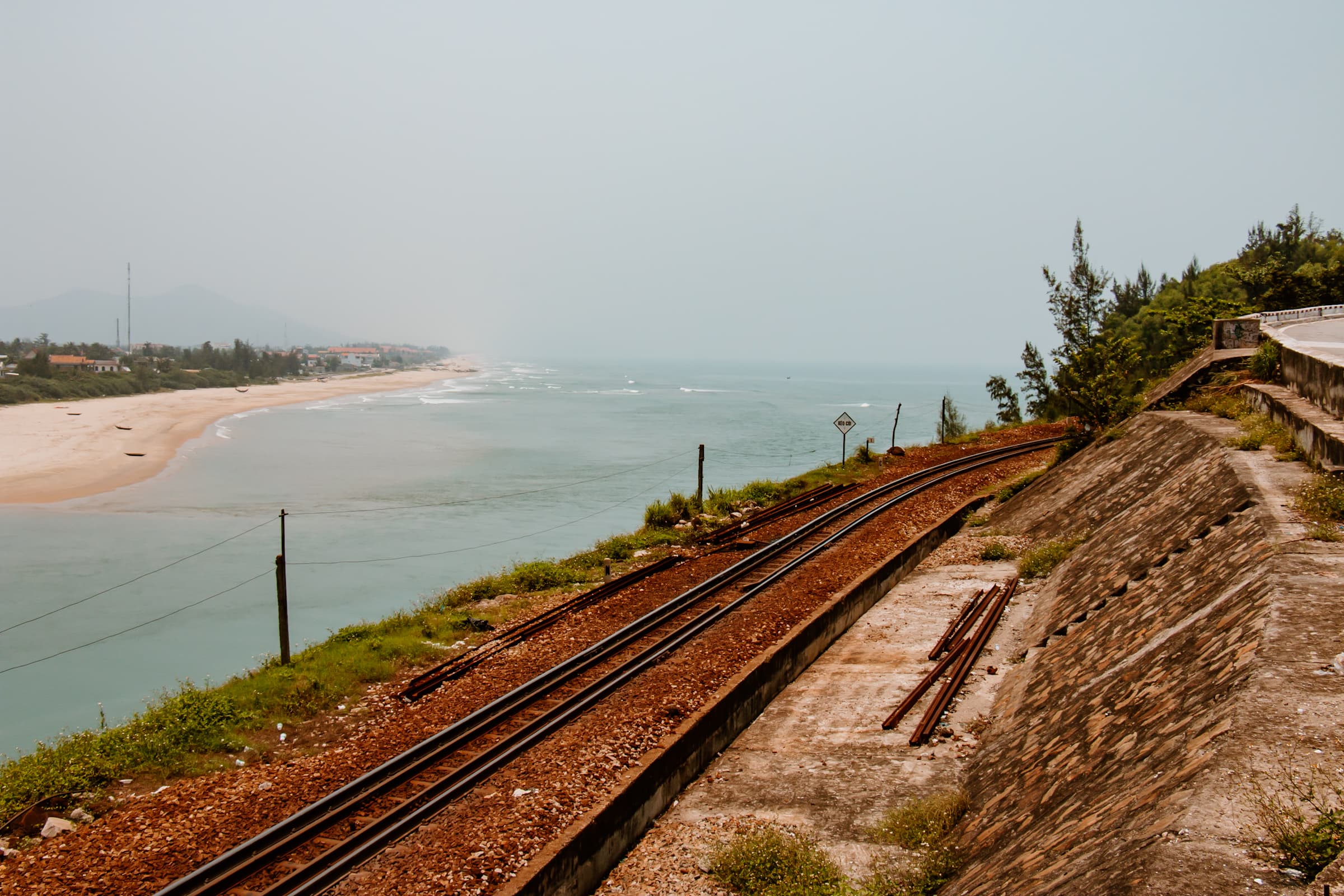
    On the Cloud Pass, the train runs along the sea – gorgeous views included.

    Is a train ride in Vietnam worth it?

    The train ride was really comfortable (be sure to book 1st class) and relaxing. There was something about letting the landscape pass you by in the morning. For those traveling on a tight budget, there is also the advantage of saving a hostel/hotel night when traveling by overnight train.

    Certainly there are night buses. Personally, I always try to avoid them, as night buses seem fundamentally more unsafe to me in terms of potential bag/luggage theft, etc. On the train, on the other hand, I didn’t worry about it, it doesn’t stop often on the way, and the luggage always stays close by in the compartment.

  • Saigon Street Food Guide: What You Need to Know

    Saigon Street Food Guide: What You Need to Know

    Saigon Street Food – this has become a household name even back home in Berlin. So a street food tour in Saigon* or Ho Chi Minh City seemed pretty obvious! Vietnamese cuisine is so diverse, so fresh, so full of new flavors, and within Southeast Asia, it’s a flavor all its own. In Saigon in particular, the choice of street food stalls, small snack restaurants and roadside food stalls is almost endless.

    Vietnamese are sociable and love food, people are constantly chewing on something somewhere, (unfortunately disposable) bowls filled with goodies change hands and you really wonder how the majority of the population here can still be so slim. Because Vietnamese cuisine is not always easy! In Vietnam, too, people fry for all they’re worth, and sugar is consumed just as excessively.

    Street Food Tour Saigon

    Street Food in Vietnam – a culinary adventure

    One thing in advance: you might not want to try many dishes served in the streets of Saigon in general. Unless you’re really into experimenting. Vietnamese cuisine is often praised for its French influences and thus exciting combinations – and at the Vietnamese at home in Germany it is always delicious. But what is often overlooked: In Vietnam, people really do eat everything.

    Vietnamese love meat, so much so that vegetarians sometimes have a hard time finding a vegetarian dish. Vegans even more so. And on the one hand very commendable, but for the European (or at least my) palate quite unusual, here really everything is eaten from beef, pork, chicken, fish, seafood, and even frog or snake: From fillet to the most bizarre offal.

    Street Food Tour Saigon

    At the really authentic stalls you don’t get far with English, there is no map even in Vietnamese. Often you don’t dare to try something – you never know… For this reason and because I still really wanted to try some (but not quite so) exotic street food in Saigon, I went on a street food tour in Saigon*– and it was great! Sam, who was traveling with me, showed me the wackiest corners of Saigon and let me sample fantastic food (with no unpleasant surprises).

    What is the difference between summer rolls and spring rolls?

    While in this country spring rolls are deep-fried rolls and called summer rolls rolled in soft, light rice paper, for Vietnamese everything is simply spring rolls! Summer rolls seem probably rather an invention of the West. So we started off with one of the freshest spring summer rolls to roll yourself that I have ever eaten. Fresh herbs and lettuce that it just cracked.

    Street Food Tour Saigon

    Bánh Tráng Nướng: Vietnamese pizza

    Vietnamese have invented their very own version of pizza. It doesn’t really have anything to do with an Italian pizza except for the shape, but it’s still a popular snack. Rice paper, a cream that is supposed to represent cheese, various sauces and mayonnaises, sliced sausages – somehow all sorts of things end up on the Bánh Tráng Nướng Pizza. Which amazingly then even tastes! In addition, there was then Nem nướng, grilled sausages – garnished with the obligatory fresh herbs, which must not be missing anywhere.

    Street Food Tour Saigon

    Trứng Cút Nướng Phô Mai: Grilled quail eggs with cheese

    Why quail eggs are so popular in Vietnam is for a very simple reason, Sam revealed to me. A whole hen’s egg would be far too much as a portion for a small cupcake like the ones in the mini bowls – and would be too filling. Slowly, I discovered the secret of the Vietnamese diet, which seemed to eat all the time: Always small portions instead of huge dishes.

    Street Food Tour Saigon

    In the pale glow of streetlights, we were now sitting somewhere in the middle of Saigon on the side of the road on our kindergarten stools, like those used in abundance at street food stalls in Vietnam, eating our quail egg muffins called Trứng Cút Nướng Phô Mai and Bánh Xèo, stuffed pancakes. And here again lots of fresh herbs, which Sam explained to me individually (and whose names I also immediately forgot again, because I was only busy with amazement).

    Chè Bưởi: Dessert in Vietnamese

    I have no idea what Sam was handing me – it was called Chè Bưởi and she translated it as “sweet grapefruit soup.” Somehow it was sweet, creamy, fruity and fresh at the same time; just the right thing at night 30 degrees air temperature.

    Street Food Tour Saigon

    Book Street Food Tour in Saigon

    Street food tours like this take you to very remote corners of the city that I probably never would have gotten to see without Sam. They are usually advertised as “Students show you street food in Saigon” and in fact Sam was a student who knows a lot about street food mainly because she only lives in a small room and actually eats out all the time – just like many students in Ho Chi Minh City.

    Street Food Tour Saigon

    The spots are spread all over the city and you are driven from spot to spot on a scooter. Helmets are provided. A great opportunity to experience the crazy traffic in Ho Chi Minh City first hand! In addition, the tours are very individual and personal, because there is a guide or driver for every guest.

    Book authentic street food tours through Saigon here*

  • Mekong Delta in Vietnam: The Floating Markets of Cai Rang

    Mekong Delta in Vietnam: The Floating Markets of Cai Rang

    From Saigon, I continued south—and even though I’d already really liked Ho Chi Minh City —things were about to get even better in the Mekong Delta. I highly recommend taking a side trip to the Mekong Delta from Saigon! Here, you’ll find vibrant life at the floating markets on the Mekong and a glimpse of the real, authentic Vietnam. A Mekong Delta boat tour is a once-in-a-lifetime experience. If you do it right, you can immerse yourself deeply in the local culture and get to know the lives of the locals. In this article, I’ll tell you the best way to make that happen.

    Mekong Delta

    Homestays in the Mekong Delta: Off into Nature

    I often decide spontaneously on the spot where I want to go further and after the busy and sometimes noisy Ho Chi Minh City, a bit of nature seemed like a good change. In the Mekong Delta you can find a lot of homestays. There you stay with locals on their property or in their house, sometimes more, sometimes less easy.

    By chance, I came across a homestay with lots of little bungalows: small bamboo huts overlooking the river—a tributary of the Mekong—just like the hundreds of others here. Very simply furnished, without air conditioning or frills, but with a genuine tropical vibe right in the middle of South Vietnamese jungle. Chirping crickets, croaking geckos and frogs, crowing roosters. Real country life, far away from any civilization, at least that’s how it feels. In reality, the nearest major city, Can Tho, is only a few kilometers away – but that just seems unbelievable.

    ➜ Click here for the homestay in the middle of the jungle*

    Mekong Delta

    Have you acquired a taste for it?
    On the Vietnam Blog, you’ll find even more tips for your trip to Vietnam

    A Boat Trip Through the Vast and Branched Mekong Delta

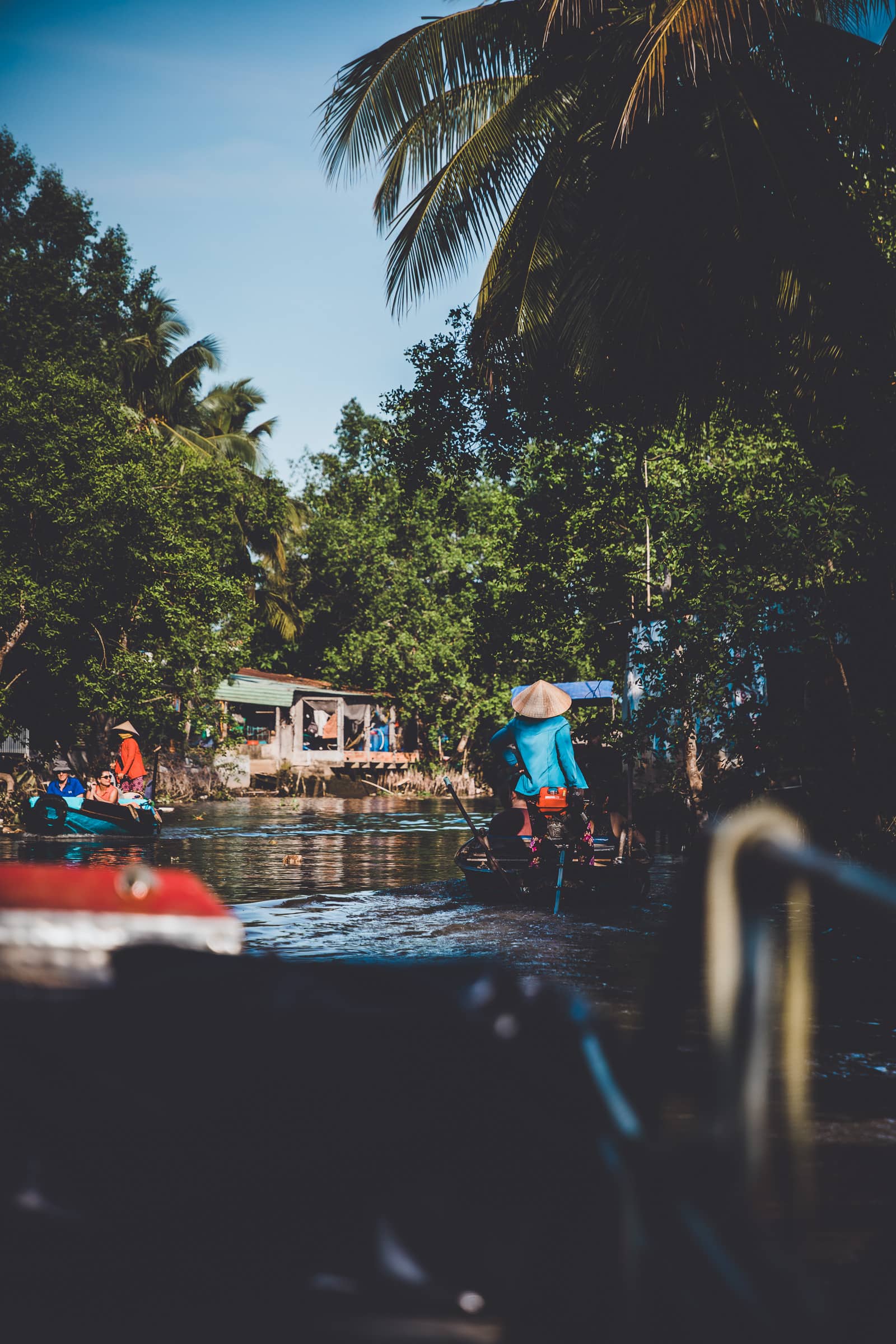
    Traveling individually is often exhausting, planning everything, organizing everything – it rarely looks like a vacation. In return, you will be gifted with the most impressive experiences. With a small motorboat made of wood, more nutshell than boat, we sailed at half past five towards the sunrise, in our mini-group, through the branched, narrow side arms of the Mekong.

    On the right and left, densely overgrown riverbanks full of palm trees and tropical trees. Lucy, our tour guide, courageously cuts down a palm leaf with a huge knife and with admirable dexterity makes rings and small animals out of the leaves to pass the time. But this is not necessary at all, the ride over the almost still sleeping river in the middle of this jungle panorama is already pastime enough.

    Mekong Delta

    The Cai Rang Floating Market: Sunrise on the Mekong

    Just in time for sunrise, the rising sun behind us, we turn into the floating market of Cai Rang, the Cai Rang Floating Market, with our little boat tour. That’s right, a floating market: Like so many markets here in the Mekong Delta, the market of Cai Rang is located in the middle of the river.

    Mekong Delta

    Traders exchange goods directly from boat to boat, in between old women in their mini-boats, on which they have installed small cookshops and thus supply the workers – and depending on the time of day also the one or other tourist boat. We in our little nutshell were early, before the big tourist rush. To experience the floating market of Cai Rang at sunrise, when the market life is still in full swing, is unique.

    Mekong Delta

    Market Life at the Floating Markets on the Mekong River

    We hopped from boat to boat, ate breakfast to karaoke music (Vietnamese love karaoke, regardless of their own singing skills, which is both quirky and likeable), shimmied out of our nut shell up steep boat walls to nibble on freshly carved, cardboard-sweet pineapple – and around us, pure market life. Rumbling diesel engines, sacks of vegetables and grain flying around, people hard at work. Somehow surreal that all this takes place on the water – but that’s Vietnam in the Mekong Delta: The Mekong is the lifeline without which nothing would function here.

    Mekong Delta

    Around the floating market of Cai Rang there are also numerous manufactories. Like this one, for example, which painstakingly makes rice noodles. First, the dough is baked into a flat cake, which is then dried and stacked on bamboo mats and finally put through a noodle press. Everything by hand, without large machines and almost in the open air. Just like the coconut candy you can buy anywhere. They are not for loose fillings or third teeth, but taste very delicious and coconutty!

    Boat Tour to the Mekong Delta from Saigon or Ho Chi Minh City

    From Saigon, there are numerous operators offering day trips into the Mekong Delta to the floating markets. The vendors like to go to the markets of Cai Rang and Cai Be, usually also with a small supporting program. If you have only little time and don’t want to continue your journey from Saigon towards Cambodia or Phu Quoc, but rather towards the north, such a day trip is a good possibility to see at least something of the Mekong Delta.

    ➜ Book a day trip from Saigon to the floating markets in the Mekong Delta here*

    Mekong Delta

    Disadvantage: Most of the way to the market is by bus. The trip takes about 3 hours, so you spend a lot of time getting there and back. While most tours are very inexpensive, most also stop at coffee run type shopping areas. Also, the groups are usually quite large, and you arrive at the markets relatively late—by which time most of the hustle and bustle has already died down. (I’ve linked a slightly more expensive tour for you above; the group is smaller, and the itinerary sounds nicer. Travel agencies in Saigon often offer tours for a fraction of the price, but every traveler I spoke with was, without exception, disappointed by these tours!)

    So if I were to go on an organized tour, I would choose a multi-day tour of the Mekong Delta.

    ➜ You can book multi-day tours to the Mekong Delta here*

    Mekong Delta

    Planning Your Own Mekong Delta Tour: Accommodations & Helpful Tips

    But you can also organize your own Mekong Delta tour! It takes more effort, but it’s definitely worth it! Here are a few tips:

    • Take the Open Bus from Saigon to Can Tho—> —preferably on the orange buses operated by Futa Travel, and then continue by taxi from there
    • Homestay in Can Tho, right in the middle of the jungle : Homestay Mekong Can Tho*(from there, you can book a $15 sunrise boat trip to the Cai Rang floating market, as well as an $8 sunset boat trip that includes a visit to private fruit orchards) Note: Due to its location, there are a lot of mosquitoes—it’s worth bringing mosquito repellent containing DEET with you from Saigon!
      ➜ You can book your stay at Homestay Mekong Can Tho here
    • For those who prefer a more urban vibe: A super-friendly and comfortable homestay run by a pair of Australian-Vietnamese sisters—I would have loved to stay here even longer; they’re both so warm and helpful! I wholeheartedly recommend it!
      ➜ You can book your stay at The Mag here*

    Tip: From Can Tho, you can also organize your own boat trips to the floating markets! Just walk along the pier and within a few minutes, you’ll be approached by various ladies. You can rent boats for a Mekong tour all day long, but it’s still worth going early in the morning before sunrise to get a real feel for the market atmosphere!

    Mekong Delta
  • The 10 Best Things to Do in Saigon, Vietnam

    The 10 Best Things to Do in Saigon, Vietnam

    Are you planning a stopover in Ho Chi Minh City or Saigon during your trip to Vietnam? You’ve come to the right place: in this article, I’ll reveal my best Saigon tips and which Saigon sights you shouldn’t miss! Whether it’s the best street food, the coolest restaurants or the best accommodation: In this guide to Ho Chi Minh City (official name of Saigon!) you will find what you are looking for.

    Street in Ho Thy Ky Flower market Saigon flower market

    How to enjoy your stay in Saigon

    Saigon may be the largest city in Vietnam, but it’s nowhere near as overwhelming as Bangkok or Hong Kong. The only thing that really takes some getting used to (and this applies to the whole of Vietnam in general) is the traffic with trillions of scooters, of which every Vietnamese seems to own at least one. Honking is a way of making yourself noticed in traffic, but you don’t flash your lights – so the traffic in a city like Saigon is simply a huge, loud wave of honking scooters.

    Mototaxis, scooters that you simply hop on, are also popular. Grab, a cab service similar to Uber where you can choose between a scooter or a normal cab, is also popular. However, when it was 40 degrees I usually took the car – and enjoyed the air conditioning. In general, Grab is an ideal way to get from sight to sight, it is cheap and much easier than traveling by public transport.

    Why Saigon should be on your bucket list for your trip to Vietnam

    It has now been four years since I was last in Vietnam. I left the country feeling very ambivalent at the time – somehow I didn’t get the full enthusiasm. I had previously only known Thailand in Southeast Asia, a country that makes it very easy for Western tourists to feel at home straight away. I had a slightly different experience in Vietnam. But more on that later. As I had visited the most important places in northern Vietnam such as Halong Bay, Hanoi, Hoi An, Hue and Da Nang last time and didn’t have time for the south, this time I wanted to get to know Saigon, the Mekong Delta and a few other places and try Vietnam again.

    Are you planning a trip to Vietnam?
    Here you’ll find all the articles and helpful tips for Vietnam!

    1. The Main Post Office Notre-Dame Cathedral

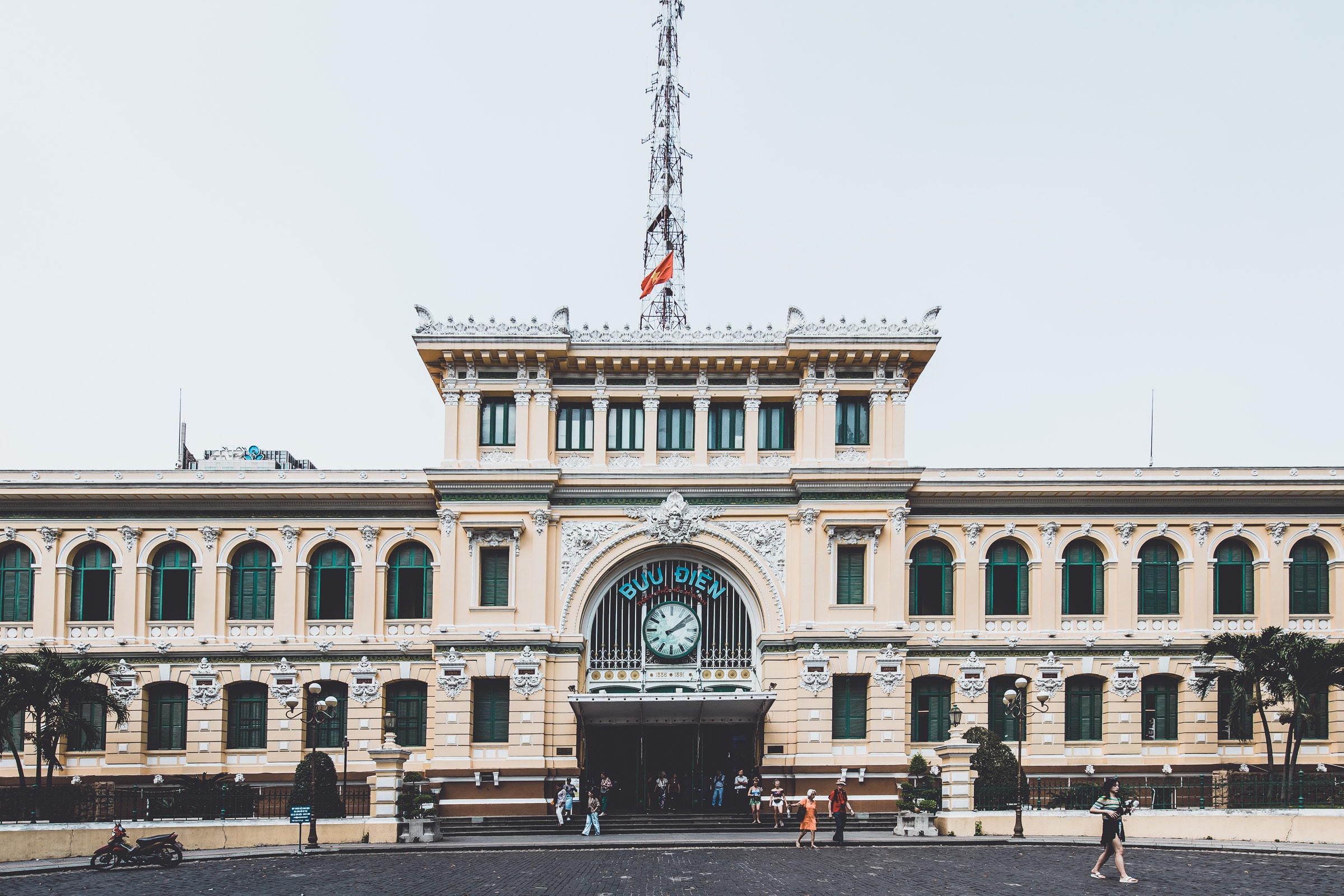
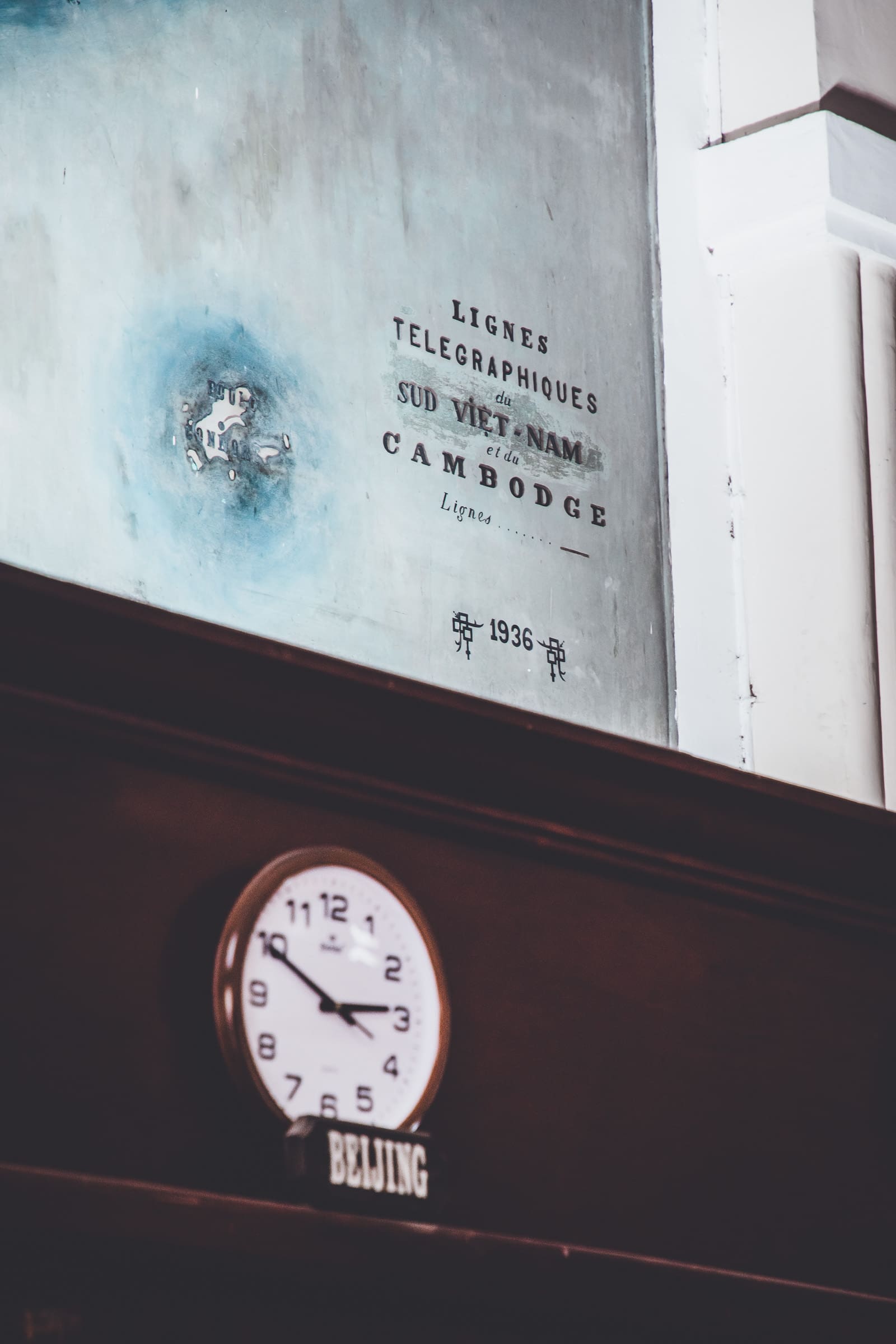
    Saigon has few really spectacular sights, but many places are still interesting. The main post office, for example, was built during the French colonial era, and the steel structure inside was designed by Gustave Eiffel. A portrait of Ho Chi Minh hangs large at the head of the main hall. Quirky: Souvenir shops are located in the side wings and in the center of the hall, and the entire post office is filled with groups of tourists, while business as usual continues at the post office counters all around—with people buying stamps and picking up packages.

    Places of interest in Saigon Main Post Office
    The main post office in Saigon dates back to the French colonial era.
    Saigon Sights Picture of Ho Chi Minh at Saigon Main Post Office
    Regular operations in Saigon’s main post office under the oversized portrait of revolutionary leader Ho Chi Minh.
    Saigon sights Clock and map in the main post office of Saigon
    French traces can be found everywhere in Saigon.

    The great architectural influence of the French can also be seen in another of Saigon’s sights, Notre-Dame Cathedral (yes, there’s one here too!), just opposite the main post office. It is currently being renovated.

    Notre Dame Cathedral in Ho Chi Minh City Saigon Vietnam
    The Notre Dame Cathedral is also a relic from the French colonial era in Saigon.

    2. Ho Chi Minh City People’s Committee and Saigon Opera House

    Two other landmarks from the French colonial era are the Ho Chi Minh City People’s Committee—Saigon City Hall—and the Saigon Opera House. While City Hall is not open to the public, the Opera House can be visited during performances: the acrobatic show with South Vietnamese influences is said to be well worth seeing!

    ➜ Click here for the A-O and Teh Dar show at the Saigon Opera House*

    Saigon sights City Hall in the evening light Ho Chi Minh City People's Committee
    Could also be in California: Saigon City Hall.
    Saigon sights Statue of Ho Chi Minh
    …except for the huge Ho Chi Minh statue in front of it, of course.
    Saigon sights Opera House
    Sometimes even with a red carpet: the Saigon Opera House.

    3. Viewing platforms on the Bitexco Financial Tower Landmark 81

    The Bitexco Financial Tower is Saigon’s second tallest skyscraper after the brand new Landmark 81 just outside the city. The large, protruding platform at the top of the tower is striking. However, this is not the viewing platform, but a helipad. It doesn’t seem to be used much – and it looks more like a prestige object. The Skydeck slightly below on the 49th floor is the publicly accessible viewing platform, where you can enjoy a view over Saigon for the equivalent of around 8 euros. Further up there is a restaurant/bar, which is free of charge, but understandably you have to consume something here.

    Sights in Saigon Bitexco Tower from the backyard
    The architectural contrast could hardly be greater. You can see the Bitexco Tower directly from an old backyard.

    Landmark 81 also has an observation deck. However, I skipped the views from both locations because I was running out of time—and I’d already had a fantastic view of the city from the plane. The view of Saigon from the opposite bank is also spectacular!

    Ho Chi Minh City skyline by night
    The Saigon skyline at night: a bit like Shanghai.

    Tip: In the evening, this is where the locals hang out. There are the usual street food stalls and makeshift cocktail bars, and it’s the perfect way to wind down the day here on one of the folding chairs with the best view of the Saigon skyline! And best of all: no tourist crowds!

    4. Ben Thanh Market

    I always love checking out markets in unfamiliar cities—getting lost in the hustle and bustle and discovering exotic things, especially in faraway countries; that’s right up my alley. The Ben Thanh Market is right in the heart of the city—a large, covered market hall with fruit, vegetables, clothes, souvenirs, and street food stalls. However, it’s also a huge tourist magnet; if you prefer a more local experience, you should check out a market like Tan Dinh Market or An Dong Market.

    Saigon sights Ben Thanh market with market stalls
    The Ben Thanh market has everything: food, handbags, tailor-made suits, false eyelashes in economy packs.
    Snails, crayfish and seafood at Ben Thanh Market, a tourist attraction in Saigon
    Tailoring in the Ben Thanh market in Saigon
    Tailor-made suits in one day: no problem in Vietnam.

    Right next to Ben Thanh Market, there’s also a well-known pho restaurant called Pho 2000. Pho is one of Vietnam’s national dishes—you absolutely have to try it! Pho is a noodle soup to which fresh herbs, chili, and lime juice are added at the table. It’s traditionally served with chicken or beef, and often with tofu as a vegetarian option. Pho 2000, a simple restaurant, became famous above all after Bill Clinton slurped down a bowl of pho here in 2000 during a state visit.

    Pho 2000 in Saigon
    Pho 2000: Bill Clinton was here.
    Pho soup at Pho 2000, restaurant tip in Saigon
    Vietnamese pho: noodle soup with lots of fresh herbs. A specialty!

    5. Reunification palace

    Before the Vietnam War, the Reunification Palace was the seat of the South Vietnamese president. The Vietnam War came to an end with the fall of Saigon on April 30, 1975, at the hands of the Vietnam People’s Army and its tanks, which rolled over the fences here. Today, the grounds and some of the rooms are open to the public.

    Propaganda poster end of war in front of Reunification Palace, Saigon, Vietnam
    The end of the war is celebrated in a big way every year. There are posters everywhere in the city, as if from another era.

    6. War Remnants Museum

    The War Museum was probably my biggest disappointment in Saigon. Many tourists I had spoken with beforehand were absolutely thrilled by the War Museum, which is considered one of the largest and best of its kind in Asia. I really took a thorough look at everything from top to bottom (the museum spans three floors), hoping to learn a little more about the historical context and background of the Vietnam War.

    I found the possibility that the depictions might be biased quite intriguing, and in a way, I had actually expected it. Even though I’d heard many times that the exhibition was supposed to be completely neutral. In my experience, however, it’s anything but neutral! On top of that, the exhibition is very poorly designed from a technical standpoint. I was particularly interested in the photo exhibition featuring famous war photographers—but the images, which are actually quite impressive, are so poorly lit that you’re better off picking up a good photo book.

    War Remnants Museum, place of interest in Saigon

    As expected, the exhibition is anti-American and completely omits the background of the opposing side. To a certain extent, this is understandable. But to pretend to be neutral in this context is very risky. Historical context is also only touched upon briefly, so that when I left the museum, I didn’t feel any wiser about the history of Vietnam.

    I also found the matter-of-fact display of American military equipment—such as machine guns, bazookas, and bombs—at every turn to be very bellicose and unsettling. It’s part of the theme, but the way it was presented and the sheer volume of it were somehow too much.

    War planes in the War Remnants Museum, Saigon
    Solidarity with Vietnam poster from the Vietnam War at the War Remnants Museum, Saigon

    My personal low point, however, was two other things: First, the gift shop, which sells completely out-of-place souvenirs ranging from card games to American Hollywood movie posters to a biography of Michelle Obama (even though everything else here is anti-American) —and second, the fact that visitors were beaming with joy as they had their pictures taken with the tanks in front of the museum. When I saw the two girls—obviously tourists from the West—having a friend film them as they performed a cheerful cheerleading dance routine among tanks and military helicopters, my jaw finally dropped.

    Souvenir store at the War Remnants Museum, Saigon

    7. Ho Thy Ky Flower Market

    Vietnamese people love flowers. Flowers are often used as decorations at the numerous festivals held throughout the year or as religious offerings. At the Ho Thy Ky Flower Market, you can immerse yourself in a sea of flowers while sampling delicious street food. Most of the flowers here come from the mountainous region further north around Dalat or from the Mekong Delta. By the way, I tried in vain to figure out exactly what’s added to the flower water to keep them so incredibly fresh. Especially with air temperatures just shy of 40 degrees… I guess the chemicals are at work here. By the way, I read that you should stay away from apples in Vietnam because they’re sprayed with such incredibly strong pesticides there—so be careful.

    Flowers at the Ho Thy Ky Flower Market

    8. Tan Dinh Church / Pink Church

    What makes this church special—as the name suggests—is its color. Painted pink from top to bottom, even on the inside, this church is a sacred spot for all Asian Instagrammers. At least, that’s how it seems when you see the hordes of young girls posing in front of the church, all searching for the best photo spot. (Try searching for #pinkchurch on Instagram!) I would have liked to see the inside of the church, too—but unfortunately, a service was in progress.

    Saigon sights Pink Church Tan Dinh Pink Church
    The pink church in Saigon: quite beautiful.
    Girl in front of Pink Church, Ho Chi Minh City
    Selfie alert in front of the pink church in Saigon.

    9. Sri Mariamman Temple

    The Hindu community in Vietnam isn’t particularly large, so the Sri Mariamman Temple near Ben Thanh Market isn’t all that spectacular either. But if you’re in the area anyway, it’s worth a visit. Note: Take off your shoes!

    Sri Mariamman Temple from the inside, Saigon

    10. Pham Ngu Lao – Backpacker Street with night market

    Once darkness falls, the nightlife here really comes alive. Thumping bass, street food vendors with their little carts, local girls, Western tourists—from backpackers to those on Neckermann tours—and locals too— Pham Ngu Lao is a must-see.

    During the Vietnam War, bars and lodging options—ranging from expensive to inexpensive—sprang up along this street. Here, American troops could stock up on everything they needed. In some ways, the Western influence has lingered to this day, and you can still find numerous bars and lodging options around Pham Ngu Lao.

    Saigon sights Nightlife on Pham Ngu Lao
    Party every day: Pham Ngu Lao is quite reminiscent of Khao San Road in Bangkok.

    Excursions from Saigon: What else can you see?

    There are a number of excursions you can take from Saigon. A visit to the Cu Chi Tunnels is a popular choice. During the Vietnam War, the Viet Cong expanded the tunnel system—which had already existed since the colonial era—to create a complete infrastructure that included living quarters, hospitals, and schools.

    What makes the connecting tunnels particularly remarkable is their size: 80 centimeters high and 60 centimeters wide. One section of the tunnel has been preserved to this day (and has even been slightly enlarged to accommodate the towering tourists from abroad) and is open to visitors.

    ➜ You can book your tour to the Cu Chi tunnels here*

    Another popular excursion is a day trip to the Mekong Delta to visit the floating markets on the Mekong River. However, a day trip is really quite rushed, and there’s a high chance you’ll end up on a mass-market tour that feels like a sales pitch. I think it’s advisable to book a trip for several days.

    ➜ Multi-day tours through the Mekong Delta*

    I was also in the Mekong Delta after Saigon. But as I didn’t want to go back to Saigon for the time being, I went there on my own:

    ➜ C lick here for my article about the floating markets in the Mekong Delta

    My very personal Saigon tips: Street Food & Cafés

    Aside from the typical sights you’ll find in any Saigon travel guide, I discovered plenty more exciting things in Saigon! I found the many truly great and unique cafés and restaurants particularly interesting—they even impressed me, a Berliner who’s quite spoiled in this regard. And the delicious street food—which I probably would never have discovered without a fantastic street food tour.
    But the best thing of all was the great locals, who immediately made me forget my bad experience last time and gave me lots of great tips. I often think that you should definitely visit a country a second time, even if the first time wasn’t particularly nice. Sometimes a country only reveals itself to you on a second visit.

    Where can you find the best street food in Saigon? What is typical Vietnamese street food?
    More About Street Food in Saigon

    Saigon sights Katinat Café
    There are countless cafés in Saigon – each one more beautiful than the next.

    Practical tips for Saigon – information for your trip

    From the airport to the city

    When you arrive at the airport by plane, you can take either a regular taxi, Grab, or the public airport bus into the city. The airport is only 7 kilometers from downtown, so a taxi won’t be too expensive. I used Grab the whole time, since I’d read quite a bit about rigged taximeters and fake taxis. I preferred Grab because, like with Uber, the price is fixed from the start. From the city to the airport, I once paid about 90,000 dong, which is about €4.50. The only cheaper option is the airport bus, which goes via Ben Thanh Market to the bus station near Pham Ngu Lao: 20,000 dong, just under 1 euro.

    Continue by bus

    If you want to continue your journey by bus from Saigon, any hotel or travel agency can usually help you. The intercity buses operated by FUTA Travel—which are usually orange—are popular and reliable. They have offices throughout the city, including near Pham Ngu Lao. There, you can buy a ticket and will be taken by minibus to the bus station, which is located outside the city center. Fares are very affordable, and the comfort is decent—the sleeper buses, with their semi-reclining seats on two (!) decks, were perfectly adequate for me at 1.60 m tall. Full-grown European men might find it a bit more cramped.

    Moving around the city

    Within Saigon, I highly recommend Grab! Although there’s good Wi-Fi everywhere and you can use the app, I’d highly recommend buying a local SIM card, which you can pick up right at the airport. Or you can buy an eSIM in advance; I like to use eSIMs from Saily or Holafly.

    Safety in Saigon: Is it dangerous?

    I’ve been warned several times by locals about pickpocketing and cell phone theft. Apparently, pickpockets riding by on scooters often snatch cell phones right out of people’s hands. The same thing seems to happen with handbags or backpacks that are carried over just one shoulder. If you carry them on both shoulders, you’re probably safe. However, as a solo traveler, I’ve always felt relatively safe, even at night. That’s also one of the reasons why I always buy a local SIM card and keep my cell phone handy—if I start to feel uncomfortable, a Grab taxi will be there in a few minutes.

    Best time to travel to Saigon: When is the best time to travel to South Vietnam?

    Basically, the seasons in Vietnam are divided into a dry season (November through April) and a rainy season (May through October). For Europeans, this coincides with the European winter. Just before the rainy season begins, it gets really hot and humid again. From my own experience, I can say: This is only for the truly hardy! You’ll have to scale back on hardcore sightseeing itineraries—otherwise, frequent breaks are a must.

    Cat in raffia basket

    Accommodation in Saigon

    Most tourist hotels are located around Pham Ngu Lao (which has many backpacker accommodations) or right in the city center. However, it can get very noisy around Pham Ngu Lao, so if you’re hoping for a peaceful night’s sleep, you might be better off choosing a different place to stay.

    I chose a place to stay a little outside the hustle and bustle, but still very centrally located. The Common Room Project* is more of a housing project than a hotel—the staff are really nice, and all in all, it has a very warm and welcoming atmosphere. They offer both dorms and private rooms.

    ➜ It’s best to book your room at the Common Room Project in advance (there are only a few private rooms available)

    Once, when I came back very late, the receptionist jumped up from his chair, looking both relieved and excited—he had been worried about me because he hadn’t seen me the whole time. I’ve never experienced anything like that before.

    The roof terrace is also legendary and is a popular venue for movie nights. And what made me even happier as a Brazilian: the caipirinha bar probably makes the best caipirinhas in Vietnam!

    Caipifruta with passion fruit in rooftop bar in Saigon Vietnam

    Do you say Saigon or Ho Chi Minh City?

    The first question I asked myself was: Do I say Ho Chi Minh City or Saigon? After all, I don’t want to put my foot in my mouth. The last time I was in Vietnam, I noticed that political topics are often avoided (at least with tourists). Vietnam is a communist country, but as in China, the boundaries to capitalism are very blurred on the surface and with a Starbucks or H&M in front of your nose, you are quite confused as to what is supposed to be communist here.

    Katinat Café at an intersection in Ho Chi Minh City Vietnam

    After the end of the Vietnam War and the communist Viet Cong’s takeover of South Vietnam, Saigon lost its name—which dated back to the French colonial era—and was renamed in 1976 after the (communist) revolutionary leader Ho Chi Minh, who had already passed away by that time. So a tremendous piece of history is associated with that name.

    I then asked around cautiously several times, but the locals still always say “Saigon”—“Ho Chi Minh City” is only used on official occasions. (Incidentally, Vietnam’s political history is very complex. I’m doing my best to present the facts here truthfully and accurately. After all, even a travel blogger who only visits places superficially should be mindful of historical context. But if anyone knows more about this or wants to point out corrections—please feel free to leave a comment. I’d really appreciate it.)

  • Hoi An: 8 tips for one of the most beautiful cities in Vietnam

    Hoi An: 8 tips for one of the most beautiful cities in Vietnam

    Hoi An is probably the biggest tourist trap in Vietnam. And I still thought it was great, even though I’m rarely enthusiastic about places like this. Hoi An was completely different to what I had seen of Vietnam so far. At first glance, the old town of Hoi An is a mix of crowded tourist stronghold and highly polished attraction that has little to do with the rest of Vietnam.

    Old Vietnamese building with a bicycle and a vintage sign
    Beautiful motifs can be found on every corner in the old town of Hoi An.

    Having previously sailed through Halong Bay, fought my way through the hustle and bustle of Hanoi and taken a unique tour from Hue on a motorcycle, this stop was something completely different.

    Still, I had such relaxing days. So in this article, I’m sharing my best tips and spots in Hoi An with you, along with 8 reasons why you shouldn’t miss Hoi An on your trip to Vietnam!

    1. Hoi An: Paradise in Vietnam

    You’ll probably follow the usual itinerary on your trip to Vietnam, which means traveling either from north to south or vice versa. Hoi An is located almost exactly in the middle of Vietnam. This makes it the perfect place to spend a few quiet days after a hectic trip through cities like Hanoi or Ho Chi Minh City.

    If you’ve been traveling in Vietnam for a while, you’ll notice how loud the streets are—and it might get on your nerves. That’s because the Vietnamese love to honk! They honk constantly—when passing other cars, at traffic lights, and when turning. And the streets are full of scooters, which are especially popular in Vietnam.

    Traditional Vietnamese lanterns hang in front of an old building in Hoi An

    Hoi An is a welcome exception: Only bicycles and non-motorized rickshaws are allowed in the historic center; cars and scooters are banned. The entire historic center is one big pedestrian zone! This means you can explore the old town on foot at your own leisure, without having to worry about getting run over by the nearest scooter rider.

    A woman wearing a straw hat strolls through a bustling Vietnamese old town

    The old town is quite clear. All the sights in Hoi An are close to each other. You can stroll leisurely through the streets and stop at the pretty cafes and restaurants. Many houses are also open to the public: there are often benches in the courtyards: just sit down and let yourself drift.

    2. the history of Hoi An and the historical old town

    Hoi An was founded by the Cham in the 4th century—that’s how old the city is! Between the 16th and 19th centuries, the city grew in importance. The port became one of the most important trading ports in the South China Sea until it was replaced by nearby Da Nang. However, the old buildings were preserved, and since Hoi An had completely lost its strategic importance, the old town remained entirely untouched even during the Vietnam War. That’s great for us, because it means Hoi An is now a magical place steeped in history.

    Traditional Vietnamese gate in Hoi An with the Vietnamese flag

    Although the old wooden houses in the Old Town have been hit by flooding several times, they are in very good condition. Most have been in the same family for generations, and many of the houses can also be toured from the inside. Most of the houses in Hoi An’s Old Town are actually inhabited, which is something to keep in mind when choosing what to wear. Vietnamese people are not very open-minded: covering your shoulders and knees is always a good and respectful choice when entering a private home.

    hoi an

    There are small ticket booths scattered throughout the Old Town where you can buy a 3-day pass. This pass grants you free admission to all attractions in Hoi An.

    backyard in old house
    old house in hoi an

    Looking for accommodation in Hoi An?
    Book here at affordable prices

    3. food in Hoi An: Vietnamese cuisine at its best!

    Hoi An is truly every foodie’s dream! There’s great food around every corner here, no matter your budget. Whether it’s small street snacks or elaborate menus at one of the many upscale restaurants, I haven’t had a single bad meal in Hoi An! Vietnamese cuisine is always very fresh and flavorful, but in Hoi An there are also plenty of innovative cafes and restaurants offering fantastic takes on Vietnamese specialties.

    Cooking course in Hoi An

    If you want to know how to recreate these dishes at home, just sign up for the right cooking class. Many restaurants also offer these kinds of classes, and they usually include a trip to the market. That way, you can get familiar with the ingredients right away.

    Book a cooking class in Hoi An

    You’ll find cooking classes in many countries in Southeast Asia. You’ll learn a lot about the exotic ingredients, and recreating the dishes at home won’t be that hard after all.
    Here you’ll find a detailed report on my cooking class in Thailand

    Restaurant Tips for Hoi An

    Green Mango serves delicious fusion cuisine that combines Vietnamese basics with Western elements. Things get a bit more experimental at the Mango Rooms, where unusual combinations meet tropical flair. And if you’re only going to visit one restaurant in Hoi An, make it Morning Glory —that’s where I had the best pork bánh mì I’ve ever had.

    But it doesn’t always have to be a restaurant: the street food in Hoi An is delicious everywhere, too!

    A colorful market stall with tropical fruits such as dragon fruit and mango
    Street food in Hoi An
    street food hoi an
    hoi an

    4. cafés in Hoi An: Ca phe sua da & Co.

    As much as I wanted to, I couldn’t bring myself to eat all day. But with temperatures over 35 degrees in the shade, I developed quite a taste for cà phê sữa đá, the typical Vietnamese iced coffee. And there are quite a few cafés in Hoi An. My favorites are Hoi An Roastery and Coco Box.

    A cozy Vietnamese café with guests at night
    One of my favorite cafes in Hoi An: Cocobox.

    You can find even more travel inspiration for Vietnam here

    5. shopping in Hoi An: tailor stores on every corner

    Hoi An is famous for its tailor shops. Throughout the old town, you’ll find numerous small workshops where you can have suits and dresses custom-made. I didn’t buy anything there because, once again, I wanted to save weight in my luggage.

    Hoi An tailor made fabrics

    What I have heard, though, is that tailors in Hoi An are supposed to be more expensive than in other places—it is, after all, a major tourist destination. Also, I’d take a close look at the quality of the fabrics: I’ve often had the impression that they cut corners there, and nothing is more disappointing than investing money and effort in a beautiful piece that, in the end, looks like it came from a discount store just because of the poor fabric quality.

    Hoi An tailor made fabrics

    As for souvenirs, I ended up sticking to tea—it weighs less—and the tea was really great. And if you’re lucky, you can even sample all kinds of different varieties during an authentic Vietnamese tea ceremony.

    Vietnamese tea products in a traditional tea shop
    Popular souvenir from Vietnam: tea in all variations.

    6. nightlife in Hoi An: lanterns, street food and balmy nights

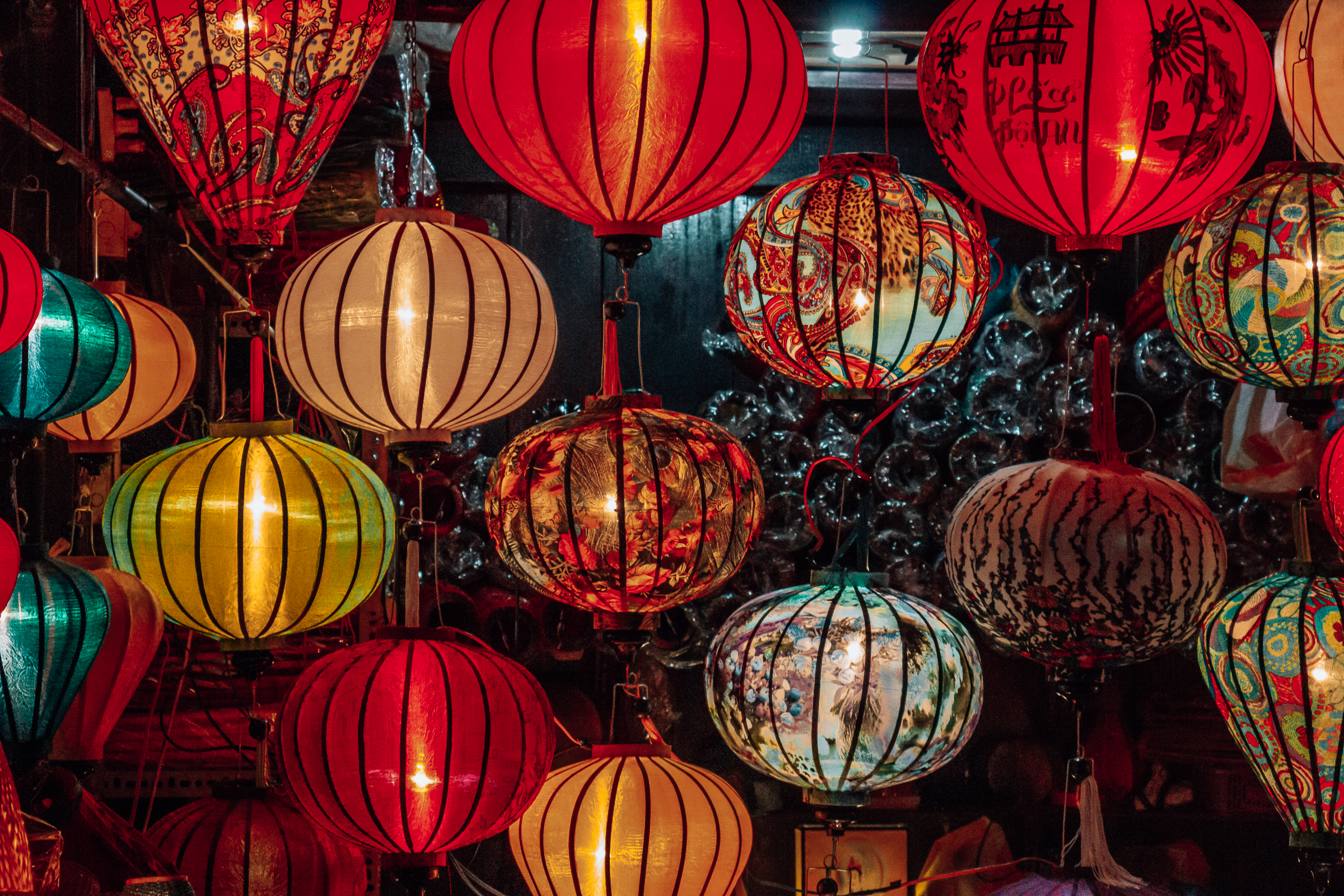
    Hoi An is truly beautiful in the evening, when colorful lanterns light up the entire Old Town. The streets fill with people, and everyone enjoys the balmy nights with a fresh cocktail or dinner at one of the many fantastic restaurants. If you’d like, you can even buy your own paper lanterns at the night market.

    Colorful, glowing Asian lanterns hang decoratively at night
    Especially beautiful in the evening: the many stalls with colorful paper lanterns.
    Glowing lanterns above a bustling street in Hoi An at night
    The whole of Hoi An is decorated with lanterns.
    Hoi An's Old Town at Night with Lanterns and Boats
    Glowing red paper lanterns with candles at a nighttime festival

    7. relaxing on the beach – An Bang Beach

    Had enough of the Old Town? Right nearby, just a 20-minute bike ride away, is An Bang Beach—and it’s a wonderful place to relax after all that sightseeing. The beach is clean and wide, and the water is warm. And just like in the Old Town, you don’t have to worry about food and drinks: the beach is full of vendors who unobtrusively offer snacks and ice-cold water for a small fee.

    A quiet sandy beach with thatched-roof umbrellas and lounge chairs
    Hoi An An Bang beach sunset

    8. off to the countryside!

    If you’re in the mood for some country air and want to experience a bit of life around Hoi An, you should book one of the many day tours offered throughout the city.

    Traditional boat on the riverbank in Hoi An, Vietnam

    Many tours are done by bike, and in some cases you can also visit the small workshops where, for example, the famous paper lanterns are made. Or you can take the opportunity to pet a few water buffalo!

    Traditional bamboo fish traps in the tranquil river delta
    A water buffalo wallows in the mud among the green grass
    A farmer wearing a straw hat leads a water buffalo across a river
  • The Marble Mountains in Vietnam

    The Marble Mountains in Vietnam

    The motorcycle trip over the Cloud Pass in Vietnam held many surprises for me. Every few kilometers we stopped. My driver told me a story, showed me the most beautiful views, and dropped me off somewhere for dinner or coffee. Then in Da Nang we suddenly stopped at an elevator that seemed to be in the middle of nowhere. It quickly became apparent that the elevator led high up on the Marble Mountains.

    For me, one of the absolute insider tips in Vietnam: The Marble Mountains near Da Nang have really impressed me and were an absolute surprise on the trip!

    Marble Mountains Vietnam Da Nang
    The Marble Mountains near Da Nang: A real insider tip in Vietnam.

    My driver Duc would not go up, but now bought me a ticket for me to go all the way down again. (What can now be summarized in one sentence was a quarter of an hour pantomime show due to his English and my non-existent knowledge of the Vietnamese language).

    Da Nang beach

    The Marble Mountains in Da Nang: An absolute surprise!

    That’s all I could get out of Duc, so I just drove up. Probably the Marble Mountains were just a barren tourist trap for some marble souvenirs, I thought, and once at the top I immediately looked for the fastest way down. Not so easy – there were no signs, I didn’t even know where I had landed; and many winding paths led to a few temples and Buddha statues – but not down to Duc.

    marble mountains

    In any case, there were a few tourists around, so this must have actually been some kind of tourist attraction. One of the elderly ladies in front of the temple talked me into buying a few incense sticks, and I briefly enjoyed the silence before continuing my way down the hill.

    marble mountains
    marble mountains

    Check out my Vietnam blog for more interesting travel stories!

    Thanks to the lack of signage, I wandered around a bit until a couple of Vietnamese shouted “here, here!” to me between the densely overgrown paths around the temple. So I just follow behind. (Hm. As a solo traveler I should probably work on this naive reflex – strange men call “this way” and I’ll just follow.)

    The Marble Mountains in Vietnam: So many caves

    The path led behind the temple and grew darker and darker. A few other tourists were also wandering around. My curiosity was piqued. Suddenly, I found myself standing in a cave that was incredibly tall and densely overgrown—and I felt like Indiana Jones. What on earth was this? I glanced briefly into the dark, dim corners of the cave. And there, sure enough, were the most beautiful Buddha statues. Just like that.

    Marble mountains-51

    Beware of the “tour guides” in the Marble Mountains!

    Unfortunately, I couldn’t quite enjoy the moment—one of the “here, here” men had already sensed his chance, ran toward me, and snatched my last few incense sticks, which I had actually wanted to keep as a souvenir. I ran after him, and what at first seemed like an attempted purse snatching was probably meant more as a guided tour of the cave.

    marble mountains

    “Here, to get lucky, get lucky!” my newly appointed cave guide lit an incense stick, pressed it into my hand, and frantically motioned for me to place it in front of a Buddha statue. “Buddha good, Buddha good!” he shouted shrilly. I didn’t have time to take a closer look, because my tour guide had already lit the next incense stick and was herding me toward the next statue.

    We must have put on quite a show: the so-called “tour guide,” who was obviously high on too many stimulants, running manically with me from one dark corner to the next, and me, a naive sheep who was slowly starting to find the situation unsettling but who nevertheless decided to go along with the “tour” for the time being, running after the cave guide—who was on speed and waving my incense sticks behind him.

    Statue Cave Marble Mountains Vietnam
    Gloomy atmosphere: Many of the caves in the Marble Mountains are accessible.

    Fortunately, my pack of incense was soon completely torched, the “guided tour” through part of the Marble Mountains was over, and I pressed a few dong into the man’s hand, which he already held out to me as a matter of course. I was really worried whether his tip would be enough… Well, then. I’ve learned something new. So, in the Marble Mountains, you have to watch out for “tour guides” hanging around.

    Caves & Altars

    The way down, however, turned out to be more relaxed, suddenly huge groups of tourists appeared – I was no longer queasy now – and somehow I had half an orientation. Along the way I discovered one cave after another, large and small, sometimes so small that they could only be reached by climbing and crawling. (I recommend good shoes!) Each cave was an experience in itself!

    marble mountains
    marble mountains

    Practical information for the Marble Mountains

    • You have to pay for the elevator, the exact price slipped my mind, but it wasn’t much.
    • The Marble Mountains are located centrally in Da Nang, tour operators offer various tours there.
    • Be sure to pack sturdy shoes—the descent isn’t suitable for high heels, and the stone steps and caves are often slippery.
    • Be wary of so-called tour guides (see above) and of vendors once you leave the mountain. As soon as you’ve climbed the last step, they’ll immediately be hot on your heels, first trying to strike up a friendly conversation and then trying to foist their marble souvenirs on you.
    marble mountains

    What else to do in Da Nang

    If you’re not continuing on to Hoi An like I am, Da Nang is also a great place to stop for a while. Da Nang has a wide sandy beach with a few beach bars—perfect for a day of relaxation. Also, the Golden Bridge in Da Nang opened a while back—it’s a true work of art that you should definitely add to your itinerary. So spending a night in Da Nang is a great way to explore the area at your own pace!

    Find affordable accommodations in Da Nang here

  • Crossing the Hai Van Pass in Vietnam with an Easy Rider

    Crossing the Hai Van Pass in Vietnam with an Easy Rider

    The Hai Van Pass in Vietnam separates North and South Vietnam. And that’s where I had to go. When I asked at the hotel about the best way to get from Hue to Hoi An, the helpful receptionist advised me to take a motorcycle with a driver. Okay, then just with the motorcycle. If I hadn’t met two English girls in Hanoi on a boat tour through Halong Bay, who had done the same trip in the opposite direction and were totally enthusiastic about it, I probably would have decided against it.

    By motorcycle over the Hai Van Pass in Vietnam: An adventure.

    On a motorcycle? With 18 kilos of luggage (yes, I travel like a total girl)? The way they drive here? Never. But I couldn’t get the enthusiasm of the two girls out of my head – and I calmed myself down with the thought that they had survived the trip unharmed after all.

    Hai Van pass Vietnam road bend hairpin mountain curve

    Hai Van Pass in Vietnam: Endless serpentines

    The temptation was there. The route from Hue to Hoi An is very picturesque because it runs right over the Cloud Pass—a mountain range that cuts through the country like a swath, separating northern and southern Vietnam both geographically and meteorologically.

    Alternatively, you can do the route by train, bus or private car. Train I already knew, car was too expensive alone and the bus drives dull and without panoramic view through the tunnel under the mountains.

    Rent a motorcycle with driver in Vietnam: Safety & Organization

    My concerns about safety proved unfounded. My driver Duc conscientiously lashed my luggage to the luggage rack, wrapped in sturdy plastic to protect it from dust, and drove over the Hai Van Pass with European prudence.

    Cloud Pass

    Well, the helmet I brought with me only had a chin strap, and no one knows protective clothing in Vietnam either. As a motorcyclist, you’re on the road differently at home. No matter, at 36 degrees you are anyway glad about every piece less on the body. As Duc told me afterwards, we Germans are probably the most shy about a ride with him or with the motorcycle in general: safety and such. Therefore, I would like to put here especially to your heart: If you are ever in Vietnam before the choice… Just do it!

    Have you gotten a taste for it? On the Vietnam Blog, you’ll find lots more travel stories and general tips for a trip to Vietnam!

    Hai Van Pass Vietnam: Adventurous switchbacks and breathtaking views

    I had only booked the ride. Thought. But I have to admit, I hadn’t asked Duc again beforehand where we were actually going along and how the day was shaping up – communication in English was even worse than with the receptionist, with whom I also only understood the most important key data, so I just let it go. I would already arrive in Hoi An.

    Cloud Pass

    From Hue to Hoi An: Impressive landscape on the Hai Van Pass

    In fact, the one-way trip to Hoi An via Hai Van Pass turned out to be a total surprise package. Duc stopped with me at the most beautiful places on the way, took photos and joked around, and I tried to piece together info about the country and its people from his scraps of English.

    Hai Van Pass Vietnam View Motorcycle Ride
    Hai Van Pass Vietnam Da Nang Beach
    The mega wide beach of Da Nang.

    Takeaway of the day: Just letting things happen naturally feels so good! If I’d chosen the supposedly “safe” option of taking the bus, I would have missed out on so many wonderful things. The day was absolutely beautiful and worth every cent!

    Details about the motorcycle tour across the Hai Van Pass

    The Hue to Hoi An motorcycle tour crosses Hai Van Pass, also called Cloud Pass. The package includes both the driver and motorcycle, allowing you to relax and simply enjoy the scenery.

    Plan to spend around six to seven hours on the trip. The driving itself is shorter, but frequent stops in the mountains, Da Nang, and the Marble Mountains make it memorable. Because of these stops, it’s best to leave by 9:30 a.m. at the latest to avoid a rush at the end. Departure times are often flexible.

    Vietnam fishing boats Hai Van pass
    On a fishing boat used to live(!) whole families – up to 8 or 9 people!

    You’ll be picked up right at your hotel in Hue and dropped off at your lodging in Hoi An. The driver will carefully strap your luggage onto the motorcycle, and I was able to secure my heavy backpack on the luggage rack for the entire trip. While I can’t speak to larger suitcases or bulkier bags, I suggest checking with the provider ahead of time. It’s truly incredible how much luggage can fit on a motorcycle like that!

    If you still have time, you can add the Imperial Tombs in Hue to the tour for a small extra fee—they’re on the way out of town anyway.

    Here you can book a similar tour with an Easy Rider

    [thj_promo slug=”easy-rider-wolkenpass-vietnam”]

    Different option instead of a motorcycle

    If you’re not keen on riding a motorcycle, consider taking the Panoramic Train instead of the bus for the scenic route over the Hai Van Pass. This allows you to enjoy the beautiful views comfortably while traveling.

    Book your ticket here for the ride on the Panoramic Train over the Hai Van Pass

    [thj_promo slug=”zug-wolkenpass-vietnam”]

    Hai Van pass Vietnam train
    The train tracks belong to the train that runs from Hanoi down to Ho Chi Minh City – fantastic view included.
  • Hue: The Best Things to Do in the Imperial City of Vietnam

    Hue: The Best Things to Do in the Imperial City of Vietnam

    There I was in Huế after an extremely interesting train ride. Well. I have to say one thing up front: I only stayed in Huế for one day. And this despite the fact that Huế appears in various travel guides that I had devoured as a stop worth seeing on the tourist trail from Hanoi to Ho Chi Minh City.

    Somehow I expected more, so I explored the citadel and my hotel district and then decided to travel on the very next day. I didn’t want to get involved with Huế any further. Shame on me. Getting to know the country and its people, immersing in the life of the locals off the beaten track, really getting to grips with a destination: I threw all good intentions overboard. The realization came: Sometimes you just can’t get along with a place. That’s basically it.

    hue sights citadel
    Hue sights Citadel
    Hue Sights

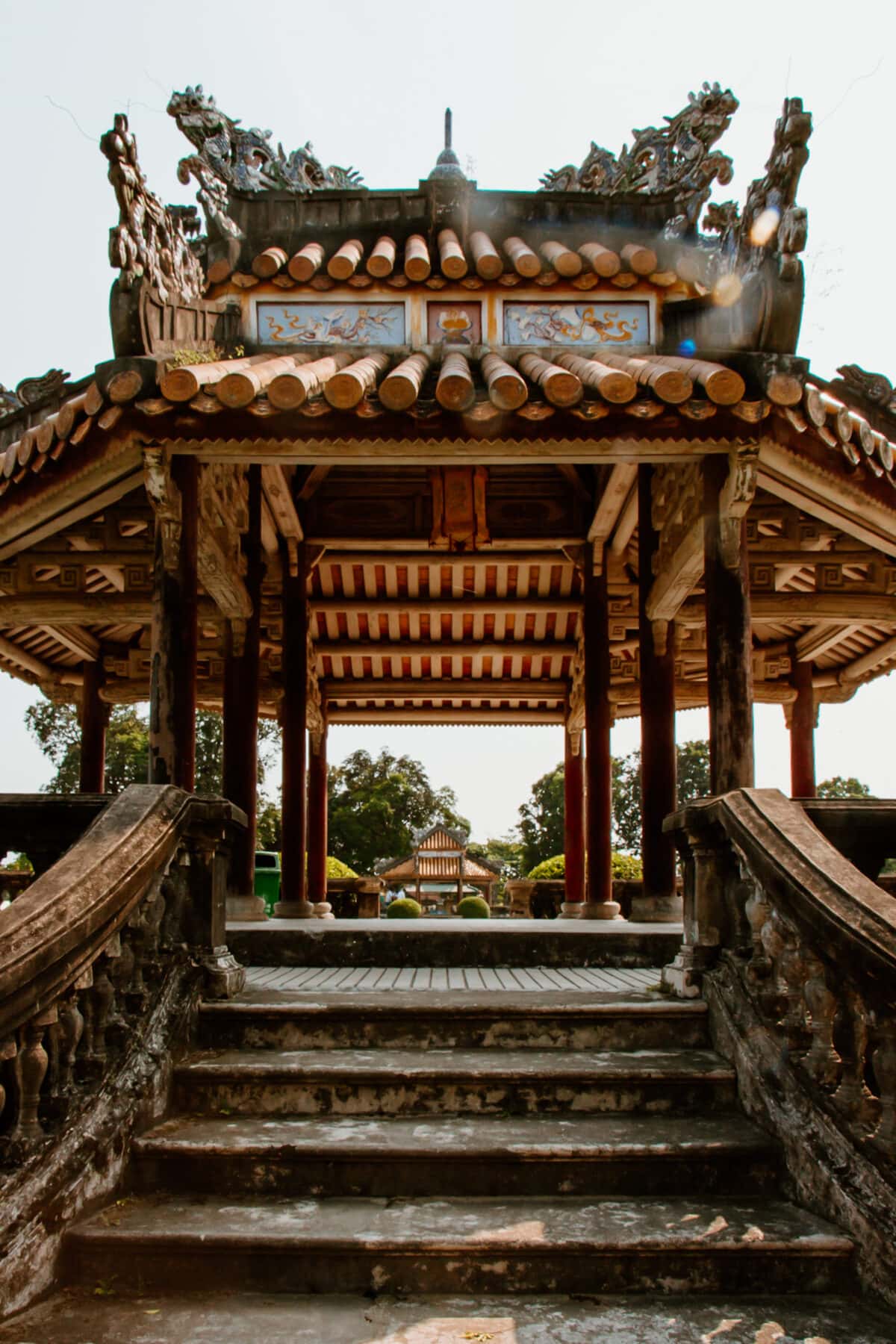
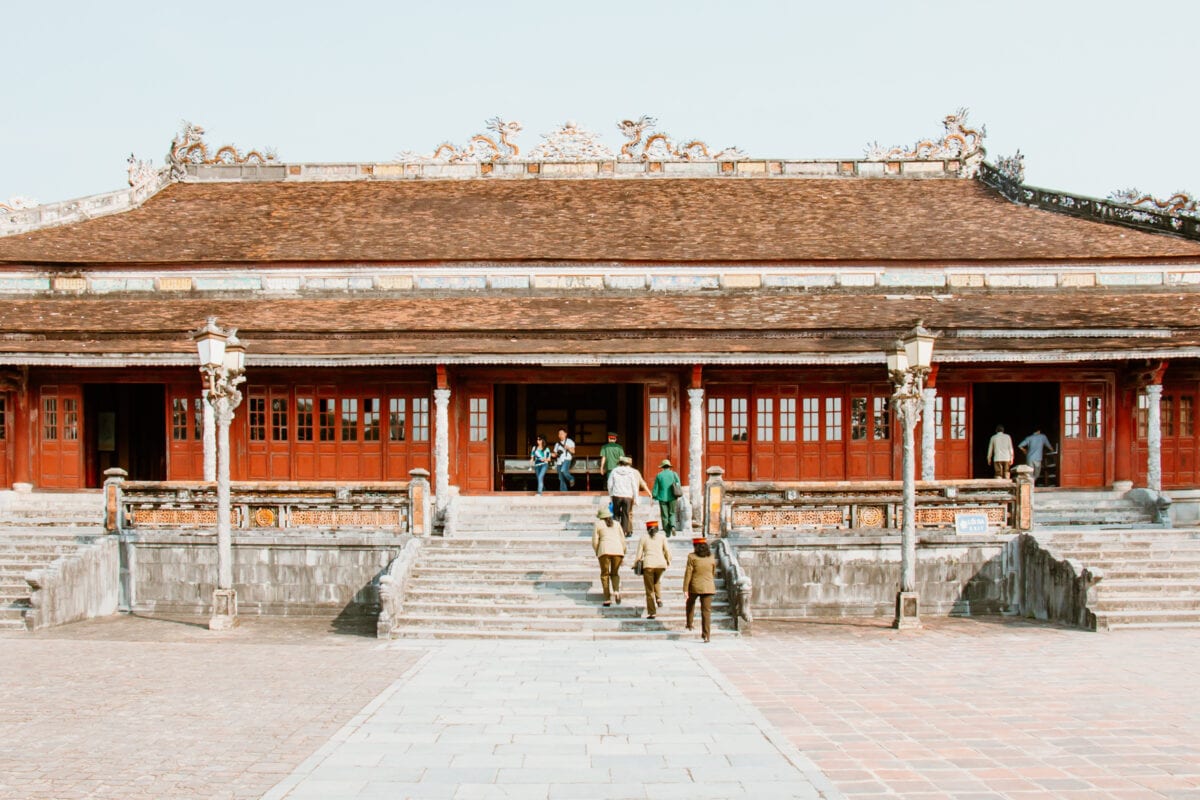
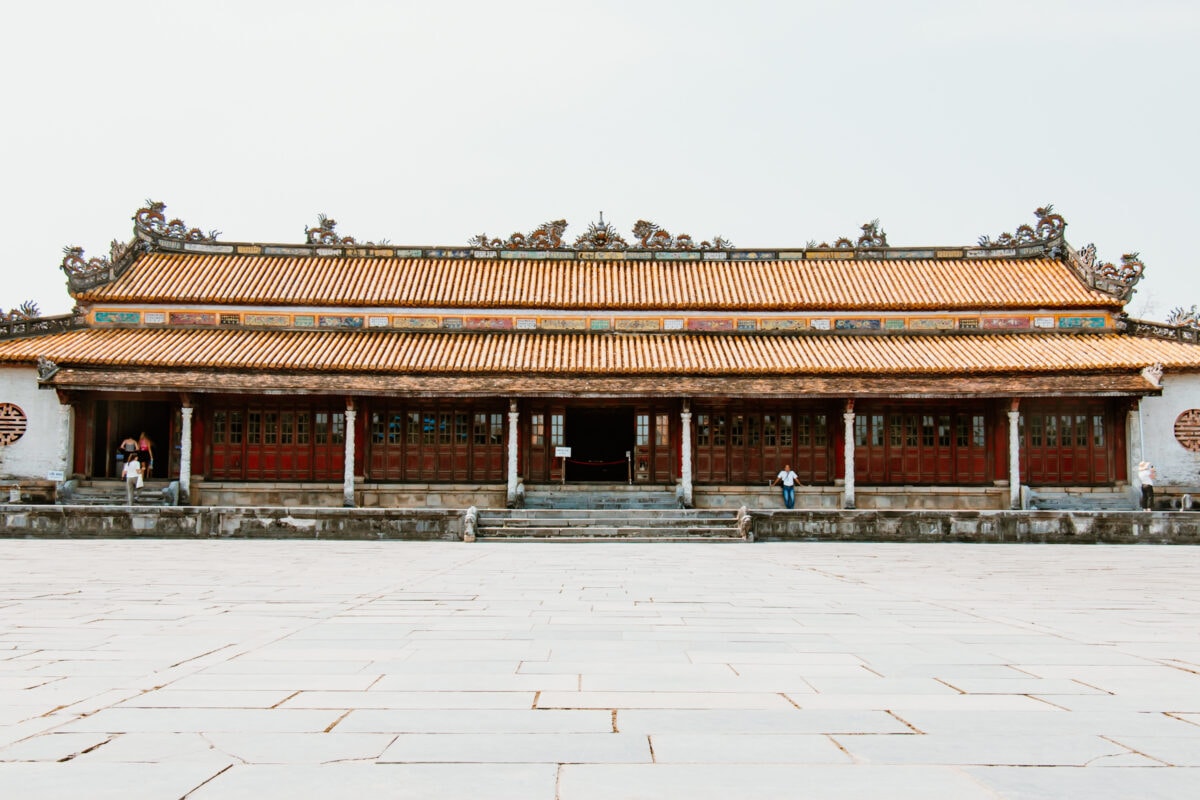
    The Forbidden City in Hue

    The citadel as a main attraction seemed to me rather uninspiring. Maybe I’m not interested enough in history after all. However, Huế didn’t bother to change that with his citadel either. Although the entrance fee of 150,000 Dong (approx. 6.20€) is very high by Vietnamese standards, the visitor can expect little.

    Hue Sights Forbidden City Red Doors
    Magnificent: Some buildings in the Forbidden City have been restored in recent years.

    Well, the reconstruction after the destruction during the Vietnam War, which has probably only really taken off a few years ago, is still taking place in many corners – but there is little explanation, there are no or only few signs (and if, then in Vietnamese), so that you learn nothing about the site without an extra hired tour guide or brought guide and stumble aimlessly through the site.

    Imperial City Hue Vietnam
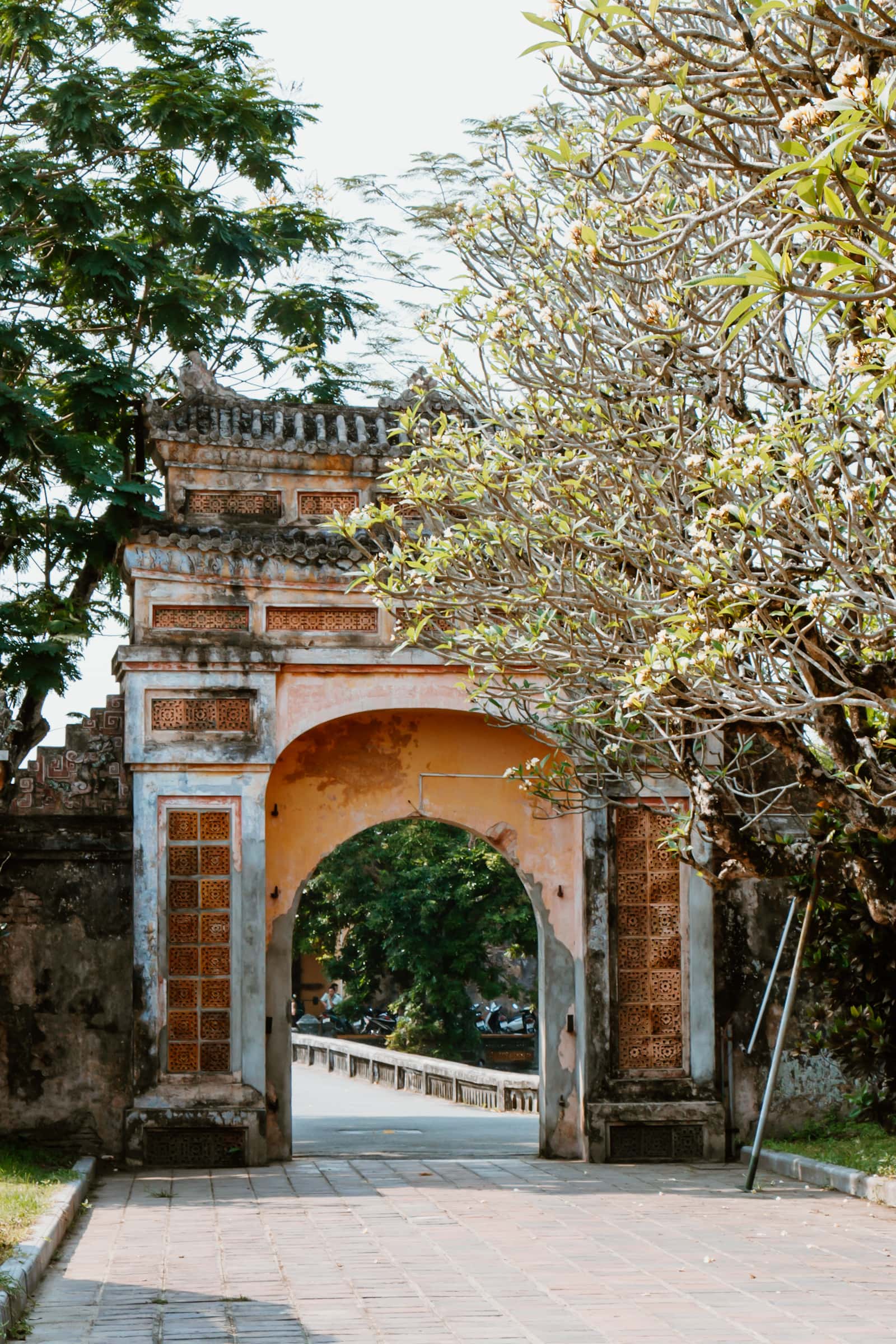
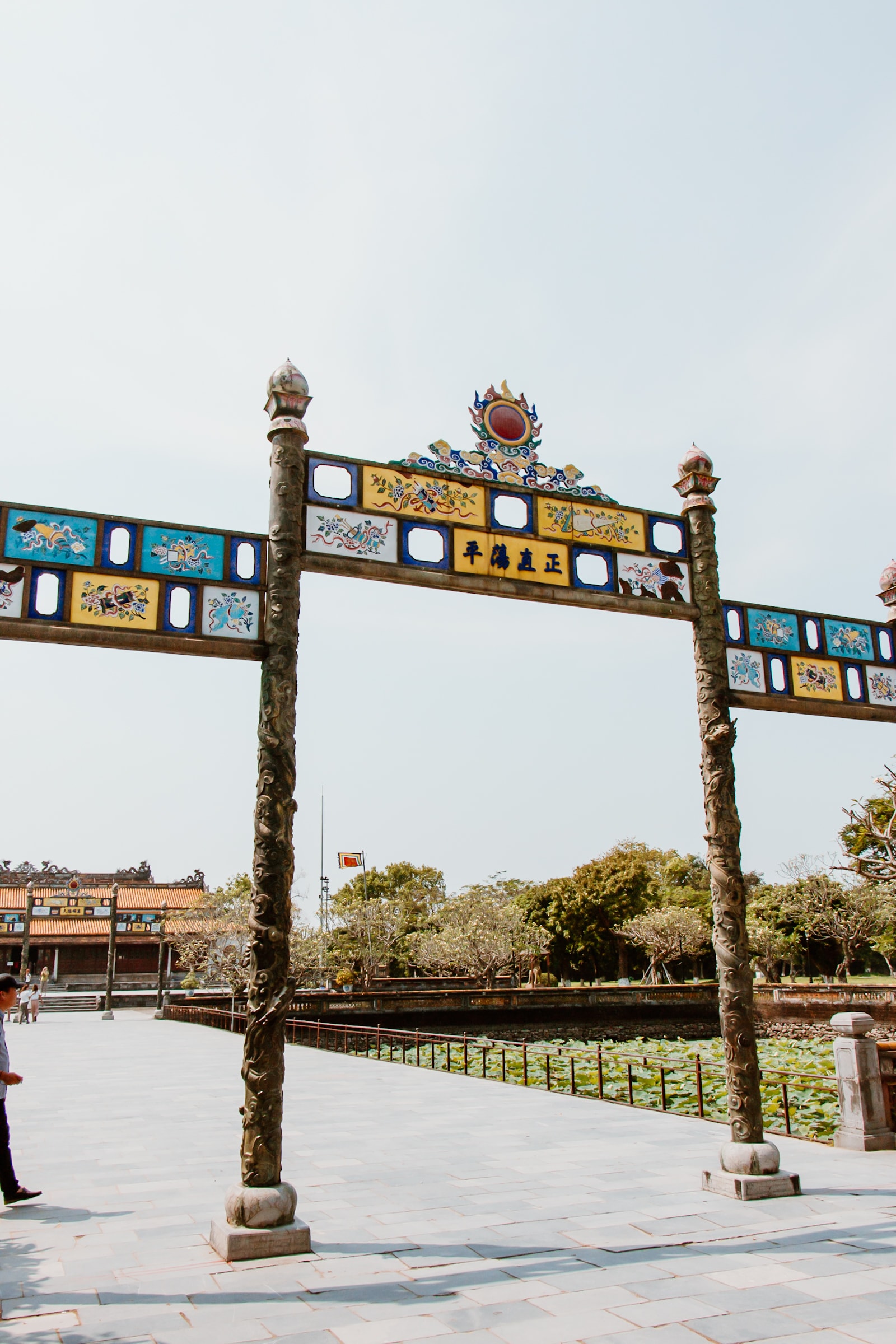
    Hue Sights Gate Forbidden City

    Planning a trip to Vietnam?
    ➜ Here you will find valuable tips for your trip to Vietnam

    Hue Citadel Forbidden City

    In the Forbidden City: Impressions & Pictures

    In the main building I finally found a TV in a corner, on which a small simulation was running in an endless loop, how the plant looked like in imperial Vietnam – that was something. Unfortunately, the midday sun also took its toll on me – there are few shady spots and the sun was just burning down on my skull. Good that I like hot temperatures. But it was still enough for a few nice impressions.

    Hue Vietnam Citadel Palace
    Hue Sights Forbidden City
    Hue Forbidden City Pond Koi Carp

    Dressing up in the Forbidden City: Costume Rental & Photo Sessions

    Those who enjoy costume games can also have their picture taken in one of the buildings in an imperial outfit with a throne and all kinds of majestic paraphernalia:

    Information & entrance fees

    The Citadel, which includes the Forbidden City, is located on the north bank of the Perfume River and has been a UNESCO World Heritage Site since 1993. Admission costs 200,000 VND for adults; children between the ages of 7 and 12 pay 40,000 VND; and admission is free for children under 7.

    The site is open daily, from 6:30 a.m. to 5:30 p.m. during summer and from 7:00 a.m. to 5:00 p.m. in winter. Keep in mind, the grounds are extensive with minimal shade between the palaces and courtyards, making midday visits very hot. Visiting early in the morning is cooler and more comfortable.

    If you’re interested in visiting the Imperial Tombs, definitely consider the combo ticket—it’s a great deal! It costs 530,000 VND and gives you two days to explore both sites at your own pace. Alternatively, you might want to join a guided tour that covers both locations in just one day. The tour usually includes tickets and pickup from your hotel, making the whole experience smooth and convenient for you.

    Book a day tour to the Citadel, including the Forbidden City, and the Imperial Tomb with transportation

    [thj_promo slug=”hue-zitadelle-und-kaisergraeber”]

  • The Best Halong Bay Cruise from Hanoi, Vietnam

    The Best Halong Bay Cruise from Hanoi, Vietnam

    No visit to Hanoi without a tour to Halong Bay, that much was already certain. Somehow, a stamp like “Unesco World Heritage Site” is a decisive indication that you will miss something worth seeing here if you skip this place when planning your trip. And if you’re ever in Vietnam, you shouldn’t miss Halong Bay with its impressive karst rocks.

    2 days to Halong Bay from Hanoi

    I decided on a 2-day tour to Halong Bay with an overnight stay on the boat, meals included. Since I was traveling alone, I basically got only a “half” double room—if demand had been high, I would have had to share it with someone else. In the end, though, it wasn’t a problem; another solo traveler and I each ended up with our own cabin—which, by the way, wasn’t half bad. It really felt like a cruise.

    Cabin on a cruise in Halong Bay, Vietnam
    The interior of the cabin on the ship in Halong Bay: Not bad at all!

    Cruising through Halong Bay in Vietnam

    We set off early in the morning at 8. The bus ride in a rustic Vietnamese minivan took a good four hours, and aside from a bathroom break at a rest stop with an attached tourist trap in the form of an oversized souvenir shop, there was: nothing.

    Halong Bay Vietnam junk

    At the harbor in Halong City, we boarded a shuttle boat that took us to our junk. We settled into our rooms, and until lunchtime we were able to explore the boat and doze on the sun deck. Slowly, the ship picked up speed, and so did our group dynamic.

    Book your tour of Halong Bay

    No one had actually gotten the trip they’d booked; the original boat was either fully booked after all or otherwise unavailable. Instead, we got a great upgrade to this better ship—and as it quickly turned out, our stories were similar. My guess is that they’re trying to put together a suitable group rather than accommodating individual boat preferences. In our case, at any rate, the mix worked out well—a colorful group of people from all corners of the world—so the group was a good start. And slowly, the initial fog in Halong Bay began to lift.

    We were lucky: The sky cleared up more and more until not a single cloud was in sight, and everyone was over the moon. We toured a stalactite cave—it was big, but if you’ve visited other caves before, you might not be quite as blown away—we went kayaking, went for a swim in the evening sun, and climbed up to a super-high lookout point.

    Halong Bay Tour Boat Trip Vietnam

    Thanks to Alex and Maria, two well-prepared British girls with an almost inexhaustible supply of good gin, we also got the obligatory karaoke evening on the boat behind us and all together let the evening end on the sun deck under a starry sky in the mirror-smooth bay.

    Is a tour to Halong Bay worth it?

    Of course, you don’t sail through the entire, vast Halong Bay on this tour—but maybe that’s for the best. Environmental protection is a bit of a mixed bag in Vietnam. Dirty dishwater (I’d rather not think about the other stuff here), for example, simply flows out of the open galley door at the back of the ship and into the sea. With so many ships out there, that really adds up.

    Looking for more inspiration for your trip to Vietnam?
    ➜ All articles about Vietnam

    Which tour should you choose for Halong Bay?

    You don’t have to plan a trip from Hanoi very well – enough tour operators offer boat tours through Halong Bay in agency offices. Each hotel is also happy to help and acts as a tour office. Alternatively, you can book boat tours online in advance:

    How many days do you need?

    It’s a good idea to take the time to book a 3-day tour that includes a second night on Cat Ba Island—according to many fellow travelers I met along the way, it’s well worth it. I would strongly advise against the one-day tour. The four-hour bus ride feels like it goes on forever. Traveling this route both there and back in a single day is a real ordeal. And there’s hardly any time left to enjoy the bay itself.

    Book the 2-day tour to Halong Bay here

    Book the 3-day tour of Cat Ba here

This site is registered on wpml.org as a development site. Switch to a production site key to remove this banner.