Laos is the only country in Southeast Asia without a beach, but it has a lot to offer: Nature, landscapes and the friendliness of the Laotians. Anyway, for me Laos is one of the most beautiful countries in the region! Here in the blog you will find tips and inspiration for a round trip through Laos.
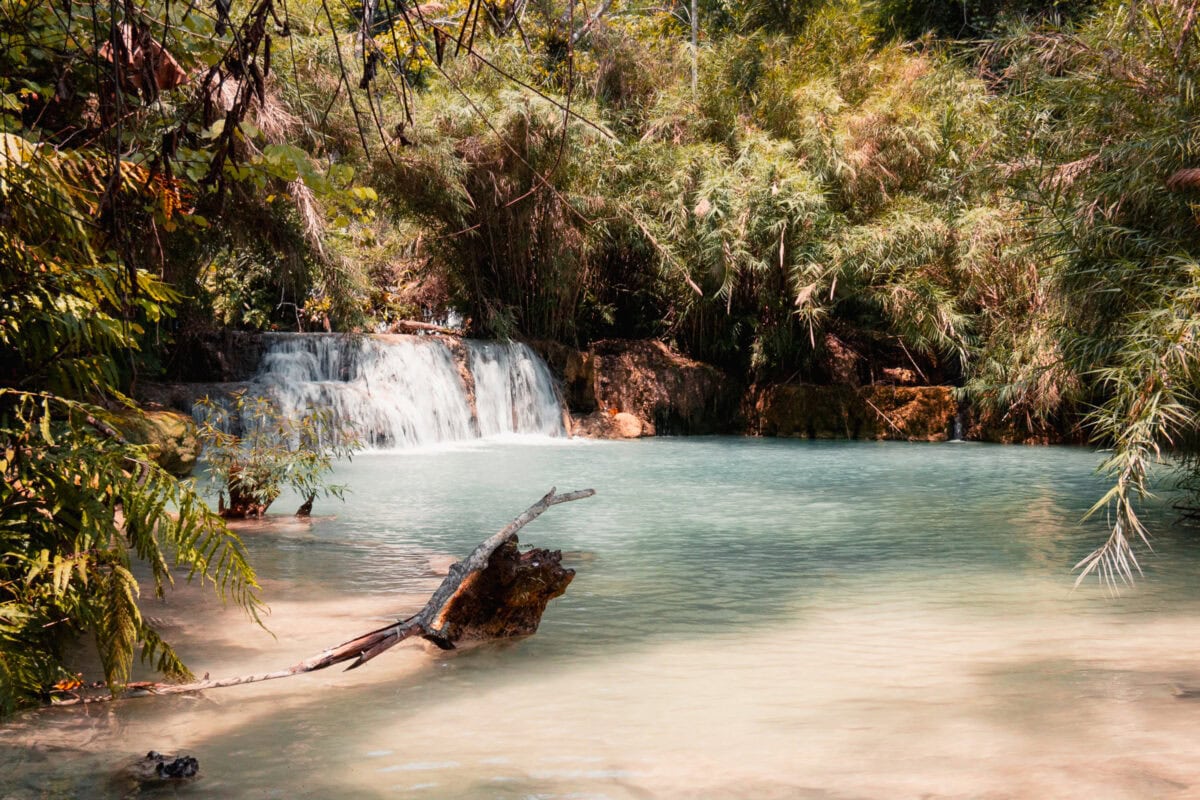
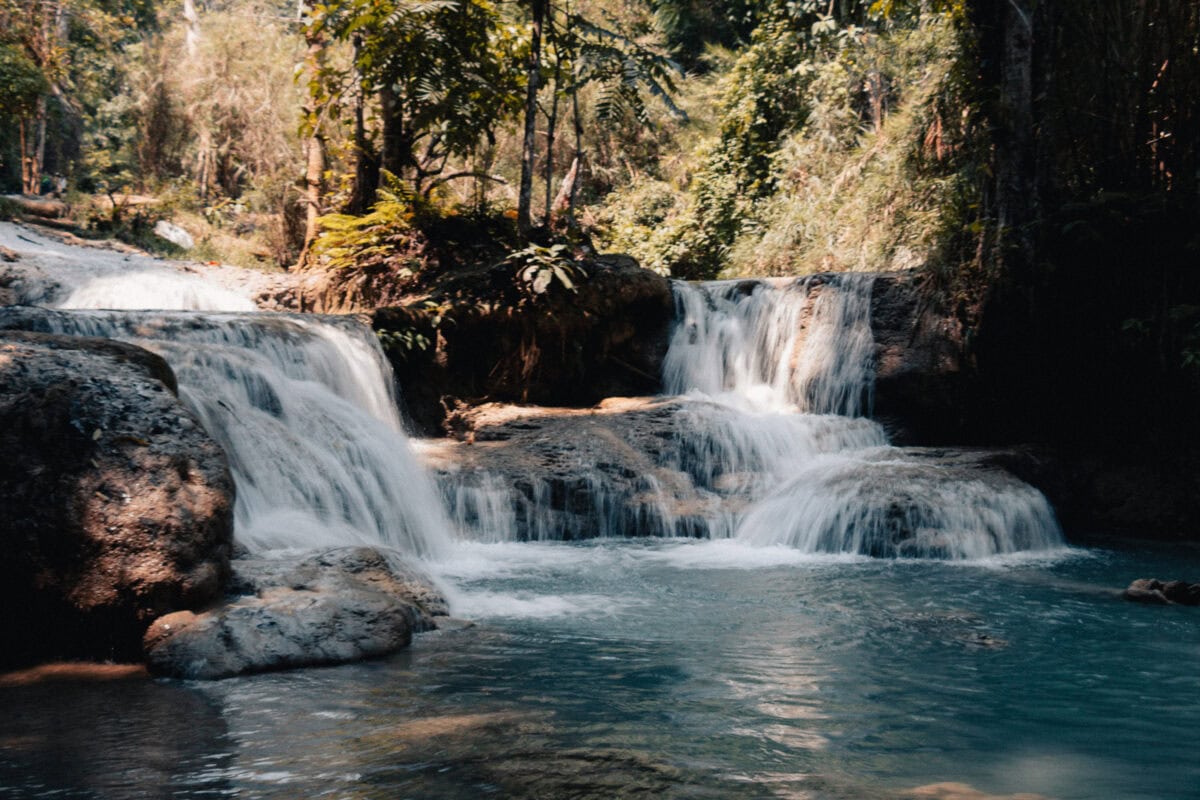
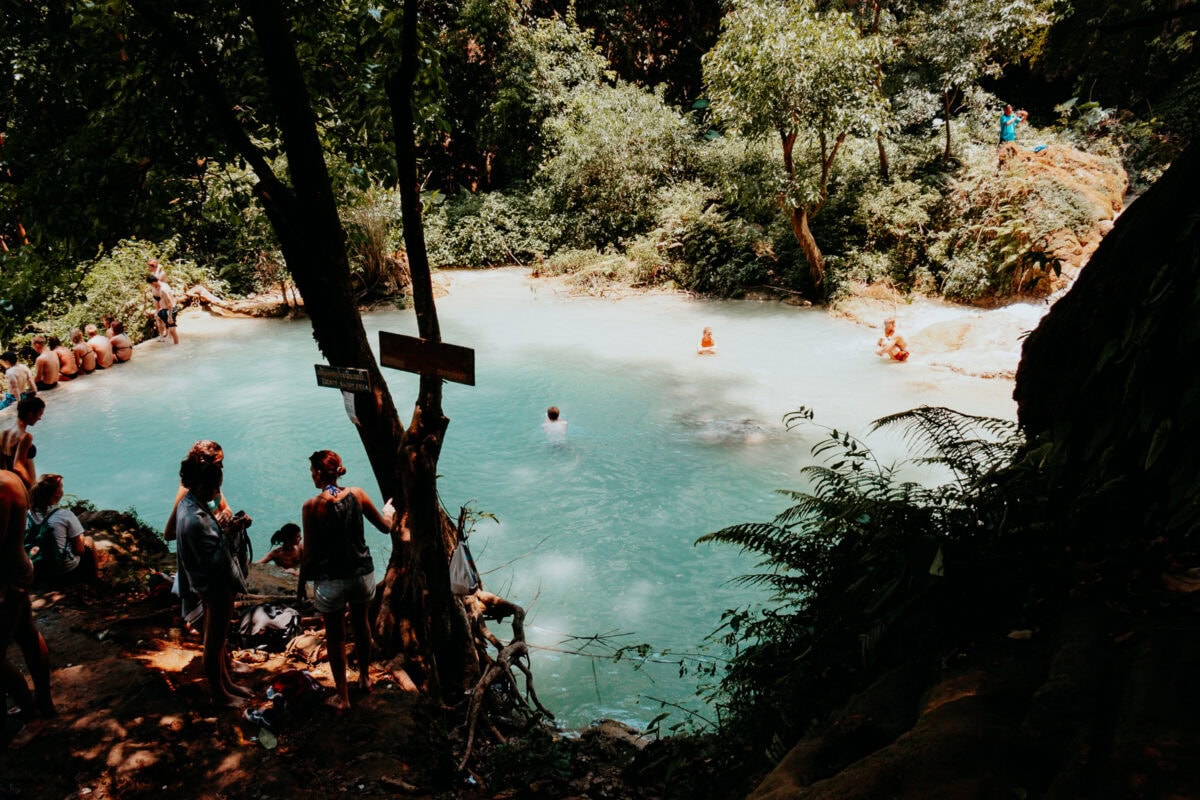
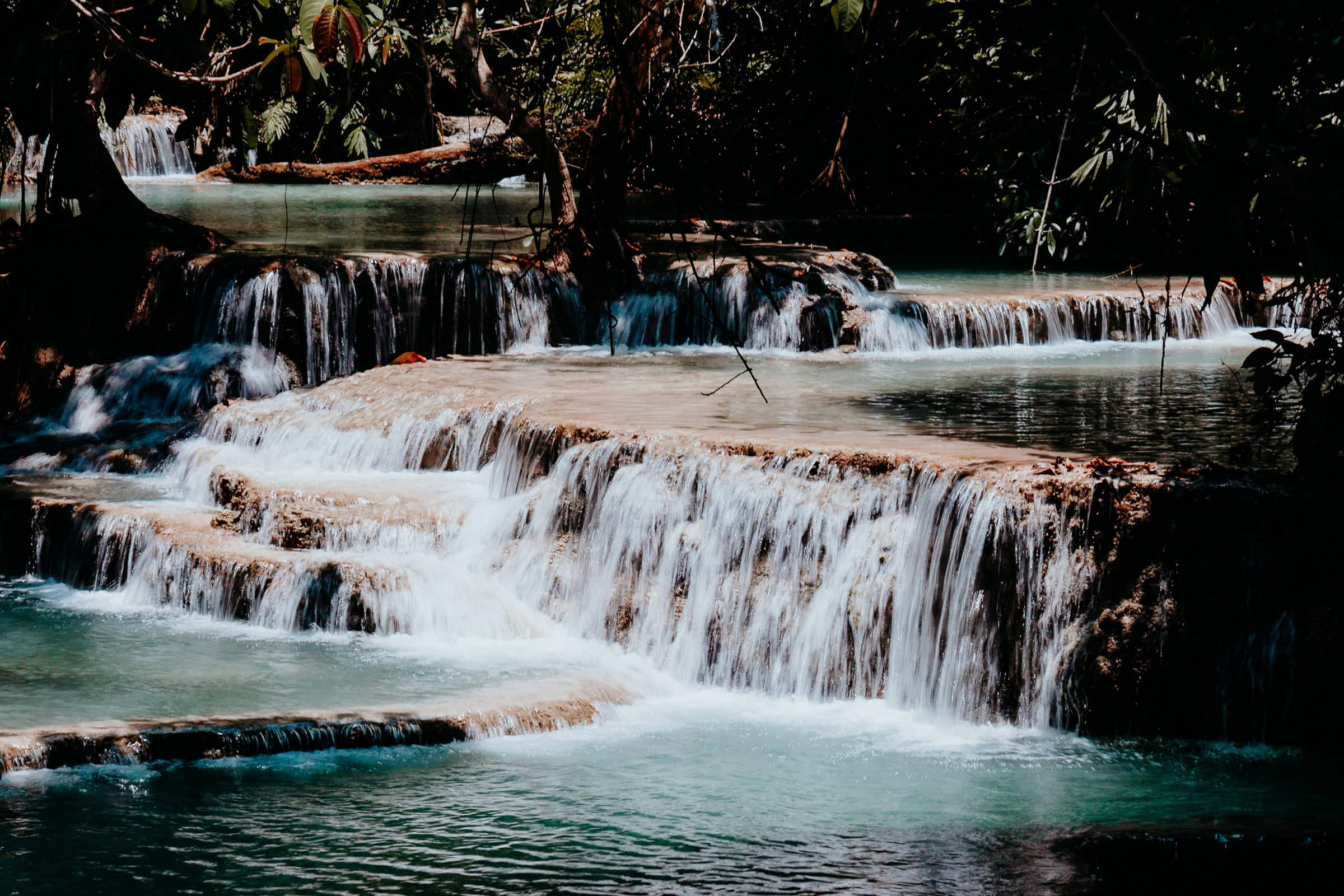
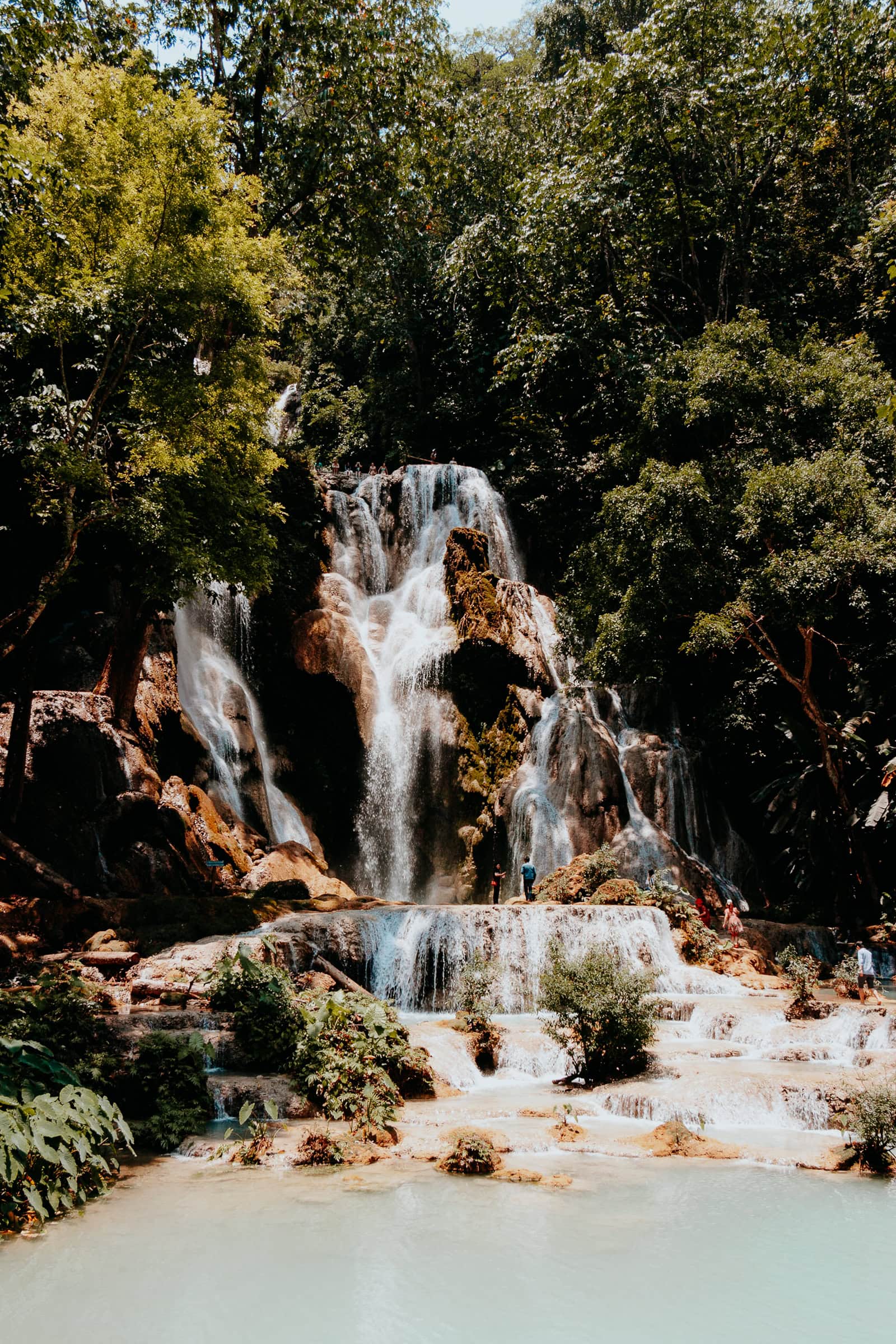
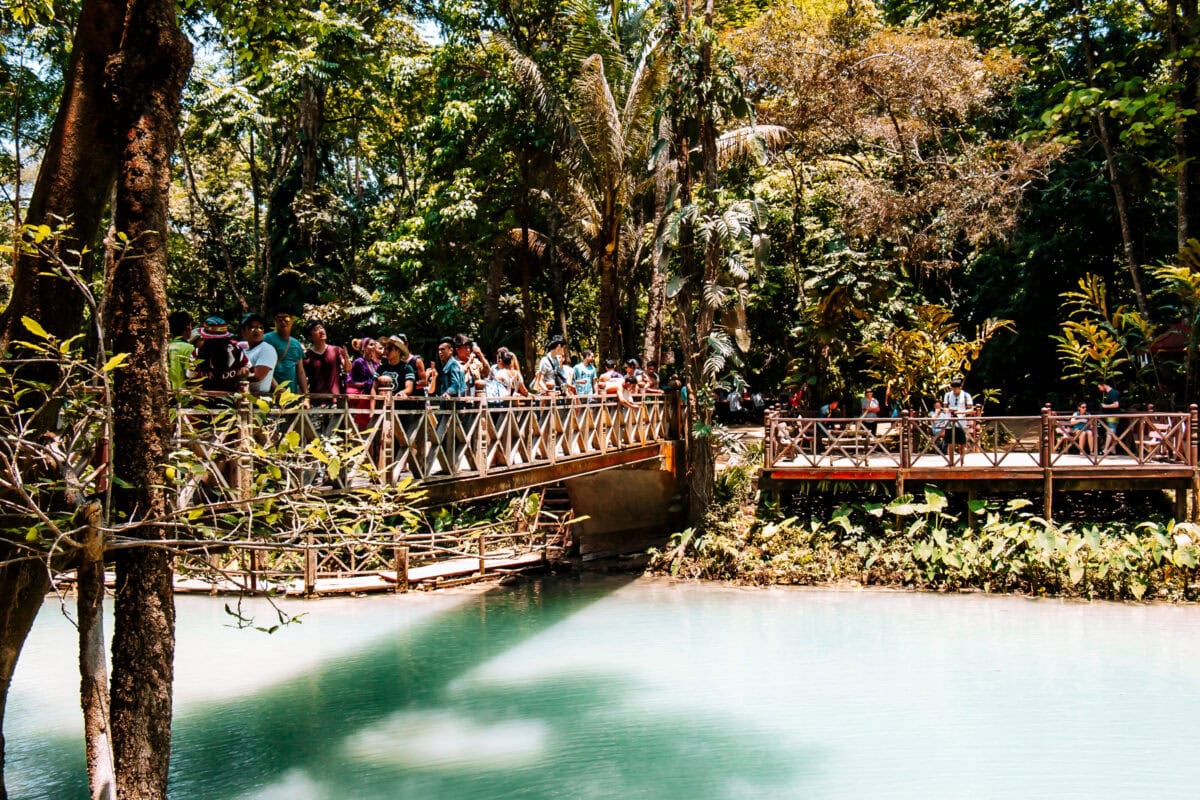
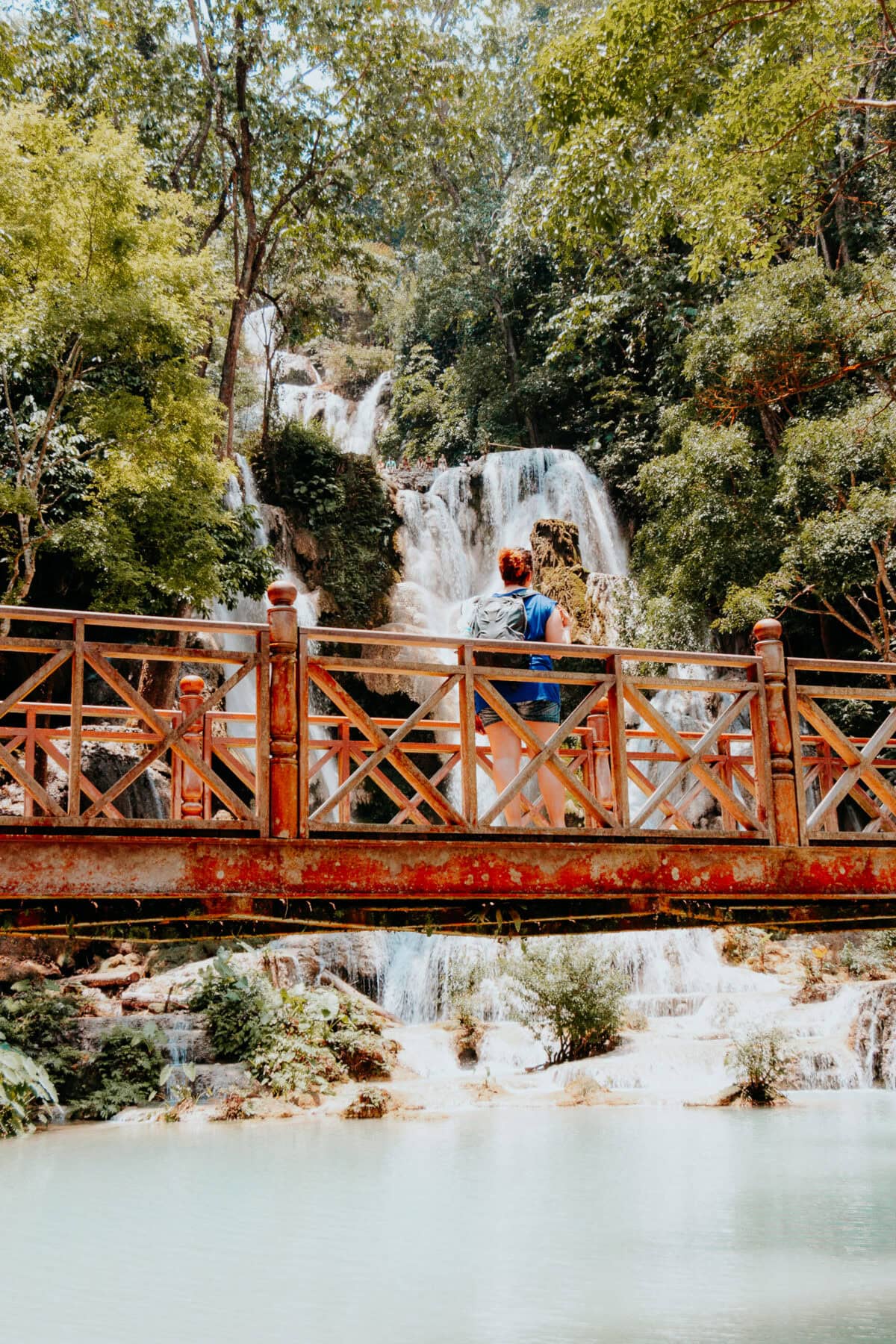
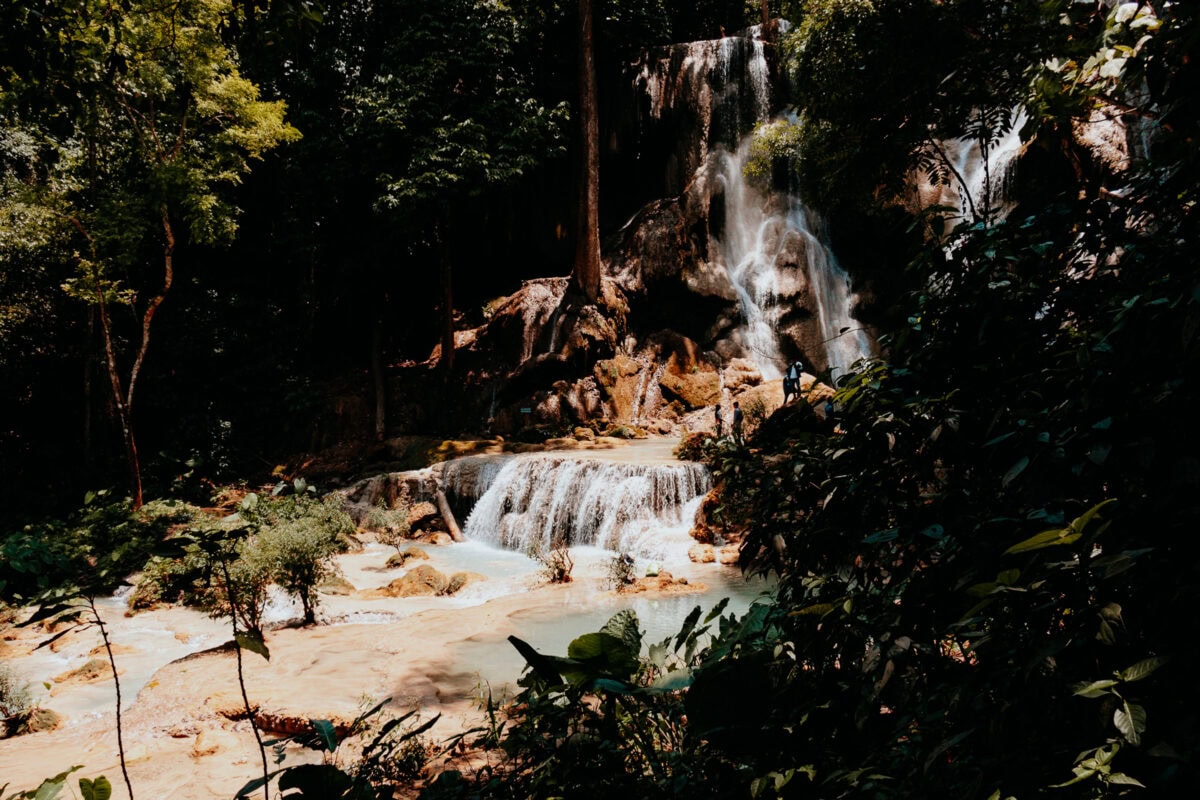
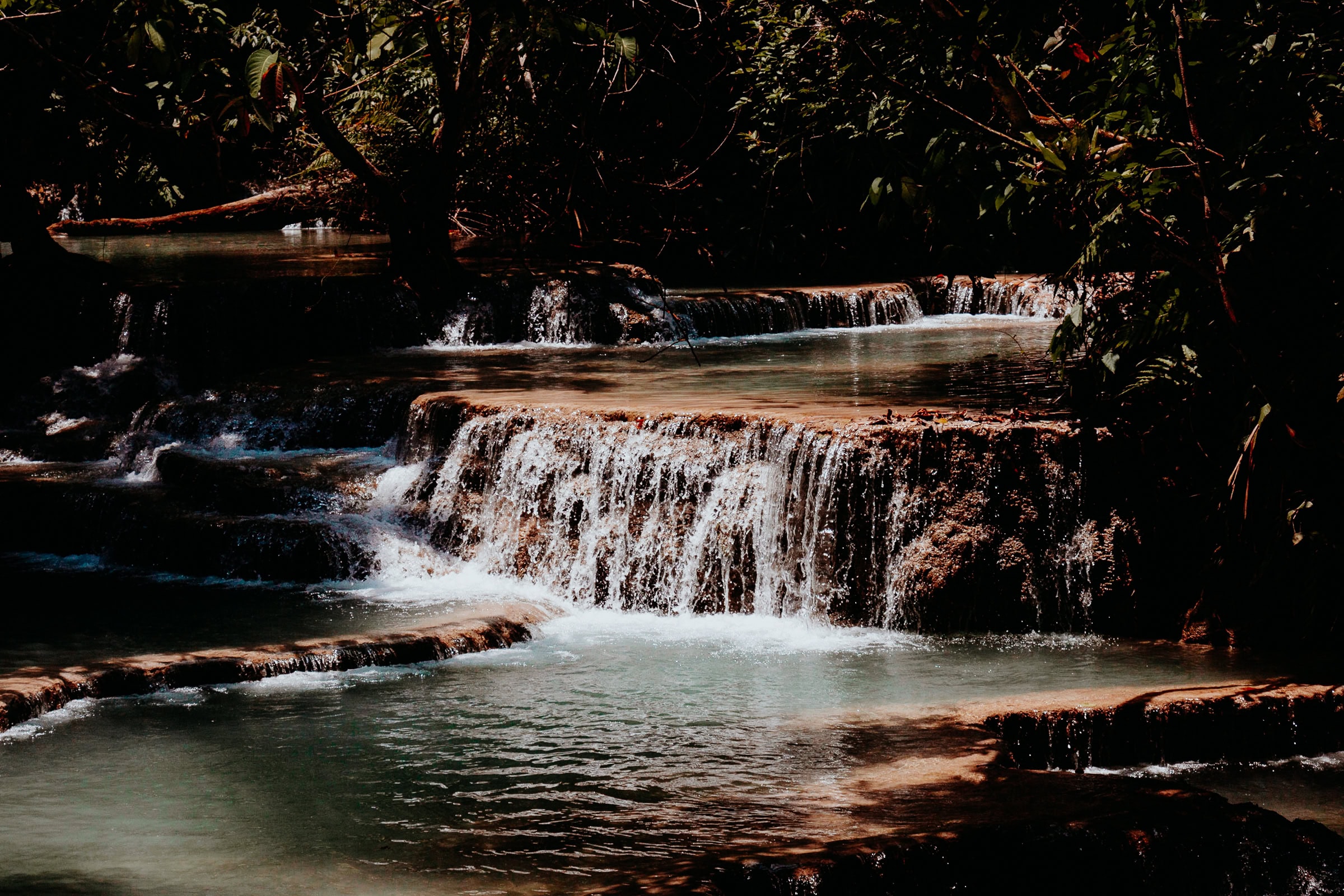
The 30 minutes on the back of a rattling tuktuk were worth it: near Luang Prabang are the Kuang Si waterfalls – and they are spectacularly beautiful. Clear turquoise water in small pools spread at the foot of the waterfall. And the waterfall itself, in the middle of a tropical forest. All breathtaking.
Waterfall for adventure lovers
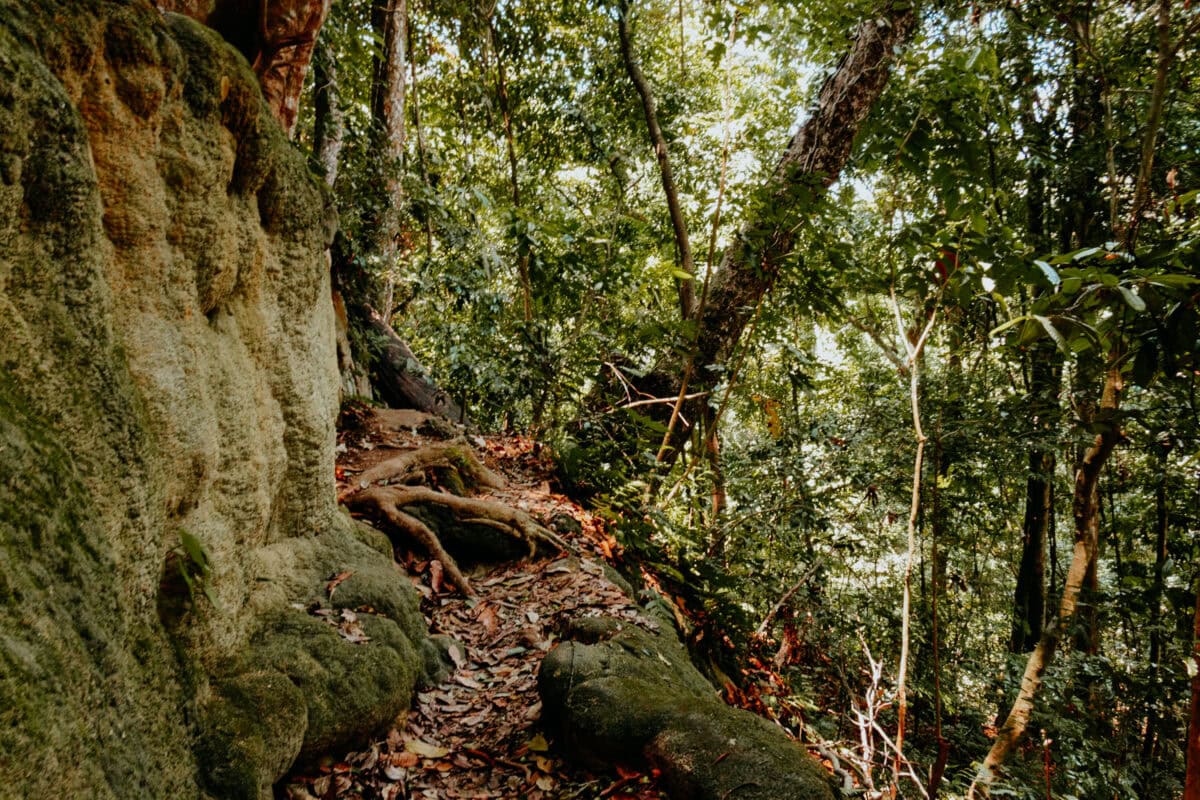
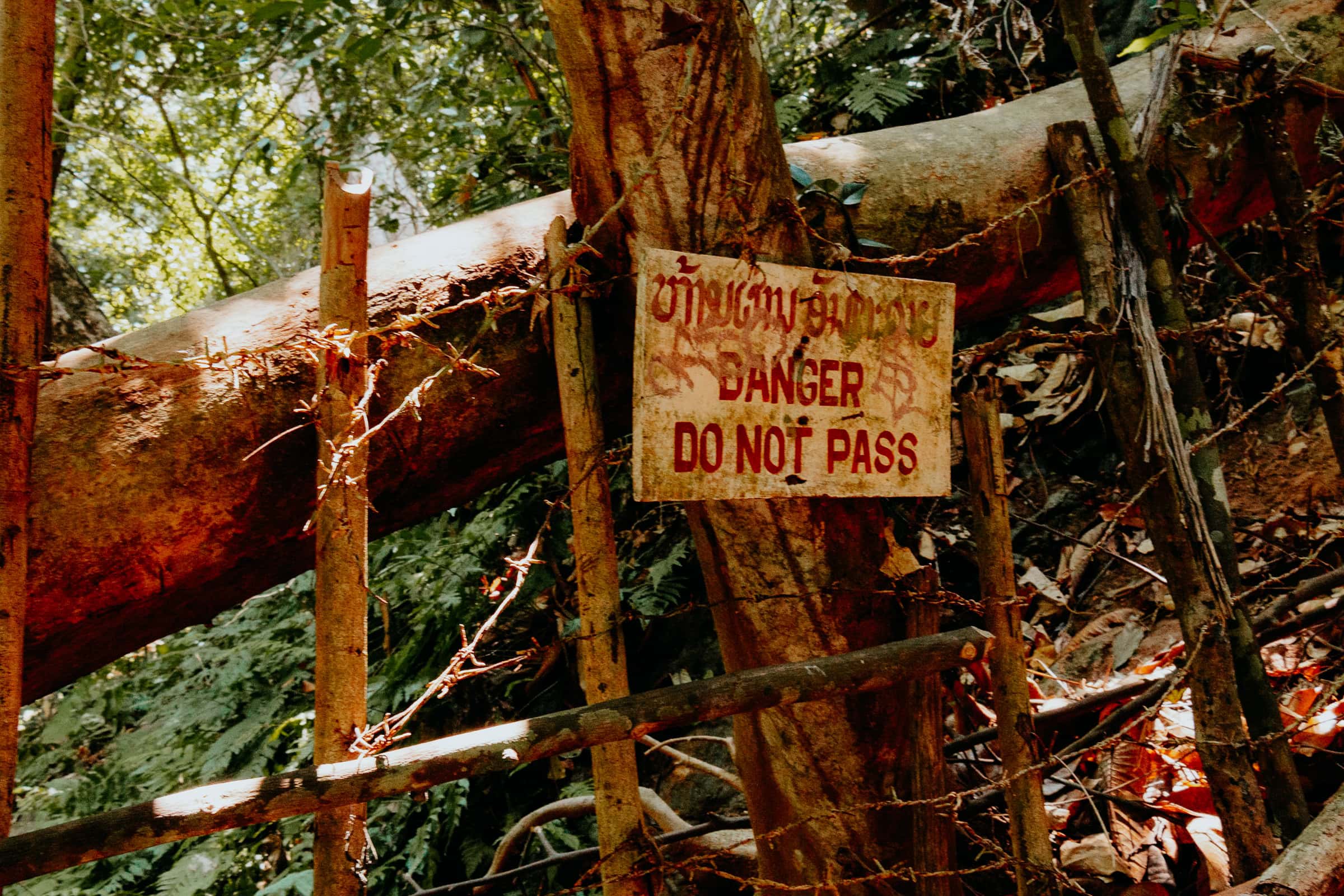
If you’re feeling particularly adventurous, you can also take a look at the waterfall from above. A small trail leads up the mountain – and right at the sign “Danger! Do not pass!” you do exactly the opposite: off through the hole next to it and further up to the waterfall. But be careful, already the regular hiking trail is sometimes not without due to the wet ground… and here it does not get better.
And even if thousands of backpackers show you how to do it, it’s better to swap your flip-flops for sturdy sneakers. If you still need the total kick, you can then, once at the top, sit right on the cliff of the waterfall!
In the Laos blog you will find many more tips for a great Laos round trip!
It is best to start early in the morning in the direction of the waterfalls, because from late morning the first tour groups slowly start to arrive, and then it gets really crowded. On weekends, the Kuang Si waterfalls are of course also a popular destination for the locals.
Many families spend the whole day there, picnicking, swimming and enjoying nature and family time. So if you prefer to travel more solitary, come during the week. However, the atmosphere is very nice on weekends so among locals, so is also a nice option.
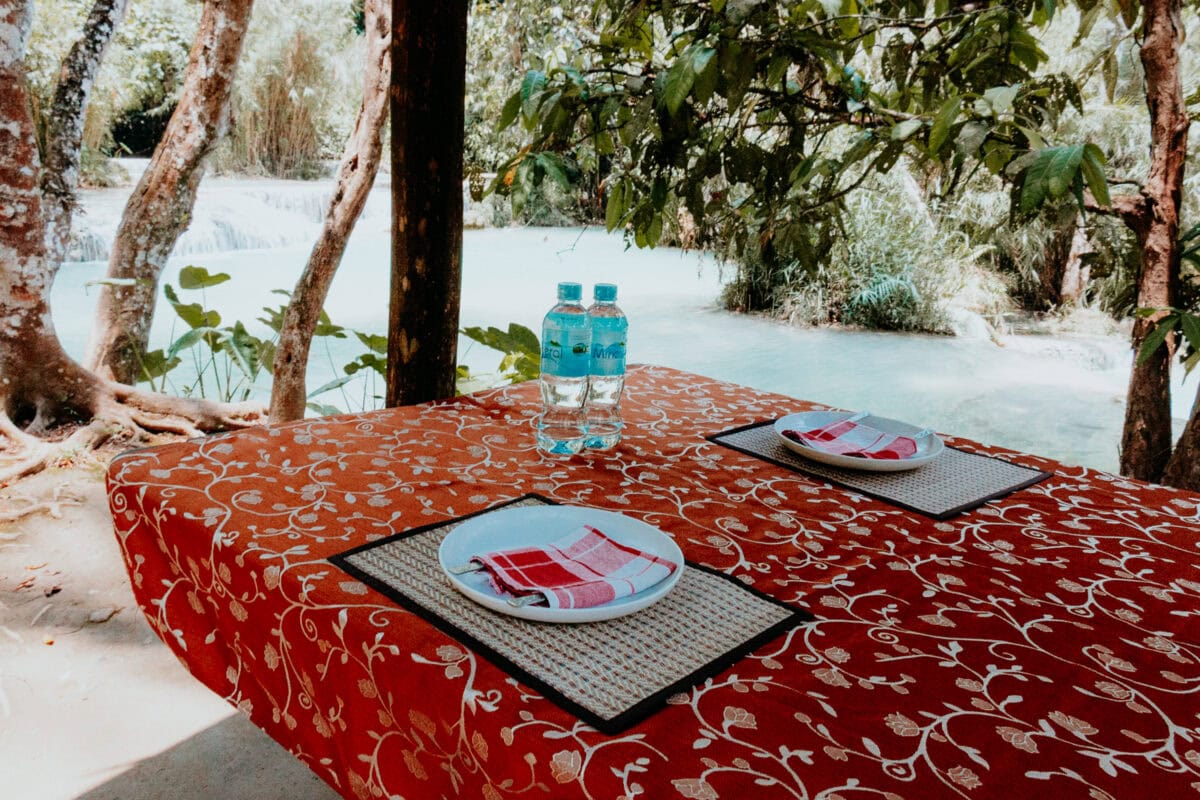
Some locals even bring their own secret pop-up restaurant and nicely set the available tables and serve lunch – in case you forgot your packed lunch, you won’t starve either!
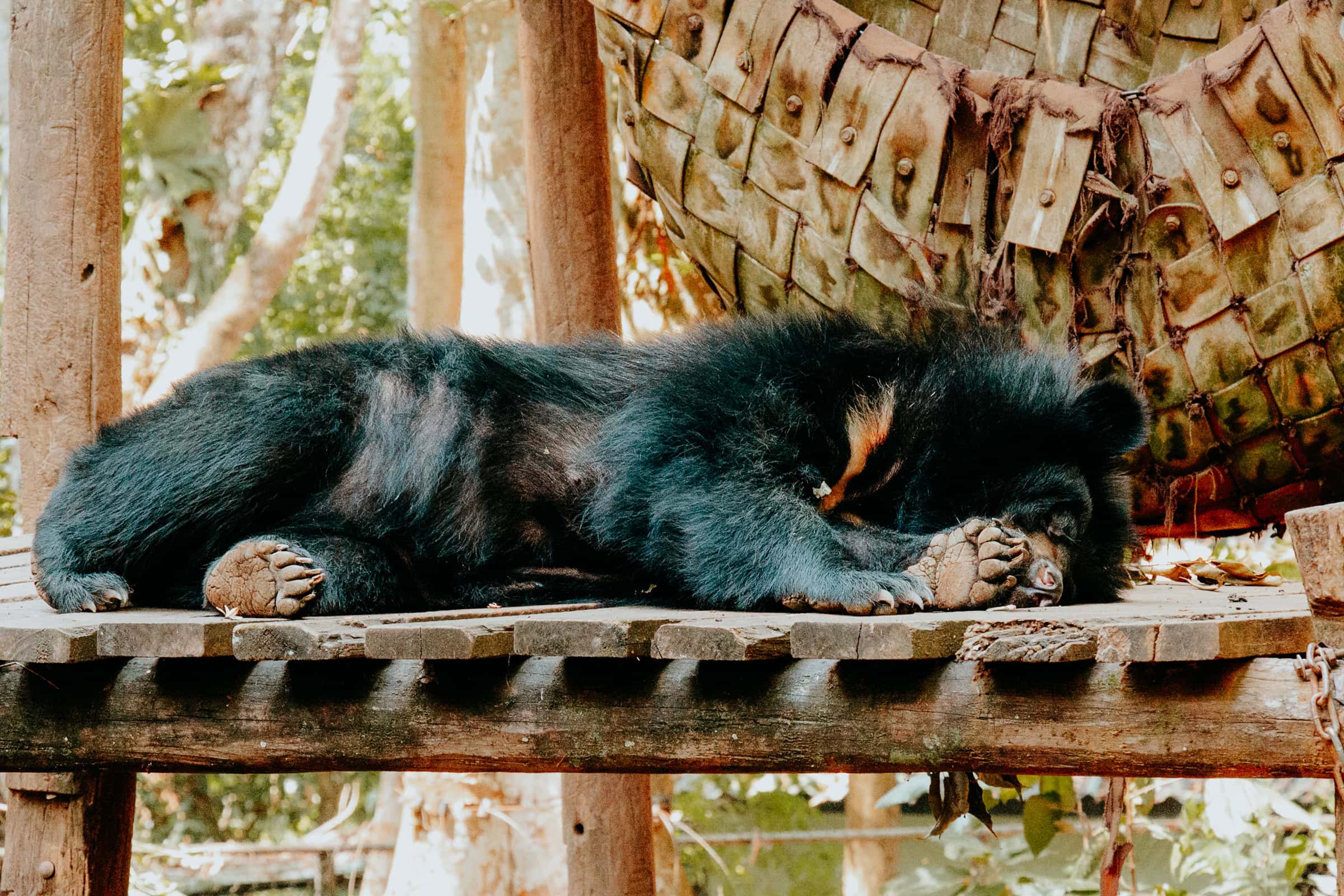
Bears at Kuang Si waterfall
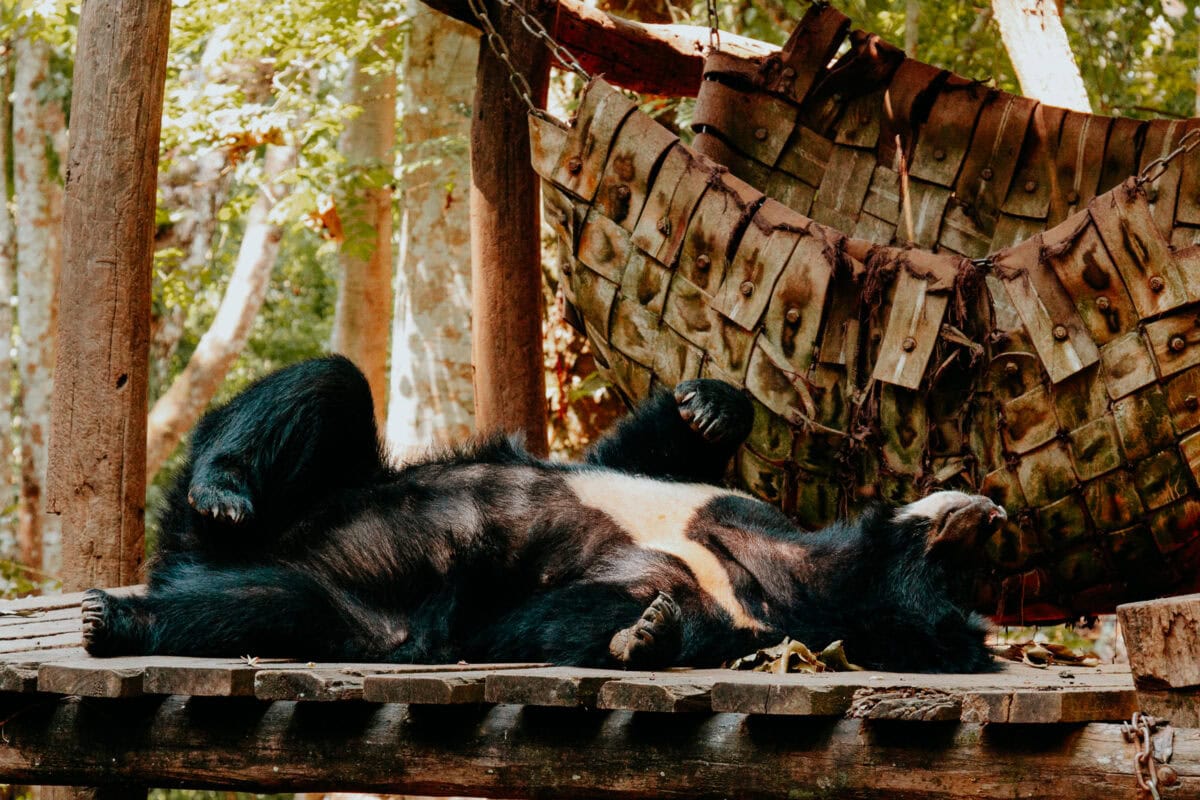
At the entrance to the waterfall is also the Bear Sanctuary, a sanctuary for bears, where you can watch them play and chill in their enclosure.
How to get to Kuang Si Waterfall?
There are two ways to get from Luang Prabang to Kuang Si Waterfall. Either book one of the many tours offered to Kuang Si or simply take a tuktuk from Luang Prabang, which is also waiting on site as long as you explore the waterfalls. Of course, this is a bit more expensive, but it’s definitely worth it to arrive before the crowds and have the flexibility to arrive and depart.
Even when you are on vacation, you sometimes have to push yourself to do things you’d never do willingly. Like getting up at 5am. Well, traveling can be hard work sometimes, too. But when in Luang Prabang you have to get up early to see the monks’ daily ceremony of receiving alms. I don’t know what was more fascinating, the procession itself or the fact, that it turned out to be a very touristy event – which was kind of irritating.
A part of Sisavangvong Road is blocked for the whole procession and so the street was filled more with tourists taking pictures of the scenery than with the main characters of this event, namely the monks and buddhist people giving alms.
Peace and quiet
But in the end, as a tourist myself watching the procession I became a part of the bizarre monk-watching event, too, and I decided to go with the flow. It was kind of strange, as the whole thing has still a religious meaning and should be respected as such. So, no music, no loud yelling, no noise at all – despite of all the people in the street it was really calm and quiet. Small chairs were put on one side of the street, so people could sit and give their alms like money, sweets or sticky rice to the monks passing by. Monks are not allowed to have any possessions, so they really live on what people share with them every day.
Thoughts – how was it?
All in all, it was an interesting thing to see, but I left with mixed emotions. Is it really necessary to watch such an intimate ceremony of a religion I barely know? Of which I don’t know the rules and habits? Should a religious event become a tourist sight? I didn’t come to a clear conclusion. I just know that I was impressed once more how peaceful buddhism can be and with how much dedication people are sharing. I was glad for that insight, but somehow – it had its awkward moments and I had the very strong feeling I was at the wrong place at the wrong time.
“Should I go see the monk procession?”
After reading this, you might ask yourself that – and the answer is simple: Just go. See for yourself. Maybe you won’t find it that awkward at all. Maybe you will. But that’s the purpose of traveling:
The Patuxai Monument in Vientiane is one of the central landmarks in the capital of Laos. Built in the 1950s and 1960s, it is meant to resemble the Arc de Triomphe in Paris. But if you look closely, you’ll notice Laotian influences—a unique building that you definitely shouldn’t miss while in Vientiane.
For a few kip (really not much), you can walk up the Patuxai Monument—all the way to the top.
Sightseeing in Vientiane: The Patuxai Monument
As you walk up, you can stop on two floors. Souvenir vendors have set up their stalls there, and you can find all kinds of knickknacks.
One floor reminded me very much of old Russian department stores with high ceilings and their saleswomen behind glass counters. One of the few times in Laos where I felt reminded that I was actually in a communist country.
Once you reach the very top, you’ll come to this romantic spiral staircase—isn’t it pretty? And just look at those ornate window grilles!
Some of the busiest main roads in Vientiane lead to the traffic circle around Patuxai Monument. One of the most central transport hubs, in other words. And here is already noticeable: Vientiane is so very different from most Southeast Asian capitals: No traffic collapse, no constant honking – everything very quiet.
Patuxai Monument: Best at sunset
It is most beautiful up here at sunset. No more crowds, and the setting sun bathes everything in a very special light. The architecture is really very unusual, everything is decorated in great detail.
How do you get there?
Patuxai Monument is located just outside the city center. From the old town (where most of the accommodations are located), it takes about 20 minutes by bike. Bikes can be rented everywhere in the old town. Or you can just take a tuktuk.
Have you ever heard of Vientiane? Neither had I, really, until I planned my trip to Laos. Probably for good reason: Vientiane is simply less spectacular than other major cities in Southeast Asia, like Bangkok or Hanoi. On the other hand, that’s exactly what makes Vientiane so special: it just feels like a big village.
The skyline of Vientiane: The Don Chan Palace
Vientiane lacks true skyscrapers, which is unusual for an Asian city. The only exception is the Don Chan Palace, a 14-story hotel that stands out as an architectural misfit in this peaceful city. Interestingly, it is also the tallest building in Laos, although it’s hard to imagine given the city’s skyline. No building in Vientiane can surpass the Patuxai Monument, one of the few prominent landmarks in the city.
Vientiane’s must-see attractions
Vientiane is a small city, which makes it easy to get around. Most of the main sights are close to each other, so you can explore at your own pace and see a lot in just a short time. You’ll still have time to relax with a great Laotian coffee at one of the cozy cafés in the Old Town or try different foods at the night market along the river.
The Patuxai Monument resembles the Laotian version of the iconic Arc de Triomphe in Paris, though it was only built in the 1960s. When you reach the top, you’ll enjoy the most incredible view of the city, and the monument itself is quite charming with its many intricate details. Visiting in the afternoon is lovely, especially when the weather is clear and the sunlight makes everything glow beautifully. Just remember to arrive early, as the monument closes at 5 p.m., so you don’t miss out on the experience.
That Luang: The Golden Landmark
The huge stupa of That Luang is Laos’s most important religious landmark. It’s big, golden, and truly impressive. Though you can’t get very close, it’s definitely worth seeing. The complex is expansive and features some beautiful temples and buildings. The best way to explore the area is by bike, which you can rent easily anywhere in the city. Biking is a fantastic way to enjoy the whole site comfortably.
That Dam: The Forgotten Stupa
That Dam is a large, old stupa located in the middle of a residential neighborhood, now abandoned. Surrounding the square are a few restaurants, making it a pleasant spot to enjoy a quick break from sightseeing.
How to Get to Vientiane
By Bus
Intercity buses stop at either the northern or southern bus station, both of which are quite far from the city. Afterward, depending on traffic, you’ll need about 45 minutes in a tuk-tuk to reach the city center. Private tourist buses are more convenient; they typically go directly to the Old Town, where most of the city’s hotels are located. City buses operate from and return to the central bus station near Talat Sao, right in the city center.
Heading north, the bus has become less significant since the railway opened; few people now opt for the winding road to Vang Vieng or Luang Prabang. However, for trips south to Thakhek and Pakse, and for long-distance routes to Hanoi or Hue, it remains the primary choice. Schedules and prices are available on 12Go Asia.
By Train
This is the area that has seen the most change since my last visit. Vientiane now features two train stations, each part of a different rail network.
The China-Laos Railway has been operational since December 2021, starting from Vientiane Station in Don Noun, about 15 kilometers northeast of the city center. From there, you can reach Vang Vieng in just over an hour and Luang Prabang in approximately two hours. Previously, the bus journey to these destinations took about eight to ten hours. The northernmost border station is Boten, where once daily, a through train connects directly to Kunming in China. Tickets are in high demand, especially on weekends and holidays, and can be purchased at the station, through the LCR Ticket app, or at various travel agencies. Note that tickets for departures from Laos are only sold within Laos and are not available for advance purchase in China.
Since July 2024, there has also been a direct overnight train from Bangkok. It departs in the evening from Krung Thep Aphiwat Station and arrives in Vientiane the next morning—the trip takes about eleven hours and includes border checks handled directly at the stations—you don’t have to change trains. The train arrives at Khamsavath Station, about seven to nine kilometers southeast of the city center.
A sleeper car typically costs around 30 euros, varying with the class, while a standard seat is much cheaper. Trains operate multiple times daily between Udon Thani or Nong Khai and Khamsavath, making travel especially convenient if you’re catching one of the modern Thai night trains to the border.
Tip: If you’re arriving by train from Bangkok and plan to continue on to Luang Prabang, you’ll need to arrange an additional taxi or bus ride from Khamsavath Station to the China-Laos Railway station. Allow at least an hour for this trip. Also, you cannot book a through ticket.
By plane
The small Wattay Airport (VTE) is located just about three kilometers from the city center; a taxi ride to the Old Town takes ten to fifteen minutes.
Thai Airways and Thai AirAsia fly from Bangkok; Vietnam Airlines and VietJet fly from Hanoi and Ho Chi Minh City; and Scoot flies from Singapore to Vientiane. In addition, numerous flights to China are operated by China Eastern, China Southern, and other airlines. Within Laos, Lao Airlines, Lao Skyway, and Lanexang Airways operate flights. There are no direct flights from Europe.
Luang Prabang feels like a charming place frozen in a gentle moment. The relaxed pace of life and the warm, easygoing nature of the people, just like in the rest of Laos, make it truly special. The Old Town is undoubtedly the heart of Luang Prabang—no surprise that most tourist stays are centered here. I’ve put together a list of all the wonderful sights you can enjoy in Luang Prabang. And just to be honest, I have to say: Luang Prabang really left a lasting impression on me.
Temple over temple in Luang Prabang
Luang Prabang is the spiritual heart of Laos. While temple visits are generally worthwhile in Southeast Asia, in Luang Prabang they are an absolute must! Here are some of the most beautiful temples:
Don’t miss the chance to see the sunset from Phou Si (or Phusi) Mountain—it’s truly unforgettable! The stunning view of the city and river will stay with you forever. To enjoy the best sights, try to arrive early and find a cozy spot to take it all in.
There isn’t much space at the top of the mountain, and it tends to get crowded. It’s important to drink plenty of water in the Asian heat, especially while climbing. Just keep in mind that there are no restrooms at the top, so try not to overdo it with the water.
There are two ways up, one on the Nam Khan side, the other just in front of the National Museum.
The Night Market in Luang Prabang
Every city in Southeast Asia has a night market. In Luang Prabang, the Night Market operates daily from 6pm along Sisavongvang Road, directly opposite the National Museum. Even if you’re not interested in typical tourist attractions, it’s definitely worth taking a closer look here. A few things are really different and the prices are quite reasonable.
Food Drinks
In Luang Prabang, you’ll never go hungry. Around every corner, you’ll discover cozy pubs, cafés, and restaurants offering delicious meals. While the street food scene is limited mostly to a few spots at the Night Market, there are plenty of affordable restaurant options as well, making it easy to enjoy a great meal whenever you like.
Restaurant Tip for Luang Prabang
Och Pop Tok is a small textile manufacturer with great handmade and fair-trade products. If you’d like, you can also take the free shuttle to their small production facility just outside the Old Town. And, by the way, there’s a cozy café near the store:
Where to Stay in Luang Prabang
Compared to the rest of Laos, staying in Luang Prabang tends to be a bit more expensive, especially during special holidays like Lao New Year in April. But I found the prices to be quite reasonable overall. If you’re looking to indulge a little, definitely consider exploring the charming luxury hotels in town. They offer a lovely, unique feel that sets them apart from the big hotel chains—which are less common here, or often come with individually managed accommodations that add to their special charm.
3 Tips for Different Budgets
Basic: View Khem Khoung Guest House —cozy, French owner, helpful and friendly, great location Mid-range: My Dream Boutique Resort —a charming resort nestled in a tropical garden Luxury: 3 Nagas Luang Prabang —it’s a hotel chain, but: unique atmosphere, cozy, few rooms, and great deals during the off-season
Tours from Luang Prabang
There’s plenty of nature to discover around Luang Prabang, and three destinations top the list. The Kuang Si Waterfall is the absolute highlight among them—turquoise-blue pools, multiple cascades, and plenty of time to just sit back and take it all in. I’ve written all about it in a separate article: Kuang Si Waterfall: Welcome to Paradise
The Tad Se Waterfall, on the other hand, isn’t really worth visiting during the dry season because there’s simply not enough water flowing—if you’re traveling during this time, you’re better off skipping the trip. Unfortunately, I missed the Pak Ou Caves myself, but they’re said to be very beautiful: two caves on the Mekong, crammed with thousands of Buddha statues that worshippers have placed there over the centuries.
I don’t know what it was. I, who was quite carried away from a 24-hour trip from Berlin to Luang Prabang in northern Laos, or the city itself, still on the ropes from the Buddhist New Year celebrations two weeks earlier. Luang Prabang was so incredibly quiet and calm, sleepy, yet relaxed. I had not expected this calm. And it was hot. Incredibly hot.
Was this something the tranquility of Luang Prabang that I had read and heard so much about before? I have rarely experienced a place that radiates so much relaxation. It felt as if I had landed from busy Berlin straight into another dimension, where there is a completely different concept of time – it didn’t seem important here at all.
On my Laos blog page, you’ll find even more tips for this fascinating travel destination
Luang Prabang: The beginning of a journey through Laos
No rush, no hurry. Just a small, pretty place, in the middle of nowhere, on the peaceful flowing Mekong River. Full of the most beautiful Buddhist temples, at the very end of the world. Luang Prabang was definitely the right place to start a journey through Laos.
I could have easily spent two weeks in Luang Prabang, just relaxing. Unfortunately, I did not have quite so much time, but I swore to myself: Someday I’ll be back, and then I’ll rent one of the great accommodations in Luang Prabang and just do nothing but enjoy.