“You want to watch the sunrise in Masada see?” I didn’t want to miss a single highlight on my trip to Israel. “Don’t be surprised, the road there is completely unlit, but that’s okay. Just keep driving, even if it’s dark.” It’s a good thing that the nice receptionist in Arad gave me this tip when I asked her for directions to the Masada fortress in the Judean Desert. Otherwise I would probably have turned back immediately after the first signs warning of “extremely dangerous bends”. Driving all alone at half past four in the morning in the pitch dark along winding desert roads with not a soul around – that was an adventure.
The road from Arad to Masada: great views during the day, pitch black at night.
Sunrise in Masada: an experience for every trip to Israel
There are places in the world that are particularly famous for their spectacular sunrises or sunsets – and Masada in Israel is undoubtedly one of them. After the long drive through the middle of nowhere, I was skeptical whether the whole ordeal of getting up early would really be worth it. Especially as I was expecting busloads of tourists who were also heading for “Sunrise Masada”. But apart from a handful of rental cars parked in the parking lot, there were few tourists to be seen on the east side of the fortress.
From the fortress you can see far across the Dead Sea.
It already looked different at the top of the fortress, most of the visitors had probably taken the route via the other ascent on the west side. Nevertheless, the site was not overcrowded. An impressive silence fell over the area as everyone waited for the one moment when the sun slowly rose from behind the mountain range opposite, glowing bright red.
Incredibly beautiful: sunrise in Masada.
All around us was nothing but a barren desert mountain range, deep below us the Dead Sea, mirror-smooth and still – and suddenly everything was illuminated by the rising, warm sun: One of the most impressive moments of my trip to Israel!
Impressive lunar landscape: the Judean Desert by the Dead Sea.
History of Masada, Israel – Historical significance
The fortress of Masada has a turbulent history behind it. In 73/74 AD, during the Jewish War, the fortress was besieged by the Romans. As the capture by the Romans drew ever closer, over 900 inhabitants of the fortress killed themselves to avoid being taken prisoner by the Romans. Since then, Masada has been a symbol of Jewish aspirations for religious freedom and self-determination. Masada has been a UNESCO World Heritage Site since 2001.
Archaeological finds at Masada
Various parts of the fortress are still preserved and were made accessible as part of an archaeological excavation. Today, for example, you can see the remains of the huge storage rooms or the bathhouses. In addition, replicas show what King Herod ‘s residential palace must have looked like: Front Row on a slope! The inhospitable surroundings make you wonder once again how much effort it must have taken to build such a structure here on this mountain plateau under the conditions of the time.
Below: The foundations of the palace.Front Row and unobstructed view: King Herod’s palace with a view of the Dead Sea.
How do you get to Masada?
There are essentially two approaches to Masada, one from the west and one from the east. The route from the east seemed much more popular to me. There is also a cable car on this side that takes you up to the summit. At sunrise, however, you have to walk up the so-called Snake Path, which takes about 45 minutes. There will also be a visitor center with stores and a small museum on this site. This access road is closer to the Ein Gedi Oasis and the Dead Sea.
The Roman siege ramp before sunrise.
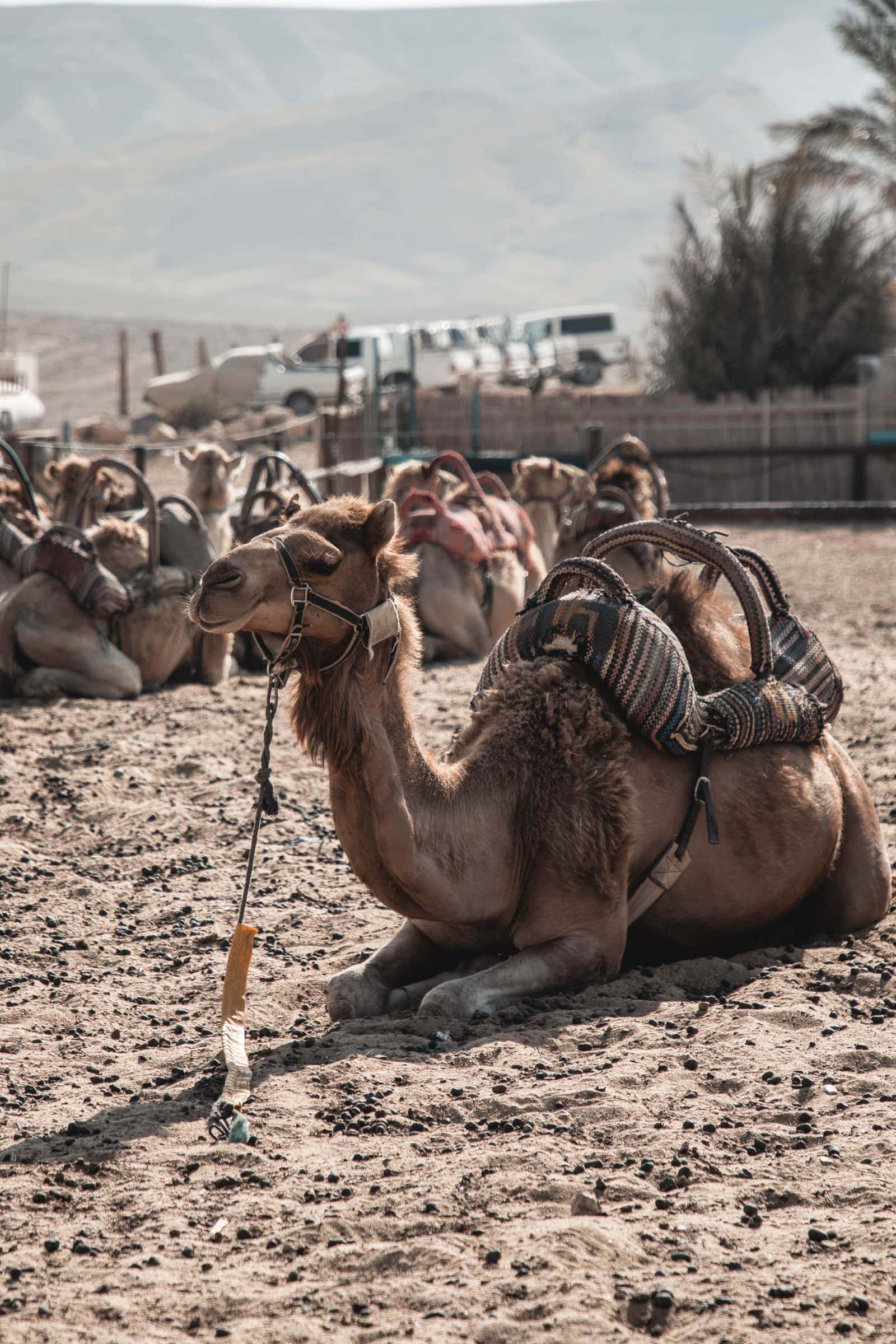
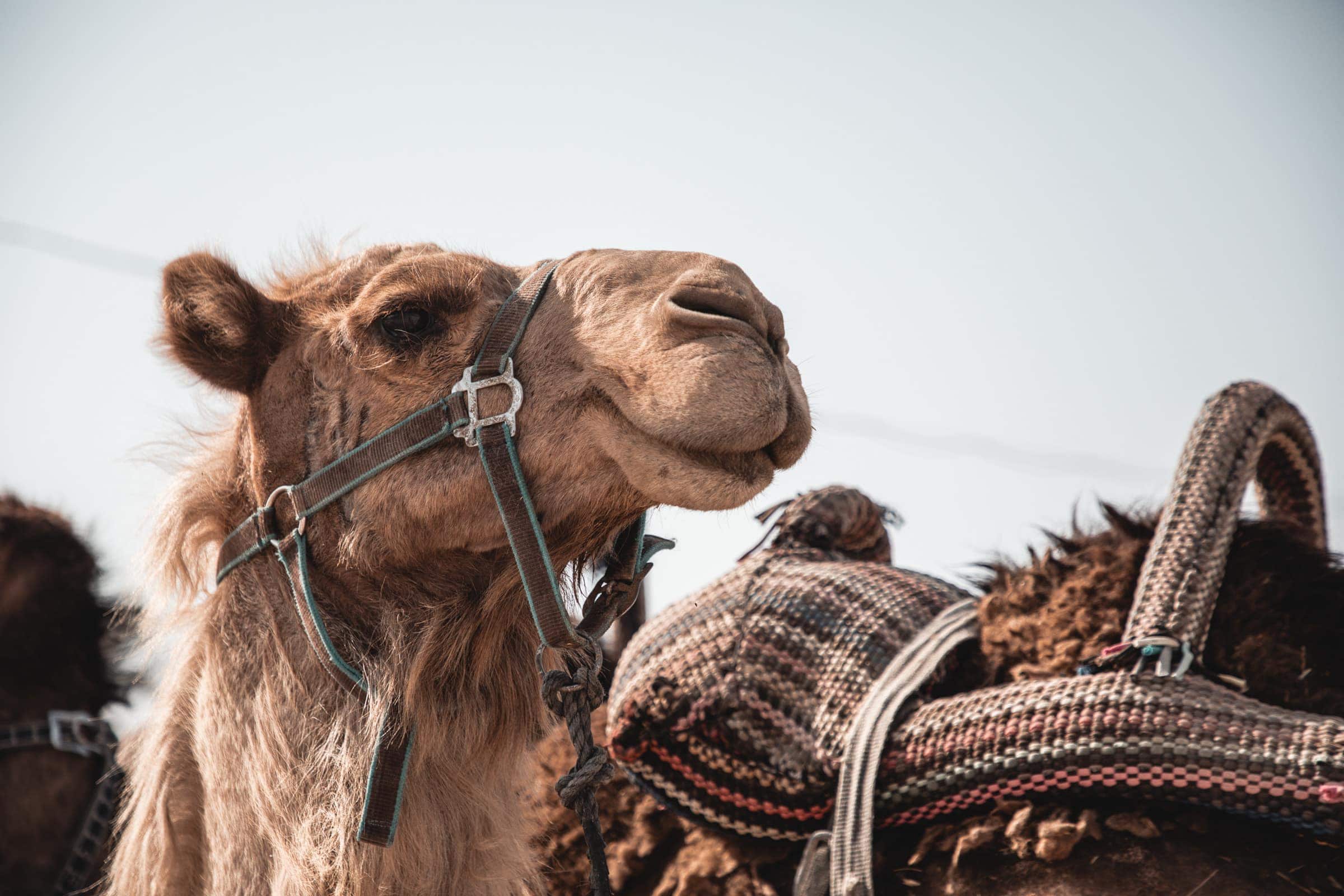
I came from the west side, the road from Arad is adventurous in the dark. But the way up to the fortress is shorter. The Roman siege ramp (yes, this access is that old!) is steep, but it only takes 15 minutes to get up to the fortress. On the way back to Arad, you have unforgettable views of the Judean Desert – and can pet cute camels on the way (warning: lots of heart-warming camel content to follow!), with which you can go on a desert tour. From Arad (the next town) Masada is signposted, so you just have to follow the road.
Excursions to Masada from Jerusalem and Tel Aviv
Masada is one of the most popular day trips from Jerusalem and Tel Aviv! You can book both daytime tours and sunset tours. There are also providers who combine a tour to Masada with a visit to the Dead Sea (also highly recommended!):
Basically, I wasn’t particularly fascinated by the archaeological excavation, and it also got hot quite quickly, so sun protection and headgear are recommended. After all, it is a mountain plateau in the middle of the desert and the sun shines mercilessly. I would therefore always recommend visiting at sunrise – it’s a truly unforgettable experience! You can find my tips for a great visit here:
If you’re traveling by rental car and don’t like getting up in the middle of the night like I do, you can look for accommodation nearby the night before. Then the alarm clock doesn’t ring quite so early. I picked up my rental car in Tel Aviv and then dropped it off at the airport for my return flight.
I spent the night in Arad at the Inbar Hotel*. Not a highlight, but decent – and contrary to the reviews I had skimmed beforehand, I was greeted warmly by the lovely receptionist, who provided me with lots of tips straight away. (Nice service is unfortunately not always a matter of course in Israel). Without being asked, we were given a plate of fruit in our room as a breakfast substitute.
If you would prefer to stay on the east side and access the fortress from there, perhaps because it is more on the way, there is the affordable HI Massada Hostel*, where many Masada visitors stay overnight.
***
You can also find out more about Israel in the following articles:
Jerusalem is a fascinating city and, alongside Tel Aviv, the top destination on any trip to Israel! But what are the must-sees in Jerusalem? Here I’ll tell you which sights you should definitely see and give you some valuable tips!
Places of interest in Jerusalem
Most of the sights in Jerusalem can be found in the Old City. Everything is within walking distance here, and you can easily visit the most important locations such as the Wailing Wall or the Church of the Holy Sepulchre in one day. You will also find the very picturesque narrow streets here. But the newer part of Jerusalem is also well worth seeing and a little more secular.
#1 The Wailing Wall / Western Wall
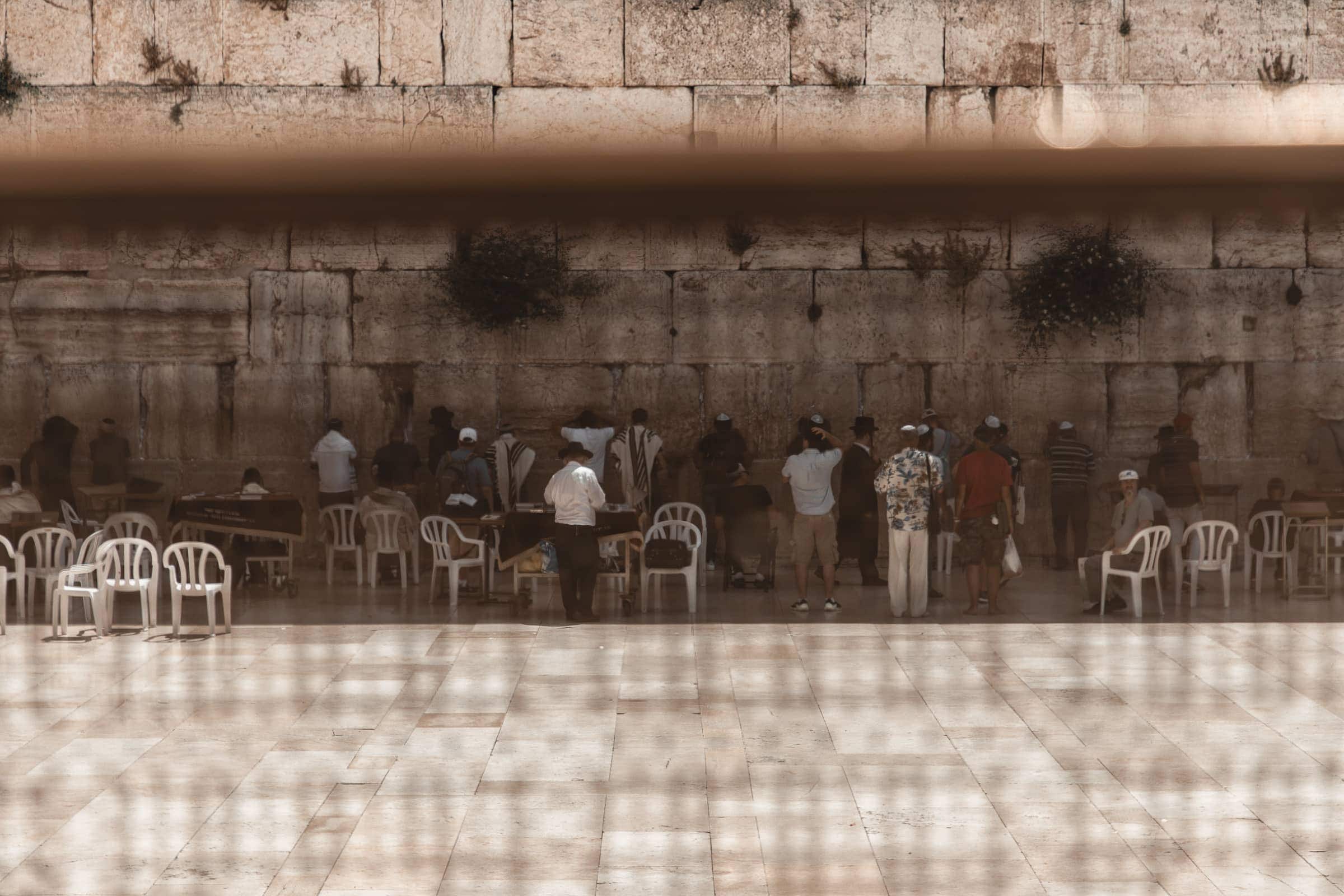
The Wailing Wall is actually the back of a protective wall of the Second Temple of Jerusalem, built by King Herod and almost completely destroyed in 70 AD during the battle between Jews and Romans for supremacy in Jerusalem. Seventy years after Christ – that’s how early people were already arguing and fighting in Jerusalem! And there are still remains from this period to this day – Jerusalem is a treasure trove of antiquity. Over the centuries, this section of the Western Wall (hence the English name“Western Wall“) became a place of Jewish pilgrimage, today’s Wailing Wall – and a symbol of Jerusalem.
The Wailing Wall is THE landmark of Jerusalem.
Helpful tips for visiting the Wailing Wall:
Access to the Wailing Wall is blocked off by security gates. Bringing cameras is not a problem – but photography is not permitted at the Wailing Wall during the Sabbath.
A visit to the Wailing Wall itself is free of charge,
Women and men pray strictly separate at the Western Wall. The men’s side usually seems emptier because 1. it is larger and 2. the men also use a covered part under an archway.
Men have to wear a kippah right next to the wall, women should cover their shoulders and knees, but somehow it’s not particularly noticeable in warm weather, if not.
There are small benches on the partition wall to the men’s section, which you can climb on to look over to the men’s section.
At the entrance in front of the wall you can get a pen and paper to write your prayers/wishes/thanksgiving/etc. on. The paper is then inserted into one of the cracks in the wall.
You move away from the wall in reverse – so as not to turn your back on it
The Wailing Wall is open 24 hours a day
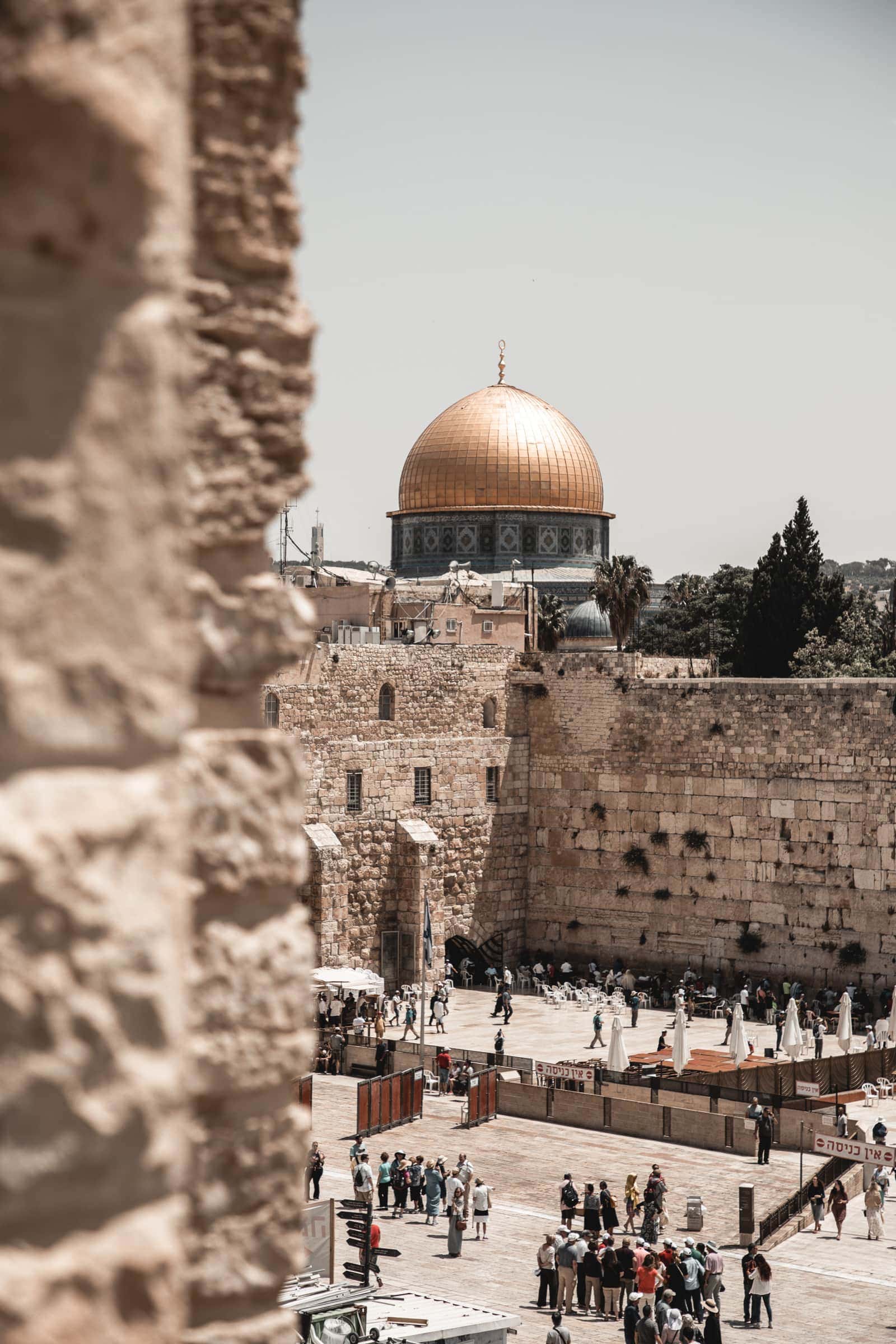
Some of the roof terraces opposite are open to the public. From there you have the world-famous postcard view of the Dome of the Rock and the Wailing Wall.
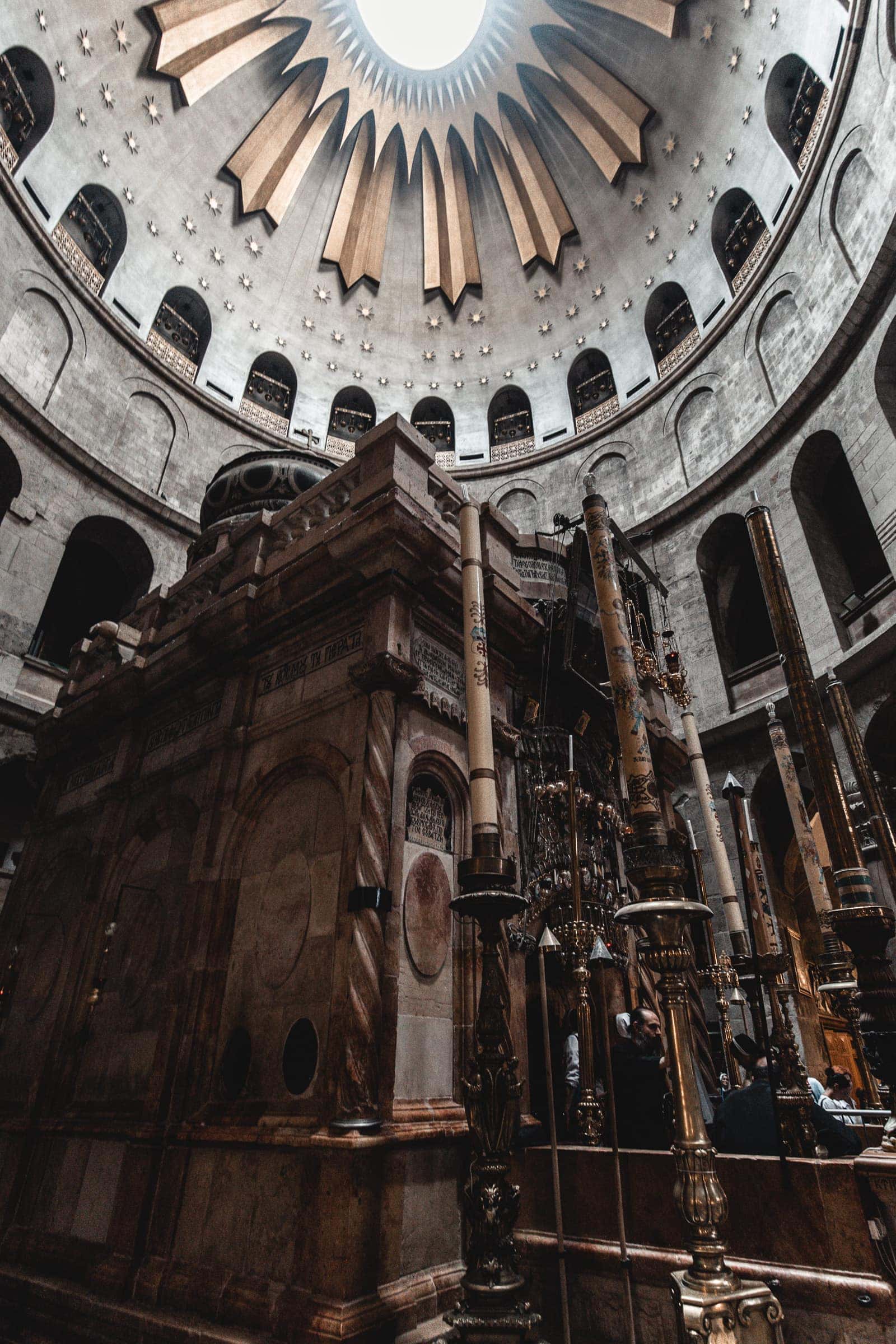
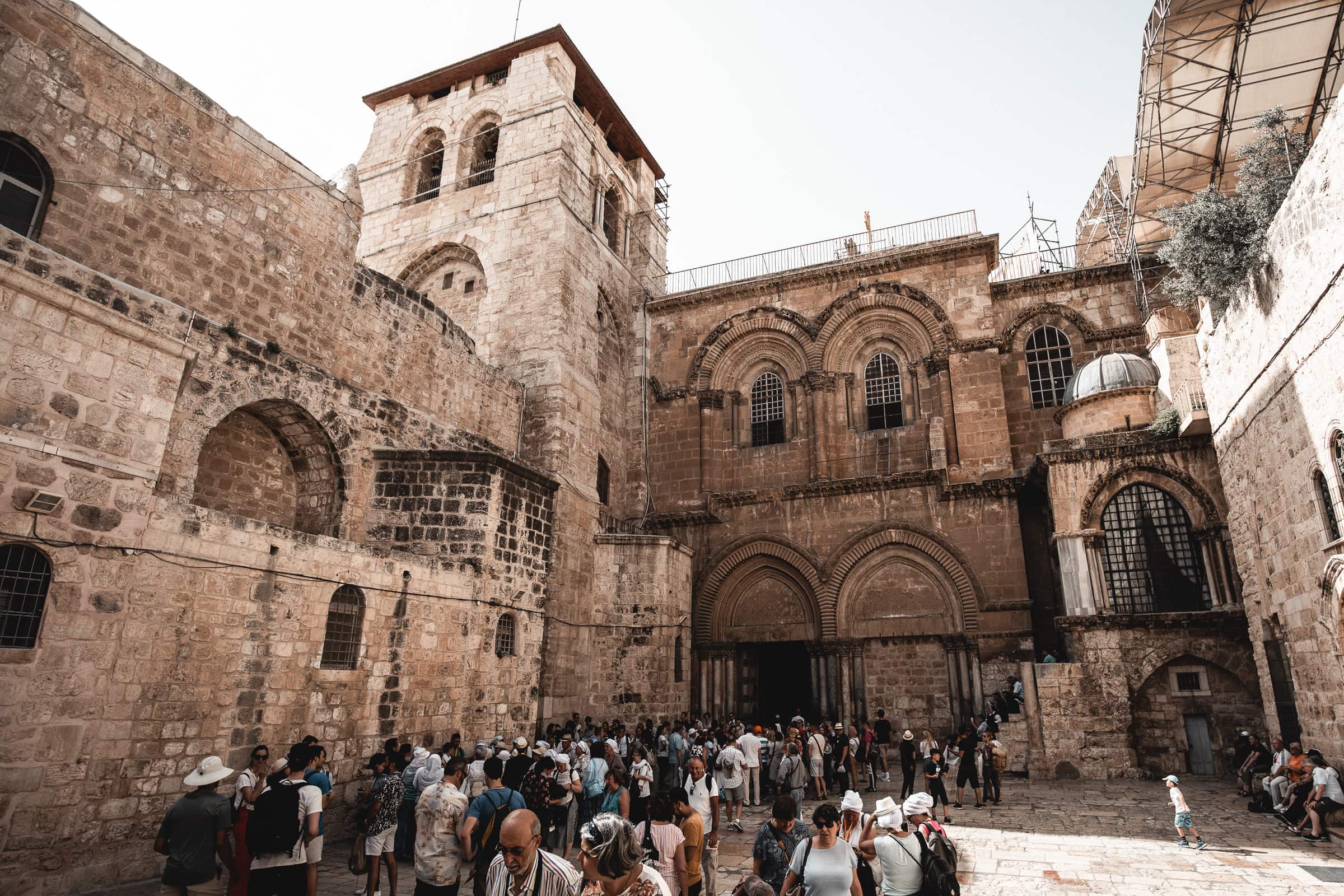
The Church of the Holy Sepulchre is THE hotspot of Christianity, no other church in the world is as significant, as important. This is where Jesus is said to have been crucified and buried, then resurrected. Whether this is true or not is still disputed by historians to this day, as it is at many sites in Jerusalem – much of what is assumed today is biblical tradition that has not always been scientifically proven beyond doubt. This is also one of the reasons that can be so confusing in Jerusalem. What is true, what is not? What is scientifically proven? The stories in individual places change depending on the faith and world view. In any case, I was very impressed by the Church of the Holy Sepulchre, a veritable labyrinth of chapels for all possible Christian faiths and so very different from other classic large sacred buildings. The first church was built on this site between 326 and 335 and was extended, destroyed and rebuilt several times over the following centuries.
The Church of the Holy Sepulchre is one of the holiest sites in Christianity.
What you should look at here:
The anointing stone right at the entrance: This stone commemorates the anointing of the body of Christ, where believers wipe the stone with cloths and towels and pray
The tomb of Jesus, THE pilgrimage destination for devout Christians all over the world: another small building stands in the huge, mystical-looking rotunda. Inside is the place where Jesus is said to have been buried. You can enter the shrine, but you have to queue – sometimes for up to an hour! (I have to admit, I then gave it to myself)
The Rock of Golgotha: Under the altar in the Greek Orthodox chapel is the rock on which Jesus is said to have been crucified – you can even touch it!
The sacred interior of the Church of the Holy Sepulchre: this is where Jesus’ tomb is said to be located.
Fun fact (or not so fun, as the case may be): The Church of the Holy Sepulchre is used by six different Christian denominations. However, as they were never able to agree on certain issues, two Muslim families hold the key to the Church of the Holy Sepulchre and open the church in the morning and lock it again in the evening. The key is passed down from generation to generation within the family.
#3 Jewish, Armenian, Muslim and Christian quarter
The Old City of Jerusalem is divided into four different neighborhoods; Jewish, Armenian, Muslim and Christian. In the old town itself, you mainly get around on foot – and this is the best way to explore the individual districts.
The bazaar atmosphere in the Old City of Jerusalem is a wonderful place to browse.
My tip is: just start walking, the most important sights are well signposted for orientation on the way anyway, let yourself drift and find out for yourself which part you are currently in. In the Muslim quarter you will find a colorful market in the alleys of the old town, the Church of the Holy Sepulchre is the center of the Christian quarter, where you will also find many souvenir stores with religious articles.
Orthodox Jews in their black clothing and black hats are part of everyday life in Jerusalem.
The Jewish quarter was badly damaged during the Palestine War in 1948 and is therefore largely rebuilt in the old style – which is also well worth seeing. In the Armenian quarter, people tend to keep to themselves and there is less street life here.
Razzouk Tattoo in Jerusalem is the oldest tattoo parlor in the world. Tattooing has been going on here for over 700 years: A family business in its 27th(!) generation.
The Via Dolorosa is a pilgrimage route that follows the traditional path of Jesus through the city to his crucifixion. There are a total of 14 stations, and if you are interested you can take part in the Franciscan procession of the cross on the Via Dolorosa every Friday. The starting point is at the Stephanstor (St. Stephen’s Gate), but beware: the cross procession is a huge event, even among religious tourists – it gets crowded in the Old Town.
#4 Temple Mount with Dome of the Rock and Al-Aqsa Mosque
The golden dome of the Dome of the Rock is probably one of Jerusalem’s most famous landmarks. The Al-Aqsa Mosque is less magnificent from the outside, but together with the Dome of the Rock it is one of the most important shrines of Islam.
Impressive: the golden dome of the Dome of the Rock on the Temple Mount.
Access to the Dome of the Rock for non-Muslims is only possible via the covered wooden structure at the Wailing Wall and under the following conditions:
A passport/ID document must be presented.
A security check must be passed upon entry and, in addition to dangerous objects, non-Muslim religious objects may not be brought onto the Temple Mount
Observe the dress code: Shoulders and knees must be covered
Non-Muslims are not allowed to enter the Dome of the Rock and the Al-Aqsa Mosque
Visiting times for the Temple Mount: Sunday to Thursday 7.30-11.30, 13.30-14.30 (summer), Sunday to Thursday 7.00-10.30, 12.30-13.30 (winter)
The crowds are very large, the controls very high – it is advisable to arrive early. However, access may also be blocked at short notice due to the political situation. It is best to obtain the latest information on the day in advance.
The Al Aqsa Mosque looks rather inconspicuous.
All too much history? Especially in Jerusalem, it is a good idea to take part in a tour to find out more about Jerusalem! It’s worth it, because you can’t get that much background knowledge!
Located right next to the Jaffa Gate, the citadel offers an absolute panoramic view of the old town. In addition to the impressive building itself, you can also visit the museum with exhibits on the history of Jerusalem and interesting temporary exhibitions (I was very impressed by the expressive photo exhibition!).
Magnificent views during the day, beautifully illuminated at night: The Citadel of David in Jerusalem.
After dark, there’s a light show on the history of Jerusalem, and if you think it’s boring, it’s best to see it for yourself – there’s almost no better and more light-footed way to be guided through the history of the city.
The Dome of the Rock in private photos throughout history.
#6 City of David
The City of David is an archaeological site near the old town, which I have already written about in this post in this post. A particular highlight is the Hiskija Tunnel, a 2700-year-old water supply canal that still carries water today and can be forded with the appropriate equipment.
#7 Israel Museum & Yad Vashem
If you still have time for art and culture after all the sightseeing in the Old City, you should also visit the Israel Museum, one of the top museums in Israel. Everything from archaeology to modern art is represented here. The main attraction are the Dead Sea Scrolls, the Qumran scrolls, named after the Qumran caves in which they were found. The scrolls are around 2000 years old and provide important information about the time of ancient Judaism. The scrolls are displayed in a specially constructed building, the “Shrine of the Book”, which looks like a white onion cut in half from the outside.
Yad Vashem is probably the world’s most important memorial to the victims of the Holocaust. The architecture and exhibition should be very moving – and I think it is always important to remember what happened so that such a memorial never has to be built again. Unfortunately, I was no longer able to visit Yad Vashem. Which I very much regret. If you have the opportunity: definitely go. With time, because this is not a program item that you should tick off in a hurry.
Admission is free, and the nearby “Mount Herzl” streetcar stop is only a 15-minute ride from the city center. A free shuttle bus runs from the bus stop to Yad Vashem.
#8 Montefiore windmill
A windmill? That’s right, the world’s most visited windmill is in Jerusalem! Holland my ass. (They have thousands for that, too.) This windmill was built in 1857 to enable the surrounding new settlements to become self-sufficient.
Holland, my ass: this smart windmill stands in the middle of Jerusalem.
There wasn’t much wind after all, but a pretty little residential area, Mishkenot Sha’ananim, grew up around the windmill. The mill has recently been extensively restored and flour is still ground here for special events, albeit now motorized.
Wine tastings are also organized in the Montefiore windmill. My untrained palate can only ever distinguish between “I like” and “I don’t like” – but the wines I tasted mostly fell into the “I like” category. So Israeli wines can’t be all that bad. A clear recommendation for a wine tasting in a somewhat different ambience.
In front of the windmill is a large viewing terrace, according to our tour guides the most popular place in Jerusalem for marriage proposals! The view of the surrounding hills is truly fantastic. However, I couldn’t help but stare at the towering concrete wall on the opposite ridge, which reminded me so much of the remains of the wall at home in Berlin – and couldn’t follow our guide’s stories about the history of this and the surrounding neighborhoods. “We have our problems, you know,” he commented curtly, and I wondered whether this human need to always have to build walls would ever stop.
We went up to the Montefiore windmill as part of a Segway tour. I’ve only ever ridden a Segway on the flat promenade along Lake Michigan in Chicago – that was quite nice. The hilly Jerusalem then gives a Segway tour a completely different adventurous twist!
#9 Mahane Yehuda Market
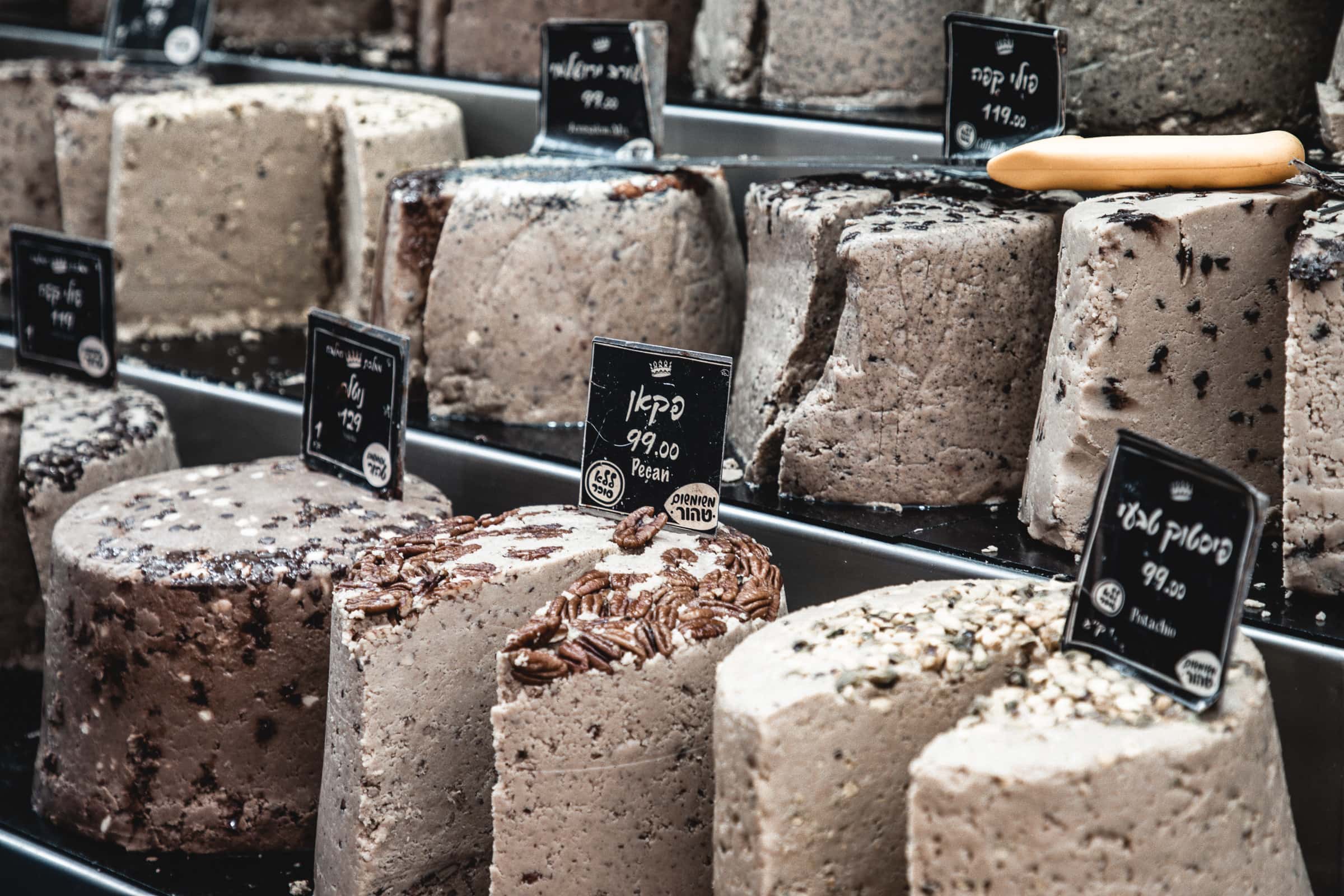
You shouldn’t miss the hustle and bustle at the Mahane Yehuda market – and it’s best to come twice: once during the day and once at night. Because during the day, normal market life takes place here: Fruit, vegetables, sweets, spices – you can find tasty delicacies on every corner. For example, at the stand that only sells halva, a sesame sweet.
In between there are always small cafés, but also bars and pubs – and when the fruit and vegetable vendors close for the day, the Mahane Yehuda market mutates into a hip pub mile!
#10 First Station
Formerly the station from which trains to Tel Aviv departed, the First Station stood empty for a long time until it was reopened as an event space a few years ago. There are cafés, bars, restaurants, coworking spaces and various events from time to time – here as part of the Pride Parade that takes place in the city in June. The remarkable thing is that, on the one hand, Jerusalem is a strictly religious city, but on the other hand, despite many dissenting voices from religious camps, it is slowly opening up towards more diversity.
Recommended: The DIY market, every Thursday in summer, from 4 pm.
Food tips: Cafés and restaurants in Jerusalem
This list can only remain incomplete – the range of great restaurants, bars and cafés is simply huge. You can eat well in Jerusalem, as in the rest of Israel, on every corner – unfortunately the price level is often very high. That means: Close your eyes and go for it if you don’t want to miss out on the truly fantastic cuisine!
Incidentally, in my experience, the portions are very large in return – it often makes sense to share a dish before you have to go back for half due to an acute food coma. (Dishes are often served in several bowls anyway, which makes it easier). Alternatively, there is always a falafel store somewhere that also serves good food on a budget.
Pergamon Vegetarian cuisine, very nice to sit outside in the evening!
At first glance, Mori’s Grill Bar looks like a simple chip shop, but it has the best grilled meat!
Grill Bar the Grill Bar without a name! Tip: The starters alone are so varied – there’s no need for a main course.
Café Rimon good cocktails, but the best thing is the location: sit here in the evening in the pedestrian zone and watch the nightlife!
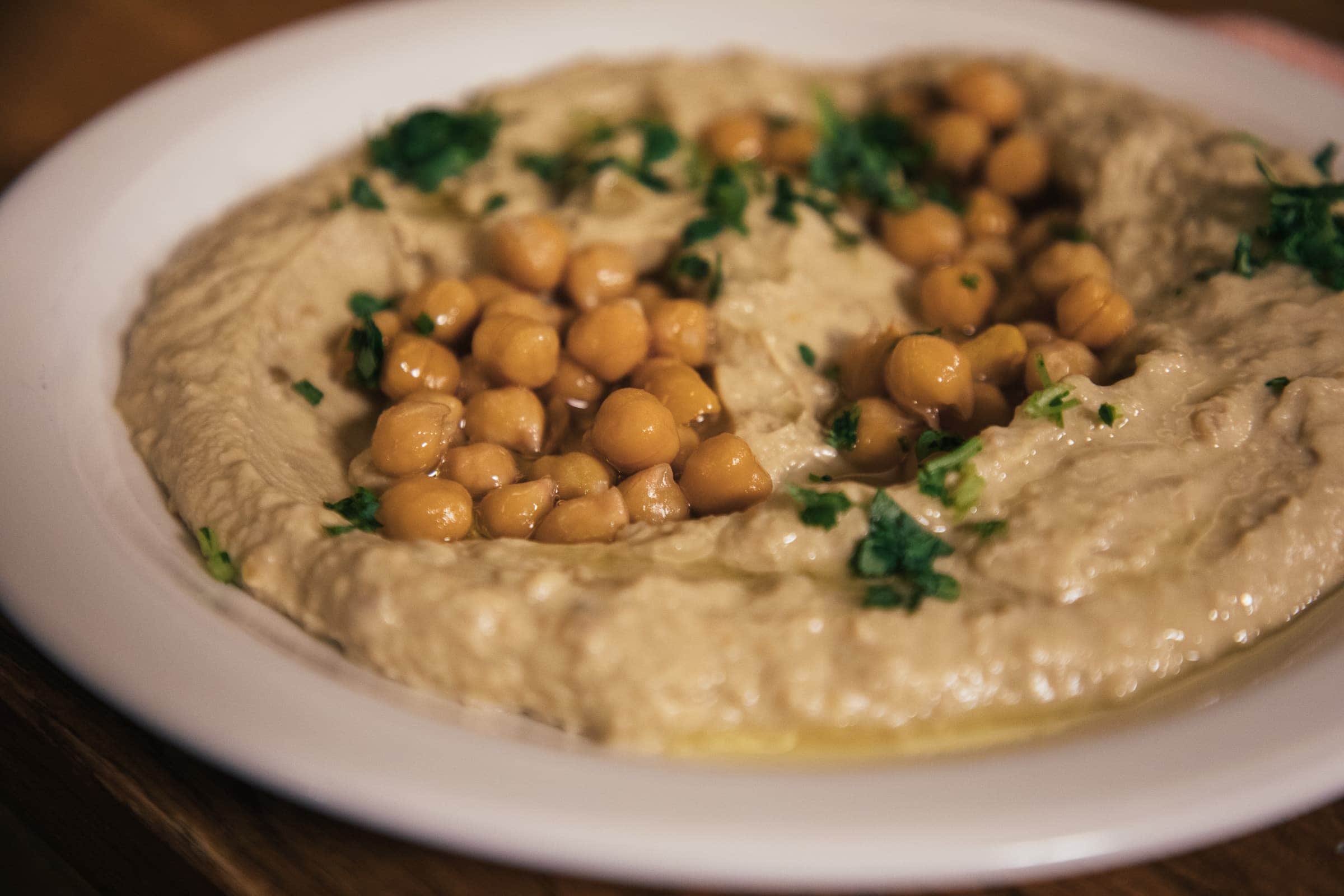
Acrmavi – the best hummus in town, so they say. The store has existed at Damascus Gate since the 1950s and somehow you get the feeling that not much has fundamentally changed since then. Except for the hummus! This is prepared fresh every day according to an old family recipe, early in the morning, as the store opens at 5.30am. Hummus is still considered the daily bread of the little man and is eaten for breakfast as well as on all other occasions. Everyone comes here: construction workers, students, office workers. You should come by by early afternoon before the hummus runs out and you have to wait until the next day’s production. Because what’s gone is gone!
Hummus is a typical Israeli dish and is super filling.
Hummus recipe:
Ingredients: 140g dried chickpeas 50g tahini (sesame butter) 1 large clove of garlic 3 tbsp olive oil 3 tbsp lemon juice Salt and pepper to taste
Soak the chickpeas in water overnight. Cook for approx. 3 hours. (Yes, it takes time! And cheating with canned chickpeas is not an option!) Drain and collect the pea water. Crush the garlic clove and mix with the other ingredients. Add the peas and mash until creamy. If the mixture becomes too firm, add pea water until the desired texture is achieved.
Hotels in Jerusalem – accommodation for every budget
Luxury hotels in Jerusalem – high-end, but worth a look even without an overnight stay!
King David Hotel – The King David Hotel has a storied past: This monumental building served as the seat of the British Mandate government in the 1930s and 1940s, survived a bomb attack during that time, and later became one of Israel’s most luxurious hotels. Heads of state and everyone who’s anyone stay here. YMCA Three Arches —The YMCA Three Arches, located directly across the street, is part of the Jerusalem YMCA (Young Men’s Christian Association), and even if you can’t afford to stay the night here, you should still come by: The unmissable bell tower is the tallest building in Jerusalem, and from the top you’ll have the best view of the city!
Medium budget – Middle class hotels in Jerusalem
Ibis Styles – A solid, clean hotel in a prime location—and brand-new! Right in the heart of Jerusalem’s new city center, with restaurants, bars, and a shopping district just steps away—it doesn’t get any better than this. The Old City is within walking distance.
And best of all: the breakfast buffet on the top floor with a view of the city is amazing. Typically Israeli, typically abundant, typically delicious. Be sure to book.
Low budget hostels in Jerusalem
The Post – Super central location, relaxed atmosphere. Private rooms are also available. Abraham Hostel*– Probably the best-known hostel in Jerusalem: Not quite as party-like as the offshoot in Tel Aviv, but still a good option for those who are on a budget and love communicative accommodation. There are also private rooms.
Journey to Jerusalem
If you are traveling to Israel from Germany or Europe, you will almost certainly land in Tel Aviv (and will certainly want to see Tel Aviv!). Ben Gurion Airport is outside on the way from Tel Aviv to Jerusalem and both cities are very easy to reach directly from the airport.
From Ben Gurion/ From Tel Aviv Airport to Jerusalem
The train connection from Tel Aviv airport to the train station in Jerusalem is brand new and takes just under half an hour. From the station, it is only a few stops by streetcar to the city center. Alternatively, there is a bus – but it takes a good hour and only goes as far as the station. I would generally advise against taking a cab – taking a cab in Israel is sometimes adventurous anyway and the train connection is unbeatable in terms of comfort.
With the Jerusalem City Pass, travel by train or bus to Jerusalem and back to the airport is free! The pass is available in three versions, the cheapest of which costs 35 euros.
From Tel Aviv (city center) to Jerusalem
There are plenty of bus connections from Tel Aviv to Jerusalem, the journey takes about 1 1/4 hours. On the website of Egged (the state bus company) you can find current timetables. Alternatively, you can also see if you can book a day trip from Jerusalem or Tel Aviv, e.g. to the Dead Sea*, and be dropped off in the other city on the way back (some tour providers offer this), saving you a trip.
Or you can book a day trip to Jerusalem from Tel Aviv, the journey doesn’t take long. However, I would say that a single day is far too short for Jerusalem – if you have the time, it’s better to stay overnight or longer.
I will probably write a separate post about entering Israel in general, as it is a bit more extensive. Please note: Traveling within Israel by public transport is generally difficult on Shabbat . From late Friday afternoon until Saturday evening there is no public transportation! Especially in Jerusalem, the rules of Shabbat are strictly adhered to, restaurants, cafés, stores, everything is closed – if possible, it is better to travel to Jerusalem on one day.
Security in Jerusalem
Basically, I wasn ‘t at all afraid of minor crimes like purse snatching or trick theft, which often occur at tourist hotspots, in Jerusalem. There are no official warnings about this, nor was I personally approached – that tends to happen to me when I’m traveling, as I’m often out and about with a camera that isn’t exactly inconspicuous. In this respect, Jerusalem seemed very safe to me.
However, this may also be due to the enormous police and military presence, which suggests that a machine gun is quickly at hand in an emergency. As a pickpocket, you’d probably be better off looking for another field of activity. Weapons can be seen everywhere, even individual young soldiers carry their machine guns outside of their duty time, both in military uniform and in private clothing, as they are only allowed to keep their weapons out of sight under certain conditions for security reasons. What at first seems disturbing for us Central Europeans is everyday life for Israelis and – in contrast to us – has an extremely calming effect on the locals. Most Israelis have also completed basic military training (men three years, women two years) and are well equipped for emergencies of any kind. Someone told me, not without a little pride, that there are always very few casualties in attacks on Israeli soil, because everyone knows what to do at the crucial moment thanks to their basic training and this may save more lives.
I got a taste of this speed of reaction one evening when we were standing in front of our hotel and a commotion suddenly broke out about 200 meters away in one of the busy street cafés: shouting, plastic chairs falling over. It was impossible to tell from a distance exactly what had happened, perhaps just a quarrel between guests, a scuffle, nothing more serious – but nevertheless the crowd around them suddenly jumped apart as if choreographed and soldiers ran off in a star shape in different directions. However, our Israeli escort had immediately analyzed the situation in no time at all and determined that there was no immediate danger to us and remained relaxed – while I, with my jaw dropped, was still busy trying to assess what was happening.
We were warned just once: we shouldn’t go to the Damascus Gate. (Buses to East Jerusalem and the Palestinian territories stop in front of this gate). Unfortunately, we did not receive an answer to our question about the reason for this very firm warning.
Later, however, I remembered that on my last visit in 2017, I strolled along there without a care in the world, ate hummus at Acrmavi and couldn’t remember feeling uncomfortable.
My personal assessment? It is ambivalent. Personally, I wouldn’t let the current overall situation stop me from traveling to Jerusalem; I didn’t feel in any danger. However, I don’t want to make a general statement on safety issues in particular, as everyone has a different perception of safety and is responsible for their own well-being.
I therefore recommend that you carefully follow the news from the region before traveling (there’s nothing like the Tagesschau and heute-journal!) and check the information page of the Federal Foreign Office for the current situation.
Conclusion: Is a trip to Jerusalem worthwhile?
After so much information and my very subjective opinion, you may be wondering whether a trip to Jerusalem is worthwhile at all. If you want to go on a city break other than Paris, Milan, London or Lisbon for a longer weekend – why not? Jerusalem it is. It’s also something a little more exotic to make your friends jealous of. The old town is very pretty, the narrow alleyways make for excellent posing pictures for your Instagram feed and it’s even more picturesque when one of the many Orthodox Jews with their big black hats scurry through the picture in the background while you’re walking around in your Sunday best.
Jerusalem is a very well developed tourist destination, there are great hotels with pools to relax in after sightseeing and good food everywhere (provided you have the necessary change, because Israel is expensive and Jerusalem as the number one Israeli tourist attraction even more so),
You don’t really have to fear handbag thieves due to the high police presence, despite religion everywhere you can still run around in a mini dress and in general you can have a really nice time here, even if you’re not at all interested in religion, history, politics, art and culture. A few pictures in front of the Church of the Holy Sepulchre, leaning dreamily against the Wailing Wall, trying hummus at the Mahane Yehuda market in between, enjoying the balmy summer breeze with a glass of wine in the evening (Jerusalem is always a winner in terms of weather with its mild to hot climate!
You can even go on a pub crawl* here with the people from Abraham Hostel* if you’re in the mood for nightlife – also a good tip for accommodation if you like it more budget-friendly but also more communicative. Jerusalem wants to become a bit hipper, and there’s nothing wrong with jumping on this bandwagon too.
But if, after reading this article, you have come across some details that have made you feel insecure, I would like to say to you: Then travel to Jerusalem all the more! If you have the feeling that you would have similar thoughts to mine, then I highly recommend a trip to Jerusalem!
It will not be easy, many things will keep you busy for a long time, you will be confused and doubt your perception. But that’s exactly what this city is all about! Feel the intensity of the city for yourself, talk to the local people, educate yourself as you pass by and learn about the history, culture and religion of a region that has influenced world events for thousands of years, ask questions, seek answers and form your own opinion – and you will be rewarded with a travel experience that you will remember for the rest of your life!
More about Israel:
Disclaimer: I was invited on this trip by iTravelJerusalem and the Jerusalem Development Authority.
Last month I had a somewhat unusual invitation in my mailbox. Wouldn’t I like to participate in the International Travel Bloggers’ Summit in Jerusalem, which would take place for the first time this year. 40 bloggers and Instagrammers from 6 nations, plus lots of expert talks, workshops, lectures and many new tips for Jerusalem.
The Old City of Jerusalem: picturesque and exciting
I already knew that the Old City of Jerusalem is picturesque and photogenic – and this time I was even more determined to capture my impressions in pictures.
Jerusalem is simply full of interesting sights: The Church of the Holy Sepulchre, the Wailing Wall, the Dome of the Rock with its striking golden dome in the background, the Tower of David, the Cardo, the shopping street from Roman times; and oh yes, there were plenty of them, the Orthodox Jews with their black hats, who always look good in photos as they scurry through the winding alleyways.
But somehow questions still remained open in me. I usually get a good feel for a city pretty quickly; that’s no wonder, after almost two decades of flying and various spontaneous and less spontaneous overnight stays in cities that were sometimes foreign to me until then, you develop your own routine when it comes to exploring and feeling out a city. Besides, I consider myself to be the uncrowned queen of speed sightseeing (well, some of my crewmates, who already incited me to the craziest speed sightseeing actions shortly before pickup, could dispute the title) and Jerusalem should not be a problem in just four days. But it did.
Jerusalem and its history: the center of three great world religions
Jerusalem is the center of three major world religions: Christianity, Judaism and Islam. Which has always held a potential for conflict, because as it is in the history of mankind: Sharing usually doesn’t work out so well. I’m not religious, but sometimes I think I have a penchant for the spiritual that I rarely bring up publicly because, let’s face it, that sounds more like barefoot dancing, spiritually entranced cult disciples in self-batiked robes than anything else.
Nevertheless, in Jerusalem I again felt the special energy of this place in my own body – whether it was due to the place itself, its history or the importance that millions of believers attach to Jerusalem and go there in droves? As I landed at the airport in Tel Aviv, a fervently chanting group of 40 cheerful pilgrims sheered in right in front of me on the way to passport control; judging by the inscription on their printed shirts, they had come from the Ivory Coast for a Pentecostal trip, and this trip seem to be an extraordinary event in their lives. This religious devotion of the many pilgrims and pilgrimages is also clearly felt in the city itself.
Excursion to the City of David – a morning on the trail of Indiana Jones
Then one morning we went to the City of David. A rather less touristy spot in Jerusalem, most people want to see the Wailing Wall and explore the Old City. The City of David is an archaeological site that has been opened to the public and features finds from the time when King David (who made David and Goliath – it’s getting biblical!) made Jerusalem a thriving city 3000 years ago. Secretly, I hoped that this program item would quickly pass me by – looking at excavations, that didn’t sound very tempting. I mean, half the city is old, there’s no need to look at that separately, is there?
Archaeology in Jerusalem: Exciting finds and insights
I was proven wrong. We descended into an underground cave, got a little refresher course in the Old Testament (which I sorely needed) as we stood in the middle of its setting, so to speak, watched a very realistic multimedia presentation of ancient Jerusalem and marveled at the incredibly ingenious irrigation system: We wound our way through narrow crevices in the rock, which were carved into the rock at the time as a water supply for the surrounding fields, and couldn’t believe that this was supposed to be several thousand years old.
The Hezekiah Tunnel from the 8th century BC, an underground canal for water supply, has also been opened up and can be visited along almost its entire length. The special treat: to this day, the tunnel is at least knee-high with water and must be waded through! Waterproof shoes and a flashlight (compulsory!) can be purchased on site.
The entrance to the Hezekiah tunnel: It gets wet and dark
Archaeology live: the latest discovery in the City of David
At present, another great discovery is being uncovered: In an excavation not previously open to the public, the pilgrimage route several hundred meters long from the Shiloah Basin (where the faithful underwent ritual ablution) up to the temple of the city is being excavated. What is today an underground tunnel, for which we had to descend quite a bit, was 2000 years ago an open-air road – so much has been built over it in the centuries that followed! Live and in color, we were allowed to see the ongoing excavation work – and suddenly archaeology seemed quite exciting. Soon, by the way, this tunnel will be open to the public – and that will be great!
Outside again, we enjoyed the view of the valley, behind us a slope on which the residential buildings of the surrounding neighborhood were piled up. The different layers of rock also revealed that there was a lot of history in this slope. “You know, the ground on which Jerusalem stands is made up of countless layers of building fabric. Nothing was removed. It’s been thousands of years of just building on top of each other, layer by layer,” said our Israeli escort, Maria. “The big archaeological question in Jerusalem is never whether you’ll find anything – because you always find something, that’s for sure. The only question is whether it’s worth destroying what you’ve discovered so far in order to dig even deeper.”
My indefinable feeling about Jerusalem melted away and I made my peace with the fact that I would probably never be able to solve my question marks about Jerusalem. How could one ever classify a city under whose surface the history of mankind from millennia is buried?
Practical tips for the City of David
The City of David is located not far from the Old City, behind the Wailing Wall as you pass through the Dung Gate. I would allow half a day to explore the whole area at your leisure – it’s probably hard to do that on a day trip. But anyway, in my opinion, a single day for Jerusalem is far too little. And the City of David is really a location I would highly recommend to you, preferably with a guided tour – it helped me a lot to understand Jerusalem a bit better.
Cabrera is a popular excursion destination from Mallorca. From Colonia Sant Jordi, regular boat trips can be taken there – and contrary to my expectations, the tour to Cabrera was a complete success even in high summer.
Cabrera is part of an offshore archipelago south of Mallorca and also belongs to the Balearic Islands. At the same time, the island of Cabrera is a nature reserve. And a popular destination for excursions from Mallorca! So the chances seemed high to be overrun by crowds of tourists.
The island of Cabrera can be reached from Colonia Sant Jordi by various boat trips
By boat to Cabrera
In the high season there are several trips daily. Our tour was the only one that day that still had seats available. It takes just under three quarters of an hour to drive from Colonia Sant Jordi in the southeast of Mallorca to Cabrera. Although we were already sitting in the larger of the two types of boats on offer (50 seats instead of just 12), the ride was damp and bumpy, but just right for a breath of really fresh sea air.
The small pier on Cabrera
Tip: Colonia Sant Jordi is located in the beautiful southeast of Mallorca, with many beautiful beaches all around. The dream beach Es Trenc, for example, is right next door. Situated directly on the coast, Colonia Sant Jordi is a small and tranquil old fishing village with everything you need for a relaxing Mallorca vacation. So if you’re still looking for a great vacation spot, I highly recommend checking out accommodations there!
Arrived on the island: Astonishment. Where were all the crowds? Slowly we entered the secluded natural harbor of Cabrera. Some sailboats were lying there in the calm water, a few people were sunbathing on the small beach and otherwise: silence, silence, silence!
View from the fortress of Cabrera
Activities on Cabrera: Hiking to the Mirador de Cabrera
If you come to Cabrera by excursion boat for a day trip, you have a few hours to explore the island on the longer tour. Some parts of the island of Cabrera are not open to the public, so you move with the other fellow travelers on the same trails – but you spread out relatively well on the island. For a grand view, you can hike up the fortress (Castillo de Cabrera) – and at 35 degrees in the midday sun, that’s more athletic than it sounds.
The fortress of Cabrera can be seen from afar
You can find lots more tips for your trip to Mallorca on my Mallorca blog
Those who come with their own boat may anchor only in the bay.
The Mirador de Cabrera
From the observation tower of the fortress, the Mirador de Cabrera, you have the perfect view over the island and the turquoise sea. On the way back stop at the island bar, then swim in the clear windless water and enjoy the pure nature around you: If you can not relax on Cabrera, it’s your own fault!
At sunset: The blue grotto in Cabrera
The excursion usually includes a stop at the blue grotto, depending on the weather conditions – this is only possible when the sea is calm. And the name… I wonder where it comes from? The water is just so incredibly deep blue that it wants to suck you in.
At sunset it shines warmly into the Blue Grotto
All excursion boats stop here for swimming and snorkeling. Due to the water depth, however, this is only something for swimmers. With luck you will even meet curious rays! If you have booked the afternoon tour, you get a romantic sunset on top!
Tip: If you are not staying near Colonia Sant Jordi or are traveling by rental car, it is a bit more complicated to organize a trip to Cabrera on your own. But there are tour operators who offer complete trips to Cabrera with arrival in Colonia Sant Jordi and still stops at the beaches nearby!
Making garbage forbidden! Cabrera is a nature reserve and the garbage that you bring or produce there, you have to take back: There are no garbage cans on the island, because the transport of tons of tourist garbage back to Mallorca is too costly. However, the system is not quite well thought out, waste avoidance and recycling are generally not a big issue on Mallorca.
In the island bar, drinks are served in cans or disposable cups – that could also save quite a bit of trash. And resourceful tourists simply litter the toilet garbage cans in the public toilets for lack of litter garbage cans on the paths. Or throw food scraps into the bushes. Is organic. Well. A little more education and awareness for all visitors couldn’t hurt. This was completely absent from our tour, and if an island guard hadn’t happened to intercept me and enlighten me when I was looking for a trash can for my apple crate after leaving the boat – the topic of trash wouldn’t have come up anywhere else.
Cabrera used to be the Alcatraz of Mallorca. Or like this. At the time of the Spanish Wars of Independence at the beginning of the 19th century, 9000 French soldiers were taken here as prisoners of war, under the worst conditions – and a large part met their death here. You can also learn more about the history of the island in the island’s own museum!
Be sure to bring sturdy shoes! Going up to the castle in flip-flops is no fun.
Do not forget snorkeling equipment: On the beach and in the blue grotto is wonderful snorkeling and fish watching.
The island bar serves wonderful Horchata (a Mallorcan almond milk drink) with fresh almonds!
If you want to stay longer: there is a small, simple hostel on the island. Please note: It is essential to book in advance and the length of stay is limited to a few days! ➜ Make a reservation for the hostel of Cabrera
More tips for Cabrera:
marcabrera excursions to Cabrera from Colonia Sant Jordi. If you book online, there’s a 10% discount, the half-day excursion as above then costs 36€. Resident discount is also available, but is only 7% and cannot be combined with the online discount.
Valldemossa is one of the most beautiful places on Mallorca. The small alleyways with their colorful planted doors are a popular photo motif and a must-see on a trip to the Serra Tramuntana with its pretty villages. In this article, I’ll tell you what else you shouldn’t miss out on in Valldemossa!
Valldemossa Charterhouse
The Valldemossa Charterhouse is the central point of the village. Behind the Charterhouse is a small, very well-kept garden, which is particularly inviting in summer. The charterhouse in Valldemossa was built and used as the summer residence of the King of Mallorca (no, not Jürgen Drews – Mallorca really was once an independent kingdom) at the beginning of the 14th century. The Charterhouse can also be visited from the inside for an entrance fee.
Save time: You can buy your ticket to the Kartause online here*.
Visible from afar: The extravagant tower of the Valldemossa Charterhouse on Mallorca.
Even the famous composer Frédéric Chopin once stayed here, in the winter of 1838, together with his lover George Sand. However, due to his progressive tuberculosis, Chopin had to leave Mallorca and Valldemossa after just one winter. The Valldemossa Charterhouse, or Cartuja in Spanish, and the entire monastery complex, where Chopin lived, are very well maintained and well worth a visit!
There is even a street named after Valldemossa’s most famous resident.
The beautiful alleys of Mallorca
Many people will know Valldemossa from pictures of Mallorca without realizing it: Here you can take wonderful pictures of the small picturesque alleyways, which are often beautifully decorated in summer due to the many festivities.
Typical for Valldemossa: the rough stone facades of the houses are decorated with many small flower pots.
The typical Mallorcan architecture with heavy stones and rustic wooden doors can be found everywhere. The facades of the houses are often hung with Mediterranean terracotta pots around the doors and are beautifully planted.
The many small artists’ studios dotted around the village are also wonderful photo motifs and very instagrammable.
Many Valldemossa residents go to great lengths to plant their houses.
Local specialty: The best cocas de patata on Mallorca
You should definitely try one of the cocas de patata in Valldemossa, a sweet, fluffy yeast roll made from potato flour, which is dusted with plenty of powdered sugar after baking. If you’re lucky, you’ll still be able to get slightly warm cocas fresh from the oven in the bakeries, as cocas are sold throughout the day in the high season and are therefore baked again and again. A delicious sweet with coffee, popular all over the island, but the original simply comes from Valldemossa. The best way to enjoy a coca is with a cool horchata, a kind of cold almond milk smoothie. Don’t miss it!
The best spot with authentic Mallorcan charm—a true classic: Pasteleria Ca’n Molinas When the weather is nice, there’s no better place to sit than under the lemon and orange trees in the courtyard!
In Valldemossa you eat cocas de patata! Nowhere on Mallorca do they taste better than here.
In addition to the bakeries on the main street that serve fresh cocas, I can recommend the following locations in Valldemossa:
Cappuccino – the classic on Mallorca is also a must in Valldemossa! See and be seen with a view of the Charterhouse! Gelato Mossa – ice cream parlor right next to the Charterhouse. Yes, the ice cream is more expensive here, but good ice cream is expensive on Mallorca and even more so in Valldemossa. I can still only recommend it! Aromas – a little more hidden and away from the hustle and bustle, but good food and an atmospheric courtyard!
The atmosphere at Aromas in Valldemossa is particularly cozy.
Tips for a visit to Valldemossa
Arrival by car
Valldemossa can be easily visited on a day trip with a rental car along the Tramuntana mountains. Please note: the winding roads on Mallorca are quite twisty, so it’s not for anxious or impatient drivers! Especially when the roads get crowded in summer and some people like to push, get overconfident or drive at a snail’s pace out of sheer fright. But the view is so beautiful – I can never get enough of it, even though I’ve driven the route so many times.
Arrival with a tour
If you don’t feel comfortable driving your rental car along that route, you can also join a guided tour. The downside: you’re completely tied down. There’s so much to discover in this part of Mallorca in particular. It’s much more convenient to be able to stop wherever you want and plan the trip yourself.
On a tour, however, you can travel at a relaxed pace—especially if you don’t like riding challenging routes in unfamiliar areas.
Public transport is also an alternative: bus line 203 connects Palma with Valldemossa and Port de Soller. However, it doesn’t run that often (usually only every 60-90 minutes), so you should plan well in advance.
Finding a parking space in Valldemossa is not easy, especially in summer. It is best to leave your car in one of the public parking lots along the main road. You only have to cross the road to get to the old town. At the height of summer and at weekends it can get really busy, so keep your nerve and give up hope of finding a free parking space! Valldemossa is very popular!
Saigon Street Food – this has become a household name even back home in Berlin. So a street food tour in Saigon* or Ho Chi Minh City seemed pretty obvious! Vietnamese cuisine is so diverse, so fresh, so full of new flavors, and within Southeast Asia, it’s a flavor all its own. In Saigon in particular, the choice of street food stalls, small snack restaurants and roadside food stalls is almost endless.
Vietnamese are sociable and love food, people are constantly chewing on something somewhere, (unfortunately disposable) bowls filled with goodies change hands and you really wonder how the majority of the population here can still be so slim. Because Vietnamese cuisine is not always easy! In Vietnam, too, people fry for all they’re worth, and sugar is consumed just as excessively.
Street Food in Vietnam – a culinary adventure
One thing in advance: you might not want to try many dishes served in the streets of Saigon in general. Unless you’re really into experimenting. Vietnamese cuisine is often praised for its French influences and thus exciting combinations – and at the Vietnamese at home in Germany it is always delicious. But what is often overlooked: In Vietnam, people really do eat everything.
Advertising / *affiliate link
Vietnamese love meat, so much so that vegetarians sometimes have a hard time finding a vegetarian dish. Vegans even more so. And on the one hand very commendable, but for the European (or at least my) palate quite unusual, here really everything is eaten from beef, pork, chicken, fish, seafood, and even frog or snake: From fillet to the most bizarre offal.
At the really authentic stalls you don’t get far with English, there is no map even in Vietnamese. Often you don’t dare to try something – you never know… For this reason and because I still really wanted to try some (but not quite so) exotic street food in Saigon, I went on a street food tour in Saigon*– and it was great! Sam, who was traveling with me, showed me the wackiest corners of Saigon and let me sample fantastic food (with no unpleasant surprises).
What is the difference between summer rolls and spring rolls?
While in this country spring rolls are deep-fried rolls and called summer rolls rolled in soft, light rice paper, for Vietnamese everything is simply spring rolls! Summer rolls seem probably rather an invention of the West. So we started off with one of the freshest spring summer rolls to roll yourself that I have ever eaten. Fresh herbs and lettuce that it just cracked.
Bánh Tráng Nướng: Vietnamese pizza
Vietnamese have invented their very own version of pizza. It doesn’t really have anything to do with an Italian pizza except for the shape, but it’s still a popular snack. Rice paper, a cream that is supposed to represent cheese, various sauces and mayonnaises, sliced sausages – somehow all sorts of things end up on the Bánh Tráng Nướng Pizza. Which amazingly then even tastes! In addition, there was then Nem nướng, grilled sausages – garnished with the obligatory fresh herbs, which must not be missing anywhere.
Trứng Cút Nướng Phô Mai: Grilled quail eggs with cheese
Why quail eggs are so popular in Vietnam is for a very simple reason, Sam revealed to me. A whole hen’s egg would be far too much as a portion for a small cupcake like the ones in the mini bowls – and would be too filling. Slowly, I discovered the secret of the Vietnamese diet, which seemed to eat all the time: Always small portions instead of huge dishes.
In the pale glow of streetlights, we were now sitting somewhere in the middle of Saigon on the side of the road on our kindergarten stools, like those used in abundance at street food stalls in Vietnam, eating our quail egg muffins called Trứng Cút Nướng Phô Mai and Bánh Xèo, stuffed pancakes. And here again lots of fresh herbs, which Sam explained to me individually (and whose names I also immediately forgot again, because I was only busy with amazement).
Chè Bưởi: Dessert in Vietnamese
I have no idea what Sam was handing me – it was called Chè Bưởi and she translated it as “sweet grapefruit soup.” Somehow it was sweet, creamy, fruity and fresh at the same time; just the right thing at night 30 degrees air temperature.
Book Street Food Tour in Saigon
Street food tours like this take you to very remote corners of the city that I probably never would have gotten to see without Sam. They are usually advertised as “Students show you street food in Saigon” and in fact Sam was a student who knows a lot about street food mainly because she only lives in a small room and actually eats out all the time – just like many students in Ho Chi Minh City.
The spots are spread all over the city and you are driven from spot to spot on a scooter. Helmets are provided. A great opportunity to experience the crazy traffic in Ho Chi Minh City first hand! In addition, the tours are very individual and personal, because there is a guide or driver for every guest.
From Saigon, I continued south—and even though I’d already really liked Ho Chi Minh City —things were about to get even better in the Mekong Delta. I highly recommend taking a side trip to the Mekong Delta from Saigon! Here, you’ll find vibrant life at the floating markets on the Mekong and a glimpse of the real, authentic Vietnam. A Mekong Delta boat tour is a once-in-a-lifetime experience. If you do it right, you can immerse yourself deeply in the local culture and get to know the lives of the locals. In this article, I’ll tell you the best way to make that happen.
Homestays in the Mekong Delta: Off into Nature
I often decide spontaneously on the spot where I want to go further and after the busy and sometimes noisy Ho Chi Minh City, a bit of nature seemed like a good change. In the Mekong Delta you can find a lot of homestays. There you stay with locals on their property or in their house, sometimes more, sometimes less easy.
By chance, I came across a homestay with lots of little bungalows: small bamboo huts overlooking the river—a tributary of the Mekong—just like the hundreds of others here. Very simply furnished, without air conditioning or frills, but with a genuine tropical vibe right in the middle of South Vietnamese jungle. Chirping crickets, croaking geckos and frogs, crowing roosters. Real country life, far away from any civilization, at least that’s how it feels. In reality, the nearest major city, Can Tho, is only a few kilometers away – but that just seems unbelievable.
A Boat Trip Through the Vast and Branched Mekong Delta
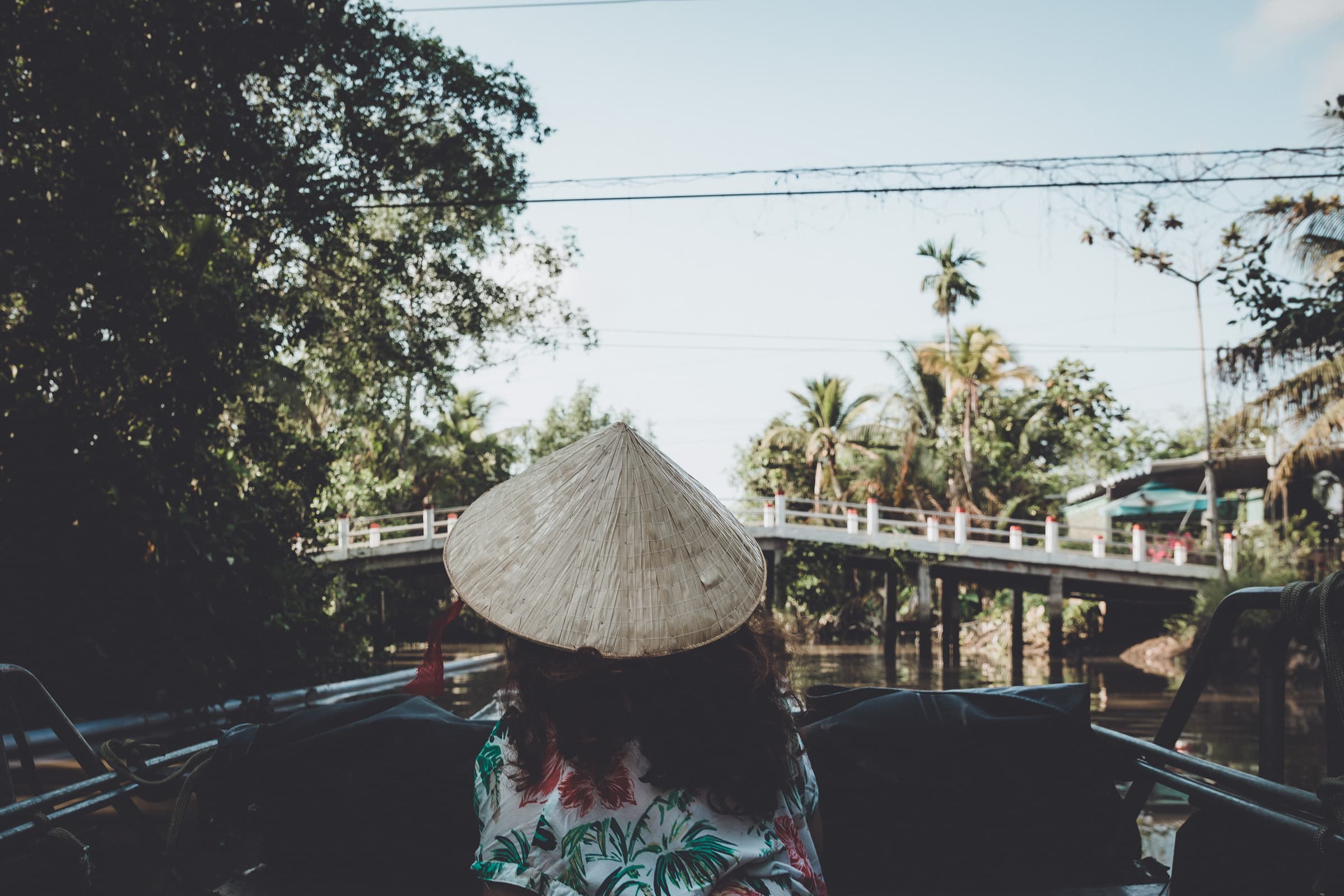
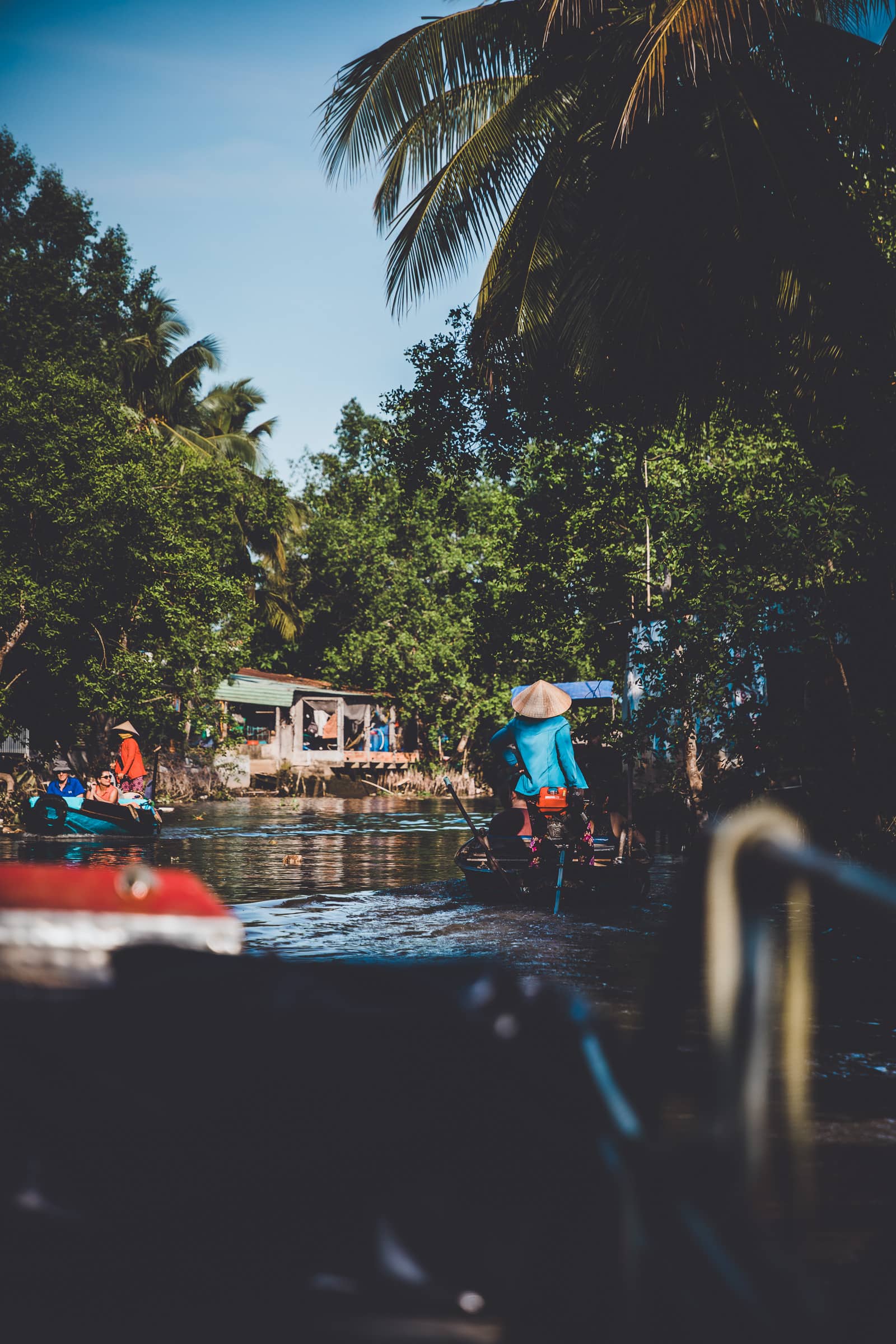
Traveling individually is often exhausting, planning everything, organizing everything – it rarely looks like a vacation. In return, you will be gifted with the most impressive experiences. With a small motorboat made of wood, more nutshell than boat, we sailed at half past five towards the sunrise, in our mini-group, through the branched, narrow side arms of the Mekong.
On the right and left, densely overgrown riverbanks full of palm trees and tropical trees. Lucy, our tour guide, courageously cuts down a palm leaf with a huge knife and with admirable dexterity makes rings and small animals out of the leaves to pass the time. But this is not necessary at all, the ride over the almost still sleeping river in the middle of this jungle panorama is already pastime enough.
The Cai Rang Floating Market: Sunrise on the Mekong
Just in time for sunrise, the rising sun behind us, we turn into the floating market of Cai Rang, the Cai Rang Floating Market, with our little boat tour. That’s right, a floating market: Like so many markets here in the Mekong Delta, the market of Cai Rang is located in the middle of the river.
Traders exchange goods directly from boat to boat, in between old women in their mini-boats, on which they have installed small cookshops and thus supply the workers – and depending on the time of day also the one or other tourist boat. We in our little nutshell were early, before the big tourist rush. To experience the floating market of Cai Rang at sunrise, when the market life is still in full swing, is unique.
Market Life at the Floating Markets on the Mekong River
We hopped from boat to boat, ate breakfast to karaoke music (Vietnamese love karaoke, regardless of their own singing skills, which is both quirky and likeable), shimmied out of our nut shell up steep boat walls to nibble on freshly carved, cardboard-sweet pineapple – and around us, pure market life. Rumbling diesel engines, sacks of vegetables and grain flying around, people hard at work. Somehow surreal that all this takes place on the water – but that’s Vietnam in the Mekong Delta: The Mekong is the lifeline without which nothing would function here.
Around the floating market of Cai Rang there are also numerous manufactories. Like this one, for example, which painstakingly makes rice noodles. First, the dough is baked into a flat cake, which is then dried and stacked on bamboo mats and finally put through a noodle press. Everything by hand, without large machines and almost in the open air. Just like the coconut candy you can buy anywhere. They are not for loose fillings or third teeth, but taste very delicious and coconutty!
Boat Tour to the Mekong Delta from Saigon or Ho Chi Minh City
From Saigon, there are numerous operators offering day trips into the Mekong Delta to the floating markets. The vendors like to go to the markets of Cai Rang and Cai Be, usually also with a small supporting program. If you have only little time and don’t want to continue your journey from Saigon towards Cambodia or Phu Quoc, but rather towards the north, such a day trip is a good possibility to see at least something of the Mekong Delta.
Disadvantage: Most of the way to the market is by bus. The trip takes about 3 hours, so you spend a lot of time getting there and back. While most tours are very inexpensive, most also stop at coffee run type shopping areas. Also, the groups are usually quite large, and you arrive at the markets relatively late—by which time most of the hustle and bustle has already died down. (I’ve linked a slightly more expensive tour for you above; the group is smaller, and the itinerary sounds nicer. Travel agencies in Saigon often offer tours for a fraction of the price, but every traveler I spoke with was, without exception, disappointed by these tours!)
So if I were to go on an organized tour, I would choose a multi-day tour of the Mekong Delta.
Planning Your Own Mekong Delta Tour: Accommodations & Helpful Tips
But you can also organize your own Mekong Delta tour! It takes more effort, but it’s definitely worth it! Here are a few tips:
Take the Open Bus from Saigon to Can Tho—> —preferably on the orange buses operated by Futa Travel, and then continue by taxi from there
Homestay in Can Tho, right in the middle of the jungle : Homestay Mekong Can Tho*(from there, you can book a $15 sunrise boat trip to the Cai Rang floating market, as well as an $8 sunset boat trip that includes a visit to private fruit orchards) Note: Due to its location, there are a lot of mosquitoes—it’s worth bringing mosquito repellent containing DEET with you from Saigon! ➜ You can book your stay at Homestay Mekong Can Tho here
For those who prefer a more urban vibe: A super-friendly and comfortable homestay run by a pair of Australian-Vietnamese sisters—I would have loved to stay here even longer; they’re both so warm and helpful! I wholeheartedly recommend it! ➜ You can book your stay at The Mag here*
Tip: From Can Tho, you can also organize your own boat trips to the floating markets! Just walk along the pier and within a few minutes, you’ll be approached by various ladies. You can rent boats for a Mekong tour all day long, but it’s still worth going early in the morning before sunrise to get a real feel for the market atmosphere!
Are you planning a stopover in Ho Chi Minh City or Saigon during your trip to Vietnam? You’ve come to the right place: in this article, I’ll reveal my best Saigon tips and which Saigon sights you shouldn’t miss! Whether it’s the best street food, the coolest restaurants or the best accommodation: In this guide to Ho Chi Minh City (official name of Saigon!) you will find what you are looking for.
How to enjoy your stay in Saigon
Saigon may be the largest city in Vietnam, but it’s nowhere near as overwhelming as Bangkok or Hong Kong. The only thing that really takes some getting used to (and this applies to the whole of Vietnam in general) is the traffic with trillions of scooters, of which every Vietnamese seems to own at least one. Honking is a way of making yourself noticed in traffic, but you don’t flash your lights – so the traffic in a city like Saigon is simply a huge, loud wave of honking scooters.
Mototaxis, scooters that you simply hop on, are also popular. Grab, a cab service similar to Uber where you can choose between a scooter or a normal cab, is also popular. However, when it was 40 degrees I usually took the car – and enjoyed the air conditioning. In general, Grab is an ideal way to get from sight to sight, it is cheap and much easier than traveling by public transport.
Why Saigon should be on your bucket list for your trip to Vietnam
It has now been four years since I was last in Vietnam. I left the country feeling very ambivalent at the time – somehow I didn’t get the full enthusiasm. I had previously only known Thailand in Southeast Asia, a country that makes it very easy for Western tourists to feel at home straight away. I had a slightly different experience in Vietnam. But more on that later. As I had visited the most important places in northern Vietnam such as Halong Bay, Hanoi, Hoi An, Hue and Da Nang last time and didn’t have time for the south, this time I wanted to get to know Saigon, the Mekong Delta and a few other places and try Vietnam again.
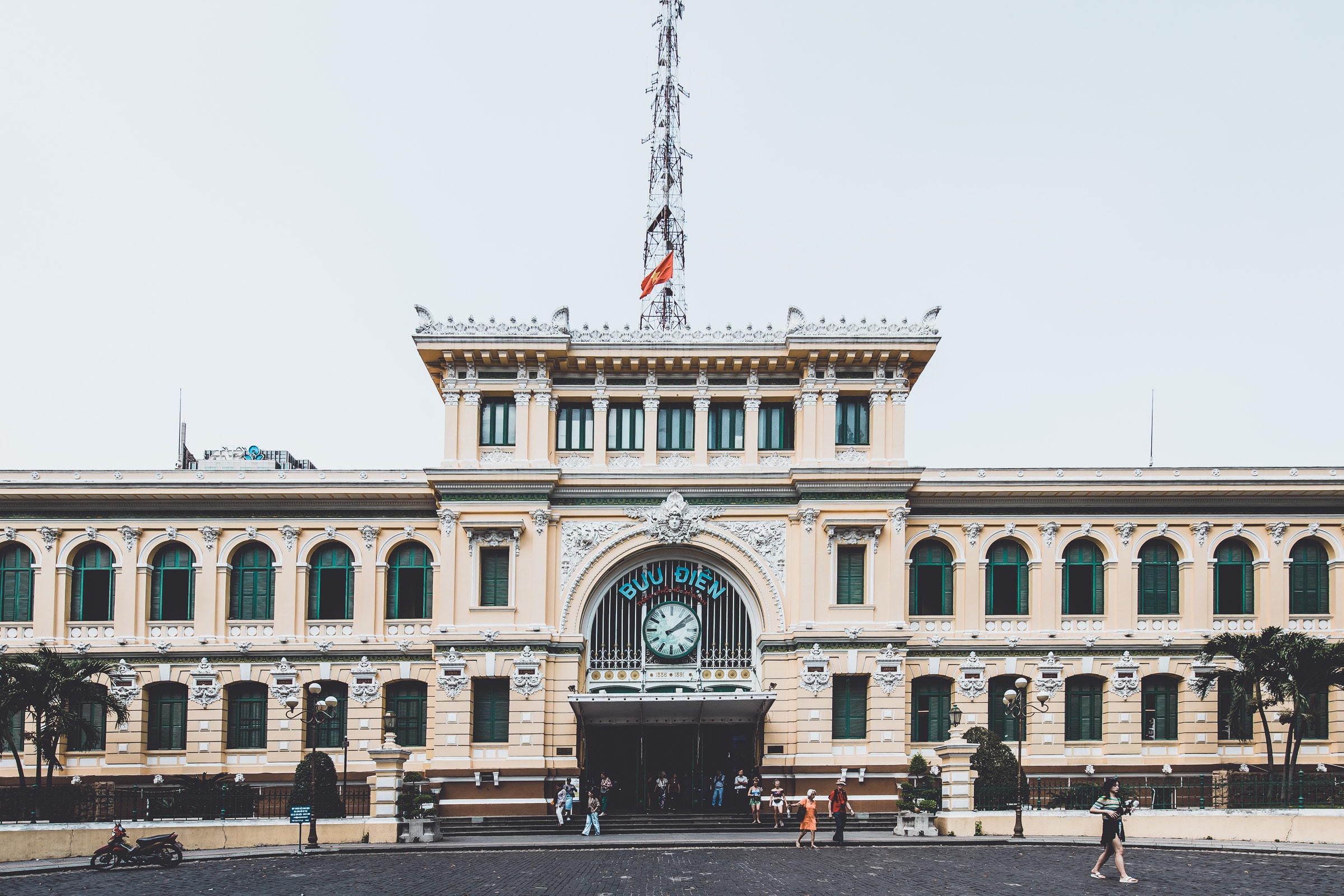
Saigon has few really spectacular sights, but many places are still interesting. The main post office, for example, was built during the French colonial era, and the steel structure inside was designed by Gustave Eiffel. A portrait of Ho Chi Minh hangs large at the head of the main hall. Quirky: Souvenir shops are located in the side wings and in the center of the hall, and the entire post office is filled with groups of tourists, while business as usual continues at the post office counters all around—with people buying stamps and picking up packages.
The main post office in Saigon dates back to the French colonial era.Regular operations in Saigon’s main post office under the oversized portrait of revolutionary leader Ho Chi Minh.French traces can be found everywhere in Saigon.
The great architectural influence of the French can also be seen in another of Saigon’s sights, Notre-Dame Cathedral (yes, there’s one here too!), just opposite the main post office. It is currently being renovated.
The Notre Dame Cathedral is also a relic from the French colonial era in Saigon.
2. Ho Chi Minh City People’s Committee and Saigon Opera House
Two other landmarks from the French colonial era are the Ho Chi Minh City People’s Committee—Saigon City Hall—and the Saigon Opera House. While City Hall is not open to the public, the Opera House can be visited during performances: the acrobatic show with South Vietnamese influences is said to be well worth seeing!
Could also be in California: Saigon City Hall.…except for the huge Ho Chi Minh statue in front of it, of course.Sometimes even with a red carpet: the Saigon Opera House.
3. Viewing platforms on the Bitexco Financial Tower Landmark 81
The Bitexco Financial Tower is Saigon’s second tallest skyscraper after the brand new Landmark 81 just outside the city. The large, protruding platform at the top of the tower is striking. However, this is not the viewing platform, but a helipad. It doesn’t seem to be used much – and it looks more like a prestige object. The Skydeck slightly below on the 49th floor is the publicly accessible viewing platform, where you can enjoy a view over Saigon for the equivalent of around 8 euros. Further up there is a restaurant/bar, which is free of charge, but understandably you have to consume something here.
The architectural contrast could hardly be greater. You can see the Bitexco Tower directly from an old backyard.
Landmark 81 also has an observation deck. However, I skipped the views from both locations because I was running out of time—and I’d already had a fantastic view of the city from the plane. The view of Saigon from the opposite bank is also spectacular!
The Saigon skyline at night: a bit like Shanghai.
Tip: In the evening, this is where the locals hang out. There are the usual street food stalls and makeshift cocktail bars, and it’s the perfect way to wind down the day here on one of the folding chairs with the best view of the Saigon skyline! And best of all: no tourist crowds!
4. Ben Thanh Market
I always love checking out markets in unfamiliar cities—getting lost in the hustle and bustle and discovering exotic things, especially in faraway countries; that’s right up my alley. The Ben Thanh Market is right in the heart of the city—a large, covered market hall with fruit, vegetables, clothes, souvenirs, and street food stalls. However, it’s also a huge tourist magnet; if you prefer a more local experience, you should check out a market like Tan Dinh Market or An Dong Market.
The Ben Thanh market has everything: food, handbags, tailor-made suits, false eyelashes in economy packs.Tailor-made suits in one day: no problem in Vietnam.
Right next to Ben Thanh Market, there’s also a well-known pho restaurant called Pho 2000. Pho is one of Vietnam’s national dishes—you absolutely have to try it! Pho is a noodle soup to which fresh herbs, chili, and lime juice are added at the table. It’s traditionally served with chicken or beef, and often with tofu as a vegetarian option. Pho 2000, a simple restaurant, became famous above all after Bill Clinton slurped down a bowl of pho here in 2000 during a state visit.
Pho 2000: Bill Clinton was here.Vietnamese pho: noodle soup with lots of fresh herbs. A specialty!
5. Reunification palace
Before the Vietnam War, the Reunification Palace was the seat of the South Vietnamese president. The Vietnam War came to an end with the fall of Saigon on April 30, 1975, at the hands of the Vietnam People’s Army and its tanks, which rolled over the fences here. Today, the grounds and some of the rooms are open to the public.
The end of the war is celebrated in a big way every year. There are posters everywhere in the city, as if from another era.
Ad / *affiliate links
6. War Remnants Museum
The War Museum was probably my biggest disappointment in Saigon. Many tourists I had spoken with beforehand were absolutely thrilled by the War Museum, which is considered one of the largest and best of its kind in Asia. I really took a thorough look at everything from top to bottom (the museum spans three floors), hoping to learn a little more about the historical context and background of the Vietnam War.
I found the possibility that the depictions might be biased quite intriguing, and in a way, I had actually expected it. Even though I’d heard many times that the exhibition was supposed to be completely neutral. In my experience, however, it’s anything but neutral! On top of that, the exhibition is very poorly designed from a technical standpoint. I was particularly interested in the photo exhibition featuring famous war photographers—but the images, which are actually quite impressive, are so poorly lit that you’re better off picking up a good photo book.
As expected, the exhibition is anti-American and completely omits the background of the opposing side. To a certain extent, this is understandable. But to pretend to be neutral in this context is very risky. Historical context is also only touched upon briefly, so that when I left the museum, I didn’t feel any wiser about the history of Vietnam.
I also found the matter-of-fact display of American military equipment—such as machine guns, bazookas, and bombs—at every turn to be very bellicose and unsettling. It’s part of the theme, but the way it was presented and the sheer volume of it were somehow too much.
My personal low point, however, was two other things: First, the gift shop, which sells completely out-of-place souvenirs ranging from card games to American Hollywood movie posters to a biography of Michelle Obama (even though everything else here is anti-American) —and second, the fact that visitors were beaming with joy as they had their pictures taken with the tanks in front of the museum. When I saw the two girls—obviously tourists from the West—having a friend film them as they performed a cheerful cheerleading dance routine among tanks and military helicopters, my jaw finally dropped.
7. Ho Thy Ky Flower Market
Vietnamese people love flowers. Flowers are often used as decorations at the numerous festivals held throughout the year or as religious offerings. At the Ho Thy Ky Flower Market, you can immerse yourself in a sea of flowers while sampling delicious street food. Most of the flowers here come from the mountainous region further north around Dalat or from the Mekong Delta. By the way, I tried in vain to figure out exactly what’s added to the flower water to keep them so incredibly fresh. Especially with air temperatures just shy of 40 degrees… I guess the chemicals are at work here. By the way, I read that you should stay away from apples in Vietnam because they’re sprayed with such incredibly strong pesticides there—so be careful.
8. Tan Dinh Church / Pink Church
What makes this church special—as the name suggests—is its color. Painted pink from top to bottom, even on the inside, this church is a sacred spot for all Asian Instagrammers. At least, that’s how it seems when you see the hordes of young girls posing in front of the church, all searching for the best photo spot. (Try searching for #pinkchurch on Instagram!) I would have liked to see the inside of the church, too—but unfortunately, a service was in progress.
The pink church in Saigon: quite beautiful.Selfie alert in front of the pink church in Saigon.
9. Sri Mariamman Temple
The Hindu community in Vietnam isn’t particularly large, so the Sri Mariamman Temple near Ben Thanh Market isn’t all that spectacular either. But if you’re in the area anyway, it’s worth a visit. Note: Take off your shoes!
10. Pham Ngu Lao – Backpacker Street with night market
Once darkness falls, the nightlife here really comes alive. Thumping bass, street food vendors with their little carts, local girls, Western tourists—from backpackers to those on Neckermann tours—and locals too— Pham Ngu Lao is a must-see.
During the Vietnam War, bars and lodging options—ranging from expensive to inexpensive—sprang up along this street. Here, American troops could stock up on everything they needed. In some ways, the Western influence has lingered to this day, and you can still find numerous bars and lodging options around Pham Ngu Lao.
Party every day: Pham Ngu Lao is quite reminiscent of Khao San Road in Bangkok.
Excursions from Saigon: What else can you see?
There are a number of excursions you can take from Saigon. A visit to the Cu Chi Tunnels is a popular choice. During the Vietnam War, the Viet Cong expanded the tunnel system—which had already existed since the colonial era—to create a complete infrastructure that included living quarters, hospitals, and schools.
What makes the connecting tunnels particularly remarkable is their size: 80 centimeters high and 60 centimeters wide. One section of the tunnel has been preserved to this day (and has even been slightly enlarged to accommodate the towering tourists from abroad) and is open to visitors.
Another popular excursion is a day trip to the Mekong Delta to visit the floating markets on the Mekong River. However, a day trip is really quite rushed, and there’s a high chance you’ll end up on a mass-market tour that feels like a sales pitch. I think it’s advisable to book a trip for several days.
Aside from the typical sights you’ll find in any Saigon travel guide, I discovered plenty more exciting things in Saigon! I found the many truly great and unique cafés and restaurants particularly interesting—they even impressed me, a Berliner who’s quite spoiled in this regard. And the delicious street food—which I probably would never have discovered without a fantastic street food tour.
But the best thing of all was the great locals, who immediately made me forget my bad experience last time and gave me lots of great tips. I often think that you should definitely visit a country a second time, even if the first time wasn’t particularly nice. Sometimes a country only reveals itself to you on a second visit.
There are countless cafés in Saigon – each one more beautiful than the next.
Practical tips for Saigon – information for your trip
From the airport to the city
When you arrive at the airport by plane, you can take either a regular taxi, Grab, or the public airport bus into the city. The airport is only 7 kilometers from downtown, so a taxi won’t be too expensive. I used Grab the whole time, since I’d read quite a bit about rigged taximeters and fake taxis. I preferred Grab because, like with Uber, the price is fixed from the start. From the city to the airport, I once paid about 90,000 dong, which is about €4.50. The only cheaper option is the airport bus, which goes via Ben Thanh Market to the bus station near Pham Ngu Lao: 20,000 dong, just under 1 euro.
Continue by bus
If you want to continue your journey by bus from Saigon, any hotel or travel agency can usually help you. The intercity buses operated by FUTA Travel—which are usually orange—are popular and reliable. They have offices throughout the city, including near Pham Ngu Lao. There, you can buy a ticket and will be taken by minibus to the bus station, which is located outside the city center. Fares are very affordable, and the comfort is decent—the sleeper buses, with their semi-reclining seats on two (!) decks, were perfectly adequate for me at 1.60 m tall. Full-grown European men might find it a bit more cramped.
Moving around the city
Within Saigon, I highly recommend Grab! Although there’s good Wi-Fi everywhere and you can use the app, I’d highly recommend buying a local SIM card, which you can pick up right at the airport. Or you can buy an eSIM in advance; I like to use eSIMs from Saily or Holafly.
Advertising / *affiliate link
Safety in Saigon: Is it dangerous?
I’ve been warned several times by locals about pickpocketing and cell phone theft. Apparently, pickpockets riding by on scooters often snatch cell phones right out of people’s hands. The same thing seems to happen with handbags or backpacks that are carried over just one shoulder. If you carry them on both shoulders, you’re probably safe. However, as a solo traveler, I’ve always felt relatively safe, even at night. That’s also one of the reasons why I always buy a local SIM card and keep my cell phone handy—if I start to feel uncomfortable, a Grab taxi will be there in a few minutes.
Best time to travel to Saigon: When is the best time to travel to South Vietnam?
Basically, the seasons in Vietnam are divided into a dry season (November through April) and a rainy season (May through October). For Europeans, this coincides with the European winter. Just before the rainy season begins, it gets really hot and humid again. From my own experience, I can say: This is only for the truly hardy! You’ll have to scale back on hardcore sightseeing itineraries—otherwise, frequent breaks are a must.
Accommodation in Saigon
Most tourist hotels are located around Pham Ngu Lao (which has many backpacker accommodations) or right in the city center. However, it can get very noisy around Pham Ngu Lao, so if you’re hoping for a peaceful night’s sleep, you might be better off choosing a different place to stay.
I chose a place to stay a little outside the hustle and bustle, but still very centrally located. The Common Room Project* is more of a housing project than a hotel—the staff are really nice, and all in all, it has a very warm and welcoming atmosphere. They offer both dorms and private rooms.
Once, when I came back very late, the receptionist jumped up from his chair, looking both relieved and excited—he had been worried about me because he hadn’t seen me the whole time. I’ve never experienced anything like that before.
The roof terrace is also legendary and is a popular venue for movie nights. And what made me even happier as a Brazilian: the caipirinha bar probably makes the best caipirinhas in Vietnam!
Do you say Saigon or Ho Chi Minh City?
The first question I asked myself was: Do I say Ho Chi Minh City or Saigon? After all, I don’t want to put my foot in my mouth. The last time I was in Vietnam, I noticed that political topics are often avoided (at least with tourists). Vietnam is a communist country, but as in China, the boundaries to capitalism are very blurred on the surface and with a Starbucks or H&M in front of your nose, you are quite confused as to what is supposed to be communist here.
After the end of the Vietnam War and the communist Viet Cong’s takeover of South Vietnam, Saigon lost its name—which dated back to the French colonial era—and was renamed in 1976 after the (communist) revolutionary leader Ho Chi Minh, who had already passed away by that time. So a tremendous piece of history is associated with that name.
I then asked around cautiously several times, but the locals still always say “Saigon”—“Ho Chi Minh City” is only used on official occasions. (Incidentally, Vietnam’s political history is very complex. I’m doing my best to present the facts here truthfully and accurately. After all, even a travel blogger who only visits places superficially should be mindful of historical context. But if anyone knows more about this or wants to point out corrections—please feel free to leave a comment. I’d really appreciate it.)
Actually, I could have guessed it. When I answered the usually not at the mouth fallen cab driver at the airport Salzburg to his question, where it goes now: “Once to the hotel Stein Salzburg, please!”, his eyebrows suddenly shot up and it escaped him only one “Oooooh!
The oldest hotel in Salzburg
“Good evening, have a seat, how was your journey?” I have to say, I do love hotels anyway where you have to sit down to check in. Not because I’m that exhausted from a trip – but because it already reveals a lot about the atmosphere of a hotel. Here, there is no anonymous online check-in, extra-fast and efficient, without frills and always the same.
At Hotel Stein you sit down, take a breath, arrive, relax.
I let myself fall into the armchair. On the other side of the reception desk, a young man, friendly, attentive and in the best of moods. His chair seems to be just as comfortable. Or it’s just the ambience in general. I’ve never really been into Feng Shui, but somehow I do believe that there are places where energy flows differently. I wonder if someone here has explicitly dealt with Feng Shui when planning the interior?
The “new” Hotel Stein
It’s quite possible—who knows? After all, the Hotel Stein was recently renovated from top to bottom. The entire renovation took a full two years, during which the city’s oldest hotel was completely closed. You can sense just how much attention to detail went into it in every corner of the building. It probably would have been quicker to just tear down the entire building and rebuild it from scratch. Instead, both the small and large details reveal the rich history the Hotel Stein holds—while skillfully bridging the gap to a modern design.
A hotel – and a Salzburg institution
Some details clearly bear the charm of the 1950s, from the preserved neon sign on the facade to the old “telephone” sign in a corner of the lobby that was meant to indicate the telephone booth for guests. How long ago was it that hotels had phone booths in the lobby instead of in-room phones?
The friendly receptionist wishes me a nice stay, and I am quite confident that his wish will come true. “Wait a minute, I have something else for you.” He ceremoniously slides a gift box across the table for each guest to receive. Contents: a greeting card and two Detox Good Night Smoothies in two versions. One light, one smoothie extra strong. I don’t know, I have the feeling that I definitely won’t need any help falling asleep here in this relaxed hotel, but I still have to smile: I guess they really want to make sure that no one goes home unrelaxed here.
I’m still happy about the smoothies, which are made from purely natural ingredients without additives! However, it should turn out that great importance is attached to high-quality products here, even when it comes to food.
The roof terrace at Hotel Stein: The best view over Salzburg
I spent three nights at the Stein Hotel, and I got out of bed early every day despite a full schedule, just to fully enjoy the pleasant ambience at the breakfast at Seven Senses, the hotel’s own restaurant with a famous rooftop terrace. That means something as I’m not the early bird!
By the way: On my Salzburg blog, you’ll find lots more great tips for a trip to Salzburg.
Homemade & high quality: The breakfast
Breakfast at Seven Senses is a pleasant change from overcrowded hotel buffets that lack charm. The buffet here is small, uncluttered and fits on two or three bar tables at the entrance. Some may find the breakfast meager for this price range – but after two decades of experience with hotel breakfast buffets, I can say: less is more. And more high quality. What good is the most enormous hotel buffet if the scrambled eggs, which have been laid out for hours, aren’t even freshly made? It’s the little things that make a hotel special, and it’s very pleasing to see that here, at breakfast, more emphasis is placed on class than on numbers.
From fresh, homemade banana bread to vegan energy balls, Hotel Stein also caters to every dining preference. Egg dishes as desired (of course in fresh and à la minute!) and a small breakfast platter is available fresh individually at the table. If I hadn’t already been convinced – the selection of Kusmi teas at the latest would have done it. Or the daily changing selection of homemade cakes, cookies and desserts.
Cocktails & Specialties
In the afternoon (or in the morning for those who like to have an early pint), Airone is served here, an Italian bitter similar to Aperol, which is only available in Salzburg at Seven Senses. Tastes good, like Italy and more. But this may also be due to the best hotel terrace view in Salzburg: From here you have the perfect postcard view with the old town, the fortress Hohensalzberg and the Mönchsberg together.
Speaking of Italy: This also plays a major role at Hotel Stein. The motto “Salzburg meets Venice” runs discreetly but consistently through the entire house. Lots of blue, lots of Venetian glassblowing art, lots of Italian design (hello Artemide bedside lamps!) and lots of Mediterranean lightness paired with Salzburg tradition.
Tip: The Seven Senses is of course also open for non-hotel guests. If you’re not staying at a hotel – I would definitely recommend a drink here for a visit to Salzburg. The location is really unique!
Staying at Hotel Stein in Salzburg
I really can’t think of anything that speaks against the Hotel Stein. And I’m really, really critical because of my job. But location, ambience and service really play on a high level here. My stay was very pleasant and therefore also recommendable for those who might feel rather intimidated by so much comfort.
Who will feel at home here:
Couples on a romantic Salzburg trip on the weekend
Design aficionados
Art lovers (in the hotel lobby there is a sculpture by Sir Anish Kapoor hanging in the corner)
Singapore doesn’t always have to be expensive: The gardens surrounding Marina Bay Sands, Singapore’s famous hotel, are free! You can easily spend a few hours here at Gardens by the Bay and unwind from the stress of city life.
The gardens of Singapore
During the day, you can go into the adjacent greenhouses and marvel at the beautiful plants. At night, the famous trees in the Gardens by the Bay are illuminated. When the planted supertrees are really put in the limelight with the Gardens by the Bay light show, the gardens in Singapore are truly impressive. The lightshow is really a unique experience! No wonder many people just look for a quiet place and stare fascinated at the luminous sky.
Marina Bay Sands: The most famous infinity pool in the world
Next door, you will immediately notice this familiar futuristic building. Who doesn’t know the now world-famous postcard view from the infinity pool of the Marina Bay Sands in Singapore?
Opened in 2010, the Marina Bay Sands and the area around it have quickly become Singapore’s new attraction. There was nothing here before. Now a complete recreational resort has been built on the empty lot.
The hotel itself is not only a hotel, but also a shopping center and casino. The luxury shopping center houses brands from Dior to Louis Vuitton to Dolce&Gabbana.
I’m sure before the Marina Bay Sands, no one really knew what the term “infinity pool” meant. Until the first pictures of the pool on the roof of the ship-shaped Marina Bay Sands Hotel in Singapore appeared. After every self-respecting Instagrammer was hanging around the edge of the world’s highest pool, the term “infinity pool” became a household word. By the way, you can only get access as a hotel guest. Smuggling in is pointless. With luck, the cheapest room starts at about 350 euros a night. So that’s already a higher investment. It’s worth checking, the prices vary greatly.
If you don’t want to spend that, you can visit the viewing platform next door, which is open to the public for an entrance fee, and enjoy the view of Singapore without the pool.
Gardens by the Bay: the glowing trees of Singapore
Equally impressive are the Supertrees at night, when the light show kicks in. The show is well attended, but the area is relatively spacious and you don’t step on each other’s feet. Many simply lie down on blankets, jackets or just nothing on the bare floor and watch the lightshow so quite chilled – I’ve also done the same: you just can not get out of the amazement!
When is the light show at Gardens by the Bay?
The show is held twice a day: 19.45h and 20.45h. The OCBC Skyway that connects the various Supertrees at altitude can also be accessed during the light show.
It just had to be a New York sunset. And especially from the Top of the Rock at Rockefeller Center. As I’ve gotten more into photography, my travel habits while on location have changed more and more. When I’m searching for the perfect light, no time of day is too odd for me. Like that time, for example, when I left the hotel at 4:30 a.m.—still in the dark—to catch the perfect sunrise over the Brooklyn Bridge in New York. Sunrises—and sunsets, for that matter—are always amazing anyway!
Especially with a view that’s so fascinating and surreal at the same time, you finally get to see it in person from the Top of the Rock observation deck. I’ve seen this skyline thousands of times—in American TV shows, on posters, in movies, and on Instagram. Every kid knows the Manhattan skyline, and without even thinking, you know right away: That’s New York.
From the Top of the Rock, you have the perfect postcard view of the Empire State Building and southern Manhattan.
Ad / *affiliate links
Top of the Rock: The Most Beautiful Sunset in New York
And even if, in the end, it’s just a cluster of towering skyscrapers in an even more massive city, teeming with people and traffic: watching the sunset in New York from the Top of the Rock is one of the most magical moments of my entire travel career.
At Top of the Rock in the evening: Goosebumps at the sight of the Empire State Building.
Sunset over Manhattan: Magical.
By the way: You’ll find lots more tips on my New York blog.
Information & Tickets for Top of the Rock at Rockefeller Center
Top of the Rock is the observation deck at Rockefeller Center. Located on Fifth Avenue, it’s impossible to miss, thanks to the statue of Atlas struggling to hold up his globe.
However, the entrance to Top of the Rock is tucked away on a side street (50th Street) between Fifth and Sixth Avenues. The tickets are time-stamped, which means you can only go up at a predetermined time.
It wasn’t very busy in January, and since I was just passing by by chance, I bought a ticket right away and didn’t have to wait long. During busier months (which, in New York, means pretty much every month except January and February), it’s a good idea to buy tickets in advance.
Please note: Tickets for the sunset viewing are $10 more expensive when purchased on-site or on the Rockefeller Center website! Get Your Guide offers flexible tickets for this event, which you can then exchange for a timed ticket on-site.
At GetYourGuide, there’s actually only one price, but at Top of the Rock itself, there’s an additional sunset surcharge of a full 10 US dollars for late-afternoon time slots (they know why people like to come in the late afternoon).
How much time should you set aside for the Top of the Rock?
Although you’re assigned a time slot, it can still take a while to finally make it to the top. I was down at the ticket counter about an hour before sunset, and it worked out perfectly. So it’s best to plan enough time if you absolutely want to catch the sunset from the very beginning (it’s worth it!). Once you’re up there, though, you can stay as long as you like.
That worked out well for me, because I’d actually only intended to take a quick photo—and in the end, it took me nearly four hours before I could tear myself away from the spectacular view. Seeing the lights of Manhattan twinkling in the darkness after that perfect sunset was just too beautiful. New York at night: indescribable.
If you want to get to know a different side of Singapore, then I can highly recommend a walk through Tiong Bahru. I had already chosen accommodation in Tiong Bahru in advance for part of my trip to Singapore and didn’t regret spending two days a little off the beaten track.
Tiong Bahru in Singapore: a district for insiders
Singapore is a melting pot of diverse cultures. A bit like Hong Kong, only Singapore seemed to me even more diverse, even more crowded in the smallest space. Indians, Chinese, Malays, British, every culture has left something here and created this multicultural place that I still find difficult to categorize. The few days I spent in Singapore were probably not enough, I didn’t just visit the usual sights such as Chinatown and Marina Bay with its Gardens by the Bay, but also more unusual corners such as Tiong Bahru.
Tiong Bahru: residential district in Singapore with history
Strictly speaking, there are no real sights in Tiong Bahru, it’s just too residential for that. But a very special one. Tiong Bahru ist das erste soziale Wohnungsbauprojekt in Singapur und wurde schon in den 1930er Jahren erbaut. Da in Singapur wegen des Platzmangels oft Gebäude abgerissen werden, um neuen, besseren und höheren Wolkenkratzern zu weichen, ist Tiong Bahru heute das älteste Wohnviertel der Stadt.
Formerly a cemetery, then a purely residential area and now one of the trendiest districts in Singapore. Incidentally, social housing has a long tradition in Singapore. I was very surprised, because when you think of Singapore, you usually only think of big banks in tall skyscrapers and spectacular architecture such as the Marina Bay Sands Hotel in the Gardens by the Bay.
Without social housing, many Singaporeans would not be able to afford a home: Singapore has been very far-sighted in the past. The entire Tiong Bahru district with its residential buildings is now a listed building. And rightly so, because the Art Deco-style houses are truly special: rounded shapes characterize the design of the buildings and are reminiscent of Bauhaus or Miami South Beach.
The Tiong Bahru Heritage Trail also leads through Tiong Bahru and tells a little about the history of this special district with information boards. Here you will also pass the Tiong Bahru Air Raid Shelter , the last remaining bunker in Singapore from the Second World War. However, you can only get inside on a guided tour.
The new hipster district in Singapore
In recent years, hipsters have conquered the previously sleepy Tiong Bahru and breathed new life into the district. In any case, I was very surprised at the contrast to the other parts of Singapore that I had visited up to that point.
The atmosphere in Tiong Bahru is simply special. In the evening, for example, you can sit in one of the cozy bars or restaurants in sultry temperatures, half outside under arcades, with the ceiling fan humming peacefully above you. There is also good food or the best cocktails, all in a tropical ambience with lots of green plants and the bright houses all around: Tiong Bahru is a real insider tip.
During the day, we recommend a visit to the Tiong Bahru Market. Recently renovated, it is one of the most popular hawker centers in Singapore. And as you know, you can never go wrong in Singapore if you are looking for good, reasonably priced food.
Hawker centers are food courts in indoor shopping malls. You can find real culinary highlights there. There is even a stall in Singapore that is so good that it even has a Michelin star.
Tips for Tiong Bahru: shopping, cafés and restaurants
Tiong Bahru Bakery One of THE institutions in Tiong Bahru. Bakery with kitchen, for coffee or a snack in between.
Plain Vanilla Bakery Famous for its fantastic cupcakes, located in a small street with some other lovely cafés and stores such as Books Actually.
Café Pandan —Simple atmosphere, but very well-kept and affordable. The Char Siew Rice (Cantonese-style barbecue-marinated pork over rice) is divine. A must-try specialty in Singapore!
Hotel Tip | Tiong Bahru
I stayed at the COO Boutique Hostel* for two nights. Pretty hip, clean rooms, but unfortunately small and cramped – but that’s Singapore. However, I can still highly recommend it, especially if you’re looking for budget-friendly accommodation. The price level in Singapore is very high, especially for accommodation.