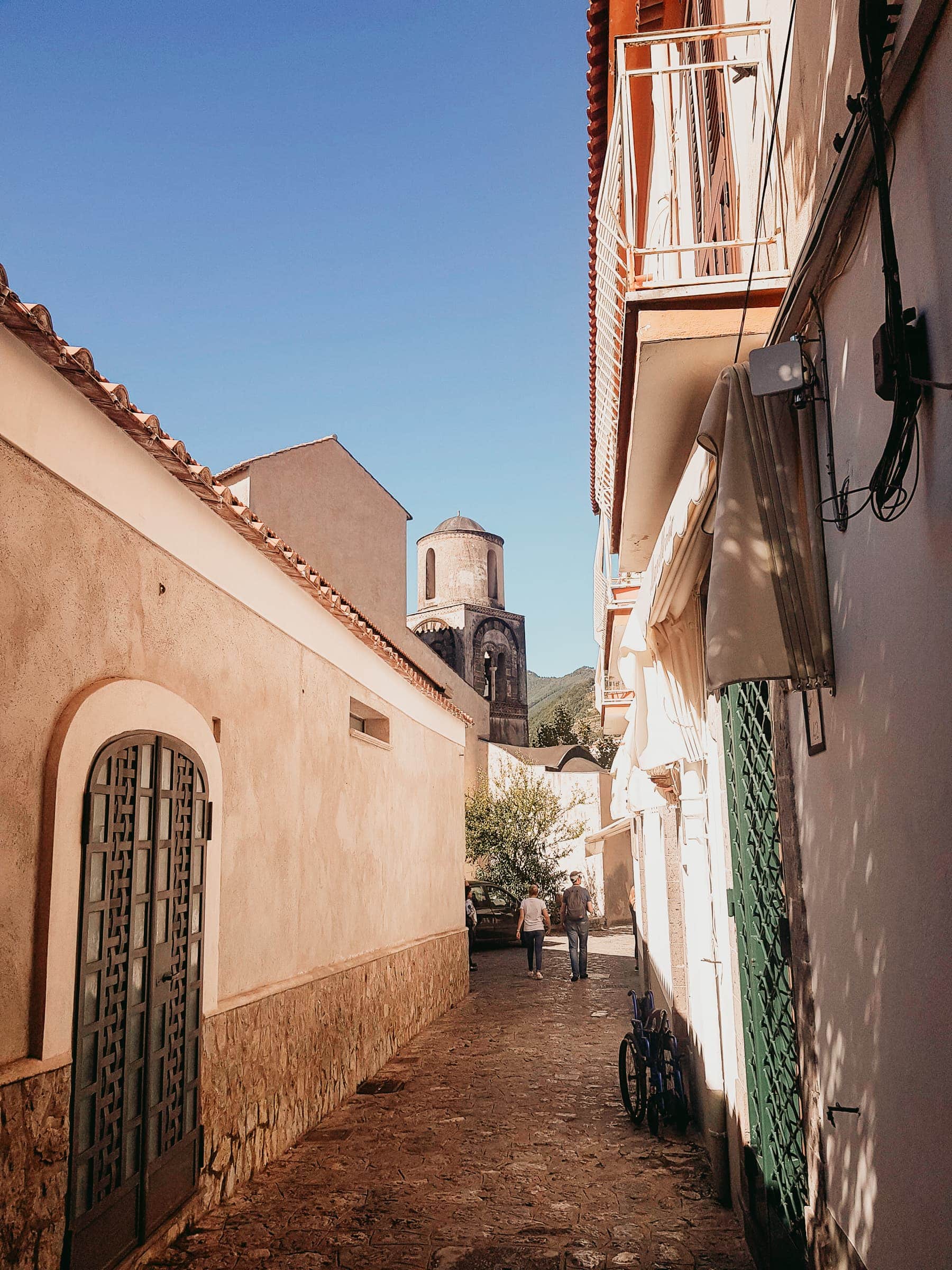
Although Ravello is not located directly on the Amalfitana, it is still one of the most worthwhile places to visit on the Amalfi Coast. Half a day in the picturesque village in the mountains with crystal-clear mountain air and a fresh sea breeze – and the batteries are recharged! I’ll show you the main sights in Ravello and give you a few tips for a great day out!
Ravello is a popular destination on the Amalfi Coast
From the Amalfitana to the mountain village of Ravello
If you’re traveling along the Amalfi Coast by car, you’re already used to a lot. After winding our way along the dizzying coastal road for several kilometers, it couldn’t get any worse. But the road up to Ravello is all the more adventurous. Narrow, winding and many more large coaches on it, which also have the cozy mountain village as their destination. Somehow we made it after all, and up in Ravello, peace, relaxation and lots of music awaited us!
The Duomo of Ravello and the Piazza Duomo in front of it are the heart of this romantic town. The neighboring restaurants seemed to me to be tourist traps. However, the location is too beautiful not to treat yourself to an Aperol Spritz or a cappuccino and enjoy the fantastic mountain panorama all around.
Duomo in RavelloRavello has always attracted artists and art lovers
From Piazza Duomo, you can also start a short walk through the clearly laid out town center. Here you’ll find studios, galleries and small stores selling arts and crafts: I’m particularly taken with the colorful plates!
Villa Rufolo is one of the most beautiful sights in Ravello, and you really shouldn’t miss it! The seat of the rich noble family of the same name was built in the 13th century and has one of the most beautiful views of the Amalfi Coast. The garden is beautifully planted and such a feast for the eyes that it is a popular location for wedding shoots.
The most beautiful view in Ravello: Villa Rufolo
Torre Maggiore
You have an even better view from the Torre Maggiore, but there are glass panes here for security reasons – so it’s better to take photos of the view from the garden side. In the tower itself, however, there is an interesting exhibition on the history of Ravello and Villa Rufolo.
Wagner & the Villa Rufolo
You will soon notice the classical music playing softly in the gardens of Villa Rufolo. Even if you’re not a fan of classical music, it’s a good fit here. In a wondrous way, the music combines with the magnificent view, the view of the deep blue Mediterranean and the clear mountain air. For me, Ravello was one of the most relaxed places on the Amalfi Coast.
This magical connection is nothing new: Ravello has always attracted not only old Italian aristocratic families, but also artists! The composer Richard Wagner is said to have been inspired by the gardens of Villa Rufolo for the set design of the Klingsor Gardens in Parsifal.
A music festival is also dedicated to him, which takes place every year at Villa Rufolo: The Ravello Festival lasts for two months every summer and offers many musical concerts and events throughout the town.
Also worth seeing: the gardens of Villa Cimbrone. Just like Villa Rufolo, there is an entrance fee, and you may prefer to choose just one of the two gardens.
But if you want to immerse yourself more deeply in the atmosphere of Ravello and soak up the elegance of this special village, you can even spend the night there in style:
It’s more for architecture fans, but I was fascinated by my family connection to Brasília, the life’s work of Oscar Niemeyer. Clear lines, a modern building and yet the auditorium built for the numerous events in 2010 nestles perfectly into the blue backdrop of the Mediterranean. Great photo spot.
Modern architecture in the heart of Ravello: the Oscar Niemeyer Auditorium
(Oscar Niemeyer was a visionary all his life, his style and his view of things were really very impressive! If you are more interested, I recommend this documentation*).
Ravello & the Amalfi Coast
The Amalfi Coast is full of great places and sights. It can be difficult to make a decision. But I would really recommend Ravello to you! It’s very touristy there (which is unavoidable in this region), but it’s a nice contrast to the other popular spots! A day trip is enough, but if you like the atmosphere here, you can also consider making a stopover here if you are traveling along the coast for several days. It’s always relaxing in Ravello!
Why not Glasgow? Scotland is a destination that has a lot to offer: Vast landscapes, wild coasts, castles steeped in history and, last but not least, the charming Scots themselves. But city trip lovers won’t miss out either: guest author Julia from Delicious Stories shows you the best Glasgow sights and tips for a successful city trip! You can learn more about Julia and her blog at the end of this article.
The best tips & sights in Glasgow: On the road with Julia!
I started my exploration tour of Glasgow. Unfortunately, the weather still did not play along, but that’s how it is in Scotland. Rain and dramatic clouds are just part of it.
#1 St. Mungo’s Cathedral
Glasgow was the last stop on my Scotland tour. Accordingly, I had already seen and experienced quite a bit! Topping that was difficult. So it was not surprising that Glasgow could not inspire me at first. Maybe I was tired from what I had already experienced, plus gray clouds and rain: I would have loved to snuggle up in bed! However, that was not an option. In 2 days the return flight left and I wanted to give Glasgow a chance to excite me.
The medieval church is not located directly in the city center; you can reach it by bus or a walk. After the death of St. Mungo in 600 A.D., the present cathedral was built in place of the chapel erected by him. It is one of the few Gothic buildings that has survived the centuries.
104 St. Vincent Street, Glasgow G2 5UB
Typical for gothic churches is the gloominess, so no charm at first sight here either. It is all the more beautiful that the darkness is disturbed by colorful light from the stained glass windows. The most beautiful part of the cathedral for me was the chancel with an ornate wooden vault adorned with various coats of arms.
#2 Necropolis
Crossing a bridge in front of the cathedral, you reach the Glasgow Necropolis, the largest cemetery in the city. The bridge is also called the Bridge of Sighs because it leads directly to the cemetery where over 50,000 dead people began their final journey. Here you will find wonderful Victorian pavilions, monuments and crypts lined up on the hill.
At the top of The Craigs hill is the pillar of the reformer John Knox, but he is not buried here at all. Previously, the site was to be used as a park, not a cemetery, and the monument was the focal point. Only in the 19th century, after a tender among architects, the park was transformed into a cemetery.
Advertising / *affiliate link
#3 George Square
George Square is located in front of the City Hall, it is Glasgow’s central square and a very popular meeting place. In the square there are monuments and statues of Queen Victoria, Prince Albert and James Watt, a famous Scottish inventor. Here you can listen to bagpipers and watch the hustle and bustle of the city.
The building of the former Bank of Scotland now houses a pub, The Counting House. The perfect place to take a little break and have a beer in an impressive atmosphere.
#4 Glasgow Green
In 1450 the king donated the park to the people, at that time the area was still more meadow than park. Over time, many sights were added. For example, the Nelson Obelisk, the McLennan Arch and the Doultain Fountain, a fountain dedicated to the then Queen Victoria for her Jubilee. Here is also the magnificent winter garden made of iron and glass.
#5 Street Art in Glasgow
Glasgow is famous for its street art pieces, which are spread all over the city. These murals make the otherwise somewhat gray city wonderfully colorful. While exploring the city, one always discovers one of the impressive works.
One artist in particular stands out: Smug. He is responsible for many murals in Glasgow, including probably the most famous, a man in a red cap with a sparrow on his finger.
The most famous mural in Glasgow: Man with bird by Smug
To explore Glasgow, I recommend taking your cue from the street art pieces while also discovering the classic landmarks.
You can always convince me with food, so I also started searching for culinary highlights in Glasgow. Even though I struggled to find restaurant tips while researching before the trip – I was not disappointed on the spot! Glasgow has something for everyone, whether classic, modern or international.
Award-winning burgers, hot dogs and poutine are available at Bread Meats Bread. There are a total of 3 branches in Glasgow. Simple, modern design, fast service and excellent burgers. Just the thing during a city trip. Burgers from £8.50.
Modern Scottish cuisine and a great ambience. Here, the inexpensive lunch menu is especially recommended. I treated myself there to fresh mussels in white wine sauce and a juicy steak. Lunch menu from £20. Dishes from £15.
325 Hope St, Glasgow G2 3PT, Scotland
Shopping in Glasgow
Glasgow is one of the shopping capitals of Great Britain, along with London and Birmingham. So if the weather is bad, no problem, shopping is always possible. The shopping district with many stores and malls stretches between Sauchiehall and Buchanan Street.
Buchanan Street is a beautiful pedestrian street with beautiful architecture and very good shopping opportunities, which invites you to stroll.
Stay overnight in Glasgow
For the last few nights of my trip, I opted for a slightly more comfortable option. There would have been plenty of affordable Airbnb options as well. However, I decided on the Motel One right next to the main train station. You know exactly what to expect there, and the location was perfect—both for exploring the city and for the concert at the O2 Academy that I wanted to attend.
At the reception I got a city map and some very valuable restaurant tips on request.
From Glasgow Airport to the city
The quickest way to get into the city from Glasgow Airport is to take the Glasgow Airport Express. During the day it runs every 10 minutes, at night every hour. Travel time from the airport to the Buchanan Bus Station in the city is 25 minutes. Depending on the location of your accommodation, you can also get off at Glasgow Central or Queen Street Station. Tickets are available from the bus driver or in advance online.
Or are you looking for more inspiration for unusual city breaks in Scotland? Then perhaps Aberdeen would be something for you: Tips for the Silver City Aberdeen
About the guest author Julia
34 years
Munich kid
Trained as a travel agent, studied tourism management, now work as IT project manager in a tourism company
I’ve had my food & travel blog Delicious Stories since 2015.
I love to travel and have adventures. I’m always on the lookout for culinary highlights, which regularly escalates into extensive research before each trip. My itineraries are often based primarily on restaurants, and then I look at what there is to see and otherwise experience.
Are you looking for a beautiful hiking route in Germany that is easy to hike, even for beginners? Come with me to the southern Harz: From Bad Frankenhausen I’ll show you a wonderful route through the Kyffhäuser! If you love nature and forests, you will like this tour. But hiking in the Harz mountains doesn’t sound like you, do you think? As a total city gal, I have to admit that I really discovered hiking last year only, too!
Hiking in the Southern Harz and the Kyffhäuser mountains
The starting point of my little hiking trip is Bad Frankenhausen, an idyllic little town in Thuringia. The town center is clearly laid out but homely, with half-timbered houses adorning the well-kept little streets. Despite its small size, Bad Frankenhausen has a lot to offer and many hiking enthusiasts use it as a starting point or stopover.
What to do in Bad Frankenhausen
Probably the most famous sight in Bad Frankenhausen immediately catches my eye: the Leaning Tower of Bad Frankenhausen. Over 600 years old and built on less than stable ground, the leaning Oberkirchturm tower is the town’s landmark. Unfortunately, the nave no longer exists in its entirety. But an elaborate construction ensures that at least the tower can still adorn the city panorama.
It’s even more inclined that the famous Leaning Tower of Pisa!
Hiking around the Kyffhäuser mountain
My hiking trail around the Kyffhäuser begins in Bad Frankenhausen. Conveniently, all the hiking trails are well marked – as an absolute beginner when it comes to hiking, I’m already struggling to use the popular hiking apps that allow you to choose suitable tours. But thanks to the good signposting, it’s almost impossible to get lost (I still managed it a few times, but never mind).
The Kyffhäuserweg
I hike along the Kyffhäuserweg, a long-distance hiking trail, and although it goes up and down the Kyffhäuser, even as a beginner hiker I find the route long but doable. The total distance is 38 kilometers, which is split over two days. However, you can also hike only part of the route, for example by taking the regular bus service from Bad Frankenhausen up the Kyffhäuser to the monument and then walking down the Kyffhäuser Trail into the valley.
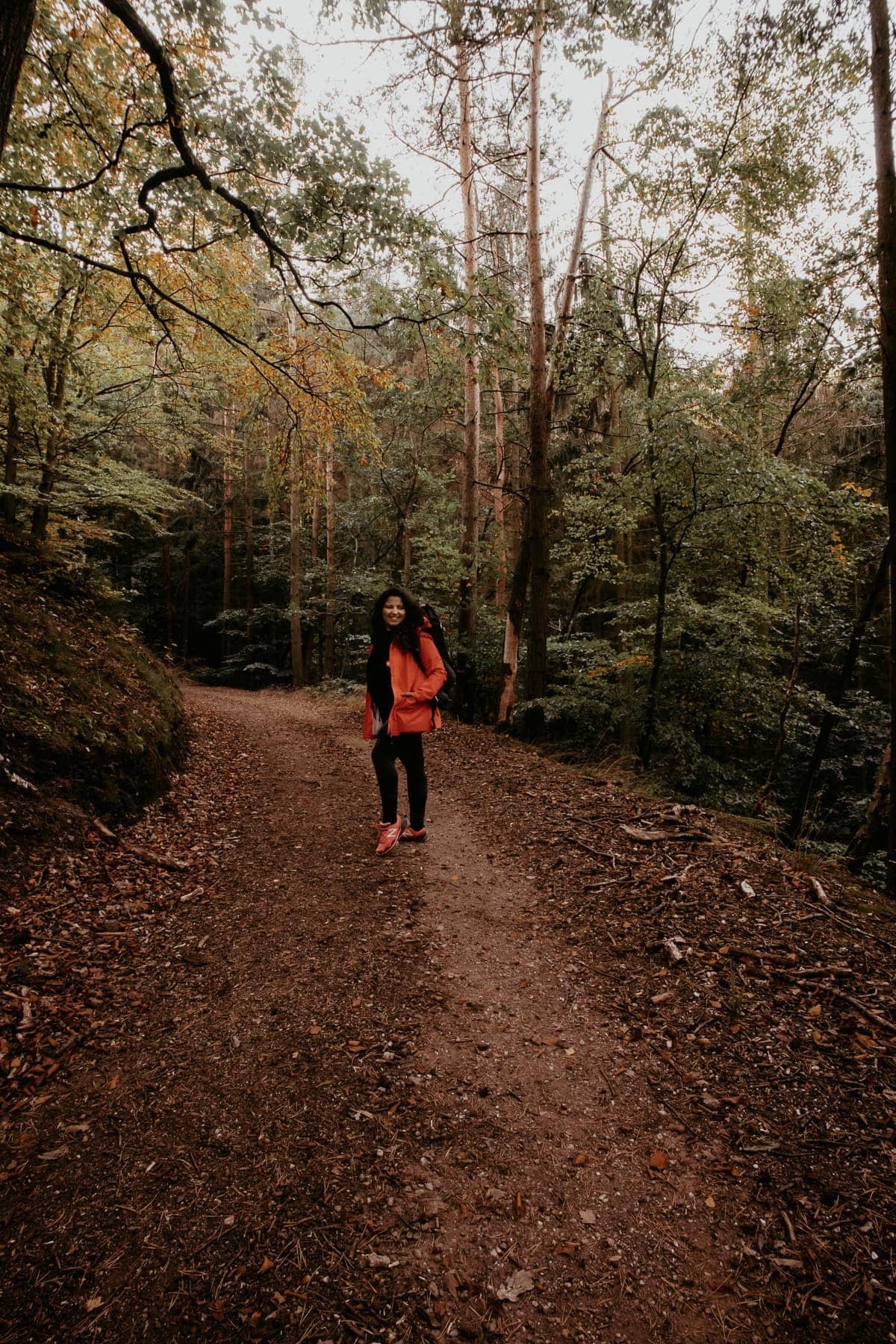
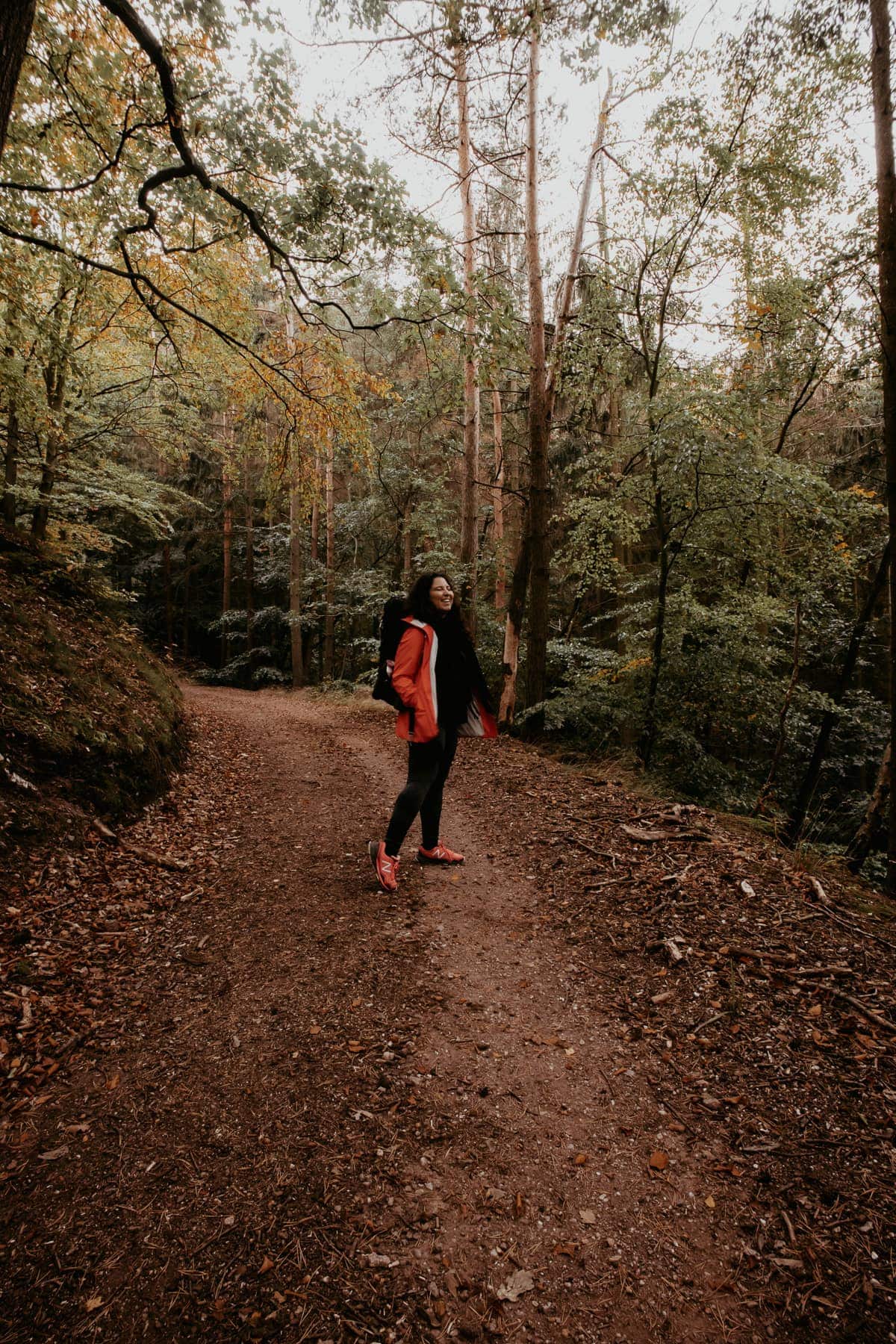
It is full of variety. At first, my biggest worry on my first long hike alone was that I might get bored. But this was unfounded, sometimes I listened to podcasts that I had always wanted to hear in peace, or simply immersed myself in nature, enjoyed the silence and consciously breathed in the fresh forest air. Many parts of the trail lead through dense tree cover, not a soul far and wide, just tall trees and paths on the fluffiest forest floor, which feels like soft absorbent cotton underfoot.
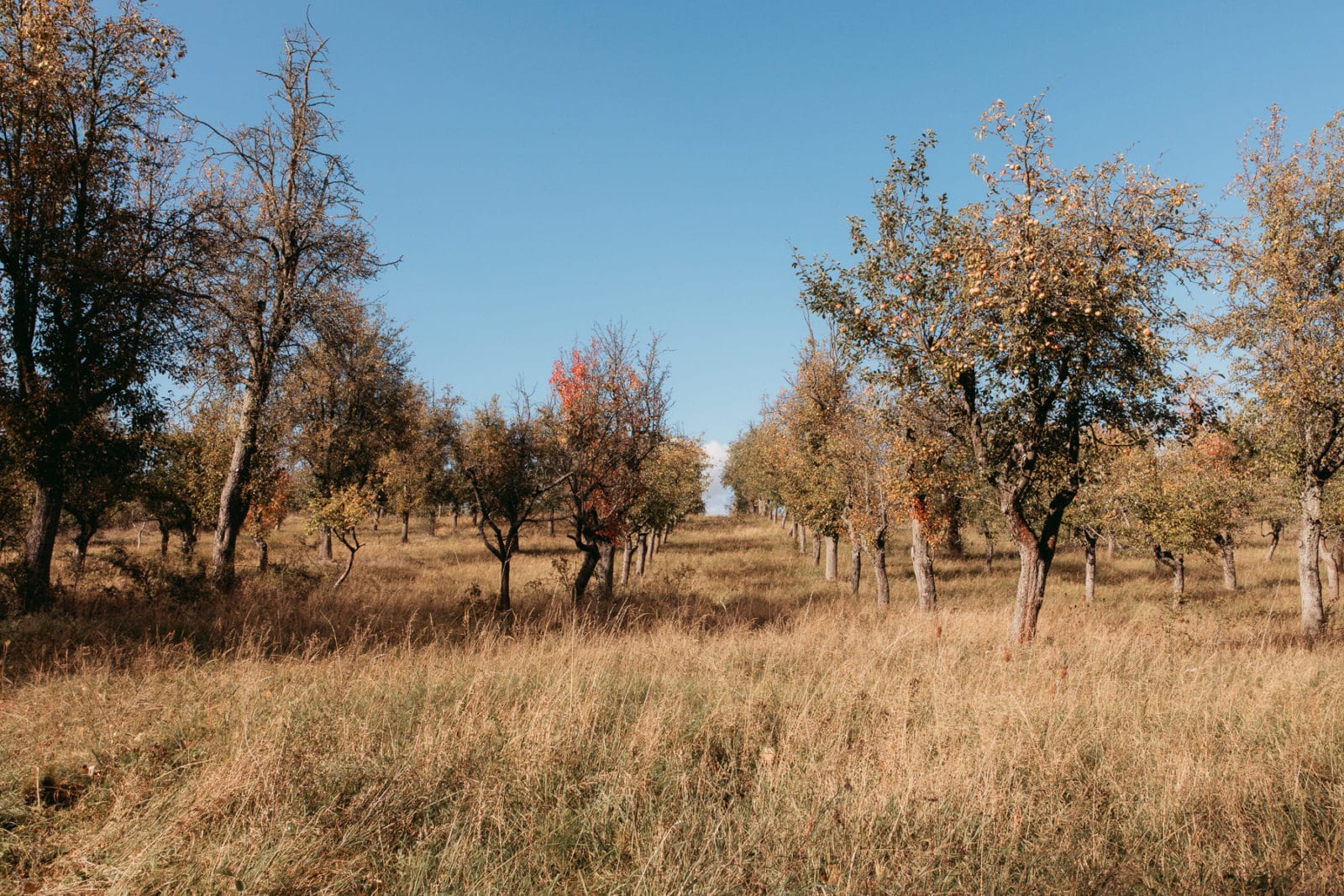
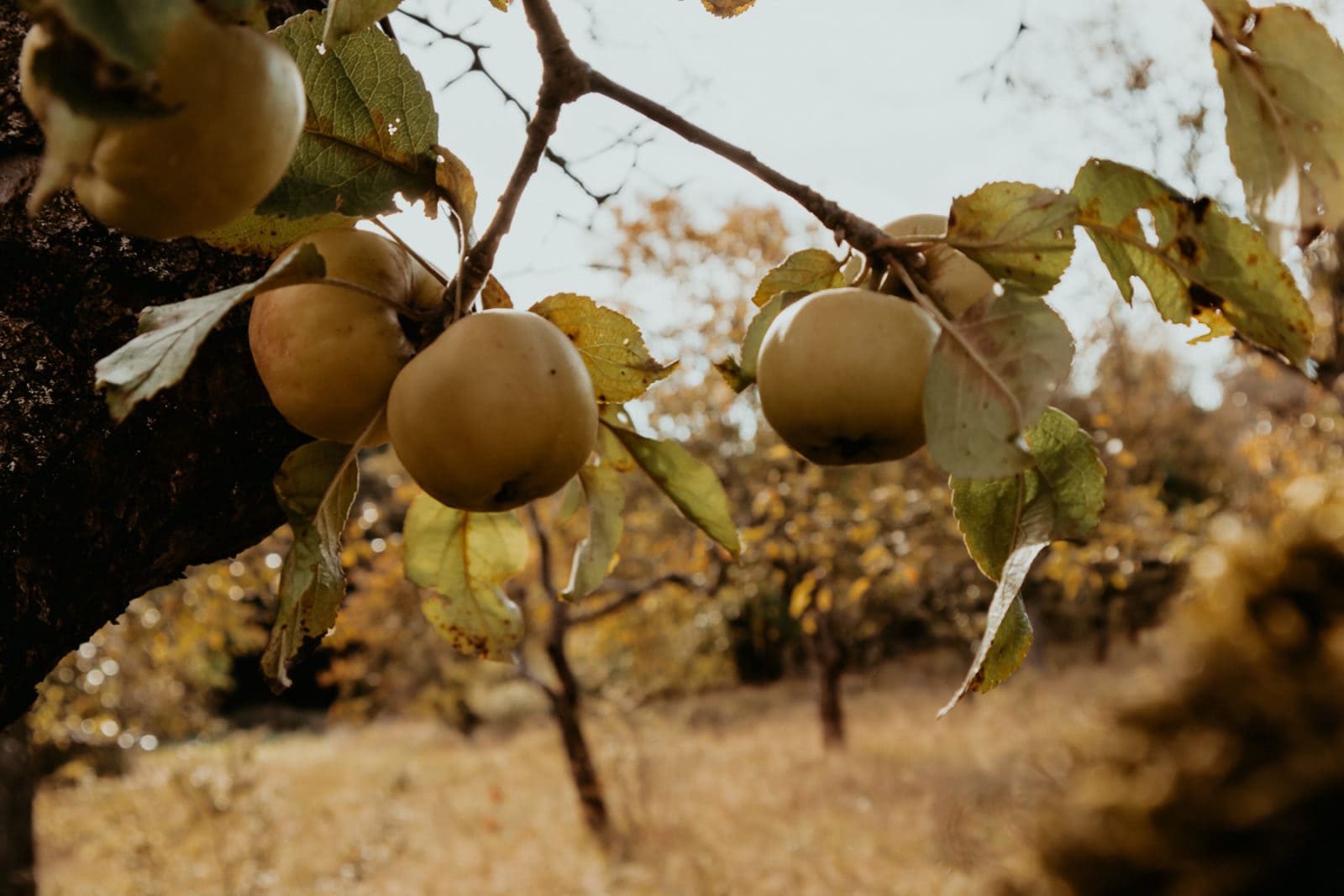
Around Tilleda you will pass huge orchards with apples in the brightest colors. Coming here in the sunny late autumn was definitely a good decision!
In Tilleda you will find idyllic meadow orchards as well as a small café, which is wonderful for a short break!
At the very top of the Kyffhäuser, the Kyffhäuser Monument is enthroned, highly visible and a popular weekend destination for families and motorcyclists who enjoy the ride up the winding roads. The Kyffhäuser Monument is sometimes also called the Barbarossa Monument, but is dedicated to Emperor Wilhelm I.
The Kyffhäuser MonumentThe Kaiser Wilhelm Monument on the Kyffhäuser Mountain
Country life and autumn impressions
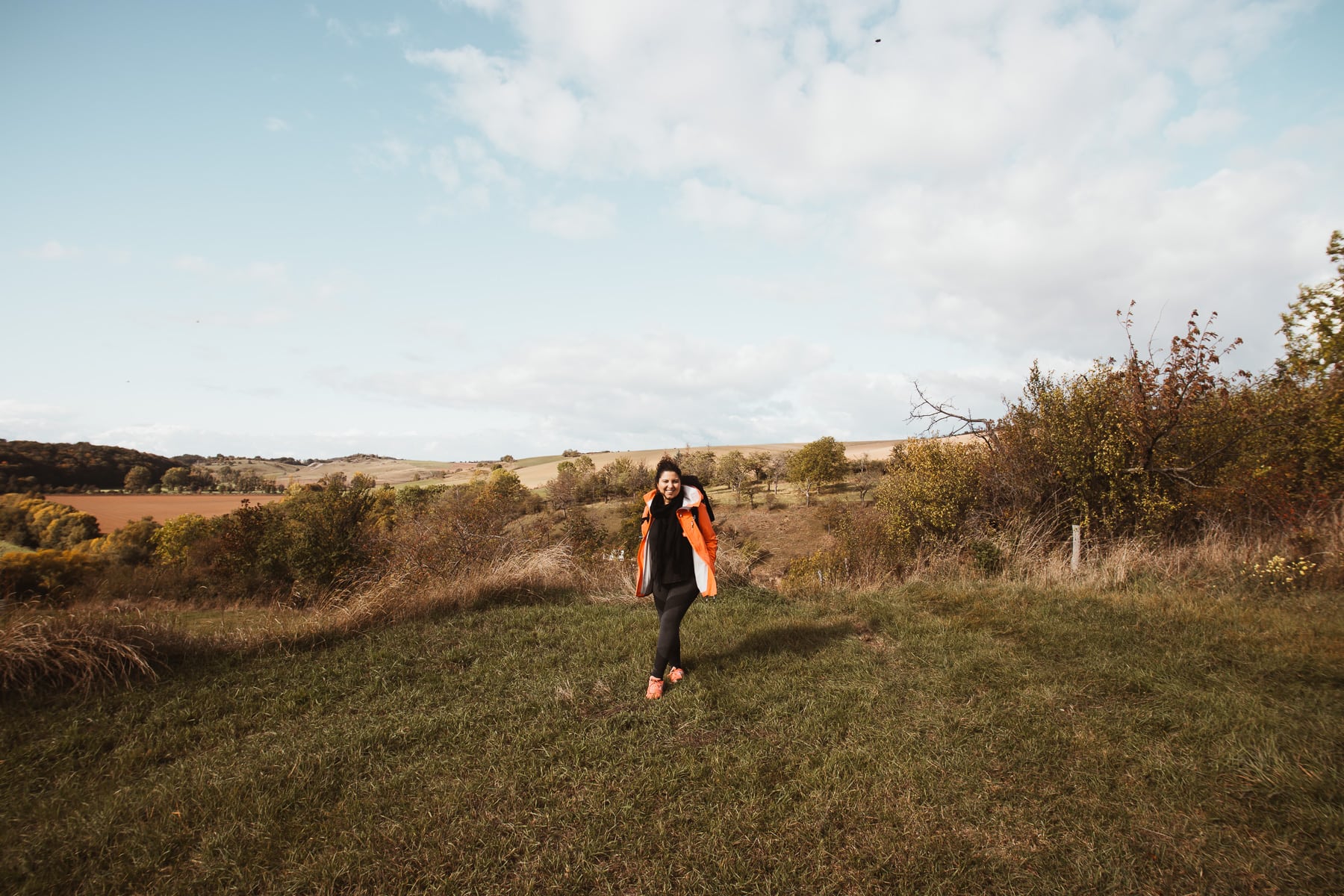
My feet were already getting heavier on the last part, but the landscape made up for it! Broad views of the valley with cows, close enough to touch:
More interesting tips in and around Bad Frankenhausen
Locations & Attractions
For those who want to explore more of German and Thuringian history and culture, I highly recommend the following locations:
Panorama MuseumThe Panorama Museum above the city shows only one painting, the “Early Civil Revolution in Germany” by Werner Tübke or Peasants’ War Panorama. Painted as a huge panorama, you are immersed in the history of the region and experience the period surrounding the German Peasants’ War of 1525 as if you were right in the middle of it. For fans of: German history, art, culture
Kyffhäuser thermal baths As befits a spa town, Bad Frankenhausen also has a great brine spa with bathing and sauna facilities! If it hadn’t been for the pandemic, this would definitely have been my first port of call after my long hike: The best relaxation in the brine water! For fans of: Wellness & Relaxation
Brine water vitality parkLocated in the middle of the spa park, you will find a modern outdoor saltwater pool with such illustrious features as a foot reflexology course, Kneipp pools and an inhalation pavilion. A dream come true for me as a pollen allergy sufferer. For fans of: Outdoor pools, wellness and outdoor
Barbarossa Cave You come across this name often: according to legend, the legendary Emperor Frederick I, also known as Barbarossa, is said to sleep in the Kyffhäuserberg – with a little imagination, you can see him sitting at a stone table in a rock formation, while his long beard grows around the table. For fans of: Legends, Myths, Archaeology, History
Where to eat in Bad Frankenhausen
Thüringer Hof Hotel with restaurant. Traditional house, here you can enjoy hearty Thuringian specialties!
Kur-Café Trautmann If you hike so much, you can also stop by here without hesitation: with the obligatory pot of coffee (yes, it still exists!) you can treat yourself to freshly baked waffles with hot cherries and lots of cream!
Where to stay in Bad Frankenhausen
I stayed at the Hotel garni Anger* for my trip. Situated in the middle of the village, modernly renovated and the perfect starting point for all hikes around the Kyffhäuser.
Hiking solo in the Harz mountains
I would never have thought that I would like hiking so much! More than 40 kilometers came together on my long weekend. And all the worries I had before! Did I bring the right equipment, does the backpack fit, do I have the right shoes? For me, as a novice hiker, I was utterly overwhelmed with the choice of my equipment alone. But in the end, it was no problem at all.
I also had no problems with the many meters of altitude, I was probably much slower than experienced hikers, but the whole thing wasn’t a competition. And I’ve acquired a taste for hiking longer distances – who knows what’s to come in the future!
Are you experienced hikers? Do you have any tips for beginners? Or is that not for you at all? Feel free to tell me about it in the comments!
In the Jardines de Alfabia in Mallorca, close to Soller, you will learn a lot about the island’s history – and you can enjoy an amazing day in the middle of a well-kept botanical garden oasis. Was there really a time on Mallorca before binge-drinking at the beach and clubbing all night on the Britishs’ and Germans’ favourite party island? Still, to many people Mallorca is the place for a perfect party vacation. Nothing wrong with that, but Mallorca has also an interesting and long history – who knew?
Jardines de Alfabia: Stepping into Mallorca’s exciting past
On my way to learn more about Mallorca’s past I found myself at the Jardines d’Alfabia – an old manor house built in the 12th century surrounded by a tropical garden. Located at the foot of the Tramuntana mountains in between of a landscape which is usually very dry during the hot Mallorquinian summers with almost no rain, the Jardines are truly a cool and relaxing oasis.
The architecture reflects various influences of the owners who have lived here – the land has been owned by Arabs, Andalusians, Moors, Spains and many more. Due to its geographic location in the middle of the Mediterranean Sea, the island of Mallorca has always been of interest for powerful European and Arabic imperors. Up to today, you will find traces of the most diverse cultures on Mallorca!
Jardines de Alfabia: The Botanical Garden
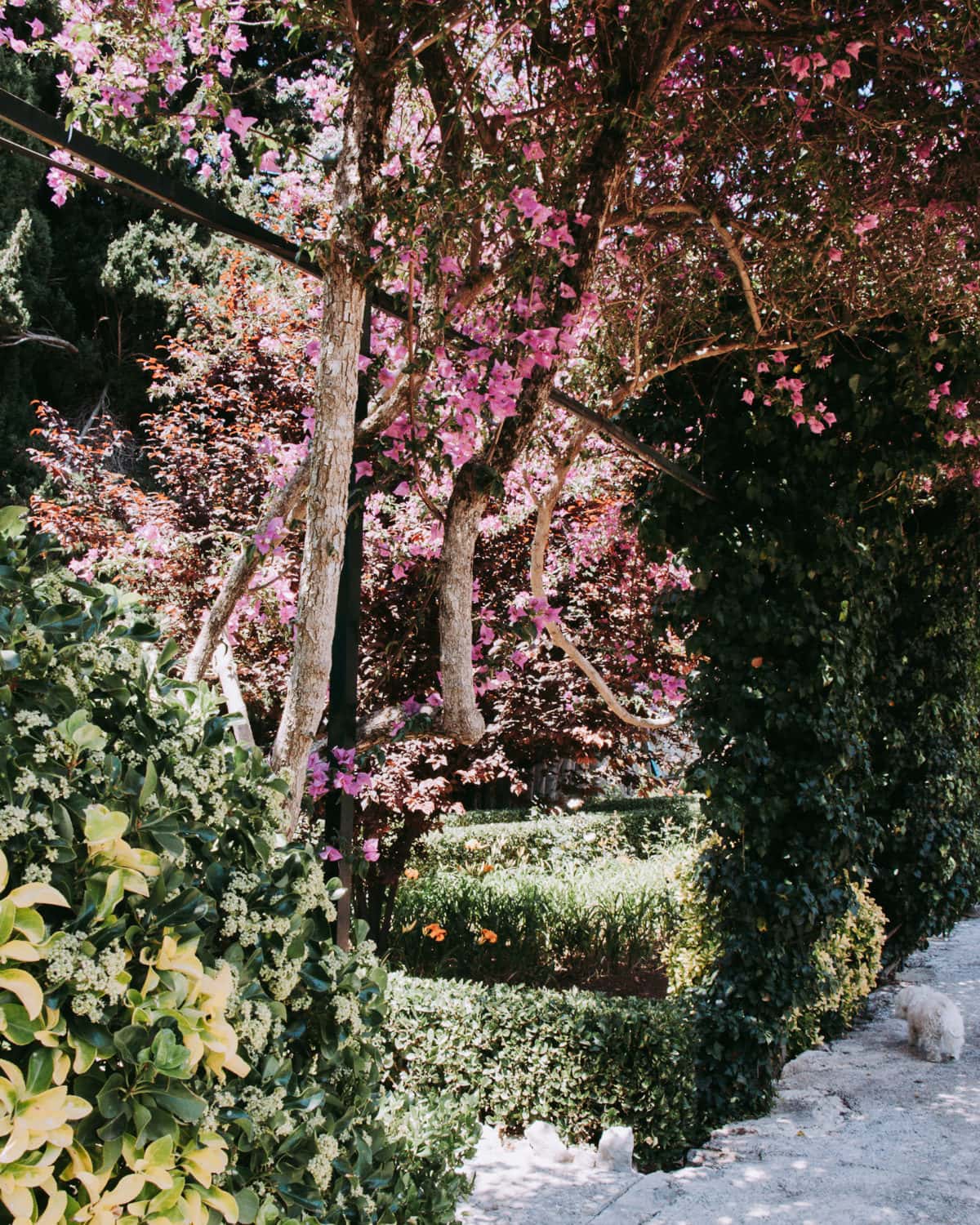
The main house and some stables can be visited – and once you are through you will arrive at the gardens. With enormously high palm trees and a well-cared, densely planted vegetation the gardens are a real sight. The blooming gardens also attract many animals and the twittering of an army of birds makes you feel like you were in an exotic forest.
The Gardens of Alfabia: A small paradise on Mallorca
And in the end, here’s the reason why I really fell in love with the Jardines de Alfabia: the donkey which lives on the property as well. Isn’t it the cutest with ist big brown eyes?
Wie gemalt: Die Gärten von Alfabia sind traumhaft schön.
Best time to go to the Jardines de Alfabia on Mallorca
The whole area isn’t very big, you take a look at the house, wander around the gardens and enjoy the panoramic view. Perfect for spending the morning or the afternoon, until you continue your trip around the island. Or, as the historic cable car from Palma to Soller has recently opened a station near the Jardines, you can stop for a few hours at the Jardines d’Alfabia and then head to Soller.
***
Information:
The Jardines d’Alfabia are located near Bunyola, right next to the entrance of the tunnel to Soller. Good news for dog owners: Dogs are allowed in the gardens! (quite unusual for Mallorca)
Georgia is one of the latest trend travel destinations. In recent years, the country in the Caucasus has become one of the most interesting destinations in the region. But how to travel such a relatively exotic country? In this post you’ll find travel tips and helpful information for your Georgia trip – and don’t worry, it’s not that complicated!
Travel tips for Georgia
So if you’re in the mood for an exciting destination that’s (still) off the beaten path and has a few surprises in store, this is the place for you! Georgia’s landscape is a dream for outdoor fans and hiking enthusiasts, and city lovers will ravel about the capital Tbilisi on a trip to Georgia! So why not take a vacation in Georgia?
Winter is harsh and very cold in the mountains. In the capital Tbilisi, temperatures are more pleasant and somewhat warmer than in Central Europe. In summer , it can get really hot in Tbilisi as well as in the rest of the country, so a beach vacation at the Black Sea might be more suitable.
In Tbilisi you can still find many charming old buildings!
How to get to Georgia
From Germany, Lufthansa and Georgian Airways fly directly to Tbilisi, Ryanair is planning to establish a regular flight. Turkish Airlines offers connections via Istanbul. Georgian Airways offers direct flights from several German airports. The duration of the flight is about 4 hours.
Not particularly crowded: The spacious airport of TbilisiWith Georgian Airways to Tbilisi
Transportation within Tbilisi and to other places
You can get from city to city in Georgia by bus, train or so-called Marshrutkas (minibuses). You can also hire a private guide and driver! More on this under ➜ Language & communication. Within Tbilisi, there are buses and a metro network that is easy to use for tourists without any knowledge of Georgian.
You should set aside some money for typical souvenirs (also relatively cheap), e.g. carpets or other handicrafts.
Accommodation
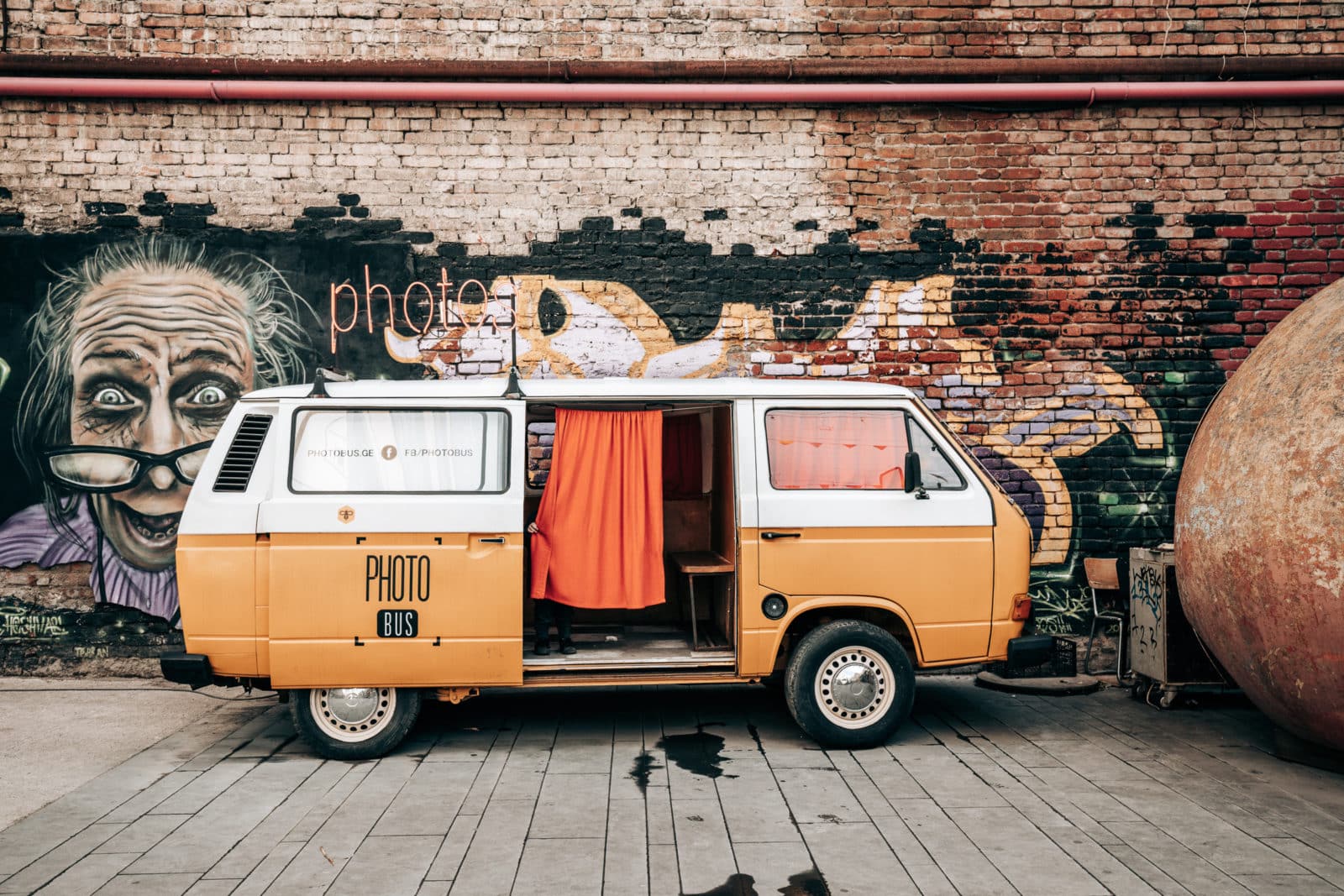
Especially in the capital, Tbilisi, there are now some really chic little boutique hotels that offer excellent value for the money. For example, I can recommend the Museum Hotel Orbeliani or the Fabrika Hostel for those on a tight budget.
The restaurant of the Fabrika Hostel is also open for non-guests – absolute recommendation!
Food Drinks
Georgian cuisine
Georgia is famous for its varied cuisine. Eating out is very affordable. However, Georgian cuisine is very meat-heavy, so vegetarians may experience some restrictions. Vegan cuisine is not very widespread or even known.
Dishes are often served in such a way that they are divided at the table
Georgian wine
Besides the numerous specialties such as Khachapuri and Chinkali, Georgia is also known for its wines. Georgia is one of the first countries in the world where wine was grown. The special aging in underground clay amphorae gives the traditional Georgian wine its special bouquet.
Language & Communication
English is not very widely spoken in Georgia. Even in the capital Tbilisi, it is sometimes difficult to communicate. The Georgian language belongs to the South Caucasian languages and even uses its own script, which makes it all the more difficult if you want to learn the basics.
With language skills, travelling is definitely easier! Many Georgians with foreign language skills have recognized this shortcoming and offer themselves to tourists as tour guides for the entire trip. So if there is still room in your budget for this, I highly recommend hiring a local guide for your stay!
I have never been able to decipher anything, but I loved the Georgian script!
In Tbilisi, for example, we met Irina, who, in addition to touring Tbilisi, also shows tourists around the whole country. Irina even speaks German. I have already recommended her frequently and have received very positive feedback. So if you need a tour guide, write to me under contact and I’ll forward you her details (she doesn’t have her own website etc, so this is a real first hand recommendation!).
Safety
Petty crime and road traffic
I felt safer in Tbilisi than in many bigger European cities. However, you should also exercise the usual caution here. In general, I found road traffic in Tbilisi much more dangerous, both as a pedestrian and as a passenger: Georgians have a very fast driving style!
Unsafe regions in Georgia
Many might think of possible unstable political situations in the Caucasus and resulting dangers, but I didn’t notice anything of that in Tbilisi, and according to our Georgian companions it should be the same in other tourist areas like Batumi or Swanetia.
Travel to the regions of Abkhazia and South Ossetia, however, is not advised. (Source: German Federal Foreign Office)
Solo female travel in Georgia
I was not traveling alone, yet I wouldn’t worry about traveling to Georgia alone as a woman. Also, I have not heard of any major problems of women traveling alone.
Vaccinations & Health
Georgia may still be an exotic destination, but you are safe from tropical diseases. Particular caution is required when coming into contact with the many street dogs and with hygiene in simple restaurants. Medical care often does not meet European standards. A private travel health insurance is advisable, also in case of a possible return transport for better care!
There are many street dogs in Tbilisi, but they are chipped by the city administration.Street dogs characterize the cityscape and are tolerated even in front of official buildings – Georgians seemed to me very relaxed and animal-friendly
Internet & WiFi
Free Wi-Fi is offered in many restaurants and cafes. In Tbilisi there is also a public network of the city with several hotspots in the center. The network quality in Tbilisi is very good in general.
You will find Wi-Fi everywhere in restaurants and cafes in Tbilisi.
Tbilisi in particular is emerging as an international hotspot for digital nomads, thanks to the low cost of living. Co-working spaces like Fabrika are a good place to start.
Salzburg is always suitable for a short city trip. To give you a good overview, I have put together a guide with the best sights in Salzburg! Salzburg is full of great locations that you can easily discover in a whole weekend or even a day!
Tips for your trip to Salzburg: ➜ Find affordable hotels in Salzburg ➜ Save on high admission prices for many of Salzburg’s attractions and public transportation tickets with the Salzburg Card
Fortress Hohensalzburg: One of the major tourist attracions in Salzburg
Best Things to Do in Salzburg
The Hohensalzburg Fortress, the Mönchsberg, Mirabell Palace or the pretty old town with many sights such as the birthplace of Wolfgang Amadeus Mozart: Salzburg has a lot to offer in a small area! The best place to start is here:
#1 Fortress Hohensalzburg & Fortress Funicular
The city’s landmark also provides a breathtaking view of Salzburg and the surrounding mountains. At Hohensalzburg Fortress you can not only enjoy the panorama, but also explore one of the best preserved medieval castles in Europe! Almost 950 years ago, the first foundation stone for the huge castle overlooking Salzburg was laid on the fortress hill.
The man on the golden globe: the sculpture makes the view of Hohensalzburg Fortress perfectView from the fortress over the old town of Salzburg
By the way, the Festungsbahn takes you up and back down in just a few minutes. The train runs every 10 minutes and is free for Salzburg Card holders. It takes about 20 minutes to walk up to the castle; the path is paved but still requires some effort. Once you reach the top, you’ll also have to pay an admission fee if you don’t have a Salzburg Card.
#2 Mozart’s Birthplace
Even if you say that you have nothing to do with classical music – I bet you’ve certainly heard a piece by Wolfgang Amadeus Mozart. His compositions were legendary even in his lifetime! You can’t miss his birthplace in the Getreidegasse: Either the bright yellow facade or the long lines of waiting tourists in front of the door will show you the way.
Inside the house itself, in the Mozarts’ former apartment and adjacent rooms, you’ll find a lovingly curated museum featuring old letters, Mozart’s original childhood violin, and, of course, plenty of music. Don’t let the crowds of tourists deter you—it’s well worth a visit and free if you’ve purchased the Salzburg Card in advance. Mozart’s birthplace is the quintessential Salzburg attraction.
At Makartplatz, on the other side of the Salzach, you will find the Mozart family’s residence. If you want to dive deeper into Mozart’s life, you’ve come to the right place! Destroyed during the Second World War, the former dancing master’s house was rebuilt and now houses a multimedia exhibition on the life of Mozart and his equally musical family.
If you have little time, however, I would recommend that you give priority to the birthplace and only visit that one.
The Salzburg Cathedral is impressive. No wonder, Salzburg was ruled by archbishops for centuries. They ensured a correspondingly high density of churches in the city, with the Salzburg Cathedral as the most outstanding of all. And they did not spare any pomp, I can assure you! You should definitely take a look at the cathedral as well.
Salzburg CathedralThe Salzburg Cathedral is really impressive from the inside!Impressive ballrooms in the DomQuartier next door
Insider tip: Via the DomQuartier next door, you can get through various state rooms and exhibition spaces via a large terrace on the upper floors directly to the organ loft! Between the antique organ and all kinds of orchestral equipment, you have a mega view of the nave.
Great photo ops from the terrace of the DomQuartier: View of the Salzburg Museum in the Neue ResidenzInside Salzburg CathedralOrgan gallery in the cathedral
Admission to Salzburg Cathedral is free. With the Salzburg Card, you also get free admission to the entire DomQuartier.
Very cool photo spot: On Kapitelplatz stands the sculpture “Sphaera” by Stephan Balkenhol. The man on the golden sphere with the fortress Hohensalzburg is a super photo motif. (By the way, the sculpture is in two parts: can you find the female figure that goes with it?)
The sculpture “Sphaera” with the man on the golden globePerfect view from the other side with the Hohensalzburg Fortress in the background
If you are interested in funny details of church history, you should definitely drop by the Kajetanerkirche on Saturdays exactly between 10 and 11 a.m. (not earlier and not later!). Then a small inconspicuous looking chapel opens, in which there is an offshoot of the Scala Santa from Rome. Like the “real” Scala Santa, this staircase may only be climbed kneeling! One of the insider tips among the Salzburg sights.
You can also find more unusual places and wacky stories from over 800 years of Salzburg in this article: Salzburg and its secrets
May only be slid up kneeling: The Scala Santa in the Kajetanerkirche
#5 Mirabell Palace and Gardens
Very close to the Markartplatz you will find the Mirabell Palace with its beautiful Mirabell Gardens. The Mirabell Palace today houses parts of the city administration. Here you can see the impressive Marble Hall, where concerts are also held.
Not only beautiful for getting married: The Marble Hall at the Mirabell Palace
The Mirabell Palace is also a popular place for weddings. Couples from all over the world come here to tie the knots. Maybe you’ll be lucky and are able to watch a fairytale wedding!
The Mirabell Garden around Mirabell Palace The small palm house in the Mirabell Garden
In the Mirabell Garden you should also take a look at the small palm house. Another nice photo op! Admission is free.
#6 The Getreidegasse & the old town of Salzburg
The heart of Salzburg is the old town! Even though it can get crowded in high season, I love the pastel-colored houses in the winding alleys. After all, they are a sight in themselves in Salzburg! The main street here is Getreidegasse, where next to Mozart’s birthplace you can find a lot of stores from expensive to a little less expensive. In the old town of Salzburg cars are prohibited, so you can stroll leisurely through the streets.
The Goldgasse in the old townOne of the busiest streets in Salzburg’s old town: GetreidegasseThe typical thin rain in Salzburg is called “Schnürlregen”Narrow alleys, pastel-coloured facades: Salzburg’s old town is a little dream.
Tip: If you feel like shopping, on the other side of the Salzach you will also find Linzer Gasse with many shops and cafés!
Are you a coffee addict like me? In my big Salzburg Food Guide you will find many extraordinary addresses for a cozy coffee in between!
#7 The Mönchsberg
You can walk up to the Mönchsberg from the old town. Much more impressive, however, is the ride on the Mönchberg elevator, which is simply carved into the middle of the massive rock and provides a total contrast between the picturesque old town and the futuristic complex.
Entrance to the Mönchsberg lift
At the top of the Mönchsberg is the Museum der Moderne, which you literally fall into from the elevator. A lot of concrete, a lot of art and regularly changing exhibitions: Salzburg is also a modern city! And the view over the old town is fantastic. One of my absolutely favourite places in Salzburg.
Museum der Moderne at the Mönchsberg in SalzburgIn the middle of nature: the Museum der Moderne presents first-class exhibitions on several floorsView from Mönchsberg to the old town with the fortress Hohensalzburg
Tip: The M32 serves fine Austrian cuisine and/or coffee in a relaxed atmosphere. Pretty cool, pretty nice atmosphere: A good address for a cozy evening above the roofs of Salzburg.
Salzburg Card
The Salzburg Card not only gives you free travel on all public transport and the Festungsbahn, it also gives you free entry to sights such as the Mozart Birthplace and the DomQuartier.
#8 Alter Markt | Café Tomaselli & Konditorei Fürst
The Alter Markt is another central point in the old town. Café Tomaselli is one of the most famous cafés in Salzburg and is so old that even Wolfgang Amadeus Mozart was a guest here! The prices are reasonable, but there is an original coffee house atmosphere. The Fürst patisserie is located directly opposite.
Even Mozart drank coffee here: Café TomaselliYou have to try this: The Mozartkugeln from the Konditorei FürstThe Café Habakuk in Linzer Gasse also makes very tasty Mozartkugeln
And if there’s one thing you really should have done in Salzburg, it’s to try the different Mozartkugeln! Yes, that’s right, there are several pastry shops that make Mozartkugeln! Ever since I tried the Mozartkugeln from Fürst and Café Habakuk in Salzburg, I’ve never had anything else in the house 🙂
Tray with Mozartkugeln from Salzburg
Salzburg is a true paradise for foodies! Be sure to read my great food guide for Salzburg with lots of great restaurant and café tips! There you will also learn everything about the most popular specialties such as the Salzburger Nockerln!
Tip: Be sure to visit the nearby Goldgasse and Judengasse! The two alleyways in the old town exude a real Salzburg feeling.
#9 The Nonntal & Stift Nonnberg
If you want to escape the tourist hustle and bustle for a while and are blown away by all the sights in Salzburg, you should make a detour to the Nonntal. Here you will find the new and young Salzburg with some nice cafés and restaurants. But what is even more worthwhile is a visit to Nonnberg Abbey. And now you have to be strong, because you really have to get out of bed early for this experience. Every morning at 6.45 am – and I really mean EVERY morning – the nuns of the Benedictine monastery sing Gregorian chants in the collegiate church. Incredibly impressive.
Sunrise at Nonnberg AbbeyMystical: The chorales of the nuns in the Benedictine monastery of Nonnberg
The church is open to everyone, you can just walk in. I’m telling you, it was quite an experience to sit in this dimly lit church and hear the nuns chanting out of nowhere from the gallery! I’m not a churchgoer, but that really blew my mind.
It’s worth getting up early for the view!
From Nonntal, you can reach Hellbrunn Palace with its extensive park in about an hour’s walk along Hellbrunner Allee.
#10 The Almkanal
The Almkanal is a particularly fascinating construction in Salzburg that not many visitors know about! Connected to the Königsseeache, it still supplies parts of the city of Salzburg with water, such as the air conditioning system of the Festspielhaus.
Important for the guided tour through the Almkanal: rubber boots!
Every September, the Almkanal is shut down for three weeks for maintenance. During this time, you can wade through the narrow, 800-year-old Stiftsarmstollen, a tunnel that leads under the Mönchsberg to the Festungsbahn. An absolute experience! Unless you suffer from claustrophobia 😉
Entrance to the StiftsarmstollenIt is not allowed to enter the Almkanal without a guide!Humid, dark and narrow: this is where the water of the Almkanal usually runs.
#11 The Kapuzinerberg
From the Kapuzinerberg you have a perfect view of the old town of Salzburg. Depending on your fitness level, the ascent is a little more strenuous, but it’s worth it!
Up to the Kapuzinerberg
If you’re lucky, you’ll see one of the dozen or so chamois that have settled on the mountain at some point and are now simply indispensable.
From Kapuzinerberg you have one of the best views of Salzburg
You’ll find the entrances on Steingasse via the Imbergstiege, on Linzergasse via the Franziskuspforte, and on Fürbergstraße behind the “Im Berg” shopping center.
#12 Augustiner Braustübl at the Kloster Mülln
People from Salzburg are very sociable! So when the weather is nice, you shouldn’t miss out on a visit to a beer garden. At the Augustiner Braustübl in the Mülln Monastery, you’ll experience authentic Salzburg beer garden tradition on a massive scale. To give you an idea: the beer garden can seat 1,400 guests!
The Augustiner Bräustubl in Mülln Monastery is a Salzburg institution!
Don’t be shy: Just grab a pitcher from the shelf, rinse it with ice-cold water, and have it filled with freshly tapped beer at the counter. You can bring your own snacks or even dinner, but in the Schmankerlgang with its many stalls there are plenty of delicacies to choose from. A classic is the Atanassoff family’s radish, which is available in all variations!
The bazaars are a hive of activity. Daily shopping is done, gold and jewelry are traded, men sit together conspiratorially and barter something or other. Iran is a country of men, who would be surprised, and women are not always a part of it. I adjust my headscarf, uncertainly we stand in front of the bazaar entrance, it is inconspicuous and dark. The street is full of people, we stand out, foreigners in Tehran, a rarity.
Welcome to Iran
A woman approaches us at a brisk pace, and I am startled. I wonder if we did something wrong. The questions bubble out of her, where are you from, oh Germany!, very nice, wonderful, I have a brother in Düsseldorf, do you know Düsseldorf, do you like Tehran? And then what I was to hear even more often in Tehran, usually accompanied by a warm smile, outstretched arms and at the top of my lungs: Wel-come to I-raaaan!
She shyly grabs my young colleague, who could be her daughter, in her bright blond hair, you are so beautiful, she says with a smile, and can’t tear herself away from us. She wants to know more about us, somehow keep the conversation going, just spend a moment with us. It warms my heart. I get a premonition that Tehran will probably do more to me than just beautiful photo opportunities and the eternally annoying struggle with my headscarf.
In the middle of the bazaar: A mosque.
Secret confessions
She whispers to me quietly in her broken English: “Iran is wonderful country, but politics no good. Too much religion, too much, you know. My eyeballs are falling out of their sockets, we are standing on one of the busiest streets in the middle of Tehran, here and there people in uniform, I have the wildest scenes in my head, you can’t just say that here? Nor can you, her whisper suggests, and I am touched that it was nevertheless an important matter for her to let us know.
How many camels does a young girl actually cost?
The Grand Bazaar stretches over several blocks of houses, divided into the individual branches, in one corner sit the gold dealers, in the other there are household goods or food. The corridors are dark and follow no system. It’s one big maze. We split up into small groups before we get lost anyway, and I end up at a nut stand with two bloody young colleagues. I’m excited, at markets I’m always careful, the bag, the camera, and then so strange, as a woman. You hear a lot of things. The nut seller senses a deal and maybe more, and lures us into his store. Two more men appear out of nowhere and look at us with wide eyes. The door slams shut behind us. Instinctively, I turn to face the door and the window, who knows, maybe someone can still save us if the situation here tips over.
But it does not tilt. I’m a bit ashamed that I’ve already calculated how many camels we’ll be bartered for, how silly and stupid, while the nut seller pesters us with questions: where are you from, oh Germany!, nice, wonderful country, I worked for a German company, do you know BMW, do you like Tehran?
By the way, the nut vendor invited us over for dinner. At his family’s home, in a very civilized setting. I’m still a little annoyed that I turned down the invitation back then. It’s good to be cautious when traveling, but it’s even better to throw your preconceptions out the window.
I developed a fondness for Jorge Amado in Paraty! Not the writer, but the cocktail. (I’ll tell you what the author Jorge Amado is all about afterwards). Few drinks embody the taste of summer, the sea and palm trees so much. If you like caipirinha anyway, you’ll love Jorge Amado as a caipirinha alternative. And so that you too can bring a little bit of Brazil home with you, I have brought you the recipe from Paraty.
With a Jorge Amado in your hand, it’s easier to dream of Paraty.
Tips for a good Jorge Amado
The right sugar
I don’t know why this misconception is still so widespread, but a caipirinha isn’t made with brown sugar. The same goes for the Jorge Amado, which is basically just a variation of the caipirinha. In Brazil, they don’t use brown sugar in caipirinhas!
Conventional white sugar is used, but this is typically always obtained from sugar cane and has a slightly different taste to our household sugar. However, white cane sugar is now also very easy to find here, e.g. at dm or in organic markets. By the way, sugar is not spared: Jorge Amado as well as “normal” Caipirinha are drunk super sweet in Brazil!
The right passion fruit
Brazilian passion fruit is really hard to find in Germany! Unfortunately for me, because I’m really addicted to it. Passion fruit in Brazil is much larger, elongated, yellow, relatively sour and very intense. If you eat too much passion fruit, you will get tired quite quickly, as it has a sleep-inducing effect.
In our latitudes you are more likely to find the small purple ones, if at all. These have less flesh, so you will need to use two fruits for the recipe above.
The main ingredient: Gabriela
Gabriela is the signature cachaça from Paraty. Unlike conventional sugar cane schnapps, Gabriela is also infused with cinnamon and cloves, which makes Jorge Amado particularly aromatic.
Many discos around Paraty produce Gabriela, like here at Pedra Branca.
Outside of Paraty, gabriela is rarely available in stores in Brazil (or here), but thanks to the internet you can have the main ingredient for the Jorge Amado delivered directly to your home!
Jorge Amado: Cocktail from Paraty, Brazil
Wooden mortar
1 lime
1 yellow passion fruit ((if you use purple ones, use two!))
4 cl Gabriela
2 tsp white cane sugar
Crushed ice
Dice the limes and pour into a large caipirinha glass.
Halve the passion fruit, place the flesh in the glass and add the sugar.
Pour over the gabriela.
Crush with a wooden mortar until the juice comes out of the lime pieces.
Fill the glass completely with ice and stir with a long cocktail stick or stirring spoon. Cheers!
Drinks
Brazilian
Cocktail
You can find out more about Paraty, its beautiful old town and dreamlike surroundings with secluded islands and waterfalls in the middle of the jungle here:
Paraty is world-famous for its picturesque old town!
The story behind Jorge Amado
Jorge Amado is one of Brazil’s most important authors. His works are often set in Bahia, are very passionate and deal with social injustice and the Brazilian attitude to life. The book Gabriela like Cinnamon and Cloves* was filmed in Paraty decades ago. Paraty used to be an important center of sugar cane cultivation and still has many disceries today. This is how the special Cachaça Gabriela, a sugar cane schnapps with cinnamon and cloves, was created.
When I’m not traveling, I’m cooking! My favorite thing to bring back is recipes from the road, like this original recipe for red and green curry paste from Thailand! The right curry paste is the essence of a good Thai curry!
In addition to chili peppers, a curry paste contains many different herbs and spices.
Curry paste in Thai cuisine
The curry paste adds the right amount of spice to the curry! After it is fried in the pan, the aromas of the spices such as chili, lemongrass, coriander and many more exotic ingredients unfold. The spiciness is then regulated with coconut milk: The more coconut milk, the milder the curry. Then vegetables and meat/tofu are added.
Recipe for red and green curry paste
Green and red Thai curry paste (Nam Phrik Kaeng Khiaw Whaan + Kaeng Ped)
Original curry paste recipe from Thailand!
7 small green chili peppers ((for green curry paste))
1 tbsp dried red chilli peppers (for red curry paste)
4 garlic cloves
2 shallots
1 stalk of lemongrass
1 piece of galangal (approx. 2-3 cm long)
1 handful of fresh coriander
3 kaffir lime leaves
1 piece of fresh turmeric ((approx. 2-3cm long piece))
1/2 tsp white pepper ((whole))
2 tsp coriander seeds
1 teaspoon cumin seeds
1/2 tsp salt
1/2 tsp shrimp paste
Peel the garlic cloves, galangal and turmeric.
Chop the garlic, shallots, lemongrass, galangal, coriander, kaffir lime leaves and turmeric into small cubes. (For green curry, add the green chili peppers).
Roast the peppercorns, coriander seeds and cumin seeds briefly in a pan without oil.
Place all the ingredients (except the shrimp paste) in a mortar and grind everything until a paste forms.
Finally, add the shrimp paste and grind everything in a mortar until the paste is fine.
This quantity is enough for a curry dish for 2 to 3 people, depending on the desired degree of spiciness. You can also make a little more in advance: The paste will keep for a few days in the fridge if well sealed.
Where can you get the ingredients?
While you can now find turmeric and lemongrass in conventional supermarkets, it is difficult to find other exotic ingredients. In any case, you will find everything in the standard range of an Asian store.
You can also find most of the ingredients for a fresh curry paste in Asian stores.
Tip: You can usually find frozen kaffir lime leaves in the freezer.
Paraty is located between Rio de Janeiro and São Paulo, nestled in the thick foliage of the Mata Atlântica: a small tropical paradise with a rich historical charm! Quite a few travelers to Brazil simply end up staying in Paraty. The surrounding area offers everything from stunning beaches to jungle adventures among waterfalls and mountain streams—and Paraty’s historic district is magically beautiful!
Romantic and steeped in history: Paraty’s Old Town
Paraty: Relaxation with an Exotic Colonial Flair
Despite the tourism, the Old Town has retained its laid-back character. Time seems to stand still. In the picturesque Old Town, you feel as if you’ve been transported back a hundred years to old Brazil under Portuguese colonial rule.
Are you looking for more information about Brazil? As someone who is half-Brazilian, I’m sure I have a few special tips for you: All articles about Brazil
Praça da Matriz is the heart of the Old Town.Today, horse-drawn carriages carry tourists along the cobblestone streets.
Horse-drawn carriages rattle leisurely over the huge cobblestones (you can leave your high heels at home!) and now take tourists on sightseeing tours. Nearly the entire historic center of Paraty is very well preserved; Paraty has been a UNESCO World Heritage Site since the mid-1950s.
Many of the once-neglected houses have been purchased and restored by wealthy Brazilian businesspeople and public figures. One of these houses is even home to a descendant of Brazil’s last emperor, Dom Pedro II, who lives there right in the heart of the neighborhood, without any pomp or ceremony.
Tip: Every morning, a free walking tour departs from Praça da Matriz and takes you to all the major sights in the Old Town. (Portuguese & English)
There are small bars and restaurants on every corner.
Advertising / *affiliate link
Nightlife & Shopping in Paraty
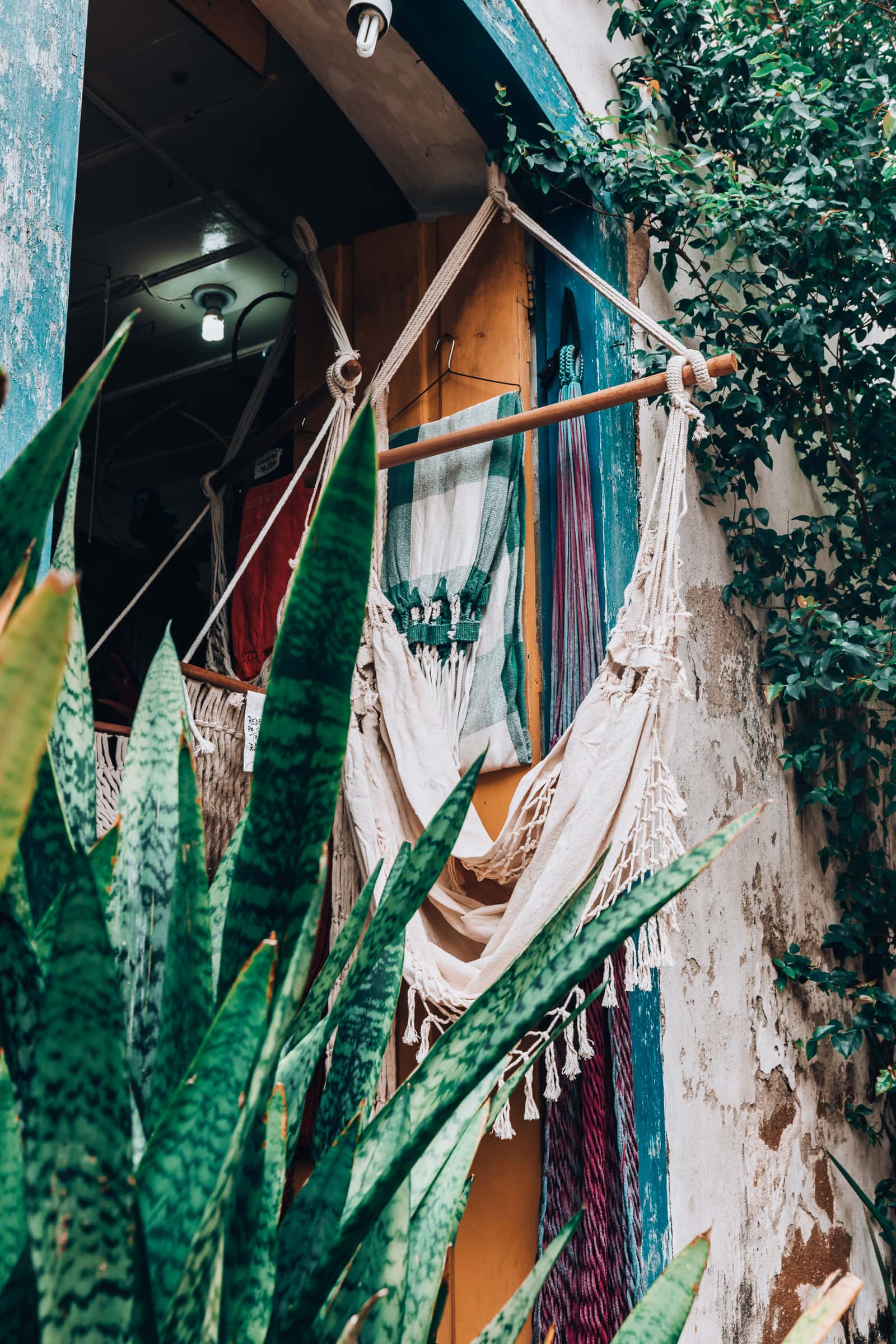
In the evening, the otherwise tranquil old town comes to life: shops showcase truly beautiful souvenirs; no two stores are alike, and there are so many handmade, original items—from plates to hammocks—that you can’t get enough of them. Paraty has style—no question about it.
Livraria das Marés – A small bookstore with a curated selection, featuring many coffee-table books about Paraty and Rio, as well as English-language literature and a cozy café in the backyard. An insider’s tip!
Shopping: Handmade hammocks.
Food & Drink in Paraty
A good meal and a little cervejinha (beer) are a must in Brazil in the evening! Around Praça da Matriz, the central market square in the Old Town, you’ll find many bars and restaurants, but there are also plenty of interesting spots in the cozy side streets. Most venues feature live music every evening; the atmosphere is cheerfully Brazilian and infectious—you can really let loose almost anywhere here.
Café Paraty | Very popular—you’ll have to wait during peak hours, but the tropical atmosphere with laid-back live music makes it worth it! Brazilian cuisine. Recommendation: Picanha (beef steak cut in a special way).
Frida y Diego | A small taqueria with live music in the evening, away from the hustle and bustle of the Old Town, serving Mexican cuisine.
Sabor da Terra | A down-to-earth self-service restaurant serving delicious Brazilian cuisine. Self-service restaurants are very popular in Brazil and offer visitors a great opportunity to sample a variety of typical Brazilian dishes.
Manuê Sucos | It’s technically a juice bar, but it’s open until the evening and offers plenty of fresh snacks like açaí or pão na chapa (toasted rolls with cheese). Good and affordable. It could be the perfect place to work for digital nomads who want to get some work done while on the go—though laptops aren’t allowed.
The following applies to all venues: When there is live music, it is customary to charge a cover charge of 10 to 15 R$ (3–4€) per person.
The historic district of Paraty is full of colorful details.
If you’re feeling a little hungry, there are plenty of street stalls offering a wide variety of dishes, from tapioca (pancakes made from cassava flour) to pasteis (fried pastries). Be sure to stop by one of the many cake carts scattered throughout the old town: Brazilians are true masters of sweets! Try a cocada (fresh, sugared shredded coconut) or a bolo de tapioca: this snow-white, sticky mixture made from cassava flour tastes more like pudding at first, but the sugared condensed milk poured fresh over it makes the dessert perfect.
There’s one name you need to remember: Jorge Amado!
You absolutely have to try a Jorge Amado here—you’ll find it in every bar! Paraty’s signature cocktail tastes like a sweet caipirinha: instead of cachaça, the sugarcane spirit, it uses Gabriela liqueur, which is infused with cloves and cinnamon (cravo e canela). It’s no coincidence: Jorge Amado is one of Brazil’s most famous authors, and his novel *Gabriela, Cloves and Cinnamon* was adapted into a film right here in Paraty. You don’t have to like his books—but after five days in Paraty, I was hooked on Jorge Amado!
But Paraty is so much more than just culture and history: there are so many different places to explore around the town, from the deepest jungle to secluded islands! That’s why most tourists spend their days exploring the area around Paraty. I’ve put together a list of the most beautiful spots for you here!
Trindade
There is a beach in Paraty itself, but the beaches in Trindade are even more beautiful! You can easily get there on your own: A bus leaves for Trindade every hour from the central bus station (Rodoviária). (One-way fare: 5 R$, approx. 1.20€, pay on the bus, get off at the last stop).
Whether you’re looking for peace and quiet or a party atmosphere, Trindade has something for everyone. At Praia dos Ranchos, you’ll find plenty of bars and restaurants. There, you can use the umbrellas and chairs if you order something at one of the nearby establishments. It’s a typically lively Brazilian spot with lots of music.
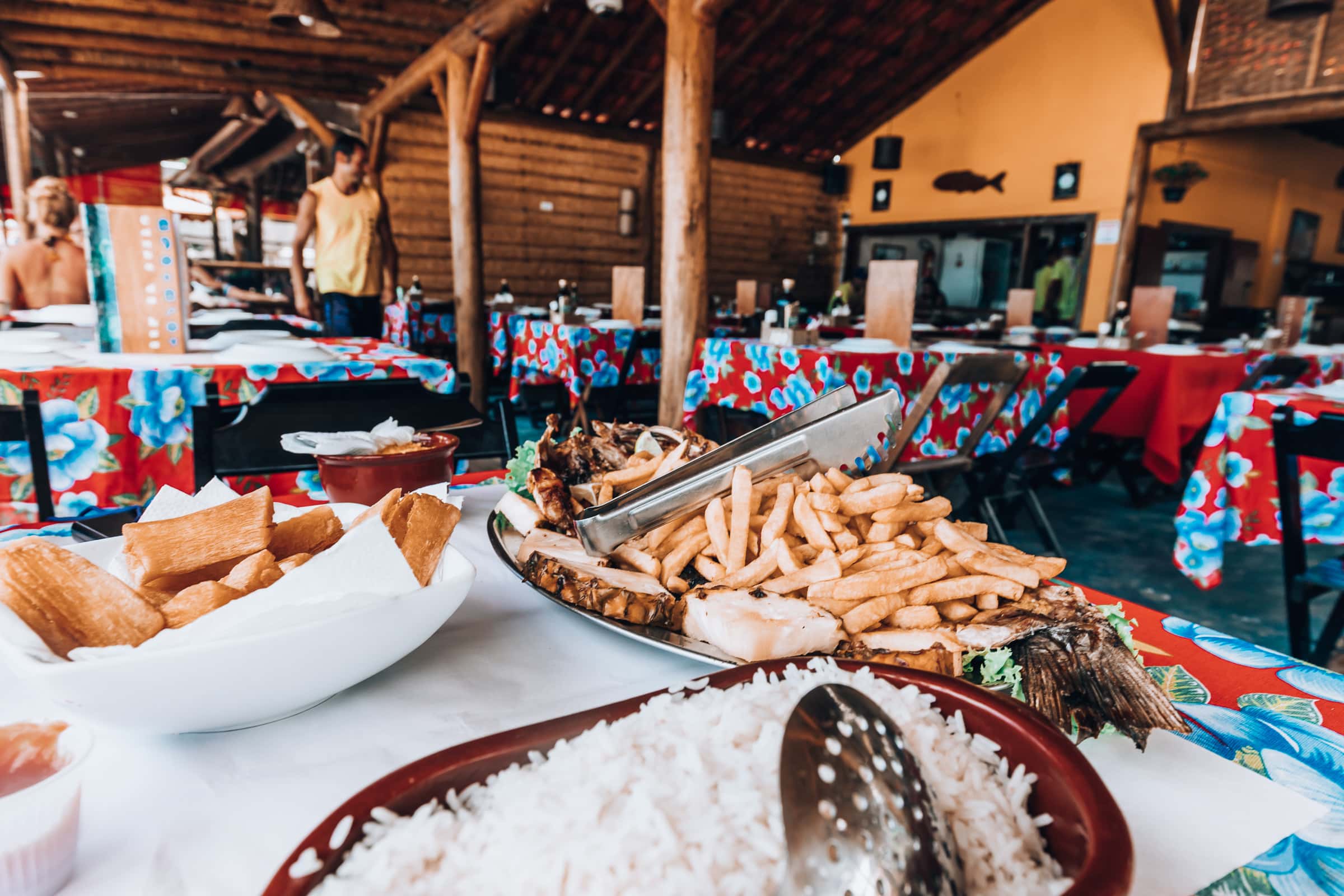
There are also livelier beaches in Trindade.Fresh fish: It’s never as delicious as it is by the sea.
Follow a small path to reach Praia do Meio. Restaurants and beach vendors are not allowed here, as this beach is part of the surrounding nature reserve. The beach is relatively spacious, and the huge rocks are very impressive.
Nature Reserve: Praia do Meio in Trindade.
Waterfalls Around Paraty
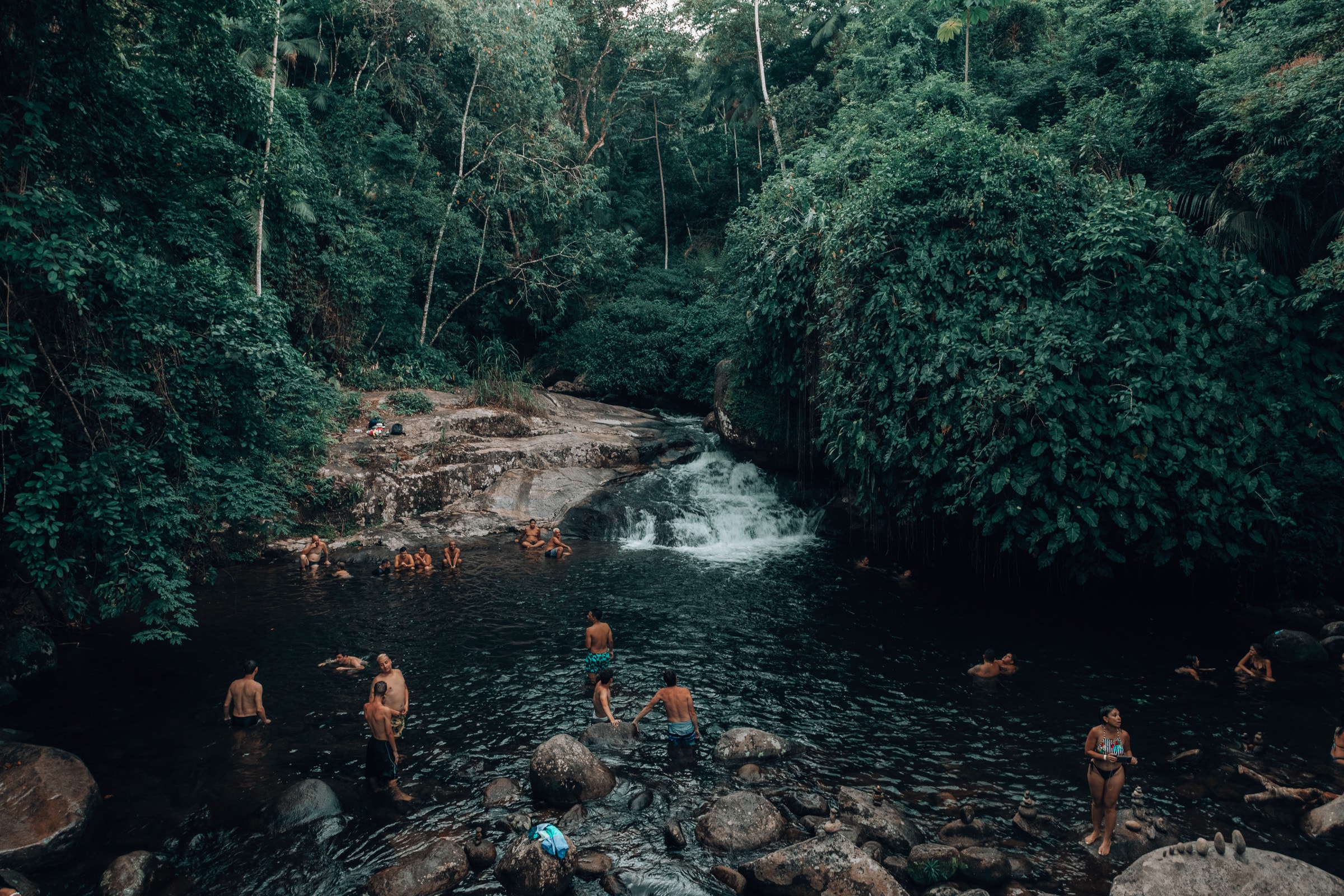
There are plenty of waterfalls in the densely forested mountains around Paraty. One of them is particularly impressive and is simply called Tobogã . In Portuguese, that means “water slide,” and once you’re there, it becomes clear why: on a huge, slippery rock, you can plunge down the waterfall like a killer slide. If that’s too dangerous for you (accidents aren’t uncommon here), it’s best to just watch the local kids, who’ve already perfected their daring stunts—my jaw dropped.
At Poço do Tarzan (Tarzan’s Pond) further up, you can safely wade into the water and feel a little like Tarzan taking a dip. Just remember, though, that you’re in the middle of the jungle: don’t forget your bug spray!
Swimming like Tarzan: The waterfalls around Paraty are breathtaking.
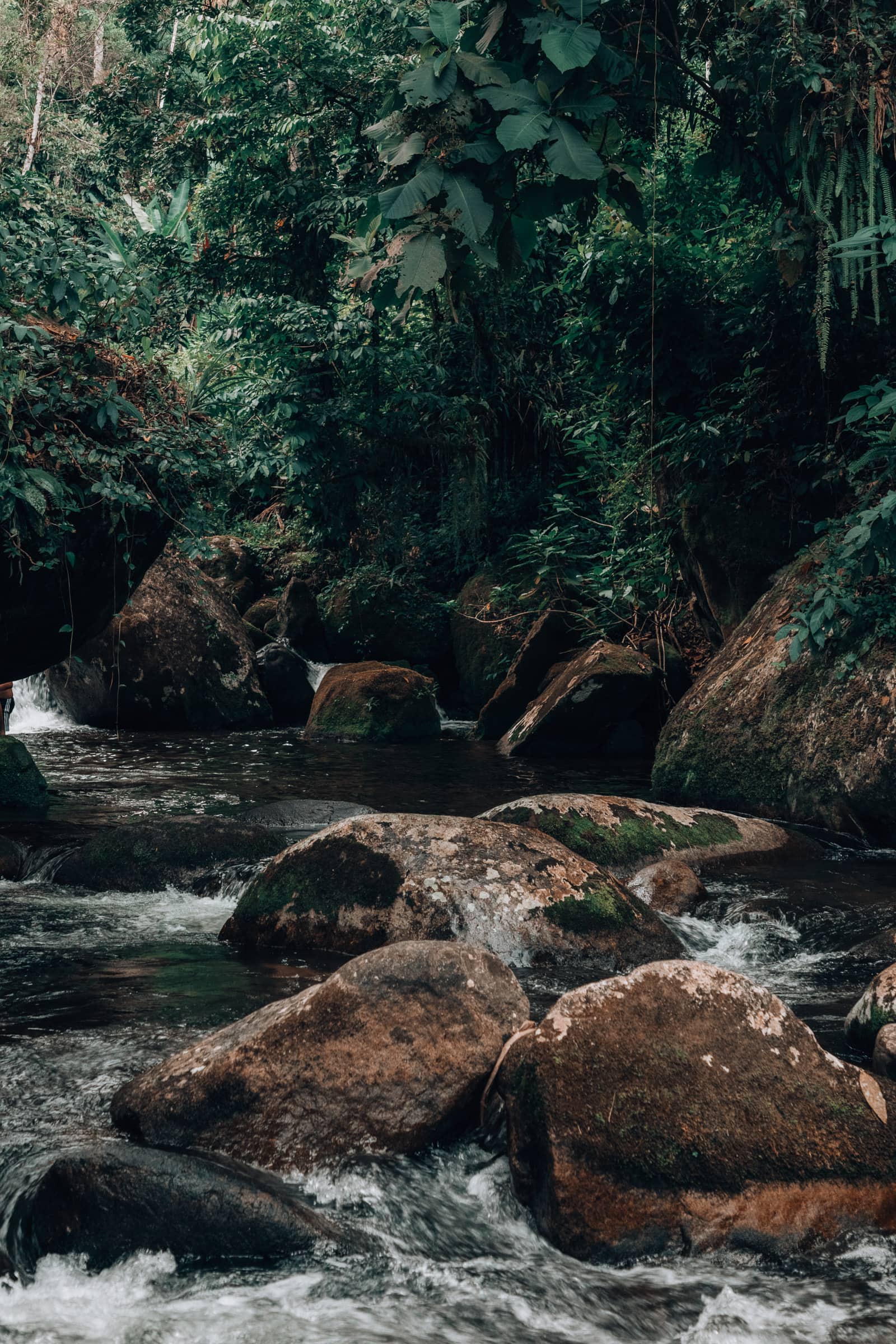
Right next to the Vila Verde restaurant, guests will find one of the most beautiful swimming spots: Here, you can take a dip in a cool mountain stream, far away from the hustle and bustle! The water may be cold, but it’s crystal clear—pure nature! If you’re visiting the restaurant as part of an outing, you don’t have to eat there—you can just relax and enjoy nature!
All kinds of exotic plants grow in the Vila Verde garden.Perfect for a cool refreshment during the hot temperatures of the Brazilian high summer.
The best way to visit these places is on a guided jeep tour! I recommend Paraty Tours—the organization was great, and their Land Rover jeeps were nicer than the competition’s, whose passengers had to sit in stuffy cars 🙂
(Don’t let the reviews get to you—during our long lunch break, we just relaxed, floating down the mountain stream and enjoying our picnic!)
By Boat Around Paraty
You definitely shouldn’t miss a boat trip either! For one thing, you’ll get to meet Brazilians on vacation (spoiler: they’re even more exuberant than usual!), and for another, you’ll get to see the beautiful islands around Paraty. If you choose a “Passeio de escuna,” it’s a larger boat, usually with a full kitchen and bar on board.
Turquoise-blue water & sunshine: You can reach the islands in Paraty Bay by taking a boat tour.
If you get there early, you’ll get the best spots. You’re welcome to bring your own food, but it’s not absolutely necessary. The trip lasts about 4–5 hours; we’ll stop at beaches, there will be opportunities to swim (I love jumping right into the water from the boat), and plenty of music. And, of course, Jorge Amado!
The swimming spots are great for snorkeling. However, equipment is only available on board for a fee, and it’s not that great, so it’s better to bring your own if you want to snorkel!
Where to Stay in Paraty
Location is everything in Paraty! The best spots are actually near the historic center! There, you’ll enjoy an idyllic stay right in the heart of it all. Praia do Pontal, just a few minutes’ walk from the center, is also a great place to stay—and it comes with that laid-back beach vibe to boot.
It’s often cheaper to stay outside the city, but everything interesting is farther away, and the newer neighborhoods aren’t necessarily that pretty either. So it’s worth spending a little more!
How do you get to Paraty?
Traveling by Bus
Paraty is located between Rio de Janeiro and São Paulo; you can reach both cities by intercity bus. Paraty does not have a commercial airport. The trip takes about 4 hours in either direction, and a one-way ticket costs around 80 R$ (approx. 20 €). The buses are comfortable, but they often don’t have Wi-Fi or USB charging ports.
Bus Station in Paraty
The bus station in Paraty is located relatively centrally in the city, and you can reach many accommodations on foot from there. If you have a lot of luggage or need to go farther away, just take a taxi from the taxi stand—it won’t cost an arm and a leg. Uber isn’t available in Paraty (yet).
Buying Bus Tickets in Brazil
In Brazil, you can always buy tickets directly at the bus stations. It’s best to take care of your tickets a little in advance. Intercity buses are a popular mode of transportation in Brazil, and especially for destinations like Paraty, they can get quite crowded during peak travel season or on weekends.
But so you don’t have to make a special trip to the station (in Rio, for example, the Rodoviária/bus station is relatively far from downtown), I recommend buying your tickets online at Clickbus*. You can often get an additional discount there.
Clickbus* is the largest ticket platform in Brazil, and most bus companies are listed there. (Note: With some bus companies, you have to exchange your online tickets at the ticket counter.)
The bus station is centrally located in Paraty, near the Old Town.
Where to go next from Paraty?
Paraty, for example, is a popular destination from Rio de Janeiro. On the way there, you can also stop at the beach resort of Angra dos Reis or take a ferry to Ilha Grande —a paradise for nature lovers.
Advertising / *affiliate link
Helpful Tips
Avoid the peak travel season between Christmas and Carnival: Prices go up and accommodation options become scarce!
On the topic of safety: While it’s generally a good idea to be cautious here as well, Paraty is actually a very laid-back place. I never felt unsafe at any point—quite the opposite, in fact.
Don’t forget mosquito repellent—the strong kind with DEET—if mosquitoes love you as much as they love me! You can find good repellents at any local pharmacy.
In Brazilian Portuguese, “Paraty” is pronounced “Pa-ra-tschie” 😉
Búzios is actually called Armação dos Búzios, but among Brazilians the popular resort is simply called Búzios. There you will find some of the most beautiful beaches in Brazil! When the weather is nice, many Cariocas from Rio de Janeiro are drawn here.
So if you’re ever in Rio, I highly recommend a trip to Buziós! In only three and a half hours by car you can reach unforgettable dream beaches. I’ll show you the best locations, sights and give you some tips for a great vacation in Brazil!
Fishing boats on the Orla of Buzíos
Armação dos Búzios: Beaches & Brazilian Lifestyle
Búzios is located on a peninsula and has more than 20 beaches, each more beautiful and unique than the other. While the water on the beaches in the north is calmer and warmer, the beaches in the south are wider, the water temperature is colder and the waves are rougher. Depending on your mood, you can choose busy and less busy beaches: On some beaches one beach hut follows the other, on others you are relatively alone.
Praia de Geribá
One of the wilder mega beaches in Buzíos. Relatively natural and wide, but with many small beach stalls that rent umbrellas and chairs and sell small snacks. In the high season very well visited to full, but also the perfect opportunity to experience original Brazilian beach life. The water here is a bit colder, the waves higher, but the beach falls relatively shallow into the water, so even children and non-swimmers can have fun here.
Praia de Manguinhos
Very quiet, with some nice bars on one side, nothing but a few fishing boats on the other. If you are looking for total peace and quiet, this is the place for you! Here, by the way, you can also stand-up paddle well and with luck you can even see a few large sea turtles swimming past from the board! Otherwise, the water is not suitable for swimming in all places; there are probably also a few sewage land here, but that is unfortunately not uncommon in Brazil.
For those who like it quieter, Praia de Manguinhos is the place to be.
Rua das Pedras
It’s all night on the Rua das Pedras! Between chic boutiques and simple restaurants, everything squeezes on the famous pedestrian street in the center of the former village. You stroll, walk, have dinner or just a little drink – but the evening trip to Rua das Pedras is a must.
More desire for Brazil? You can find all articles in the ➜ Brazil Blog
Rua das Pedras is rarely this empty in the evening. After sunset life is raging here!
The Orla in Búzios and Brigitte Bardot
At the end of Rua das Pedras you reach Orla, the beach promenade of Armação dos Búzios. Despite the many tourists (especially in the high season between Christmas and Carnival), the atmosphere here is particularly cozy in the evenings. Small fishing boats are still anchored here in front of the narrow promenade of natural stone, the view wanders over the quiet bay. One place is always particularly busy: everyone wants to have their picture taken with the statue of Brigitte Bardot!
Until the sixties, Búzios was a really sleepy fishing village, no trace of tourism! Until Brigitte Bardot showed up here in 1964, in tow with her then-boyfriend Bob Zaguri. Fed up with the hype in Rio de Janeiro (such a world star at that time in Brazil, that was an event!) they fled to the then unknown Armação dos Búzios – the reporters after them and suddenly everybody knew Buzíos. Therefore, until today, Búzios is called the “Saint-Tropez of Brazil”. In fact, the atmosphere here is similar; to this day, the rich and famous of Rio and Brazil meet in Buzíos.
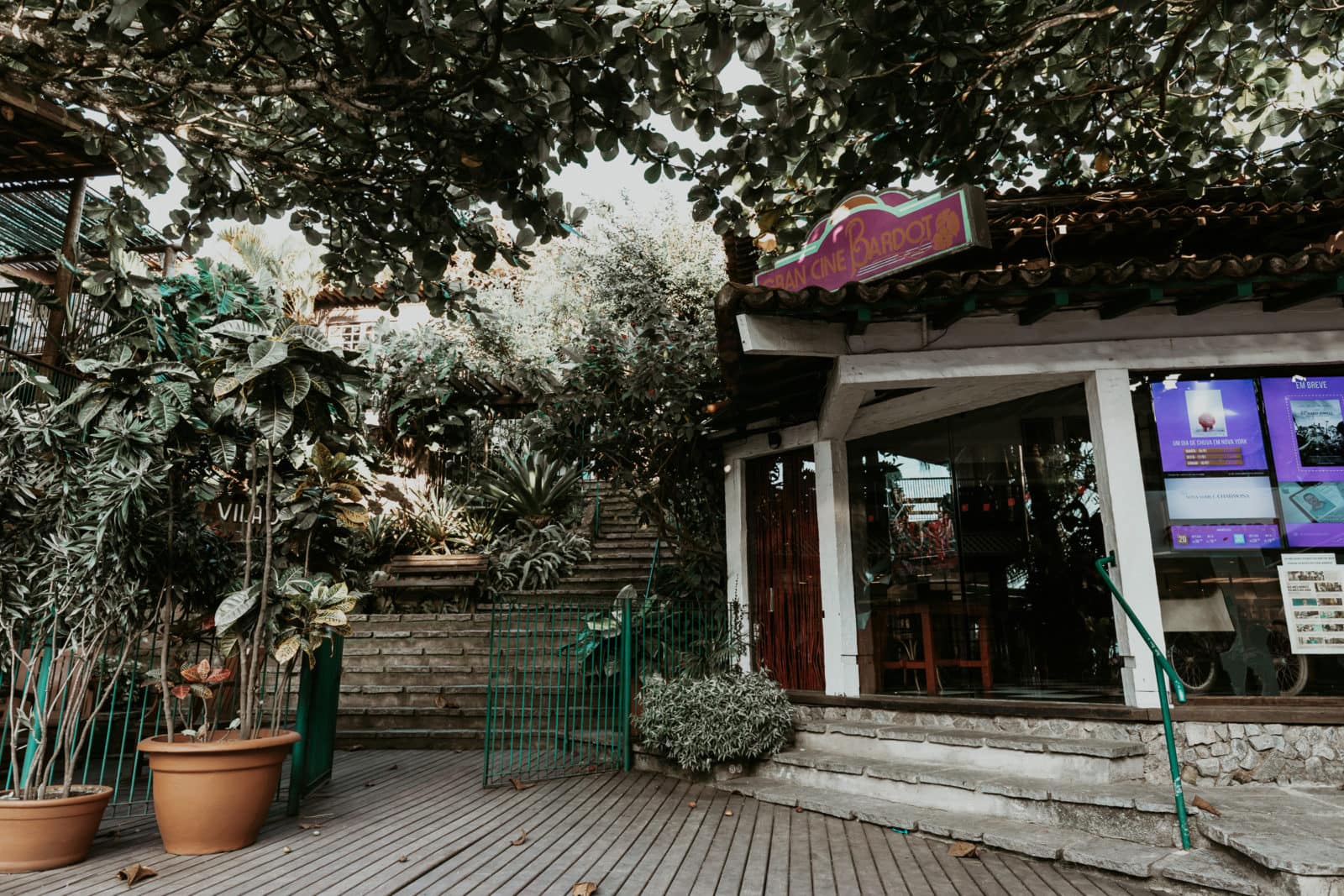
Directly on the promenade in Búzios: The restaurant La Bardot.Rather untypical for Brazil: There is even a small art house cinema, “Gran Cine Bardot”.Still a bit the romantic fishing village of yesteryear: the Orla Brigitte Bardot.
Practical tips for your stay in Búzios
Arrival | Plane, Bus, Shuttle Service & Tour
From Rio de Janeiro it is only a three and a half hour drive to Búzios. From Rio you can also book day trips by car, van or boat, but in my opinion it is not worth it.
If you have the time, organize transportation separately and spend several days in Búzios!
There are plenty of shuttle services that go directly to Búzios from Rio’s Galeao International Airport or from neighborhoods like Copacabana or Ipanema.
Just as convenient (and cheaper), however, are the intercity buses that depart either from Rio de Janeiro’s central bus station (Rodoviária) or from Galeão Airport. There is no airport for scheduled flights in Búzios.
From Búzios you can also reach the beaches of Arraial d’Ajuda by day trips.
Best time to travel | May to August
I was in Búzios in January, right in the middle of Brazil’s peak tourist season. However, trips in the low season, e.g. from May to August, are more recommended. Then the prices are lower, the weather is dry and warm. During the peak tourist season from Christmas to Carnival, prices rise, accommodations are often fully booked, beaches and the town itself are crowded. In addition, there can be rainy days every now and then due to the rainy season.
Accommodation in Búzios
Tip: Look for a small pousada (guesthouse). Pousadas are usually very small, family run and communicative. There you always quickly find a connection, even among the other guests. Most of them also offer breakfast, usually very rich with fresh typical fruits like papayas, pineapples or watermelons and many sweet treats, often homemade.
There are pousadas for every budget, from simple to luxurious. I can recommend the Blanca Hostel*(don’t be put off by the “hostel”, there are also nice, simple double rooms), very close to Praia do Geribá and with bus or Uber you are quickly in the center.
As in Rio, Uber is always a good and safe choice to get from point A to point B. However, public buses also run regularly and are cheaper. Tickets are available on the bus. In addition, so-called vans, privately organized lines, stop at the bus stops, but you can take them without any problems. Payment is made directly to the driver when boarding or disembarking.
A walk along the Orla River in Buzíos is a must, from there many small boats also depart for individual tours.
Security | Crime & Women traveling alone
Even though Búzios is very close to Rio, you will quickly notice that the mood regarding public safety is quite different here. In Rio you are often warned of somewhat unsafe corners, general attention is in order.
In Búzios, however, the situation is much more relaxed, there is little sign of crime and after a visit to Rio, Búzios is a real boon in this respect.
Women traveling alone can move around here (and, in my opinion, the rest of Brazil) without any problems and do not have to take any different precautions than men, couples or friends traveling together.
Many Brazilians vacation in Buzíos with the entire family or you go here in a large group of friends: be just as open-minded and you’ll make friends right away! Brazilians are very communicative, open and like to accept strangers into their group!
* * *
Looking for more tips about Rio de Janeiro and Brazil?
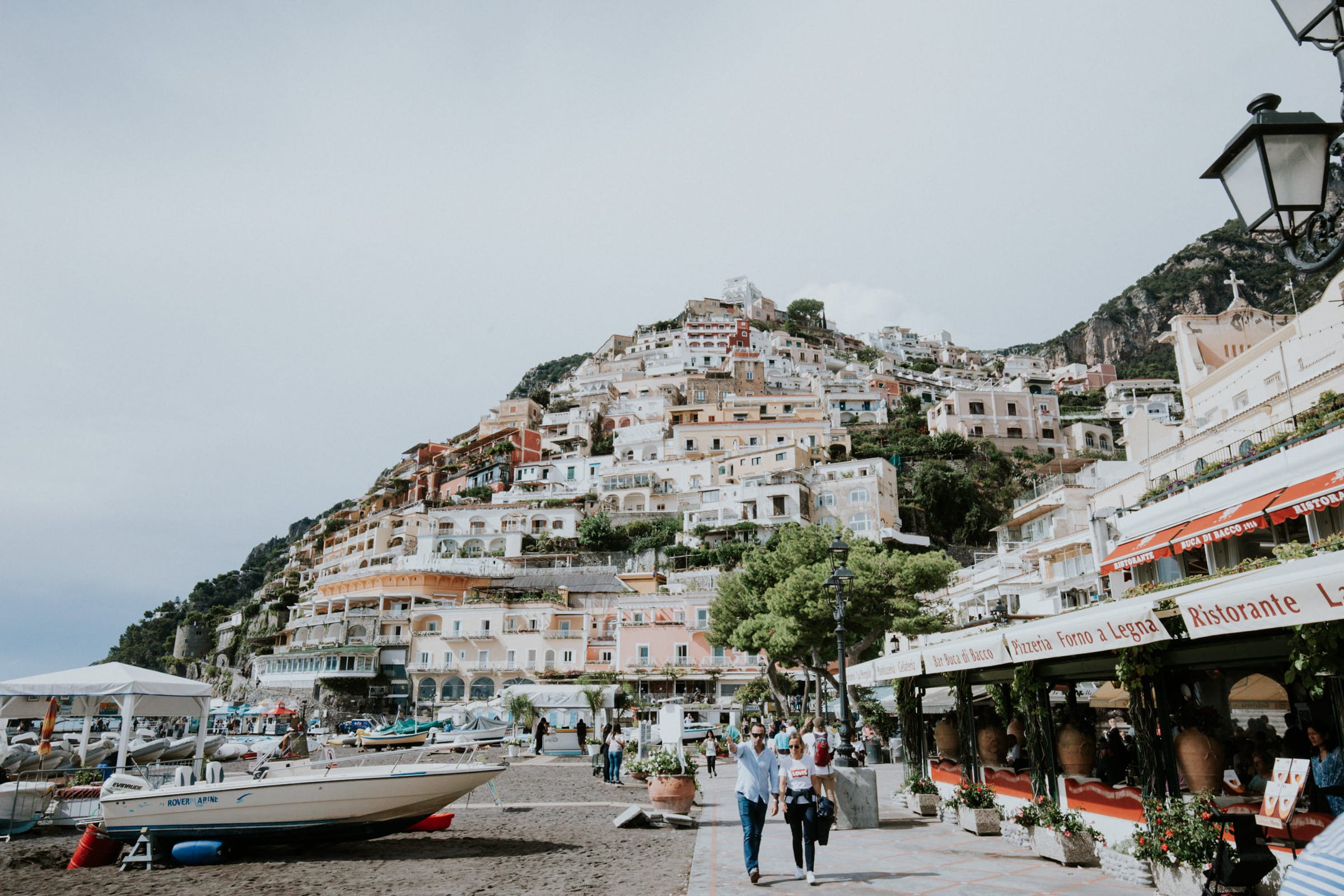
Positano is Instagram’s favorite. Not that the rest of the Amalfi Coast, with places like Amalfi and Ravello, is just as worth seeing: Positano is in a different league. There aren’t really many sights in Positano. The special atmosphere of the most famous town on the Amalfi Coast is enough of an attraction in itself. Is it really worth staying there? And what if you just want to have a good time in Positano instead of chasing after the next hotspots? See for yourself.
Positano is the small Italian coastal village with the pretty little houses that frame a bay on steep slopes. Positano is probably the most famous town on the Amalfi Coast and the highlight of any trip through the region. The journey is adventurous: you drive towards Positano on winding, narrow roads. The town center itself and the slope down to the bay are best reached on foot. And Positano is definitely one of the places in the world that has become even more popular thanks to Instagram.
However, I thought Positano looked nice in pictures, but it wasn’t the place that was at the top of my wish list for our road trip along the Amalfi Coast. The Instagram hype was too much for me. But since we’ve been there before, I’ve researched a few nice Instagram hotspots in Positano:
#1 The beach of Positano & Fornillo Beach
Positano has two beaches, both of which are rather disappointing for real beach lovers. The beaches are relatively small. Sun loungers are expensive and the sand is dark brown instead of powdery white. But the real attraction is the scenery around it: the steep slopes with the cute houses frame the beaches. Positano Beach is the beach directly below the town center, Fornillo Beach is a little away from the center and is less crowded.
In the Blu Bar you can enjoy the beach life in the first row with a cocktail, but the same applies here as everywhere else in Positano: don’t look at the prices!
#2 Santa Maria Assunta Church
The Santa Maria Assunta church is part of the panorama of Positano. The dome with its majolica tiles is one of the town’s most striking features. From the stairs down to the large forecourt, you even have a view of the sea.
#3 Viewpoint: Restaurant Il Capitano
From the restaurant Il Capitano you have a perfect view over the bay of Positano. But if you don’t necessarily want to eat here, the view from the path above is at least as beautiful.
StillMore dolce vita? You can also find lots of tips on Naples and the Amalfi Coast here ➜ To the Italy blog
#4 Lunch tip: Casa E Bottega
We discovered Casa E Bottega by chance, the perfect lunch spot in Positano and: Very instagrammable! At Casa E Bottega, special emphasis is placed on freshness and good quality. There are several options for vegans and vegetarians. The dishes are okay, the portions small, but definitely a good choice for Positano if you don’t fancy the usual tourist traps. And when I saw the dog of the house, I was a fan anyway. Incidentally, Casa E Bottega is the cheaper sister restaurant of Next 2 a little further up the street.
#5 The alleyways of Positano
A tip for choosing an outfit for Positano: sneakers are an advantage! Many steps and narrow alleyways lead down to the town center and the beach. High heels are out of place here. The most beautiful Insta-motifs appear in the romantic urban canyons.
Practical tips for Positano
Well, Positano is indeed very picturesque. However, I didn’t become a real fan. Even in the low season in October, day tourists and tour groups squeeze through the narrow streets. After a few days on the Amalfi Coast and places that were also unexpectedly quite crowded, I didn’t like seeing crowds any more. And the prices! Positano is an expensive place, a visit to a restaurant is a small investment, not to mention an overnight stay in a hotel.
Where to stay in Positano
It’s worth booking early, especially in the high season! Positano and the Amalfi Coast are then so overcrowded that the cheapest options are long since fully booked. If you are traveling by rental car, make sure you have good parking facilities at your accommodation. Otherwise it can be expensive and difficult to find a parking space in the narrow and winding streets. Parking spaces are rare!
Tip: Accommodation in Positano is scarce in summer! And don’t shy away from the high prices – it doesn’t get any cheaper, and whoever books first has a clear advantage.
You can get to Positano by SITA bus, the public transport on the Amalfi Coast, with some ferry companies that call at the small bay of Positano from several ports nearby or by car/rental car (which is my personal recommendation due to the beautiful route!).
If you are only going to the city for one day, I recommend going straight to one of the paid parking lots at the entrance to the city. The parking options don’t get any better, you have to walk a lot in Positano anyway (and climb a lot of stairs!) and you save yourself a lot of stress. Also, the main road is a one-way street, so you can’t just turn around and drive back to the parking lot.
Paid parking lots are often privately operated and cost 5 euros/hour during our visit. The vehicles are parked on site by the staff to make use of every last centimeter, so you have to hand in your car keys. I was suspicious at first, but everything went well. However, as always, I had taken out fully comprehensive insurance with no excess for the rental car, so I didn’t have to worry about parking damage.
***
You can find more articles about Naples and the Amalfi Coast here: