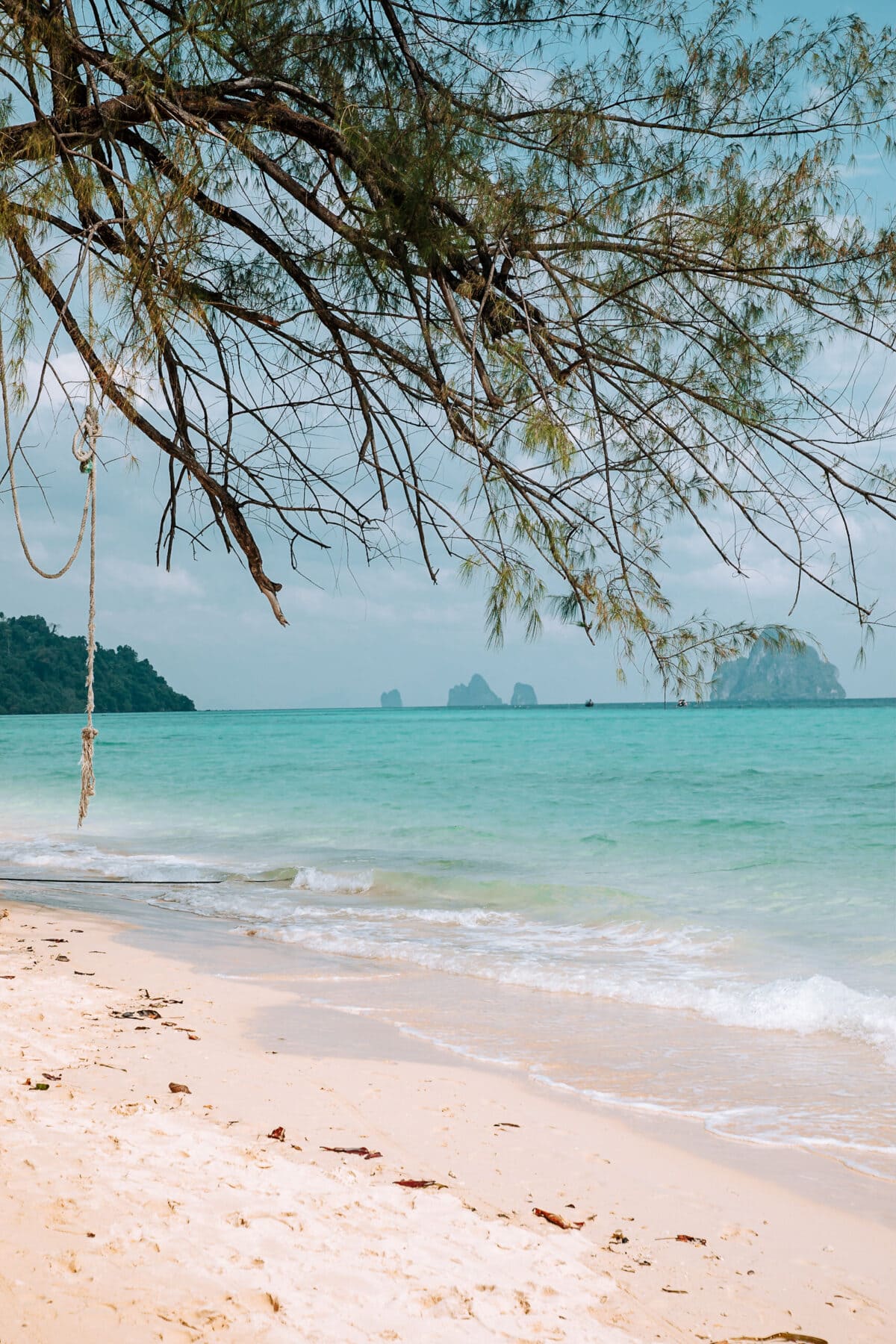
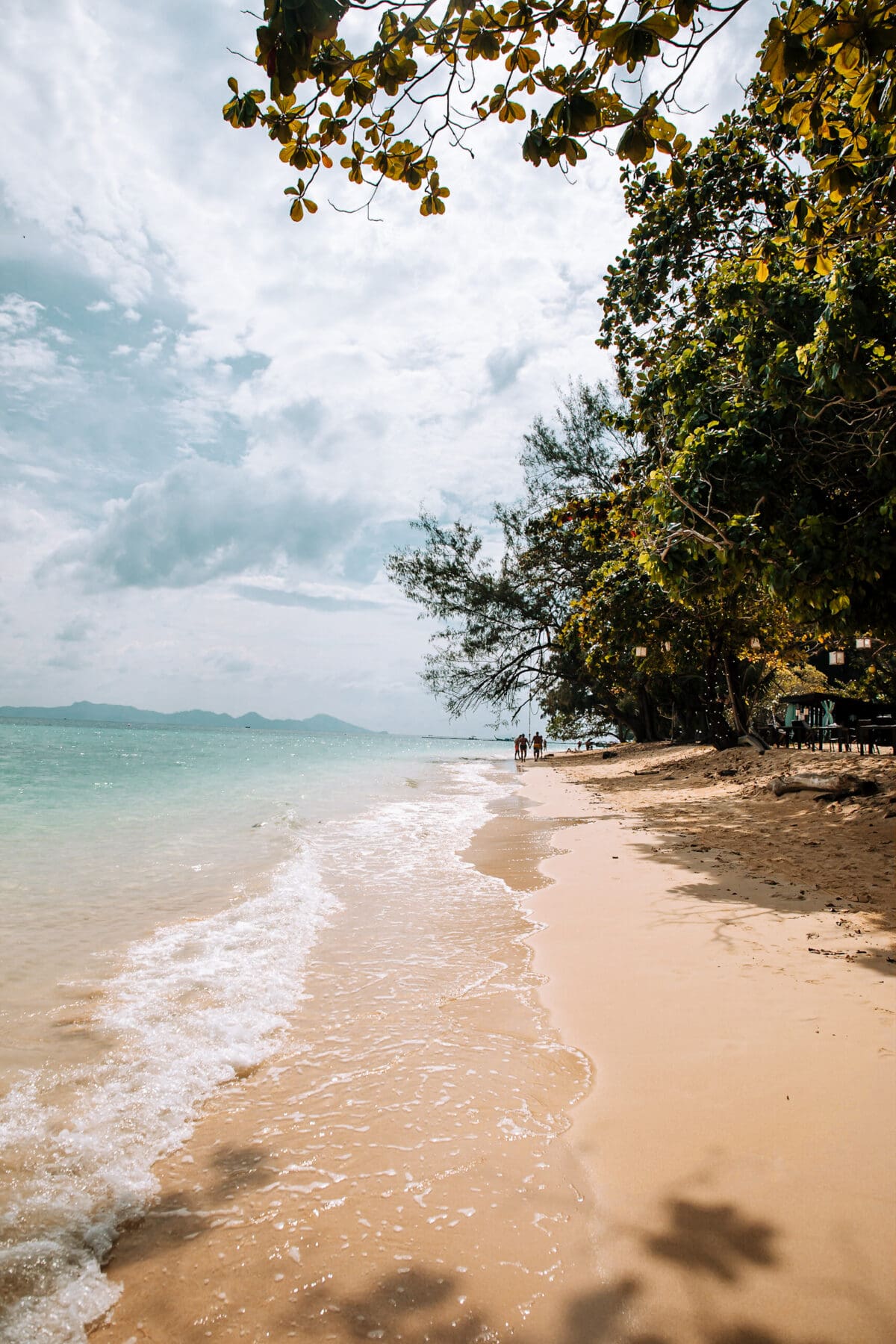
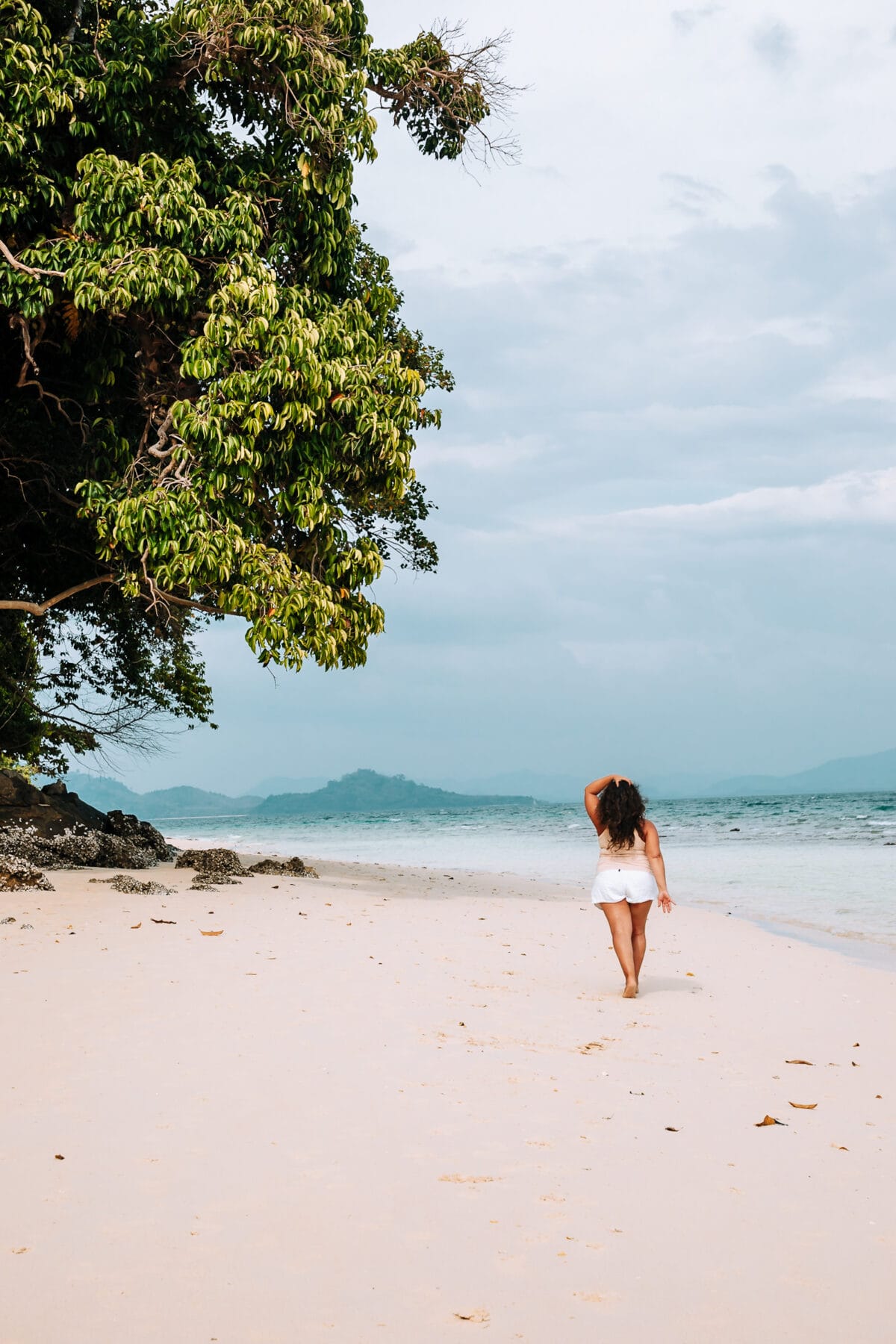
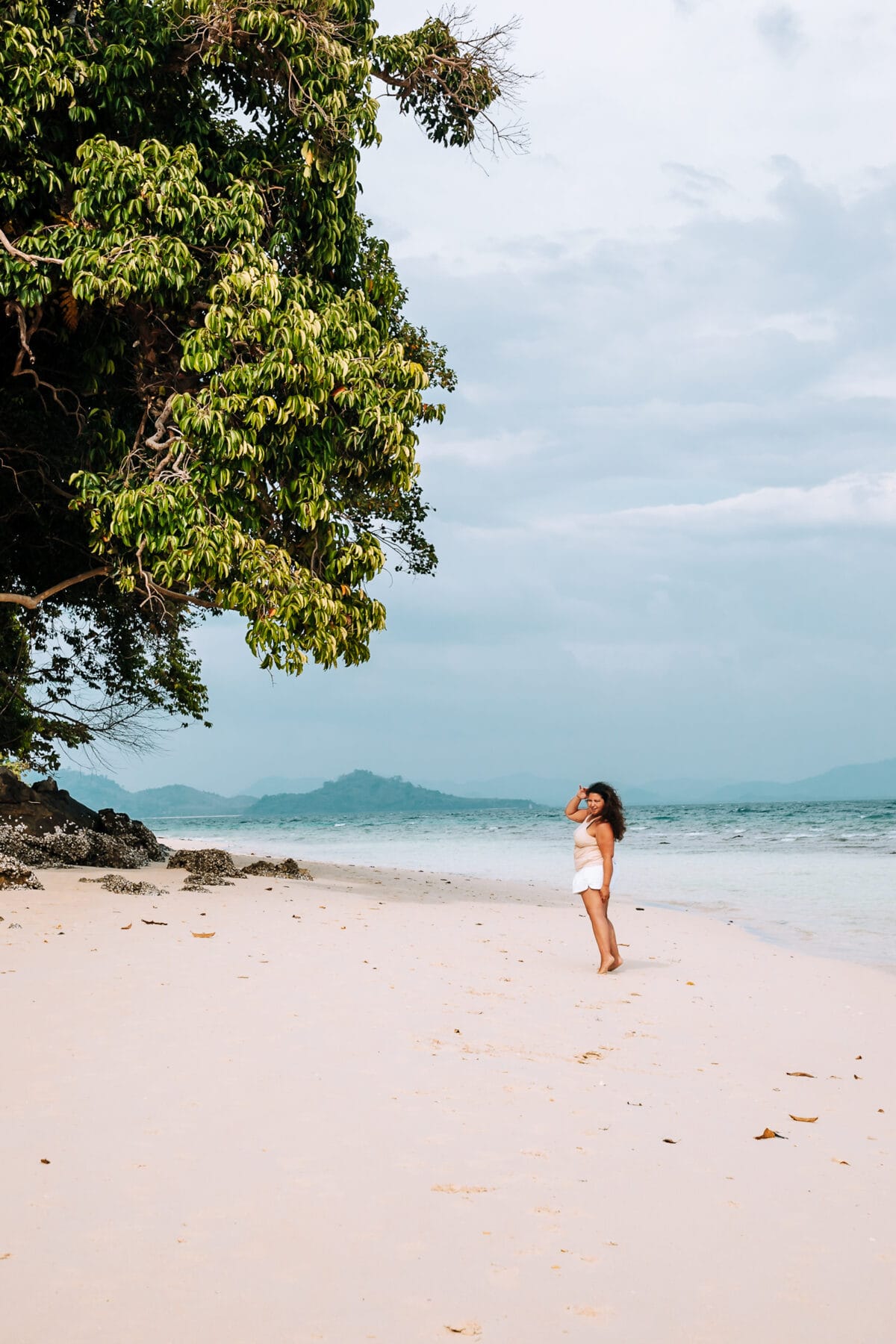
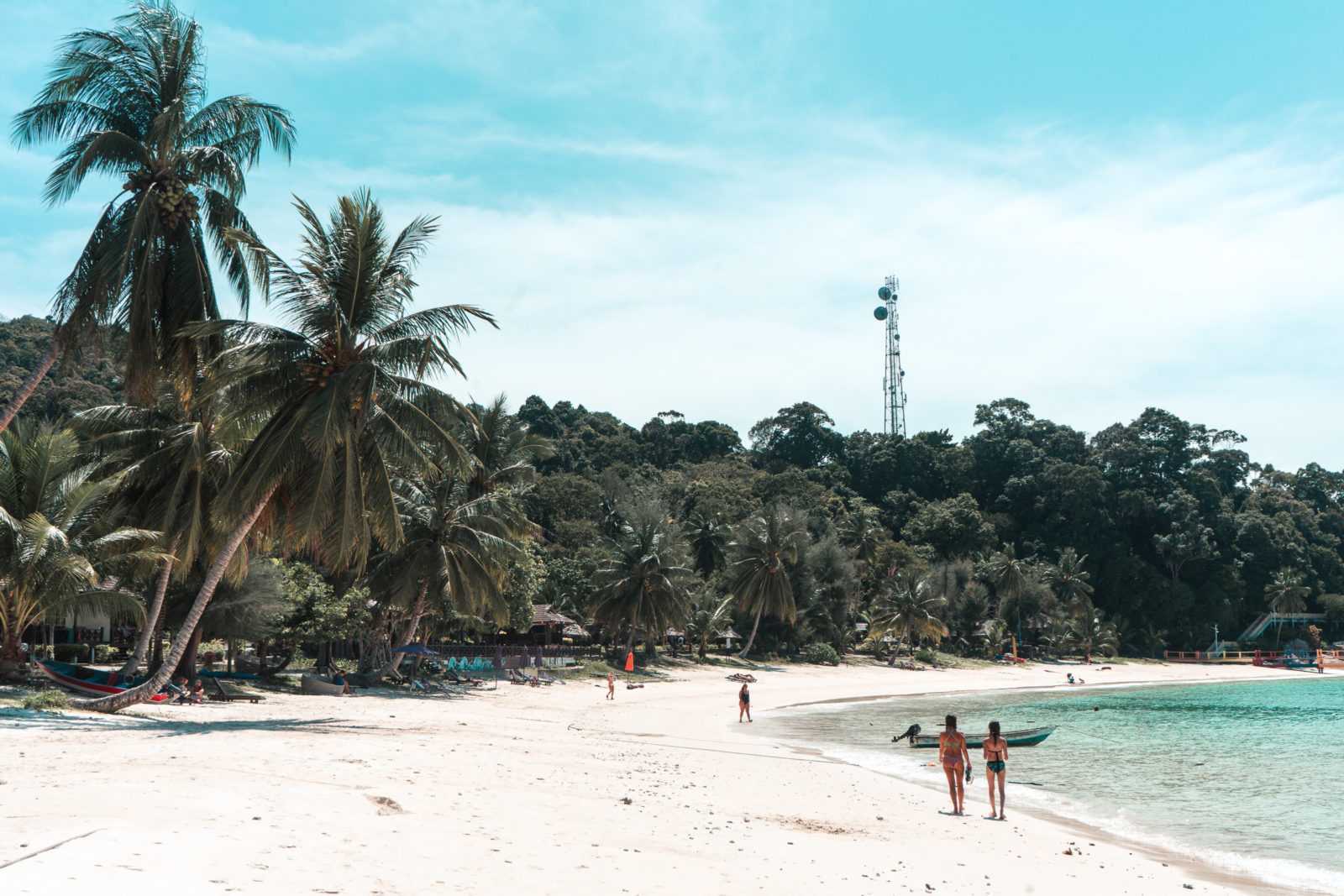
Are you looking for long dream beaches and turquoise blue water in Thailand? Then you should not miss this island: Koh Kradan is a true paradise! In this article I will tell you how to get to Koh Kradan and what you can experience there!
Koh Kradan, like Koh Mook, is part of the Had Chao Mai National Park in the Andaman Sea and is a mere two and a half square kilometers in size. The island is located only 10 kilometers as the crow flies from the mainland in the south of Thailand and is also a popular destination for locals.
Koh Kradan: One of the most beautiful beaches in the world
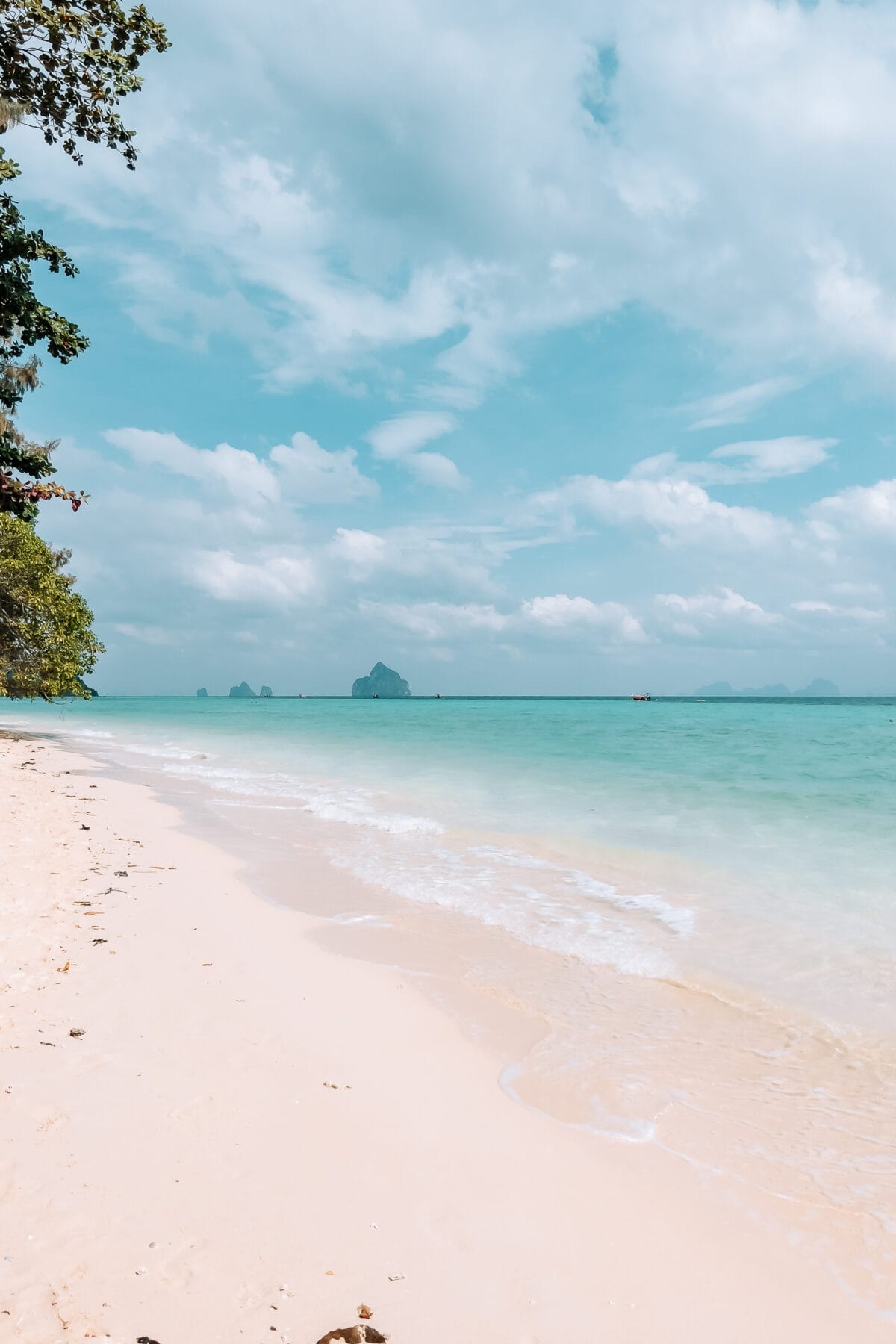
You read that right: Koh Kradan is home to one of the most beautiful beaches in the world! In any case, in 2016, the British daily newspaper “The Guardian” voted Koh Kradan one of the top 10 most beautiful beaches in the world – and this has really raised Koh Kradan’s profile.
By the way, Koh Kradan is also known for its underwater weddings on Valentine’s Day, for which people willing to get married travel from all over Thailand.
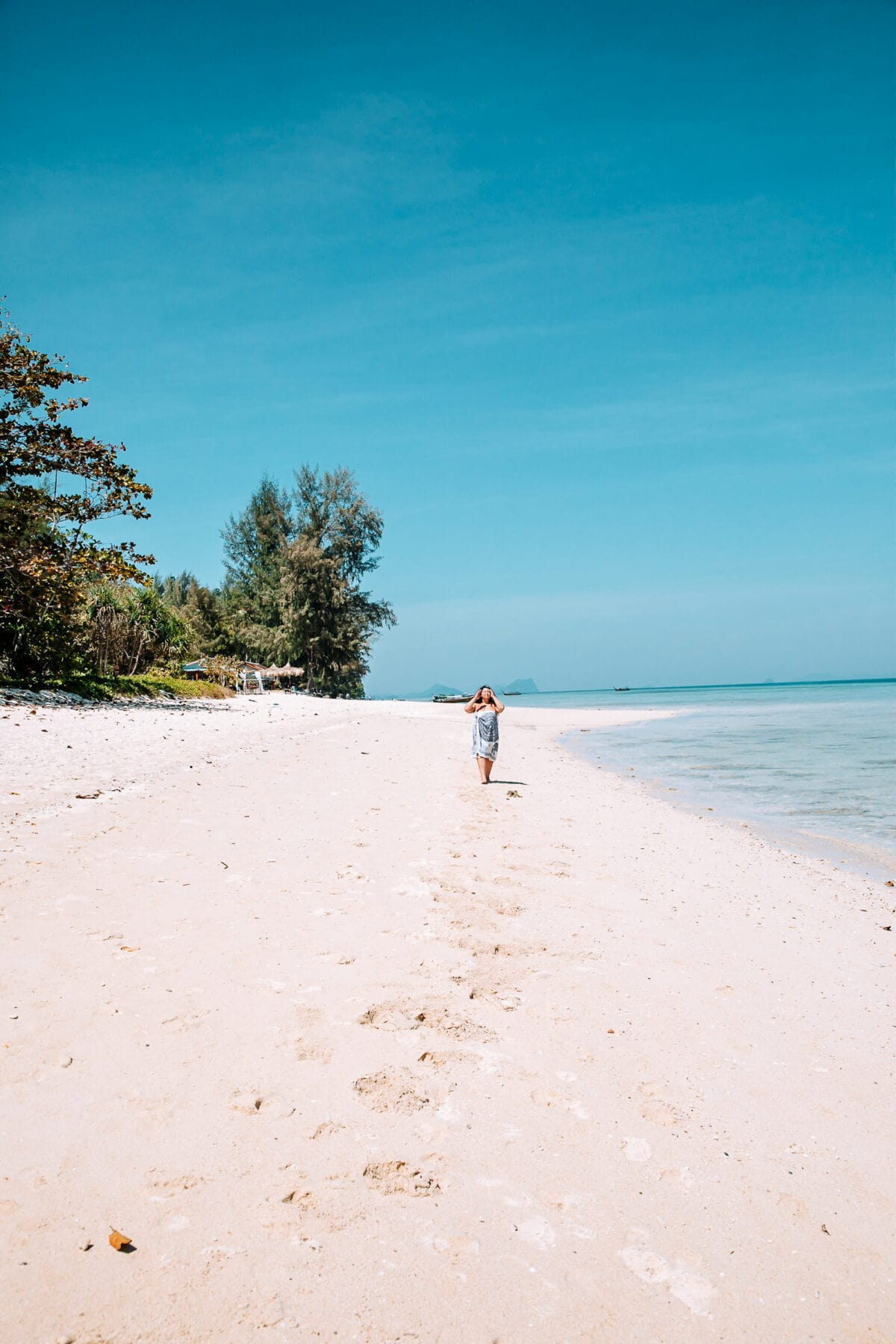
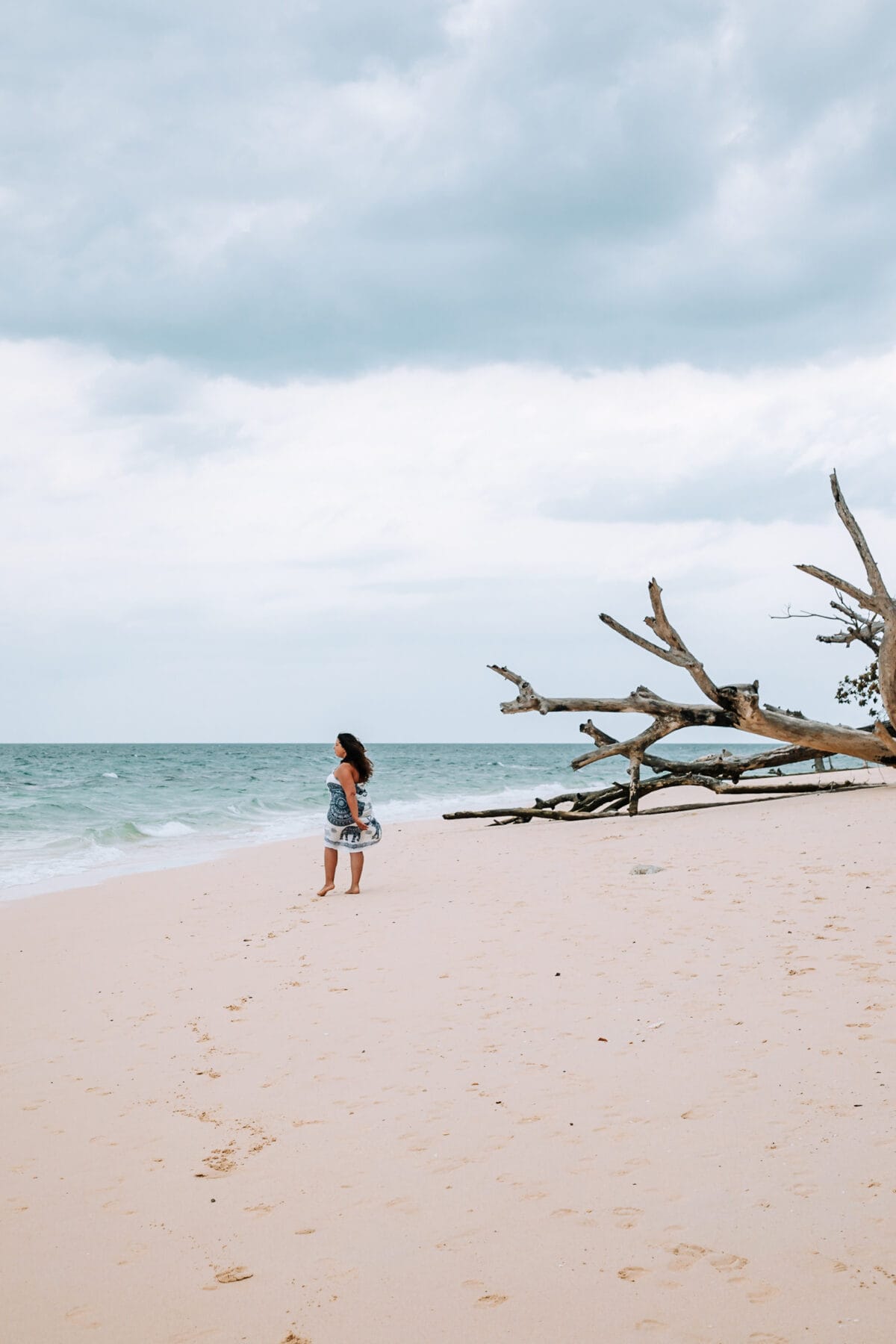
Paradise Beach on Koh Kradan.
Beaches on Koh Kradan
The famous Paradise Beach is located on the east coast of the island; this is also where most of the resorts are located. Here you can snorkel directly and explore the underwater world.
You will also find other good snorkeling opportunities in the southeast of the island. Just walk south along Paradise Beach, past the ferry dock and the national park ranger base: Ao Nieng Beach doesn’t have as many tour boats and resorts as Paradise Beach.
A jungle path leads to Sunset Beach through the middle of the island to the west coast. It is said that you can experience a great sunset here. Unfortunately, the beach itself is a bit littered. Along the way, you’ll also pass Paradise Lost Bungalows*, the island’s only low-budget resort.
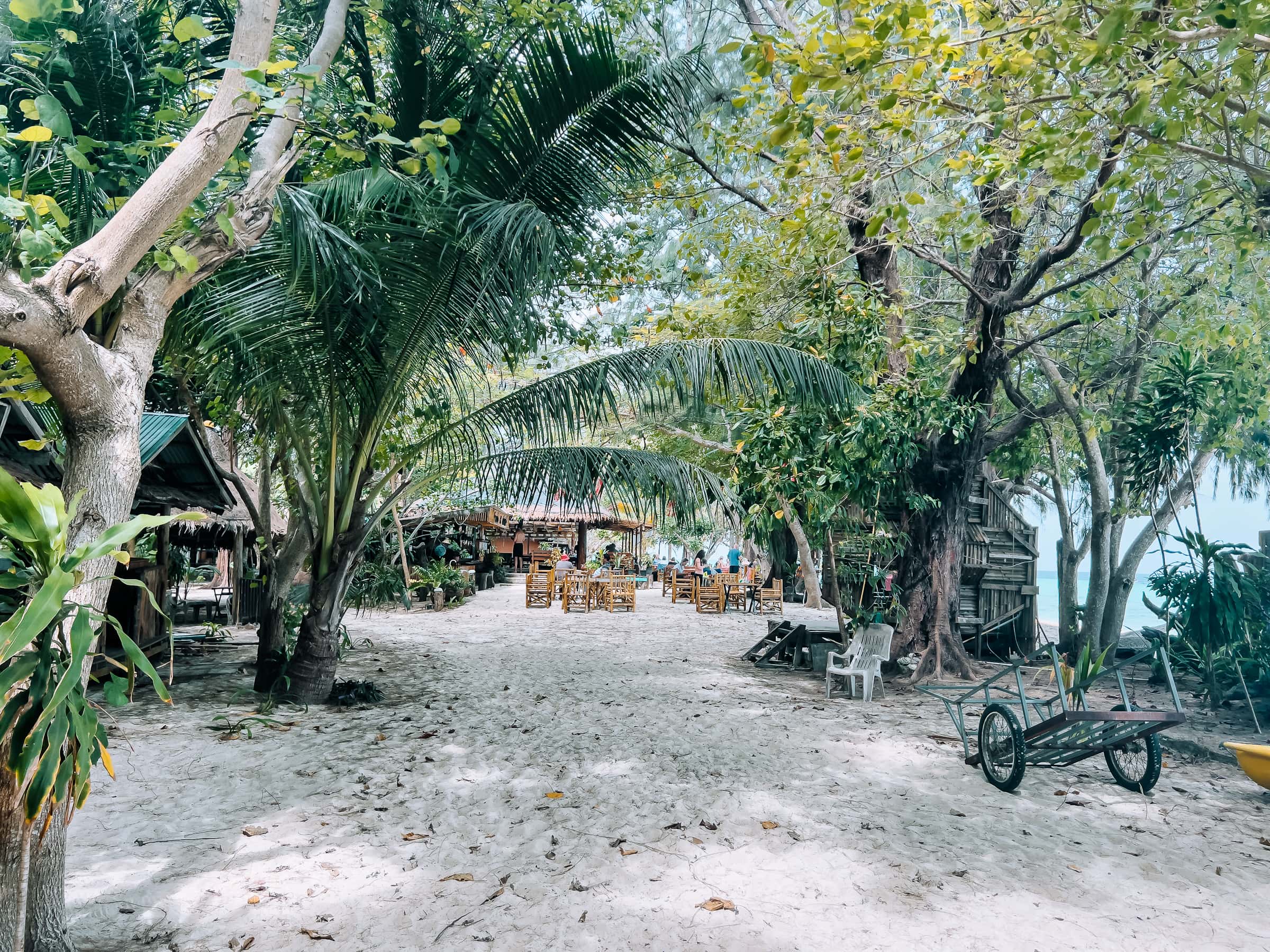
On Koh Kradan you will find only a handful of accommodations. This is also reflected in the prices: in general, everything here is much more expensive than in other vacation regions of Thailand and the price-performance ratio for accommodation is also rather poor.
Koh Kradan Beach Resort
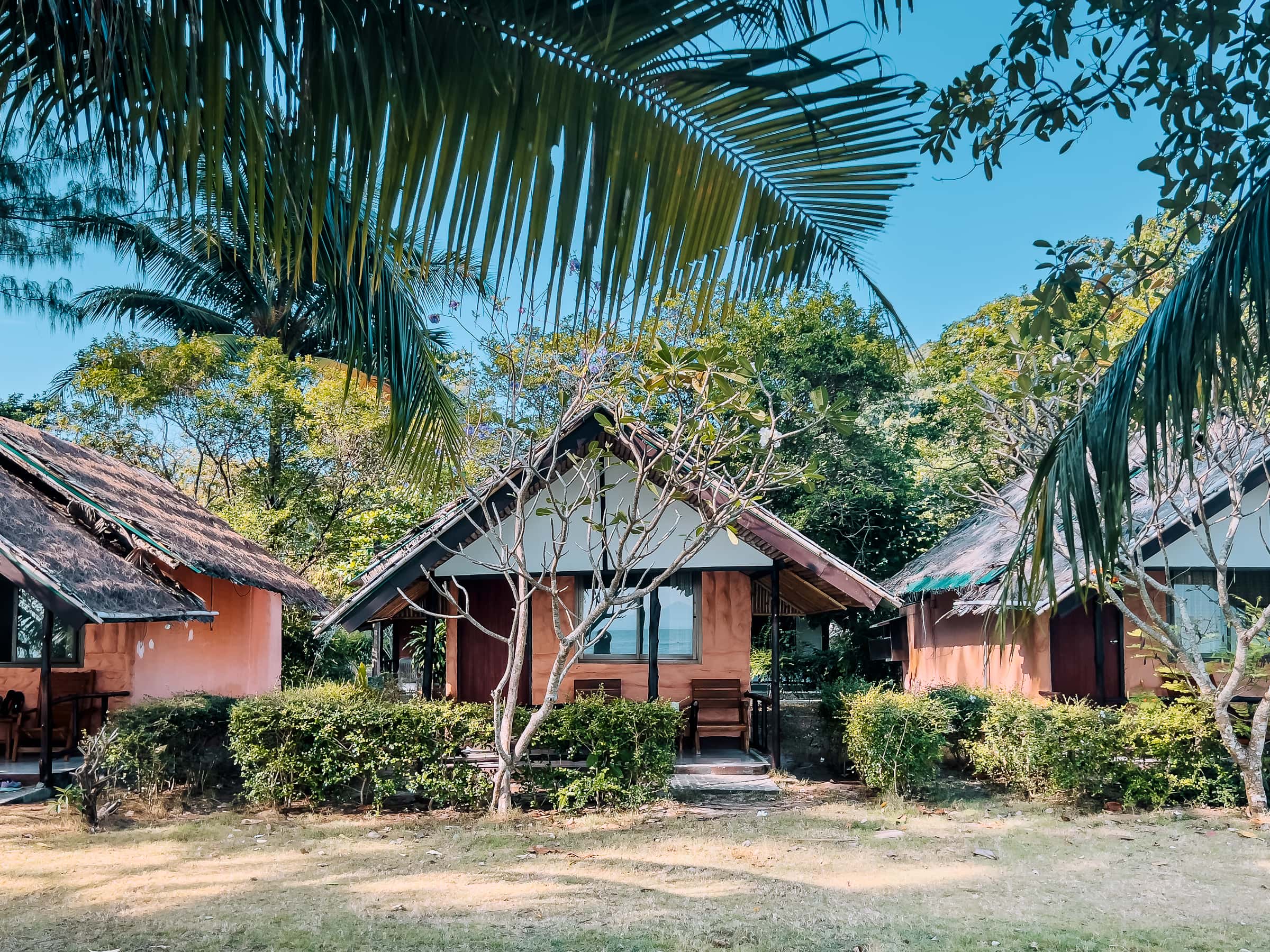
If you are looking for something solid, I can recommend Koh Kradan Beach Resort . The bungalows have mostly beach or sea view, solidly built and for those who need it, also equipped with air conditioning.
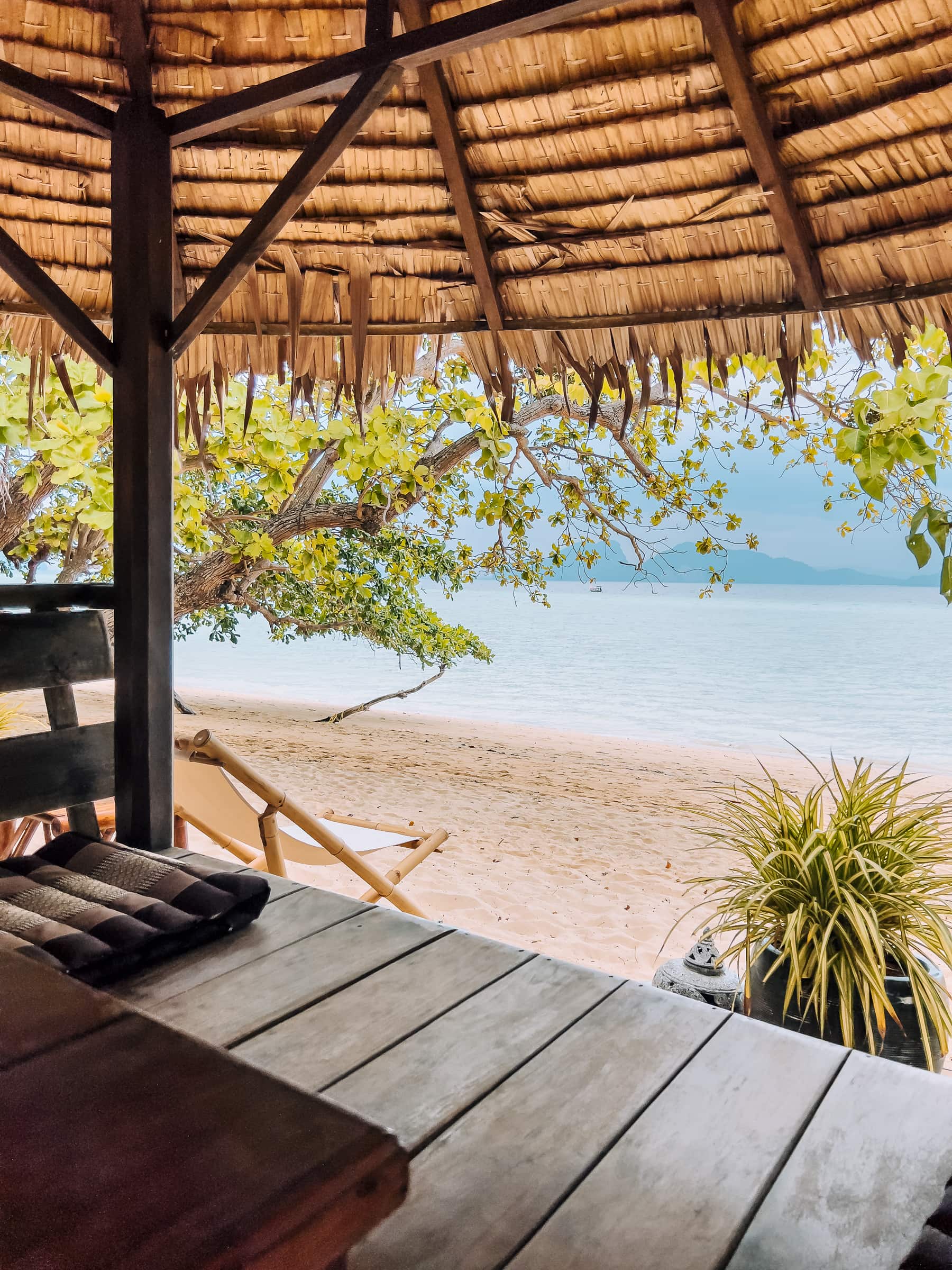
The Koh Kradan Beach Resort is located directly on Paradise Beach in Koh Kradan.
Unfortunately, the associated restaurant is not special; the included breakfast is Western-oriented and rather uncharitable. But these are fundamental compromises that you have to make on the very touristy island of Koh Kradan.
Bungalows with sea view: At Koh Kradan Beach Resort, you fall asleep to the gentle sound of the sea.
Kalume’ Eco Boutique Resort
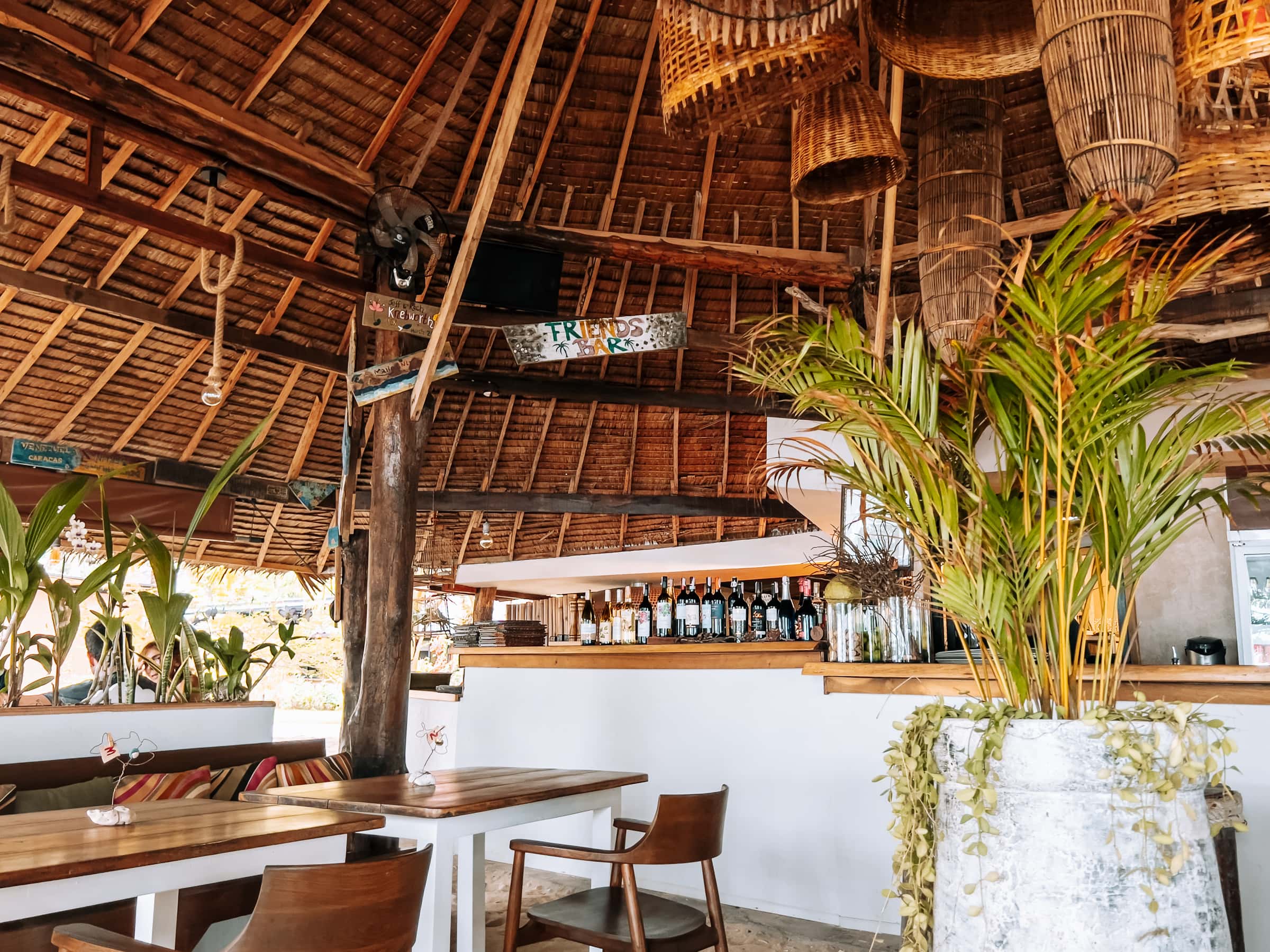
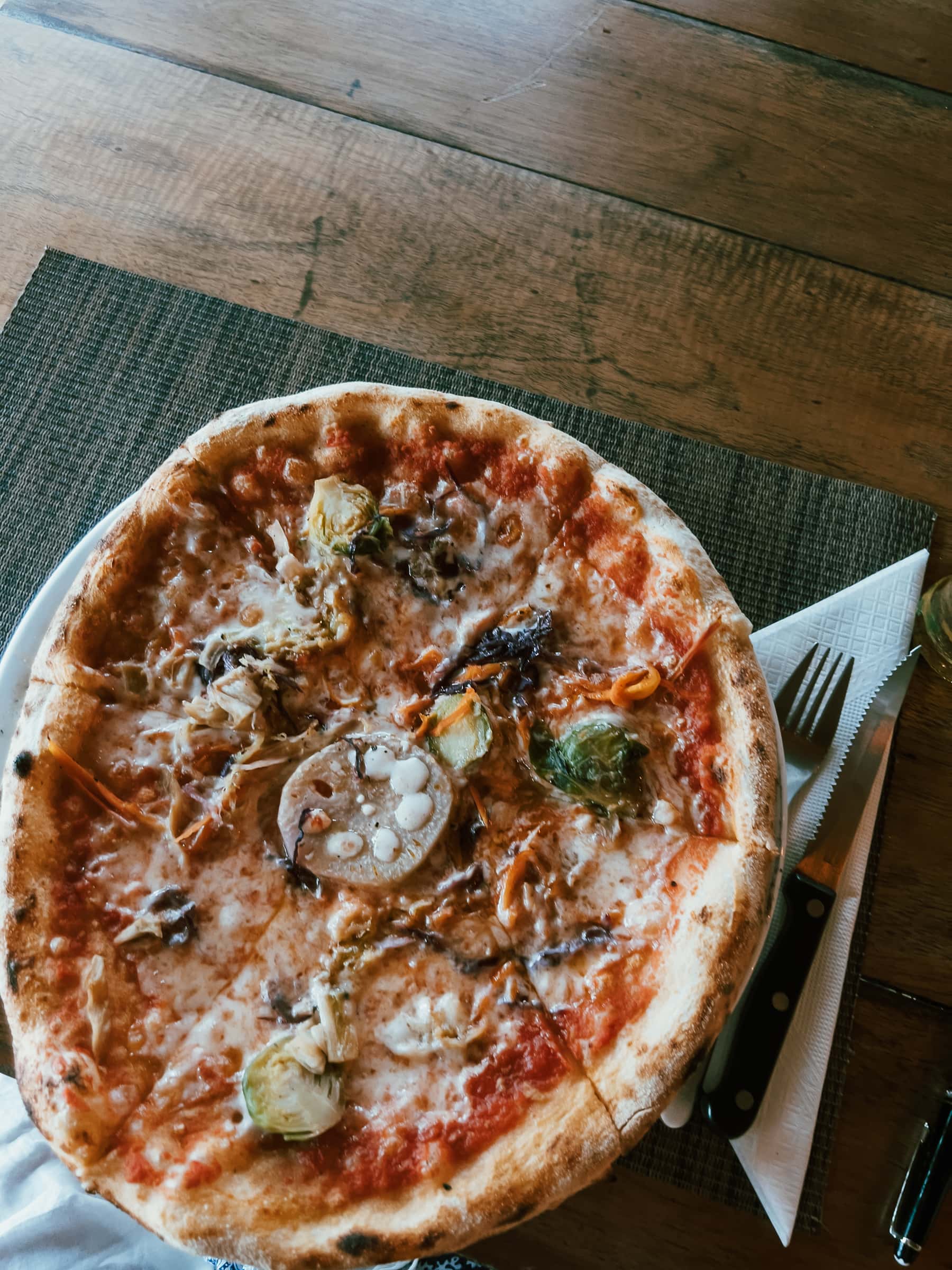
Very popular is Kalume’ Eco Boutique Resort*, a small resort run by Italians. The resort also has an Italian restaurant that offers really good Italian cuisine, from pizza to homemade pasta.
Whether that really has to be on a remote little island in Thailand is probably a matter of taste. Anyway, given the otherwise lousy food situation on the island (most restaurants are not special), it’s a good alternative. The facility is very beautiful, and certainly you have a good time here if you are one of the friends of the house, whose memories adorn the very nicely decorated bar. Unfortunately, everyone else has a bit of a hard time and has to fight for the favor of the service.
Koh Kradan is truly beautiful, but unfortunately it’s no longer a hidden gem. Sometimes the atmosphere at the resort gets a little out of hand, and surrounded by so many Western tourists, you can sometimes forget that you’re actually in Thailand. If you love Koh Samui or similar places in Thailand, you’ll still enjoy it; for others, one or two nights will be enough. (I’m in the latter group.)
However, there is another island among the Trang Islands that is very similar to Koh Kradan and where you can spend a few relaxing days.
Koh Ngai is also a small island paradise: Car- and scooter-free, quiet and perfect for snorkeling and relaxing.
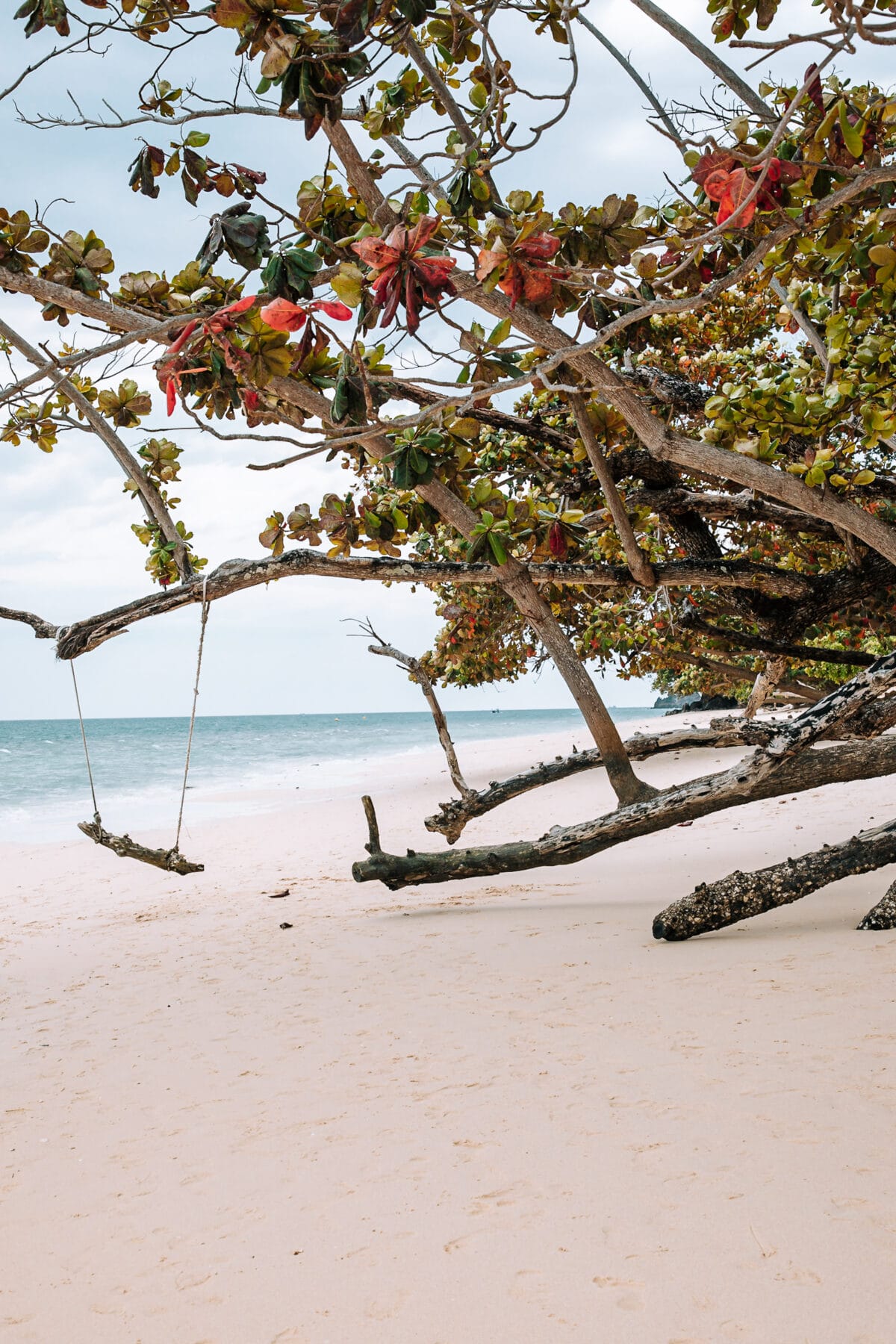
Tip: You will also find beautiful beaches on Koh Ngai.
If you don’t have much time and would prefer to choose an island, I would recommend Koh Ngai. Koh Ngai is somewhat less visited by day trippers than Koh Kradan and is therefore quieter.
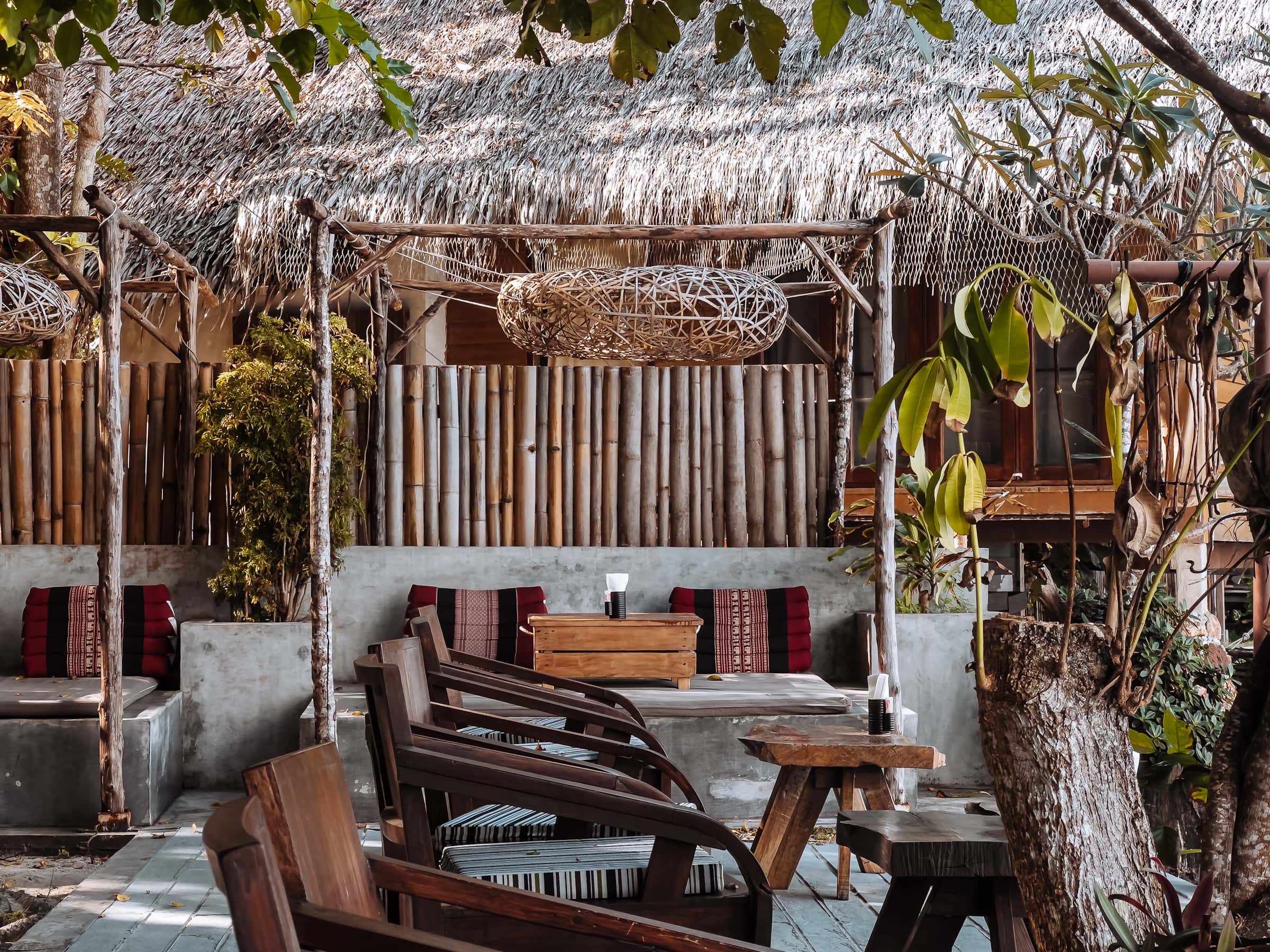
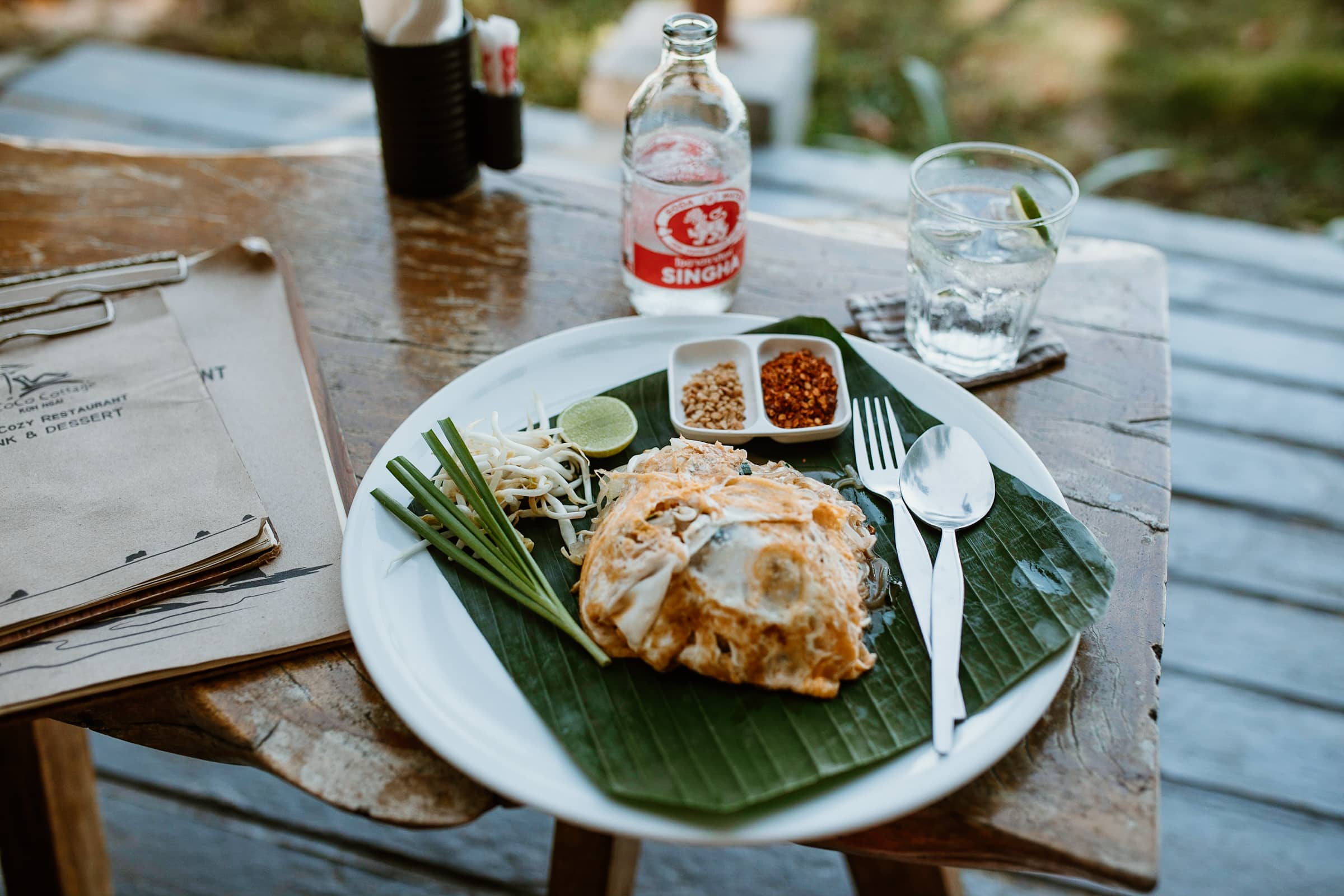
In addition, there is a really great boutique accommodation here, the Coco Cottage*, which I liked much better than the similar Kalumé Beach Resort on Koh Kradan. Since there isn’t really much to do on either island, you do spend a fair amount of time in and around your resort, so it’s an advantage to find something pretty right away.
Koh Ngai: The alternative to Koh Kradan
Journey to Koh Kradan
The nearest port on the mainland is Pak Meng Pier. From here boats depart regularly to Koh Kradan. The trip takes about 45 minutes.
In the high season from November to April, Koh Kradan is also on the speedboat route of all the major ferry operators, which connects many islands in the Andaman Sea from Phuket via Koh Lanta down to Koh Lipe. The speedboats are often very crowded, noisy and relatively expensive, but also a good way to hop from island to island.
As on many small islands, you should have some cash with you. Credit cards are often accepted only with difficulty or not at all. ATMs and the ubiquitous 7Eleven stores in Thailand are not to be found here. Some resorts have small stores where you can stock up on necessities. But it’s best if you bring everything with you.
In any case, Koh Kradan will suit you well if you long for relaxation and tranquility!
Useful are:
Mosquito repellent with DEET (you live here in the middle of nature, so to speak, with correspondingly many little animals), alternatively natural means such as citronella oil
own snorkeling equipment (depending on the accommodation you can borrow goggles and snorkel for free, but own is of course more comfortable)
Sunscreen with a high sun protection factor (look for a coral-friendly product)
a good book (here you’ll definitely have the leisure to finally start that one book you’ve always wanted to read!)
Are you looking for a relaxed island in Thailand with long beaches and chilled village life? Koh Jum (or Ko Jum, sometimes also called Ko Pu) is located south of the provincial capital of Krabi and could be the perfect island for you! Find out what you can do on Koh Jum in this article.
➜ Quick tip: Where to stay on Koh Jum? On Koh Jum, you will mainly find small bungalow resorts. Perfect for individual travelers if you want to fully enjoy island life with the great nature! Here you’ll find the best places to stay on Koh Jum
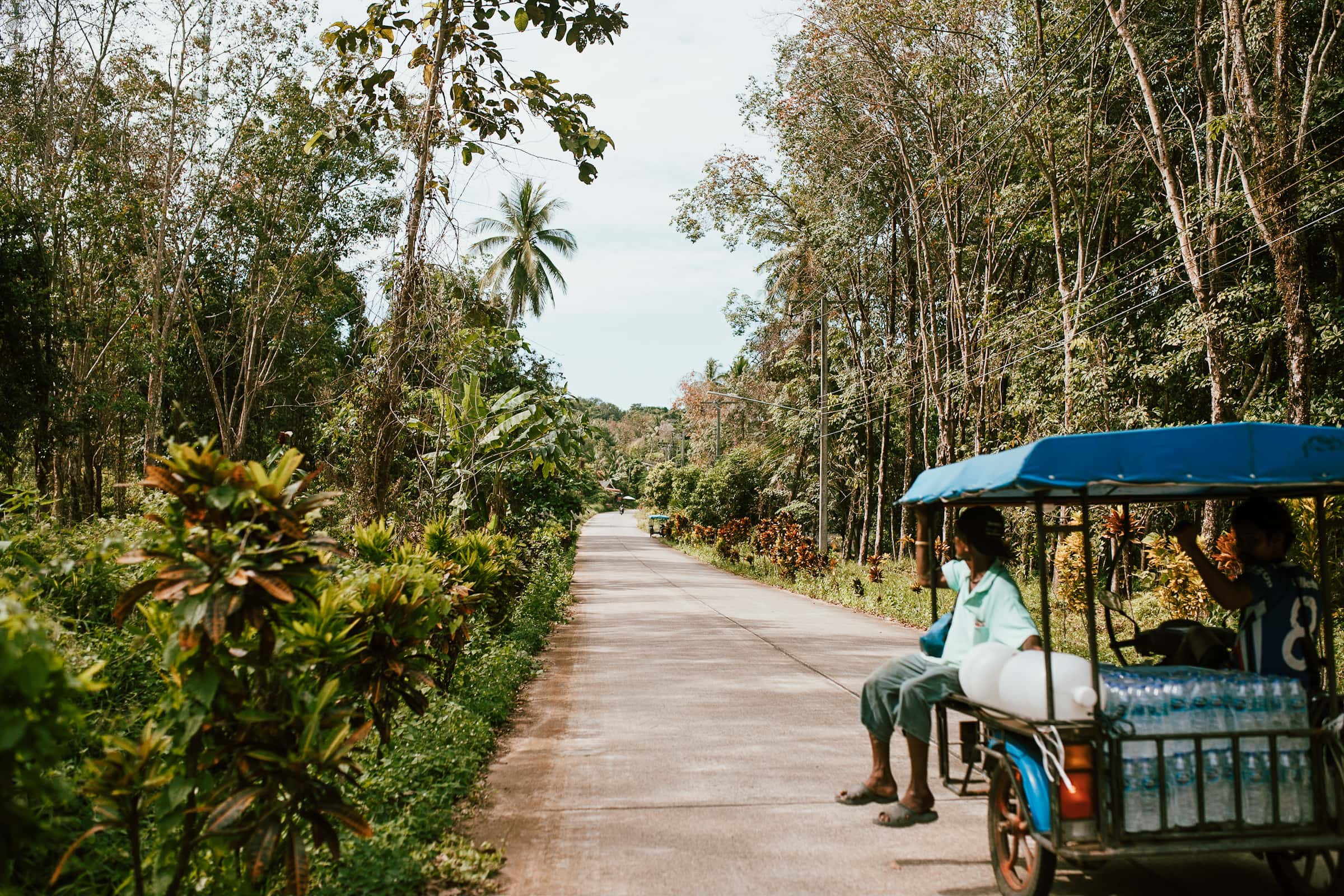
Relaxed island life: There are almost no cars on Koh Jum.
Koh Jum: A backpackers’ island?
Originally, it was classic backpackers who found their way to Koh Jum. Tourism was not particularly developed, amenities such as a developed electricity network did not exist and accommodation was limited to a few simple bungalows.
Those days are long gone; even the mainstream has discovered Koh Jum—and yet the island’s simple backpacker charm has been preserved. The former gravel road, which serves as the main thoroughfare across the island, has now been paved. The bungalow resorts are a bit larger and more comfortable, but you can still experience an authentic island vibe here. The atmosphere is generally very laid-back, and the people are exceptionally warm and friendly.
A bungalow in the green: no problem on Koh Jum.
Beaches on Koh Jum
If you love beaches as much as I do, you’ll get your money’s worth on Koh Jum. After my stay on the neighboring island of Ko Siboya, which I otherwise liked but doesn’t have particularly nice beaches, I was in heaven on Koh Jum. The Golden Pearl Beach, for example, is several kilometers long and partly deserted!
Golden Pearl Beach on Koh Jum
All beaches are located on the west coast of the island and therefore offer the most fantastic sunsets over the sea overlooking Koh Phi Phi.
At first glance, you might think that Koh Jum is a charming, yet somewhat sleepy island that doesn’t have any special hotspots. And yet I discovered one or two highlights that absolutely thrilled me!
Luboa Café
Formerly located in the village, the Luboa Café has since moved a bit further out into the countryside. The entrance is right on the street, but once you walk through the large wooden gate, you’ll find yourself in the middle of a jungle paradise! The Luboa Café serves the best coffee and an absolute rarity—freshly baked rolls made in-house every morning! So if you’re ever in the mood for a more Western-style breakfast, this is the place to be. But be warned: the rolls are very popular and sell out quickly. It’s worth arriving early.
If you can’t shake the jungle vibe with all the plants and butterflies buzzing around, you can also stay overnight on the premises (and then secure your rolls each morning) – owner Frank and his wife have tastefully built a small, sugary Tiny House in the garden! Definitely an exceptional accommodation!
Would you like to fish for your own dinner? That’s no problem at Mr. Boy: you can catch your squid from the pier on which the location is located and then have it freshly caught and prepared at Mr. Boy. I’m not so keen on squid and I also have my problems with fishing.
Absolute highlight: The atmospheric café of Mr. Boy on Koh Jum.
But the extraordinary vibe at Mr. Boy makes up for all that: the café on the wooden pier is a conglomeration of art gallery, restaurant, organic garden and hostel! Like everywhere else on Koh Jum, the atmosphere is absolutely chilled and the view of the calm water and the surrounding karst rocks does the rest.
From Mr. Boy Café you have a great view over the water.
Koh Jum: Relaxed evenings with panoramic view
If you are looking for excessive raves on the beach, the nightlife on Koh Jum will rather disappoint you. But with the Rock Bar at the end of Golden Pearl Beach, there is another extraordinary location on the island that will provide you with unforgettable evenings.
Quite hidden: The adventurous way to the Rock Bar on Koh Jum. Creatively designed: The Rock Bar is made of washed up driftwood.
Thailand is such a great destination! Click through my Thailand articles and get even more inspiration for your next trip!
On the one hand you can enjoy the free view of the most impressive sunsets, on the other hand the hidden spot between the rocks is unique. A cosy bar has been created from driftwood on several levels, where you’ll feel like you’re in a huge, cozy nest. The one or other cocktail in addition – and the vacation feeling is perfect!
Pure village life on Ko Jum
There are three villages on Koh Jum: Ban Ko Pu in the north, Ban Ting Rai in the middle and Ban Koh Jum in the south of the island. Koh Jum has a total of only 1000 inhabitants, the villages are correspondingly small. You won’t find big stores here, even ATMs are not available.
Life is simple, the people are all the more cordial and you quickly get into conversation, even if there are sometimes language barriers. Once a cab driver on his scooter overtook me, waved wildly and then almost slowed me down – only to show me the huge group of monkeys on the other side of the road, which was gyrating up and down the tree. And which, admittedly, were really cute. As a city kid who knows all the tricks of the trade, I immediately suspected some kind of scam, but it was actually just pure niceness.
Just like on Ko Siboya, locals wave to you on the street, ask where you’re from or are simply well-disposed. This also makes tourist life relatively carefree. In any case, I have always felt somehow in good hands.
While you have to worry less about things like pickpocketing in the rest of Thailand, my carelessness on Koh Jum has reached unimagined dimensions: While waiting for the next boat at the pier, I simply left my entire luggage including camera equipment at the roadside at a cookshop of an elderly lady on the day of departure and went to eat three houses away, because she unfortunately had nothing left and recommended me another stand. On Koh Jum everything no problem.
What I would also definitely recommend is to start your day with breakfast at one of these cookshops. Breakfast is not particularly worth mentioning in many simpler accommodations. Mostly they try to offer something western. This is often sweetly meant, but personally I can do without tasteless toast and prefer to stick to the local cuisine; and there’s plenty of options on Koh Jum.
Right next to my resort, for example, there was a really great street stall with all kinds of delicacies. Communication was a bit hands-on, but the warmth there blew me away again and I wondered why the site wasn’t full of tourists. If you also often have reservations about street food, just dare and trust your good sense! There, for example, they worked with the simplest of means, and yet everything was super clean and tidy.
What else you can do on Ko Jum
Koh Jum is not very big and with a scooter you can easily explore the island in one day. Most of the roads and paths are asphalted and the traffic is relaxed. If you prefer, you can also rent bikes from some roadside stores. Or you can take one of the scooter cabs. These are not really marked, but it is usually enough to stand on the side of the road and you will be approached as you drive past.
In the middle of the island there is also a viewpoint on the highest mountain of the island, Mount Pu, 422 meters high. If you don’t want to go it alone, you can also join a guided tour with a local guide.
Advertising / *affiliate link
The best accommodations on Koh Jum
I stayed at the Golden Pearl Beach Resort*. It was okay, but not very charming. Maybe you’ll be lucky and get one of the few bungalows right on the beach! Waking up in the morning and dipping your bare foot into the warm fine sand with your first step is unique. However, most of the bungalows are across the street and the scooter traffic makes it not quite as idyllic as it could be.
The OonLee Bungalows* are a bit more comfortable and closer to nature.
Arrival to Koh Jum
Koh Jum isn’t quite on the tourist radar yet, but getting there isn’t that complicated. There are several options from Krabi:
You can take a cab or songthaew or bus to the more distant Laem Kruad Pier to catch a boat to Mu Tu Pier on Koh Jum. This boat connection is used more by locals and for transporting goods, is cheap (120 baht) and personally I found the trips with it much more pleasant than on a packed speedboat.
From the more easily accessible Chao Fah Pier in the center of Krabi, you can take one of the speedboats that operate in the Andaman Sea during the high season from November to April. A ticket costs about 1500 baht.
There are also connections to Koh Jum from Koh Lanta, Koh Phi Phi or Phuket.
Tip: On 12go.asia* you can book not only boat tickets, but also complete connections with bus transfers to the nearest pier on the mainland!
Koh Jum Pier: Speedboats depart from here to many neighboring islands.
When is the best time to travel to Koh Jum?
The best time to visit Koh Jum is from November to April. Outside of these months, the weather is sometimes worse and the boat connections are fewer, or are sometimes suspended due to the weather conditions. December and January are the peak season, popular accommodations can be fully booked. Therefore, early booking is worthwhile!
What do I need to consider when traveling to Koh Jum?
Koh Jum is truly a sleepy, laid-back island with a fairly basic infrastructure. You can, however, find everyday essentials in small shops. If you’re looking for accommodations close to nature and you love animals as much as I do, it’s a good idea to have DEET-based insect repellent on hand from the start. There are no ATMs on the island, and credit cards aren’t accepted at many accommodations either.
However, there are some stores that exchange Euros or Dollars; in the village of Ban Koh Jum there are also a few small travel agencies that will easily pay you cash for a fee of about 4% cash and charge your credit card; higher amounts are also possible. If necessary, you can also get cash on Koh Jum, contrary to the information in many travel guides.
Who is Koh Jum suitable for?
Partygoers will likely find Koh Jum a bit boring; you won’t find any clubs or all-night dance parties here. But if you’re looking for relaxation, friendly people, endless beaches, and a laid-back island lifestyle, you won’t want to leave! Families with children are also very welcome here.
Looking for a pristine island in Thailand? Then you should definitely visit Ko Siboya ! The island is part of the Ko Siboya Tambon archipelago off Krabi, which also includes Ko Jum. In contrast to Koh Jum, Ko Siboya is almost completely undeveloped by tourists and perfect if you are looking for a few days of relaxation in absolute nature!
For the fact that the beaches on Ko Siboya are not supposed to be that inviting, it is quite pretty there! 🙂
The authentic Thailand on Ko Siboya
Already on the way to the only resort on the island, heads are stretching on the roadside at the simple snack stands, children are waving cheerfully, and somehow everyone is curious about who has just strayed onto the island. Very few people speak English here, so when visiting the village you have to rely on Google Translate or just try with your hands and feet. As a rule, the predominantly Muslim population does not live from tourism, but from work on the rubber plantations, which are spread over the entire island.
Looking for a place to stay on Ko Siboya? No need to spend a lot of time comparing options! There’s only one resort, and it’s really beautiful: SiBoya Bungalows
In the Siboya Bungalows you sleep in the middle of nature
Many families keep chickens, goats, cats and much more; most of the time all the animals run around freely and together with the wild animals like monkeys and iguanas you get the full program of nature here.
Tourism on Ko Siboya
Tourism plays virtually no role on Ko Siboya. The SiBoya Bungalows are frequented by long-term travelers or Thailand veterans who discovered the island for themselves at some point and have mostly been spending the winter here ever since. Some have even built their own bungalows on the resort grounds.
At first glance, this sounds a bit like a close-knit community, especially since there are not many external influences due to the isolated location. However, I have to say that the atmosphere was very positive and open. Even newcomers and first-time visitors like me are warmly welcomed not only by the resort owner Mr.Chung and his team, but also by the other guests, so that one quickly finds connection and immediately feels at home.
What you can do on Ko Siboya
The beaches are probably the main reason why Ko Siboya has not yet been stormed by crowds of tourists. There are certainly islands with more beautiful beaches such as Koh Kradan or Koh Ngai. Due to the strong tides, swimming is only possible at high tide and you won’t find powder-sugar white beaches. There are also more interesting spots for snorkeling.
At low tide you can’t swim so well on Ko Siboya. At high tide all the better for it!
But in the evening you will be rewarded with the most beautiful sunsets over the Andaman Sea.
Otherwise, there is not much to do on Ko Siboya except relax and enjoy the nature around. In the very small, but very well-kept, simple bungalows you live in the middle of the jungle, without having to do without worldly things like electricity or mobile phone network. On many small islands this is a problem, but not on Ko Siboya, which may make the island interesting for those who need a little internet in between.
However, you can also use the time here to lie down in one of the numerous hammocks and pick up the book you’ve always wanted to read.
Food & Drink on Ko Siboya
For the physical well-being one has to fall back on the resort’s own restaurant relatively often due to the lack of alternatives. They offer the usual Western food tourist menus there (not great), but the Thai options are really, really good, and definitely worth the higher price. Here I sipped the best Khao Tom (rice soup) ever and with luck Mr. Chung also organizes specialties out of the line, like Hor Mok with Barracuda, a fish curry pie cooked in banana leaves.
Not only to eat but also worth a trip with the scooter over the island. Officially, the resort does not rent bikes or scooters, but somehow you could always borrow the resort’s very good scooter for a small fee. The whole island can be circumnavigated in about 15 to 20 minutes; the roads are usually well paved.
On the roadside you will find here and there small, simple restaurants where you can eat for little money and still make contact with the absolutely warm locals. The curiosity and effort to show visitors a good time is omnipresent and truly heartwarming. If you are up early in the morning, you can have a delicious breakfast in the main village from six or seven o’clock.
No wonder that many travelers just get stuck here or keep coming back – Ko Siboya is a real insider tip and simply a beautiful, relaxing place!
Travel to Ko Siboya from Krabi
To get to Ko Siboya, you first have to go to Krabi. In Krabi there are popular places like Ao Nang Beach or Railay Beach; furthermore you can easily get to famous islands like Koh Lanta or Koh Phi Phi from there. Krabi is only a good hour’s flight from Bangkok.
Unlike other islands, getting from Krabi to Ko Siboya is a bit more complicated, but not completely impossible. Ko Siboya is simply not one of the islands and destinations that any of the numerous travel agencies in the area have on offer. To Koh Lanta or Koh Phi Phi, for example, you will find offers on every corner with pick-up at your accommodation and seamless transportation to your destination (as is so often the case in Thailand), so you don’t have to worry about a thing. Ko Siboya requires a little initiative.
By cab to Laem Kruat
The best boat connection to Ko Siboya departs from Laem Kruat Pier. This is located just outside of Krabi and the travel time from Krabi Town to there is about an hour. The easiest solution is to go there by cab. In Krabi there is also Grab, the Asian equivalent of Uber, but the likelihood of your ride being accepted is quite low due to the distance.
It is cheaper to get to Laem Kruat by public transport. To do this, take a songthaew (one of the Thai shared cabs) from Krabi Town to the bus station, which is just outside the town in the direction of the airport. From there there are buses or shared cabs to Laem Kruat Pier.
By boat to Ko Siboya
From Laem Kruat you simply take one of the boats to Ko Siboya. Just make sure to be at the pier by 4pm, after that there is no boat to Siboya. Not many tourists leave here, you’ll probably have a little trouble orienting yourself as to which boat is the right one. Just ask around, people are very helpful and you will end up on the right boat. The ride itself takes about 20 minutes and costs 70 baht.
Transportation on Ko Siboya
Since Ko Siboya isn’t particularly touristy, there isn’t a fleet of taxis waiting at the pier there, as you might be used to seeing on other islands in Thailand. However, you can contact the staff at SiBoya Bungalows in advance and let them know when you’ll be in Laem Kruat. Then someone will come pick you up. I’ve experienced firsthand just how well this works: I didn’t even let them know in advance because I literally hopped on the boat at the last minute, and yet, miraculously, someone was already at the pier to pick me up.
Onward journey from Ko Siboya
If you want to travel on from Ko Siboya to another island, you’ll usually have to head back to the mainland to Laem Kruat Pier and then take another boat, for example, to Koh Jum. Alternatively, you can charter a longtail boat, which is worth it if you’re traveling with a group. Or you can simply join a day trip and stay on the island. You can arrange this at the resort—just ask around, and you might find like-minded people with whom you can split the cost.
Turquoise waters, pure nature and a snorkeling paradise literally on your doorstep: Koh Ngai (also called Koh Hai) is one of the most beautiful islands in the southern Andaman Sea in Thailand. If you are looking for peace and quiet and want to relax, then this is the right place for you!
Where is Koh Ngai located?
The small island of Koh Ngai is still a real natural paradise. It is only a cuddly 5 square kilometers in size and is located south of the island of Koh Lanta in the Andaman Sea. Here are some of the most beautiful islands in Thailand and Koh Ngai is definitely one of them! It is only 15 kilometers to the nearest pier on the mainland, Pak Meng Pier. The next largest city on the mainland is Trang.
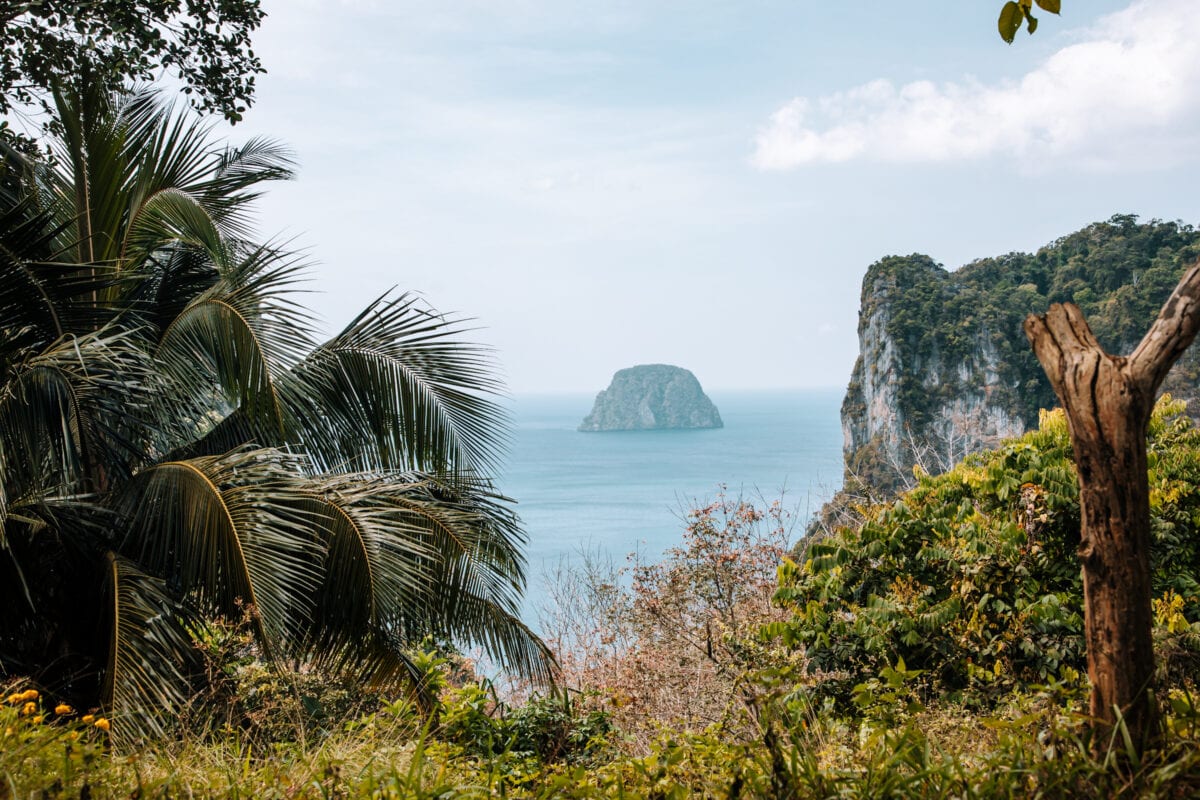
It’s easy to list the activities on Koh Ngai. Snorkeling, sunbathing, relaxing, and unwinding: there isn’t much else to do. You can stroll up and down the beautiful beach or explore the underwater world. In fact, there are small coral reefs right off the beach. The water is crystal-clear and turquoise blue.
The impressive hornbills live right in the neighborhood
If you need some exercise, you can also rent a kayak almost anywhere. If the water is calm, you can also paddle to one of the small inhabitated islands nearby.
You can reach Paradise Beach on the other side of the island after a short hike through the jungle. There’s a small beach there. However, the only resort there is closed. So be sure to bring enough water and food with you. Sturdy shoes are helpful.
Day trip to Koh Ngai
If you’re short on time, you can also take a day trip to Koh Ngai. Tours are offered from several islands around Koh Ngai as well as from the mainland. These usually include additional stops. You can either book a spot on one of these tours or charter an entire boat once you’re there. However, this is usually only worth it if you’re in a larger group.
If you are accommodated on Koh Ngai, the excursions can sometimes spoil the paradisiacal atmosphere, depending on the day of the week. On weekends, several boats can dock one after the other. However, the main beach is very spacious, and there are always longtail boats carrying small groups heading to Koh Ngai. So the crowds are spread out quite well.
More annoying are the loud longtail boats crisscrossing the waters off the coast, which serve as a reminder that you’re still relatively close to civilization—the mainland is clearly visible from Koh Ngai.
Thailand really is a fantastic travel destination and incredibly diverse. Why not take a look at my other articles on Thailand and see for yourself!
How expensive is Koh Ngai?
Koh Ngai is one of the more expensive vacation destinations in Thailand. This gives the island a kind of exclusivity and Koh Ngai is still not overcrowded like many other islands. However, this exclusivity also has its price.
Prices are higher than elsewhere in Thailand (e.g., a serving of spring rolls costs 140 THB, approx. €, and a large bottle of water for the day costs 40 THB). Restaurants typically add a 10% service charge and a 7% tax to the final bill.
Where to stay on Koh Ngai
Since the island is relatively small, there aren’t many places to stay. Unlike on other islands, it’s best to decide in advance where you’d like to stay and book right away. For one thing, accommodations here fill up quickly during peak season; for another, when you arrive by boat, you’ll be dropped off right in front of your resort.
There is a pier, but if your resort is located a bit further up the beach, the only way to get there would be to walk along the beach with all your luggage. However, the more expensive resorts usually find a convenient way to pick you up from the boat, luggage and all. That’s because there are no roads, scooters, or any other means of transportation on Koh Ngai. It’s best to contact your resort again after making your reservation.
Koh Ngai Seafood
Koh Ngai Seafood consists of a few small bungalows on the beach. The bungalows are simple, but are all facing the sea and even from the two cabins located in the second row you’ll have a sea view. There is no hot water (but that is really not bad considering the tropical temperatures) and electricity is also only available from about 6pm until about 8am in the morning.
Just don’t get the very first bungalow next to the restaurant, it’s not quite as heavenly in terms of noise.
If I had seen Coco Cottage before, I would have booked right here! In person, I found the small plant much prettier and more atmospheric. I would even say I could have spent an entire 2-week vacation here without really doing much and recover like never before. The restaurant is expensive, but a pleasant change from the other locations, and the service so nice that I became a regular here pretty quickly, even though I lived two resorts away.
Be sure to remember that you’re going to a nearly deserted island ! Here there is no 7Eleven like elsewhere in Thailand, which is open around the clock and which supplies you with everything. Some resorts have small “stores” where you can stock up on essentials, such as water for the day or if you run out of toothpaste. But it’s best if you bring everything with you beforehand.
Here’s a list of things you should pack:
Sunscreen (preferably coral friendly)
Mosquito repellent with DEET (you’re in the middle of the jungle, and there are already some pesky mosquitoes in the evening when there’s no wind).
Snorkeling equipment such as goggles and snorkels (the resorts also rent equipment, but it is usually only the simplest models, which are of course already very used. With the goggles you don’t necessarily have the best view).
How to get to Koh Ngai
Koh Ngai is connected to the speedboat network operated by the major ferry companies between Phuket and Ko Lipe. The boats run on this route between November and April and stop at just about every island along the way, such as Koh Kradan, Koh Jum, and Koh Mook. Operators on this route include Bundhaya, Tigerlinetravel, Phuketferry, and Satun Pakbara. As with all modes of transportation in Asia, you can easily book tickets in advance on 12go .
When I made my booking, I could still specify whether I wanted to book a transfer from the pier by longtail boat for an additional 100 baht, but in the end the speedboat itself docked on the beach in front of Koh Ngai Seafood. On departure, however, I was first taken to the speedboat by longtail boat. As always, the luggage is unloaded for you, you then simply hop off the boat into the sand and, if necessary, you also get help getting off.
If you are looking for parties and really want to party, Koh Ngai is not for you. You will also look in vain for milder forms of evening entertainment such as fire shows.
Nightlife on Koh Ngai
Hikers & Outdoor Enthusiasts
If you want to explore and hike a lot, it will be difficult on Koh Ngai. Basically, there is only the main beach, where most of the resorts are located, and Paradise Beach in the south, which you can reach via a hiking trail. The only resort there, however, has closed since the pandemic.
The rest of the island is completely densely forested, completely undeveloped and partly mountainous. For this, Koh Ngai is the perfect island to relax and enjoy the nature all around. You can see hornbills, sea eagles and many other exotic birds.
Families with children
I wouldn’t recommend Koh Ngai to families with smaller children: Although the beach slopes relatively shallowly in most places, the coral reef starts relatively close to shore and it can be hard to find a spot without uneven ground. Also, glass shards keep washing up, some dull, but others still very sharp. But older children will certainly enjoy the fascinating underwater world.
Solo travelers
With all the paradise vibes, you might think that Koh Ngai is mainly for couples in love. But even as a solo traveler I felt very comfortable here and was not the only person traveling alone.
Koh Ngai is simply perfect if you need a few days’ rest from traveling and want to relax. But beware, one or two people stayed on this beautiful island longer than planned 🙂
Are you also dreaming of an island vacation with wide sandy beaches, turquoise blue water and exotic cocktails? I in any case in continuous loop! On my last trip, I more than fulfilled this dream by island hopping in Thailand through the southern Andaman Sea and the Trang Islands. I’ll tell you here which islands I particularly liked and which island is still a real insider tip.
Island hopping in Thailand: From Krabi from island to island
Krabi is the perfect starting point for island hopping. From Bangkok, a flight of just over an hour will take you to a fairly laid-back Thai coastal town that’s also worth a quick stop. Many vacationers even spend their entire stay in Thailand here, as the popular Ao Nang Beach —with its many hotels and tourist amenities—is located just outside the town. Partygoers tend to head to Railay Beach, a stretch of beach surrounded by towering karst cliffs with a small village that’s accessible only by boat.
Krabi Town, the city itself, is less crowded, but if you have to make a stopover here, e.g. because the plane has landed so late and the last boat has already left, you can pass the time in great cafés, with a climb up the Tiger Cave Temple or a stroll through the atmospheric night market.
Tip: Organize your own excursion to Tiger Cave Temple or join a tour*.
“How many times have you been to Siboya?” my cab driver asks me curiously, and it seems like this is the standard question for all tourists heading there. The island Ko Siboya is namely unbelievably still like a black spot on the tourist map around Krabi. Either you don’t know the island at all, or once you’ve discovered it for yourself, you’ll keep coming back.
The only resort on the island: Ko Siboya Bungalows.
And indeed, the only resort on the island with few visitors is home to almost only repeat offenders, from older Thailand veterans, some of whom have even built their own little house on the grounds of the resort, to individual tourists who have been stranded here at some point and succumbed to the charm of sweet idleness on the edge of civilization. In any case, I was very surprised that this insider tip in Thailand has not yet spread!
Must-do: plunge into the sea right in front of the resort at high tide at noon, explore the island by scooter or on foot, and sip iced tea with the locals at the roadside.
Koh Jum (also known as Ko Jum or Ko Pu) used to be known primarily as a backpacker’s island. Most visitors who remember the island from that time rave about the simplicity and authentic island life of back then, when there weren’t even paved roads. Things have changed a bit since then; the main road running across the entire island is now easily passable. There are also expensive resorts here now—but Koh Jum has still retained its village charm.
Meanwhile asphalted: The main road on Koh Jum
Must-Do: Get infected by Mr. Boy’s good humor at the quirky pier restaurant & lose yourself in a walk on the endless beaches
Tip: Luboa Hut*, a Tiny House in the middle of the jungle & cozy coffee shop right outside the door
Endless beach: There are no space problems on Koh Jum.
Koh Mook
On Koh Mook, you can still find the authentic, rural Thailand. Unlike Koh Jum, however, Koh Mook is a bit livelier and even has a small shopping area in the main village. Somehow the whole island is terribly charming and the locals are really warm. Although Western tourists are no longer a rarity here, you are greeted with a smile at almost every corner when you pass the simple residential houses or whiz along the partly still unpaved streets on a scooter cab.
On Koh Mook you can hike to a spectacular viewpoint.
Unfortunately, Koh Mook also has problems like many other islands: Waste and sewage are a problem that is noticeable once you turn your gaze in other directions. However, Koh Mook has one of the most impressive beaches in the region, Sivalai Beach, and if you want to take your mind off things, simply book a few nights at the Sivalai Beach Resort* in a cottage right on the white dream beach and let yourself be pampered.
On Koh Ngai I stayed longer than planned, because the island is just too beautiful! Apart from snorkeling and lazing around on the beach, there’s not really anything to do, but that’s exactly what makes Koh Ngai so special. Here you can really relax and just enjoy the nature around you.
Every evening hornbills gather in the high trees directly at the beach, cicadas screech and even a small gecko got lost in my toilet bag once. Not to mention the underwater world right on your doorstep: On Koh Ngai, you can snorkel right from the beach.
You can observe the exotic hornbills on Koh Ngai from very close.
Koh Kradan
Once voted one of the most beautiful beaches in Thailand by the British newspaper “The Guardian“, the dream beach of Koh Kradan is an absolute island paradise. Similar to Koh Ngai, everything here is concentrated on one beach, and leisure activities are limited to snorkeling, basking in the sun, or simply staring at the unreal panorama.
The beach on Koh Kradan is one of the most beautiful in Thailand.
Unfortunately, the island experience is somewhat spoiled by the invasion of day tourists, whereby Koh Kradan is even more popular than Koh Ngai. In principle, I would also recommend spending at least one night on the island. However, if you have to choose between Koh Kradan and Koh Ngai, I would personally choose the quieter Koh Ngai.
If you are looking for a relaxed atmosphere, a bit of nature and reggae vibes, then you should check out Koh Lanta. Koh Lanta is well connected to the nearby mainland with several ferry connections and is therefore a good option if you don’t want to do quite as much boating or have less time.
Koh Lanta is particularly popular with Swedish families, but curiously also with cannabis lovers, even before legalization in Thailand. The long beaches are dotted with laid-back reggae bars.
Long beaches: Koh Lanta is also very popular with families.
Koh Phi Phi
One of Thailand’s most popular islands should not go unmentioned here: Alongside Koh Lipe, Koh Phi Phi is one of the biggest tourist hotspots. Unfortunately, the island itself is all the smaller, and is overrun with tourists, especially after Maya Bay, located on the neighboring island of Ko Phi Phi Leh, rose to fame through the film adaptation of the novel “The Beach”.
I think Koh Phi Phi is beautiful, of course, but I personally don’t want to see the negative effects of the overflowing tourism on the island, so a short visit was enough for me. But if you’re in the area for the first time, you might want to take a side trip to Koh Phi Phi as well.
Don’t expect a lonely dream island though! The density of 7-Elevens (the almost ubiquitous chain of small convenience stores in Thailand is always a good indicator) is frighteningly high, and sometimes you can’t see the beach at night because of all the fire shows.
When is the best time to travel to Thailand’s islands?
The best time to travel to Thailand to hop from island to island depends mainly on which region you are staying in. You should avoid the rainy season with its monsoon-like rainfall. Ferry and boat connections are severely limited then anyway, and sitting on a small island in constant rain (if you can get there at all) is no fun. In the Gulf of Thailand, where the islands of Koh Phangan, Ko Tao and Koh Samui are located, for example, the rainy season is somewhat shorter and only lasts from around October to December.
The best time to visit the Andaman Sea on the west coast of Thailand is from around December to April, although it gets hotter from March/April onwards. In addition, the speedboats that connect most of the islands from Phuket through Koh Lanta down to Koh Lipe only operate from November to April due to weather conditions.
How do I get from island to island?
In the main tourist season, the best way to get from island to island is by speedboat, which generally only transport tourists. For less developed islands, such as Ko Siboya, you simply travel like the locals on longtail boats or slightly larger boats, which transport pretty much everything you need on the island. It’s much cheaper and also a little more exciting!
You can book tickets for the speedboats in advance on 12go.asia*(in which case I am delighted that you are supporting this blog with your booking! Most accommodations also sell tickets for ferries, speedboats, buses and intercity transfers. Also, on islands with a bit of tourist infrastructure like Koh Jum or Koh Mook, you can find small travel agencies where you can book everything.
Which boat providers are safe?
Popular boat companies in the southern Andaman Sea are Bundhaya, Satun Pakbara, Phuketferry or Tigerlinetravel. Many ticket sellers don’t work with Tigerlinetravel because this provider probably has a very bad reputation when it comes to punctuality, but I didn’t notice any significant difference on my trip. Everyone was a bit unpunctual at times, whether due to the weather or unplanned stops along the way.
In any case, everything is well organized, even if it looks chaotic at first. Transferring to other boats always goes smoothly; Koh Lanta often serves as a sort of hub, and from some small islands, you first have to take a longtail boat to a speedboat and then make a somewhat adventurous transfer on the water. The crew always loads your luggage (as is often the case when traveling in Southeast Asia, backpacks are much more practical here) and unloads it again when you disembark. I also brought a small suitcase for my camera gear, which was always handled with extra care whenever I let them know—really great.
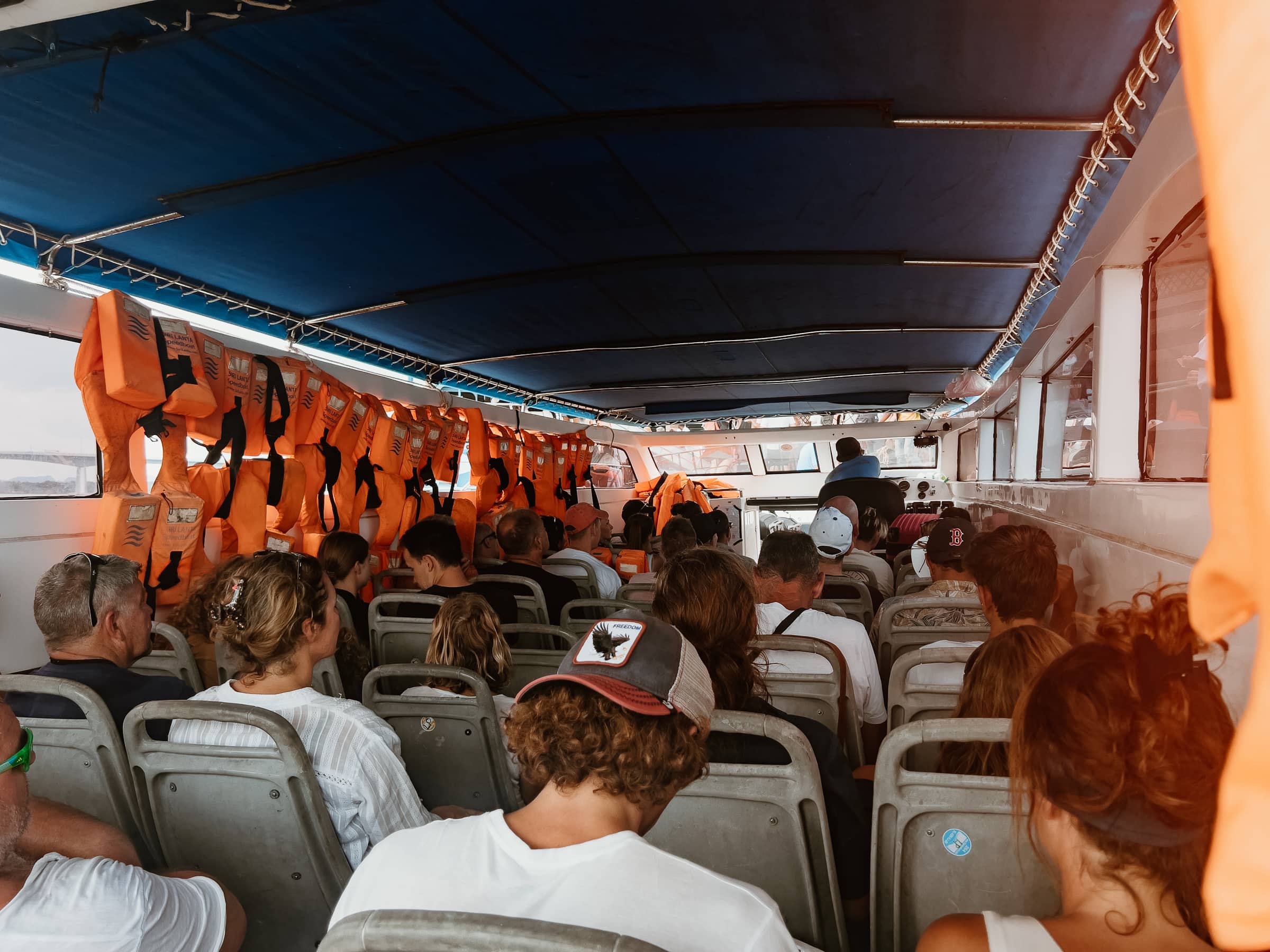
Speedboats are fast when island hopping in Thailand, but not always comfortable.
However, it is better not to insist on German safety standards. The speedboats are booked to the last seat in high season. Once I bought my ticket online and therefore didn’t have a paper ticket that I could exchange for the obligatory sticker with my destination on it at the pier. Nobody really checked this, and every time questions arose, I pointed out that I had bought my ticket online. Then everything was okay. I still had the impression that I was somehow a stowaway with the online ticket, as the speedboat was hopelessly overcrowded and other passengers and I had to stand on the narrow boat.
How to best survive the speedboat ride
Unfortunately, people often imagine island hopping in Thailand to be more romantic than it actually is. While the speedboats take you from one small island to another relatively quickly, the rides aren’t pleasant. For one thing, you’re seated so low that you can’t see the beautiful panorama outside with all the little islands and karst rocks jutting out of the water; for another, the noise from the engines is deafening. And the stench of diesel doesn’t help matters. When the sea gets a little rough, the boat can get quite rocky.
So if you get seasick quickly, it’s better to pack a few travel pills and a spit bag for the worst-case scenario (not available anywhere on board). Don’t travel with a hangover, an empty stomach or one that is too full. Luckily, I don’t get seasick quite that easily, but I’m pretty sensitive to noise—especially from engines—and I’ve been grateful more than once for my earplugs, which were always lying around somewhere in my purse. Listening to music is also helpful, so be sure to bring headphones and a charged cell phone (believe it or not, there’s cell service even out on the water—the coverage in Thailand is simply amazing. I recommend getting a SIM card for your stay in Thailand anyway!)
Looking for more tips for Thailand? Just browse through my Thailand articles
Alternative: charter longtail boat
One alternative might be to charter a smaller longtail boat yourself. This can be a good option for larger groups or families, especially since you’ll be able to decide for yourself when you want to go. You might even find other travelers who want to join you! Just talk to the people at your accommodation when you’re there , or ask at the pier or at travel agencies. By the way, you can also charter longtail boats for local excursions, such as to beautiful snorkeling spots. In popular areas, this can be an advantage if you want to avoid large tour groups!
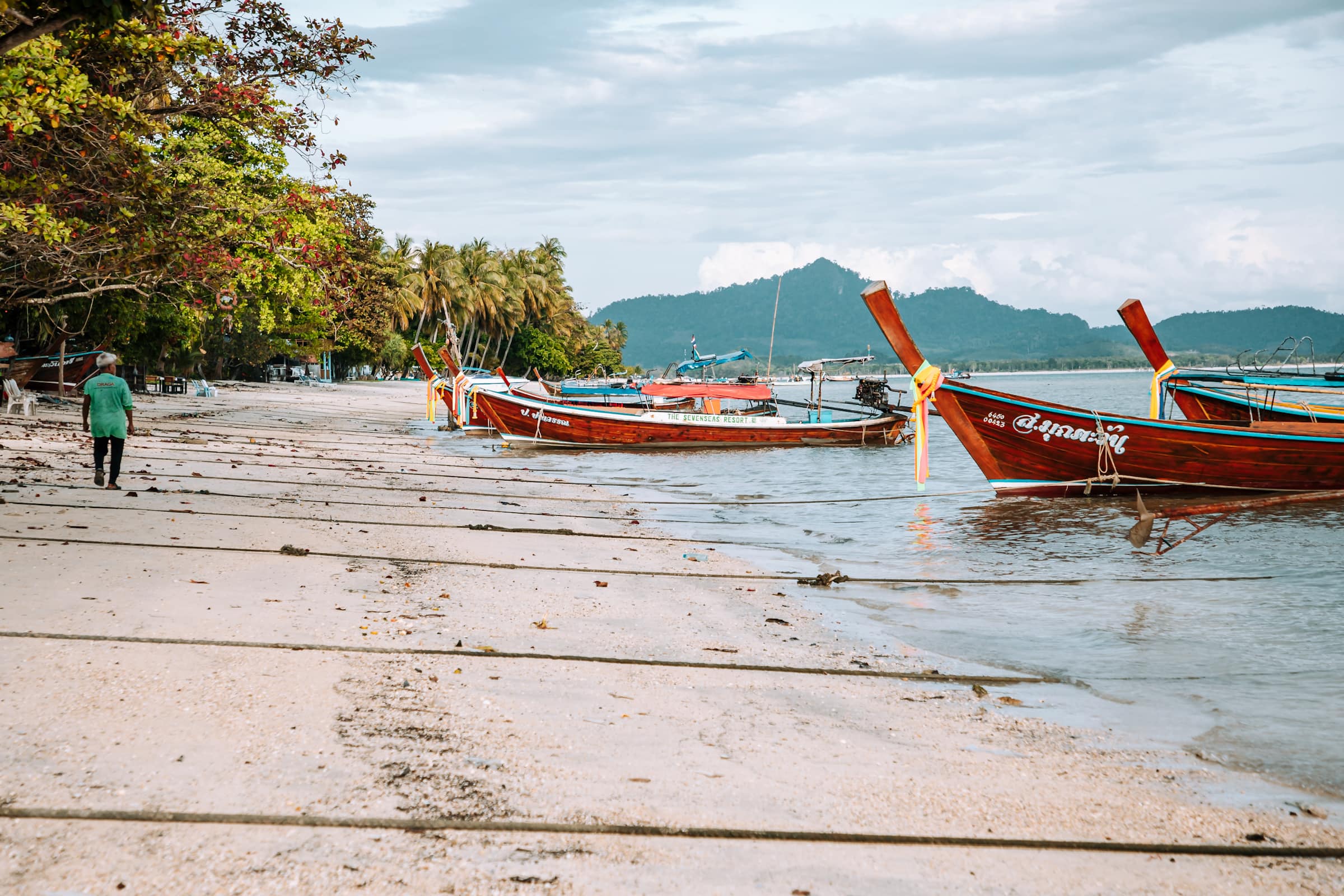
Longtail boats you can also charter completely
What do I need to take with me
On some of the islands mentioned, such as Koh Ngai or Koh Kradan, there is really nothing except the resorts. Some facilities have small sales corners where you can find necessities like toothpaste, cookies or mosquito repellent. However, it’s better if you bring everything you need. Equipment for snorkeling can be rented everywhere. There are no ATMs even on larger islands like Koh Jum, but you can change money in many small stores or get cash on presentation of your credit card. However, you will be charged a fee of approximately 6% for this.
You won’t find stores like here on Koh Mook on the smaller islands like Koh Kradan and Koh Ngai: so stock up well!
In most resorts on the smaller islands such as Koh Ngai or Koh Kradan, you can also only pay with cash, even if you book online in advance. In exceptional cases, credit cards are also accepted, but this requires more effort and prior registration – someone has to come specially or be informed. Cash payment is simply no problem. So it’s best to remember to withdraw enough cash on the mainland. I always use my DKB credit card for this. It’s relatively cheap and easy to do at any ATM worldwide.
How much time do I have to plan for island hopping in Thailand?
In general, Thailand has an incredible number of beautiful islands. You will hardly be able to see them all on one trip. I would also advise you to concentrate on a single region. For example, if you want to see Koh Phi Phi and Koh Phangan at the same time, which is on the other side of the country, you will spend a lot of time on the bus, at best on a plane to Koh Samui, and on ferries. Especially if you only have 2-3 weeks, this is rather counterproductive.
You can also visit smaller islands such as Koh Ngai or Koh Kradan on a day trip. Of course, this has less of a Robinson Crusoe vibe in a large group, but it may be more practical to have a base on an island such as Koh Lanta for a few days longer.
However, two weeks is an absolute minimum – also because a direct long-haul flight to Bangkok or Phuket from Germany takes over 10 hours. And maybe you want to spend a few more days in Bangkok? In any case, the more time you have, the better!
Every good backpacking trip through Thailand starts right here: Khao San Road is the gateway for anyone who wants to explore Thailand or the whole of Southeast Asia with a backpack. In this article, I’ll show you what the myth of Khao San Road is all about and give you a few insider tips if you want to experience more than morning hangovers from all-nighters and grilled scorpions on the side of the road.
Kilometer Zero: The Khao San Road is where many Thailand trips really got started.
Where is Khao San Road located?
Khao San Road is located in the Banglamphu district of Bangkok, the capital of Thailand. Although it is difficult to identify a real city center in the megacity of Bangkok, Khao San Road is relatively central and close to popular sights such as the Grand Palace with the famous Wat Phra Kaeo temple, the Wat Pho temple and the lesser-known Wat Suthat temple.
By the way, another beautiful temple in Bangkok is Wat Traimit with its Golden Buddha!
Loud music is part of the night on the Khao San.
Why Khao San Road is so famous
Somehow, Khao San Road has always been a major attraction in Bangkok. The mix of shops, street food stalls, bars, and restaurants keeps the street bustling around the clock. But Khao San Road didn’t really become a must-see for every backpacker until 1996, with the publication of Alex Garland’s novel “The Beach.” In the book, the protagonist begins his trip to Thailand right here, amid the hustle and bustle of cheap bars and the wild nightlife. The subsequent film adaptation starring Leonardo DiCaprio did the rest, and the legend of Khao San Road was born.
Are you also planning a trip to Southeast Asia? You can find all my articles about Bangkok and Thailand here
Especially for backpackers, Khao San Road used to be the first port of call in Bangkok.
Khao San Road: Now for everyone
Originally more of a meeting place for low-budget vacationers and backpackers, Khao San Road is now actually a must-see for any Bangkok visitor. In the evenings, the atmosphere ranges from parties to social gatherings, while during the day there are endless shopping opportunities. Street food is available around the clock anyway. Particularly popular photo motifs are snack stands with grilled insects, worms or scorpions, which are always used for culinary tests of courage. Even tattoo studios can be found here. I don’t want to know how many people wake up early in the morning with a tattoo as a souvenir: The nights on Khao San Road can get wild!
Nightlife on Khao San Road in Bangkok
If you’re not into dancing the night away, you can take it easy around Khao San Road. Between the bars, there are always individual massage parlors where you can have your feet massaged in comfortable armchairs right on the street, for example. Personally, I don’t find it particularly appealing and always somehow a bit unhygienic, but people seem to be into it!
Rambuttri Road: The laid-back alternative to Khao San
The parallel street, Rambuttri Road (or Rambuttri Alley), is much quieter. There you will find not only tourist hangouts, but also very cozy bars and unexpectedly hip food locations!
Worth seeing: Rambuttri Road is much more atmospheric than Khao San Road.
From the Molly Bar, you can watch the hustle and bustle on the street, listen to music and enjoy the nightlife with a cocktail. And Camp Burger has really good burgers if you’re not into Thai cuisine.
Insider Tip: Samsen Road
I’ve been to Bangkok several times and I’m not necessarily one of those people who has to start a Thailand trip compulsorily near Khao San Road. For many, this is simply part of a perfect trip to Bangkok. What I can also somehow understand is that the vibe around Khao San Road is very special. During my last stay in Bangkok, I also ended up there rather by chance, because I had booked a hotel so spontaneously that I didn’t really realize where it was. But it was still a 20-minute walk to Khao San Road. That way, I’ve discovered quite another insider tip!
If you’re in the mood for a cozy, tropical-warm evening with good food and want to escape the hustle and bustle of Khao San Road for a while, you only need to walk a few streets further in the direction of Samsen Road. Around Soi 2 (the side streets of a main street are often just numbered) you’ll find a cute little neighborhood with nice restaurants, like So Samsen, which is really nicely decorated. Along Samsen Road itself there are also some less touristy, exciting locations like Neighbourhood (address: 59, 61 Samsen Rd) for evening/nighttime or Ganja Café for daytime.
Insider Tip: Samsen Road
Shopping on Khao San Road
You can shop endlessly on Khao San Road and the surrounding area. However, the stores are very focused on tourists. So if you can no longer see the infamous Elephant Pants either, I recommend a visit to Chatuchak Market or The One Ratchada night market, which replaced the formerly popular Ratchada Train Night Market after the pandemic.
Shopping tip: Something about us
If you don’t have time to browse through the huge markets, I have a little shopping tip for you near Khao San Road: At something about us, you will find beautiful little things such as costume jewelry, accessories and fine stationery by local artists.
Where to stay near Khao San Road
In the immediate vicinity of Khao San Road, you will mainly find low-budget accommodation, but now also typical tourist hotels. If you want to stay in the middle of the party and tourist hustle and bustle, this is the place for you!
However, I find that there are so many great neighborhoods and exciting locations to stay in Bangkok that I tend to avoid the direct area around Khao San Road.
I was really happy with my hotel, which was located a little further away from Khao San on Samsen Road. Overall, I found the area surprisingly cool for staying overnight—very local and safe (though, to be honest, I rarely feel unsafe in Bangkok anyway). And I can highly recommend Lost in BKK, whether as a hotel or a hostel (they offer both private and shared rooms): friendly staff who go above and beyond!
There are direct bus connections to Khao San Road from both the major Suvarnabhumi Airport, where all long-haul flights land, and Don Mueang Airport, which is often served by low-cost airlines. Alternatively, you can take a cab or the Thai equivalent of Uber, Grab.
Suvarnabhumi Airport is also connected to the city by the Airport Rail Link, a skytrain. While this is super convenient and fast, it only has a few stations. To use it to get to Khao San Road, you would have to get off at Phaya Thai station, and then transfer to bus or cab.
Saigon Street Food – this has become a household name even back home in Berlin. So a street food tour in Saigon* or Ho Chi Minh City seemed pretty obvious! Vietnamese cuisine is so diverse, so fresh, so full of new flavors, and within Southeast Asia, it’s a flavor all its own. In Saigon in particular, the choice of street food stalls, small snack restaurants and roadside food stalls is almost endless.
Vietnamese are sociable and love food, people are constantly chewing on something somewhere, (unfortunately disposable) bowls filled with goodies change hands and you really wonder how the majority of the population here can still be so slim. Because Vietnamese cuisine is not always easy! In Vietnam, too, people fry for all they’re worth, and sugar is consumed just as excessively.
Street Food in Vietnam – a culinary adventure
One thing in advance: you might not want to try many dishes served in the streets of Saigon in general. Unless you’re really into experimenting. Vietnamese cuisine is often praised for its French influences and thus exciting combinations – and at the Vietnamese at home in Germany it is always delicious. But what is often overlooked: In Vietnam, people really do eat everything.
Advertising / *affiliate link
Vietnamese love meat, so much so that vegetarians sometimes have a hard time finding a vegetarian dish. Vegans even more so. And on the one hand very commendable, but for the European (or at least my) palate quite unusual, here really everything is eaten from beef, pork, chicken, fish, seafood, and even frog or snake: From fillet to the most bizarre offal.
At the really authentic stalls you don’t get far with English, there is no map even in Vietnamese. Often you don’t dare to try something – you never know… For this reason and because I still really wanted to try some (but not quite so) exotic street food in Saigon, I went on a street food tour in Saigon*– and it was great! Sam, who was traveling with me, showed me the wackiest corners of Saigon and let me sample fantastic food (with no unpleasant surprises).
What is the difference between summer rolls and spring rolls?
While in this country spring rolls are deep-fried rolls and called summer rolls rolled in soft, light rice paper, for Vietnamese everything is simply spring rolls! Summer rolls seem probably rather an invention of the West. So we started off with one of the freshest spring summer rolls to roll yourself that I have ever eaten. Fresh herbs and lettuce that it just cracked.
Bánh Tráng Nướng: Vietnamese pizza
Vietnamese have invented their very own version of pizza. It doesn’t really have anything to do with an Italian pizza except for the shape, but it’s still a popular snack. Rice paper, a cream that is supposed to represent cheese, various sauces and mayonnaises, sliced sausages – somehow all sorts of things end up on the Bánh Tráng Nướng Pizza. Which amazingly then even tastes! In addition, there was then Nem nướng, grilled sausages – garnished with the obligatory fresh herbs, which must not be missing anywhere.
Trứng Cút Nướng Phô Mai: Grilled quail eggs with cheese
Why quail eggs are so popular in Vietnam is for a very simple reason, Sam revealed to me. A whole hen’s egg would be far too much as a portion for a small cupcake like the ones in the mini bowls – and would be too filling. Slowly, I discovered the secret of the Vietnamese diet, which seemed to eat all the time: Always small portions instead of huge dishes.
In the pale glow of streetlights, we were now sitting somewhere in the middle of Saigon on the side of the road on our kindergarten stools, like those used in abundance at street food stalls in Vietnam, eating our quail egg muffins called Trứng Cút Nướng Phô Mai and Bánh Xèo, stuffed pancakes. And here again lots of fresh herbs, which Sam explained to me individually (and whose names I also immediately forgot again, because I was only busy with amazement).
Chè Bưởi: Dessert in Vietnamese
I have no idea what Sam was handing me – it was called Chè Bưởi and she translated it as “sweet grapefruit soup.” Somehow it was sweet, creamy, fruity and fresh at the same time; just the right thing at night 30 degrees air temperature.
Book Street Food Tour in Saigon
Street food tours like this take you to very remote corners of the city that I probably never would have gotten to see without Sam. They are usually advertised as “Students show you street food in Saigon” and in fact Sam was a student who knows a lot about street food mainly because she only lives in a small room and actually eats out all the time – just like many students in Ho Chi Minh City.
The spots are spread all over the city and you are driven from spot to spot on a scooter. Helmets are provided. A great opportunity to experience the crazy traffic in Ho Chi Minh City first hand! In addition, the tours are very individual and personal, because there is a guide or driver for every guest.
From Saigon, I continued south—and even though I’d already really liked Ho Chi Minh City —things were about to get even better in the Mekong Delta. I highly recommend taking a side trip to the Mekong Delta from Saigon! Here, you’ll find vibrant life at the floating markets on the Mekong and a glimpse of the real, authentic Vietnam. A Mekong Delta boat tour is a once-in-a-lifetime experience. If you do it right, you can immerse yourself deeply in the local culture and get to know the lives of the locals. In this article, I’ll tell you the best way to make that happen.
Homestays in the Mekong Delta: Off into Nature
I often decide spontaneously on the spot where I want to go further and after the busy and sometimes noisy Ho Chi Minh City, a bit of nature seemed like a good change. In the Mekong Delta you can find a lot of homestays. There you stay with locals on their property or in their house, sometimes more, sometimes less easy.
By chance, I came across a homestay with lots of little bungalows: small bamboo huts overlooking the river—a tributary of the Mekong—just like the hundreds of others here. Very simply furnished, without air conditioning or frills, but with a genuine tropical vibe right in the middle of South Vietnamese jungle. Chirping crickets, croaking geckos and frogs, crowing roosters. Real country life, far away from any civilization, at least that’s how it feels. In reality, the nearest major city, Can Tho, is only a few kilometers away – but that just seems unbelievable.
A Boat Trip Through the Vast and Branched Mekong Delta
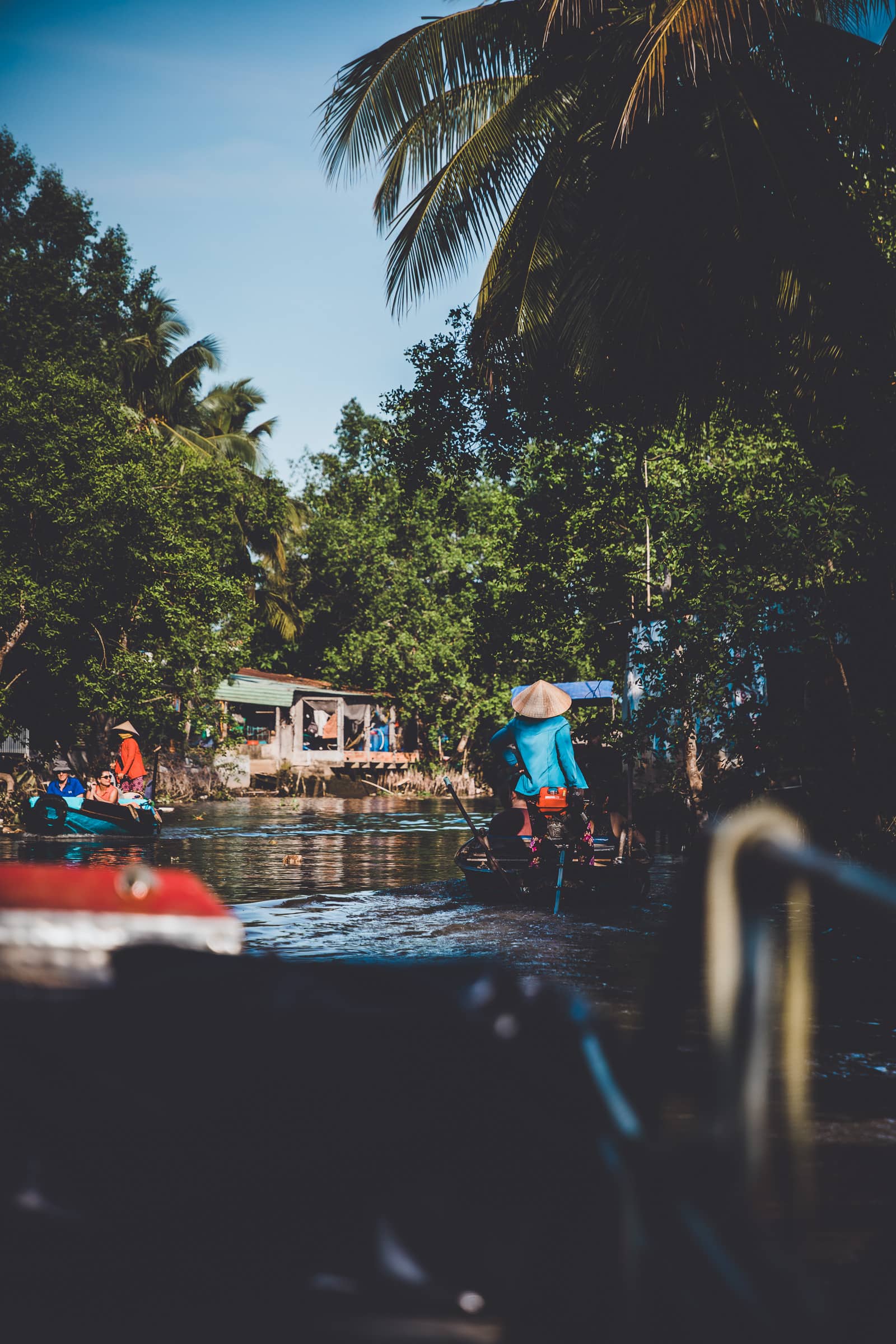
Traveling individually is often exhausting, planning everything, organizing everything – it rarely looks like a vacation. In return, you will be gifted with the most impressive experiences. With a small motorboat made of wood, more nutshell than boat, we sailed at half past five towards the sunrise, in our mini-group, through the branched, narrow side arms of the Mekong.
On the right and left, densely overgrown riverbanks full of palm trees and tropical trees. Lucy, our tour guide, courageously cuts down a palm leaf with a huge knife and with admirable dexterity makes rings and small animals out of the leaves to pass the time. But this is not necessary at all, the ride over the almost still sleeping river in the middle of this jungle panorama is already pastime enough.
The Cai Rang Floating Market: Sunrise on the Mekong
Just in time for sunrise, the rising sun behind us, we turn into the floating market of Cai Rang, the Cai Rang Floating Market, with our little boat tour. That’s right, a floating market: Like so many markets here in the Mekong Delta, the market of Cai Rang is located in the middle of the river.
Traders exchange goods directly from boat to boat, in between old women in their mini-boats, on which they have installed small cookshops and thus supply the workers – and depending on the time of day also the one or other tourist boat. We in our little nutshell were early, before the big tourist rush. To experience the floating market of Cai Rang at sunrise, when the market life is still in full swing, is unique.
Market Life at the Floating Markets on the Mekong River
We hopped from boat to boat, ate breakfast to karaoke music (Vietnamese love karaoke, regardless of their own singing skills, which is both quirky and likeable), shimmied out of our nut shell up steep boat walls to nibble on freshly carved, cardboard-sweet pineapple – and around us, pure market life. Rumbling diesel engines, sacks of vegetables and grain flying around, people hard at work. Somehow surreal that all this takes place on the water – but that’s Vietnam in the Mekong Delta: The Mekong is the lifeline without which nothing would function here.
Around the floating market of Cai Rang there are also numerous manufactories. Like this one, for example, which painstakingly makes rice noodles. First, the dough is baked into a flat cake, which is then dried and stacked on bamboo mats and finally put through a noodle press. Everything by hand, without large machines and almost in the open air. Just like the coconut candy you can buy anywhere. They are not for loose fillings or third teeth, but taste very delicious and coconutty!
Boat Tour to the Mekong Delta from Saigon or Ho Chi Minh City
From Saigon, there are numerous operators offering day trips into the Mekong Delta to the floating markets. The vendors like to go to the markets of Cai Rang and Cai Be, usually also with a small supporting program. If you have only little time and don’t want to continue your journey from Saigon towards Cambodia or Phu Quoc, but rather towards the north, such a day trip is a good possibility to see at least something of the Mekong Delta.
Disadvantage: Most of the way to the market is by bus. The trip takes about 3 hours, so you spend a lot of time getting there and back. While most tours are very inexpensive, most also stop at coffee run type shopping areas. Also, the groups are usually quite large, and you arrive at the markets relatively late—by which time most of the hustle and bustle has already died down. (I’ve linked a slightly more expensive tour for you above; the group is smaller, and the itinerary sounds nicer. Travel agencies in Saigon often offer tours for a fraction of the price, but every traveler I spoke with was, without exception, disappointed by these tours!)
So if I were to go on an organized tour, I would choose a multi-day tour of the Mekong Delta.
Planning Your Own Mekong Delta Tour: Accommodations & Helpful Tips
But you can also organize your own Mekong Delta tour! It takes more effort, but it’s definitely worth it! Here are a few tips:
Take the Open Bus from Saigon to Can Tho—> —preferably on the orange buses operated by Futa Travel, and then continue by taxi from there
Homestay in Can Tho, right in the middle of the jungle : Homestay Mekong Can Tho*(from there, you can book a $15 sunrise boat trip to the Cai Rang floating market, as well as an $8 sunset boat trip that includes a visit to private fruit orchards) Note: Due to its location, there are a lot of mosquitoes—it’s worth bringing mosquito repellent containing DEET with you from Saigon! ➜ You can book your stay at Homestay Mekong Can Tho here
For those who prefer a more urban vibe: A super-friendly and comfortable homestay run by a pair of Australian-Vietnamese sisters—I would have loved to stay here even longer; they’re both so warm and helpful! I wholeheartedly recommend it! ➜ You can book your stay at The Mag here*
Tip: From Can Tho, you can also organize your own boat trips to the floating markets! Just walk along the pier and within a few minutes, you’ll be approached by various ladies. You can rent boats for a Mekong tour all day long, but it’s still worth going early in the morning before sunrise to get a real feel for the market atmosphere!
Are you planning a stopover in Ho Chi Minh City or Saigon during your trip to Vietnam? You’ve come to the right place: in this article, I’ll reveal my best Saigon tips and which Saigon sights you shouldn’t miss! Whether it’s the best street food, the coolest restaurants or the best accommodation: In this guide to Ho Chi Minh City (official name of Saigon!) you will find what you are looking for.
How to enjoy your stay in Saigon
Saigon may be the largest city in Vietnam, but it’s nowhere near as overwhelming as Bangkok or Hong Kong. The only thing that really takes some getting used to (and this applies to the whole of Vietnam in general) is the traffic with trillions of scooters, of which every Vietnamese seems to own at least one. Honking is a way of making yourself noticed in traffic, but you don’t flash your lights – so the traffic in a city like Saigon is simply a huge, loud wave of honking scooters.
Mototaxis, scooters that you simply hop on, are also popular. Grab, a cab service similar to Uber where you can choose between a scooter or a normal cab, is also popular. However, when it was 40 degrees I usually took the car – and enjoyed the air conditioning. In general, Grab is an ideal way to get from sight to sight, it is cheap and much easier than traveling by public transport.
Why Saigon should be on your bucket list for your trip to Vietnam
It has now been four years since I was last in Vietnam. I left the country feeling very ambivalent at the time – somehow I didn’t get the full enthusiasm. I had previously only known Thailand in Southeast Asia, a country that makes it very easy for Western tourists to feel at home straight away. I had a slightly different experience in Vietnam. But more on that later. As I had visited the most important places in northern Vietnam such as Halong Bay, Hanoi, Hoi An, Hue and Da Nang last time and didn’t have time for the south, this time I wanted to get to know Saigon, the Mekong Delta and a few other places and try Vietnam again.
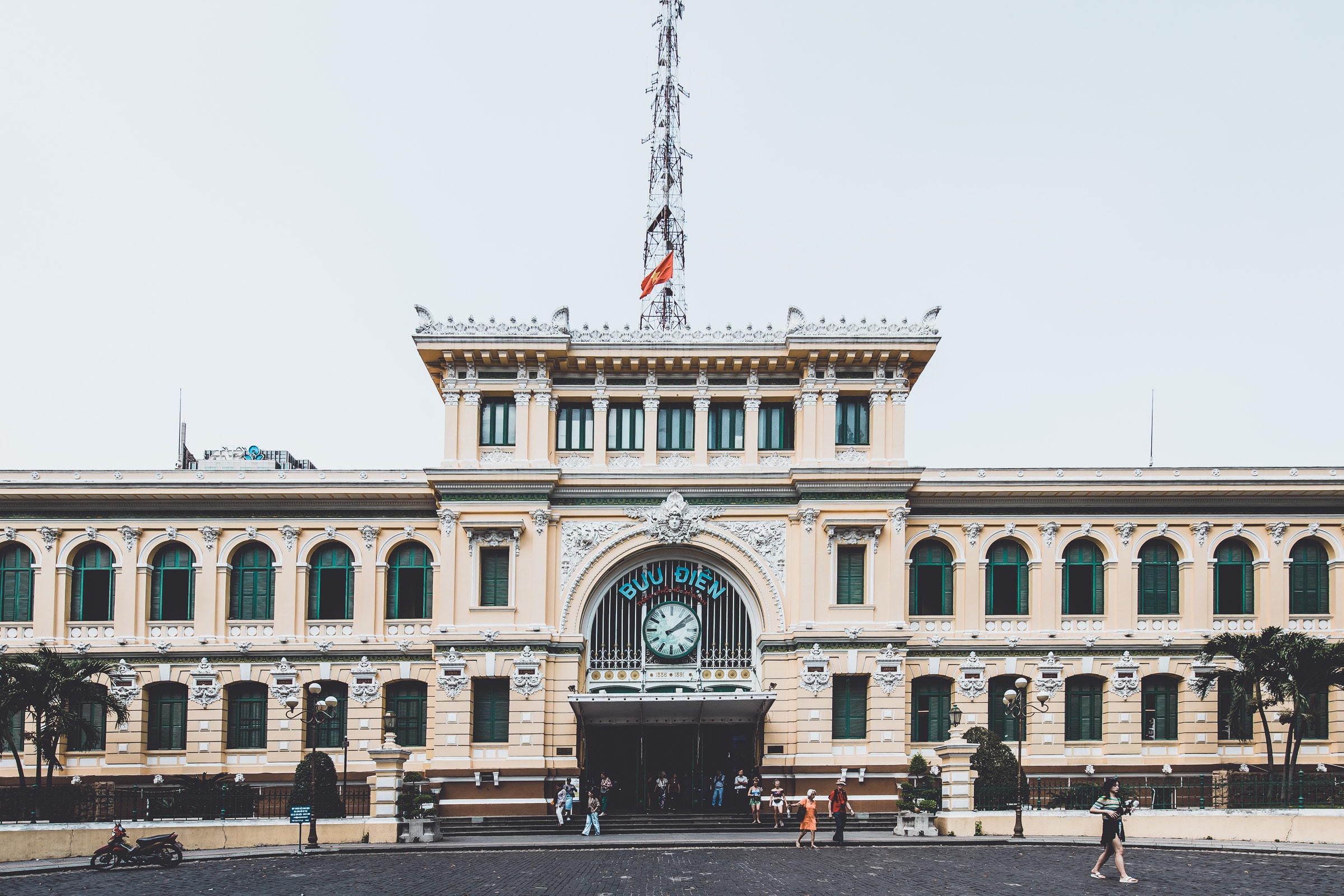
Saigon has few really spectacular sights, but many places are still interesting. The main post office, for example, was built during the French colonial era, and the steel structure inside was designed by Gustave Eiffel. A portrait of Ho Chi Minh hangs large at the head of the main hall. Quirky: Souvenir shops are located in the side wings and in the center of the hall, and the entire post office is filled with groups of tourists, while business as usual continues at the post office counters all around—with people buying stamps and picking up packages.
The main post office in Saigon dates back to the French colonial era.Regular operations in Saigon’s main post office under the oversized portrait of revolutionary leader Ho Chi Minh.French traces can be found everywhere in Saigon.
The great architectural influence of the French can also be seen in another of Saigon’s sights, Notre-Dame Cathedral (yes, there’s one here too!), just opposite the main post office. It is currently being renovated.
The Notre Dame Cathedral is also a relic from the French colonial era in Saigon.
2. Ho Chi Minh City People’s Committee and Saigon Opera House
Two other landmarks from the French colonial era are the Ho Chi Minh City People’s Committee—Saigon City Hall—and the Saigon Opera House. While City Hall is not open to the public, the Opera House can be visited during performances: the acrobatic show with South Vietnamese influences is said to be well worth seeing!
Could also be in California: Saigon City Hall.…except for the huge Ho Chi Minh statue in front of it, of course.Sometimes even with a red carpet: the Saigon Opera House.
3. Viewing platforms on the Bitexco Financial Tower Landmark 81
The Bitexco Financial Tower is Saigon’s second tallest skyscraper after the brand new Landmark 81 just outside the city. The large, protruding platform at the top of the tower is striking. However, this is not the viewing platform, but a helipad. It doesn’t seem to be used much – and it looks more like a prestige object. The Skydeck slightly below on the 49th floor is the publicly accessible viewing platform, where you can enjoy a view over Saigon for the equivalent of around 8 euros. Further up there is a restaurant/bar, which is free of charge, but understandably you have to consume something here.
The architectural contrast could hardly be greater. You can see the Bitexco Tower directly from an old backyard.
Landmark 81 also has an observation deck. However, I skipped the views from both locations because I was running out of time—and I’d already had a fantastic view of the city from the plane. The view of Saigon from the opposite bank is also spectacular!
The Saigon skyline at night: a bit like Shanghai.
Tip: In the evening, this is where the locals hang out. There are the usual street food stalls and makeshift cocktail bars, and it’s the perfect way to wind down the day here on one of the folding chairs with the best view of the Saigon skyline! And best of all: no tourist crowds!
4. Ben Thanh Market
I always love checking out markets in unfamiliar cities—getting lost in the hustle and bustle and discovering exotic things, especially in faraway countries; that’s right up my alley. The Ben Thanh Market is right in the heart of the city—a large, covered market hall with fruit, vegetables, clothes, souvenirs, and street food stalls. However, it’s also a huge tourist magnet; if you prefer a more local experience, you should check out a market like Tan Dinh Market or An Dong Market.
The Ben Thanh market has everything: food, handbags, tailor-made suits, false eyelashes in economy packs.Tailor-made suits in one day: no problem in Vietnam.
Right next to Ben Thanh Market, there’s also a well-known pho restaurant called Pho 2000. Pho is one of Vietnam’s national dishes—you absolutely have to try it! Pho is a noodle soup to which fresh herbs, chili, and lime juice are added at the table. It’s traditionally served with chicken or beef, and often with tofu as a vegetarian option. Pho 2000, a simple restaurant, became famous above all after Bill Clinton slurped down a bowl of pho here in 2000 during a state visit.
Pho 2000: Bill Clinton was here.Vietnamese pho: noodle soup with lots of fresh herbs. A specialty!
5. Reunification palace
Before the Vietnam War, the Reunification Palace was the seat of the South Vietnamese president. The Vietnam War came to an end with the fall of Saigon on April 30, 1975, at the hands of the Vietnam People’s Army and its tanks, which rolled over the fences here. Today, the grounds and some of the rooms are open to the public.
The end of the war is celebrated in a big way every year. There are posters everywhere in the city, as if from another era.
Ad / *affiliate links
6. War Remnants Museum
The War Museum was probably my biggest disappointment in Saigon. Many tourists I had spoken with beforehand were absolutely thrilled by the War Museum, which is considered one of the largest and best of its kind in Asia. I really took a thorough look at everything from top to bottom (the museum spans three floors), hoping to learn a little more about the historical context and background of the Vietnam War.
I found the possibility that the depictions might be biased quite intriguing, and in a way, I had actually expected it. Even though I’d heard many times that the exhibition was supposed to be completely neutral. In my experience, however, it’s anything but neutral! On top of that, the exhibition is very poorly designed from a technical standpoint. I was particularly interested in the photo exhibition featuring famous war photographers—but the images, which are actually quite impressive, are so poorly lit that you’re better off picking up a good photo book.
As expected, the exhibition is anti-American and completely omits the background of the opposing side. To a certain extent, this is understandable. But to pretend to be neutral in this context is very risky. Historical context is also only touched upon briefly, so that when I left the museum, I didn’t feel any wiser about the history of Vietnam.
I also found the matter-of-fact display of American military equipment—such as machine guns, bazookas, and bombs—at every turn to be very bellicose and unsettling. It’s part of the theme, but the way it was presented and the sheer volume of it were somehow too much.
My personal low point, however, was two other things: First, the gift shop, which sells completely out-of-place souvenirs ranging from card games to American Hollywood movie posters to a biography of Michelle Obama (even though everything else here is anti-American) —and second, the fact that visitors were beaming with joy as they had their pictures taken with the tanks in front of the museum. When I saw the two girls—obviously tourists from the West—having a friend film them as they performed a cheerful cheerleading dance routine among tanks and military helicopters, my jaw finally dropped.
7. Ho Thy Ky Flower Market
Vietnamese people love flowers. Flowers are often used as decorations at the numerous festivals held throughout the year or as religious offerings. At the Ho Thy Ky Flower Market, you can immerse yourself in a sea of flowers while sampling delicious street food. Most of the flowers here come from the mountainous region further north around Dalat or from the Mekong Delta. By the way, I tried in vain to figure out exactly what’s added to the flower water to keep them so incredibly fresh. Especially with air temperatures just shy of 40 degrees… I guess the chemicals are at work here. By the way, I read that you should stay away from apples in Vietnam because they’re sprayed with such incredibly strong pesticides there—so be careful.
8. Tan Dinh Church / Pink Church
What makes this church special—as the name suggests—is its color. Painted pink from top to bottom, even on the inside, this church is a sacred spot for all Asian Instagrammers. At least, that’s how it seems when you see the hordes of young girls posing in front of the church, all searching for the best photo spot. (Try searching for #pinkchurch on Instagram!) I would have liked to see the inside of the church, too—but unfortunately, a service was in progress.
The pink church in Saigon: quite beautiful.Selfie alert in front of the pink church in Saigon.
9. Sri Mariamman Temple
The Hindu community in Vietnam isn’t particularly large, so the Sri Mariamman Temple near Ben Thanh Market isn’t all that spectacular either. But if you’re in the area anyway, it’s worth a visit. Note: Take off your shoes!
10. Pham Ngu Lao – Backpacker Street with night market
Once darkness falls, the nightlife here really comes alive. Thumping bass, street food vendors with their little carts, local girls, Western tourists—from backpackers to those on Neckermann tours—and locals too— Pham Ngu Lao is a must-see.
During the Vietnam War, bars and lodging options—ranging from expensive to inexpensive—sprang up along this street. Here, American troops could stock up on everything they needed. In some ways, the Western influence has lingered to this day, and you can still find numerous bars and lodging options around Pham Ngu Lao.
Party every day: Pham Ngu Lao is quite reminiscent of Khao San Road in Bangkok.
Excursions from Saigon: What else can you see?
There are a number of excursions you can take from Saigon. A visit to the Cu Chi Tunnels is a popular choice. During the Vietnam War, the Viet Cong expanded the tunnel system—which had already existed since the colonial era—to create a complete infrastructure that included living quarters, hospitals, and schools.
What makes the connecting tunnels particularly remarkable is their size: 80 centimeters high and 60 centimeters wide. One section of the tunnel has been preserved to this day (and has even been slightly enlarged to accommodate the towering tourists from abroad) and is open to visitors.
Another popular excursion is a day trip to the Mekong Delta to visit the floating markets on the Mekong River. However, a day trip is really quite rushed, and there’s a high chance you’ll end up on a mass-market tour that feels like a sales pitch. I think it’s advisable to book a trip for several days.
Aside from the typical sights you’ll find in any Saigon travel guide, I discovered plenty more exciting things in Saigon! I found the many truly great and unique cafés and restaurants particularly interesting—they even impressed me, a Berliner who’s quite spoiled in this regard. And the delicious street food—which I probably would never have discovered without a fantastic street food tour.
But the best thing of all was the great locals, who immediately made me forget my bad experience last time and gave me lots of great tips. I often think that you should definitely visit a country a second time, even if the first time wasn’t particularly nice. Sometimes a country only reveals itself to you on a second visit.
There are countless cafés in Saigon – each one more beautiful than the next.
Practical tips for Saigon – information for your trip
From the airport to the city
When you arrive at the airport by plane, you can take either a regular taxi, Grab, or the public airport bus into the city. The airport is only 7 kilometers from downtown, so a taxi won’t be too expensive. I used Grab the whole time, since I’d read quite a bit about rigged taximeters and fake taxis. I preferred Grab because, like with Uber, the price is fixed from the start. From the city to the airport, I once paid about 90,000 dong, which is about €4.50. The only cheaper option is the airport bus, which goes via Ben Thanh Market to the bus station near Pham Ngu Lao: 20,000 dong, just under 1 euro.
Continue by bus
If you want to continue your journey by bus from Saigon, any hotel or travel agency can usually help you. The intercity buses operated by FUTA Travel—which are usually orange—are popular and reliable. They have offices throughout the city, including near Pham Ngu Lao. There, you can buy a ticket and will be taken by minibus to the bus station, which is located outside the city center. Fares are very affordable, and the comfort is decent—the sleeper buses, with their semi-reclining seats on two (!) decks, were perfectly adequate for me at 1.60 m tall. Full-grown European men might find it a bit more cramped.
Moving around the city
Within Saigon, I highly recommend Grab! Although there’s good Wi-Fi everywhere and you can use the app, I’d highly recommend buying a local SIM card, which you can pick up right at the airport. Or you can buy an eSIM in advance; I like to use eSIMs from Saily or Holafly.
Advertising / *affiliate link
Safety in Saigon: Is it dangerous?
I’ve been warned several times by locals about pickpocketing and cell phone theft. Apparently, pickpockets riding by on scooters often snatch cell phones right out of people’s hands. The same thing seems to happen with handbags or backpacks that are carried over just one shoulder. If you carry them on both shoulders, you’re probably safe. However, as a solo traveler, I’ve always felt relatively safe, even at night. That’s also one of the reasons why I always buy a local SIM card and keep my cell phone handy—if I start to feel uncomfortable, a Grab taxi will be there in a few minutes.
Best time to travel to Saigon: When is the best time to travel to South Vietnam?
Basically, the seasons in Vietnam are divided into a dry season (November through April) and a rainy season (May through October). For Europeans, this coincides with the European winter. Just before the rainy season begins, it gets really hot and humid again. From my own experience, I can say: This is only for the truly hardy! You’ll have to scale back on hardcore sightseeing itineraries—otherwise, frequent breaks are a must.
Accommodation in Saigon
Most tourist hotels are located around Pham Ngu Lao (which has many backpacker accommodations) or right in the city center. However, it can get very noisy around Pham Ngu Lao, so if you’re hoping for a peaceful night’s sleep, you might be better off choosing a different place to stay.
I chose a place to stay a little outside the hustle and bustle, but still very centrally located. The Common Room Project* is more of a housing project than a hotel—the staff are really nice, and all in all, it has a very warm and welcoming atmosphere. They offer both dorms and private rooms.
Once, when I came back very late, the receptionist jumped up from his chair, looking both relieved and excited—he had been worried about me because he hadn’t seen me the whole time. I’ve never experienced anything like that before.
The roof terrace is also legendary and is a popular venue for movie nights. And what made me even happier as a Brazilian: the caipirinha bar probably makes the best caipirinhas in Vietnam!
Do you say Saigon or Ho Chi Minh City?
The first question I asked myself was: Do I say Ho Chi Minh City or Saigon? After all, I don’t want to put my foot in my mouth. The last time I was in Vietnam, I noticed that political topics are often avoided (at least with tourists). Vietnam is a communist country, but as in China, the boundaries to capitalism are very blurred on the surface and with a Starbucks or H&M in front of your nose, you are quite confused as to what is supposed to be communist here.
After the end of the Vietnam War and the communist Viet Cong’s takeover of South Vietnam, Saigon lost its name—which dated back to the French colonial era—and was renamed in 1976 after the (communist) revolutionary leader Ho Chi Minh, who had already passed away by that time. So a tremendous piece of history is associated with that name.
I then asked around cautiously several times, but the locals still always say “Saigon”—“Ho Chi Minh City” is only used on official occasions. (Incidentally, Vietnam’s political history is very complex. I’m doing my best to present the facts here truthfully and accurately. After all, even a travel blogger who only visits places superficially should be mindful of historical context. But if anyone knows more about this or wants to point out corrections—please feel free to leave a comment. I’d really appreciate it.)
To be honest, I had imagined the trip to the idyllic Perhentian Islands in Malaysia would be different. The waves were crashing harder and harder against the tiny nutshell of a boat we were sitting in, and by then I was thinking about how much of my camera gear I’d have to say goodbye to if the next wave washed into the boat—or worse, if we all fell out of the boat.
Dream beaches right on your doorstep: The Coral View Island Resort is located right on the beach.
Strangely enough, I wasn’t afraid for my life or of drowning. That might be because I always feel safe in the water, and thanks to years of swimming lessons when I was young, I’m also pretty good at moving around in it (at least one sport that comes easily to me!). Or perhaps because the boat ride from the Perhentian Islands back to the mainland takes only forty minutes and goes through fairly open and well-traveled waters—someone would surely fish us out of the water if all else failed. And with a life jacket (thankfully, we had one) and the water at a comfortable 27 degrees Celsius—just like a bathtub—we could probably stay in the water for quite a while.
The seemingly rough seas weren’t really the problem, but rather the boats—which aren’t really seaworthy—that serve as water taxis or ferry services connecting the Perhentians to the mainland. On a large ferry, you probably wouldn’t have noticed a thing. But those can’t even get close to the Perhentians in the first place. Because there’s no harbor. Paved roads? Nope. Buses? Cars? No. None of that. And so the two Perhentian Islands— Perhentian Besar (the large island) and Perhentian Cecil (the small island)—lie like two lost islands off the coast of East Malaysia.
Perhentian Islands: Malaysia’s Diving Paradise
According to Lonely Planet, the Perhentian Islands are supposed to be the fifth most beautiful diving spot in the world. As a complete diving novice, I had no idea that beforehand. In fact, I’d always been a bit wary of diving. Water itself is my element, sure, but actually diving down there, with just an oxygen tank to breathe, and then there’s the whole pressure thing! Afterward, I can’t handle the pressure difference, I have trouble equalizing the pressure, my ears go haywire, I lose it, my eardrum bursts and won’t heal—and just like that, hello, permanently unfit to fly.
Pretty lame for a flight attendant who really doesn’t feel like retraining at this stage in her life. Okay, maybe I’m being a bit dramatic, but that’s just how I feel about diving. Sometime in the last few years, I gave snorkeling a try on Koh Phangan—and that’s when I thought for the first time, looking at the colorful coral reefs and cute little fish: Maybe diving would be something after all.
The Perhentian Islands have beaches straight out of *Robinson Crusoe*: During the off-season, you’re practically alone on Perhentian Besar.
But it took another snorkeling trip to the Perhentians to really convince me—I’ll be back, and next time I’ll have more time to dive! Unfortunately, I didn’t take any pictures underwater. But I have the most beautiful ones in my mind, and that’s worth something too: On our snorkeling trip, we saw just about every kind of marine life the reefs right off Perhentian Besar have to offer: brightly colored clownfish, huge and incredibly fast sea turtles, and sharks a meter and a half long.
And since it was the end of the season, there were only three of us on the boat anyway. We didn’t feel like we were intruding on the underwater world; instead, we were simply able to enjoy nature. Unfortunately, the end of the season also means the start of the rainy season, so the weather wasn’t quite as sunny anymore, and our guide assured us that the water—which already seemed as smooth as glass to me—would be even smoother, clearer, and simply amazing during the peak season. I guess I’ll have to go see it for myself after all. Even with the bad weather, the Perhentians were still pretty impressive.
A complete tour of Malaysia is also well worth it! You can find more travel stories on the Malaysia Blog
Perhentian Kecil or Perhentian Besar? The big island or the small island?
The water taxis serve both islands, and due to limited local capacity, it’s a good idea to book accommodations in advance on the Perhentian Islands—contrary to general travel habits in Southeast Asia. It’s also relatively expensive—Malaysia isn’t exactly a budget paradise like Thailand, but here on the islands, lodging is even a bit pricier. On top of that, you can’t really take care of your own meals—apart from a few small resort-run stands selling chips and crackers, I didn’t see much else. It’s just a remote island, after all.
By the way, I actually had the pleasure of trying out accommodations on both islands. Actually, I was only on Perhentian Besar and spent a day visiting friends on the neighboring island of Perhentian Kecil —and realized that getting around on the water taxis that connect the islands isn’t all that easy toward the end of the season. Or sometimes they don’t run at all because the waves are too high. So I ended up having to spend an unplanned night on the other island—with nothing but my beach bag. But that’s how the best stories happen, isn’t it? Anyway, the impromptu beach party with the locals—along with a few lost tourists like us, who were clearly in the minority by then—made up for it. And a little adventure in paradise never hurts.
Which island should I stay on? Perhentian Besar or Perhentian Kecil?
So here’s my tip: Be sure to check out and book accommodations in advance. Then ask yourself what you’d prefer: peace and quiet, or a family-friendly environment? If so, I recommend staying on Perhentian Besar. Or are you more in the mood for a laid-back hippie vibe and a backpacker atmosphere, with occasional nighttime fire shows on the beach and cheap booze from a makeshift cooler-beach bar? Then go for Perhentian Kecil. By the way, I liked both!
Toward the end of the season on the Perhentian Islands, the weather can take a turn for the worse. Even so, the colors of the water at Long Beach on Perhentian Kecil are amazing.
Basically, though, both islands are very quiet; there isn’t much to do besides hitting the beach, snorkeling, and diving —dining out is mostly limited to the resorts’ own restaurants, which are open to the public. And unfortunately, they’re usually not very good, in my opinion. But I was probably just spoiled by the foodie paradise in Georgetown, where I’d been before visiting the Perhentian Islands.
Getting There & Tips
How do you get to the Perhentian Islands?
The famous water taxis take you from the pier in Kuala Besut to the islands. If you’re flying in, like I did, the nearest airport is Kota Bharu, which has direct flights from Kuala Lumpur and Penang.
From there, it’s about an hour’s taxi ride to reach the boat dock. Right by the baggage carousel, there’s a booth where they sell taxi tickets. There are certainly even cheaper options, but you can usually find someone to share a taxi with. Despite the relatively long distance, as far as I recall, it doesn’t cost an arm and a leg. You can often find flights at good prices, even on short notice.
Staying Overnight on the Perhentian Islands
Accommodations are a bit of a challenge on the Perhentian Islands. Malaysia isn’t generally one of the cheapest countries for budget travelers. On the Perhentian Islands, prices are even a bit higher. And accommodations are limited.
Especially during peak season—the European summer—it’s a good idea to book your accommodations in advance. Personally, I always find this difficult in Southeast Asia; I rarely book far in advance, but on the Perhentian Islands, the better options can sell out quickly. However, don’t kid yourself—the value for money isn’t great.
I found the dining situation on Perhentian Besar particularly challenging; aside from a small shop at the Perhentian Islands Resort selling just a few bags of chips, I couldn’t find any way to take care of my own meals. So you’re dependent on the resorts’ restaurants around the clock, which, unfortunately, aren’t particularly good. Of course, it is an island, after all, so everything has to be shipped in. The situation seemed a bit better on Perhentian Kecil, though it isn’t quite as quiet and peaceful there as it is on Perhentian Besar.
My Hotel Recommendations for the Perhentian Islands
I stayed at The Barat Perhentian, which has simple cabins near the beach. If you don’t need luxury, you should be satisfied. During my stay on Perhentian Kecil, there was a lot of construction going on at Long Beach, so I spontaneously spent a night at the Rock Garden Resort. It’s really basic, but somehow also very pretty because of its hillside location. However, this is only for you if you don’t mind climbing stairs, since the cabins are on a steep slope. All around are new and nicer resorts. But it seemed to me that there might end up being a bit too much of a good thing in the future.
Best Time to Visit the Perhentian Islands
It’s essential to keep in mind that the tourist season on the Perhentian Islands lasts only from March through October—I was there toward the end of October, and while the trip there was still okay, the return trip by boat was quite a bit more adventurous than described above. Outside of the season, all resorts close, and the monsoon makes conditions unpleasant—so the Perhentians aren’t a year-round paradise.
But if you’re into idyllic beaches and a stunning underwater world and want to really unwind, then I highly recommend a trip to the Perhentian Islands.
It’s often the places that no one really knows about that make the difference. Not that Kuala Lumpur wasn’t interesting on my trip through Malaysia last October. Or Singapore, where I was later. There’s a reason why thousands of tourists from all over the world make the pilgrimage there. But in the end you only see what you already know from several travel guides or recently more and more often from your Instagram feed. To see this live and in color is of course also exciting – but in the end, places like Ipoh in Malaysia also have their charm, precisely because they are not yet so well known.
So when I’m on the road for a longer period of time, I like to stop at places that aren’t quite as crowded. Simply to deviate from the usual stream of tourists. Ipoh is not that untouristy either – however, the vast majority of visitors are from China, western tourists hardly seem to know Ipoh. And this, although Ipoh is a really nice stopover for 1-2 days, if you are traveling in Malaysia.
On my Malaysia Blog you can learn much more about Malaysia
The Old Town of Ipoh
The Old Town is small but charming, with many buildings from the colonial era. And there’s quite a bit of street art—which is a nice way to get in the mood for Georgetown if you’re on your way there. Most of the murals are easy to find, even using Google Maps. Or you can pick up a map at the tourist office. They’re very well organized in Malaysia anyway—something I hadn’t expected.
The Ipoh Heritage Trail takes you past all the town’s buildings worth seeing – from a time when Ipoh was still so rich because of its nearby tin deposits that it was called the “City of Millionaires.” And again and again there are small alleys and beautiful details to explore and discover. It is precisely the fact that Ipoh is not so smoothly polished and still has a slightly morbid vintage charm in many places that makes the old town so special.
Concubine Lane
The tourist hub of Ipoh is Concubine Lane, a narrow alley lined with shops, restaurants, and street stalls. There are actually three Concubine Lanes; in ancient times, a tin baron gave each of his three wives a street and let them collect the rent there for their own pockets—hence the three Concubine Lanes. Today, the action takes place mainly on a single street, Lorong Paglima, which is commonly known as Concubine Lane.
On what is now Market Lane—formerly Second Concubine Lane—you won’t find any shops, but you can take your time admiring street art murals and, if you have a keen eye, the tastefully displayed accessories, such as a vintage Beetle. But the umbrellas… well, they’re kind of old news… in the truest sense of the word.
Probably the most intricately designed gem in Ipoh’s Old Town is Kong Heng Square, a small block of buildings lined with shops and cafés. And it’s really beautifully done. The trees, which have been growing in the courtyard for centuries and were simply integrated into the redesign of the buildings, make you feel like you’re at Angkor Wat.
It’s a little too geared toward the hipster crowd, but you can still enjoy shopping for handmade souvenirs in the small shops here and enjoy good food and drinks at the cafés and restaurants.
Street Art in Ipoh
If it works in Georgetown on the Malaysian island of Penang, it must work in Ipoh, too. That’s probably what someone must have thought. Georgetown has become known for its largely interactive murals, which gained fame primarily through the Lithuanian artist Ernest Zacharevic. Thanks to some of his works in Penang, he’s even earned the nickname “the Banksy of Malaysia,” and tourists line up endlessly in front of his murals in Georgetown just to snap a photo.
This is not yet the case in Ipoh. But street art can still be found everywhere. There is even next to the more famous Market Lane a complete alley only with street art, the Mural Arts Lane. Partly nice, partly less so, but in any case not as crowded as Georgetown. Since the old town is also very clear and many works are centrally located, you can actually look at all the interesting murals in just a short time.
Night Market: Exploring Ipoh’s Vibrant Nightlife
As is typical in Southeast Asia, Ipoh also has a night market. However, it’s located outside the old town, and if you really want to go there after dark, you’re better off taking a taxi. Uber or Grab (which is usually a bit cheaper than Uber and also more popular). It’s not far to walk, but the streets along the way are rather dim—and to me, the savings just weren’t worth it.
Unfortunately, the market itself isn’t particularly spectacular; it mainly sells counterfeit Chinese knickknacks and trivial trinkets. So if you’re looking for local handicrafts or other authentic souvenirs, you probably won’t find what you’re looking for here.
But there’s some exciting street food here: On a street corner, there’s a restaurant called Lou Wong, which is apparently known for its chicken with rice and soybean sprouts. In any case, it’s the biggest and busiest place far and wide, and there isn’t even a menu. That’s because they only serve one dish on simple orange plastic plates—you can choose between chicken or the vegetarian option (which is probably just the same dish without the chicken). You order using hand gestures—nobody speaks English. But that doesn’t matter. The main thing is that it’s delicious—and the place is definitely worth a visit for adventurous eaters.
I thought Ipoh was really quite pretty, and if I hadn’t had only three weeks in total for the entire trip, I probably would have stayed a little longer—also to explore the surrounding area. I think Ipoh is definitely a nice change of pace, especially for long-term travelers, offering a break from all the traveling and a chance to just relax for a few days.
How to Get There
Ipoh is located north of the Cameron Highlands on the way to Penang/Georgetown, making it the perfect stopover. Ipoh is also very well connected: There’s a train connection to Kuala Lumpur, an airport with flights within Malaysia and to Singapore, and a large bus terminal outside the city from which you can travel to all parts of the country. Traveling by bus in Malaysia is highly recommended—it’s affordable and much more comfortable than you might imagine!
Where to Stay in Ipoh
There are some nice places to stay in Ipoh. Individual, stylish and yet affordable:
M Boutique Hotel – It’s just outside the Old Town, but thanks to Uber—which works great in Ipoh, too—it’s absolutely easy to get to. De Café & Rest House – Not only a highly recommended café, but also a new capsule hotel. Ideal for solo travelers. Unfortunately, there are no private rooms, but it does have a unique location in the Old Town! The Happy 8 Retreat @ Old Town Ipoh – Also located in the heart of the old town, this is a beautiful boutique hotel with unique jungle-style interior design.
The 30 minutes on the back of a rattling tuktuk were worth it: near Luang Prabang are the Kuang Si waterfalls – and they are spectacularly beautiful. Clear turquoise water in small pools spread at the foot of the waterfall. And the waterfall itself, in the middle of a tropical forest. All breathtaking.
Waterfall for adventure lovers
If you’re feeling particularly adventurous, you can also take a look at the waterfall from above. A small trail leads up the mountain – and right at the sign “Danger! Do not pass!” you do exactly the opposite: off through the hole next to it and further up to the waterfall. But be careful, already the regular hiking trail is sometimes not without due to the wet ground… and here it does not get better.
And even if thousands of backpackers show you how to do it, it’s better to swap your flip-flops for sturdy sneakers. If you still need the total kick, you can then, once at the top, sit right on the cliff of the waterfall!
In the Laos blog you will find many more tips for a great Laos round trip!
It is best to start early in the morning in the direction of the waterfalls, because from late morning the first tour groups slowly start to arrive, and then it gets really crowded. On weekends, the Kuang Si waterfalls are of course also a popular destination for the locals.
Many families spend the whole day there, picnicking, swimming and enjoying nature and family time. So if you prefer to travel more solitary, come during the week. However, the atmosphere is very nice on weekends so among locals, so is also a nice option.
Some locals even bring their own secret pop-up restaurant and nicely set the available tables and serve lunch – in case you forgot your packed lunch, you won’t starve either!
Bears at Kuang Si waterfall
At the entrance to the waterfall is also the Bear Sanctuary, a sanctuary for bears, where you can watch them play and chill in their enclosure.
How to get to Kuang Si Waterfall?
There are two ways to get from Luang Prabang to Kuang Si Waterfall. Either book one of the many tours offered to Kuang Si or simply take a tuktuk from Luang Prabang, which is also waiting on site as long as you explore the waterfalls. Of course, this is a bit more expensive, but it’s definitely worth it to arrive before the crowds and have the flexibility to arrive and depart.
***
More articles about Laos:
This site is registered on wpml.org as a development site. Switch to a production site key to remove this banner.