Want the ultimate shopping experience during your stay in Bangkok? Then you have to go to Chatuchak market. Cheap clothes and souvenirs can be found on almost every corner in Bangkok, but the Chatuchak market is really worth seeing just because of its size.
The Chatuchak market at the weekend
Here you can spend away the whole day, because the market is the world’s largest weekend market! Lose yourself in the narrow, crowded aisles of the covered market and indulge in the shopping frenzy.
What can you buy at Chatuchak market?
You’ll find almost everything you can imagine at the Chatuchak Market! From clothes to household goods to live pets, the choice is endless! To give you an impression of how big the market is – here is the location map (you can also get a free folding map at the market’s information booth – and yes, it’s helpful!):
Street food at the Chatuchak market
Fortunately, the entire market is neatly divided by industry, so if you’re looking for specifics like vintage clothes, art, soaps or something, you’ll know right where to go. Of course, you can also eat here – there is one street food stand after another on the outer sides.
On the Thailand Blog, you’ll find even more tips and tricks for your trip to Thailand
There are also some bars, such as Viva 8, where you can enjoy a live DJ and show cooking.
Chatuchak Market Hours
Chatuchak Market is open Saturdays and Sundays from 6 a.m. to 6 p.m. and is very easy to reach by bus or metro.
Tip: Get there early, because it can get really hot around noon, especially inside the market in the narrow aisles. And as always: Drink loooooads of water!
When I visit a country for the first time—like I did recently in Malaysia—I always want to see everything right away. Ideally, the whole country at once. That’s pretty unrealistic. So I try to plan my trip so that I visit just a few areas—but ones that are as diverse as possible. Fortunately, that works well in Malaysia; the country is small, and you can get around quickly and comfortably by bus, train, car, plane, or boat.
So after a weekend in Kuala Lumpur, I took the bus to the Cameron Highlands, to Tanah Rata. In the middle of the interior, in the middle of the mountains, in the middle of the tea plantations. Pure nature. And pretty much the complete opposite of busy Kuala Lumpur. And the fresh air. A little cooler – but pleasant in summer. And the nature here was really good for me: you can find out everything you can do in the Cameron Highlands in this article!
Lush green everywhere: the tea plantations in the Cameron Highlands in Malaysia.
The tea plantations ensure that the landscape is dotted with lush green fields. This is because only the very young, light green leaves are picked for our tea, while the older, dark green leaves remain on the bush. And so the tea plantations stretch like a bright green blanket over the mountain landscape of the Cameron Highlands. Incidentally, the tea plantations here are – how could it be otherwise – a legacy of the British, who found perfect conditions here in colonial times to grow their beloved tea. Mild tropical climate, not too hot, not too cold.
I just couldn’t get enough of the green mountains in the Cameron Highlands.
Advertising
Original BOH tea from the Cameron Highlands
Around the time I was in Malaysia, I became an absolute tea drinker. And after being able to enjoy really good tea right at the source in the Cameron Highlands, so to speak, I am now quite discerning when it comes to good tea.
But luckily I can now order my tea happiness from the Cameron Highlands directly to my home! In the Salacca tea house you will find a wide variety of BOH tea from Malaysia!
And it wasn’t just the tea that the English brought with them, but also plenty of Land Rovers to get them through the adventurous landscape. To this day, the world’s highest density of Land Rovers can be found in the Cameron Highlands!
Sunrise in the Cameron Highlands: the magic of nature
As a city kid, I never considered myself particularly close to nature. But that’s been changing for a while now. Maybe it’s because of my age—oh dear. Or maybe it’s because Berlin, the city where I live, is just too much of a city: too rough, too gray, too crowded. That’s annoying and sometimes makes my enthusiasm for city life fade. In other cities, on the other hand, I find my way around right away. New York, Bangkok, São Paulo—it doesn’t matter. Big cities are my territory. And they don’t impress me at all anymore, because there’s no challenge.
Be sure to join in: A sunrise tour in the middle of the Cameron Highlands is an unforgettable experience.
What really blows me away: a simple sunrise. In Berlin, you might catch one at most on your way home from a club. But a sunrise over the mountains of the Cameron Highlands, filled with lush green tea plantations and pristine tropical forest—that’s truly mind-blowing. And suddenly you’re drawn into this vast, everyday natural world—and you feel so small yourself.
The Mossy Forest in the Cameron Highlands
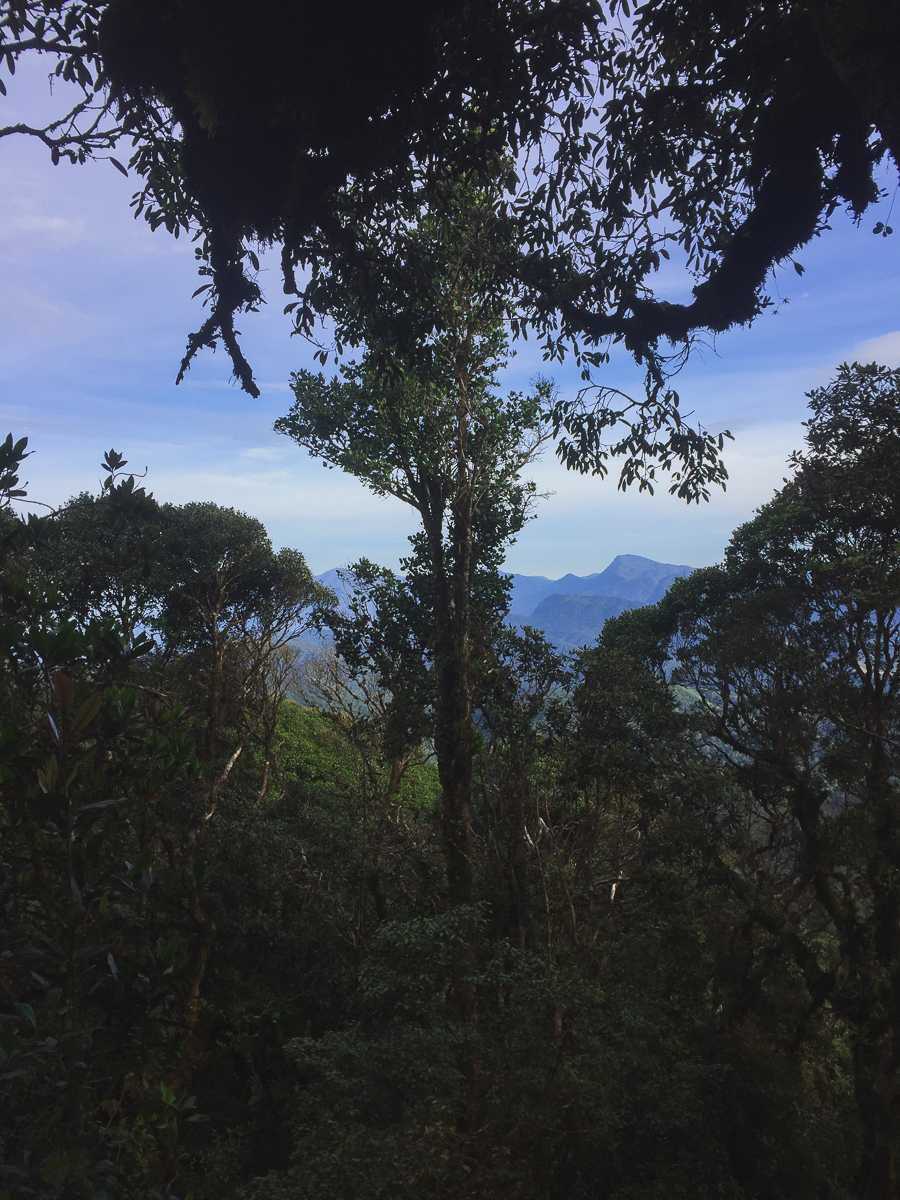
The tea plantations are certainly impressive. But in the Cameron Highlands, you’ll also come across a strip of rainforest, high up in the mountains. It’s humid and covered in moss from top to bottom.
The moss in Mossy Forest grows very slowly, which is why a large part of the area is a nature reserve.
It takes an incredibly long time for it to grow just a few millimeters. That’s why there’s a section of the Mossy Forest that you can explore via a wooden walkway—and it’s best to do so early in the morning, because otherwise you’ll have to share this impressive natural experience with many other tourists.
Impressive: a rainforest in the middle of the Cameron Highlands.
Tips for the Cameron Highlands: Enjoying Tea and Hiking
There are two major producers with tea plantations in the Cameron Highlands: BOH Tea and Bharat. Both operate visitor centers where you can buy tea, sample it, and watch it being produced. Or you can simply take a walk through the green fields. That’s nice, too.
There are numerous hiking trails around Tanah Rata. They are not necessarily well signposted, but pretty much every accommodation has more or less accurate maps. But you should be really careful, the paths are sometimes adventurous and lying injured somewhere in the Malaysian jungle is stupid. So it’s better to set off at least in pairs and always have a small survival kit with water, cell phone, etc. with you.
By the way, the strawberry farms are another major tourist attraction in the Cameron Highlands. But that didn’t really blow me away. The Butterfly Farm is small and easy to navigate, but it still gives you a nice sense of the surrounding nature. And that’s where I saw butterflies for the first time that were as big as (and looked almost like) bats.
Overnight stay in the Cameron Highlands or Tanah Rata
Accommodations in Tanah Rata are more expensive than elsewhere in terms of value for money—and also much simpler. But that’s okay, because in the Cameron Highlands you’re just walking around all day anyway, and by evening you’ll fall into bed exhausted from all that fresh air and natural beauty. Two popular places to stay (which were even recommended to me by my Uber driver in Kuala Lumpur) are Gerard’s Place and Father’s Guesthouse, which are part of the same establishment and have a similar style: simple rooms, but functional, with a friendly, sociable backpacker atmosphere.
Tanah Rata has a good selection of restaurants and cafés—even a Starbucks, for those who just can’t do without it. But I found the best breakfast right on the side of the road, at one of the self-service stands with plastic stools and folding tables. It came with lots of rice, chili, and sickly sweet Nescafé. Sounds bizarre. It was. And incredibly delicious.
Malaysia, where do you start? I am the best travel planner ever. Not. While others have thought out elaborate routes months in advance and planned whole days through, I know about three days in advance, with luck, in which direction I will set off at all. I hate planning. And so I knew about Malaysia also only what I could still read out in the fast passage from the travel guide. Was not much. Anyway, it is more exciting to experience with your own eyes and so I explored the most beautiful sights in Kuala Lumpur.
What to do in Kuala Lumpur a few facts
A few rough facts about Kuala Lumpur before I provide you with some really cool tips for your Kuala Lumpur visit:
Kuala Lumpur is the capital of Malaysia and is rather small for a major Asian city with a population of around 1.6 million
The Petronas Towers are THE landmark of the city and WERE once the tallest building in the world, but are still the tallest twin towers in the world for it
Multicultural: In Kuala Lumpur, as in the rest of Malaysia, a wide variety of cultures and religions live in a very small area: Chinese, Malays, Indians, Arabs, Buddhists, Muslims, Christians, Hindus – everyone finds their place here.
Petronas Twin Towers
In Kuala Lumpur, you can’t miss the Petronas Towers. Sparkling clean and featuring interesting design details, the twin towers are an extraordinary piece of architecture—not to mention their immense height. By the way, you can go up there, too.
Are you planning a trip to Malaysia? Then you should also check out my Malaysia blog with lots of information & inspiration!
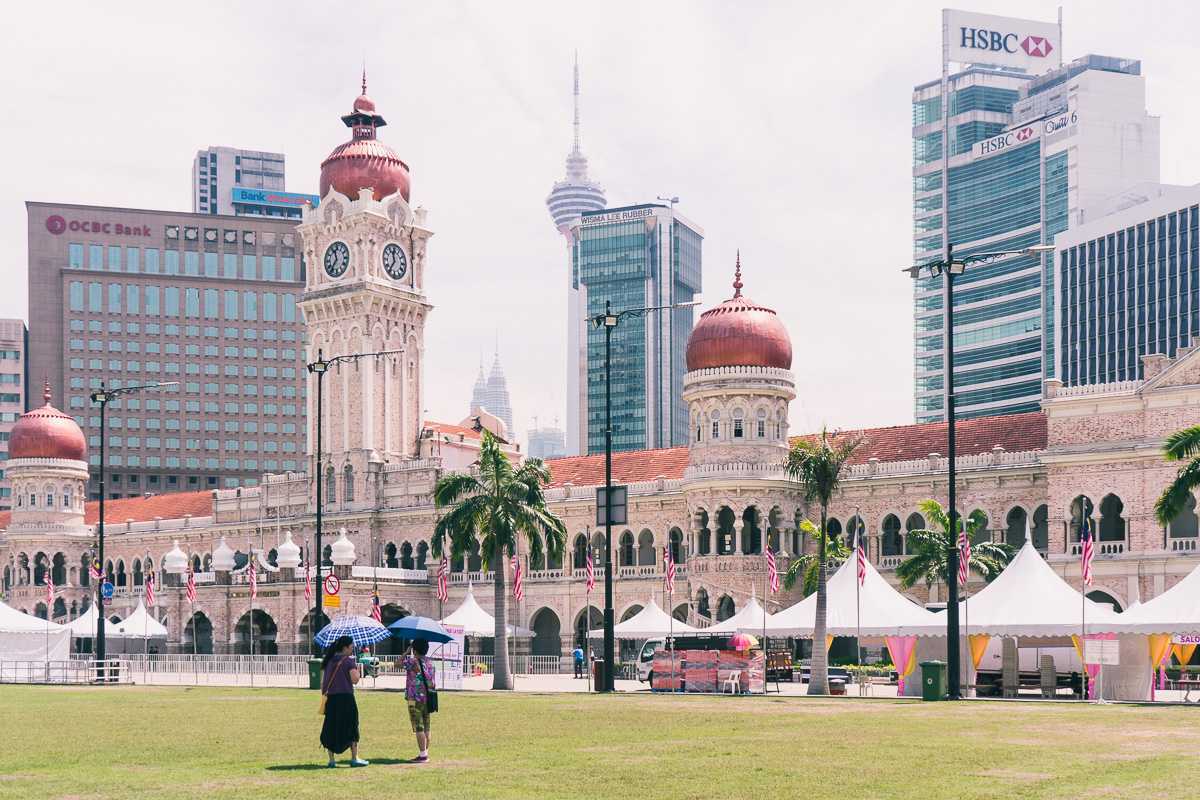
Merdeka Square
A little something for history buffs: This is where the Malaysian flag was first raised in 1957 and independence from Great Britain was celebrated. It’s really just a large lawn—it used to be a cricket field, after all. But the building on the square, the Sultan Abdul Samad Building, is well worth seeing with its huge clock tower, unusual spiral staircases, and arcades.
In addition, the two tourist information centers are a good reason to stop by here. One is the national tourist office for all of Malaysia, located in the Sultan Abdul Samad Building, and just a few meters away across the square is the Kuala Lumpur tourist information office. Here, you can pick up some really informative brochures, and the staff are consistently very friendly and happy to offer tips.
Chinatown
There are definitely more authentically Chinese and exciting Chinatowns around the world than the one in Kuala Lumpur. Still, there are some great temples and a lovely indoor market here that you shouldn’t miss:
Central Market
There are some nice souvenir stores and stalls here and a good and cheap food court on the upper floor.
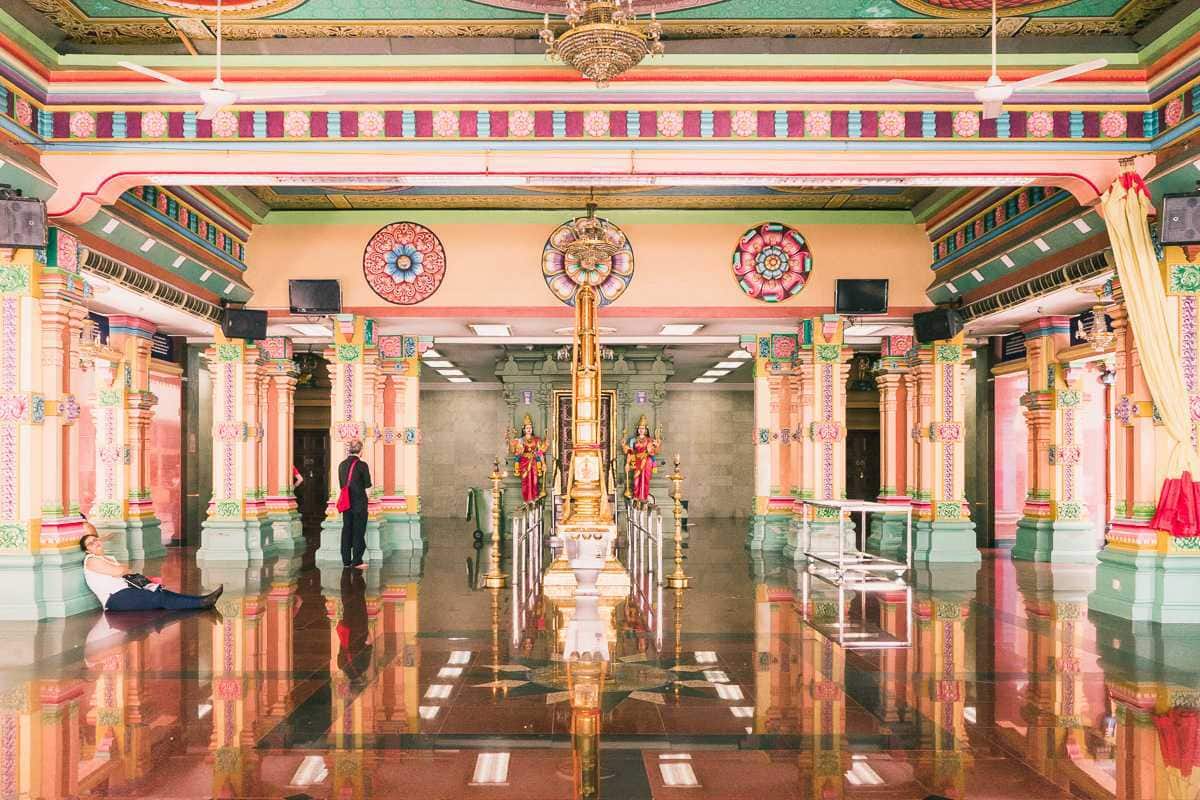
Sri Mahamariamman Temple
A Hindu temple right in the middle of Chinatown—that’s Malaysia for you. When it comes to multiculturalism, no one can outdo them. You take off your shoes at the entrance—just like in Hindu temples, where you walk around barefoot—and then you can explore the temple from the inside. The same rule applies here: it’s best to cover up those skin-tight hot pants. You can rent saris on site.
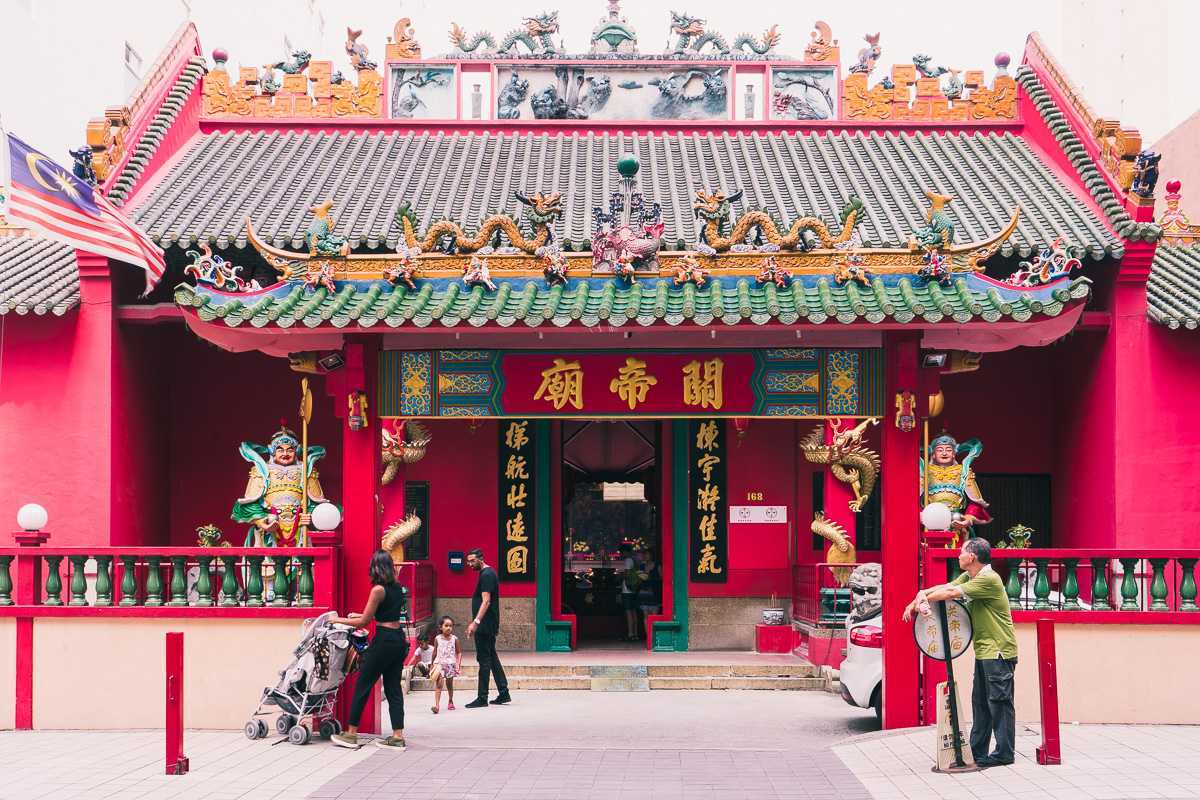
Guan Di Temple
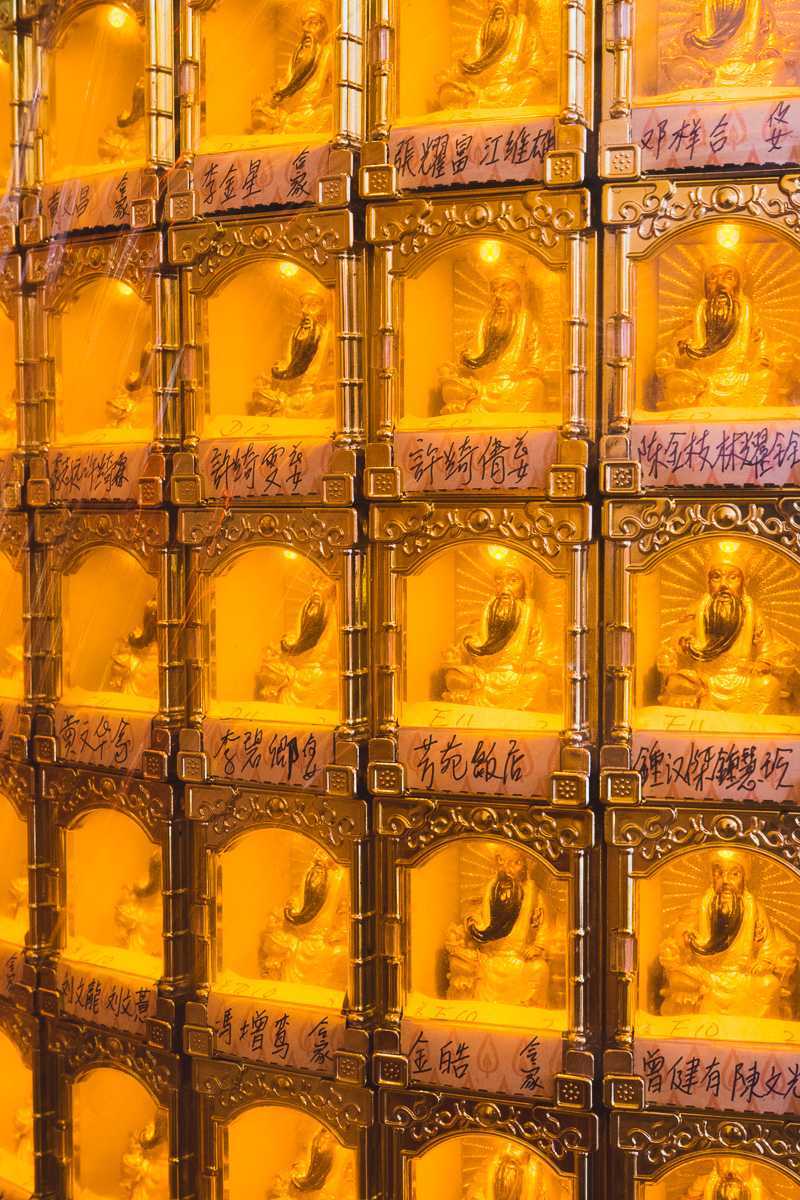
Just a few meters away from the Hindu temple, you find yourself immersed in a completely different world. Here in Malaysia, you can jump from one world religion to another in the blink of an eye. The Guan Di Temple is a Taoist shrine dedicated to the god Guan Di, the patron saint of martial arts. Police officers and triad members reportedly come here in equal measure to seek protection.
Petaling Street
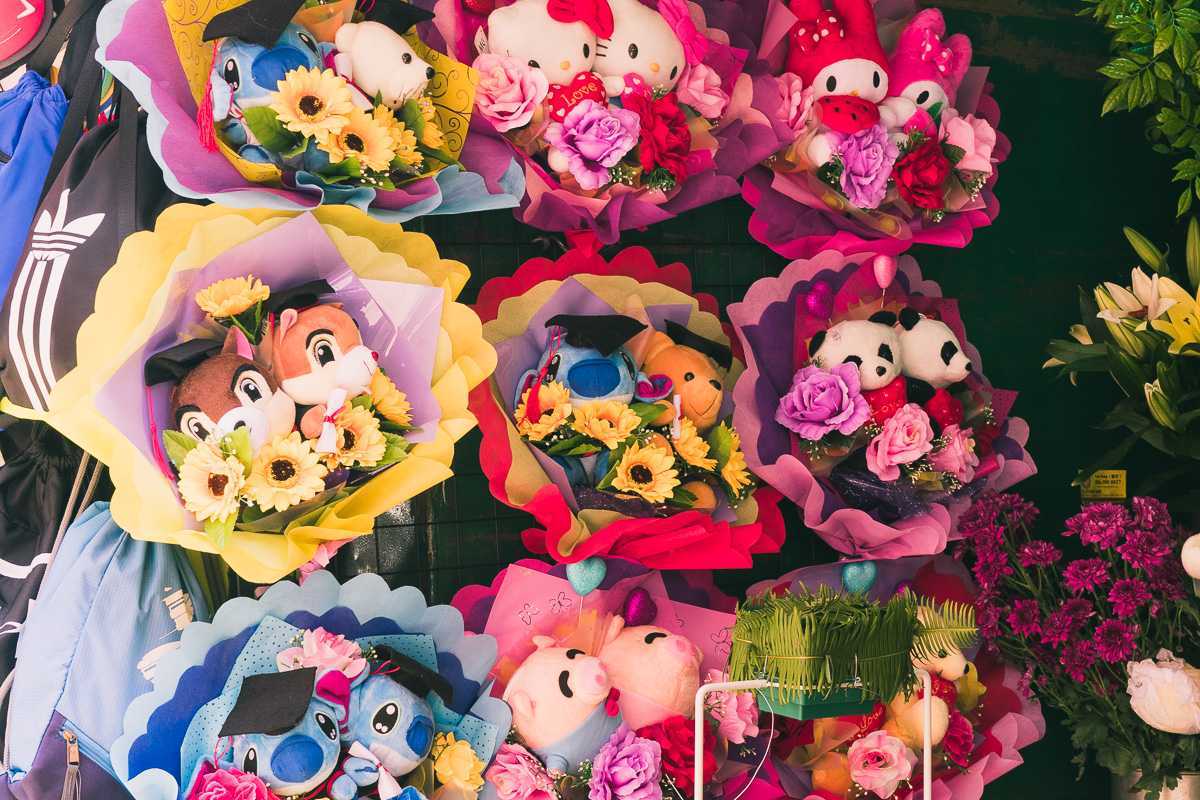
I didn’t find it all that spectacular, but anyone who wants to buy Chinese knickknacks, plastic teddy bear bouquets, and “authentic” counterfeit Louis Vuitton bags, should check out Petaling Street, a covered shopping mall right in the middle of Chinatown and at the heart of the neighborhood.
Jalan Alor Food Street
The best place for nighttime street food adventures is Jalan Alor. You’ll find everything here—but especially plenty of Chinese cuisine. There’s one restaurant after another, endless food stalls, and live music here and there.
Once you’ve had your fill of sampling the food, head over to Changkat Bukit Bintang —a nearby street with plenty of bars, music, and nightlife.
Batu Caves
The absolute highlight of the temples! A Hindu temple carved right into the middle of a huge rock crevice! The imposing statue at the entrance points the way: Steep stairs lead up into the heart of the Batu Caves. Along the stairs, among the trees, there are tons of monkeys: Don’t feed them, hold on tight to small items (cameras, etc.—monkeys are really good at stealing), and just enjoy watching them!
By the way, construction is currently underway at the temple, and the workers welcome any help, since the temple is funded by donations and there’s no admission fee—just grab a bucket of sand at the entrance upstairs, drop it off at the construction site, and take an empty bucket with you on your way out.
Rooftop bars are always a good idea. But the Heli Lounge Bar is really unique, not only for aviators. A REAL helipad (!) in the middle of Kuala Lumpur on top of a nondescript skyscraper with a spectacular, unobstructed view of the sparkling Petronas Twin Towers. Railing? There is no such thing. Free as a bird over Kuala Lumpur – plus drinks at their best. During the day, the helipad is actually used, but at night, the landing pad becomes the most unusual rooftop bar in Kuala Lumpur.
A bit more expensive, a bit difficult to find as there is hardly any signage at the entrance below – but definitely worth it. Downstairs is the lounge bar proper, but stairs and narrow metal staircases take you up to the helipad with the best view ever. It really doesn’t get any cooler than this.
Address: Menara KH Tower, 34th floor, Jalan Sultan Ismail; open Monday through Saturday starting at 6:00 p.m.
Practical tips for travel and transportation in Kuala Lumpur
Kuala Lumpur has two airports: Kuala Lumpur International Airport (KUL), called KLIA, and Sultan Abdul Aziz Shah Airport (also Subang Airport). The latter is the older of the two and is closer to the city, but is now served by only three smaller Malaysian airlines (Berjaya Air, Malindo Air, Firefly). There is no direct flight from Germany to Kuala Lumpur (KUL) – I flew from Berlin with Qatar Airways via Doha, which was the shortest connection.
The public transport system in Kuala Lumpur is very well equipped with subways and buses – but I really didn’t use it much, because in Kuala Lumpur I finally became a total Uber and Grab fan. The two services are unbeatably cheap and super convenient.
I’m not a big fan of hotel chains. Sure, the amenities are usually pretty nice—but somehow it reminds me too much of work, because we usually stay at larger hotels with the crew. And when I have time off, I tend to look for more unusual places to stay, like The Memory at On On Hotel in Phuket.
I landed in Phuket at noon and was actually just passing through on my way to Koh Phi Phi. Half a day should be enough to get from the airport to the boat dock. But somehow it all went wrong, I found myself in a totally overpriced cab to Phuket town – and way too late to catch the ferry from Phuket to Koh Phi Phi.
In the middle of Phuket Old Town: The Memory at On On Hotel
So a hotel was needed, preferably in Phuket City – and The Memory at On On Hotel was just right. The location turned out to be absolutely perfect: there was a great night market just around the corner in the evening!
The location of the Memory at On On Hotel
The location is perfect, right in the heart of Phuket City’s Old Town. Although Phuket was never really a colony like Macau, the Portuguese used to have very close trade ties with Phuket. In addition, many Chinese immigrants arrived and also left traces of their culture, so in Phuket, Thailand, you’ll now find an old town full of Sino-Portuguese colonial architecture. It’s a truly unique blend.
An unique ambience in Sino-Portuguese colonial style
The Memory at On On Hotel is designed entirely in the colonial architectural style and is located near all the attractions in Phuket Old Town. For example, there’s a great street food market just around the corner on Sundays.
The rooms are simply but comfortably furnished. The real charm, however, lies in the atmosphere of the hotel itself. The Memory at On On Hotel is simply a sight to behold. I later learned that the Memory at On On even served as the backdrop for the movie “The Beach” starring Leonardo DiCaprio!
Breakfast is served downstairs in the beautifully decorated lobby; as is customary in Thailand, it isn’t lavish, but it is served beautifully, in keeping with the style of The Memory at On On Hotel.
The Patuxai Monument in Vientiane is one of the central landmarks in the capital of Laos. Built in the 1950s and 1960s, it is meant to resemble the Arc de Triomphe in Paris. But if you look closely, you’ll notice Laotian influences—a unique building that you definitely shouldn’t miss while in Vientiane.
For a few kip (really not much), you can walk up the Patuxai Monument—all the way to the top.
Sightseeing in Vientiane: The Patuxai Monument
As you walk up, you can stop on two floors. Souvenir vendors have set up their stalls there, and you can find all kinds of knickknacks.
One floor reminded me very much of old Russian department stores with high ceilings and their saleswomen behind glass counters. One of the few times in Laos where I felt reminded that I was actually in a communist country.
Once you reach the very top, you’ll come to this romantic spiral staircase—isn’t it pretty? And just look at those ornate window grilles!
Some of the busiest main roads in Vientiane lead to the traffic circle around Patuxai Monument. One of the most central transport hubs, in other words. And here is already noticeable: Vientiane is so very different from most Southeast Asian capitals: No traffic collapse, no constant honking – everything very quiet.
Patuxai Monument: Best at sunset
It is most beautiful up here at sunset. No more crowds, and the setting sun bathes everything in a very special light. The architecture is really very unusual, everything is decorated in great detail.
How do you get there?
Patuxai Monument is located just outside the city center. From the old town (where most of the accommodations are located), it takes about 20 minutes by bike. Bikes can be rented everywhere in the old town. Or you can just take a tuktuk.
Have you ever heard of Vientiane? Neither had I, really, until I planned my trip to Laos. Probably for good reason: Vientiane is simply less spectacular than other major cities in Southeast Asia, like Bangkok or Hanoi. On the other hand, that’s exactly what makes Vientiane so special: it just feels like a big village.
The skyline of Vientiane: The Don Chan Palace
Vientiane lacks true skyscrapers, which is unusual for an Asian city. The only exception is the Don Chan Palace, a 14-story hotel that stands out as an architectural misfit in this peaceful city. Interestingly, it is also the tallest building in Laos, although it’s hard to imagine given the city’s skyline. No building in Vientiane can surpass the Patuxai Monument, one of the few prominent landmarks in the city.
Vientiane’s must-see attractions
Vientiane is a small city, which makes it easy to get around. Most of the main sights are close to each other, so you can explore at your own pace and see a lot in just a short time. You’ll still have time to relax with a great Laotian coffee at one of the cozy cafés in the Old Town or try different foods at the night market along the river.
The Patuxai Monument resembles the Laotian version of the iconic Arc de Triomphe in Paris, though it was only built in the 1960s. When you reach the top, you’ll enjoy the most incredible view of the city, and the monument itself is quite charming with its many intricate details. Visiting in the afternoon is lovely, especially when the weather is clear and the sunlight makes everything glow beautifully. Just remember to arrive early, as the monument closes at 5 p.m., so you don’t miss out on the experience.
That Luang: The Golden Landmark
The huge stupa of That Luang is Laos’s most important religious landmark. It’s big, golden, and truly impressive. Though you can’t get very close, it’s definitely worth seeing. The complex is expansive and features some beautiful temples and buildings. The best way to explore the area is by bike, which you can rent easily anywhere in the city. Biking is a fantastic way to enjoy the whole site comfortably.
That Dam: The Forgotten Stupa
That Dam is a large, old stupa located in the middle of a residential neighborhood, now abandoned. Surrounding the square are a few restaurants, making it a pleasant spot to enjoy a quick break from sightseeing.
How to Get to Vientiane
By Bus
Intercity buses stop at either the northern or southern bus station, both of which are quite far from the city. Afterward, depending on traffic, you’ll need about 45 minutes in a tuk-tuk to reach the city center. Private tourist buses are more convenient; they typically go directly to the Old Town, where most of the city’s hotels are located. City buses operate from and return to the central bus station near Talat Sao, right in the city center.
Heading north, the bus has become less significant since the railway opened; few people now opt for the winding road to Vang Vieng or Luang Prabang. However, for trips south to Thakhek and Pakse, and for long-distance routes to Hanoi or Hue, it remains the primary choice. Schedules and prices are available on 12Go Asia.
By Train
This is the area that has seen the most change since my last visit. Vientiane now features two train stations, each part of a different rail network.
The China-Laos Railway has been operational since December 2021, starting from Vientiane Station in Don Noun, about 15 kilometers northeast of the city center. From there, you can reach Vang Vieng in just over an hour and Luang Prabang in approximately two hours. Previously, the bus journey to these destinations took about eight to ten hours. The northernmost border station is Boten, where once daily, a through train connects directly to Kunming in China. Tickets are in high demand, especially on weekends and holidays, and can be purchased at the station, through the LCR Ticket app, or at various travel agencies. Note that tickets for departures from Laos are only sold within Laos and are not available for advance purchase in China.
Since July 2024, there has also been a direct overnight train from Bangkok. It departs in the evening from Krung Thep Aphiwat Station and arrives in Vientiane the next morning—the trip takes about eleven hours and includes border checks handled directly at the stations—you don’t have to change trains. The train arrives at Khamsavath Station, about seven to nine kilometers southeast of the city center.
A sleeper car typically costs around 30 euros, varying with the class, while a standard seat is much cheaper. Trains operate multiple times daily between Udon Thani or Nong Khai and Khamsavath, making travel especially convenient if you’re catching one of the modern Thai night trains to the border.
Tip: If you’re arriving by train from Bangkok and plan to continue on to Luang Prabang, you’ll need to arrange an additional taxi or bus ride from Khamsavath Station to the China-Laos Railway station. Allow at least an hour for this trip. Also, you cannot book a through ticket.
By plane
The small Wattay Airport (VTE) is located just about three kilometers from the city center; a taxi ride to the Old Town takes ten to fifteen minutes.
Thai Airways and Thai AirAsia fly from Bangkok; Vietnam Airlines and VietJet fly from Hanoi and Ho Chi Minh City; and Scoot flies from Singapore to Vientiane. In addition, numerous flights to China are operated by China Eastern, China Southern, and other airlines. Within Laos, Lao Airlines, Lao Skyway, and Lanexang Airways operate flights. There are no direct flights from Europe.
Luang Prabang feels like a charming place frozen in a gentle moment. The relaxed pace of life and the warm, easygoing nature of the people, just like in the rest of Laos, make it truly special. The Old Town is undoubtedly the heart of Luang Prabang—no surprise that most tourist stays are centered here. I’ve put together a list of all the wonderful sights you can enjoy in Luang Prabang. And just to be honest, I have to say: Luang Prabang really left a lasting impression on me.
Temple over temple in Luang Prabang
Luang Prabang is the spiritual heart of Laos. While temple visits are generally worthwhile in Southeast Asia, in Luang Prabang they are an absolute must! Here are some of the most beautiful temples:
Don’t miss the chance to see the sunset from Phou Si (or Phusi) Mountain—it’s truly unforgettable! The stunning view of the city and river will stay with you forever. To enjoy the best sights, try to arrive early and find a cozy spot to take it all in.
There isn’t much space at the top of the mountain, and it tends to get crowded. It’s important to drink plenty of water in the Asian heat, especially while climbing. Just keep in mind that there are no restrooms at the top, so try not to overdo it with the water.
There are two ways up, one on the Nam Khan side, the other just in front of the National Museum.
The Night Market in Luang Prabang
Every city in Southeast Asia has a night market. In Luang Prabang, the Night Market operates daily from 6pm along Sisavongvang Road, directly opposite the National Museum. Even if you’re not interested in typical tourist attractions, it’s definitely worth taking a closer look here. A few things are really different and the prices are quite reasonable.
Food Drinks
In Luang Prabang, you’ll never go hungry. Around every corner, you’ll discover cozy pubs, cafés, and restaurants offering delicious meals. While the street food scene is limited mostly to a few spots at the Night Market, there are plenty of affordable restaurant options as well, making it easy to enjoy a great meal whenever you like.
Restaurant Tip for Luang Prabang
Och Pop Tok is a small textile manufacturer with great handmade and fair-trade products. If you’d like, you can also take the free shuttle to their small production facility just outside the Old Town. And, by the way, there’s a cozy café near the store:
Where to Stay in Luang Prabang
Compared to the rest of Laos, staying in Luang Prabang tends to be a bit more expensive, especially during special holidays like Lao New Year in April. But I found the prices to be quite reasonable overall. If you’re looking to indulge a little, definitely consider exploring the charming luxury hotels in town. They offer a lovely, unique feel that sets them apart from the big hotel chains—which are less common here, or often come with individually managed accommodations that add to their special charm.
3 Tips for Different Budgets
Basic: View Khem Khoung Guest House —cozy, French owner, helpful and friendly, great location Mid-range: My Dream Boutique Resort —a charming resort nestled in a tropical garden Luxury: 3 Nagas Luang Prabang —it’s a hotel chain, but: unique atmosphere, cozy, few rooms, and great deals during the off-season
Tours from Luang Prabang
There’s plenty of nature to discover around Luang Prabang, and three destinations top the list. The Kuang Si Waterfall is the absolute highlight among them—turquoise-blue pools, multiple cascades, and plenty of time to just sit back and take it all in. I’ve written all about it in a separate article: Kuang Si Waterfall: Welcome to Paradise
The Tad Se Waterfall, on the other hand, isn’t really worth visiting during the dry season because there’s simply not enough water flowing—if you’re traveling during this time, you’re better off skipping the trip. Unfortunately, I missed the Pak Ou Caves myself, but they’re said to be very beautiful: two caves on the Mekong, crammed with thousands of Buddha statues that worshippers have placed there over the centuries.
I don’t know what it was. I, who was quite carried away from a 24-hour trip from Berlin to Luang Prabang in northern Laos, or the city itself, still on the ropes from the Buddhist New Year celebrations two weeks earlier. Luang Prabang was so incredibly quiet and calm, sleepy, yet relaxed. I had not expected this calm. And it was hot. Incredibly hot.
Was this something the tranquility of Luang Prabang that I had read and heard so much about before? I have rarely experienced a place that radiates so much relaxation. It felt as if I had landed from busy Berlin straight into another dimension, where there is a completely different concept of time – it didn’t seem important here at all.
On my Laos blog page, you’ll find even more tips for this fascinating travel destination
Luang Prabang: The beginning of a journey through Laos
No rush, no hurry. Just a small, pretty place, in the middle of nowhere, on the peaceful flowing Mekong River. Full of the most beautiful Buddhist temples, at the very end of the world. Luang Prabang was definitely the right place to start a journey through Laos.
I could have easily spent two weeks in Luang Prabang, just relaxing. Unfortunately, I did not have quite so much time, but I swore to myself: Someday I’ll be back, and then I’ll rent one of the great accommodations in Luang Prabang and just do nothing but enjoy.
I ended up stranded in Phuket—or rather, Phuket Town—unexpectedly during my trip to Thailand. Phuket is known for its beaches, package tours, and the Thailand you see in travel brochures. But after a long day of traveling and endless arguments with taxi drivers over far too expensive fares, I’d lost all interest in any major adventures. Lucky me!
It’s rare to find something like the Old Town of Phuket in Thailand: a mix of Chinese and Portuguese colonial flair.
I hadn’t actually planned to stay in Phuket, but rather to take the ferry directly to Koh Lanta—though the ferry for that day had already left. So, at the next available opportunity, I ended up near the pier in Phuket Old Town. There I was—right in the middle of Phuket’s wonderful Old Town, which I would never have discovered if everything had gone according to plan. Phuket Town was a surprise and completely different from what I’d heard about Phuket up to that point.
The red lanterns provide the Chinese touch in Phuket town.
Phuket Old Town: A mixture of China and Portugal
Phuket used to be a trading and transshipment hub for both the Chinese and the Portuguese —which is why many buildings in the Old Town still bear the hallmarks of this unusual combination.
Many buildings from that era still stand, and there has been a great deal of modernization and restoration, especially in recent years, which adds greatly to the charm of Phuket Town.
Even on rainy days, Phuket’s Old Town is a worthwhile destination: Many small, quirky cafés and shops invite you to pop in, and the overall atmosphere is young and creative. And the wonderful pastel-colored building facades do the rest, making it impossible to stop gazing and marveling.
Sunday Walking Street Market in Phuket Old Town
I was lucky to end up in Phuket Town on a Sunday, because that’s when the Sunday Walking Street Market takes place, featuring all kinds of street food stalls and the most delicious treats. I just love street food in Thailand!
For me, this is the best chance to try Thai cuisine. You often get small portions, too. That way, you can spend the whole evening strolling through a night market and working your way from one street food stall to the next.
Street Food & Live Music
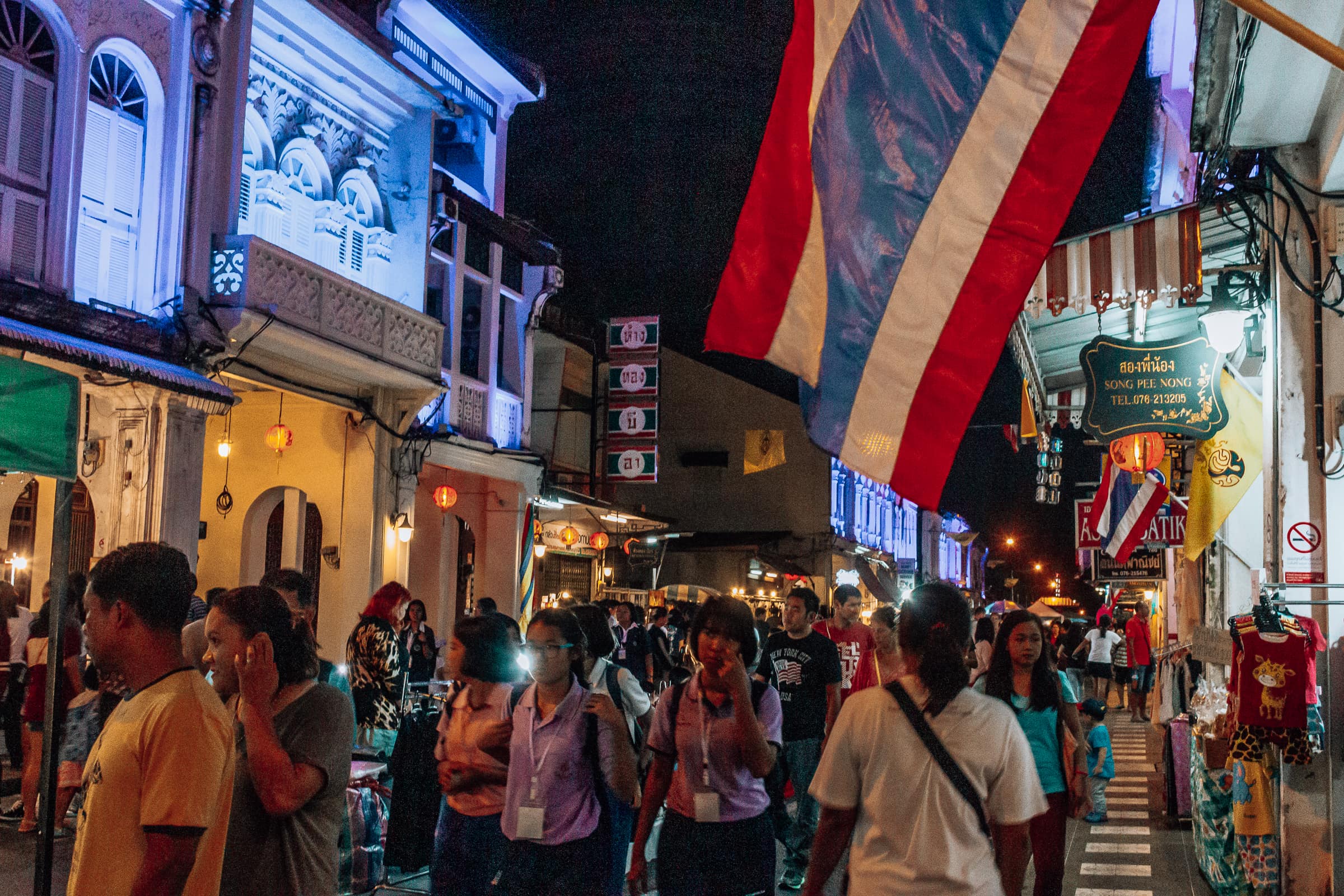
At the night market in Phuket Town—the Sunday Walking Street Market—there’s not only street food but also plenty of entertainment! So you can simply stroll from stall to stall or just listen to the live music: there’s a small stage set up right in the middle of the market.
I didn’t see that many Western tourists either—actually, there were more Thai people around. So the market seems to be (still) a real hidden gem! The room at Memory at On On turned out to be a total stroke of luck—it was right around the corner! I highly recommend it, especially if you’re just passing through on your way to Koh Lanta, for example, or island-hopping through the Andaman Sea.
The market is held every Sunday from 4:00 p.m. to 10:00 p.m. on Thalang Road in Phuket Old Town. The name “Lard Yai” means “big market” and comes from the Talat Yai district.
Starting around 3:00 p.m., the entire street is closed to cars, and the vendors begin setting up their stalls. The stalls are set up in the middle of the street, leaving a narrow path on both the left and right for pedestrians. If you come in the afternoon, you can still take your time exploring the charming side streets and shophouses. Things get significantly busier starting around 7 p.m.
You should plan on spending one to two hours exploring the entire length of Thalang Road, plus a detour into the side streets—or even longer if you stop for meals. Most of the shophouses are open as usual during the market.
The motorcycle trip over the Cloud Pass in Vietnam held many surprises for me. Every few kilometers we stopped. My driver told me a story, showed me the most beautiful views, and dropped me off somewhere for dinner or coffee. Then in Da Nang we suddenly stopped at an elevator that seemed to be in the middle of nowhere. It quickly became apparent that the elevator led high up on the Marble Mountains.
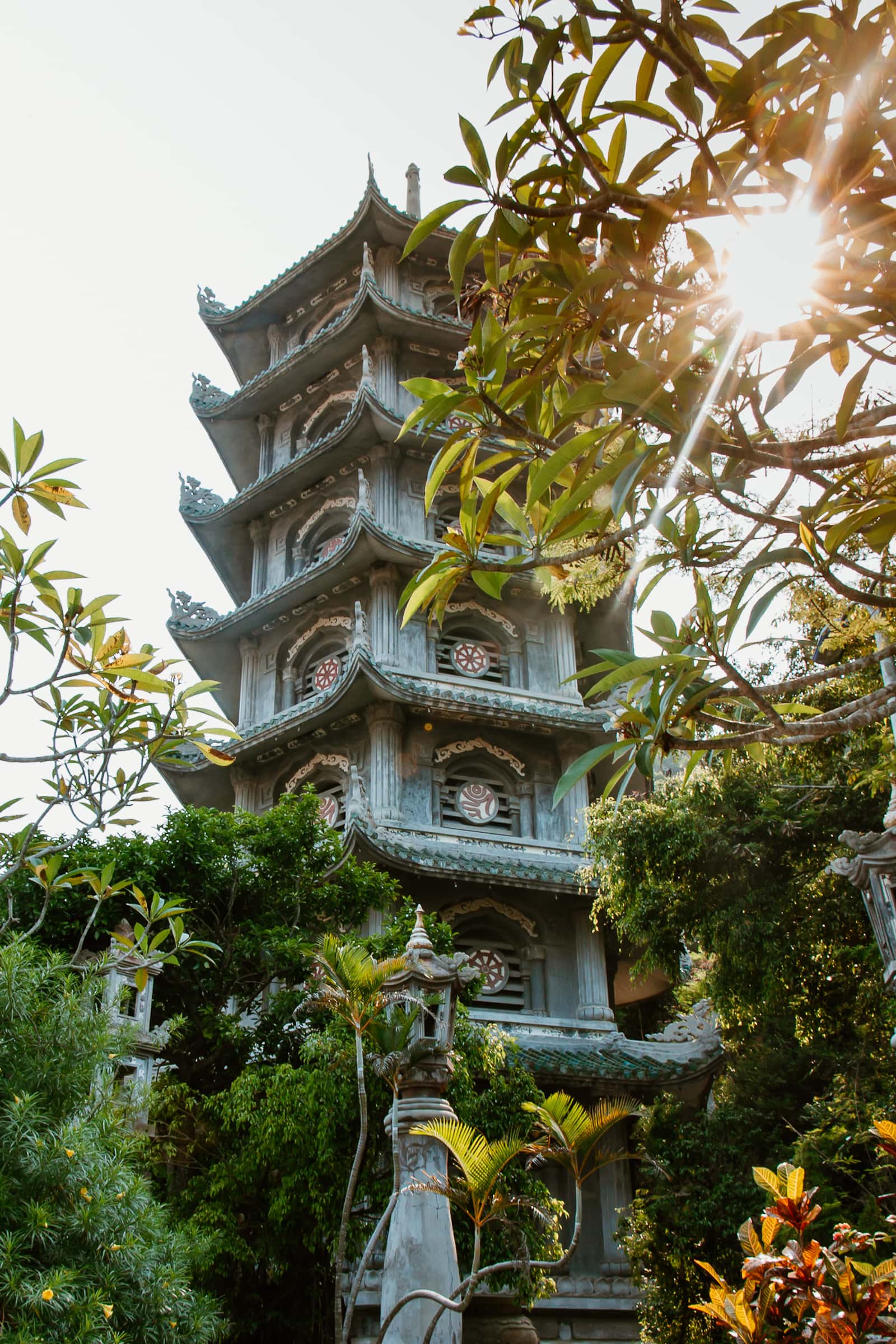
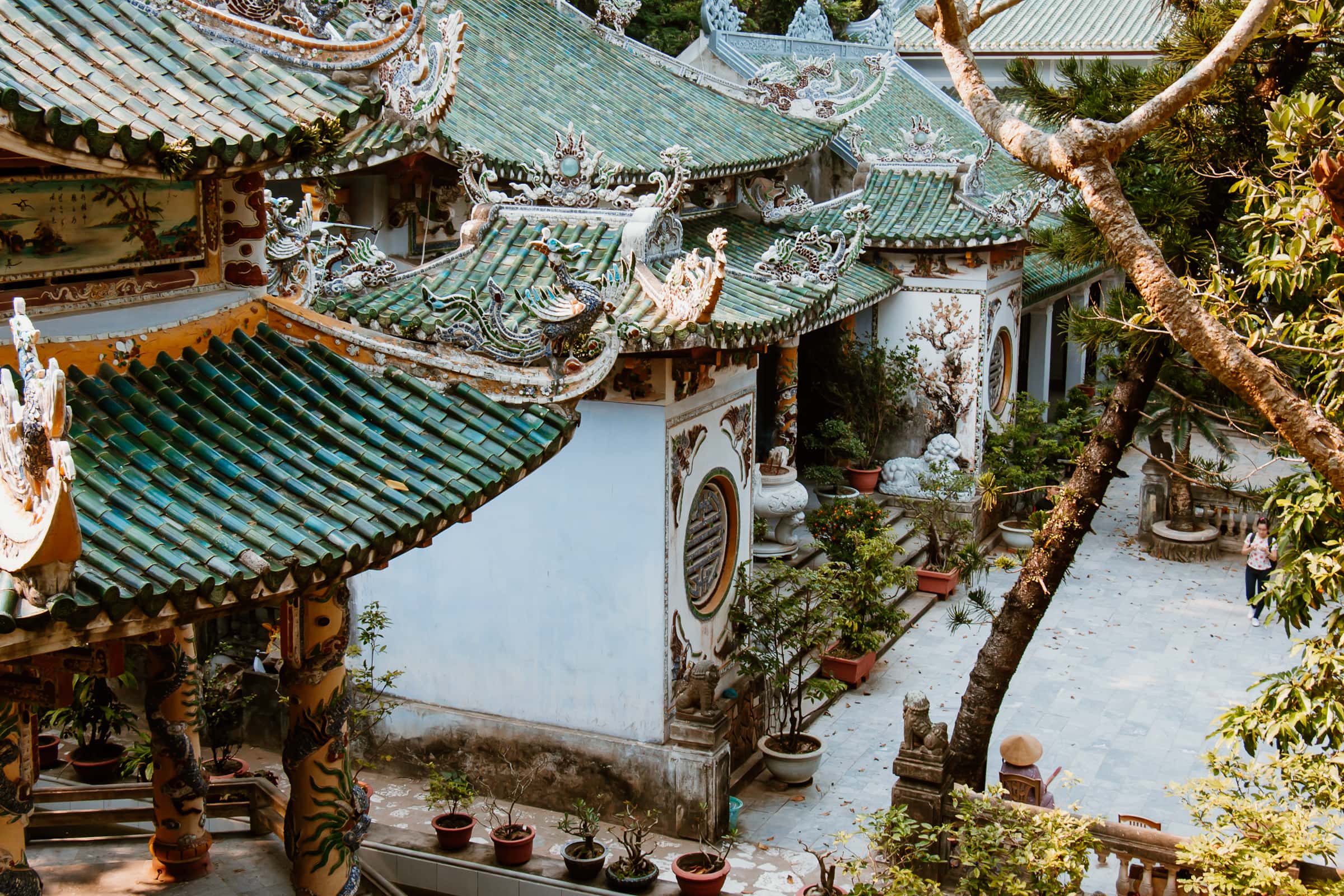
For me, one of the absolute insider tips in Vietnam: The Marble Mountains near Da Nang have really impressed me and were an absolute surprise on the trip!
The Marble Mountains near Da Nang: A real insider tip in Vietnam.
My driver Duc would not go up, but now bought me a ticket for me to go all the way down again. (What can now be summarized in one sentence was a quarter of an hour pantomime show due to his English and my non-existent knowledge of the Vietnamese language).
The Marble Mountains in Da Nang: An absolute surprise!
That’s all I could get out of Duc, so I just drove up. Probably the Marble Mountains were just a barren tourist trap for some marble souvenirs, I thought, and once at the top I immediately looked for the fastest way down. Not so easy – there were no signs, I didn’t even know where I had landed; and many winding paths led to a few temples and Buddha statues – but not down to Duc.
In any case, there were a few tourists around, so this must have actually been some kind of tourist attraction. One of the elderly ladies in front of the temple talked me into buying a few incense sticks, and I briefly enjoyed the silence before continuing my way down the hill.
Check out my Vietnam blog for more interesting travel stories!
Thanks to the lack of signage, I wandered around a bit until a couple of Vietnamese shouted “here, here!” to me between the densely overgrown paths around the temple. So I just follow behind. (Hm. As a solo traveler I should probably work on this naive reflex – strange men call “this way” and I’ll just follow.)
The Marble Mountains in Vietnam: So many caves
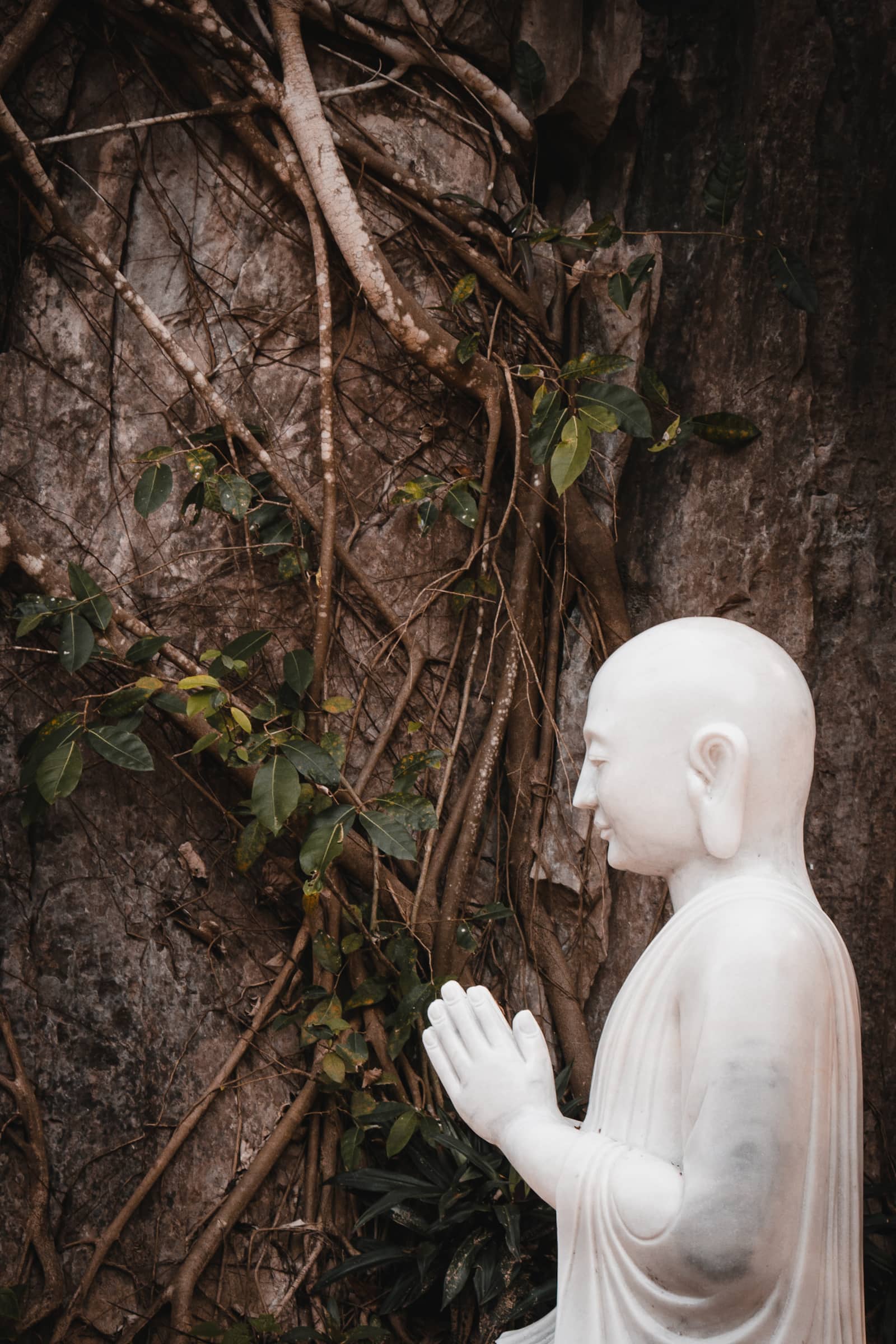
The path led behind the temple and grew darker and darker. A few other tourists were also wandering around. My curiosity was piqued. Suddenly, I found myself standing in a cave that was incredibly tall and densely overgrown—and I felt like Indiana Jones. What on earth was this? I glanced briefly into the dark, dim corners of the cave. And there, sure enough, were the most beautiful Buddha statues. Just like that.
Beware of the “tour guides” in the Marble Mountains!
Unfortunately, I couldn’t quite enjoy the moment—one of the “here, here” men had already sensed his chance, ran toward me, and snatched my last few incense sticks, which I had actually wanted to keep as a souvenir. I ran after him, and what at first seemed like an attempted purse snatching was probably meant more as a guided tour of the cave.
“Here, to get lucky, get lucky!” my newly appointed cave guide lit an incense stick, pressed it into my hand, and frantically motioned for me to place it in front of a Buddha statue. “Buddha good, Buddha good!” he shouted shrilly. I didn’t have time to take a closer look, because my tour guide had already lit the next incense stick and was herding me toward the next statue.
We must have put on quite a show: the so-called “tour guide,” who was obviously high on too many stimulants, running manically with me from one dark corner to the next, and me, a naive sheep who was slowly starting to find the situation unsettling but who nevertheless decided to go along with the “tour” for the time being, running after the cave guide—who was on speed and waving my incense sticks behind him.
Gloomy atmosphere: Many of the caves in the Marble Mountains are accessible.
Fortunately, my pack of incense was soon completely torched, the “guided tour” through part of the Marble Mountains was over, and I pressed a few dong into the man’s hand, which he already held out to me as a matter of course. I was really worried whether his tip would be enough… Well, then. I’ve learned something new. So, in the Marble Mountains, you have to watch out for “tour guides” hanging around.
Caves & Altars
The way down, however, turned out to be more relaxed, suddenly huge groups of tourists appeared – I was no longer queasy now – and somehow I had half an orientation. Along the way I discovered one cave after another, large and small, sometimes so small that they could only be reached by climbing and crawling. (I recommend good shoes!) Each cave was an experience in itself!
Practical information for the Marble Mountains
You have to pay for the elevator, the exact price slipped my mind, but it wasn’t much.
The Marble Mountains are located centrally in Da Nang, tour operators offer various tours there.
Be sure to pack sturdy shoes—the descent isn’t suitable for high heels, and the stone steps and caves are often slippery.
Be wary of so-called tour guides (see above) and of vendors once you leave the mountain. As soon as you’ve climbed the last step, they’ll immediately be hot on your heels, first trying to strike up a friendly conversation and then trying to foist their marble souvenirs on you.
What else to do in Da Nang
If you’re not continuing on to Hoi An like I am, Da Nang is also a great place to stop for a while. Da Nang has a wide sandy beach with a few beach bars—perfect for a day of relaxation. Also, the Golden Bridge in Da Nang opened a while back—it’s a true work of art that you should definitely add to your itinerary. So spending a night in Da Nang is a great way to explore the area at your own pace!
The Hai Van Pass in Vietnam separates North and South Vietnam. And that’s where I had to go. When I asked at the hotel about the best way to get from Hue to Hoi An, the helpful receptionist advised me to take a motorcycle with a driver. Okay, then just with the motorcycle. If I hadn’t met two English girls in Hanoi on a boat tour through Halong Bay, who had done the same trip in the opposite direction and were totally enthusiastic about it, I probably would have decided against it.
By motorcycle over the Hai Van Pass in Vietnam: An adventure.
On a motorcycle? With 18 kilos of luggage (yes, I travel like a total girl)? The way they drive here? Never. But I couldn’t get the enthusiasm of the two girls out of my head – and I calmed myself down with the thought that they had survived the trip unharmed after all.
Hai Van Pass in Vietnam: Endless serpentines
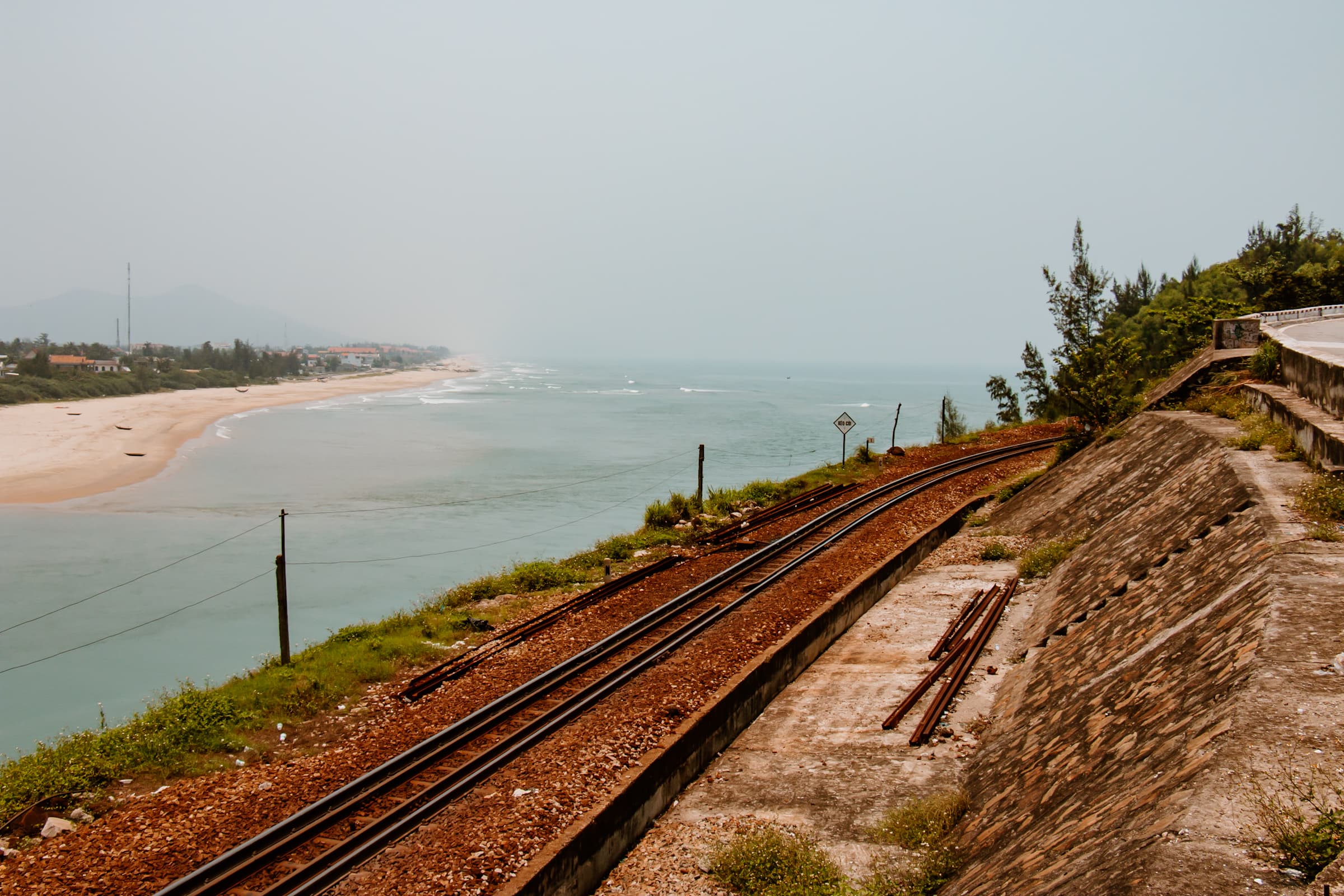
The temptation was there. The route from Hue to Hoi An is very picturesque because it runs right over the Cloud Pass—a mountain range that cuts through the country like a swath, separating northern and southern Vietnam both geographically and meteorologically.
Alternatively, you can do the route by train, bus or private car. Train I already knew, car was too expensive alone and the bus drives dull and without panoramic view through the tunnel under the mountains.
Rent a motorcycle with driver in Vietnam: Safety & Organization
My concerns about safety proved unfounded. My driver Duc conscientiously lashed my luggage to the luggage rack, wrapped in sturdy plastic to protect it from dust, and drove over the Hai Van Pass with European prudence.
Well, the helmet I brought with me only had a chin strap, and no one knows protective clothing in Vietnam either. As a motorcyclist, you’re on the road differently at home. No matter, at 36 degrees you are anyway glad about every piece less on the body. As Duc told me afterwards, we Germans are probably the most shy about a ride with him or with the motorcycle in general: safety and such. Therefore, I would like to put here especially to your heart: If you are ever in Vietnam before the choice… Just do it!
Have you gotten a taste for it? On the Vietnam Blog, you’ll find lots more travel stories and general tips for a trip to Vietnam!
Hai Van Pass Vietnam: Adventurous switchbacks and breathtaking views
I had only booked the ride. Thought. But I have to admit, I hadn’t asked Duc again beforehand where we were actually going along and how the day was shaping up – communication in English was even worse than with the receptionist, with whom I also only understood the most important key data, so I just let it go. I would already arrive in Hoi An.
From Hue to Hoi An: Impressive landscape on the Hai Van Pass
In fact, the one-way trip to Hoi An via Hai Van Pass turned out to be a total surprise package. Duc stopped with me at the most beautiful places on the way, took photos and joked around, and I tried to piece together info about the country and its people from his scraps of English.
The mega wide beach of Da Nang.
Takeaway of the day: Just letting things happen naturally feels so good! If I’d chosen the supposedly “safe” option of taking the bus, I would have missed out on so many wonderful things. The day was absolutely beautiful and worth every cent!
Details about the motorcycle tour across the Hai Van Pass
The Hue to Hoi An motorcycle tour crosses Hai Van Pass, also called Cloud Pass. The package includes both the driver and motorcycle, allowing you to relax and simply enjoy the scenery.
Plan to spend around six to seven hours on the trip. The driving itself is shorter, but frequent stops in the mountains, Da Nang, and the Marble Mountains make it memorable. Because of these stops, it’s best to leave by 9:30 a.m. at the latest to avoid a rush at the end. Departure times are often flexible.
On a fishing boat used to live(!) whole families – up to 8 or 9 people!
You’ll be picked up right at your hotel in Hue and dropped off at your lodging in Hoi An. The driver will carefully strap your luggage onto the motorcycle, and I was able to secure my heavy backpack on the luggage rack for the entire trip. While I can’t speak to larger suitcases or bulkier bags, I suggest checking with the provider ahead of time. It’s truly incredible how much luggage can fit on a motorcycle like that!
If you still have time, you can add the Imperial Tombs in Hue to the tour for a small extra fee—they’re on the way out of town anyway.
If you’re not keen on riding a motorcycle, consider taking the Panoramic Train instead of the bus for the scenic route over the Hai Van Pass. This allows you to enjoy the beautiful views comfortably while traveling.
There I was in Huế after an extremely interesting train ride. Well. I have to say one thing up front: I only stayed in Huế for one day. And this despite the fact that Huế appears in various travel guides that I had devoured as a stop worth seeing on the tourist trail from Hanoi to Ho Chi Minh City.
Somehow I expected more, so I explored the citadel and my hotel district and then decided to travel on the very next day. I didn’t want to get involved with Huế any further. Shame on me. Getting to know the country and its people, immersing in the life of the locals off the beaten track, really getting to grips with a destination: I threw all good intentions overboard. The realization came: Sometimes you just can’t get along with a place. That’s basically it.
The Forbidden City in Hue
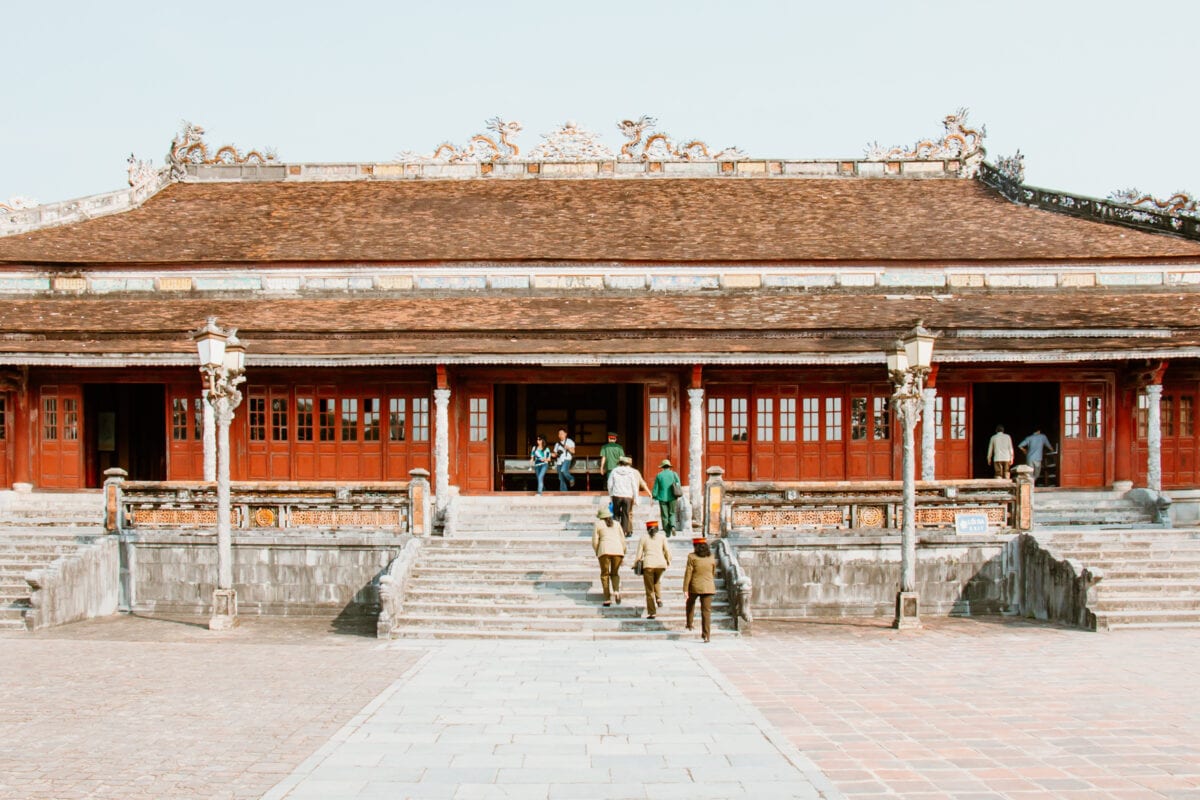
The citadel as a main attraction seemed to me rather uninspiring. Maybe I’m not interested enough in history after all. However, Huế didn’t bother to change that with his citadel either. Although the entrance fee of 150,000 Dong (approx. 6.20€) is very high by Vietnamese standards, the visitor can expect little.
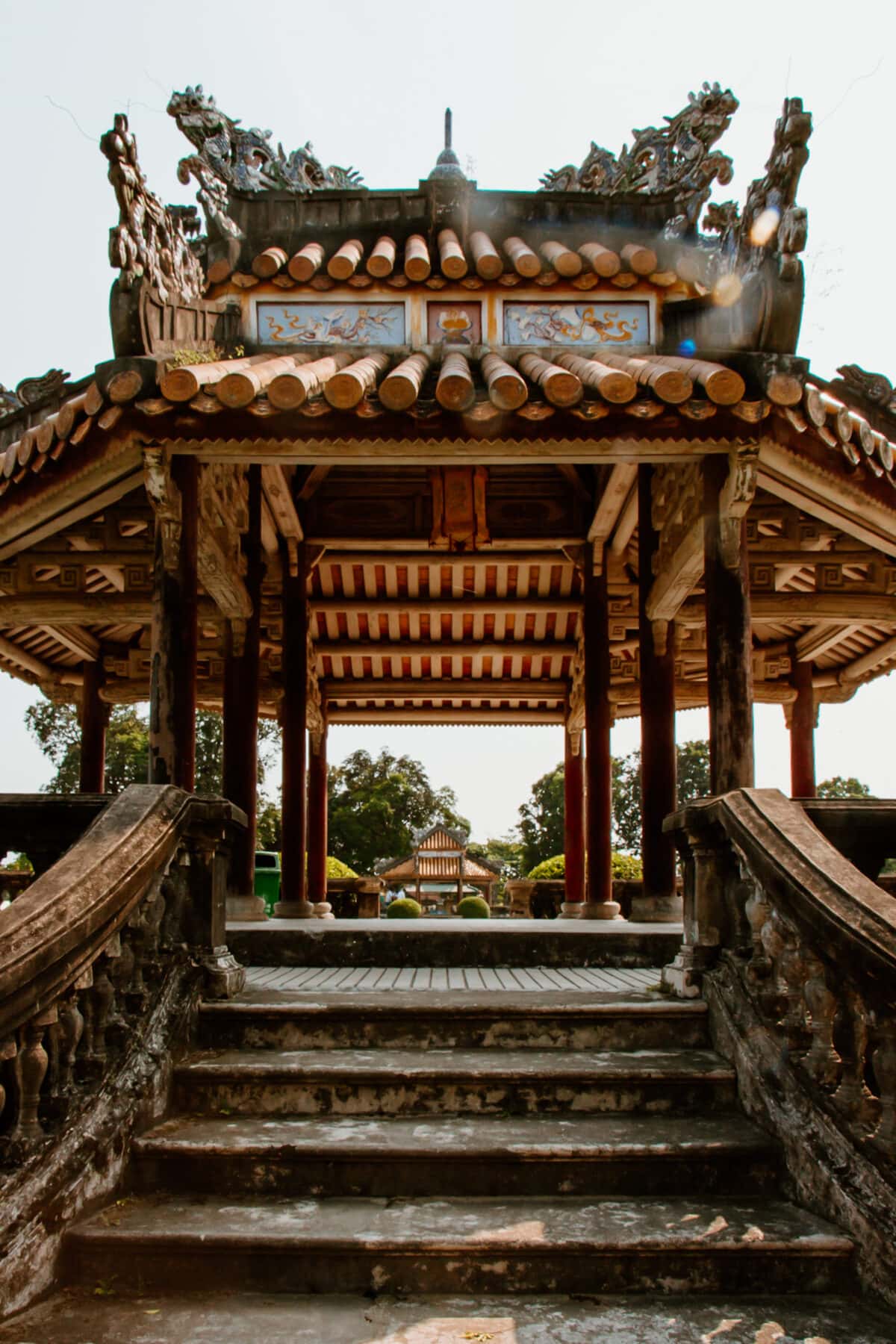
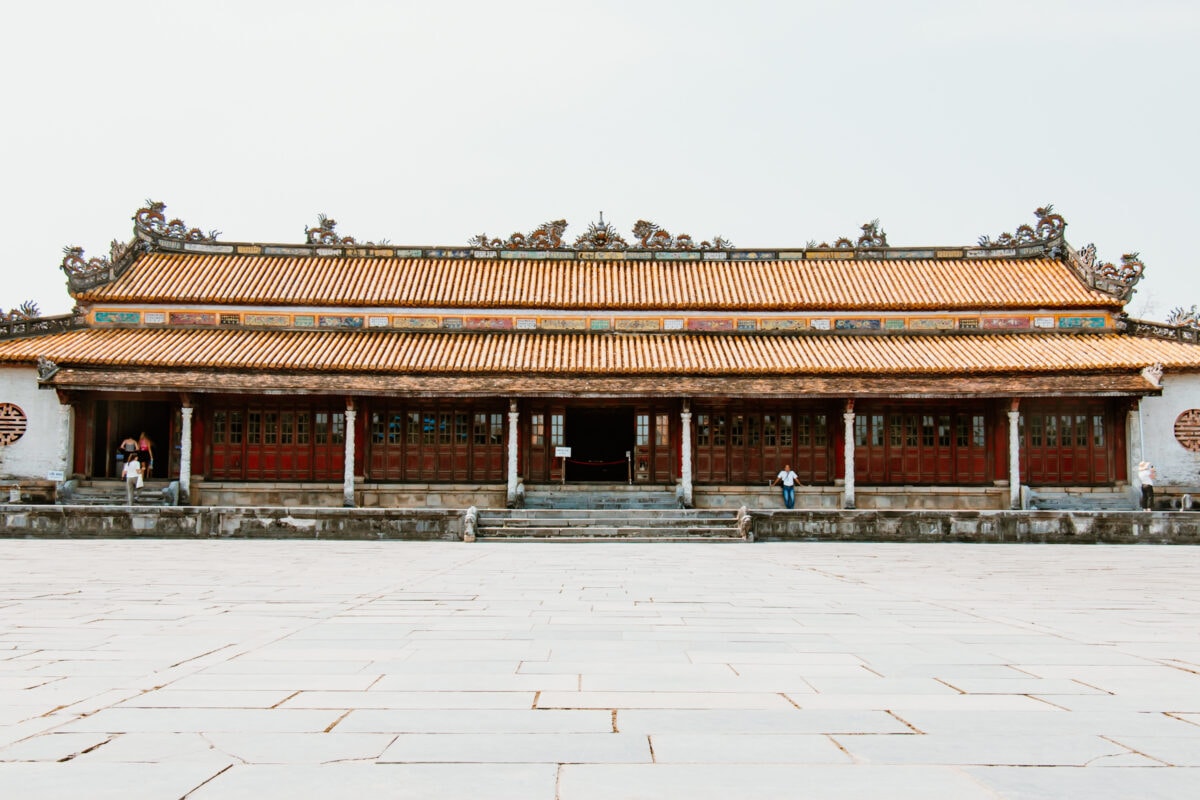
Magnificent: Some buildings in the Forbidden City have been restored in recent years.
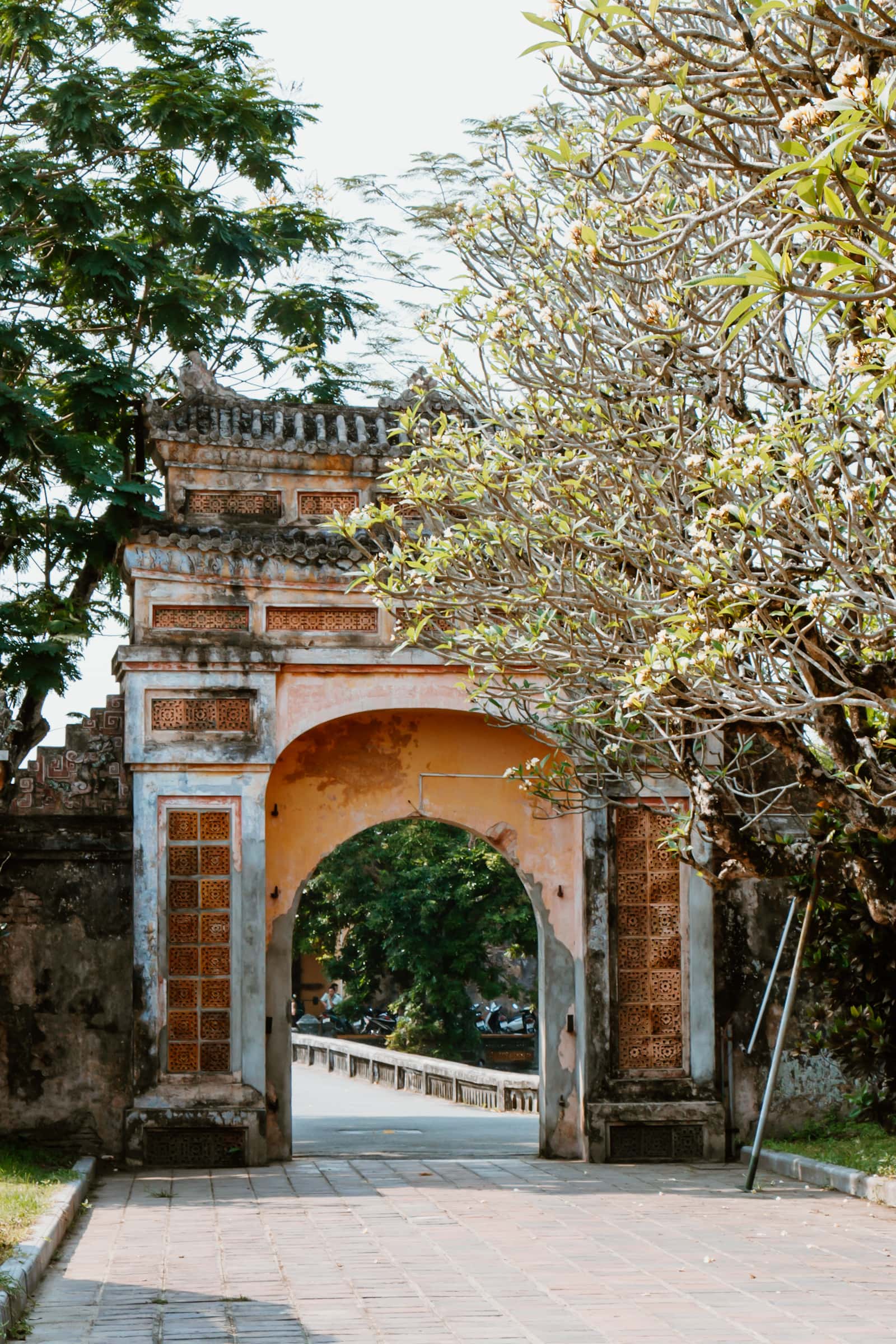
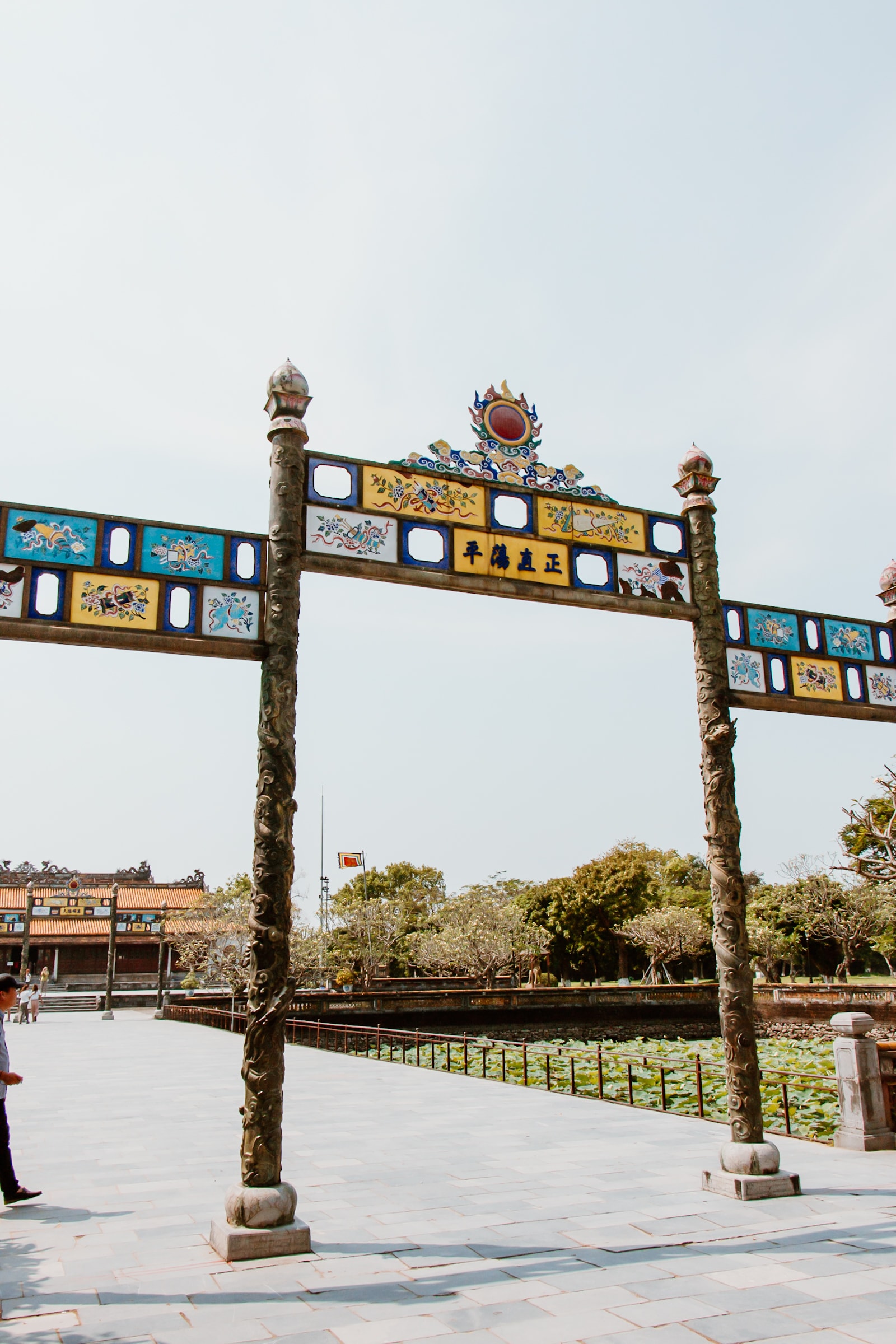
Well, the reconstruction after the destruction during the Vietnam War, which has probably only really taken off a few years ago, is still taking place in many corners – but there is little explanation, there are no or only few signs (and if, then in Vietnamese), so that you learn nothing about the site without an extra hired tour guide or brought guide and stumble aimlessly through the site.
In the main building I finally found a TV in a corner, on which a small simulation was running in an endless loop, how the plant looked like in imperial Vietnam – that was something. Unfortunately, the midday sun also took its toll on me – there are few shady spots and the sun was just burning down on my skull. Good that I like hot temperatures. But it was still enough for a few nice impressions.
Dressing up in the Forbidden City: Costume Rental & Photo Sessions
Those who enjoy costume games can also have their picture taken in one of the buildings in an imperial outfit with a throne and all kinds of majestic paraphernalia:
Information & entrance fees
The Citadel, which includes the Forbidden City, is located on the north bank of the Perfume River and has been a UNESCO World Heritage Site since 1993. Admission costs 200,000 VND for adults; children between the ages of 7 and 12 pay 40,000 VND; and admission is free for children under 7.
The site is open daily, from 6:30 a.m. to 5:30 p.m. during summer and from 7:00 a.m. to 5:00 p.m. in winter. Keep in mind, the grounds are extensive with minimal shade between the palaces and courtyards, making midday visits very hot. Visiting early in the morning is cooler and more comfortable.
If you’re interested in visiting the Imperial Tombs, definitely consider the combo ticket—it’s a great deal! It costs 530,000 VND and gives you two days to explore both sites at your own pace. Alternatively, you might want to join a guided tour that covers both locations in just one day. The tour usually includes tickets and pickup from your hotel, making the whole experience smooth and convenient for you.