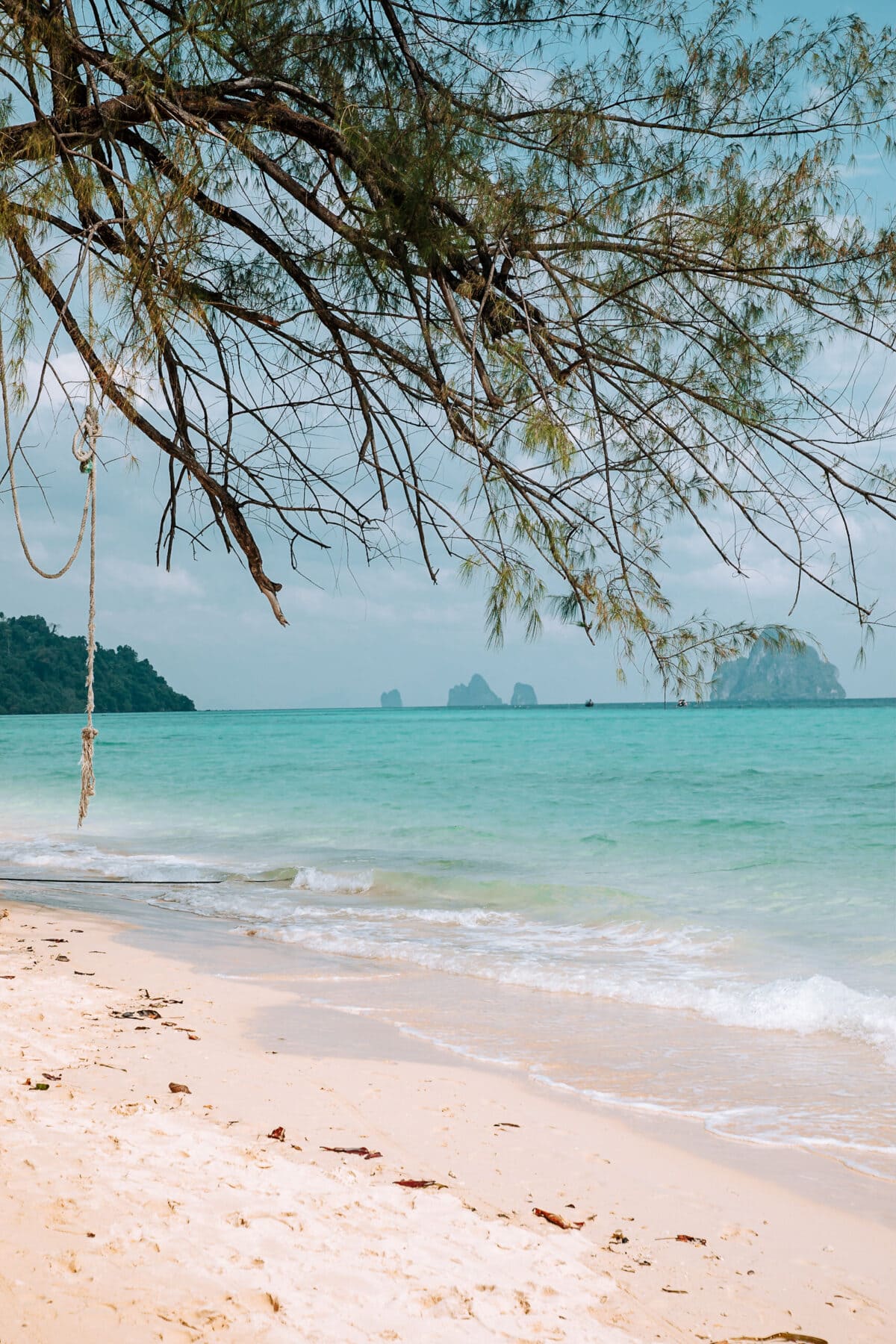
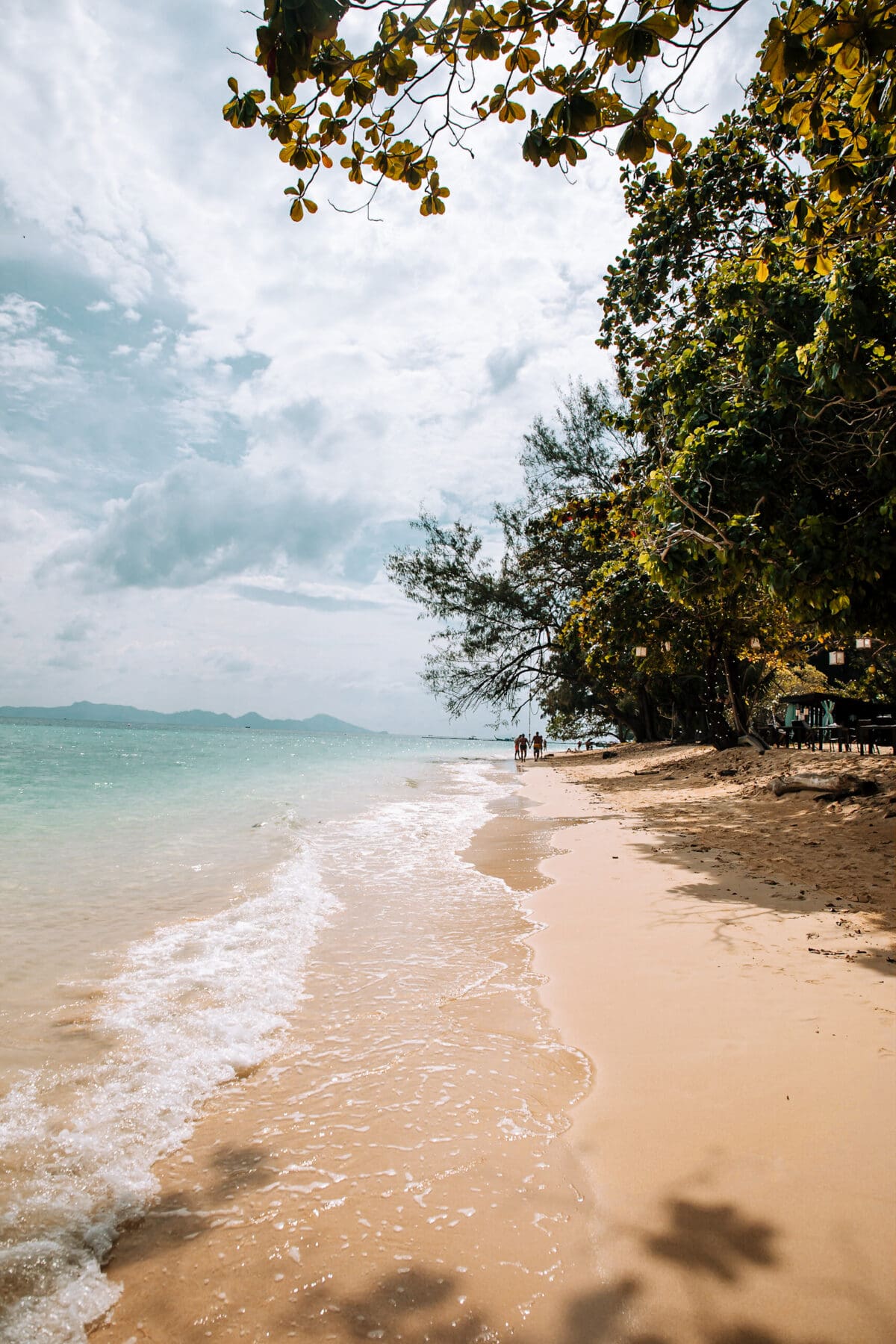
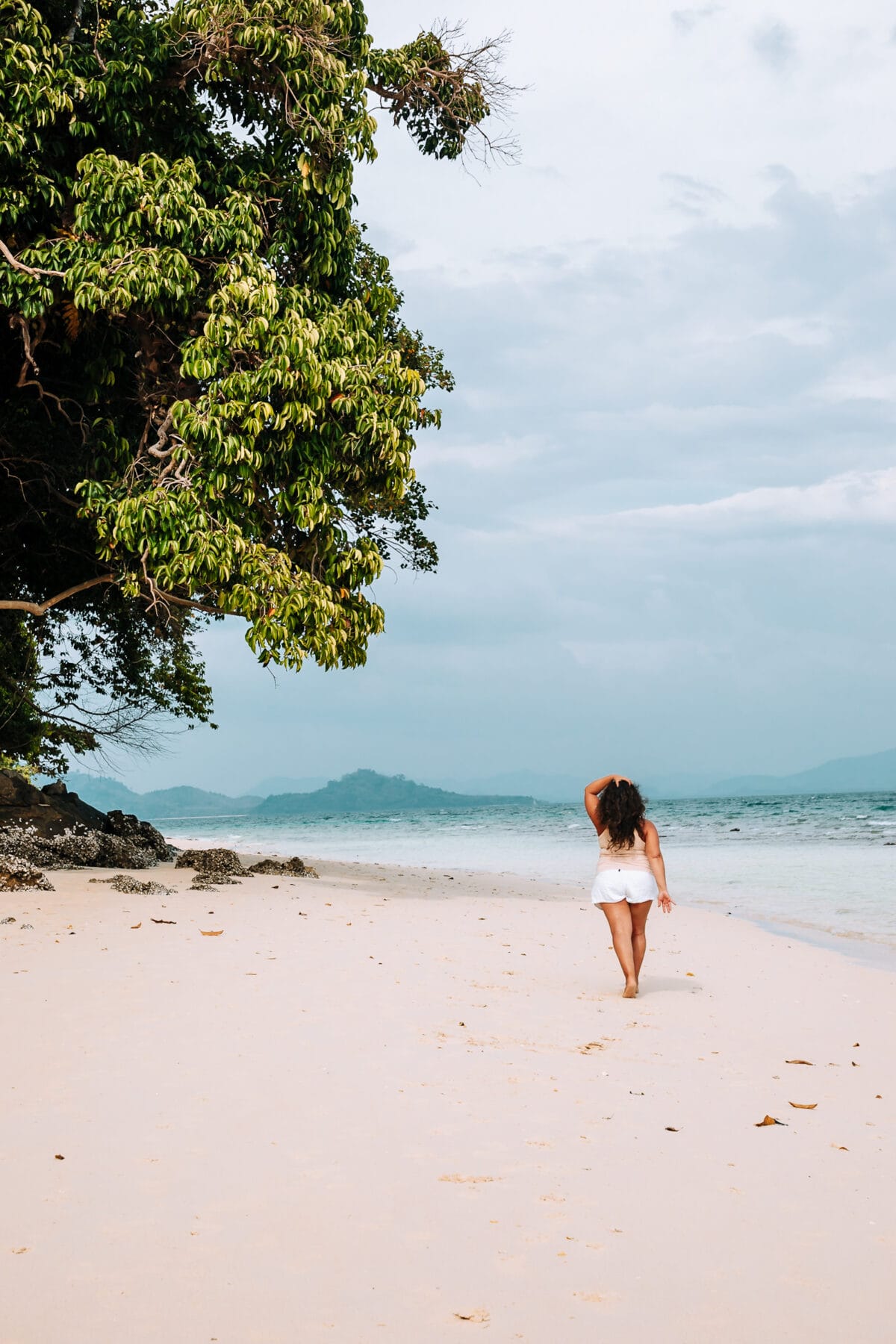
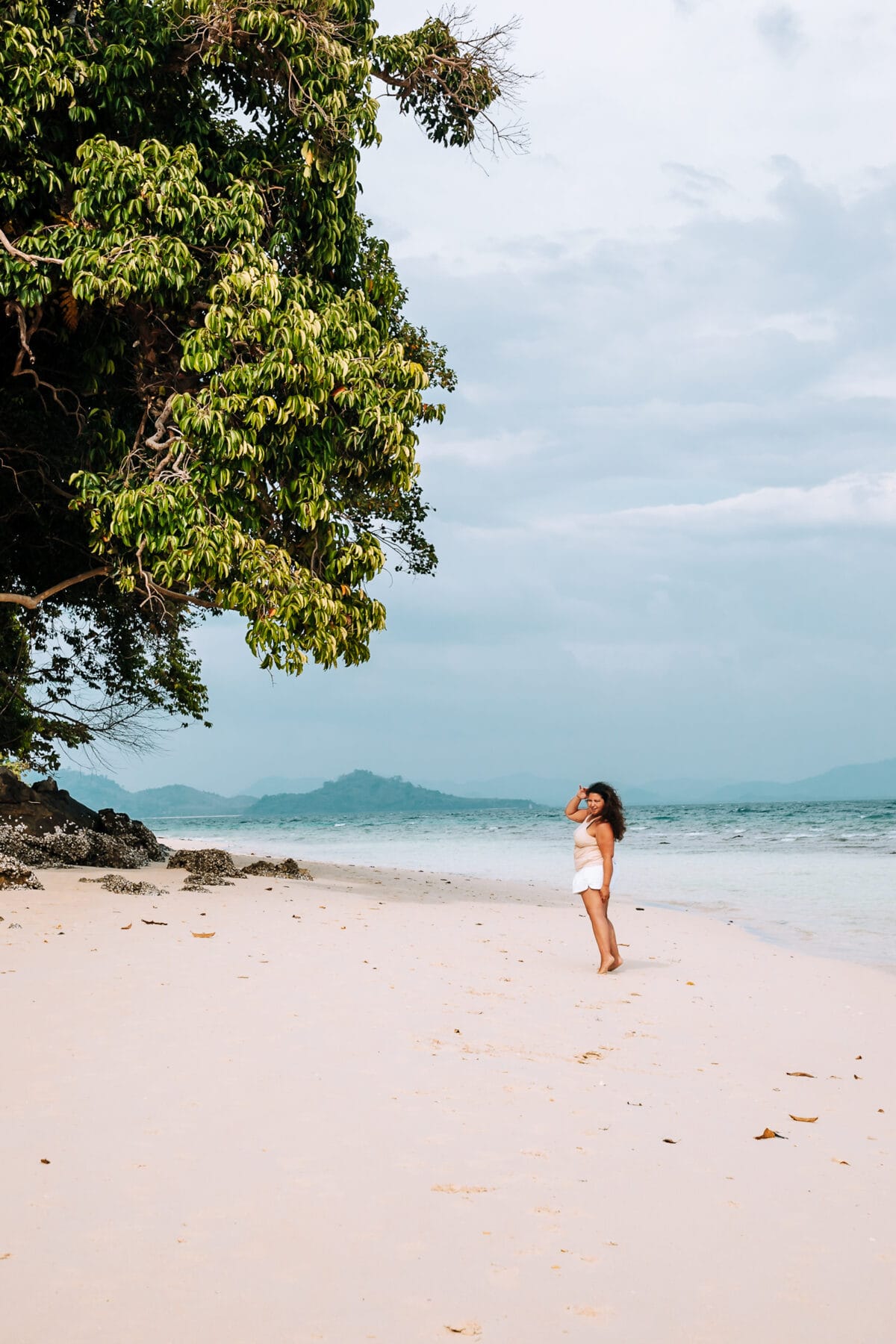
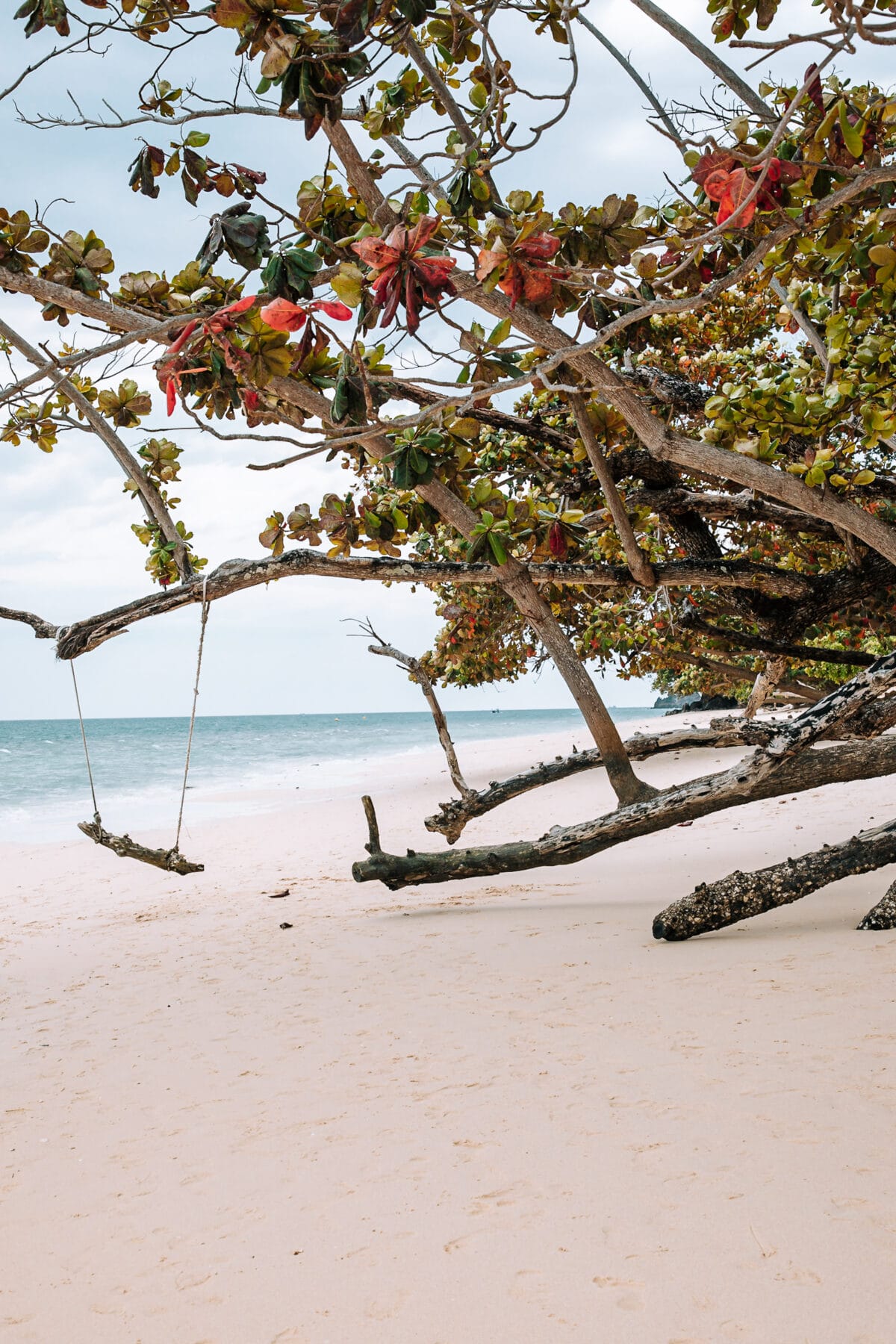
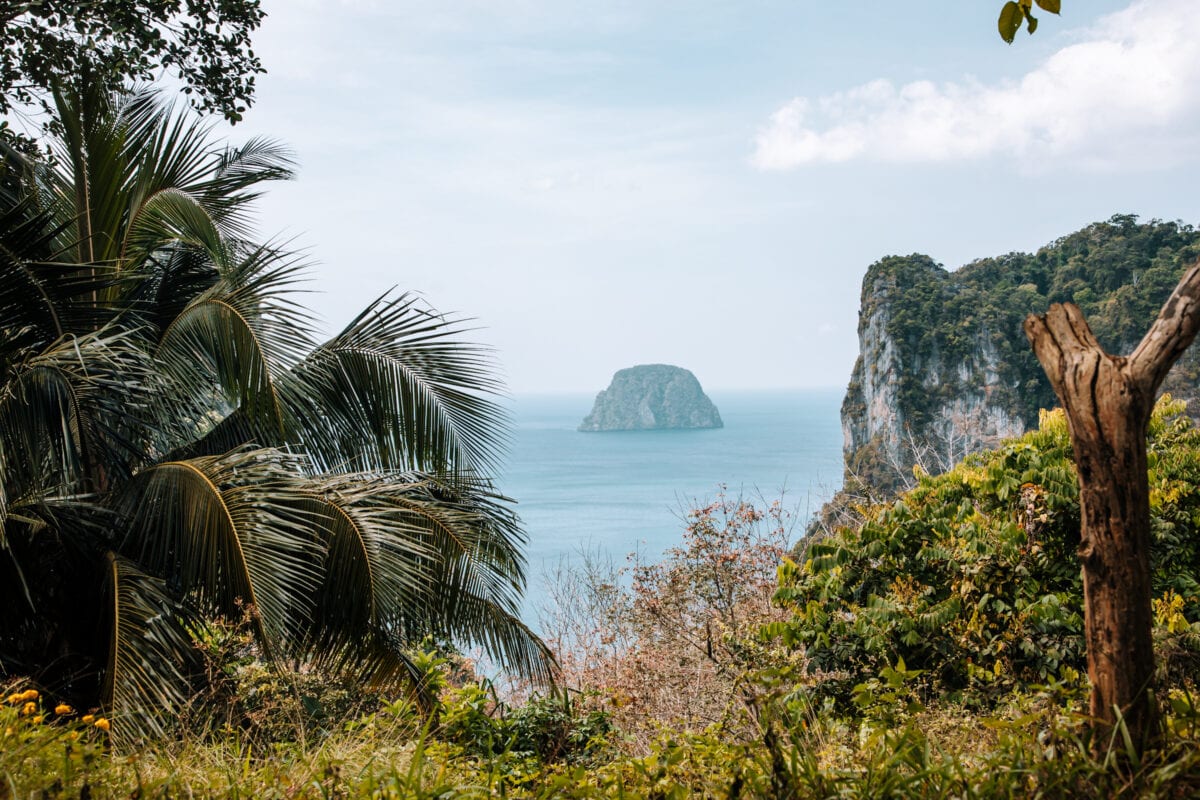
Are you looking for long dream beaches and turquoise blue water in Thailand? Then you should not miss this island: Koh Kradan is a true paradise! In this article I will tell you how to get to Koh Kradan and what you can experience there!
Koh Kradan, like Koh Mook, is part of the Had Chao Mai National Park in the Andaman Sea and is a mere two and a half square kilometers in size. The island is located only 10 kilometers as the crow flies from the mainland in the south of Thailand and is also a popular destination for locals.
Koh Kradan: One of the most beautiful beaches in the world
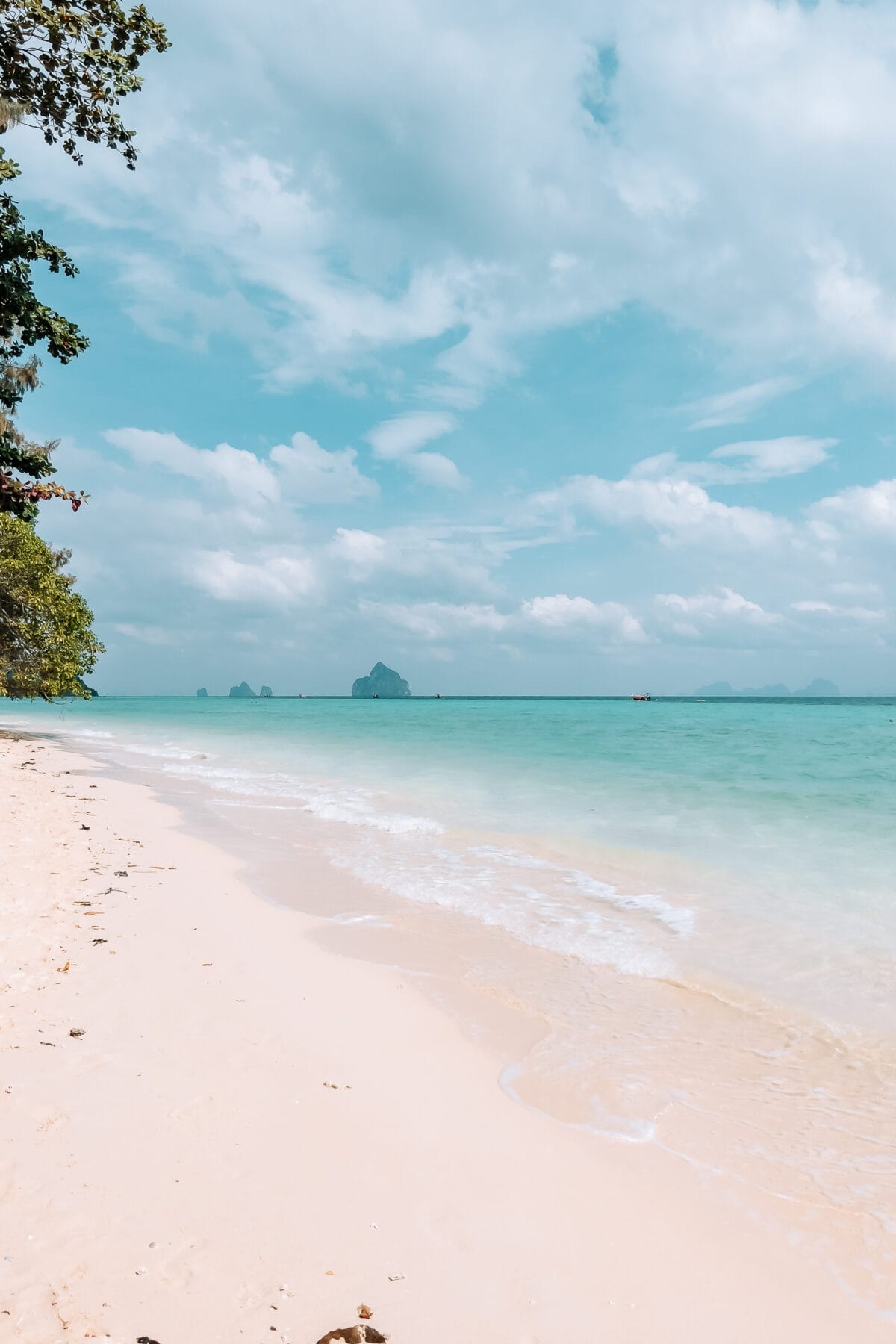
You read that right: Koh Kradan is home to one of the most beautiful beaches in the world! In any case, in 2016, the British daily newspaper “The Guardian” voted Koh Kradan one of the top 10 most beautiful beaches in the world – and this has really raised Koh Kradan’s profile.
By the way, Koh Kradan is also known for its underwater weddings on Valentine’s Day, for which people willing to get married travel from all over Thailand.
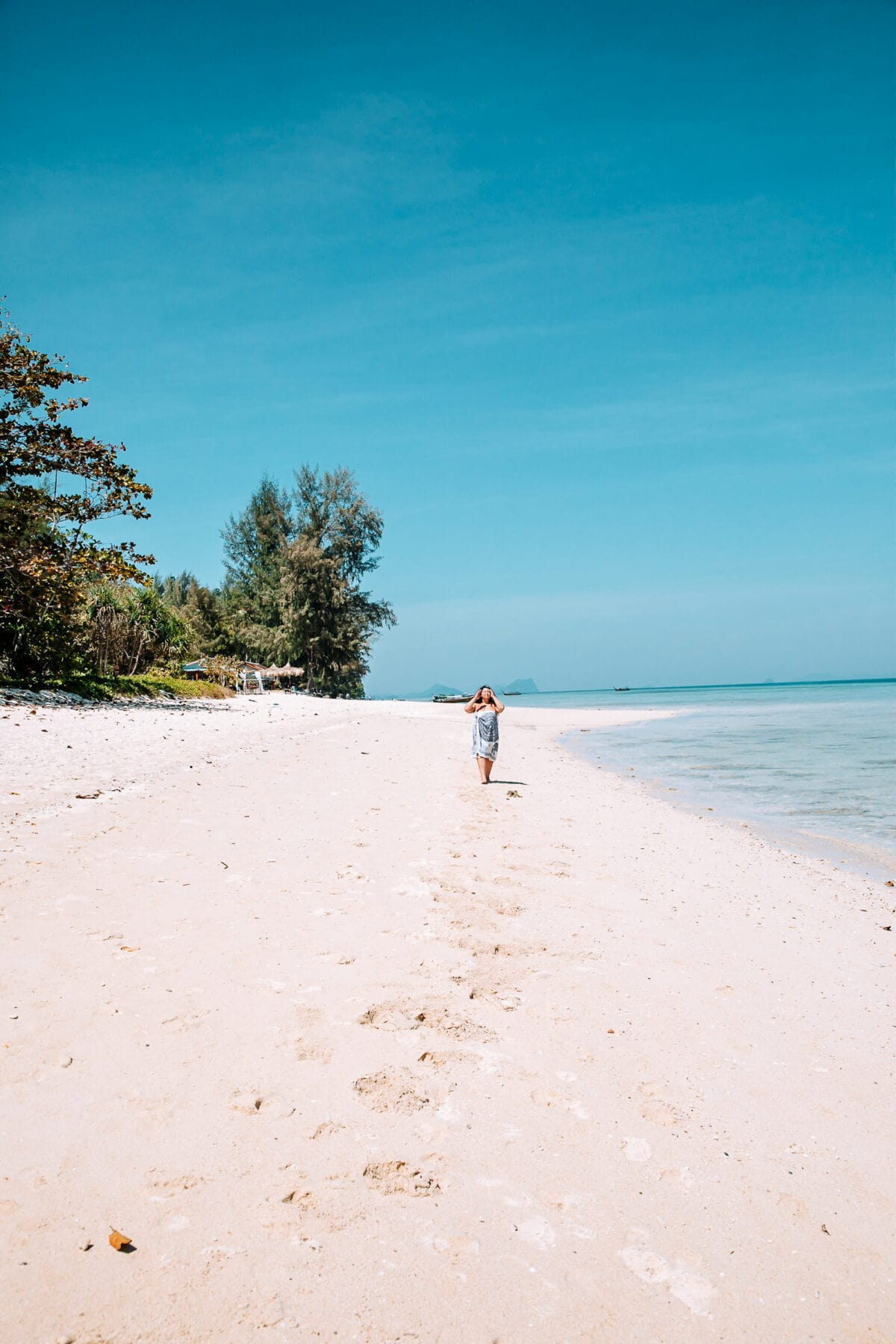
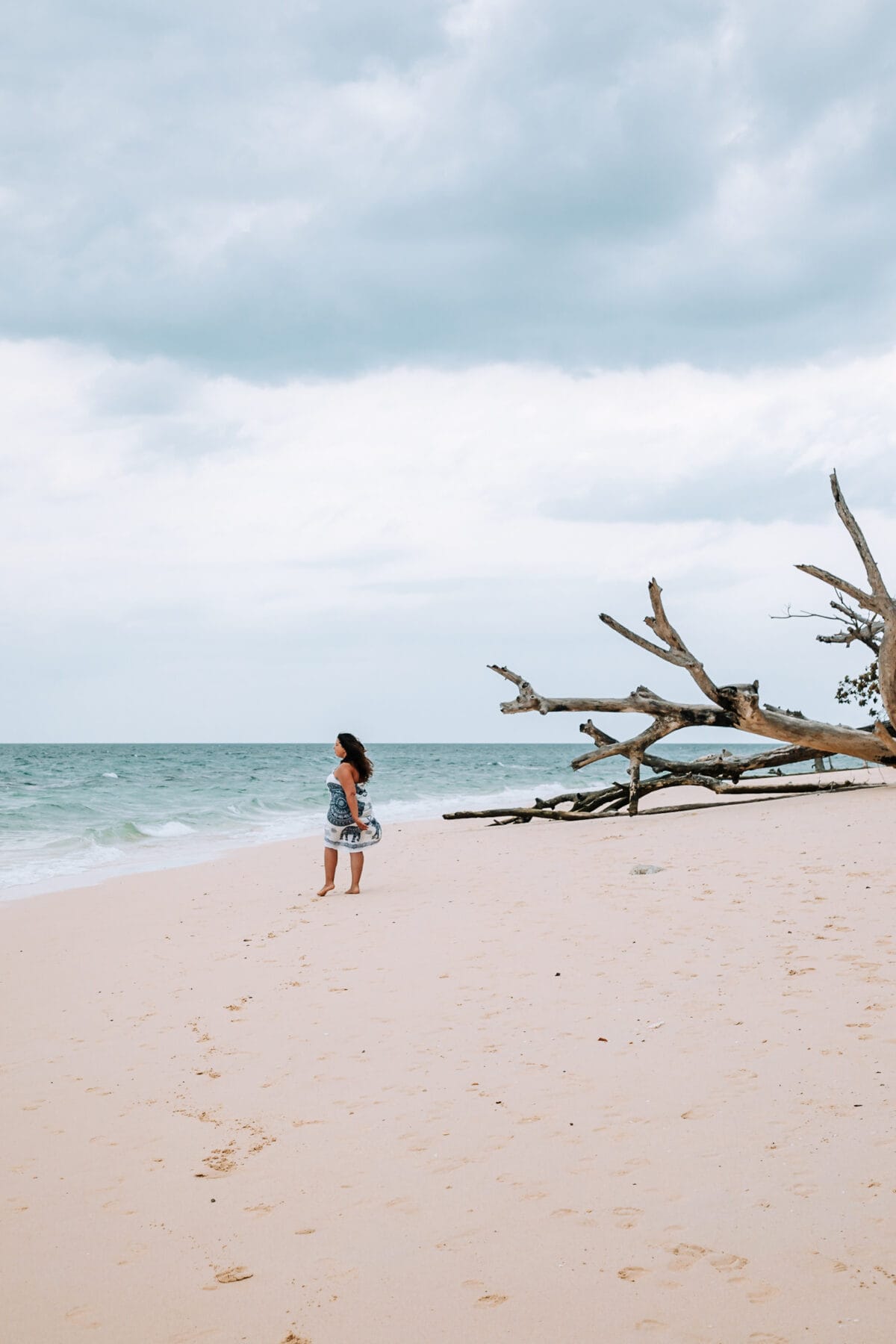
Paradise Beach on Koh Kradan.
Beaches on Koh Kradan
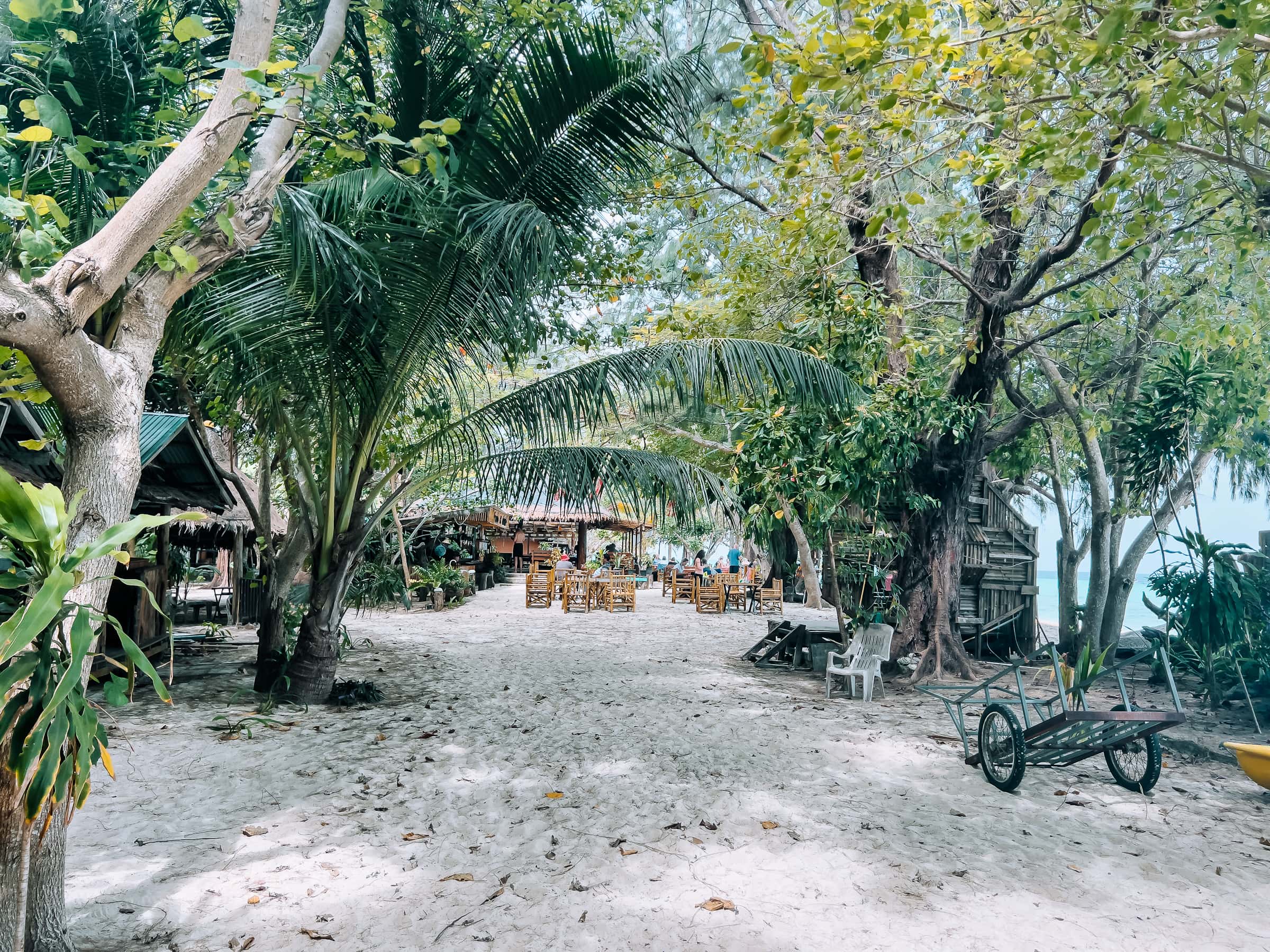
The famous Paradise Beach is located on the east coast of the island; this is also where most of the resorts are located. Here you can snorkel directly and explore the underwater world.
You will also find other good snorkeling opportunities in the southeast of the island. Just walk south along Paradise Beach, past the ferry dock and the national park ranger base: Ao Nieng Beach doesn’t have as many tour boats and resorts as Paradise Beach.
A jungle path leads to Sunset Beach through the middle of the island to the west coast. It is said that you can experience a great sunset here. Unfortunately, the beach itself is a bit littered. Along the way, you’ll also pass Paradise Lost Bungalows*, the island’s only low-budget resort.
On Koh Kradan you will find only a handful of accommodations. This is also reflected in the prices: in general, everything here is much more expensive than in other vacation regions of Thailand and the price-performance ratio for accommodation is also rather poor.
Koh Kradan Beach Resort
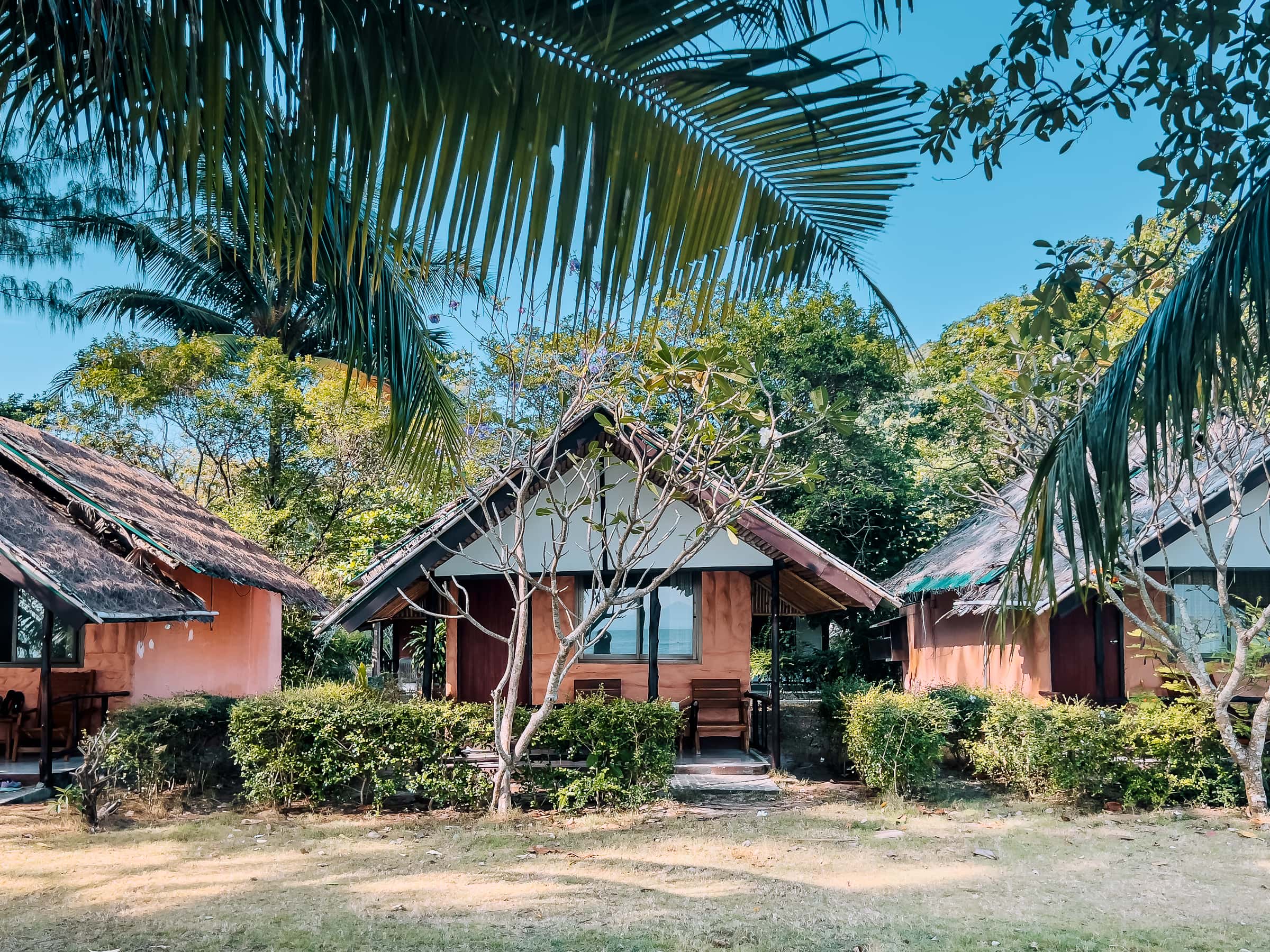
If you are looking for something solid, I can recommend Koh Kradan Beach Resort . The bungalows have mostly beach or sea view, solidly built and for those who need it, also equipped with air conditioning.
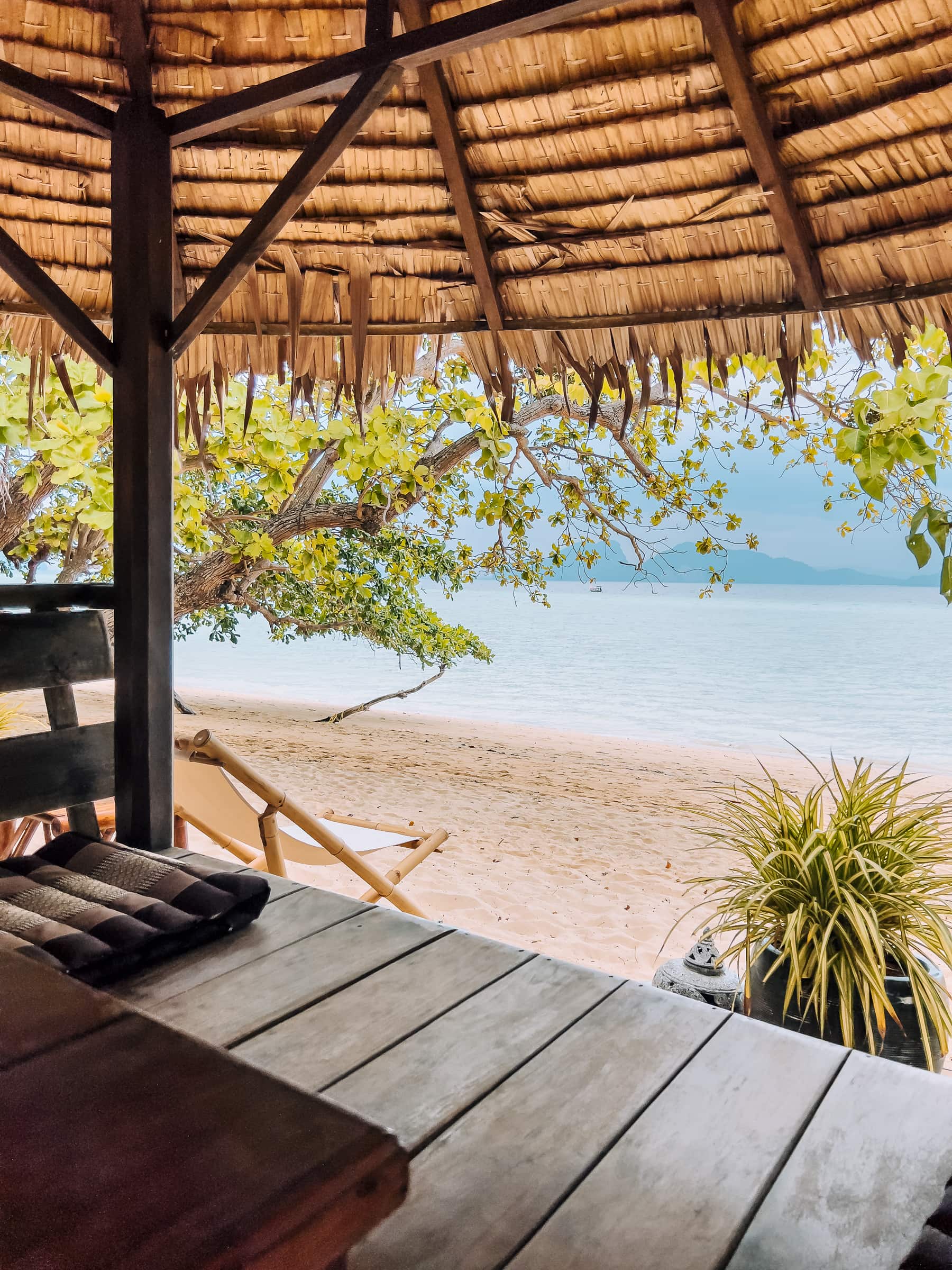
The Koh Kradan Beach Resort is located directly on Paradise Beach in Koh Kradan.
Unfortunately, the associated restaurant is not special; the included breakfast is Western-oriented and rather uncharitable. But these are fundamental compromises that you have to make on the very touristy island of Koh Kradan.
Bungalows with sea view: At Koh Kradan Beach Resort, you fall asleep to the gentle sound of the sea.
Kalume’ Eco Boutique Resort
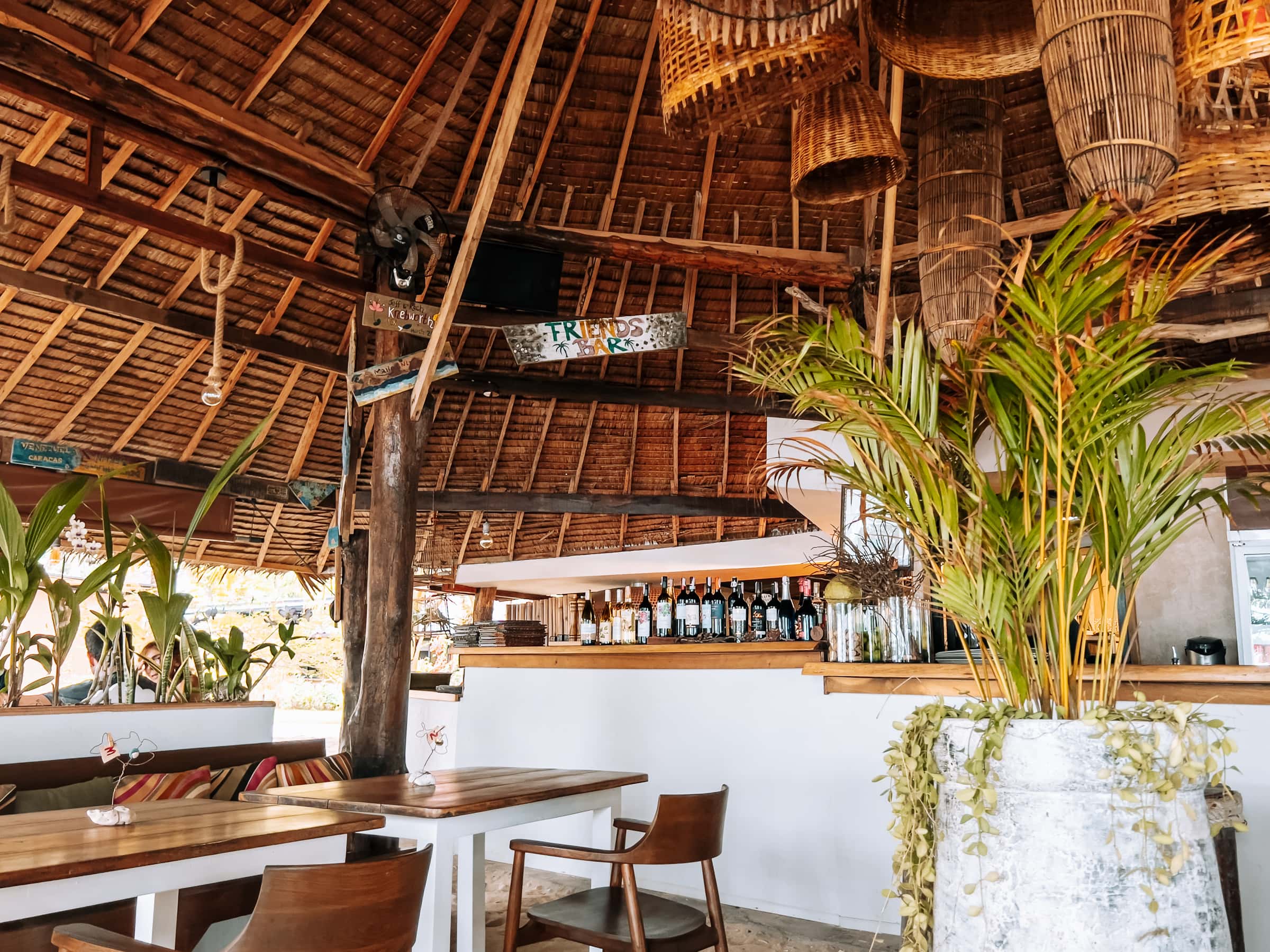
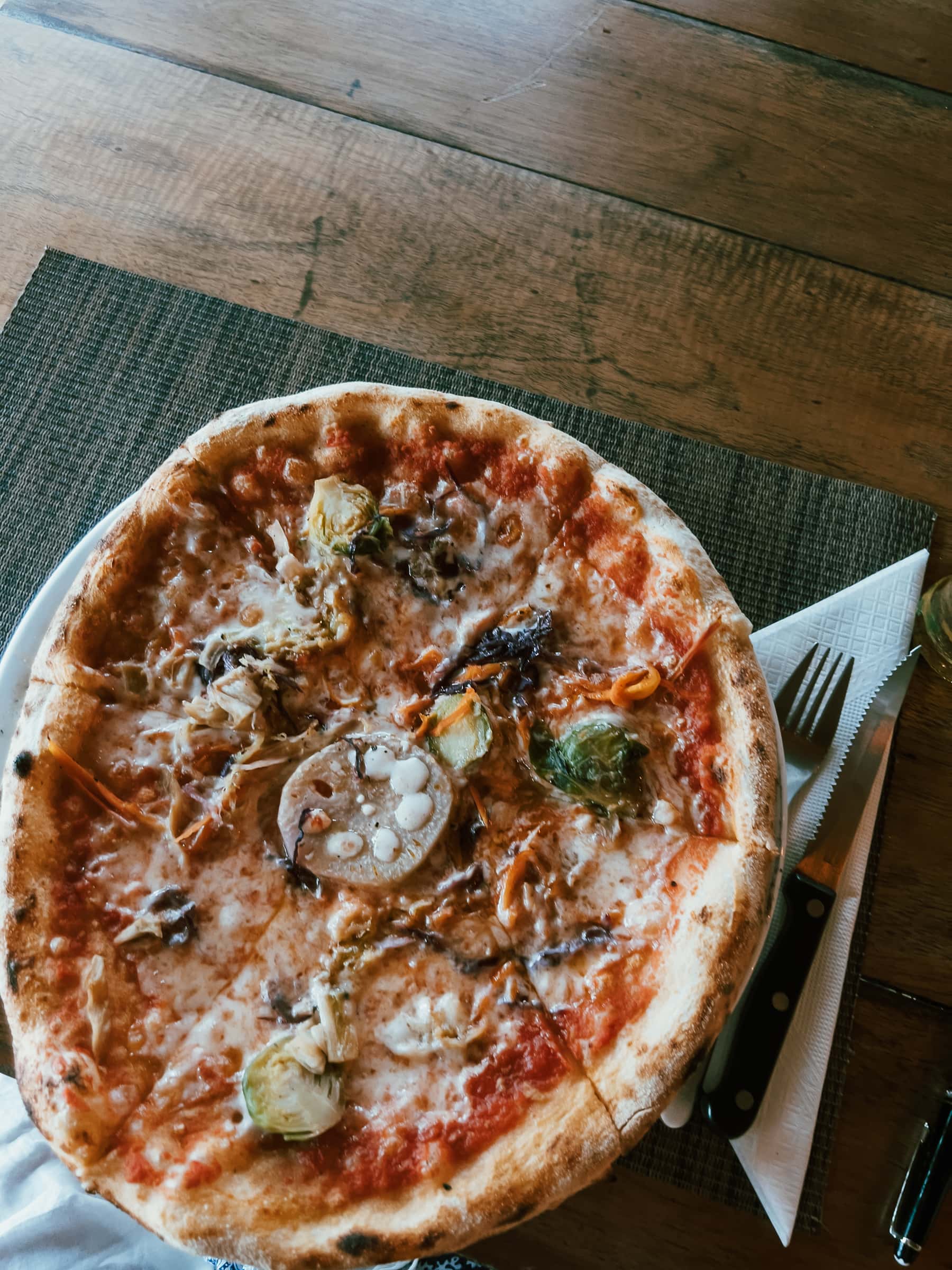
Very popular is Kalume’ Eco Boutique Resort*, a small resort run by Italians. The resort also has an Italian restaurant that offers really good Italian cuisine, from pizza to homemade pasta.
Whether that really has to be on a remote little island in Thailand is probably a matter of taste. Anyway, given the otherwise lousy food situation on the island (most restaurants are not special), it’s a good alternative. The facility is very beautiful, and certainly you have a good time here if you are one of the friends of the house, whose memories adorn the very nicely decorated bar. Unfortunately, everyone else has a bit of a hard time and has to fight for the favor of the service.
Koh Kradan is truly beautiful, but unfortunately it’s no longer a hidden gem. Sometimes the atmosphere at the resort gets a little out of hand, and surrounded by so many Western tourists, you can sometimes forget that you’re actually in Thailand. If you love Koh Samui or similar places in Thailand, you’ll still enjoy it; for others, one or two nights will be enough. (I’m in the latter group.)
However, there is another island among the Trang Islands that is very similar to Koh Kradan and where you can spend a few relaxing days.
Koh Ngai is also a small island paradise: Car- and scooter-free, quiet and perfect for snorkeling and relaxing.
Tip: You will also find beautiful beaches on Koh Ngai.
If you don’t have much time and would prefer to choose an island, I would recommend Koh Ngai. Koh Ngai is somewhat less visited by day trippers than Koh Kradan and is therefore quieter.
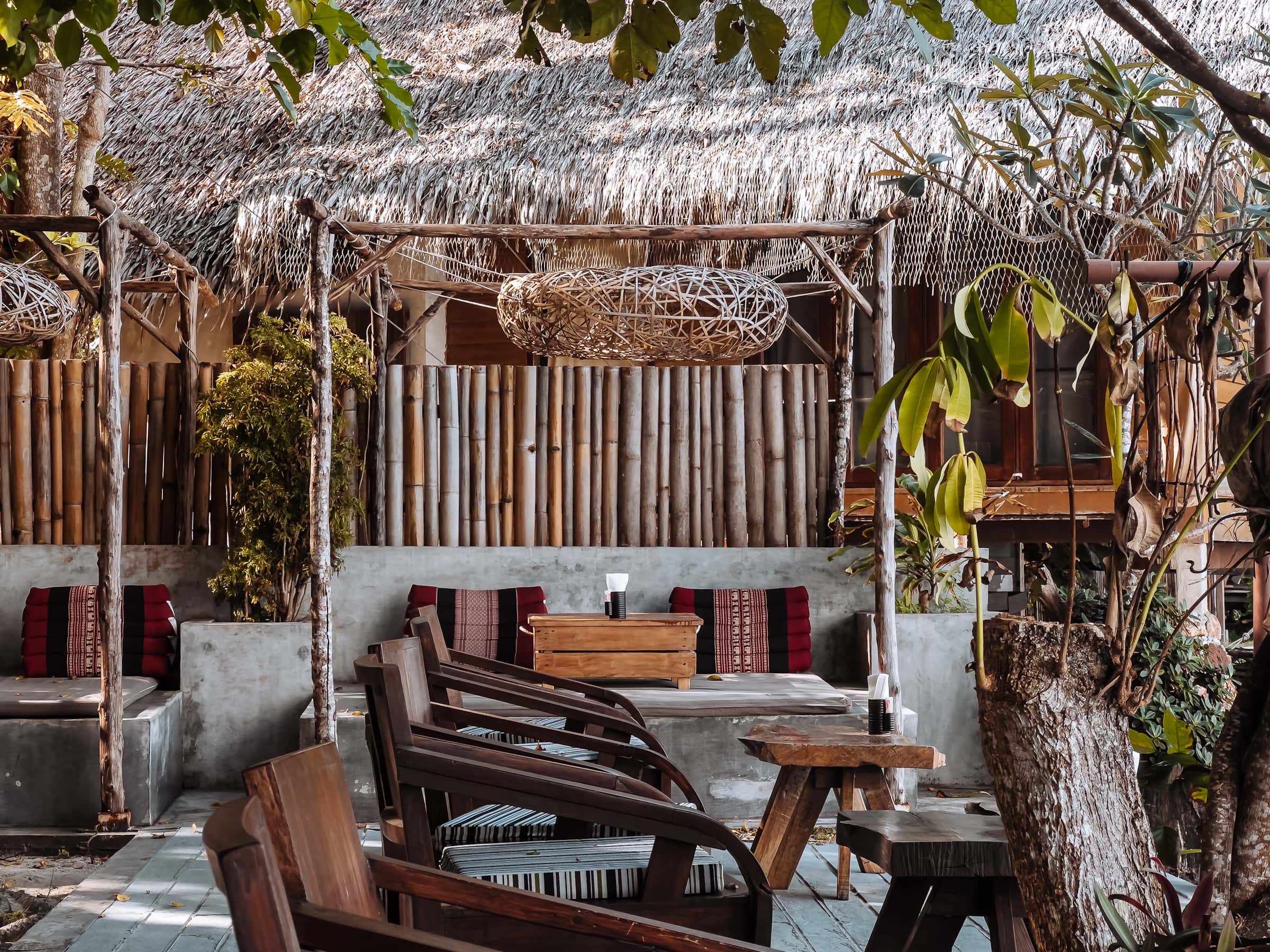
In addition, there is a really great boutique accommodation here, the Coco Cottage*, which I liked much better than the similar Kalumé Beach Resort on Koh Kradan. Since there isn’t really much to do on either island, you do spend a fair amount of time in and around your resort, so it’s an advantage to find something pretty right away.
Koh Ngai: The alternative to Koh Kradan
Journey to Koh Kradan
The nearest port on the mainland is Pak Meng Pier. From here boats depart regularly to Koh Kradan. The trip takes about 45 minutes.
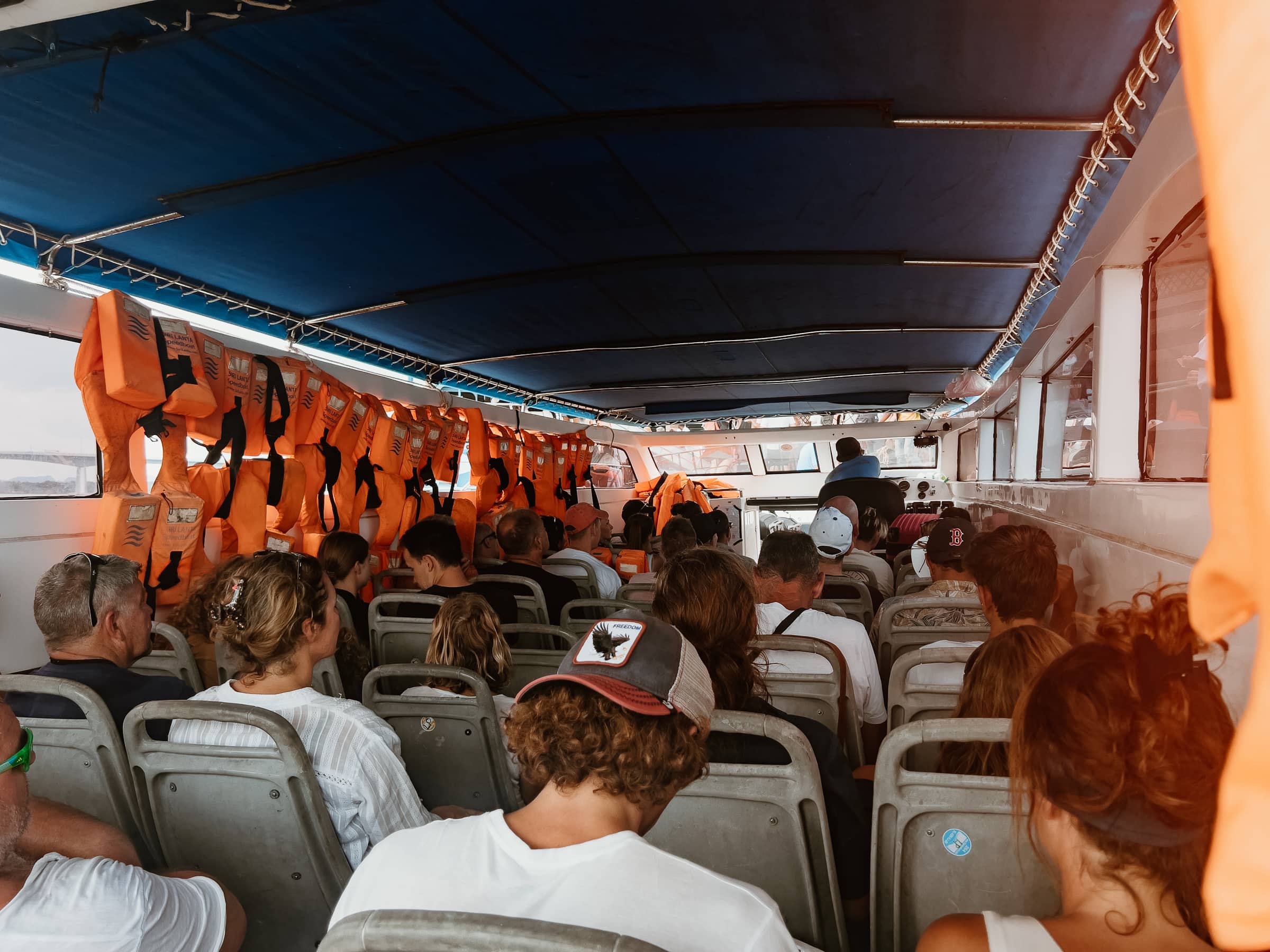
In the high season from November to April, Koh Kradan is also on the speedboat route of all the major ferry operators, which connects many islands in the Andaman Sea from Phuket via Koh Lanta down to Koh Lipe. The speedboats are often very crowded, noisy and relatively expensive, but also a good way to hop from island to island.
As on many small islands, you should have some cash with you. Credit cards are often accepted only with difficulty or not at all. ATMs and the ubiquitous 7Eleven stores in Thailand are not to be found here. Some resorts have small stores where you can stock up on necessities. But it’s best if you bring everything with you.
In any case, Koh Kradan will suit you well if you long for relaxation and tranquility!
Useful are:
Mosquito repellent with DEET (you live here in the middle of nature, so to speak, with correspondingly many little animals), alternatively natural means such as citronella oil
own snorkeling equipment (depending on the accommodation you can borrow goggles and snorkel for free, but own is of course more comfortable)
Sunscreen with a high sun protection factor (look for a coral-friendly product)
a good book (here you’ll definitely have the leisure to finally start that one book you’ve always wanted to read!)
Vilnius is not only an interesting city with an extraordinary history, but also an absolute insider tip for foodies. In this article I’ll show you a few of my favorites among the numerous cafes, restaurants and bars in the Lithuanian capital, but a trigger warning in advance: your mouth will water!
Vegan food in Vilnius: Rosehip Vegan
Located diagonally across from the MO Museum, Rosehip Vegan is already in a pretty cool neighborhood. For me, it’s the perfect spot for an “after-art” lunch—especially if you can’t get enough of the amazing exhibitions! As the name suggests, Rosehip Vegan serves delicious vegan cuisine that’s also quite photogenic. The only downside is the huge portions, which make it hard to resist trying everything on the menu right away.
Tip: For coffee, I recommend you move to the Raštinė located on the opposite street corner.
Fresh and delicious: The vegan restaurant in Vilnius.
Vilnius is an exciting destination: Find out what else you can do in Vilnius in my big Vilnius guide!
The cute tea house: Pinavija
The icy wind whipped through the streets, I was cold, my feet hurt from all the sightseeing (because who would have thought that there really is so much to see in Vilnius!) and actually I just wanted to take a quick break when I stumbled into Pinavija.
But I could have guessed right away that there was another highlight waiting for me, because honestly: In Vilnius, one great location follows the next. Pinavija is a tea house, girl’s dream and cupcake heaven at the same time. In any case, I can highly recommend the mini quiche, but afterwards I was annoyed that I didn’t go for the sweet tartlets with the artfully swirled meringue topping – maybe you can make up for it for me?
Cupcakes at the tea house Pinavija.
Breakfast in Vilnius: My Favorite
I would love to show off a very special breakfast location at this point, but the truth is: I didn’t even make it out of my hotel. But that’s no wonder, because breakfast at Hotel Pacai* really is the kind of hotel breakfast that impresses.
Cozy & elegant: Hotel Pacai in Vilnius.
On the one hand, there is the really attentive and cordial service and the casual atmosphere despite the five stars that promise luxury emblazoned at the entrance, and on the other hand, the offer of a small, fine buffet and various à la carte dishes.
When it comes to buffets, I’m now part of the “less is more” team: rather a few, but good products, and I’m in breakfast heaven. In general, I didn’t want to leave Hotel Pacai again, and I can highly recommend it to you if you want to treat yourself.
Something sweet for in between, good coffee or just a place where you can answer some mails on your laptop in a nice atmosphere? In the cozy Italala Caffè you will find everything at once.
Sugamour: Sweets for night owls
Perhaps you should save your sweet tooth for a little longer, because just a few doors down you’ll find one of six Sugamour branches. Is already the facade pompously decorated – inside it continues with the finest petit fours and tartlets!
The interior design with thousands and thousands of teddy bears takes some getting used to, but somehow it’s also pretty cute. And perfect for night birds: the branch at Vokiečių gatvės is open daily until 11 pm, and even until midnight on Friday and Saturday!
Sweet delicacies late into the evening: Sugamour in Vilnius.
Alchemikas: Booze & Co.
At Alchemikas, I ended up hanging out with a few nice people—even though it almost didn’t happen. The extensive menu at this classic cocktail bar, perfect for cozy evenings, literally fills an entire book, and I had a hard time choosing between all the delicious, evocative cocktails. The good news: Somehow, everything sounded really, really good, and in the end, I was more than satisfied with my choice!
Amandus: Fine dining in Vilnius
In itself, it’s unusual that a Michelin-starred restaurant like Amandus is located in the middle of the alternative artists’ district of Uzurpis – but after an evening there, you won’t be able to stop marveling anyway. When chef Deivydas Praspaliauskas flambéed my already appetizing-looking duck breast to ultimate perfection right in front of me at the table, I was convinced: an evening at Amandus is my absolute Vilnius tip for anyone with a taste for good food. And yes, it really is affordable!
The tasting dinner costs 70 euros, which is really nothing compared to what you would pay for a meal of this quality in many other European capitals – and for a surcharge, there is an extensive wine accompaniment.
But if you have any preconceptions about the amount of food on your plate and all the fuss, I can reassure you: Firstly, I was more than full after the umpteen courses and explosions of flavor and secondly, the atmosphere at Amandus is pleasantly unpretentious!
Are you looking for a relaxed island in Thailand with long beaches and chilled village life? Koh Jum (or Ko Jum, sometimes also called Ko Pu) is located south of the provincial capital of Krabi and could be the perfect island for you! Find out what you can do on Koh Jum in this article.
➜ Quick tip: Where to stay on Koh Jum? On Koh Jum, you will mainly find small bungalow resorts. Perfect for individual travelers if you want to fully enjoy island life with the great nature! Here you’ll find the best places to stay on Koh Jum
Relaxed island life: There are almost no cars on Koh Jum.
Koh Jum: A backpackers’ island?
Originally, it was classic backpackers who found their way to Koh Jum. Tourism was not particularly developed, amenities such as a developed electricity network did not exist and accommodation was limited to a few simple bungalows.
Those days are long gone; even the mainstream has discovered Koh Jum—and yet the island’s simple backpacker charm has been preserved. The former gravel road, which serves as the main thoroughfare across the island, has now been paved. The bungalow resorts are a bit larger and more comfortable, but you can still experience an authentic island vibe here. The atmosphere is generally very laid-back, and the people are exceptionally warm and friendly.
A bungalow in the green: no problem on Koh Jum.
Beaches on Koh Jum
If you love beaches as much as I do, you’ll get your money’s worth on Koh Jum. After my stay on the neighboring island of Ko Siboya, which I otherwise liked but doesn’t have particularly nice beaches, I was in heaven on Koh Jum. The Golden Pearl Beach, for example, is several kilometers long and partly deserted!
Golden Pearl Beach on Koh Jum
All beaches are located on the west coast of the island and therefore offer the most fantastic sunsets over the sea overlooking Koh Phi Phi.
At first glance, you might think that Koh Jum is a charming, yet somewhat sleepy island that doesn’t have any special hotspots. And yet I discovered one or two highlights that absolutely thrilled me!
Luboa Café
Formerly located in the village, the Luboa Café has since moved a bit further out into the countryside. The entrance is right on the street, but once you walk through the large wooden gate, you’ll find yourself in the middle of a jungle paradise! The Luboa Café serves the best coffee and an absolute rarity—freshly baked rolls made in-house every morning! So if you’re ever in the mood for a more Western-style breakfast, this is the place to be. But be warned: the rolls are very popular and sell out quickly. It’s worth arriving early.
If you can’t shake the jungle vibe with all the plants and butterflies buzzing around, you can also stay overnight on the premises (and then secure your rolls each morning) – owner Frank and his wife have tastefully built a small, sugary Tiny House in the garden! Definitely an exceptional accommodation!
Would you like to fish for your own dinner? That’s no problem at Mr. Boy: you can catch your squid from the pier on which the location is located and then have it freshly caught and prepared at Mr. Boy. I’m not so keen on squid and I also have my problems with fishing.
Absolute highlight: The atmospheric café of Mr. Boy on Koh Jum.
But the extraordinary vibe at Mr. Boy makes up for all that: the café on the wooden pier is a conglomeration of art gallery, restaurant, organic garden and hostel! Like everywhere else on Koh Jum, the atmosphere is absolutely chilled and the view of the calm water and the surrounding karst rocks does the rest.
From Mr. Boy Café you have a great view over the water.
Koh Jum: Relaxed evenings with panoramic view
If you are looking for excessive raves on the beach, the nightlife on Koh Jum will rather disappoint you. But with the Rock Bar at the end of Golden Pearl Beach, there is another extraordinary location on the island that will provide you with unforgettable evenings.
Quite hidden: The adventurous way to the Rock Bar on Koh Jum. Creatively designed: The Rock Bar is made of washed up driftwood.
Thailand is such a great destination! Click through my Thailand articles and get even more inspiration for your next trip!
On the one hand you can enjoy the free view of the most impressive sunsets, on the other hand the hidden spot between the rocks is unique. A cosy bar has been created from driftwood on several levels, where you’ll feel like you’re in a huge, cozy nest. The one or other cocktail in addition – and the vacation feeling is perfect!
Pure village life on Ko Jum
There are three villages on Koh Jum: Ban Ko Pu in the north, Ban Ting Rai in the middle and Ban Koh Jum in the south of the island. Koh Jum has a total of only 1000 inhabitants, the villages are correspondingly small. You won’t find big stores here, even ATMs are not available.
Life is simple, the people are all the more cordial and you quickly get into conversation, even if there are sometimes language barriers. Once a cab driver on his scooter overtook me, waved wildly and then almost slowed me down – only to show me the huge group of monkeys on the other side of the road, which was gyrating up and down the tree. And which, admittedly, were really cute. As a city kid who knows all the tricks of the trade, I immediately suspected some kind of scam, but it was actually just pure niceness.
Just like on Ko Siboya, locals wave to you on the street, ask where you’re from or are simply well-disposed. This also makes tourist life relatively carefree. In any case, I have always felt somehow in good hands.
While you have to worry less about things like pickpocketing in the rest of Thailand, my carelessness on Koh Jum has reached unimagined dimensions: While waiting for the next boat at the pier, I simply left my entire luggage including camera equipment at the roadside at a cookshop of an elderly lady on the day of departure and went to eat three houses away, because she unfortunately had nothing left and recommended me another stand. On Koh Jum everything no problem.
What I would also definitely recommend is to start your day with breakfast at one of these cookshops. Breakfast is not particularly worth mentioning in many simpler accommodations. Mostly they try to offer something western. This is often sweetly meant, but personally I can do without tasteless toast and prefer to stick to the local cuisine; and there’s plenty of options on Koh Jum.
Right next to my resort, for example, there was a really great street stall with all kinds of delicacies. Communication was a bit hands-on, but the warmth there blew me away again and I wondered why the site wasn’t full of tourists. If you also often have reservations about street food, just dare and trust your good sense! There, for example, they worked with the simplest of means, and yet everything was super clean and tidy.
What else you can do on Ko Jum
Koh Jum is not very big and with a scooter you can easily explore the island in one day. Most of the roads and paths are asphalted and the traffic is relaxed. If you prefer, you can also rent bikes from some roadside stores. Or you can take one of the scooter cabs. These are not really marked, but it is usually enough to stand on the side of the road and you will be approached as you drive past.
In the middle of the island there is also a viewpoint on the highest mountain of the island, Mount Pu, 422 meters high. If you don’t want to go it alone, you can also join a guided tour with a local guide.
Advertising / *affiliate link
The best accommodations on Koh Jum
I stayed at the Golden Pearl Beach Resort*. It was okay, but not very charming. Maybe you’ll be lucky and get one of the few bungalows right on the beach! Waking up in the morning and dipping your bare foot into the warm fine sand with your first step is unique. However, most of the bungalows are across the street and the scooter traffic makes it not quite as idyllic as it could be.
The OonLee Bungalows* are a bit more comfortable and closer to nature.
Arrival to Koh Jum
Koh Jum isn’t quite on the tourist radar yet, but getting there isn’t that complicated. There are several options from Krabi:
You can take a cab or songthaew or bus to the more distant Laem Kruad Pier to catch a boat to Mu Tu Pier on Koh Jum. This boat connection is used more by locals and for transporting goods, is cheap (120 baht) and personally I found the trips with it much more pleasant than on a packed speedboat.
From the more easily accessible Chao Fah Pier in the center of Krabi, you can take one of the speedboats that operate in the Andaman Sea during the high season from November to April. A ticket costs about 1500 baht.
There are also connections to Koh Jum from Koh Lanta, Koh Phi Phi or Phuket.
Tip: On 12go.asia* you can book not only boat tickets, but also complete connections with bus transfers to the nearest pier on the mainland!
Koh Jum Pier: Speedboats depart from here to many neighboring islands.
When is the best time to travel to Koh Jum?
The best time to visit Koh Jum is from November to April. Outside of these months, the weather is sometimes worse and the boat connections are fewer, or are sometimes suspended due to the weather conditions. December and January are the peak season, popular accommodations can be fully booked. Therefore, early booking is worthwhile!
What do I need to consider when traveling to Koh Jum?
Koh Jum is truly a sleepy, laid-back island with a fairly basic infrastructure. You can, however, find everyday essentials in small shops. If you’re looking for accommodations close to nature and you love animals as much as I do, it’s a good idea to have DEET-based insect repellent on hand from the start. There are no ATMs on the island, and credit cards aren’t accepted at many accommodations either.
However, there are some stores that exchange Euros or Dollars; in the village of Ban Koh Jum there are also a few small travel agencies that will easily pay you cash for a fee of about 4% cash and charge your credit card; higher amounts are also possible. If necessary, you can also get cash on Koh Jum, contrary to the information in many travel guides.
Who is Koh Jum suitable for?
Partygoers will likely find Koh Jum a bit boring; you won’t find any clubs or all-night dance parties here. But if you’re looking for relaxation, friendly people, endless beaches, and a laid-back island lifestyle, you won’t want to leave! Families with children are also very welcome here.
Looking for a pristine island in Thailand? Then you should definitely visit Ko Siboya ! The island is part of the Ko Siboya Tambon archipelago off Krabi, which also includes Ko Jum. In contrast to Koh Jum, Ko Siboya is almost completely undeveloped by tourists and perfect if you are looking for a few days of relaxation in absolute nature!
For the fact that the beaches on Ko Siboya are not supposed to be that inviting, it is quite pretty there! 🙂
The authentic Thailand on Ko Siboya
Already on the way to the only resort on the island, heads are stretching on the roadside at the simple snack stands, children are waving cheerfully, and somehow everyone is curious about who has just strayed onto the island. Very few people speak English here, so when visiting the village you have to rely on Google Translate or just try with your hands and feet. As a rule, the predominantly Muslim population does not live from tourism, but from work on the rubber plantations, which are spread over the entire island.
Looking for a place to stay on Ko Siboya? No need to spend a lot of time comparing options! There’s only one resort, and it’s really beautiful: SiBoya Bungalows
In the Siboya Bungalows you sleep in the middle of nature
Many families keep chickens, goats, cats and much more; most of the time all the animals run around freely and together with the wild animals like monkeys and iguanas you get the full program of nature here.
Tourism on Ko Siboya
Tourism plays virtually no role on Ko Siboya. The SiBoya Bungalows are frequented by long-term travelers or Thailand veterans who discovered the island for themselves at some point and have mostly been spending the winter here ever since. Some have even built their own bungalows on the resort grounds.
At first glance, this sounds a bit like a close-knit community, especially since there are not many external influences due to the isolated location. However, I have to say that the atmosphere was very positive and open. Even newcomers and first-time visitors like me are warmly welcomed not only by the resort owner Mr.Chung and his team, but also by the other guests, so that one quickly finds connection and immediately feels at home.
What you can do on Ko Siboya
The beaches are probably the main reason why Ko Siboya has not yet been stormed by crowds of tourists. There are certainly islands with more beautiful beaches such as Koh Kradan or Koh Ngai. Due to the strong tides, swimming is only possible at high tide and you won’t find powder-sugar white beaches. There are also more interesting spots for snorkeling.
At low tide you can’t swim so well on Ko Siboya. At high tide all the better for it!
But in the evening you will be rewarded with the most beautiful sunsets over the Andaman Sea.
Otherwise, there is not much to do on Ko Siboya except relax and enjoy the nature around. In the very small, but very well-kept, simple bungalows you live in the middle of the jungle, without having to do without worldly things like electricity or mobile phone network. On many small islands this is a problem, but not on Ko Siboya, which may make the island interesting for those who need a little internet in between.
However, you can also use the time here to lie down in one of the numerous hammocks and pick up the book you’ve always wanted to read.
Food & Drink on Ko Siboya
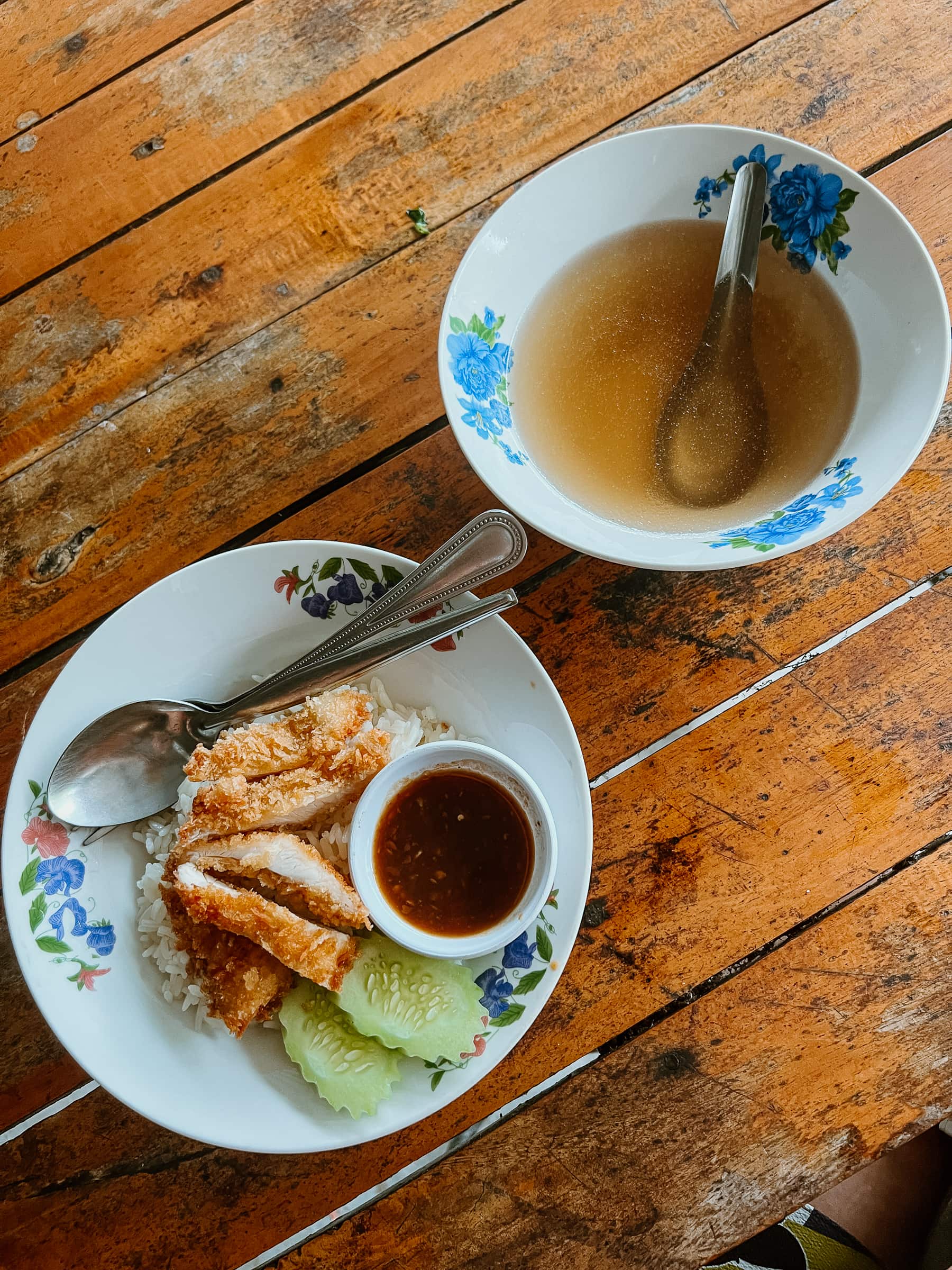
For the physical well-being one has to fall back on the resort’s own restaurant relatively often due to the lack of alternatives. They offer the usual Western food tourist menus there (not great), but the Thai options are really, really good, and definitely worth the higher price. Here I sipped the best Khao Tom (rice soup) ever and with luck Mr. Chung also organizes specialties out of the line, like Hor Mok with Barracuda, a fish curry pie cooked in banana leaves.
Not only to eat but also worth a trip with the scooter over the island. Officially, the resort does not rent bikes or scooters, but somehow you could always borrow the resort’s very good scooter for a small fee. The whole island can be circumnavigated in about 15 to 20 minutes; the roads are usually well paved.
On the roadside you will find here and there small, simple restaurants where you can eat for little money and still make contact with the absolutely warm locals. The curiosity and effort to show visitors a good time is omnipresent and truly heartwarming. If you are up early in the morning, you can have a delicious breakfast in the main village from six or seven o’clock.
No wonder that many travelers just get stuck here or keep coming back – Ko Siboya is a real insider tip and simply a beautiful, relaxing place!
Travel to Ko Siboya from Krabi
To get to Ko Siboya, you first have to go to Krabi. In Krabi there are popular places like Ao Nang Beach or Railay Beach; furthermore you can easily get to famous islands like Koh Lanta or Koh Phi Phi from there. Krabi is only a good hour’s flight from Bangkok.
Unlike other islands, getting from Krabi to Ko Siboya is a bit more complicated, but not completely impossible. Ko Siboya is simply not one of the islands and destinations that any of the numerous travel agencies in the area have on offer. To Koh Lanta or Koh Phi Phi, for example, you will find offers on every corner with pick-up at your accommodation and seamless transportation to your destination (as is so often the case in Thailand), so you don’t have to worry about a thing. Ko Siboya requires a little initiative.
By cab to Laem Kruat
The best boat connection to Ko Siboya departs from Laem Kruat Pier. This is located just outside of Krabi and the travel time from Krabi Town to there is about an hour. The easiest solution is to go there by cab. In Krabi there is also Grab, the Asian equivalent of Uber, but the likelihood of your ride being accepted is quite low due to the distance.
It is cheaper to get to Laem Kruat by public transport. To do this, take a songthaew (one of the Thai shared cabs) from Krabi Town to the bus station, which is just outside the town in the direction of the airport. From there there are buses or shared cabs to Laem Kruat Pier.
By boat to Ko Siboya
From Laem Kruat you simply take one of the boats to Ko Siboya. Just make sure to be at the pier by 4pm, after that there is no boat to Siboya. Not many tourists leave here, you’ll probably have a little trouble orienting yourself as to which boat is the right one. Just ask around, people are very helpful and you will end up on the right boat. The ride itself takes about 20 minutes and costs 70 baht.
Transportation on Ko Siboya
Since Ko Siboya isn’t particularly touristy, there isn’t a fleet of taxis waiting at the pier there, as you might be used to seeing on other islands in Thailand. However, you can contact the staff at SiBoya Bungalows in advance and let them know when you’ll be in Laem Kruat. Then someone will come pick you up. I’ve experienced firsthand just how well this works: I didn’t even let them know in advance because I literally hopped on the boat at the last minute, and yet, miraculously, someone was already at the pier to pick me up.
Onward journey from Ko Siboya
If you want to travel on from Ko Siboya to another island, you’ll usually have to head back to the mainland to Laem Kruat Pier and then take another boat, for example, to Koh Jum. Alternatively, you can charter a longtail boat, which is worth it if you’re traveling with a group. Or you can simply join a day trip and stay on the island. You can arrange this at the resort—just ask around, and you might find like-minded people with whom you can split the cost.
Turquoise waters, pure nature and a snorkeling paradise literally on your doorstep: Koh Ngai (also called Koh Hai) is one of the most beautiful islands in the southern Andaman Sea in Thailand. If you are looking for peace and quiet and want to relax, then this is the right place for you!
Where is Koh Ngai located?
The small island of Koh Ngai is still a real natural paradise. It is only a cuddly 5 square kilometers in size and is located south of the island of Koh Lanta in the Andaman Sea. Here are some of the most beautiful islands in Thailand and Koh Ngai is definitely one of them! It is only 15 kilometers to the nearest pier on the mainland, Pak Meng Pier. The next largest city on the mainland is Trang.
It’s easy to list the activities on Koh Ngai. Snorkeling, sunbathing, relaxing, and unwinding: there isn’t much else to do. You can stroll up and down the beautiful beach or explore the underwater world. In fact, there are small coral reefs right off the beach. The water is crystal-clear and turquoise blue.
The impressive hornbills live right in the neighborhood
If you need some exercise, you can also rent a kayak almost anywhere. If the water is calm, you can also paddle to one of the small inhabitated islands nearby.
You can reach Paradise Beach on the other side of the island after a short hike through the jungle. There’s a small beach there. However, the only resort there is closed. So be sure to bring enough water and food with you. Sturdy shoes are helpful.
Day trip to Koh Ngai
If you’re short on time, you can also take a day trip to Koh Ngai. Tours are offered from several islands around Koh Ngai as well as from the mainland. These usually include additional stops. You can either book a spot on one of these tours or charter an entire boat once you’re there. However, this is usually only worth it if you’re in a larger group.
If you are accommodated on Koh Ngai, the excursions can sometimes spoil the paradisiacal atmosphere, depending on the day of the week. On weekends, several boats can dock one after the other. However, the main beach is very spacious, and there are always longtail boats carrying small groups heading to Koh Ngai. So the crowds are spread out quite well.
More annoying are the loud longtail boats crisscrossing the waters off the coast, which serve as a reminder that you’re still relatively close to civilization—the mainland is clearly visible from Koh Ngai.
Thailand really is a fantastic travel destination and incredibly diverse. Why not take a look at my other articles on Thailand and see for yourself!
How expensive is Koh Ngai?
Koh Ngai is one of the more expensive vacation destinations in Thailand. This gives the island a kind of exclusivity and Koh Ngai is still not overcrowded like many other islands. However, this exclusivity also has its price.
Prices are higher than elsewhere in Thailand (e.g., a serving of spring rolls costs 140 THB, approx. €, and a large bottle of water for the day costs 40 THB). Restaurants typically add a 10% service charge and a 7% tax to the final bill.
Where to stay on Koh Ngai
Since the island is relatively small, there aren’t many places to stay. Unlike on other islands, it’s best to decide in advance where you’d like to stay and book right away. For one thing, accommodations here fill up quickly during peak season; for another, when you arrive by boat, you’ll be dropped off right in front of your resort.
There is a pier, but if your resort is located a bit further up the beach, the only way to get there would be to walk along the beach with all your luggage. However, the more expensive resorts usually find a convenient way to pick you up from the boat, luggage and all. That’s because there are no roads, scooters, or any other means of transportation on Koh Ngai. It’s best to contact your resort again after making your reservation.
Koh Ngai Seafood
Koh Ngai Seafood consists of a few small bungalows on the beach. The bungalows are simple, but are all facing the sea and even from the two cabins located in the second row you’ll have a sea view. There is no hot water (but that is really not bad considering the tropical temperatures) and electricity is also only available from about 6pm until about 8am in the morning.
Just don’t get the very first bungalow next to the restaurant, it’s not quite as heavenly in terms of noise.
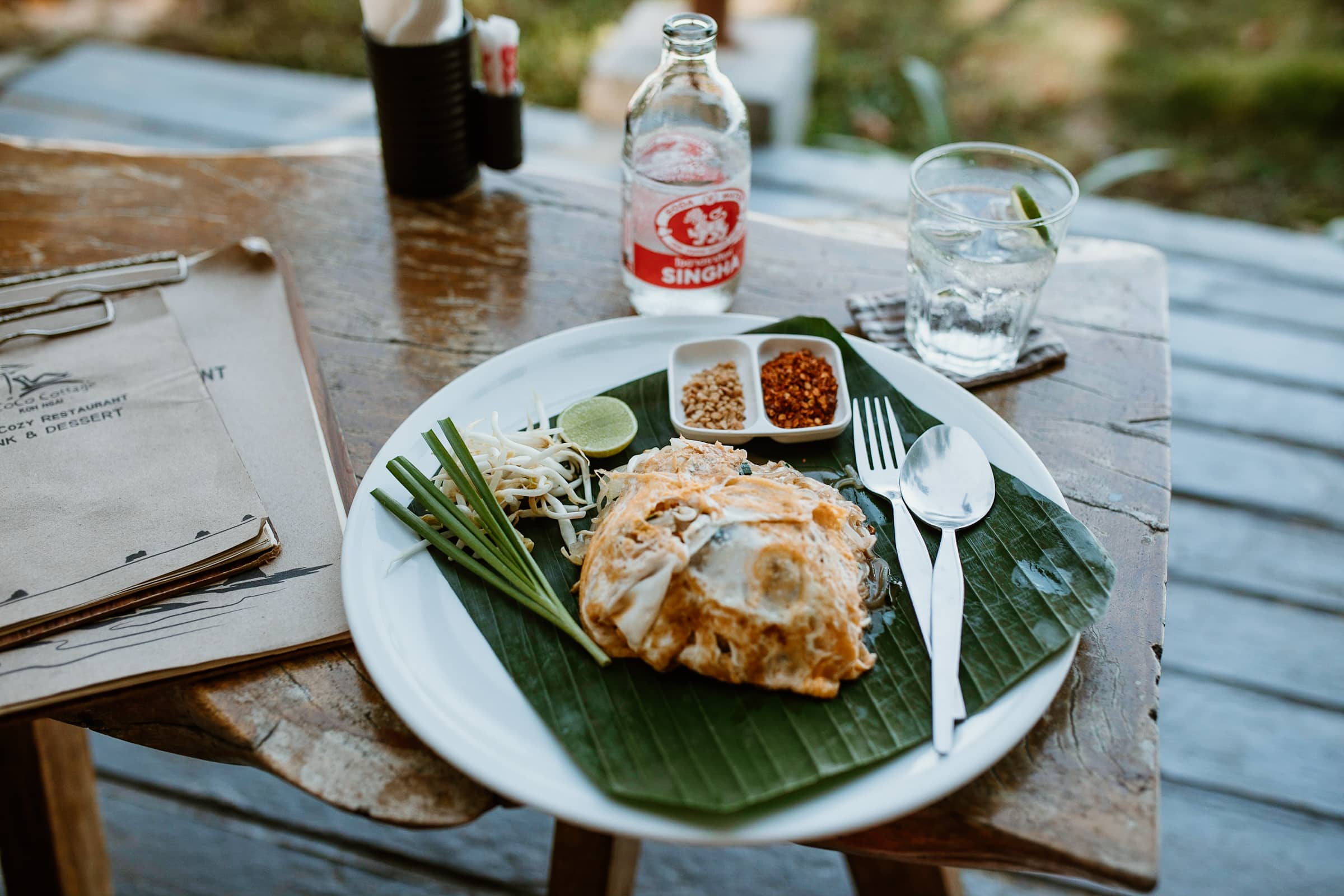
If I had seen Coco Cottage before, I would have booked right here! In person, I found the small plant much prettier and more atmospheric. I would even say I could have spent an entire 2-week vacation here without really doing much and recover like never before. The restaurant is expensive, but a pleasant change from the other locations, and the service so nice that I became a regular here pretty quickly, even though I lived two resorts away.
Be sure to remember that you’re going to a nearly deserted island ! Here there is no 7Eleven like elsewhere in Thailand, which is open around the clock and which supplies you with everything. Some resorts have small “stores” where you can stock up on essentials, such as water for the day or if you run out of toothpaste. But it’s best if you bring everything with you beforehand.
Here’s a list of things you should pack:
Sunscreen (preferably coral friendly)
Mosquito repellent with DEET (you’re in the middle of the jungle, and there are already some pesky mosquitoes in the evening when there’s no wind).
Snorkeling equipment such as goggles and snorkels (the resorts also rent equipment, but it is usually only the simplest models, which are of course already very used. With the goggles you don’t necessarily have the best view).
How to get to Koh Ngai
Koh Ngai is connected to the speedboat network operated by the major ferry companies between Phuket and Ko Lipe. The boats run on this route between November and April and stop at just about every island along the way, such as Koh Kradan, Koh Jum, and Koh Mook. Operators on this route include Bundhaya, Tigerlinetravel, Phuketferry, and Satun Pakbara. As with all modes of transportation in Asia, you can easily book tickets in advance on 12go .
When I made my booking, I could still specify whether I wanted to book a transfer from the pier by longtail boat for an additional 100 baht, but in the end the speedboat itself docked on the beach in front of Koh Ngai Seafood. On departure, however, I was first taken to the speedboat by longtail boat. As always, the luggage is unloaded for you, you then simply hop off the boat into the sand and, if necessary, you also get help getting off.
If you are looking for parties and really want to party, Koh Ngai is not for you. You will also look in vain for milder forms of evening entertainment such as fire shows.
Nightlife on Koh Ngai
Hikers & Outdoor Enthusiasts
If you want to explore and hike a lot, it will be difficult on Koh Ngai. Basically, there is only the main beach, where most of the resorts are located, and Paradise Beach in the south, which you can reach via a hiking trail. The only resort there, however, has closed since the pandemic.
The rest of the island is completely densely forested, completely undeveloped and partly mountainous. For this, Koh Ngai is the perfect island to relax and enjoy the nature all around. You can see hornbills, sea eagles and many other exotic birds.
Families with children
I wouldn’t recommend Koh Ngai to families with smaller children: Although the beach slopes relatively shallowly in most places, the coral reef starts relatively close to shore and it can be hard to find a spot without uneven ground. Also, glass shards keep washing up, some dull, but others still very sharp. But older children will certainly enjoy the fascinating underwater world.
Solo travelers
With all the paradise vibes, you might think that Koh Ngai is mainly for couples in love. But even as a solo traveler I felt very comfortable here and was not the only person traveling alone.
Koh Ngai is simply perfect if you need a few days’ rest from traveling and want to relax. But beware, one or two people stayed on this beautiful island longer than planned 🙂
Are you also dreaming of an island vacation with wide sandy beaches, turquoise blue water and exotic cocktails? I in any case in continuous loop! On my last trip, I more than fulfilled this dream by island hopping in Thailand through the southern Andaman Sea and the Trang Islands. I’ll tell you here which islands I particularly liked and which island is still a real insider tip.
Island hopping in Thailand: From Krabi from island to island
Krabi is the perfect starting point for island hopping. From Bangkok, a flight of just over an hour will take you to a fairly laid-back Thai coastal town that’s also worth a quick stop. Many vacationers even spend their entire stay in Thailand here, as the popular Ao Nang Beach —with its many hotels and tourist amenities—is located just outside the town. Partygoers tend to head to Railay Beach, a stretch of beach surrounded by towering karst cliffs with a small village that’s accessible only by boat.
Krabi Town, the city itself, is less crowded, but if you have to make a stopover here, e.g. because the plane has landed so late and the last boat has already left, you can pass the time in great cafés, with a climb up the Tiger Cave Temple or a stroll through the atmospheric night market.
Tip: Organize your own excursion to Tiger Cave Temple or join a tour*.
“How many times have you been to Siboya?” my cab driver asks me curiously, and it seems like this is the standard question for all tourists heading there. The island Ko Siboya is namely unbelievably still like a black spot on the tourist map around Krabi. Either you don’t know the island at all, or once you’ve discovered it for yourself, you’ll keep coming back.
The only resort on the island: Ko Siboya Bungalows.
And indeed, the only resort on the island with few visitors is home to almost only repeat offenders, from older Thailand veterans, some of whom have even built their own little house on the grounds of the resort, to individual tourists who have been stranded here at some point and succumbed to the charm of sweet idleness on the edge of civilization. In any case, I was very surprised that this insider tip in Thailand has not yet spread!
Must-do: plunge into the sea right in front of the resort at high tide at noon, explore the island by scooter or on foot, and sip iced tea with the locals at the roadside.
Koh Jum (also known as Ko Jum or Ko Pu) used to be known primarily as a backpacker’s island. Most visitors who remember the island from that time rave about the simplicity and authentic island life of back then, when there weren’t even paved roads. Things have changed a bit since then; the main road running across the entire island is now easily passable. There are also expensive resorts here now—but Koh Jum has still retained its village charm.
Meanwhile asphalted: The main road on Koh Jum
Must-Do: Get infected by Mr. Boy’s good humor at the quirky pier restaurant & lose yourself in a walk on the endless beaches
Tip: Luboa Hut*, a Tiny House in the middle of the jungle & cozy coffee shop right outside the door
Endless beach: There are no space problems on Koh Jum.
Koh Mook
On Koh Mook, you can still find the authentic, rural Thailand. Unlike Koh Jum, however, Koh Mook is a bit livelier and even has a small shopping area in the main village. Somehow the whole island is terribly charming and the locals are really warm. Although Western tourists are no longer a rarity here, you are greeted with a smile at almost every corner when you pass the simple residential houses or whiz along the partly still unpaved streets on a scooter cab.
On Koh Mook you can hike to a spectacular viewpoint.
Unfortunately, Koh Mook also has problems like many other islands: Waste and sewage are a problem that is noticeable once you turn your gaze in other directions. However, Koh Mook has one of the most impressive beaches in the region, Sivalai Beach, and if you want to take your mind off things, simply book a few nights at the Sivalai Beach Resort* in a cottage right on the white dream beach and let yourself be pampered.
On Koh Ngai I stayed longer than planned, because the island is just too beautiful! Apart from snorkeling and lazing around on the beach, there’s not really anything to do, but that’s exactly what makes Koh Ngai so special. Here you can really relax and just enjoy the nature around you.
Every evening hornbills gather in the high trees directly at the beach, cicadas screech and even a small gecko got lost in my toilet bag once. Not to mention the underwater world right on your doorstep: On Koh Ngai, you can snorkel right from the beach.
You can observe the exotic hornbills on Koh Ngai from very close.
Koh Kradan
Once voted one of the most beautiful beaches in Thailand by the British newspaper “The Guardian“, the dream beach of Koh Kradan is an absolute island paradise. Similar to Koh Ngai, everything here is concentrated on one beach, and leisure activities are limited to snorkeling, basking in the sun, or simply staring at the unreal panorama.
The beach on Koh Kradan is one of the most beautiful in Thailand.
Unfortunately, the island experience is somewhat spoiled by the invasion of day tourists, whereby Koh Kradan is even more popular than Koh Ngai. In principle, I would also recommend spending at least one night on the island. However, if you have to choose between Koh Kradan and Koh Ngai, I would personally choose the quieter Koh Ngai.
If you are looking for a relaxed atmosphere, a bit of nature and reggae vibes, then you should check out Koh Lanta. Koh Lanta is well connected to the nearby mainland with several ferry connections and is therefore a good option if you don’t want to do quite as much boating or have less time.
Koh Lanta is particularly popular with Swedish families, but curiously also with cannabis lovers, even before legalization in Thailand. The long beaches are dotted with laid-back reggae bars.
Long beaches: Koh Lanta is also very popular with families.
Koh Phi Phi
One of Thailand’s most popular islands should not go unmentioned here: Alongside Koh Lipe, Koh Phi Phi is one of the biggest tourist hotspots. Unfortunately, the island itself is all the smaller, and is overrun with tourists, especially after Maya Bay, located on the neighboring island of Ko Phi Phi Leh, rose to fame through the film adaptation of the novel “The Beach”.
I think Koh Phi Phi is beautiful, of course, but I personally don’t want to see the negative effects of the overflowing tourism on the island, so a short visit was enough for me. But if you’re in the area for the first time, you might want to take a side trip to Koh Phi Phi as well.
Don’t expect a lonely dream island though! The density of 7-Elevens (the almost ubiquitous chain of small convenience stores in Thailand is always a good indicator) is frighteningly high, and sometimes you can’t see the beach at night because of all the fire shows.
When is the best time to travel to Thailand’s islands?
The best time to travel to Thailand to hop from island to island depends mainly on which region you are staying in. You should avoid the rainy season with its monsoon-like rainfall. Ferry and boat connections are severely limited then anyway, and sitting on a small island in constant rain (if you can get there at all) is no fun. In the Gulf of Thailand, where the islands of Koh Phangan, Ko Tao and Koh Samui are located, for example, the rainy season is somewhat shorter and only lasts from around October to December.
The best time to visit the Andaman Sea on the west coast of Thailand is from around December to April, although it gets hotter from March/April onwards. In addition, the speedboats that connect most of the islands from Phuket through Koh Lanta down to Koh Lipe only operate from November to April due to weather conditions.
How do I get from island to island?
In the main tourist season, the best way to get from island to island is by speedboat, which generally only transport tourists. For less developed islands, such as Ko Siboya, you simply travel like the locals on longtail boats or slightly larger boats, which transport pretty much everything you need on the island. It’s much cheaper and also a little more exciting!
You can book tickets for the speedboats in advance on 12go.asia*(in which case I am delighted that you are supporting this blog with your booking! Most accommodations also sell tickets for ferries, speedboats, buses and intercity transfers. Also, on islands with a bit of tourist infrastructure like Koh Jum or Koh Mook, you can find small travel agencies where you can book everything.
Which boat providers are safe?
Popular boat companies in the southern Andaman Sea are Bundhaya, Satun Pakbara, Phuketferry or Tigerlinetravel. Many ticket sellers don’t work with Tigerlinetravel because this provider probably has a very bad reputation when it comes to punctuality, but I didn’t notice any significant difference on my trip. Everyone was a bit unpunctual at times, whether due to the weather or unplanned stops along the way.
In any case, everything is well organized, even if it looks chaotic at first. Transferring to other boats always goes smoothly; Koh Lanta often serves as a sort of hub, and from some small islands, you first have to take a longtail boat to a speedboat and then make a somewhat adventurous transfer on the water. The crew always loads your luggage (as is often the case when traveling in Southeast Asia, backpacks are much more practical here) and unloads it again when you disembark. I also brought a small suitcase for my camera gear, which was always handled with extra care whenever I let them know—really great.
Speedboats are fast when island hopping in Thailand, but not always comfortable.
However, it is better not to insist on German safety standards. The speedboats are booked to the last seat in high season. Once I bought my ticket online and therefore didn’t have a paper ticket that I could exchange for the obligatory sticker with my destination on it at the pier. Nobody really checked this, and every time questions arose, I pointed out that I had bought my ticket online. Then everything was okay. I still had the impression that I was somehow a stowaway with the online ticket, as the speedboat was hopelessly overcrowded and other passengers and I had to stand on the narrow boat.
How to best survive the speedboat ride
Unfortunately, people often imagine island hopping in Thailand to be more romantic than it actually is. While the speedboats take you from one small island to another relatively quickly, the rides aren’t pleasant. For one thing, you’re seated so low that you can’t see the beautiful panorama outside with all the little islands and karst rocks jutting out of the water; for another, the noise from the engines is deafening. And the stench of diesel doesn’t help matters. When the sea gets a little rough, the boat can get quite rocky.
So if you get seasick quickly, it’s better to pack a few travel pills and a spit bag for the worst-case scenario (not available anywhere on board). Don’t travel with a hangover, an empty stomach or one that is too full. Luckily, I don’t get seasick quite that easily, but I’m pretty sensitive to noise—especially from engines—and I’ve been grateful more than once for my earplugs, which were always lying around somewhere in my purse. Listening to music is also helpful, so be sure to bring headphones and a charged cell phone (believe it or not, there’s cell service even out on the water—the coverage in Thailand is simply amazing. I recommend getting a SIM card for your stay in Thailand anyway!)
Looking for more tips for Thailand? Just browse through my Thailand articles
Alternative: charter longtail boat
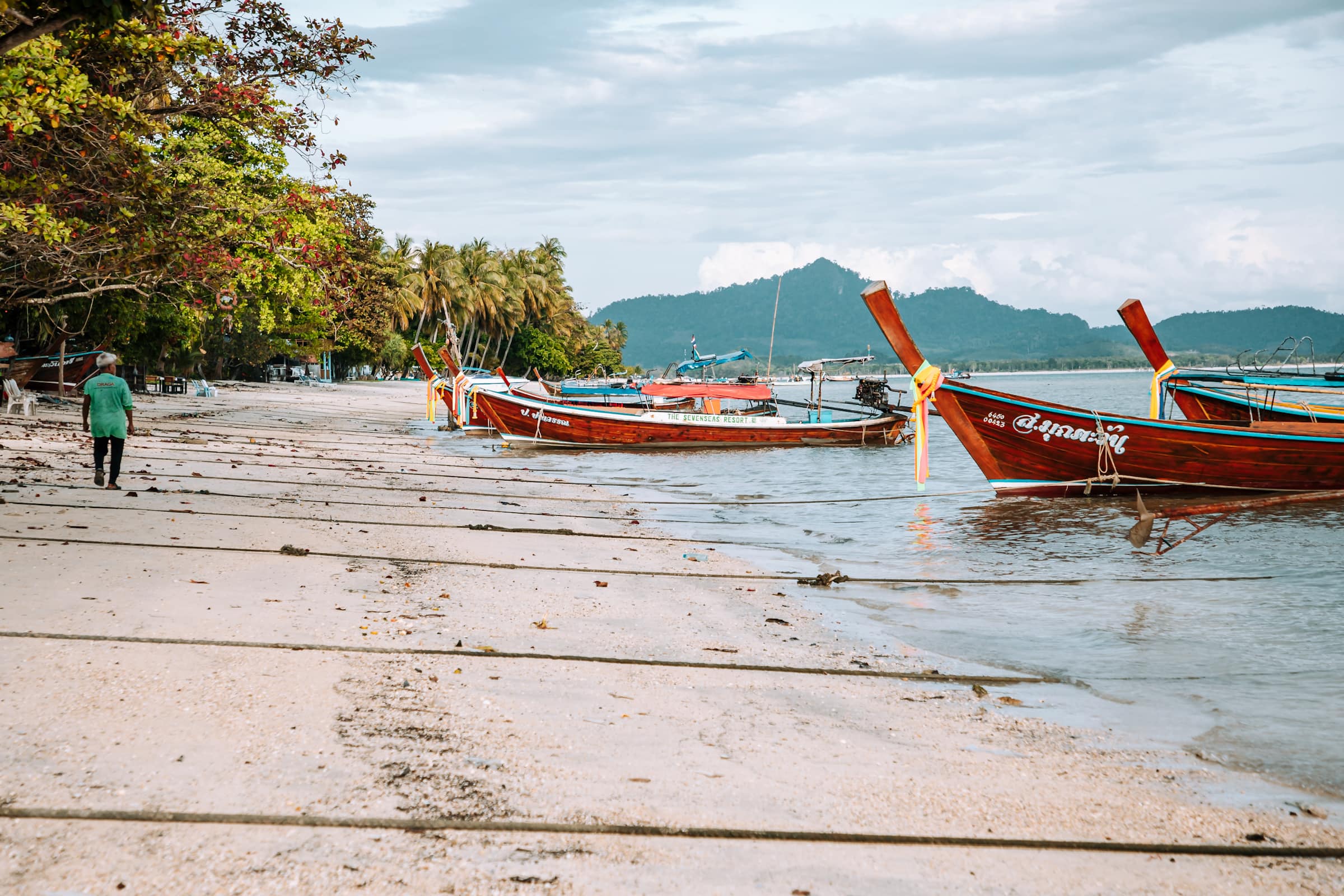
One alternative might be to charter a smaller longtail boat yourself. This can be a good option for larger groups or families, especially since you’ll be able to decide for yourself when you want to go. You might even find other travelers who want to join you! Just talk to the people at your accommodation when you’re there , or ask at the pier or at travel agencies. By the way, you can also charter longtail boats for local excursions, such as to beautiful snorkeling spots. In popular areas, this can be an advantage if you want to avoid large tour groups!
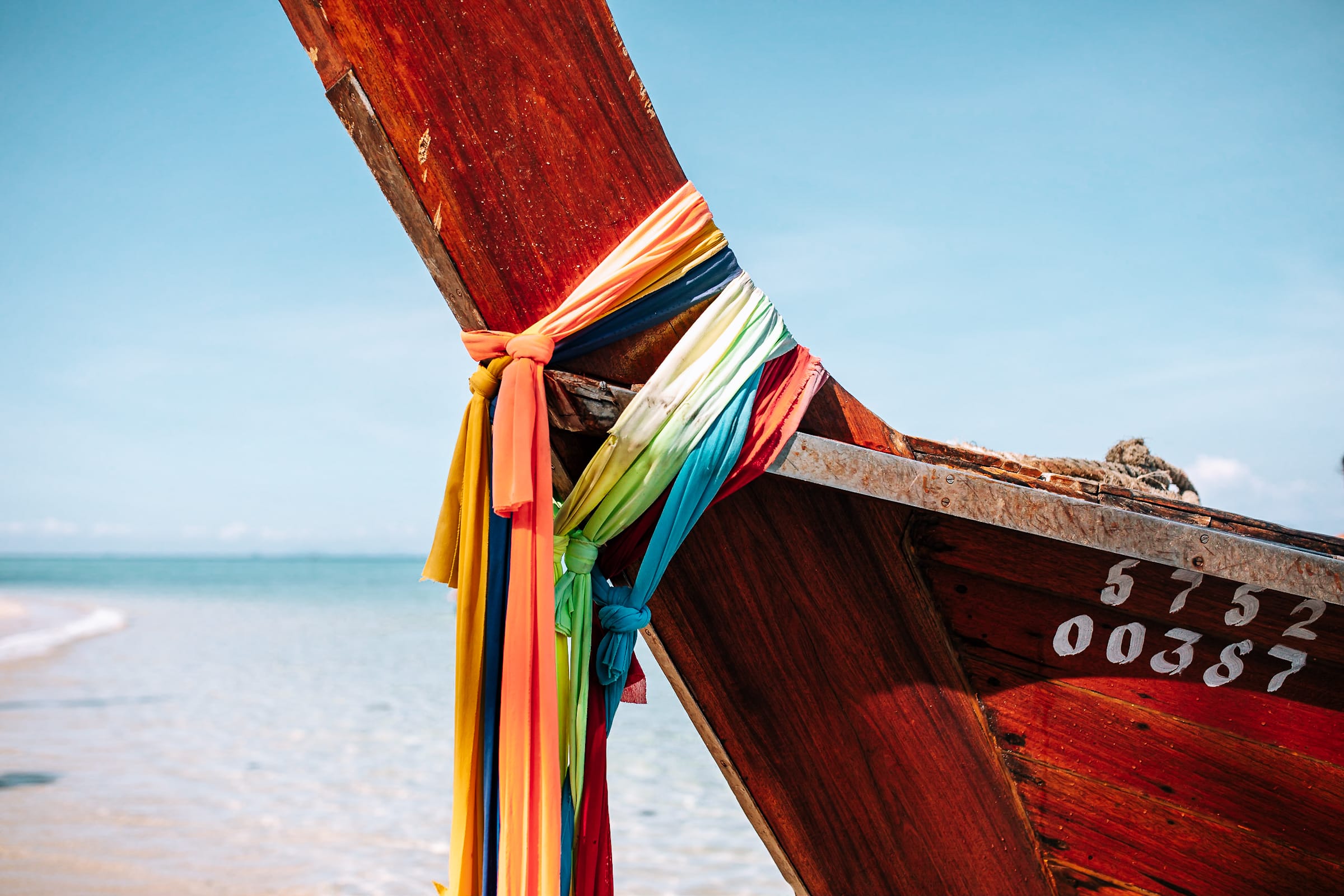
Longtail boats you can also charter completely
What do I need to take with me
On some of the islands mentioned, such as Koh Ngai or Koh Kradan, there is really nothing except the resorts. Some facilities have small sales corners where you can find necessities like toothpaste, cookies or mosquito repellent. However, it’s better if you bring everything you need. Equipment for snorkeling can be rented everywhere. There are no ATMs even on larger islands like Koh Jum, but you can change money in many small stores or get cash on presentation of your credit card. However, you will be charged a fee of approximately 6% for this.
You won’t find stores like here on Koh Mook on the smaller islands like Koh Kradan and Koh Ngai: so stock up well!
In most resorts on the smaller islands such as Koh Ngai or Koh Kradan, you can also only pay with cash, even if you book online in advance. In exceptional cases, credit cards are also accepted, but this requires more effort and prior registration – someone has to come specially or be informed. Cash payment is simply no problem. So it’s best to remember to withdraw enough cash on the mainland. I always use my DKB credit card for this. It’s relatively cheap and easy to do at any ATM worldwide.
How much time do I have to plan for island hopping in Thailand?
In general, Thailand has an incredible number of beautiful islands. You will hardly be able to see them all on one trip. I would also advise you to concentrate on a single region. For example, if you want to see Koh Phi Phi and Koh Phangan at the same time, which is on the other side of the country, you will spend a lot of time on the bus, at best on a plane to Koh Samui, and on ferries. Especially if you only have 2-3 weeks, this is rather counterproductive.
You can also visit smaller islands such as Koh Ngai or Koh Kradan on a day trip. Of course, this has less of a Robinson Crusoe vibe in a large group, but it may be more practical to have a base on an island such as Koh Lanta for a few days longer.
However, two weeks is an absolute minimum – also because a direct long-haul flight to Bangkok or Phuket from Germany takes over 10 hours. And maybe you want to spend a few more days in Bangkok? In any case, the more time you have, the better!
Every good backpacking trip through Thailand starts right here: Khao San Road is the gateway for anyone who wants to explore Thailand or the whole of Southeast Asia with a backpack. In this article, I’ll show you what the myth of Khao San Road is all about and give you a few insider tips if you want to experience more than morning hangovers from all-nighters and grilled scorpions on the side of the road.
Kilometer Zero: The Khao San Road is where many Thailand trips really got started.
Where is Khao San Road located?
Khao San Road is located in the Banglamphu district of Bangkok, the capital of Thailand. Although it is difficult to identify a real city center in the megacity of Bangkok, Khao San Road is relatively central and close to popular sights such as the Grand Palace with the famous Wat Phra Kaeo temple, the Wat Pho temple and the lesser-known Wat Suthat temple.
By the way, another beautiful temple in Bangkok is Wat Traimit with its Golden Buddha!
Loud music is part of the night on the Khao San.
Why Khao San Road is so famous
Somehow, Khao San Road has always been a major attraction in Bangkok. The mix of shops, street food stalls, bars, and restaurants keeps the street bustling around the clock. But Khao San Road didn’t really become a must-see for every backpacker until 1996, with the publication of Alex Garland’s novel “The Beach.” In the book, the protagonist begins his trip to Thailand right here, amid the hustle and bustle of cheap bars and the wild nightlife. The subsequent film adaptation starring Leonardo DiCaprio did the rest, and the legend of Khao San Road was born.
Are you also planning a trip to Southeast Asia? You can find all my articles about Bangkok and Thailand here
Especially for backpackers, Khao San Road used to be the first port of call in Bangkok.
Khao San Road: Now for everyone
Originally more of a meeting place for low-budget vacationers and backpackers, Khao San Road is now actually a must-see for any Bangkok visitor. In the evenings, the atmosphere ranges from parties to social gatherings, while during the day there are endless shopping opportunities. Street food is available around the clock anyway. Particularly popular photo motifs are snack stands with grilled insects, worms or scorpions, which are always used for culinary tests of courage. Even tattoo studios can be found here. I don’t want to know how many people wake up early in the morning with a tattoo as a souvenir: The nights on Khao San Road can get wild!
Nightlife on Khao San Road in Bangkok
If you’re not into dancing the night away, you can take it easy around Khao San Road. Between the bars, there are always individual massage parlors where you can have your feet massaged in comfortable armchairs right on the street, for example. Personally, I don’t find it particularly appealing and always somehow a bit unhygienic, but people seem to be into it!
Rambuttri Road: The laid-back alternative to Khao San
The parallel street, Rambuttri Road (or Rambuttri Alley), is much quieter. There you will find not only tourist hangouts, but also very cozy bars and unexpectedly hip food locations!
Worth seeing: Rambuttri Road is much more atmospheric than Khao San Road.
From the Molly Bar, you can watch the hustle and bustle on the street, listen to music and enjoy the nightlife with a cocktail. And Camp Burger has really good burgers if you’re not into Thai cuisine.
Insider Tip: Samsen Road
I’ve been to Bangkok several times and I’m not necessarily one of those people who has to start a Thailand trip compulsorily near Khao San Road. For many, this is simply part of a perfect trip to Bangkok. What I can also somehow understand is that the vibe around Khao San Road is very special. During my last stay in Bangkok, I also ended up there rather by chance, because I had booked a hotel so spontaneously that I didn’t really realize where it was. But it was still a 20-minute walk to Khao San Road. That way, I’ve discovered quite another insider tip!
If you’re in the mood for a cozy, tropical-warm evening with good food and want to escape the hustle and bustle of Khao San Road for a while, you only need to walk a few streets further in the direction of Samsen Road. Around Soi 2 (the side streets of a main street are often just numbered) you’ll find a cute little neighborhood with nice restaurants, like So Samsen, which is really nicely decorated. Along Samsen Road itself there are also some less touristy, exciting locations like Neighbourhood (address: 59, 61 Samsen Rd) for evening/nighttime or Ganja Café for daytime.
Insider Tip: Samsen Road
Shopping on Khao San Road
You can shop endlessly on Khao San Road and the surrounding area. However, the stores are very focused on tourists. So if you can no longer see the infamous Elephant Pants either, I recommend a visit to Chatuchak Market or The One Ratchada night market, which replaced the formerly popular Ratchada Train Night Market after the pandemic.
Shopping tip: Something about us
If you don’t have time to browse through the huge markets, I have a little shopping tip for you near Khao San Road: At something about us, you will find beautiful little things such as costume jewelry, accessories and fine stationery by local artists.
Where to stay near Khao San Road
In the immediate vicinity of Khao San Road, you will mainly find low-budget accommodation, but now also typical tourist hotels. If you want to stay in the middle of the party and tourist hustle and bustle, this is the place for you!
However, I find that there are so many great neighborhoods and exciting locations to stay in Bangkok that I tend to avoid the direct area around Khao San Road.
I was really happy with my hotel, which was located a little further away from Khao San on Samsen Road. Overall, I found the area surprisingly cool for staying overnight—very local and safe (though, to be honest, I rarely feel unsafe in Bangkok anyway). And I can highly recommend Lost in BKK, whether as a hotel or a hostel (they offer both private and shared rooms): friendly staff who go above and beyond!
There are direct bus connections to Khao San Road from both the major Suvarnabhumi Airport, where all long-haul flights land, and Don Mueang Airport, which is often served by low-cost airlines. Alternatively, you can take a cab or the Thai equivalent of Uber, Grab.
Suvarnabhumi Airport is also connected to the city by the Airport Rail Link, a skytrain. While this is super convenient and fast, it only has a few stations. To use it to get to Khao San Road, you would have to get off at Phaya Thai station, and then transfer to bus or cab.
I want to travel more again, get to know new places and rediscover old ones. Is that what you also set out to do? Then my list of ideas for a few great city trips in Europe is definitely something for you! Just save this post somewhere and you can always get ideas for the next spontaneous city trip throughout the year!
More on the road again: we are traveling for all we’re worth.
What can I say? Before I tell you about the little insider tips in Rome, you should also have seen the classics in Rome. This city is simply so bombastic and interesting that the usual sights such as the Colosseum, the Trevi Fountain or St. Peter’s Basilica alone are enough to keep you busy.
Spanish Steps in Rome
#2 Seville
Spaniards are generally Mediterranean, warm and open, but Andalusians really go the extra mile. “Hola reina”, “como estás reina”, “aqui tiene reina” – I really like this Andalusian habit of always being affectionately addressed as “reina”, meaning “queen”. If you’re looking for joie de vivre and positive energy, Seville is definitely the place for you!
Tip: Watch the flamenco dancers at the Plaza de España and let yourself be carried away by the passionate atmosphere of a city that is bursting with warmth.
If you’re looking for a place to stay in Seville, I recommend the Boutique Hotel La Parada de Marques. It’s relatively new, beautifully designed, and the staff are friendly—you’ll love it.
True to style in an Andalusian old building: My hotel tip for Seville
#3 Paris
Oh Paris! This city is just such a classic. Even though it’s super expensive and most people complain about the grumpy and overly proud French. I really can’t understand that, because I rarely find the French or Parisians rude (well, I also live in Berlin, so I have different standards) and if I were French – hey, I’d be pretty proud of this awesome city too!
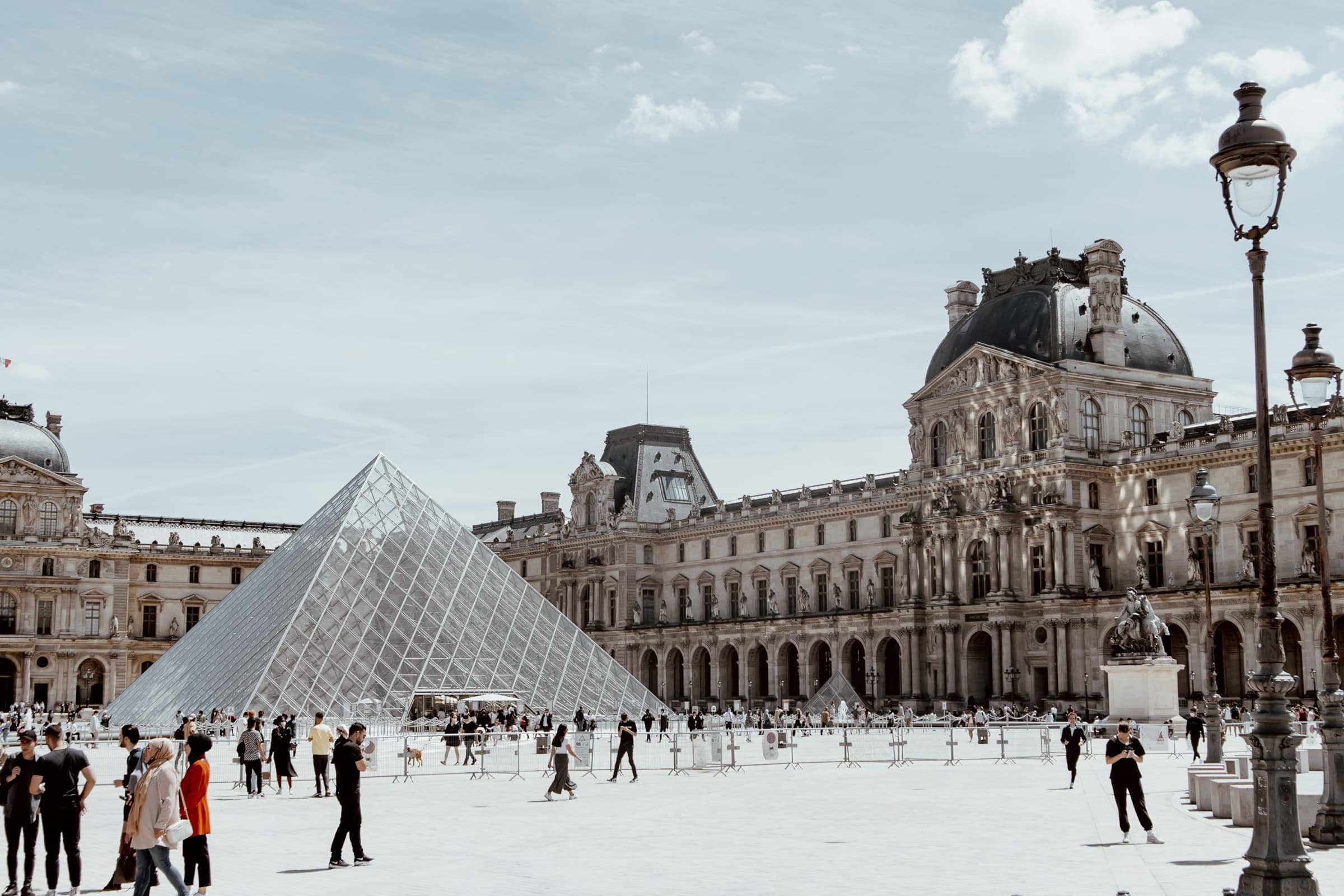
If you have time: Be sure to visit the Louvre – also a must in Paris!
#4 Zagreb
In Zagreb, I probably experienced the most memorable museum visit of my life: the Museum of Broken Relationships features artifacts from broken relationships. Sounds crazy, and a bit like those tourist museums that are supposed to seem fun, but in the end you’re just annoyed about the money you’ve spent. But it’s very different there, and not only once have the exhibits brought tears to my eyes, whether out of joy or sadness. Definitely worth a recommendation. And Zagreb as a city anyway.
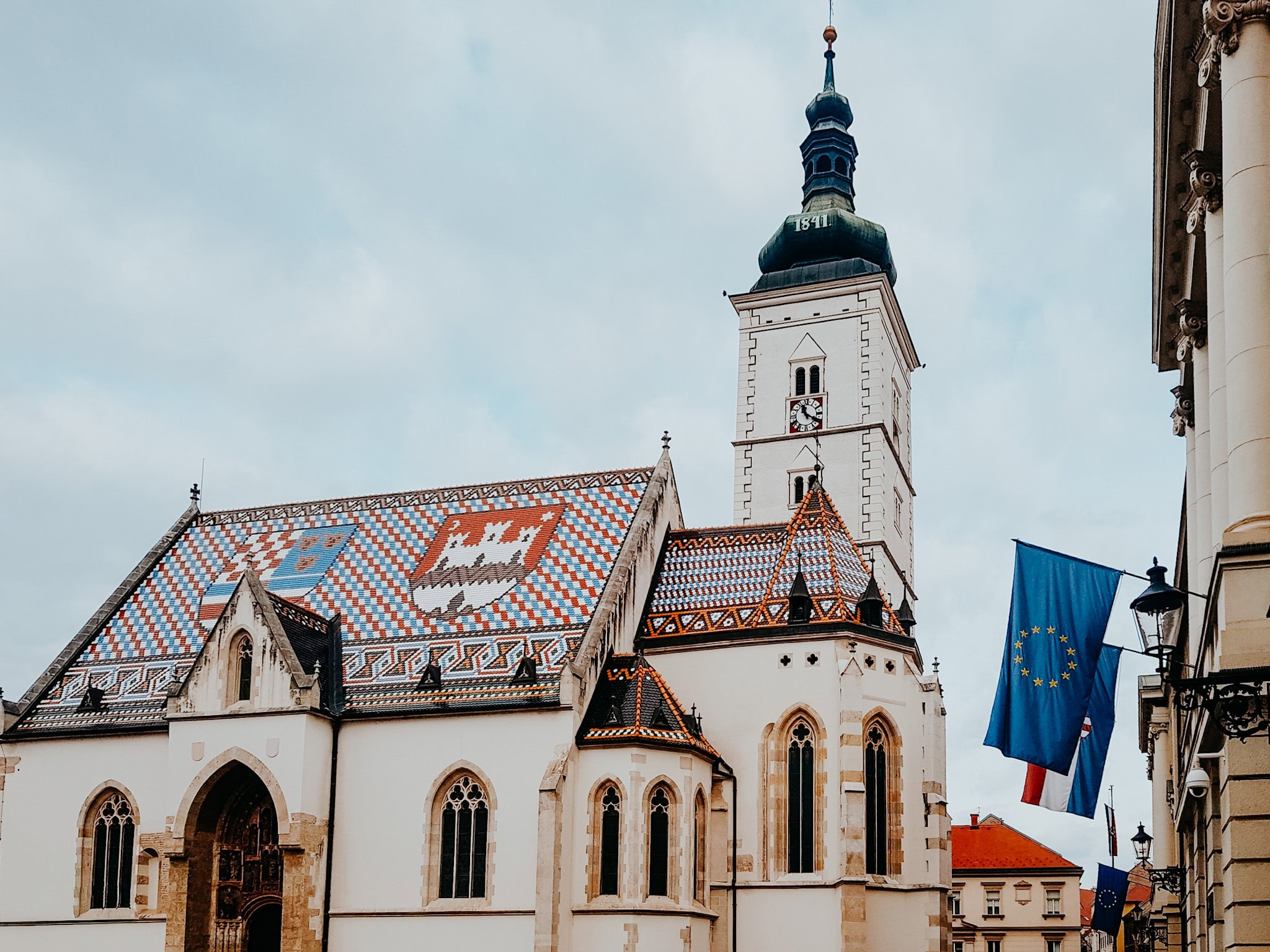
The beautiful roof of St. Mark’s Church in Zagreb
#5 Graz
Okay, Austrians are probably rolling their eyes right now, but to me, Graz—along with Salzburg —is one of Vienna’s little sisters. Less crowded, less overwhelming, but still a mix of tradition, culture, and pretty good cuisine. And thanks to its picturesque location on the Mur River and its green surroundings, Graz is perfect for a relaxing city getaway! By the way: It’s absolutely perfect if you stay at the Grand Hôtel Wiesler, which is right on the Mur River in the city and is simply gorgeous!
Tip: Visit the current exhibition at the Kunsthaus Graz (admire the impressive futuristic building on the side!) and then enjoy the panorama with a glass of wine on the Schlossberg.
View of Graz from the Schlossberg
#6 Vilnius
Vilnius was, so to speak, my last stop of the year (you can find my article about Vilnius here). When I arrived in Vilnius, winter was already just around the corner, and for someone like me—who’s notoriously sensitive to the cold—that was a real challenge. Still, the mix of history, culture, and a young, open atmosphere was really exciting. And at Hotel Pacai, I had one of the most enjoyable hotel stays I’ve had in a long time. It was relatively quiet in the winter, but from previous visits (admittedly, a long time ago), I can still remember how lively it gets here in the summer.
Tip: Vilnius is the only city in Europe where you can float over the city center in a hot air balloon.
Advertising / *affiliate link
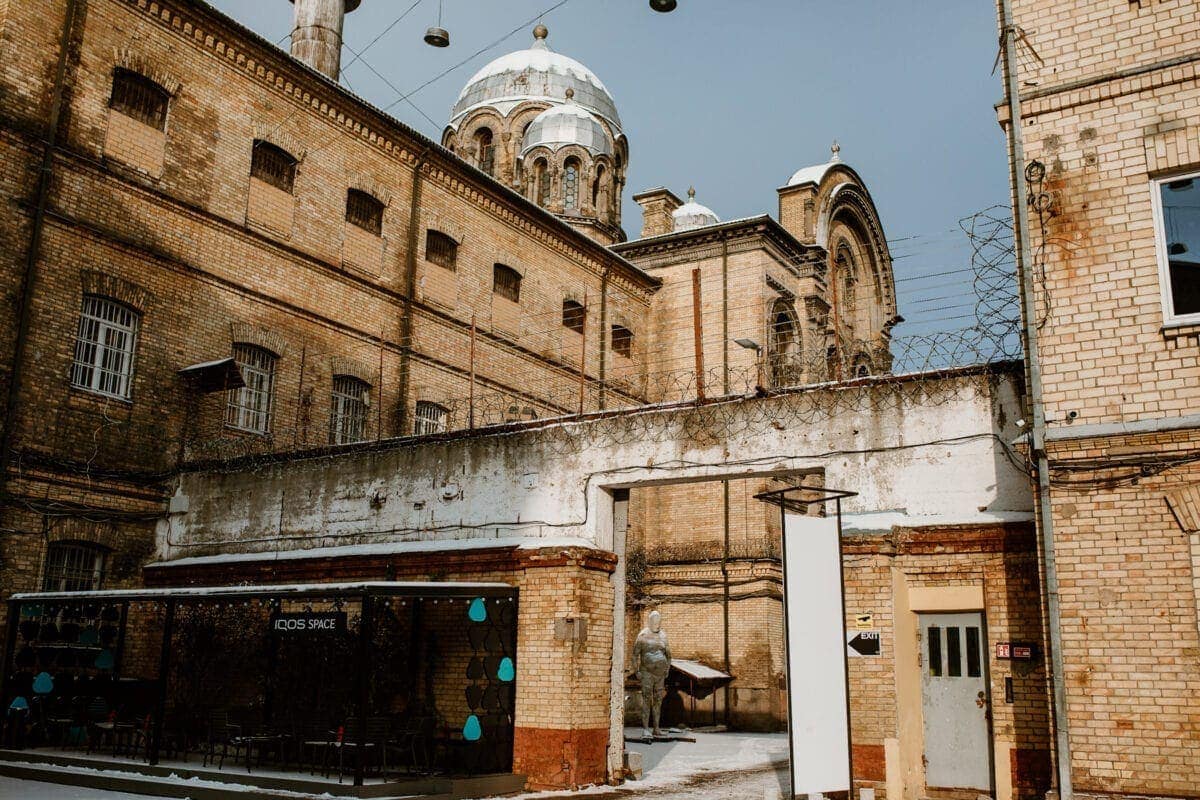
Crazy: The former Lukiskies prison in Vilnius now houses an event space
#7 Venice
Venice is always a good idea, and even if Venice is hijacked by tourists in summer – it is still an incredibly fascinating city. The location in the lagoon, the old palazzi, so much art: I’ve actually been to Venice only once, but this was certainly not the last time!
My advice: Go up to the terrace of the Fondaco dei Tedeschi for sunset & browse the shelves at the Libreria Acqua Alta.
Advertising / *affiliate link
Fantastic view over the Grand Canal from the roof terrace of the Fondaco dei Tedeschi
#8 Prague
Last year I unexpectedly ended up in Prague again and was just super happy about the day I got to spend there. Prague is just one of those cities full of history and old glamour and has a very special vibe.
It can get crowded on Charles Bridge in the summer, even though it’s so wide!
#9 London
I don’t know if it’s the upcoming coronation of King Charles III or the hype around Harry and Meghan at all, but London has been dominating my Instagram feed lately as far as major cities in Europe go! Well, London always works anyway – so why not consider it for this year?
Tip: Pick up the London Harry Potter vibe at platform 9 3/4 at Kings Cross station & then sip champagne at the bar right next door at St.Pancras station.
Très chic: The Champagne Bar at St.Pancras Station
#10 Gdansk
I’ve been to Gdansk a few times and rediscovered some great locations there. For example, it was my first time on the site of the old Gdansk shipyard – and it was so exciting! I hope to go there again in the spring or summer. That’s when the huge crane is open, from where you have a really good view over the city.
Especially in summer, the location on the Baltic Sea is worth its weight in gold: in Gdansk you can perfectly combine sightseeing & a beach day in one weekend.
#11 Palma de Mallorca
Actually, my second home, Palma, is already crowded enough in summer. Every year there are new discussions about limiting the number of cruise ships docking and thus the crowds that flood the streets of the old town during the day.
Anyway, the cruise tourists usually flock in the same direction and I still have so many tips for great locations in Palma (like my favorite neighborhood, Molinar) that the mainstream doesn’t know about. So get ready for more insider tips for Palma here on the blog!
My absolute favorite beach in Palma, for reasons 🙂
#12 Hamburg
Hamburg is only an ICE train ride away from Berlin. I like to travel by train anyway, and I don’t let constant delays or a non-existent service culture like from our German train service stop me! (By the way, with the Flixtrain there is still a good alternative to the Deutsche Bahn in Berlin; also not always perfect, but sometimes a refreshing alternative).
I’ve never been a big fan of Madrid. But after hearing my blogger bestie Sandra rave about so many tips in Madrid all last year, I should give the city another chance and go in search of the best tortillas in Madrid myself.
Advertising / *affiliate link
#14 Dresden
My insider tip for Dresden: The organic café in the Japanese Palace, with its own small garden in the courtyard!
Semper Opera House in DresdenSmall oasis: the café in the Japanese Palace in Dresden
Dresden has always been a beautiful destination. Besides the usual sights like the Zwinger, the Semper Opera and the Frauenkirche, I recommend a trip to the Neustadt where Dresden gets a bit wilder and alternative.
Advertising / *affiliate link
#15 Timisoara
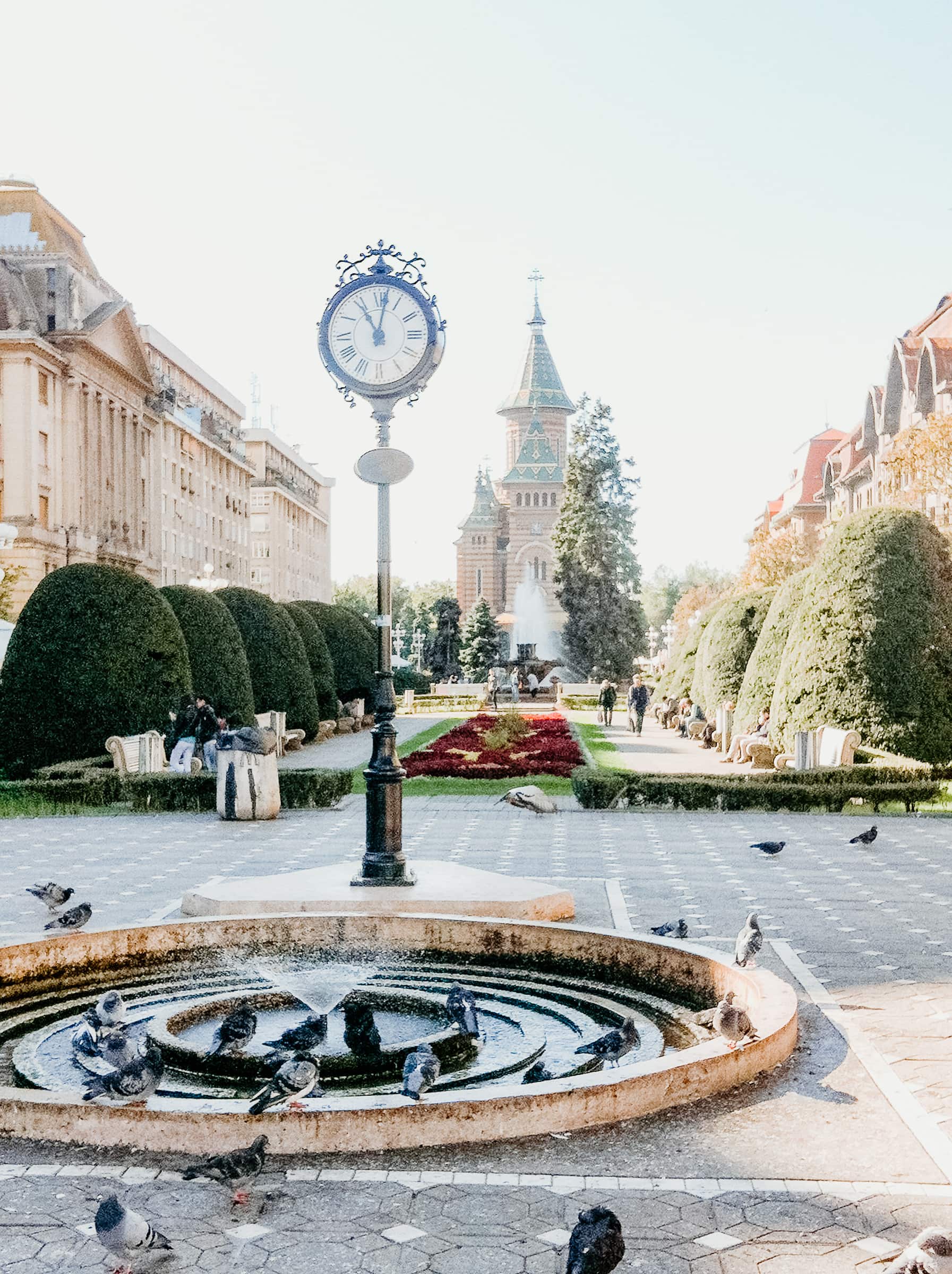
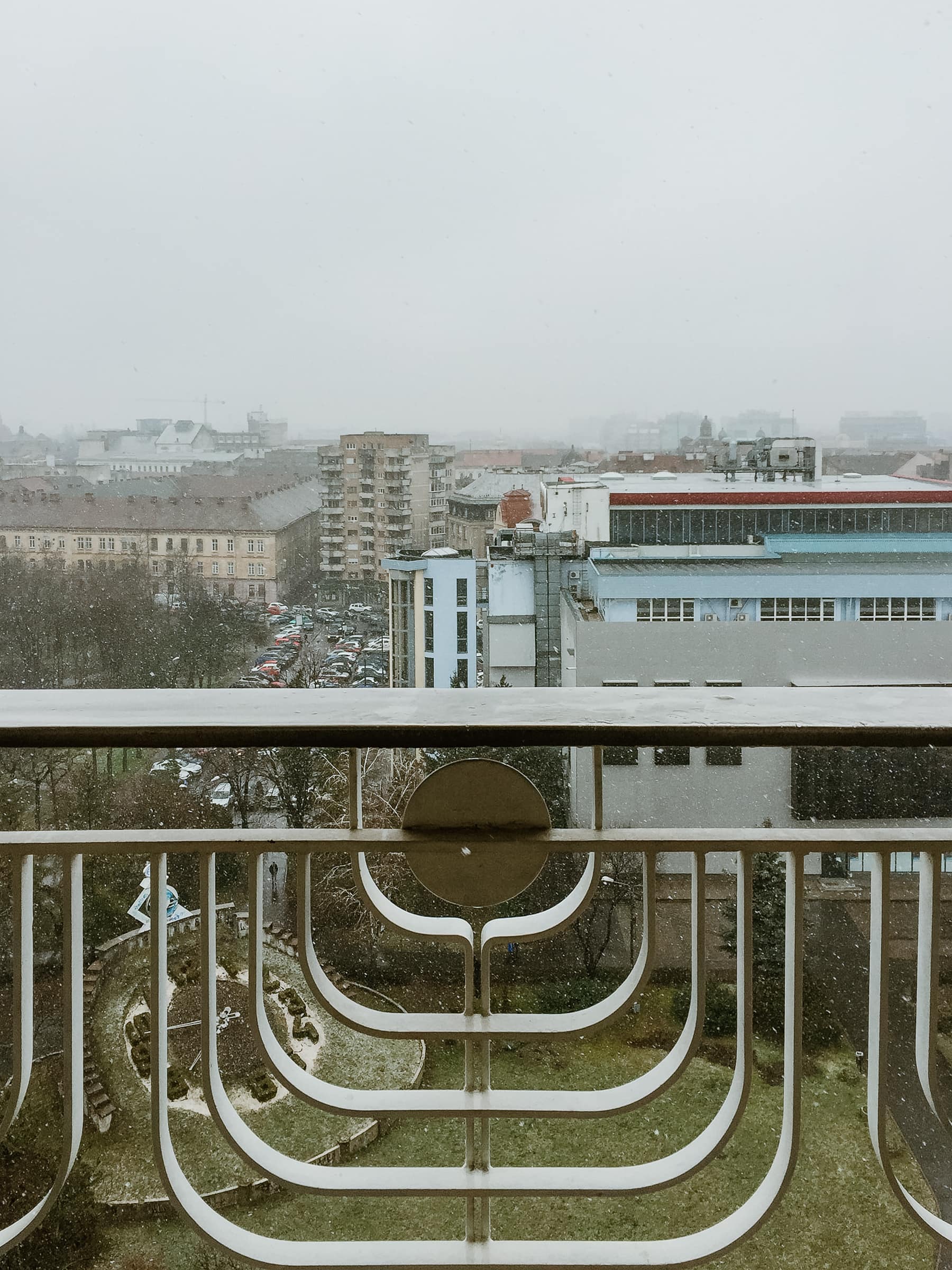
Admittedly, Timisoara and I took off on bad terms. I’ve probably been there too many times, and at a time when Timisoara and, for that matter, the rest of Romania were anything but hip and trendy. Or maybe it was due to the rather revealing nightclub advertisement in the elevator of our crew hotel, which was meant to attract guests to the hotel bar in the basement. And I bet many (mostly male) guests on a business trip were very happy about the hint. Already a very unusual flair for one of the better hotels in town. Be that as it may, Timisoara has been really spruced up in recent years, and perhaps the last windy fortune-hunters will soon disappear.
#16 Lisbon
I realized with horror how long it has been since I’ve been to Lisbon. Yet the Portuguese capital is my absolute place of strength; especially in winter, when it’s gray and dreary in Germany, a sunny day in Lisbon is worth its weight in gold I don’t know what it is, but the light, the water around it, the wind of the Atlantic make it one of my favorite cities in Europe. And of course the Portuguese, the delicious food, the great old town and much more.
The best view of Lisbon is from the many miradouros in the city
#17 Faro
After my trip to the Algarve, I almost got stuck in Faro. I just didn’t want to go back to Berlin. What it is, I don’t know, but Faro is possibly just the perfect mix of Portuguese lifestyle, laid-back cafes and stunning beaches just outside the city.
Close to Faro you will find the most amazing beaches!
#18 Manchester
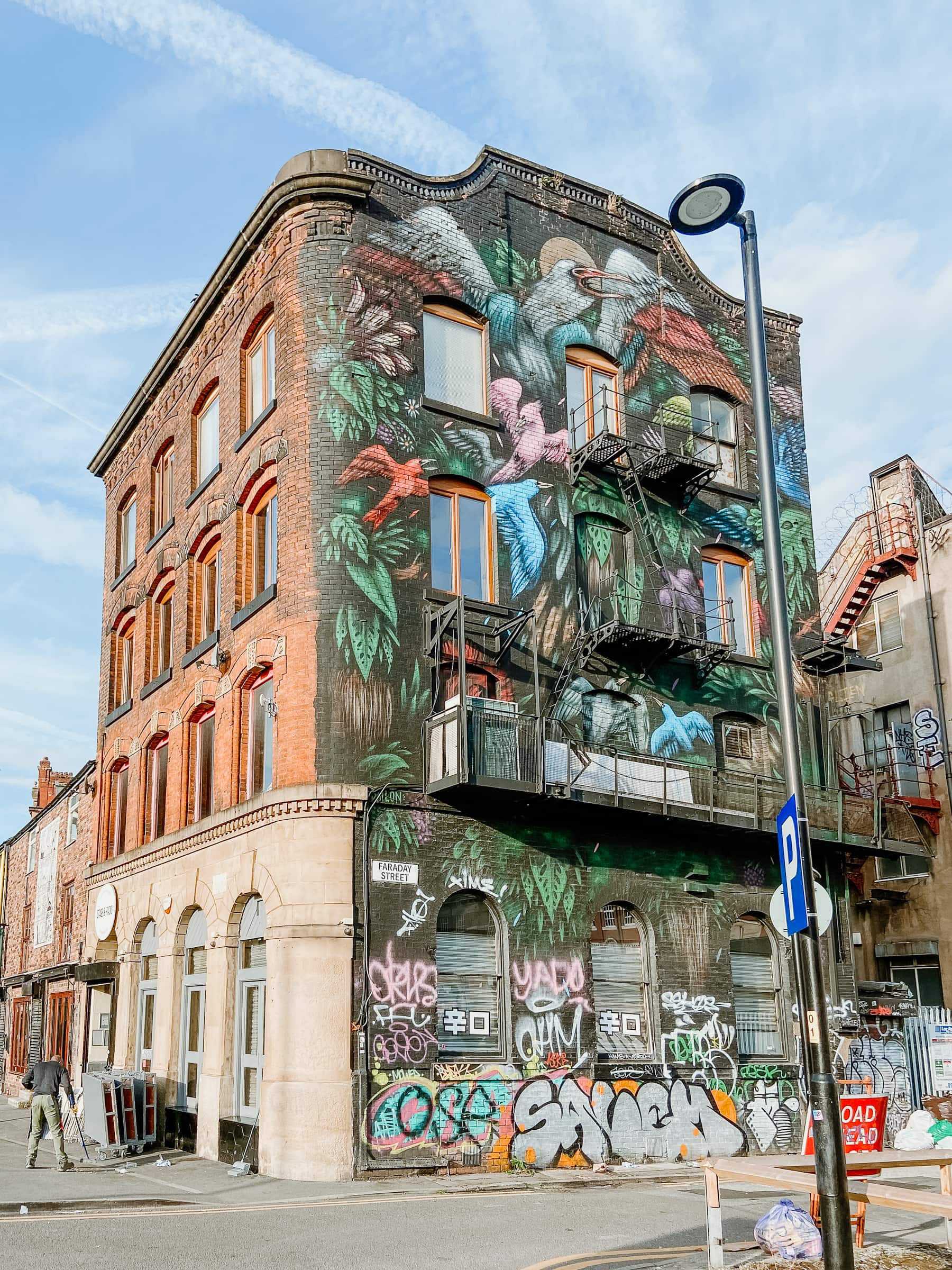
Whenever I think of Manchester and English, I always think of that hot potato that every Mancunian seems to have in their mouth when they speak. That broad accent is just so cool! And anyway, I feel a bit at home in Manchester—probably because there are quite a few parallels between Manchester, as an old industrial city, and my home region, the Ruhr area. And hey, we often talk a bit funny there, too, right?
Expert tip for Manchester: Tib Street in the hip Northern Quarter with street art, specialty coffee cafés and craft beer pubs until you drop
#19 Basel
Okay, Basel is in Switzerland, so that makes it extra expensive, and anyway, in Swiss cities you always have to ask yourself if it’s worth having half a heart attack every time you run up a bill at the café. But Basel in summer is just cool because of its Rhine swimming: Put your clothes in the so-called “Wickelfisch” (a waterproof plastic bag), swimwear on, jump into the Rhine and let yourself drift on the Wickelfisch with the quite swift current. Always an amazing experience!
If you don’t want to swim: You can also chill out by the Rhine in BaselRhine swimming in Basel
#20 Poznan
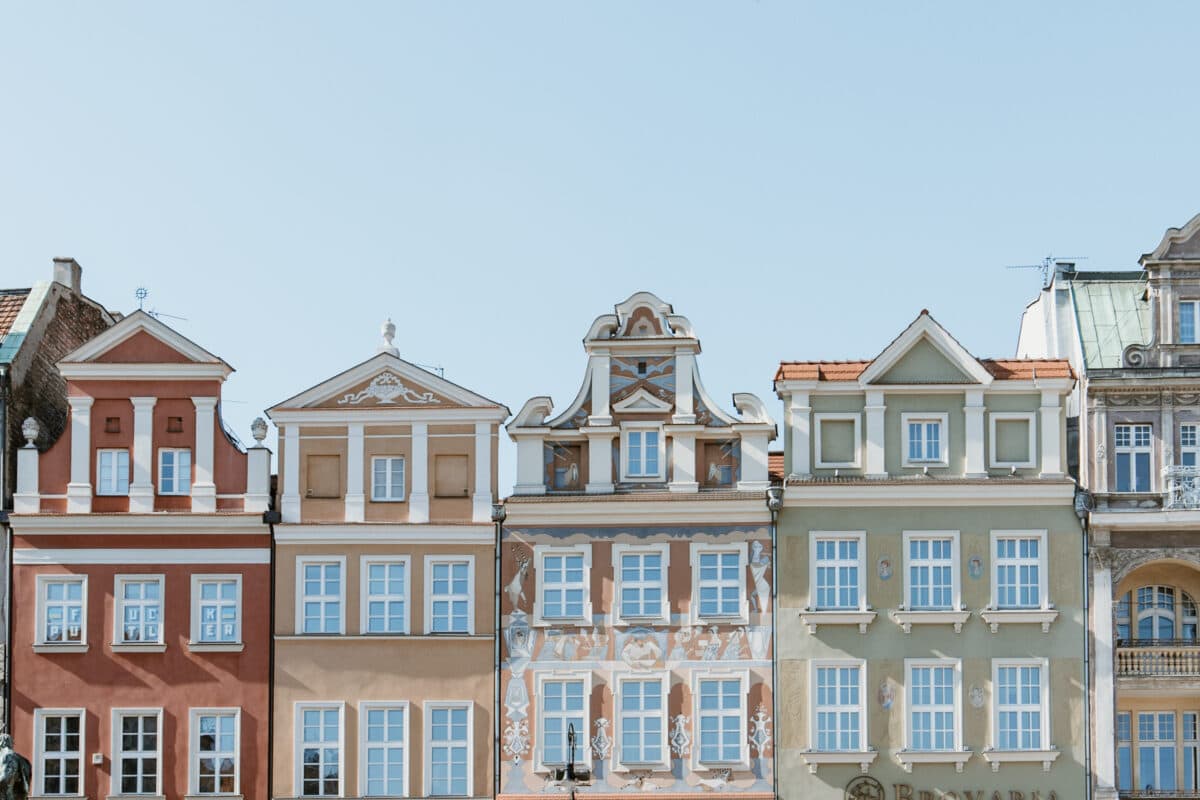
Actually, I’ve had quite an overdose of stays in Poland in the last few years, because I’m there all the time for work reasons. But that also means that a considerable number of tips have piled up that I still absolutely have to share with you here on the blog – from the best St. Martin’s croissants to a real jungle, I still have quite a few in store for Poznan. And if you’re looking for a nice and easily accessible destination for a short trip that won’t blow a huge hole in your travel budget, Poznan is just perfect!
Beautiful facades: The market square in the old town of Poznan
Advertising / *affiliate link
#21 Torino
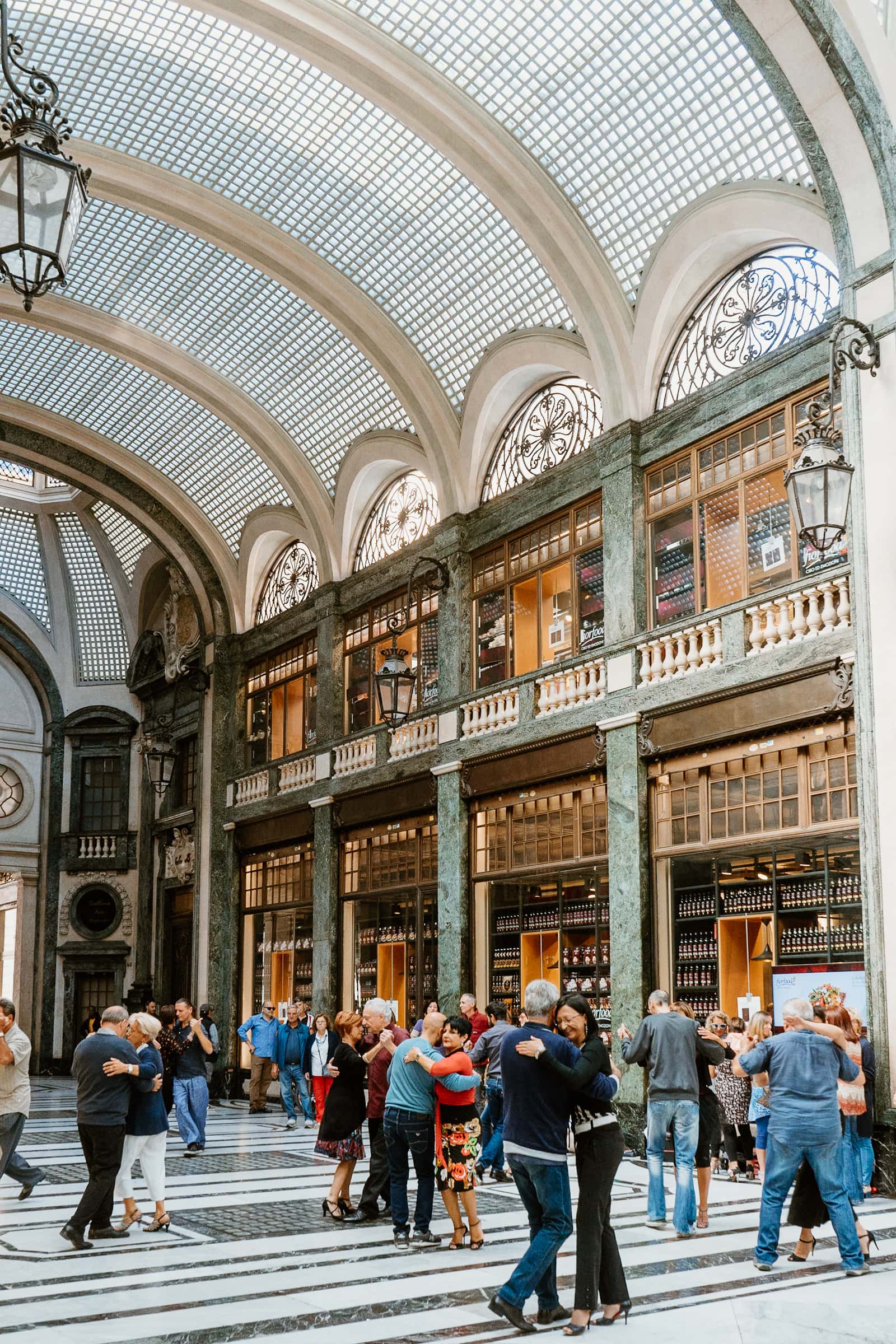
Omg, I just miss overnights in northern Italy! In the meantime, I have given up hope of ever returning to Milan, Bologna or even Torino on duty. Whether for a casual cappuccino or tango dancing under arcades, I’ll definitely have to return!
Reus was one of my new discoveries in Spain last year, along with Tarragona! Only a hundred kilometers from Barcelona, it is perfectly accessible by train for a day trip from there! Find out what you can experience there in my travel guide for Reus!
Tip: A trip to Catalonia is well worthwhile. Here you can find my Catalonia insider tips!
Casa Navas in Reus is so beautiful – an absolute discovery!
#23 Berlin
Opinions differ about my current hometown, which I constantly quarrel with, but which is also simply unique in many ways. Berlin is loud, chaotic and dirty – but you shouldn’t let such trivialities stop you!
Besides, there’s so much to see in Berlin, there’s a pretty good chance there’s still plenty to discover. When I talk to people who didn’t like the city so much, I often realize that they were just exploring the wrong corners. To make sure that doesn’t happen to you, I’ve resolved to share more tips for Berlin here on the blog this year!
Good breakfast locations are a dime a dozen in Berlin. But did you know that you can also have breakfast in the Reichstag? I show you here a very special idea for your next visit to Berlin!
Breakfast in Berlin
In probably no other city in Germany is breakfast celebrated as much as in Berlin. I’d like to be proven wrong, but I’ve never seen another city in Germany where you can eat breakfast around the clock. Finding a breakfast menu in cafés until the early afternoon hours is less the exception than the rule. And the range of dishes offered is huge. But if you really want to have breakfast in a fancy location in Berlin, you should stop by the Reichstag!
Breakfast in Berlin: Insider tip in the Reichstag
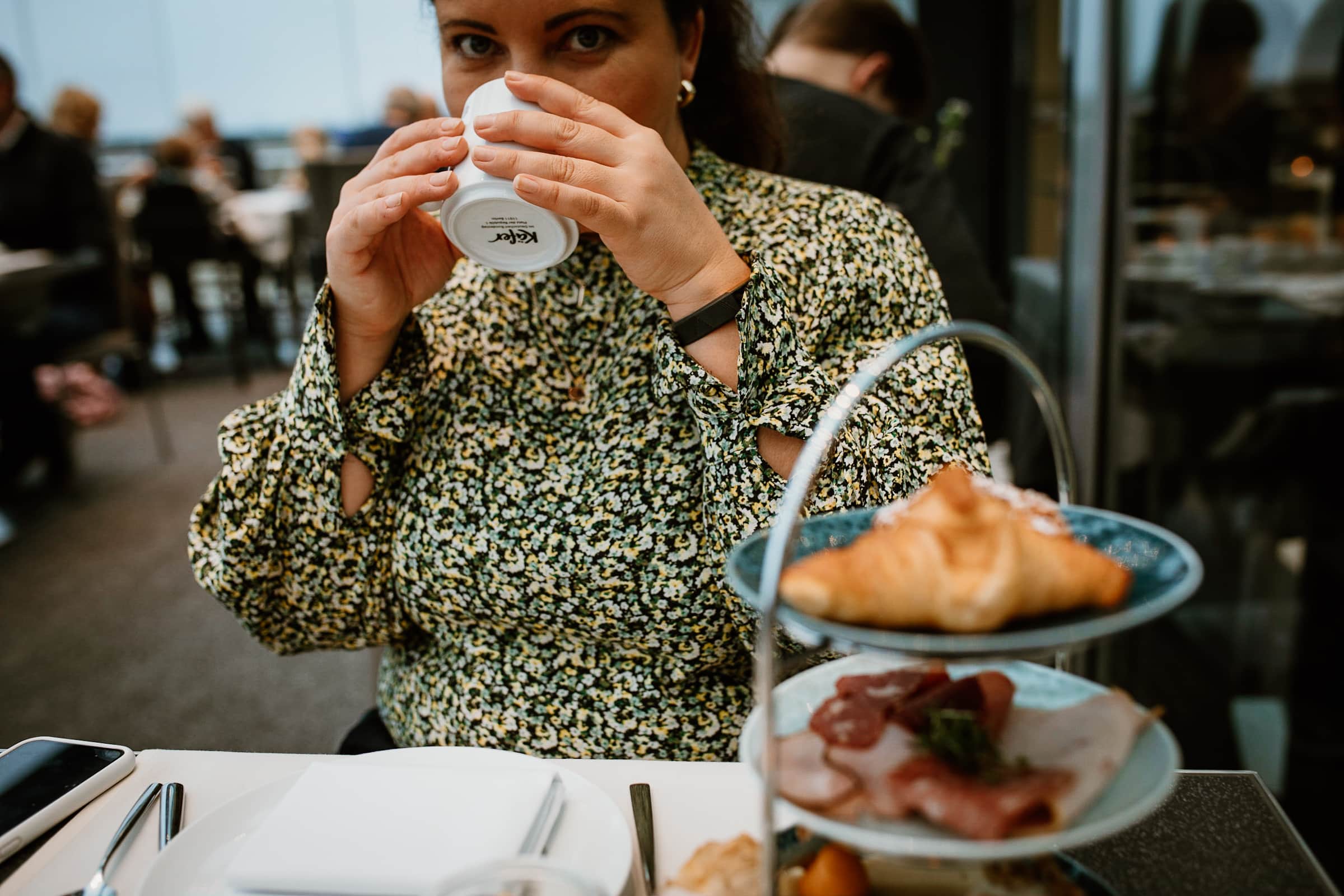
Breakfast at Käfer in the Reichstag in Berlin
You’ll probably be surprised: Breakfast in the Reichstag – where the Bundestag, the German parliament, usually meets? That’s right, because upstairs in the Reichstag there is a branch of the Munich-based delicatessen specialist Käfer. After a visit to the Reichstag, you can not only enjoy a fancy breakfast in the roof garden restaurant, but also a unique view over Berlin!
Especially in good weather and on weekends, the rooftop garden restaurant is really busy. That’s why you should definitely book in advance!
Don’t be surprised: When making a reservation, you must provide your name, date of birth and ID number. This is important because your reservation will be deposited at the bottom of the entrance and you will be allowed directly through the security gate.’ If the Reichstag is well visited, long queues can form at the entrance! But you’ll get in faster with a restaurant reservation. For this reason alone, breakfast at Käfer is a real insider tip to save time when sightseeing in Berlin!
What is the Reichstag?
The Reichstag in Berlin is the seat of the German Bundestag, the parliament of the Federal Republic of Germany. Opened in 1894, it was originally the parliament building of the German Empire. During the Second World War it was very destroyed and was without function until the fall of the Berlin Wall. From 1990, the Reichstag was again used for parliamentary sessions of the new all-German Bundestag.
The Reichstag from the outside
The glass dome of the Reichstag
You should definitely take a look at the glass dome of the Reichstag. It was completed in the late 1990s as part of the major reconstruction work on the Reichstag. The funnel-shaped dome with many glass and mirror elements was designed by British architect Sir Norman Foster and is truly fascinating.
How to visit the Reichstag?
You can visit the dome and the roof terrace of the Reichstag every day. However, registration in advance is absolutely necessary. You can register here: https://www.bundestag.de/besuch/anmeldung
If you are in the area spontaneously, you can also register on the spot. You will then receive an appointment within the next two hours if available, or you can request an appointment for the next two following days.
However, with a restaurant reservation you save a lot of time and get a great breakfast on top. Check the availability for breakfast here:
Important: To get into the Reichstag, you absolutely need a valid identification document (identity card or passport) in the original!
Breakfast Alternatives at the Reichstag
Not in the mood for breakfast? No worries! The roof garden restaurant also offers an early afternoon aperitif, where you can also visit the dome and the roof terrace of the Reichstag:
A city trip to Vilnius is easier than you think: an hour and a half flight and you’ll land in the Lithuanian capital, which apart from a turbulent history also has a lot of modern adventures to offer! Vilnius is young, a bit wild and quite innovative! I’ll show you what you can experience here, especially in winter – and why you should definitely visit Vilnius!
The main sights in Vilnius + history of the city
Cathedral Square & St.Stanislaus Cathedral
The Cathedral Square with the Cathedral of St. Stanislaus is a must-see during a sightseeing tour in Vilnius. On Cathedral Square you will also see a large monument to Gedeminas, Grand Duke of Lithuania from 1316 and founding father of Vilnius (you will come across the name more often in the city! Right next to the cathedral is the bell tower, from which you have a good view of the surroundings.
But you’ll also have a good view from the Gedeminas Tower nearby. There is also a small cable car up there, in case you are too lazy from all the sightseeing to walk all the way up! Gedeminas Tower is part of the Lithuanian National Museum.
Facts about Vilnius:
Lithuania has 2.8 million inhabitants, 570,000 of them live in Vilnius.
The Old Town is a UNESCO World Heritage Site, the largest in Eastern Europe and famous for its many Baroque churches.
Vilnius is the capital of Lithuania.
Palace of the Grand Dukes of Lithuania
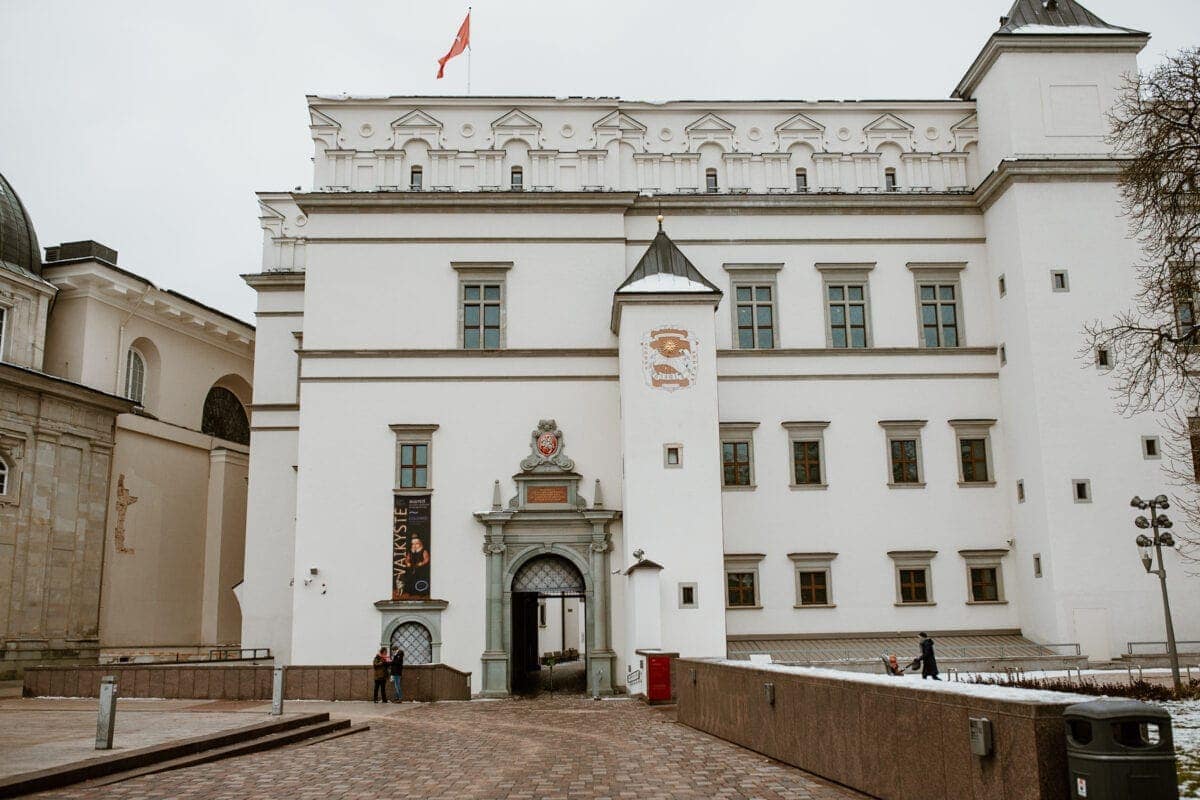
The Palace of the Grand Dukes of Lithuania, which was actually destroyed at the beginning of the 19th century and has only recently been completely reconstructed, is also located on Cathedral Square. Here you will also find the archaeological excavations found in the process, which you can see in an interesting exhibition.
As you can see, you can find a high concentration of historical places around the cathedral. Now you should have a really good overview of Vilnius and its origin!
Gate of Dawn
You shouldn’t miss the Gate of Dawn while exploring the main sights in Vilnius. Actually, it is a city gate of the old city wall around the old town. On the side, there is a small entrance from which you go up a staircase just above the archway. There is a really nice little chapel with a Madonna. The Gate of Dawn is an important pilgrimage site and is visited by many believers. (Taking photos is therefore not allowed).
St.John’s Church & Vilnius University
Churches, churches, churches. You won’t get past that in Vilnius, because the many baroque churches are simply part of the cityscape. You’re probably already a little tired from so much history and heavy church history.
But there is one more church you should see: St. John’s Church is part of the Vilnius University campus (one of the oldest in Europe, by the way!) and the altar with its many columns shows very well why the baroque churches in Vilnius are considered quite unique. By the way, in summer you can also climb the bell tower here for a small fee. The bell tower is the highest building in the old town and you’ll have a perfect view!
Best view of Vilnius Old Town: The bell tower of St. John’s Church
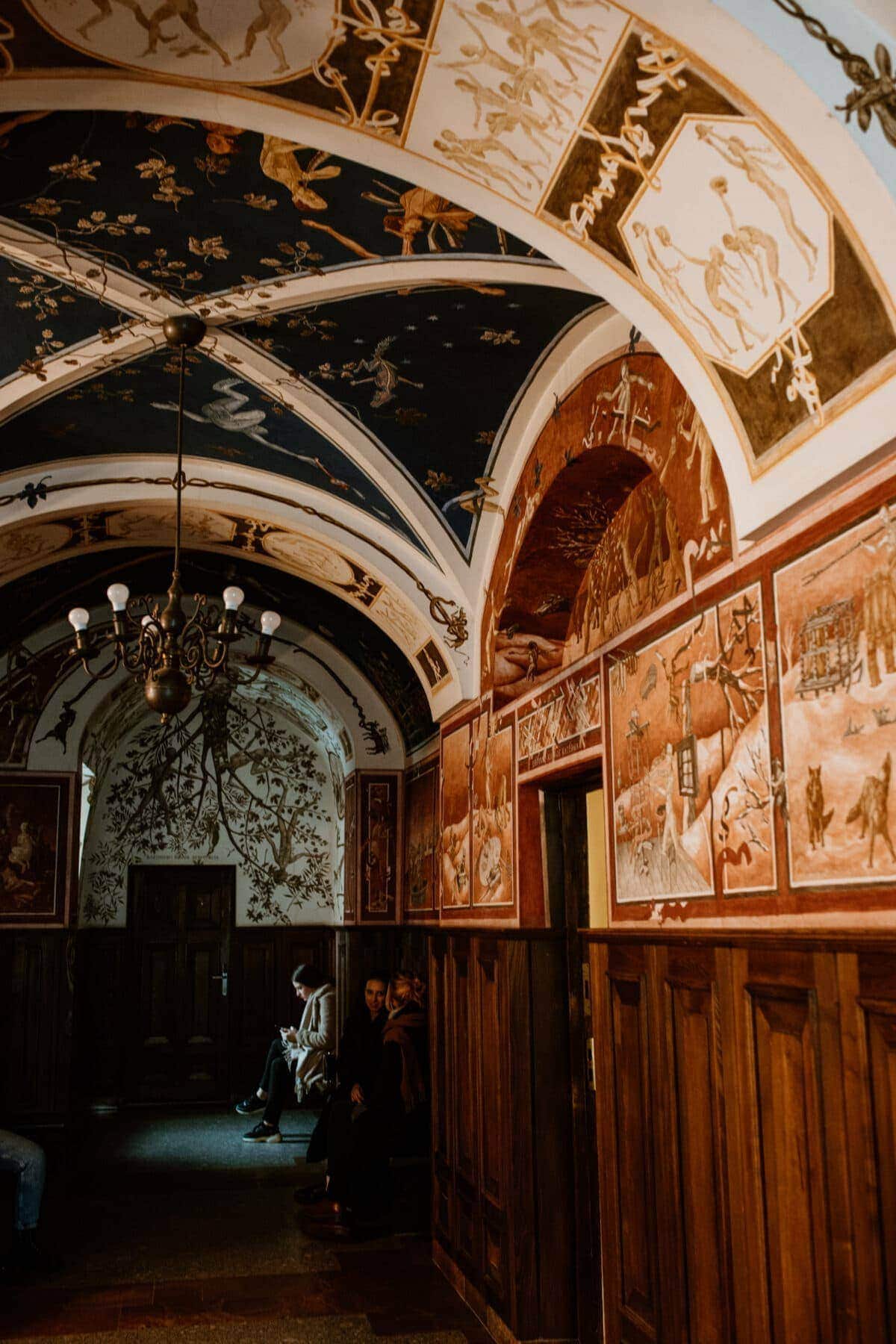
Tip: If you’re discreet, you can mingle with students on weekdays and explore the old university. In the philological faculty, thanks to my local guide, I also came across a hall with impressive murals!
Surprising how much history there is in Vilnius, isn’t it? Considering that Lithuania has been part of the EU for quite a long time, it is one of the countries in Europe that I knew very little about, and I bet I am not alone. But as interesting as the history of Lithuania and Vilnius may be, the present is also: there really is a special creative wind blowing through Vilnius, the city is young, in constant upheaval, and very creative. Vilnius itself, for example, advertises itself with the slogan“Vilnius: Amazing wherever you think it is” and so much self-irony already suggests that behind all the history you’ll find a pretty casual city.
The artists’ quarter Užupis
On the other side of the Vilnia river, next to the old town, you end up in Užupis. What somehow started by a group of several artists in the 1990s is now a must-see on any visit to Vilnius.
In Užupis you can find galleries, studios, street art and many small stores. Especially in summer, the pubs here are well attended. Užupis was proclaimed a republic with its own constitution and parliament in 1998 by some of its inhabitants; probably a bit tongue-in-cheek, but still you feel a bit like you’re entering a different world.
With a little luck you can also watch artists at work in Užupis
MO Museum
If, like me, you also like to look at contemporary art, then you should definitely visit the MO Museum. (In general, you should check out the quarter around the museum, here you’ll find some exciting stores and cafés like Raštinė or the Urban Garden.) The privately funded museum was designed by Daniel Libeskind and offers an interesting permanent exhibition as well as interactive temporary exhibitions. Nice design.
Prison 2.0: Strange things in Lukiškės
I walked through the open, large gate, to the right and left high, dark brick facades with teeny tiny windows. If the gate were to close behind me now, I definitely would feel uncomfortable. A very dominant-looking, broad-shouldered security guard with a bald head warns me that photos with a large camera are not allowed (I had overlooked the mini sign at the entrance) and for a brief moment I think he is part of the production – because Lukiškės Prison 2.0 is no longer a prison, but is now part of the creative scene in Vilnius.
Lukiškės & Stranger Things
If you’ve watched Stranger Things on Netflix, it will look familiar: In the fourth season of the series, the former Lukiškės Prison served as a filming location. In general, the old prison is a special place, and I think quite representative of the general vibe in Vilnius. The city is young, lively and open to new concepts: creating an event space and creative center in an old prison is very unique.
Lukiškės 2.0: A place for creatives
Some of the old wings now house studios, exhibition spaces, concert stages or even a bar. The former cells can be visited on a guided tour – and here you can also learn more about the history of the prison. The courtyard is also being put to new use: This winter, a large skating rink was opened, and if you’re too exhausted, you can enjoy snacks afterwards at one of the street food stands outside.
However, I recommend that you think carefully beforehand about when and if you are going to visit Lukiškės 2.0. (My mood was slightly dampened, at least afterwards; certain places just do something to you).
The history of Lukiškės
Lukiškės Prison was one of the most notorious penal institutions in the country for over 100 years; executions were still carried out here until 1996, when the death penalty was abolished in Lithuania. The undignified conditions, as well as international pressure (not least due to Lithuania’s accession to the EU), eventually led to the prison’s closure in 2019.
And once you have experienced the barren cells, the musty smell in the dark corridors, the eerie basement cells for solitary confinement (photos were not allowed in the cell wings as well as the individual cells, but I didn’t feel like it anyway) or the 10-square-meter outdoor cells live, in which the prisoners could spend their only hour outside of the cell to walk around the yard (together with the cellmate, mind you, with whom you had already spent the other 23 hours hanging on each other), then you ask yourself: Only in 2019???
The flippant tone of the tour doesn’t make it any better, and as much as I like creative concepts, I personally found the very casual approach to the past of this place (which wasn’t that long ago) and the fates associated with it very disconcerting. However, you can’t see most parts of the prison without a guided tour, so you just have to go through such embarrassments as a Polaroid mugshot to say goodbye. I didn’t like this kind approach that much, but others might feel different. See for yourself!
Nevertheless, I would recommend you to visit it, because Lukiškės 2.0 is really a moving place. Just take care of yourself. <3
Christmas time & Winter in Vilnius
Let’s put it this way: winter is a rather exotic time to visit Vilnius. It can get very, very cold; especially in January, and sometimes on the already short days you really have to look for the sun under the thick cloud cover. But during Christmas time it can also be cozy in Vilnius: Many stores and pubs decorate their facades festively and on the Cathedral Square a huge, illuminated Christmas tree creates the right atmosphere.
Decorated for Christmas: The Old Town of Vilnius
And cold temperatures are an excellent excuse to stop off at a different café or restaurant every ten meters: The gastronomic scene in Vilnius is so unique that I have a little food guide for you!
One thing in advance: a city trip to Vilnius is very easy. I would even say that you can just spontaneously get on a plane and spend a few days here without thinking too much about the organization. Still, I have a few tips for you that might help!
Where to stay in Vilnius
In the low season you can find some good deals in Vilnius; there are accommodations for every taste. I stayed in an old mansion from the 17th century, which was converted into a design hotel a few years ago with great attention to detail.
Hotel tip: Hotel Pacai – it’s as dreamy as it looks!
I enjoy good hotels anyway (although I spend so much time in hotel rooms anyway), but Hotel Pacai is really an absolute recommendation. Certainly not for every budget, but perhaps still worth a night or two – I promise you won’t forget this highlight in a hurry.
Public transportation is available (streetcar, bus, train), but I didn’t use it at all during my stay. The Old Town is best explored on foot anyway and for further distances I used Bolt (available in Vilnius instead of Uber). Bolt is also a good choice to the airport, costing about 15€ one way.
The flight time to Vilnius is e.g. from Frankfurt about 1:40h, from Berlin only 1:10h.
Language
Lithuanian is spoken in Lithuania, which I find super fascinating as a language. Lithuanian, as a Baltic language, belongs to the Indo-Germanic language family, but don’t let the “Germanic” fool you, you don’t understand anything 🙂 I’ve always tried to pick out at least a few chunks, but I didn’t get beyond “hello” and “thank you”.
The native language is very much cultivated in Lithuania. Similar to France with its radio quota, Lithuania has a kind of language committee that makes sure that the Lithuanian language is not riddled with Anglicisms, for example. Thus, all English words are Lithuanianized, so to speak, “computer” becomes “kompiuteris”, for example.
Younger Lithuanians, however, often speak English, especially in sights, cafes, restaurants, etc.. Older Lithuanians, on the other hand, also speak and understand Russian, but due to the historical background and the current situation, it is better to avoid this topic.
Transparency: My trip to Vilnius was at the invitation of Go Vilnius.
I can highly recommend Tarragona as a travel destination in Catalonia: The city is really nice to explore and is bursting with great sights. I’ll show you my tips for Tarragona here and explain why you should definitely make a detour here!
Sooner or later, you’ll come across another name for the city of Tarragona: Tarraco. That was Tarragona’s name in ancient times. In the 1st and 2nd centuries, Tarragona (or Tarraco, as it was then known) was one of the most important Roman cities on the Iberian Peninsula.
After the fall of the Roman Empire, however, Tarragona disappeared into insignificance. Many of the pompous buildings were simply built over afterwards in the course of the centuries. Today, the ensemble of monuments from the Roman period is a UNESCO World Heritage Site and is managed by the Museu d’Història de Tarragona.
These are the attractions you should see in Tarragona:
The Circus
Hard to believe how big the Circus was in ancient Tarragona! On an area of 325 meters long and between 100 and 115 meters wide, chariot races took place here, one of the greatest spectacles ever! Today you can see especially the huge vaults underneath the Circus, which actually only served to stabilize the heavy stands above. Unbelievable, for which crowds of people the Romans built at that time!
The Amphitheater
Situated directly on the sea, in Roman times the amphitheater hosted gladiatorial fights and bloody chases with wild animals that lost their lives for the amusement of the spectators.
Torre del Pretori (Praetorian Tower)
From the Torre del Pretori you have a fantastic panoramic view of Tarragona. Especially the view of the amphitheater and the old town with the cathedral enthroned in the middle are really worth seeing!
Tip: You can buy an entrance ticket for each monument individually. However, there is also a collective ticket, with which you save money already from the second location!
For a small fee, you can also join a walking tour of the Roman sites: Book here*
Advertising / *affiliate link
Tarragona Cathedral
Situated on a hill in the middle of the old town, between buildings, Tarragona Cathedral seems almost small and inconspicuous. But you should definitely take a look! The main church and the huge organ are very impressive. And inside the complex, the romantic cloister awaits you. A real oasis!
On Sundays, the square in front of Tarragona Cathedral often hosts one of the absolute highlights: Here you can watch the various groups of castellers build their dizzying towers, the castells, in a combination of teamwork and acrobatics. Every two years there is a big competition lasting several days, in which the best group is chosen. In Tarragona alone there are four different clubs that maintain this tradition with great dedication.
I was particularly impressed by how much cohesion (in the truest sense of the word) is required for a tower: hundreds of Castellers come together in a precisely thought-out formation! There is no real competition between the groups either; they even help each other to wrap the ultra-long waistbands, which provide the necessary stability in the lumbar region.
Attention: In case of rain or wet ground the whole spectacle is cancelled for safety reasons.
You can find more tips for the area around Tarragona, the Costa Dorada and Catalonia here: Catalonia tips & sights
Balcó del Mediterrani (Balcony to the Mediterranean Sea)
The balcony to the Mediterranean Sea: that’s the name of the popular beach promenade in Tarragona! And really, the promenade seems like one huge balcony: You’ll have the perfect view of the sea from up here! People like to stroll here, which the locals also call “tocar ferro” (touching the iron). In fact, superstition says that touching the railing of the Balcó del Mediterrani brings good luck!
Museu d‘art Moderna MAMT
If you are even a little bit interested in modern art, you should definitely take a look at the Museu d’Art Moderna de Tarragona (called “MAMT”). In addition to different exhibitions, you can see the famous Tapis de Tarragona by Joan Miró, behind which there is a touching story.
In 1966, Miró’s only daughter had a serious car accident near Tarragona, but was rescued and treated in a hospital in Tarragona. Grateful for the efforts of everyone involved, Miró donated his work “Tapis de Tarragona” to the Red Cross of Tarragona in 1970, which can now be seen in the MAMT. The tapestry was knotted by Josep Royo, with whom Miró went on to create further tapestries for special locations. One of these tapestries (and the largest) hung in the World Trade Center in New York until its destruction on September 11, 2001.
By the way, admission to the MAMT is free!
Beaches in Tarragona
Do you feel like going to the beach? In Tarragona this is not a problem! Even though you’re in the middle of a city and part of the coast is taken up by the admittedly unattractive harbor, you can still have a great beach day here: Tarragona even once won an award for the most natural city beaches in Spain!
From the Torre del Pretori you can see especially well the Platja Arrabassada and the Platja Savinosa. Although Tarragona’s beaches are very close to the city, they are largely unspoiled. You’ll really find a lot of greenery and great hiking trails in the area.
Shopping in Tarragona
Tarragona is not as much of a shopping destination as Reus. Nevertheless, on Calle Major, for example, which leads down from the cathedral, you will find some nice stores where you can also buy typical souvenirs such as wickerwork or porcelain.
Small handbags made of wicker are in style or can be used as a trendy basket at home. And they are often simply cheaper here than at home!
The old town of Tarragona with its small winding streets is just too romantic! Here you will find many great locations for a cozy glass of Vino Tinto in the evening or right away for dinner. But note: Take your time, because the evening starts much later in Spain! 🙂
You can sit outside until the evening in one of the many bars on Plaça de la Font! And the terrace of Pizzeria Pulvinar on Calle Mayor is a great place to enjoy the Tarragona vibe.
For rainy days or cooler weather, I recommend Entrecopes. Here you can enjoy typical Catalan cuisine in a cozy cellar vault!
Where to stay in Tarragona
Just like Reus, I was also very enthusiastic about Tarragona. I love big cities like Barcelona, but sometimes it’s the small, at first glance inconspicuous places that I really enjoy discovering.
I really liked Tarragona. Its location right by the sea, the charming old town, and the historic sites are simply unbeatable. And the hotel certainly added to the experience: watching the orange-glowing sun slowly rise over the turquoise-blue Mediterranean right from my room’s balcony in the morning is simply one-of-a-kind.
And yet the H10 Imperial Tarraco is actually one of those massive hotels that usually leave me pretty cold. But this time, I had to eat my words: Not only is the view impressive, but so is the hotel’s overall vibe—somewhere between cool Miami style and warm tropical charm!
By the way, on the roof there is a rooftop bar with pool – and a fantastic view over the sea!
From Barcelona you can reach Tarragona in just one hour by a regional train! The city is therefore perfect for a day trip if you are in Barcelona anyway.
Tarragona is located on the Costa Dorada. Nearby you will find many small coastal towns such as Cambrils, which are especially popular in the summer! You can also take a trip to beautiful Reus, the city of Modernisme. Or you can plan a complete road trip through Catalonia – it’s worth it!
The city of Reus in Spain is a real treasure! A hundred kilometers from Barcelona, you will find a place with a lot of history, great architecture and great spots for foodies. In any case, I was immediately hooked by the lovely town of Reus and would recommend it any time as a city trip in Spain!
Plaça Prim in the center of Reus also often serves as a meeting place
What to see in Reus
The city center of Reus is dominated by Modernist buildings and the flair of a once very rich commercial city. In addition, Reus is still the absolute shopping destination in the south of Catalonia. If you love cozy alleyways, old building architecture and small boutiques, this is the place for you. And although Reus, with its 100,000 inhabitants, seems like a village next to a city like Barcelona, there are many interesting sights here.
At Plaça Prim, you can see the important role Reus once played as a trading center in Catalonia. The pompous arcades along one side give the square a truly stately flair! The square is named after General Joan Prim i Prats, who was born in Reus and fell victim to an assassination attempt in 1870 during his later office as Spanish Prime Minister.
Especially worthwhile here is a visit to the Teatre Fortuny, which should look just as glamorous from the inside, as I was told. Guided tours are not available, but maybe you’re in the mood for a concert or an operetta?
Unfortunately, not all of the buildings from Reus’ heyday at the beginning of the last century on Plaça Prim have been preserved. Where high society once met in the Gran Hotel de Londres, there is now an unadorned building from the 1970s. That’s a shame, but you should still take in the elegant atmosphere of the square.
If you want to get a feel for what Reus used to look like here, it’s worth visiting Foto Niepce. In this photo store on Plaça Prim, founded in 1926, you’ll find a small photography museum with pieces from the history of this traditional family business.
Plaça del Mercadal
The Plaça del Mercadal is another central point in the center of Reus. Here you will find the City Hall, the Gaudí Centre and the opulent Casa Navàs.
From Casa Navàs you have the perfect view of Plaça del Mercadal
If you want to take a little break, here’s the perfect opportunity! My café tips:
Roslena Modern café with self-service and affordable snacks, but at the same time a well-stocked magazine store! Located next to the Gaudí Museum.
Café de Reus Located a bit off Plaça del Mercadal, but you can hardly miss it with its red facade. Great location for drinks & tapas, in the evening there’s also sometimes live music.
Very pretty: the facade of the Café de Reus
Modernism in Reus
Buildings worth seeing from the Modernisme period in Reus include Casa Navàs, the Pere Mata Institute, Casa Rull and Casa Gasull. Most of the buildings were designed by Lluís Domènech i Montaner, another famous representative of Modernism along with Gaudí.
If you’re as interested in architecture as I am, you can book a special architecture tour at the tourist information office in Reus, which will take you to and inside many buildings that you wouldn’t otherwise have seen!
Or you can follow the “Ruta del Modernisme” on your own: 29 of the almost 80 Modernisme buildings have been combined into a tour. You can get the map at the tourist information office in Plaça del Mercadal.
The architectural style of Modernisme emerged in Catalonia between 1885 and 1920. Similar to Art Nouveau, which emerged in parallel in Germany, Modernisme is characterized by novel curved lines and organic forms. Modernisme, however, was not only a style of architecture, but also a social movement that spanned all areas of life such as art, culture, and politics. One of the most famous architects of this era is Antonio Gaudí.
Casa Navàs
Built between 1901-1907, Casa Navàs is one of the best examples of the Modernist architectural style. The merchant Joaquim Navàs lived here with his wife on the upper floors, and on the first floor was the family department store until 2018, which now serves as an event location after a change of ownership. The upper floors are still furnished with the original furniture. You can visit Casa Navàs as part of a guided tour.
Personally, I love the playful style of Modernism, but at the same time the vibe of an era in which so much has changed in the whole world in terms of culture and society. In Barcelona, I was always very taken by the wealth of detail in houses such as Casa Milà, and I don’t know anyone who isn’t fascinated by the architecture there. At Casa Navàs, however, my jaw dropped by excitement. The dedication with which the entire house was designed can be felt in every room.
Just for the Casa Navás a trip to Reus is worth it! As soon as you enter the stairwell, you realize that you are entering a very special house. My tip: Ask for a tour with Ben – his love for the house is absolutely contagious and he’s a natural as a museum guide! Once I’d got my jaw dropped, I couldn’t stop laughing because the tour with him was so entertaining.
Gaudí Centre
The city’s most famous son, Antonio Gaudí, has an entire museum dedicated to him in Plaça del Mercadal. Although Gaudí was born in Reus and spent his entire childhood and youth here before moving to Barcelona, there is not a single one of him in the city of his birth. This is in stark contrast to Barcelona, where he played a major role in shaping the city’s appearance with buildings such as the Sagrada Familia, Casa Milà, Casa Batlló and Parc Güell.
If you’re in Reus, you should definitely try a vermouth. The white wine mixed with herbs and sugar is the traditional drink of the city. In the 19th century, vermouth and the trade in it brought wealth to the town. Around Reus today there are still eight different vermouth producers.
Eating & Drinking in Reus
Even if you haven’t become a fan of vermouth (with its herbal taste, it’s not for everyone), I recommend Vermuts Rofes in Reus. Once vermouth was produced here, now the former manufactory has become an atmospheric restaurant.
Tip: Walk through to the inner courtyard! Here you can try typical Catalan dishes at large, rustic industrial-style tables. And if you wish, treat yourself to a glass of the company’s own vermouth, because Vermuts Rofes is still being produced, just in a different, modern location.
Shopping in Reus
Reus is still the first port of call for the surrounding region when it comes to shopping. In the narrow pedestrian streets of the city center, you will not only find the usual suspects such as Mango and Zara, but also a surprising number of small boutiques and family-run stores.
Colmado Baró
At Colmado Baró you can stock up not only on vermouth, but also on many other typical goodies. Still family-run, this delicatessen has a very special charm. The perfect opportunity for culinary souvenir shopping!
El Barato
The stylized O behind the name El Barato is reminiscent of the time of the military dictatorship under General Franco: back then, the traditional fabric store had to drop its Catalan name “Barat” and change its name to the Spanish version “El Barato”. Then as now, hobby tailors, designers, artists, folklore groups and carnival clubs stock up on the wildest fabrics here – and probably spend whole days browsing through the overflowing shelves.
Perhaps Reus might sound familiar to you: It has an airport that is mostly served by low-cost carriers & very popular for reaching the beaches of the Costa Daurada. This is often advertised as Barcelona-Reus, although Barcelona’s actual airport El Prat is almost a hundred kilometers away. However, most airlines only fly to Reus from spring to fall.
From Barcelona, the best way to get to Reus is by regional train or by bus if you are traveling without your own car or rental car. The route can also be easily driven there and back in one day. Reus is therefore also perfect for a day trip from Barcelona!
If you are traveling by car or rental car, I can highly recommend a tour through the hinterland of Catalonia. If you like being out in nature or hiking, you will find great opportunities here. It’s also not far to the Pyrenees, where you can go skiing in winter.
Otherwise, Catalonia also has popular coastal towns. The Costa Brava and the Costa Dorada are dotted with beautiful beaches, such as those around Cambrils. Or you can simply continue south along the Spanish coast. France borders Catalonia to the north, and the beautiful city of Perpignan is only 170 kilometers from Barcelona.
Reus is only eight kilometers away from the Costa Daurada
The entire coastal region is also easy to travel by train. If you have more time and don’t want to drive yourself, you can plan a great trip through Spain and France.