Route 66. The name alone evokes all sorts of associations: I dream of freedom, endless roads through the American Midwest, and driving, driving, driving into the vastness of a country that seems both more mysterious and more fascinating to me with every visit. Did you actually know that Route 66 starts right in the heart of Chicago? Just around the corner from The Bean, so to speak? This makes it perfect to combine a few days in Chicago with a short trip along Route 66: a truly American road trip! Just like in the movies. It’s always been on my “must-see-in-my-lifetime” list.
The charm of the Midwest
Starting in Chicago, you can follow the old Route 66 throughout Illinois, and it feels like traveling back in time through the America of the last century. Every place along Route 66 in Illinois has its own charm and its own history in connection with the road that criss-crossed not only the country but also people’s lives. And it was these that made this road trip so special.
Even in Chicago, I was struck by the incomparable friendliness of the people. The gruff Berliner in me was irritated when, on more than one occasion, complete strangers threw themselves in front of me just to hold the door open for me. Or spontaneous high-fives with shoe sellers who admired my shoes. Or strange women shouting at you in the middle of the street: “I love your skirt!” Just like that. Because you can say something nice out loud instead of just looking furtively. In general, being nice is a basic requirement for life here. And we were still in an anonymous city!
But things got even more amazing when we left the city on our road trip. Chicago itself only has 2.7 million inhabitants, and the rest is so spread out that you quickly get the feeling that you’re in the countryside as soon as you leave the city by car.
And this is where the positive energy and joie de vivre of the Midwest really hits you. Not once, not a single damn time, did I have the feeling of encountering bad-tempered or unfriendly people on our road trip. It was crazy, almost unreal. On the contrary, the joy of showing his city, his Route 66, his Midwest, was a gesture from everyone’s heart – and this paragon of a positive attitude to life and pure, genuine joy was so infectious that for the first time I really understood why people are so fascinated by America.
Route 66 – a road full of American history
Actually, Route 66 no longer exists as an official road. At some point, no one was in the mood for almost 4,000 kilometers of cobblestones and/or single-lane country roads: Route 66 was put into operation as early as 1926 as the most important east-west connection.
What was a revolution for the infrastructure at the time was no longer sufficient to cope with the increasing traffic. Route 66 was relocated and rebuilt several times until it was replaced by interstate highways in most places. What remained was the legend. Along with the quirky stories, the warm-hearted people and the many rest stops and stores along the road that lured passing cars with the most eye-catching signs and craziest buildings.
*Transparency: I was invited on this trip by Enjoy Illinois for research purposes. for research purposes.
Chicago is an absolute foodie paradise! Endless restaurants, bars, and cafés! Do people think you can only get bad food in the U.S.? Not in Chicago… researching this Chicago Food Guide was really no trouble at all. I have to admit that I often have a hard time finding good food in the U.S. Burgers and the like are certainly okay every now and then, but constantly eating fried, oversalted food, with little fresh fruit and vegetables and no variety in flavors, gets boring in the long run. In big cities, you can still find alternatives—expensive as usual, but not very spectacular or worth the price. Chicago, on the other hand, is a paradise for anyone who loves good food and drinks: here, one great restaurant follows another, just like the fantastic bars with excellent bartenders. I’ve put together a small selection for you here: My Top Restaurants in Chicago—Classics and New Trends!
1) Gino’s East: The Original Chicago Deep Dish Pizza
The Deep Dish Pizza is probably the most famous Chicago dish. Invented by Italian immigrants, deep dish pizza is as much a part of Chicago as the Willis Tower. You really shouldn’t leave Chicago without trying a Deep Dish Pizza once. At the same time, the Deep Dish Pizza is so very different from the traditional Italian pizza.
It’s smaller and thicker, similar to a quiche, and secondly, the toppings are placed in a different order, almost exactly the other way around. The dough is yellowish because it’s made of corn flour and is more like a mixture of puff pastry and shortbread. The cheese goes on the bottom of the pizza, tomato sauce and other toppings on top. Cut the pizza into quarters, and when you lift the pizza slice, the abundant cheese pulls oodles of strings.
Tip for pizza fans On this food tour, you will learn all about the famous deep dish pizza and can try different varieties: Bookyour pizza tour here*
Gino’s East has been one of Chicago’s institutions when it comes to deep dish pizza since 1966! The special thing about this location is not only the pizza, but the fact that every guest is lent a sharpie with the pizza, with which he can immortalize himself somewhere on one of the walls in this restaurant, which extends over several floors! And nothing is painted over! The probability is therefore very high that you’ll find your piece of art at the next visit!
There’s also real American food in Chicago! Located right at the end of the famous Route 66 (the beginning is on the parallel street, as both streets are one-way), Lou Mitchell’s is a classic American diner. The food is authentic, heavy as usual, and perhaps therefore not everyone’s cup of tea. However, what impressed me much more than the food (and that’s why I included it here in the list) is the absolutely authentic American diner atmosphere with the vintage interior. There’s really no better place to start a road trip along Route 66!
As with the pizza, I didn’t know that there was a Chicago-style hot dog, which is available on every corner in Chicago and is much more popular than the traditional versions with fried onions or sauerkraut.
The beer garden at Navy Pier has a particularly tasty hot dog! You get a fantastic view of Lake Michigan and the Chicago skyline for free. By the way, the Chicago hot dog has all kinds of fresh stuff on it: diced white onions, lots of tomato chunks, pickles, mustard and pickled vegetables. The bun is sprinkled with poppy seeds, the sausage is made of beef only. Colorful and delicious! Plus, ketchup is an absolute no-go on the Chicago-style hot dog!
Yes, I really did it: I ate frog legs. And what can I say? They taste like chicken! Of course! 🙂 Hugo’s Frog Bar is the Chicago institution for frog legs, the French influence has left its mark in Chicago. Hugo’s is a bit more high-priced, but also unbeatable when it comes to quality. I love to eat fish anyway, seafood like crabs and mussels rather less, but at Hugo’s I even ate king crabs with pleasure.
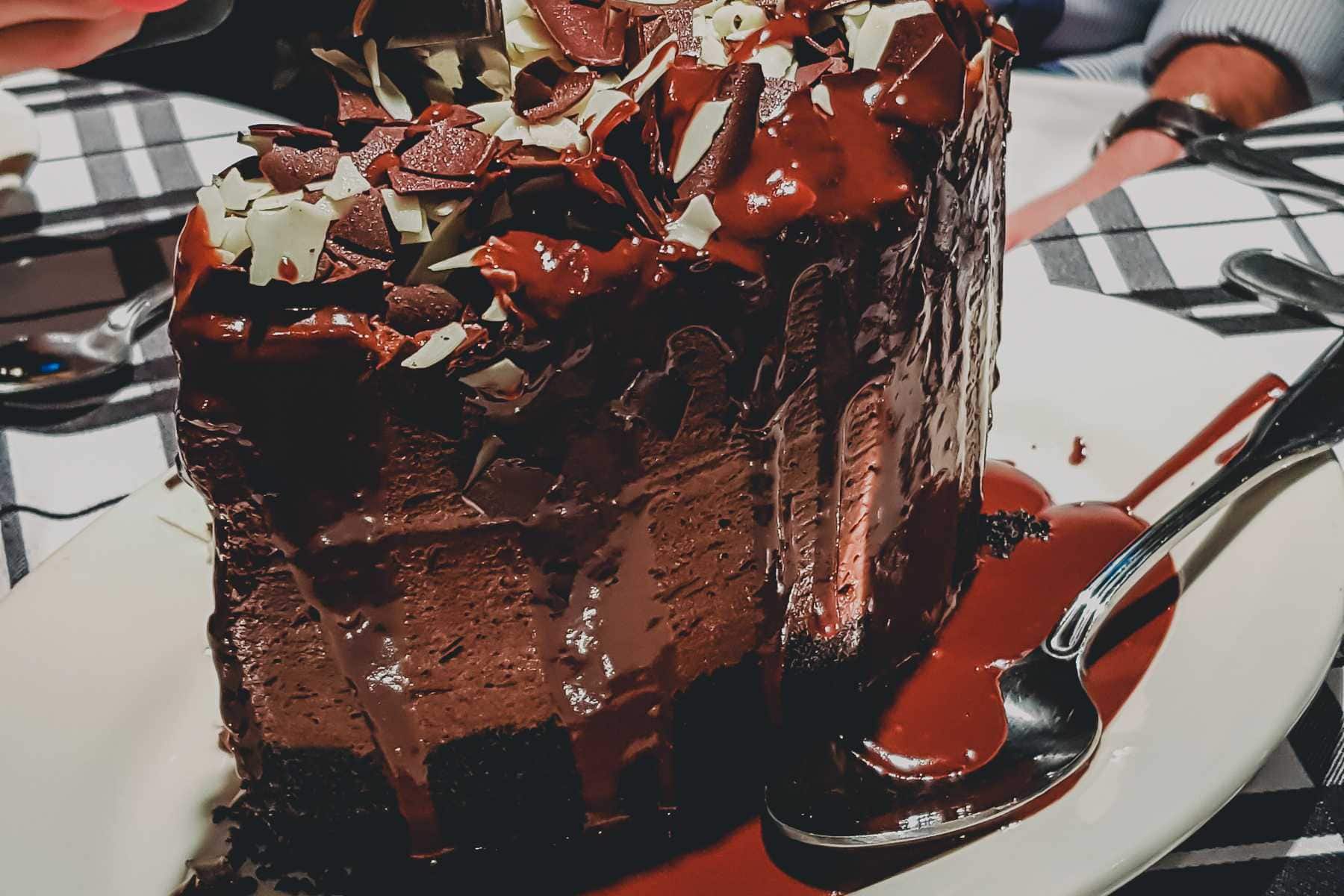
Hugo’s Frog Bar & Fish House, by the way, is owned by the best steakhouse in town, Gibson’s (right next door), and also serves the best Black Angus beef if you’re not into seafood. My filet was divine! The ambience is also classic American. Large bar, lots of dark wood, tables with checkered tablecloths and attentive service. Be careful with the desserts: One serving is easily enough for five – or you can take the rest in the doggy bag and still invite guests for coffee the next day.
A Soho House is always a guarantee of a nice cafe as well. In Chicago, you’ll find The Allis on the first floor of Soho House, nice for coffee, breakfast or afternoon tea. The decor is something between an English library and an American clubhouse, cozy but zero dusty. Drink coffee and be amazed.
6) Dove’s Luncheonette: Chicago Blues & Soul from the 70s
Another diner. This time, however, a successful symbiosis of retro look and modern Tex-Mex cuisine. The interior with wood paneling and jukebox immediately transport you to the 70s. In addition, the cuisine is modern: No overloaded plates, as you might be used to from Mexican cuisine in the USA, lots of fresh ingredients and unusual combinations.
Dove’s Luncheonette is located in Wicker Park just below the Damen CTA station. By the way, there are lots of exciting places to eat in the area, and right around the corner is Milwaukee Avenue, a really nice shopping street where you can find smaller boutiques, but also bigger stores like Urban Outfitters. Perfect if you don’t feel like shopping malls or the hustle and bustle around Michigan Avenue downtown.
Chicago has much more to offer, of course, but I think this is a nice sampling that represents well the range of possibilities. Discovering on your own is also fun – here are a few more areas where you can find great places to eat:
West Loop: a former industrial area, around Fulton Market and along Randolph Street you will find a lot of great places to eat and drink, also a nice nightlife area. Once a year, the “Taste of Randolph” food festival takes place with lots of music and food from the surrounding restaurants.
Wicker Park: around the Damen station, along Milwaukee Avenue and Division Street.
around Logan Square
and of course Downtown
More articles about Chicago and Illinois at a glance:
Want to go to Chicago this summer? City breaks in the US actually go all year round, but here in this article I’ve put together a few summer ideas for you specifically! And don’t worry, Chicago is really exciting in the summer too!
When I said goodbye to Chicago for the last time, I actually became very sentimental: only 24 hours had been enough to let this city fascinate me. Maybe also because I ended up there without great expectations.
Chicago: The insider’s tip among major American cities
Who already has Chicago on their radar as a cool city? During this time, when I exceptionally flew long haul instead of short haul, I was often in the USA. That never really gladly: the flights were anyway strenuous, the rest time short and if one already stands as actual Berlin long sleepers unusually already at four o’clock in the morning jetlagbedingt vertically in the hotel bed, then the following half free day takes already no good beginning.
And in general, there wasn’t much that attracted me to the destinations in the USA: Sure – it was great to get to know Boston, Washington or Denver, not to mention New York (which I already knew, but you can never get enough of New York) and Miami. But New York is New York, and Miami – well, with my South American roots, that was more like a visit home than the great America.
Only Chicago had grabbed me by the end of my long-distance visit, and somehow quite unexpectedly. Chicago was never on my personal must-see map – but then it turned out to be such a great city that I didn’t want to leave: Great architecture, a skyline and big city flair almost like New York, great museums, huge shopping temples and yet a friendly, almost warm atmosphere everywhere you go. The grumpy Berliner in me was irritated and thrilled at the same time. As expected, it was hard to say goodbye. I would have liked to stay 1-2 days longer, but no one asks me when I’m on duty. The pick-up is waiting, go, go, off to the airport, back to Germany. And I knew: This was definitely not the last time I was here. As luck would have it, I ended up back in Chicago almost a year later – and this time I didn’t have to go back after 24 hours. One thing in advance: My enthusiasm for the city has not changed.
Chicago as a summer destination: city trip to the USA
Chicago can get freezing cold and more than uncomfortable in the winter – summer is all the more beautiful for it. Basically, you have to be prepared for all kinds of weather in Chicago. Within a few days, the weather changed from windy and rainy to the worst heat wave with an official weather warning. But the constant extreme weather changes didn’t seem to rob anyone of their good mood, and more than once I heard the standard general saying about the weather:
If you wish for different weather in Chicago, just switch sides of the street!
And that’s how everyone enjoys summer in Chicago: with free concerts and events everywhere, street festivals, beach life (yes, there are little stretches of beach on Lake Michigan almost in the middle of the city, too) or just barbecuing in the front yard.
What is there to do in Chicago in the summer? Some tips.
The list of sights and “things to do” in Chicago is long. Especially in the summer, there are many more outdoor options, so these are just a few suggestions for making the most of your stay in Chicago.
Millenium Park – Concerts for free and a photo in front of “The Bean
The Bean is actually called Cloud Gate and is a sculpture by Sir Anish Kapoor. The Bean quickly became the city’s landmark after its completion in 2006, and today crowds of tourists scramble in front of it every day to get the best photo together with The Bean. Me too, of course, because The Bean impressed me last time I was in Chicago. The reflections of people, skyline and sky on the brightly polished surface are simply fascinating.
Next door, at the Jay Pritzker Pavilion, an open-air venue, and the adjacent parks, there are free(!) concerts and music festivals throughout the summer, from jazz to house to reggae, plus all sorts of events like morning yoga or urban gardening projects. It’s worth taking a look at Millennium Park’s annual summer program!
Street parties without end: Get out into the neighborhoods of Chicago!
It’s not just the middle of the city that’s celebrating summer; outdoor events are always happening in Chicago’s individual neighborhoods and wards. Chicago is truly a melting pot of many different cultures and each one celebrates itself with its own event, or so one gets the impression. What I found remarkable was that many immigrant families in Chicago have lived in Chicago for several generations and still maintain their own culture – without isolating themselves. They’re all Chicagoans at heart, too – and you can feel that commonality. The atmosphere in Chicago is also truly unique in terms of multicultural coexistence.
In Humboldt Park, for example, the Puerto Rican Festival took place – parades, car parades, a park full of fairground booths and salsa and reggaeton on every corner. Inviting and open to all.
Or there are food festivals like theTaste of Randolph in West Loop. This district used to be an industrial area with warehouses and factories, but in recent years it has mutated into an absolute food mecca (Chicagoans love good food so much) and hipster district.
Around Fulton Market and along Randolph Street, there are the most amazing restaurants and bars; so many that you would definitely need a few weeks to try your way through them. The Taste of Randolph is therefore the best opportunity. All of these restaurants have a food stand and offer their best dishes for a small price. In addition, there are stages with really good music – and once again: an absolutely inviting and relaxed atmosphere. They’re just hearty, these Chicagoans.
With the Segway through the parks of Chicago
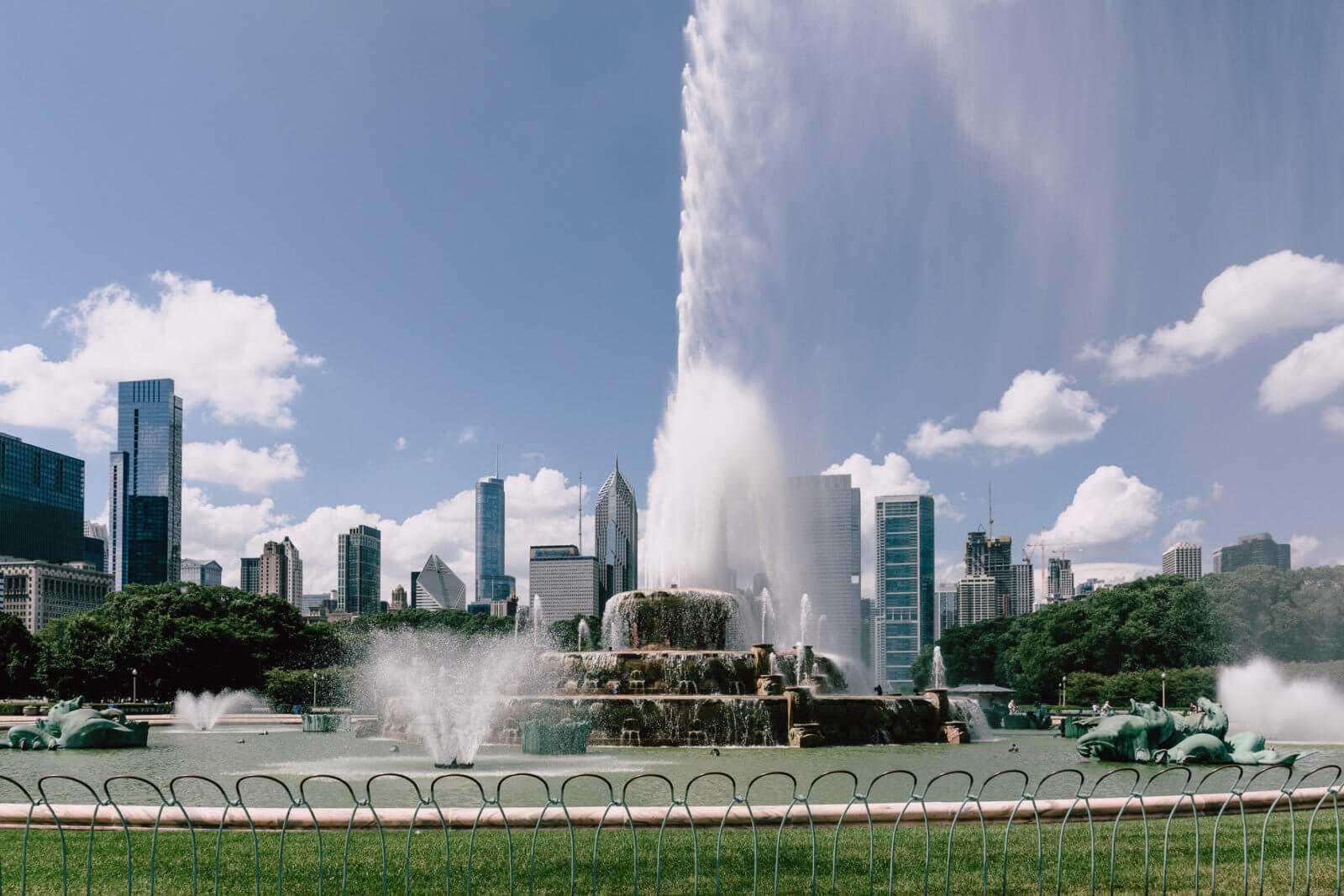
When you see all the skyline photos of Chicago, it seems incredible that there are large green spaces in the middle of this city. But just as with Central Park in New York, Chicago has made a point of maintaining large parks in the middle of the city, such as Grant Park, which houses Millennium Park, or Lincoln Park with its free (!) zoo.
I explored Grant Park and the following green areas along the shore of Lake Michigan by Segway – which in retrospect was really a good idea despite the high temperatures. On the one hand, the airstream cools a bit, and on the other hand, the whole facility is so huge that it would take a long time to walk around. In addition, the entire route is relatively flat and well paved. Segway riding is learned within minutes and is a lot of fun!
A city like Chicago is best viewed from above – there are two special spots for this: the Willis Tower (formerly the Sears Tower and once the tallest building in the world) or the 360 Chicago Observation Deck on the John Hancock Tower in the middle of Michigan Avenue, the main shopping street on the Magnificent Mile. Both offer great views of all of Chicago and Lake Michigan when the weather is good – and both locations have an extra gimmick! On the Willis Tower skydeck, there are four fully glazed exits, and in 360 Chicago, you can recline on angled panoramic windows that tilt forward.
Coming early is worth it, the view is better and you save long queues, especially in summer. The sunset from one of the viewing platforms is also worth seeing. Unfortunately, the entrance fee is quite steep, but with a Chicago City Pass you can save money. The best thing you can do is just compare: Is the Chicago City Pass worth it? (Experience & Prices)
Want to read more about Chicago? Find out more here:
The 606 – outdoor secret in Wicker Park
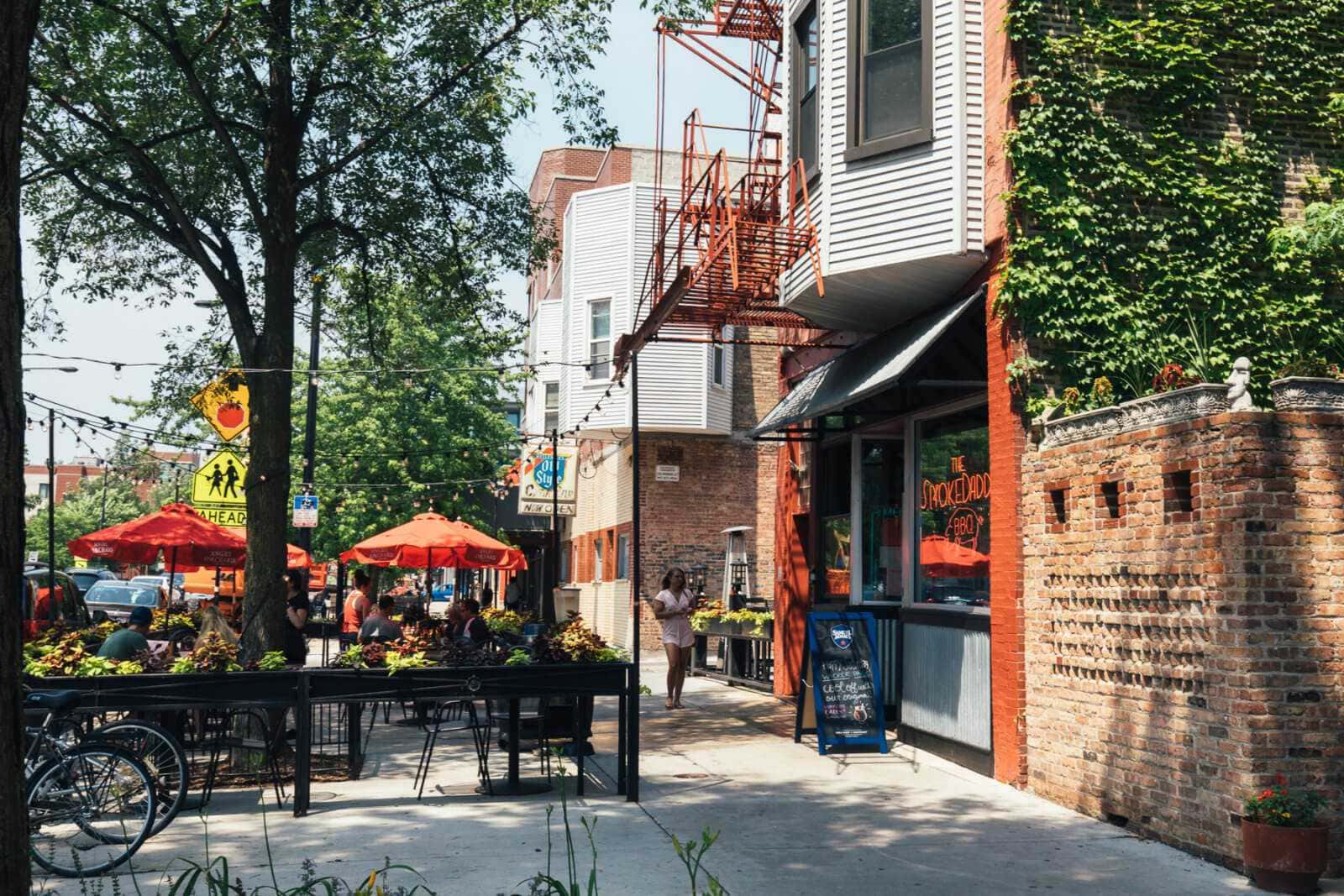
The neighborhoods in Chicago are definitely worth exploring. Areas like Wicker Park, Bucktown, Logan Square or Boystown all have their own charm and you can easily spend a whole day exploring individual neighborhoods. Wicker Park, for example, has lots of great cafés and restaurants where you can sit outside in summer temperatures (which is always very convenient for me as an air conditioning avoider!) And small, fine stores. And in between street art. The perfect environment for a chill day in Chicago!
If you’re still in the mood for the outdoors after the downtown parks, check out the 606 Trail in Wicker Park – a relatively well-hidden old elevated train track that’s been converted into a recreation area similar to the Highline in New York. The entrances are hard to find right away and tourists are less attracted to it, but once you’re up there, you get to see Chicago’s residential areas from a different perspective. Nice contrast to the busy center! How to get there: 606 Trail website.
By boat, bus and train through Chicago
Because it was so nice last time, and to remember this great day again, I took a boat trip again this time. The possibility to almost drive through the skyscrapers is unique.
The architecture boat tour* is really very good and stands out very much from usual tourist tours. The guides really have a broad knowledge of architecture – and I would never have guessed before my first visit that Chicago was so interesting architecturally! For those who are not so interested in architecture after all, I recommend at least a classic boat tour through Chicago to see Chicago from Lake Michigan at least once – the view of the skyline from the water is unique.
To get around the city, you can simply take one of the water cabs. They’re smaller, usually never crowded, and with a day pass for just $10, you can explore the city like a hop-on hop-off bus! In fact, the Water Taxis stop at all major points along the Chicago River. Coupled with a CTA day pass, also only $10, which allows you to use all public buses, subways and elevated trains (including the one that goes all around the center, The Loop, and has great views!), it’s the perfect combination.
A hotel or a place to stay is no problem in a city like Chicago – just unfortunately very expensive. But what is also really worth it with this fantastic city.
Here are a few self-tested hotel suggestions:
Low-budget with authentic charm: Freehand Chicago, right in the heart of the city and featuring a sensational bar open to everyone, not just hotel guests A massive hotel classic with an impressive ballroom serving as the lobby: Hilton Chicago on Michigan Avenue Right on the Magnificent Mile: the Warwick Allerton Chicago combines big-city flair with classic luxury
I was invited on the trip to Chicago and Illinois by Enjoy Illinois. Of course, my opinion remains unaffected – I was already enthusiastic about Chicago before anyway 🙂
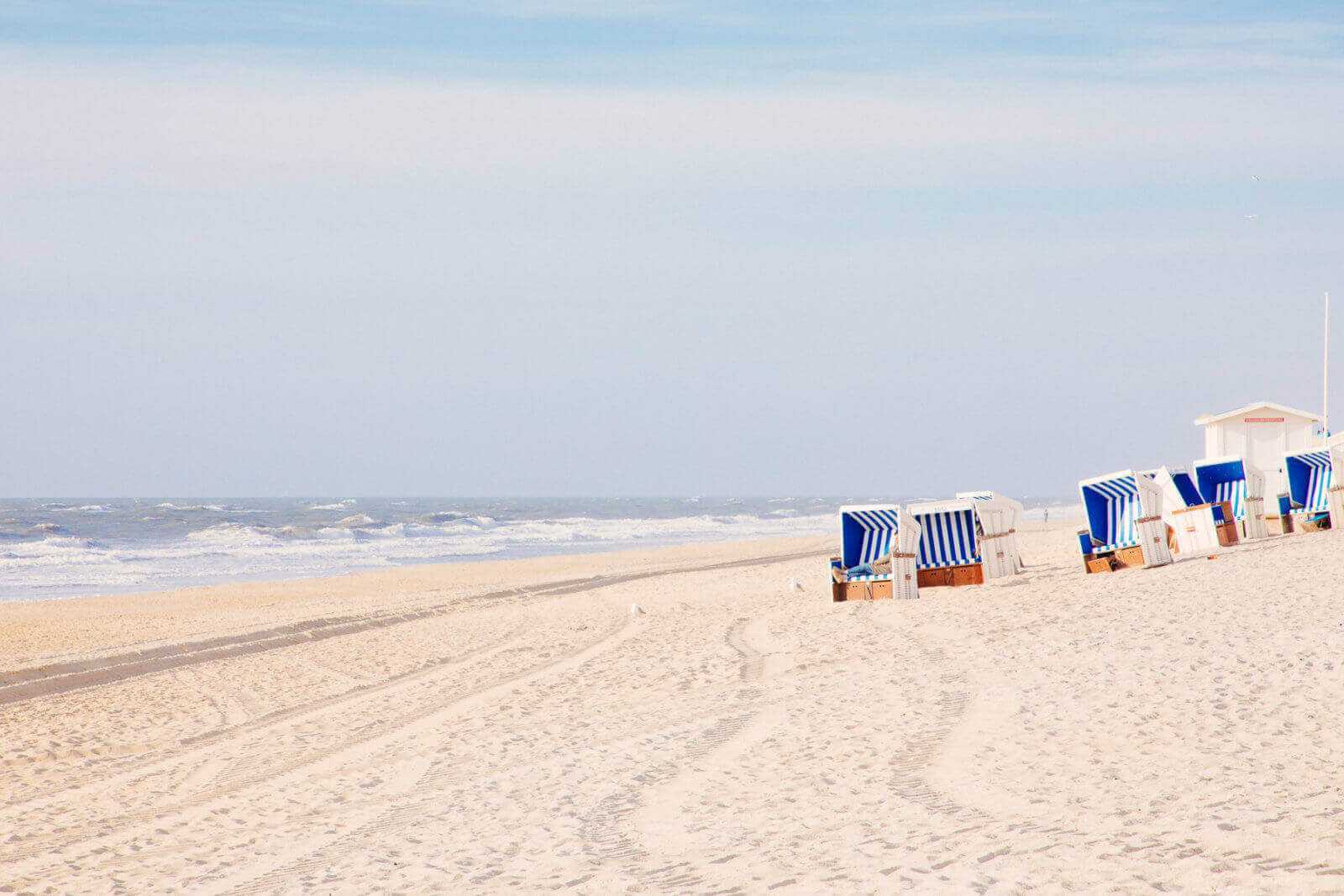
Who can’t immediately relax at the sight of such beautiful North Sea beaches? I’ve brought you some really cool tips from Sylt and will show you the most important sights on Sylt!
The best Sylt sights for a weekend
Only a weekend to spare? No problem on Sylt. The island is easily and quickly accessible: by train, plane or car on the train. On Sylt itself, the public island bus is a great way to get from A to B. And let’s be honest: longer stays on Sylt will blow your travel budget anyway. (But more on that later.) So a weekend on Sylt is all you need: as soon as you set foot on Sylt soil, you’ll feel like you’re on vacation.
Tip: With a bus tour, you can get to know all the important points on Sylt without having to squeeze into public transport! ➜ Book your tour of the island here*
It was too fresh for the beach sauna, I’m a wimp. But I definitely have to try it out next time: A sauna in the middle of the beach, how cool is that!
#1 Westerland & the spa promenade
There is also a ferry connection to the north of Sylt in List – but the majority of visitors to Sylt actually arrive in Westerland. By train or car train or by plane. Westerland as a place in itself may disappoint some people – charming thatched-roof houses and a dune feeling are few and far between.
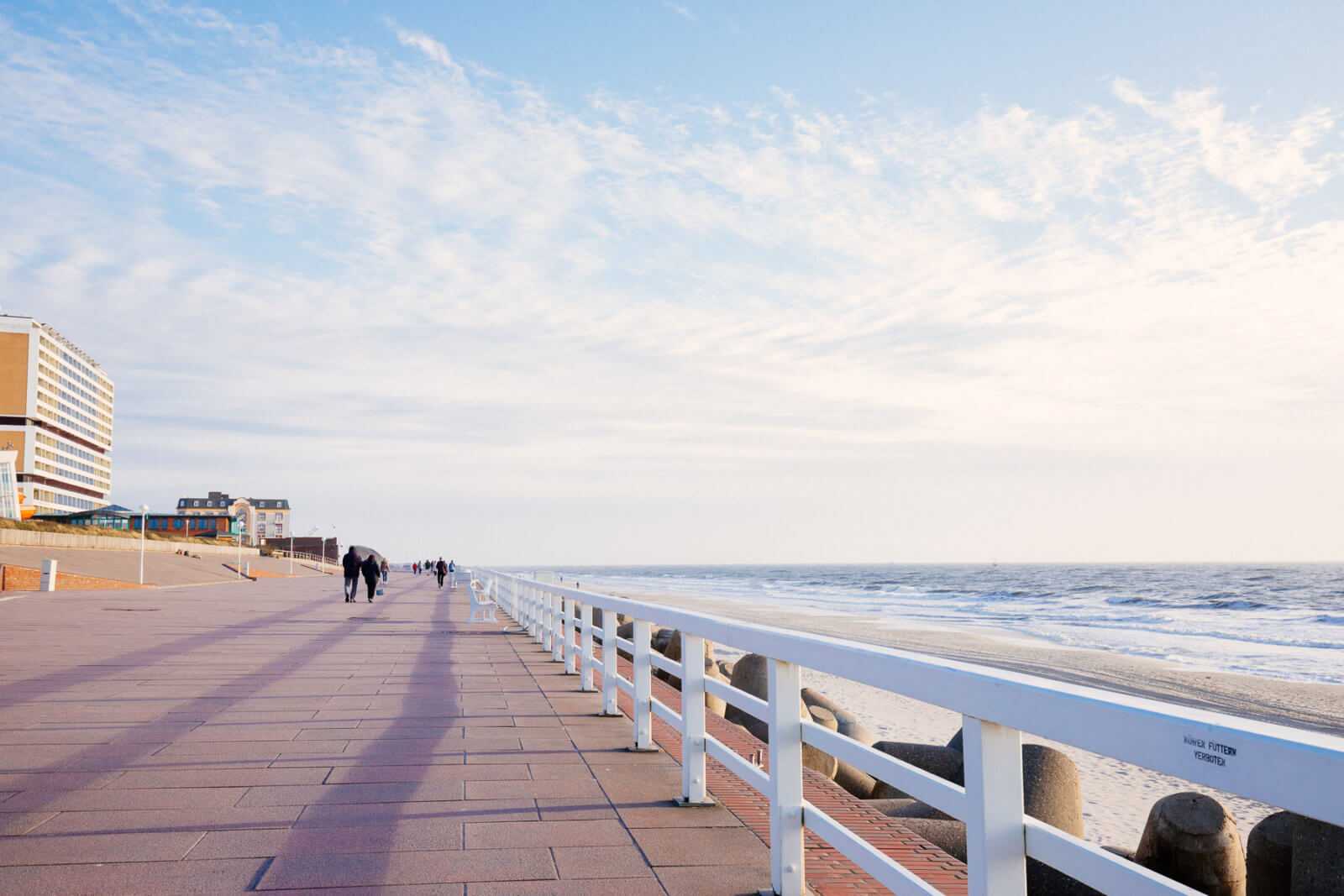
Even if Westerland is not exactly the most beautiful place on Sylt, the beach here is also impressive.
Instead, there are plenty of architectural sins in the form of apartment buildings from the sixties in the form of shabby shoeboxes – above all the new spa center directly on the beach in Westerland. Nevertheless, Westerland is a good starting point for excursions around the island – and is perfect for visitors with little time. It is easy to get anywhere from here and accommodation can be found quickly. And all in all, Westerland is a relaxed spa town with some nice restaurants and a really outstandingly high density of well-stocked, inviting bookshops! (Something I really miss in Amazon-Prime-spoiled Berlin – there’s nothing like cozy bookstores with a nice selection).
Strolling along the promenade in the evening: Favorite activity in Westerland.
#2 The Uwe Dune
To the north of Westerland lies the Uwe dune, the highest point on the island – and that’s not much for an island like Sylt, which is in constant danger of disappearing into the North Sea. A narrow wooden staircase leads up to the Uwe dune and once at the top, you can enjoy the complete panorama of Sylt from the viewing platform. On one side is Kampen with its pretty thatched-roof houses nestling snugly in the hilly dune landscape, and on the other is the roaring North Sea. Pure nature all around. And so soothing and beautiful for a city kid like me.
The highest point on the island: the Uwe dune.
Incidentally, Kampen is the hotspot for the rich and famous (actually, it’s already the whole island, but here the concentration seems to be many times higher) – and if you need something from Gucci, Prada, Louis Vuitton or whatnot, you’re guaranteed to find it in the well-stocked village boutiques on Strömwai. Kampen is also home to some of Sylt’s most famous bars and restaurants, which have contributed to the island’s reputation as a jet-set meeting place. But low-budget vacationers like me prefer not to get used to such places in the first place 😉
#3 The Red Cliff
Instead, you can take a walk from the Uwe dune over or around the red cliff, which glows red in the evening sun, especially at sunset, and is one of the island’s landmarks. You also have such a great view of the beach below from above that I had the feeling that I had taken the photos with a drone – drone photography without a drone, so to speak.
Best view: The view of the North Sea from the Red Cliff is unique.
The view is truly unique – even if every pore of your body is once again blown through by the stiff North Sea breeze. But on Sylt, the saying goes: there is no such thing as bad weather, only bad clothing.
➜ You can find more cool destinations for a short break in Germany here on the blog!
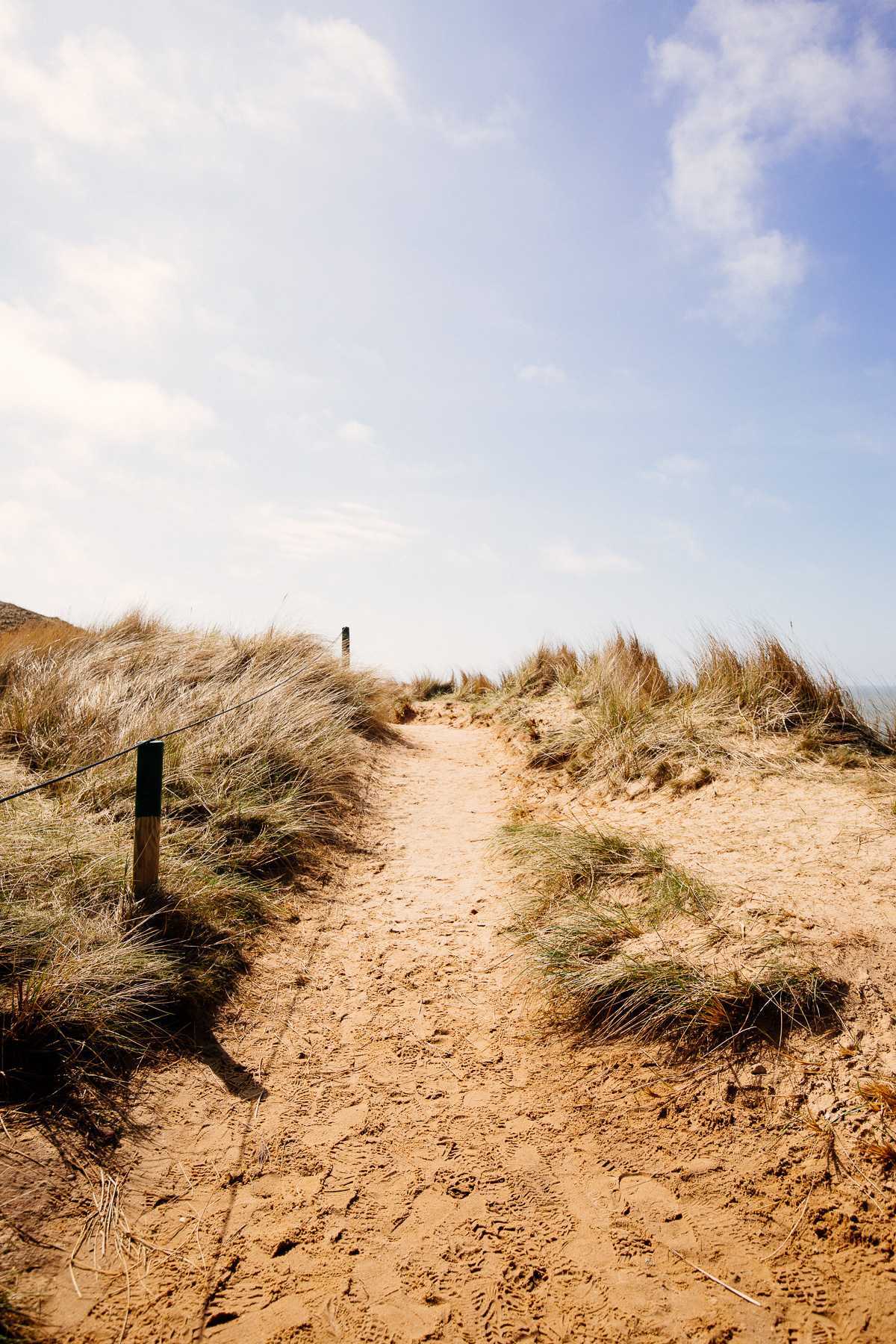
There are also beautiful dune paths on the red cliff.
#4 Stage 16 – Old hipsters, champagne and dunes
Buhne 16 is just a stone’s throw away from Kampen when you’re out and about by bike. At least on the way there, on the way back you often get caught by the headwind, which reminded me to think about an e-bike the next time I hire a bike. But you have to park your bike on the cycle path anyway. It’s a good walk through the dunes to Buhne 16.
On the way to stage 16.
In the middle of the solitude, I used my guest card for the first time, which every tourist receives after paying the tourist tax at their accommodation. This means that admission to the beach is free, otherwise it costs a few euros. You can then pay the fee on site.
In the middle of the dunes: The famous Buhne 16 in Kampen.
Buhne 16 itself is hidden in the middle of a dune and is actually nothing more than a beach kiosk with a wild history as a lively party venue for prominent beach guests. But Sylt wouldn’t be Sylt if this simple beach hut wasn’t a bit more refined. Unfortunately not the food, the potato salad, for example, also comes from a plastic bucket. No matter, Buhne 16 still exudes the flair of the uncomplicated jet-set beach life of the sixties: there’s plenty of champagne, but on the beach in swimwear everyone is almost the same. And the panorama with dunes, white powdery sandy beach and fresh sea air makes up for the record-breaking prices.
Actually inconspicuous, but pure Sylt atmosphere!
#5 Cunning and the elbow
Further north is List, which is only recommended for real cycling enthusiasts when cycling from Westerland – because the route is long. However, public transport is well organized: if you lose your strength on the way, the frequent island buses have a bike rack at the back so that you can simply charge your bike and make yourself comfortable on the bus (which also has free Wi-Fi, it’s incredible!). Incidentally, the northern tip of Sylt is called Ellenbogen because that’s exactly what it looks like.
The popular beach chairs are also located in List.
Incidentally, List is less glamorous, more sea, more dunes, more nature. In addition to a permanent exhibition, the Erlebniszentrum Naturgewalten also offers guided nature tours: Hiking through the mudflats, through the dunes or a visit to Germany’s only oyster farm.
#6 The northernmost fish stall in Germany
And a must in List: eating fish sandwiches! This is where Gosch, the famous Sylt fish cave chain, has its origins – this is where it all began. The Old Boat Hall also has a maritime flair. Unfortunately, the prices here are also steep, especially for self-service (who would have thought it), the food is okay, but not sensational, and on the whole a little too touristy. Nevertheless: Gosch must be on Sylt.
#7 Rantum
Rantum is not that far from Westerland, exactly at the narrowest point of the island. Here you will find powdery, extensive North Sea sandy beaches! If you are traveling with a camper van or tent, you can sleep on the campsite between the dunes in Rantum. Incidentally, the Sansibar, another famous beach bar on Sylt, is also located on the Rantum beach section. But you’ve known them at least since the legendary Air Berlin Zanzibar currywurst in-flight menus. Even one of Sylt’s beach saunas is located here!
Almost a bit like California: The beaches of Rantum are breathtakingly beautiful.
#8 Rantum bird sanctuary
On one side is a fine sandy beach, while on the other side of Rantum the Rantum Basin bird sanctuary is within sight. Here you can observe a wide variety of bird species. And: there are plenty of sheep – a pure natural idyll! Sylt is not particularly wide, so you have a wonderful view from the dunes on the beach to the other side of the island, where the bird sanctuary is located.
Sheep keep the grass in good shape around the Rantum bird sanctuary.
#9 Lighthouses like in Hörnum
Probably the most famous lighthouse on Sylt is located at the southern tip of the island: you can even get married in the Hörnum lighthouse! A circular walk around Hörnum-Odde is also a popular activity in Hörnum: here you can see with your own eyes how much Sylt has unfortunately been struggling with the erosion that has plagued the island for decades.
#10 The Hindenburgdamm
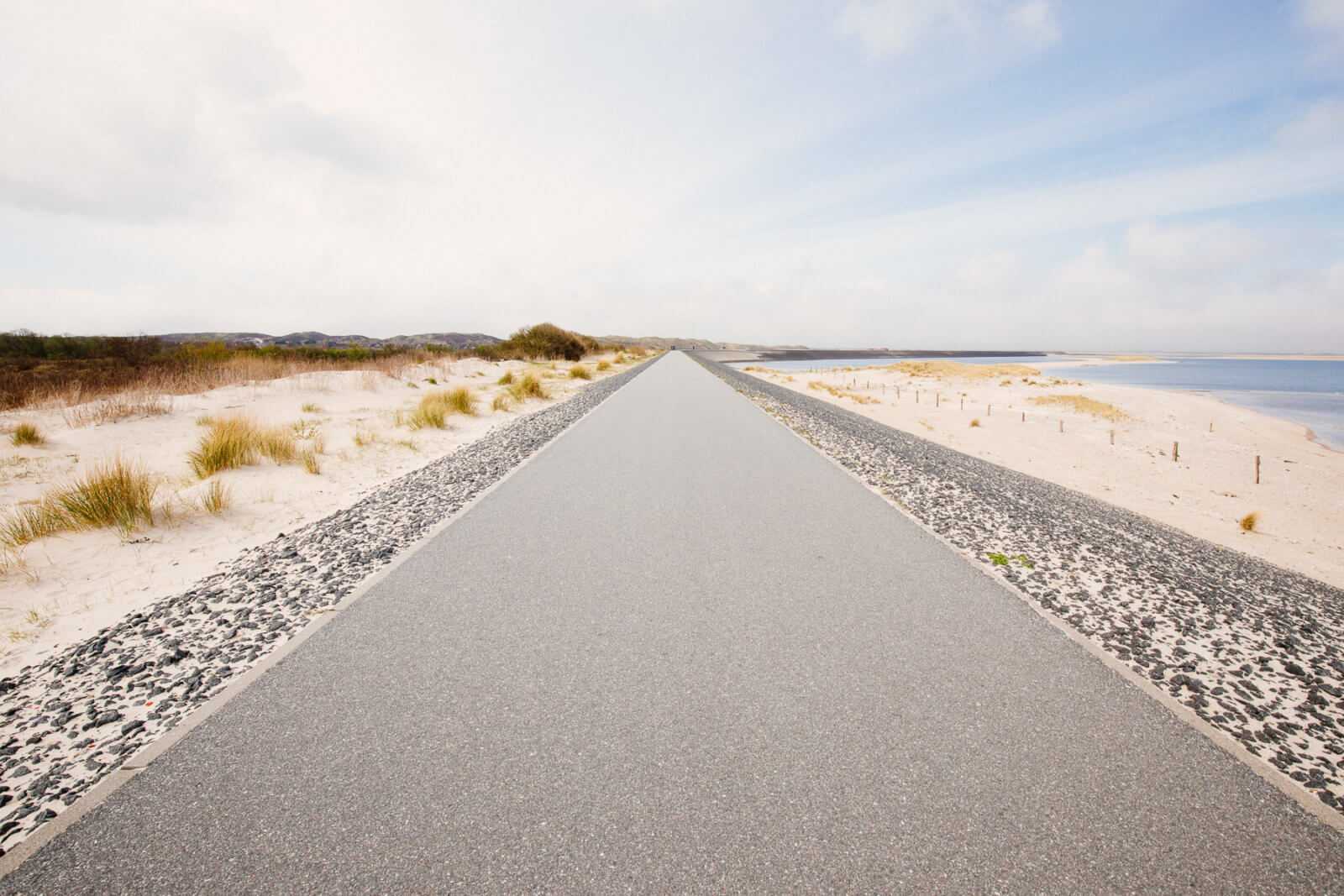
The last sight is also the first: most visitors to Sylt arrive via Hindenburgdamm. Meanwhile, Sylt also has a busy air traffic via Westerland Airport, even Airbuses land here now. And you can take the Sylt ferry from the Danish island of Rømø to List. But arriving by train via the Hindenburgdamm is still the proper way to arrive in Sylt!
The most important Sylt tip? On Sylt, people drink all day long, not just at the weekend, but every day of the week too. A glass of champagne or two in the morning, then a white wine at lunchtime with the obligatory fish; in the afternoon, depending on the weather, a tote Tante (yes, it really is called that – it’s cocoa with rum) to warm you up or a refreshing Aperol Spritz in the Sylt sun. Sylt is an island of indulgence, but the high prices sometimes make it difficult to find something suitable.
The best time to visit Sylt for most people is probably in the summer from June to August. The weather is more stable and warm enough for swimming in the rather cool North Sea. However, Sylt is particularly popular at this time of year, so it’s a good idea to book your accommodation in good time!
But Sylt can also be very beautiful in spring and fall! As everywhere else on the North Sea, you just need to be prepared for the weather with the right clothing: a rain or wind jacket is a must in your suitcase, as well as several layers for an onion look!
Sylt in the low season
While masses of tourists arrive in the high season, the low season is also becoming increasingly popular. It’s not enough to go swimming, but with a bit of luck you’ll get a few good days and have more Sylt and fewer tourists. And the hardiest of surfers simply wrap themselves in neoprene from toe to nose and plunge into the ice-cold North Sea waves anyway. Wouldn’t be anything for me. I love water, I love the sea, but I only go into the water when the air temperature is 28 degrees and above. Maybe that will change – after all, I was never really a North Sea fan. Too cold, too windy, too few palm trees. But after a few days on Sylt, I think I need to revise my opinion: It can be so beautiful on the North Sea!
Standard drink on Sylt: a cool glass of white wine.
Sylt in one weekend
Yes, Sylt is expensive. And the fact that you can find an excellent selection of the finest champagnes in even the most humble corner shop suggests that some prejudices are confirmed on Sylt. But never mind. Because the island itself, with its dunes, heathland and Wadden Sea landscape, is beautiful. A real nature experience. And you can somehow cope with the sometimes horrendous prices for food, accommodation and other things for a short stay – after all, you get something for it.
Arrival by train
What is also practical is that the island is easy to reach by train, and although you can also take your car with you on the car train, this is not absolutely necessary. All places on the island can be easily reached by bike or public bus. The buses also have bike racks so that you can load your bike in the back for more distant destinations. In midsummer, however, the train connection sometimes becomes a bottleneck and delays are not uncommon.
You might be better off taking a plane – many airlines fly to Sylt, and the airport is actually almost in the middle of Westerland. Incidentally, it’s one of the cutest little airports I’ve ever seen – with two fabulous check-in desks and an airport restaurant with the freshest crab sandwiches you’ll ever see in an airport terminal.
Nevertheless, I find the journey by train over the Hindenburgdamm nicer: the best way to get in the mood for Sylt. The Wadden Sea to the right and left. In front of you, the anticipation of the beach, sea, dunes and lots of white wine. Cheers!
“There are so many beautiful places around Berlin” is always the saying. But most of the time I’m drawn further away. Berlin’s (and Brandenburg’s) most beautiful corners always have to wait. But this month I was tired of traveling. Or rather: Berlin was too beautiful with clear skies and summer temperatures. And with a bike tour around the Müggelsee, even a city like Berlin feels like a natural paradise.
Hard to believe: Berlin can also do nature quite well.
Bike tour Müggelsee: Vacation in Berlin
I like to travel: the further away, the better. After all, I also write this blog, which is mainly about traveling. I was born with a love of travel: my mother emigrated from Brazil to Germany in the late seventies because she wanted to see the world. What sounds only moderately exciting today was a huge feat back then, and one that only the very daring decided to undertake. Emigrating – halfway around the world. Unimaginable for many people. In terms of travel, I am genetically predisposed, and I always flirt with the claim that I have a gypsy gene. After all, my parents later emigrated together again, and at a young age I chose a career that could no longer have anything to do with traveling. Then I also live in Berlin. A city that can feel like a cozy, warm nest one minute and like an exotic country two streets away. The whole world in a single city.
In the forests around the Müggelsee and the Dahme, there is one thing above all: peace and quiet.
But after almost 18 years of continuous travel, there are sometimes phases when you can only recharge your batteries at home – without living out of a suitcase, without constantly changing locations. And so this time my Vacations became Staycations: in search of the beautiful corners of Berlin.
Out of Berlin by bike: off to the Dahme
I really enjoy cycling again anyway, and I’ve recently discovered cycling tours for myself. In Berlin itself, cycling is more about getting around than having fun; sticking to the exhaust pipe of cars and crashing into spontaneously opening passenger doors simply diminishes the pleasure of cycling. Fortunately, you can get out into the countryside quickly on the S-Bahn and taking your bike on the train is often no problem.
Lots of greenery and fresh air in the forests of Berlin.
Cycle tour through Köpenick and Müggelheim / Cycle tour to Müggelsee lake
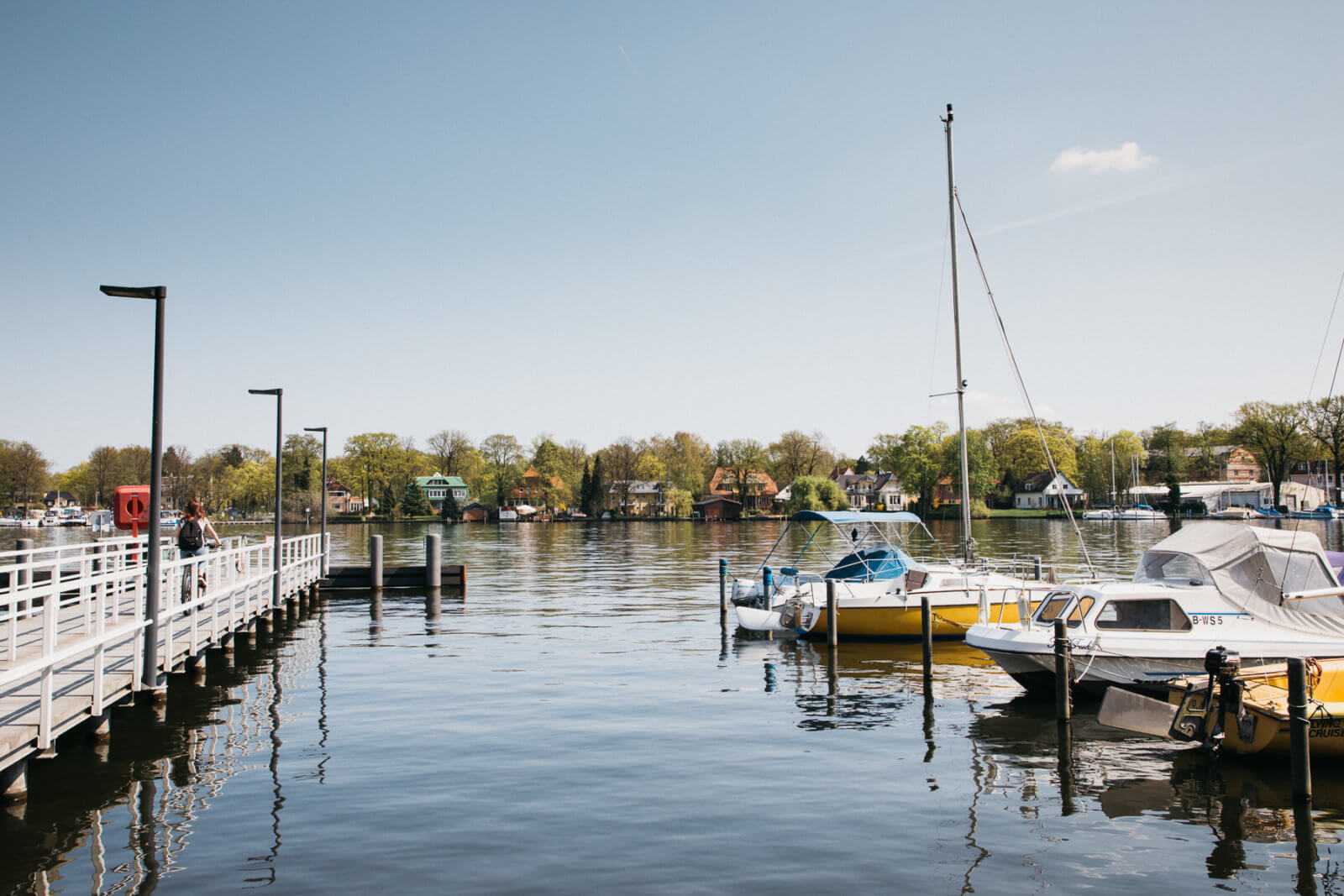
In the east and south-east of Berlin, the Große and Kleine Müggelsee lakes and the Dahme are the nearest destinations if you fancy a trip to the lake and forest. Yes, that’s right, there are large contiguous forest areas and numerous bathing spots. Perfect for a trip into the countryside. And you can’t believe that you’re really still in Berlin.
The BVG ferry stops at the end of the footbridge, allowing you to cross the Dahme.
Tour suggestion for a bike tour around the Müggelsee
Take the S-Bahn to Grünau station. (Line S8/9/45/46/47/85)
Then straight ahead down Wassersportallee towards Dahme.
(If you just want to swim and don’t feel like cycling, just follow the signs to Bammelecke and you’ll find one of the best swimming spots in Berlin, which is not overcrowded even in the height of summer).
You can even take your bike with you on the BVG ferry.
Special feature of this tour: at the end of Wassersportallee you take one of the small ferries operated by BVG – the S-Bahn ticket is still valid here! I love these little BVG ferries, which can be found in a few other places in Berlin – a totally brilliant service.
Once on the other side, simply follow the shore to the right, crossing beautiful woodland and passing secluded bathing spots. Don’t be alarmed, some bathing spots are unofficial nudist beaches.
You can go swimming in the Dahme as well as in the Müggelsee.
You can simply follow the shore and at some point you will come to a headland where another ferry stops. You can either take the ferry here or continue along the cycle path towards Müggelheim.
Here you can take a short break in the cozy village inn or ice cream parlor.
The route continues across Müggelheim along Odernheimer Straße to Kleiner Müggelsee.
If you follow the shore to the left here, you will come to the Kleiner Müggelsee lido, a large sandy beach surrounded by forest. Here you can swim or sunbathe very well.
If you prefer to continue, keep to the shore and you will automatically reach the southern shore of the Großer Müggelsee.
From here, walk halfway around the Großer Müggelsee until you reach the Spree Tunnel, which leads under the Müggelspree. (Please note: there are long flights of stairs up and down – although there is a ramp for bikes, it is still a bit of a challenge).
Now you are in Friedrichshagen. The renovated Art Nouveau houses and the beach promenade complete the vacation flair.
The harbor bar is a wonderful place to end the day with a view of the lake before heading back into the city from Friedrichshagen S-Bahn station (5 minutes away by bike and signposted).
This tour can be completed in a few hours (with plenty of breaks to enjoy the surroundings) – but you can also spend a whole day in the region and make up your own tour. The cycle paths along the Dahme and the Müggelsee are well signposted and with a day ticket you can use all BVG ferries (also by bike) for free.
My trip to Jerusalem had nothing to do with religion, even though most tourists make the pilgrimage there for religious reasons. I have absolutely nothing to do with that. Especially since a large part of my Brazilian family has been engaging with the subject more and more intensely, and their own religion has become ever-present.
That bothers me a lot and is increasingly becoming a breeding ground for conflict, because everyone secretly thinks their faith is the only true one. It’s a trend that’s currently taking place in many areas of Brazil—and sometimes I worry that this religious fervor might eventually take a turn for the worse. Perhaps that’s why the trip to Jerusalem was so intense for me. So, just to be clear: This travelogue about Jerusalem is very personal; some people may experience it differently—but that’s just part of traveling.
Travel to Tel Aviv: Adventure Israel
My trip just wasn’t off to a good start. I flew directly from Germany to Tel Aviv, and—probably just because I wanted to find out—I chose Israel’s national airline. Were the security measures there really that different? Indeed they were. Completely unprepared as always, I found myself just before the check-in counter being subjected to an intense interrogation about my travel plans and my living situation in Berlin.
That intense conversation felt so much like an interrogation to me that I feared my interlocutor would throw me into a secret airport dungeon at any moment and let me rot there. For whatever reason. But he didn’t, after all. Drenched in sweat, I then had to have my luggage subjected to a thorough security check, and eventually I was deemed worthy of checking in. But my mood was at rock bottom, and I would have loved nothing more than to go home crying. What a great start.
Read even more tips and travel stories about Israel on my Israel blog
I had never really given Jerusalem a second thought before. It was actually just a coincidence that led to this trip. So I arrived there early in the morning, relatively unprepared. And quite surprised. Jerusalem is THE center of three world religions that, as we know, don’t always get along. But I could feel that tension throughout the city, all the time. It’s quite curious, considering that all these religions preach love and peace.
What not to miss in the old town
Jerusalem’s Old City is peppered with world-famous sights that you must see. You can find the most important ones here, but I also recommend my great Jerusalem Guide. There you will find more sights outside the Old City and many practical tips for your trip to Jerusalem.
#1 The Church of the Holy Sepulchre
The Church of the Holy Sepulcher is tucked away, almost in the heart of the Old City, and if it weren’t for the trails left by thousands of tour groups pointing the way, one would hardly suspect that one of Christianity’s greatest shrines lies behind its unassuming facade.
Jesus is said to have been crucified at the spot where the church was later built. And his tomb is said to be located here. Because the Church of the Holy Sepulcher is therefore significant to just about every Christian denomination, a corresponding number of interest groups have been squabbling over it since time immemorial. At some point, this led to the keys to the church being passed down within a certain Muslim family—every morning and evening, someone comes with the key to unlock or lock the church. Crazy.
#2 The Wailing Wall
The Western Wall, along with the Temple Mount and the golden dome of the Dome of the Rock, is arguably one of the most famous postcard views of Jerusalem—and, indeed, probably of Israel as well. It is a pilgrimage site for (Orthodox) Judaism. For this reason, men and women pray separately here.
Access is restricted: You have to pass through one of the security checkpoints first. The scene couldn’t have been more fitting when a group of teenagers suddenly appeared, all cheerfully singing “Hava Nagila” and dancing in a circle.
#3 The David’s Citadel
The Citadel of David, next to the Jaffa Gate, not only features an informative museum on the city’s history but also offers a great view of the Old City. In the evening, there’s also an open-air light show at the citadel. It might sound like tourist kitsch, but it’s actually quite impressive against the unique backdrop of the fortress. (Admission prices and opening hours are available on the museum’s website.)
#4 The labyrinth of alleys in the old town
Jerusalem’s Old City consists largely of small, narrow alleys, and at every turn in this labyrinth of alleys, you feel as though you can experience the history of the city—oh, what am I saying, of all humanity!—firsthand. If only these massive walls could speak. You can easily spend a whole day in the Old City, just letting yourself wander. You almost have no other choice, because sooner or later your sense of direction will fail you anyway in the maze of alleys.
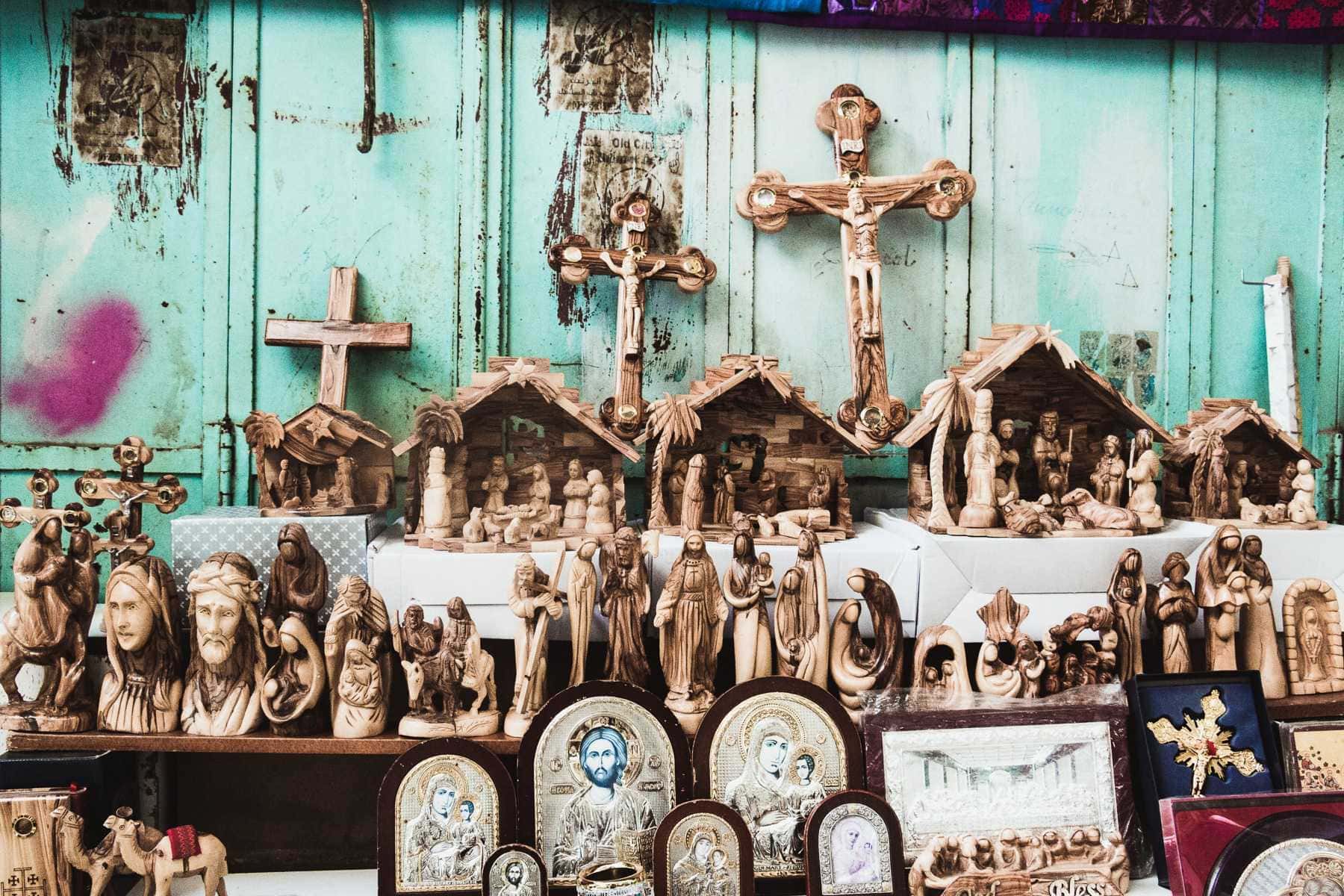
Here’s the great thing: Anyone who thinks the Old City is just a place full of tourist trinkets is mistaken. Sure, there are plenty of souvenir shops—which is no surprise, given the number of tourists who stream through Jerusalem’s Old City every day. But there’s also real, local life going on there!
The Jerusalem Syndrome and Me
In fact, I felt more and more uncomfortable with every passing hour during my stay in Jerusalem. Rarely has a place unsettled me so much. Is it an overdose of religion? I rushed back home because I just wanted to get away. And that’s even though I would actually have liked to see more of the city to get a better picture of it. I was there for an event sponsored by the local tourism office, which tended to take us to places that left us with a rather incomplete picture of Jerusalem—I think you know what I mean.
In any case, behind closed doors, I was repeatedly advised in whispers to go check out the Palestinian side as well—they said it was completely different. Be that as it may, I found the atmosphere in Jerusalem so oppressive—or rather, my own personal mood—that I could only stand it for a few days. However, as a colleague who knows Israel well later assured me, strong reactions among visitors to Jerusalem are not uncommon.
Some people have miraculous visions, receive all kinds of spiritual messages, or simply have a meltdown because of all the religion—just like me. The Jerusalem Syndrome actually refers to a mental disorder in which those affected suffer from religious delusions—it sounds amusing, but somehow Jerusalem does give off a strange energy, so it’s no wonder that some people are so strongly drawn to this city.
Ah, New York. I’ll probably never get tired of this city, even the fresh breeze on Brighton Beach in Coney Island couldn’t harm me. In January, I flew to New York again. In nine months on the long haul I was there three or four times, I think. This is a special circumstance, because I have actually always made sure that the destinations in my roster do not repeat themselves too much. I wanted to see as much as possible of the flight schedule in the short time available.
But for New York, I made an exception to my resolution. New York is never too much. But the stays were always short and I had to fight with my mixture of exhaustion and jetlag, so that at the end of a good 24 hours on site minus long bus rides to the hotel and a bit of sleep there was never much time. So it was clear: I would have to go back to New York again with more time. And so I packed my bags.
Coney Island is located in the southern part of the New York borough of Brooklyn
At the beginning of the 20th century, Coney Island was famous worldwide for its amusement mile
Rides such as theWonder Wheel, built in 1920, andthe wooden roller coasterThe Cyclone, which opened in 1927, were revolutionary
The Mermaid Parade, a large street parade that marks the start of the summer season, takes place every year
Coney Island in winter
Three factors then came together at the beginning of the year: I had plenty of time off, I still had a vacation flight left over from last year, and best of all, there was a direct flight from Berlin to New York, which was always empty. Long-haul flights from Berlin are always a rarity, and many routes do not survive more than one season. (The flight to New York is no longer available either). I hate changing planes, especially at large airports. You have to walk a lot, the hustle and bustle is stressful and noisy. That’s why a direct flight from a smaller airport right on your doorstep is a real gift.
The famous Wonder Wheel Ferris wheel is the landmark of Coney Island
Brighton Beach: The Beach of Coney Island
It became clear pretty quickly during my time on the long-haul route: I like New York, I like traveling far away—but I’d rather do it for personal reasons than for work. Having more time in America again for the first time, without being plagued by total exhaustion and various emotional distractions, was so relaxing and pleasant. And all that time on the ground! I spent almost an entire day driving from Coney Island all the way to Brighton Beach and enjoying a sunny day by the sea. Weather-wise, it was a real treat.
Perfect for swimming in summer: The wide beaches of Coney Island
And everything is so beautifully nostalgic. The boardwalk, the food stands, the famous Wonder Wheel, which is one of Coney Island’s most impressive attractions. Everything is closed during the winter; no wonder, since winters in New York are sometimes so harsh that you don’t want to leave the house for weeks on end. Still, on a clear winter day, Coney Island offers a complete change of pace from the urban jungle of Manhattan, and you can let the fresh Atlantic breeze clear your head.
If you want to experience Coney Island in full swing, with all its food stands and rides, you should visit between spring and fall: The season in Coney Island runs from late March to late October. For a ride on the legendary Wonder Wheel, head to Deno’s Wonder Wheel Amusement Park; for the nostalgic Cyclone roller coaster, head to Luna Park.
Coney Island is kind of like a cabinet of curiosities from days gone by: Every year, the Coney Island Art Center organizes quirky events like the Mermaid Parade. Mainly during the season, of course—you can find all the dates here.
The famous hot dogs of Coney Island
Nathan’s Famous is said to have the best hot dogs in town, and definitely the most famous. Founded in 1916 by Polish-Jewish immigrants, the initially small hot dog stand became a popular fast food restaurant in Coney Island.
In the 1970s, the annual hot dog eating contest was invented, which brought Nathan’s Famous even more popularity. This well-attended and very popular event takes place every year on July 4, Independence Day, a major national holiday in the United States. It is held at the large flagship location on the corner of Surf and Stillwell Avenues.
But even if you can’t make it to the big eating contest (and you like meat, because unfortunately there aren’t too many options for vegetarians), you should definitely stop by the main branch and try one of the legendary hot dogs in a stylish ambience.
Popular since 1916: the hot dogs from Nathan’s Famous in Coney Island.
The Coney Art Walls are also just around the corner. The freely accessible open-air gallery consists of several colorful murals and reminded me a bit of the Wynwood Walls in Miami. Very worth seeing and another beautiful photo spot in Coney Island.
Frequently asked questions about Coney Island
Are you planning a trip to New York? Coney Island isn’t necessarily the very first place you’d think to visit in New York, but it’s still well worth seeing. Plus, Coney Island is relatively easy to get to. Here, I’ll answer the most important questions so you have a good overview.
It’s often the places that no one really knows about that make the difference. Not that Kuala Lumpur wasn’t interesting on my trip through Malaysia last October. Or Singapore, where I was later. There’s a reason why thousands of tourists from all over the world make the pilgrimage there. But in the end you only see what you already know from several travel guides or recently more and more often from your Instagram feed. To see this live and in color is of course also exciting – but in the end, places like Ipoh in Malaysia also have their charm, precisely because they are not yet so well known.
So when I’m on the road for a longer period of time, I like to stop at places that aren’t quite as crowded. Simply to deviate from the usual stream of tourists. Ipoh is not that untouristy either – however, the vast majority of visitors are from China, western tourists hardly seem to know Ipoh. And this, although Ipoh is a really nice stopover for 1-2 days, if you are traveling in Malaysia.
On my Malaysia Blog you can learn much more about Malaysia
The Old Town of Ipoh
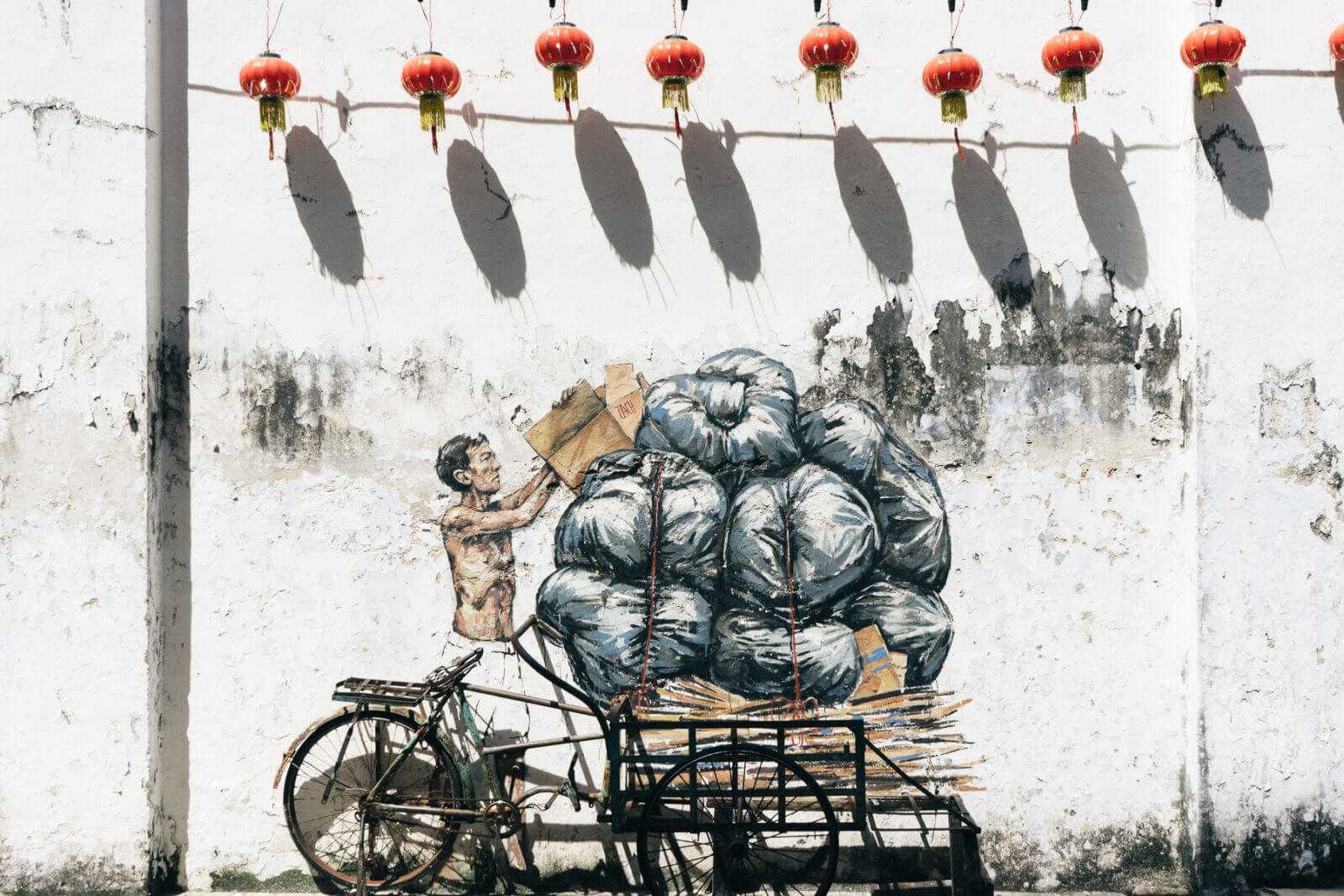
The Old Town is small but charming, with many buildings from the colonial era. And there’s quite a bit of street art—which is a nice way to get in the mood for Georgetown if you’re on your way there. Most of the murals are easy to find, even using Google Maps. Or you can pick up a map at the tourist office. They’re very well organized in Malaysia anyway—something I hadn’t expected.
The Ipoh Heritage Trail takes you past all the town’s buildings worth seeing – from a time when Ipoh was still so rich because of its nearby tin deposits that it was called the “City of Millionaires.” And again and again there are small alleys and beautiful details to explore and discover. It is precisely the fact that Ipoh is not so smoothly polished and still has a slightly morbid vintage charm in many places that makes the old town so special.
Concubine Lane
The tourist hub of Ipoh is Concubine Lane, a narrow alley lined with shops, restaurants, and street stalls. There are actually three Concubine Lanes; in ancient times, a tin baron gave each of his three wives a street and let them collect the rent there for their own pockets—hence the three Concubine Lanes. Today, the action takes place mainly on a single street, Lorong Paglima, which is commonly known as Concubine Lane.
On what is now Market Lane—formerly Second Concubine Lane—you won’t find any shops, but you can take your time admiring street art murals and, if you have a keen eye, the tastefully displayed accessories, such as a vintage Beetle. But the umbrellas… well, they’re kind of old news… in the truest sense of the word.
Probably the most intricately designed gem in Ipoh’s Old Town is Kong Heng Square, a small block of buildings lined with shops and cafés. And it’s really beautifully done. The trees, which have been growing in the courtyard for centuries and were simply integrated into the redesign of the buildings, make you feel like you’re at Angkor Wat.
It’s a little too geared toward the hipster crowd, but you can still enjoy shopping for handmade souvenirs in the small shops here and enjoy good food and drinks at the cafés and restaurants.
Street Art in Ipoh
If it works in Georgetown on the Malaysian island of Penang, it must work in Ipoh, too. That’s probably what someone must have thought. Georgetown has become known for its largely interactive murals, which gained fame primarily through the Lithuanian artist Ernest Zacharevic. Thanks to some of his works in Penang, he’s even earned the nickname “the Banksy of Malaysia,” and tourists line up endlessly in front of his murals in Georgetown just to snap a photo.
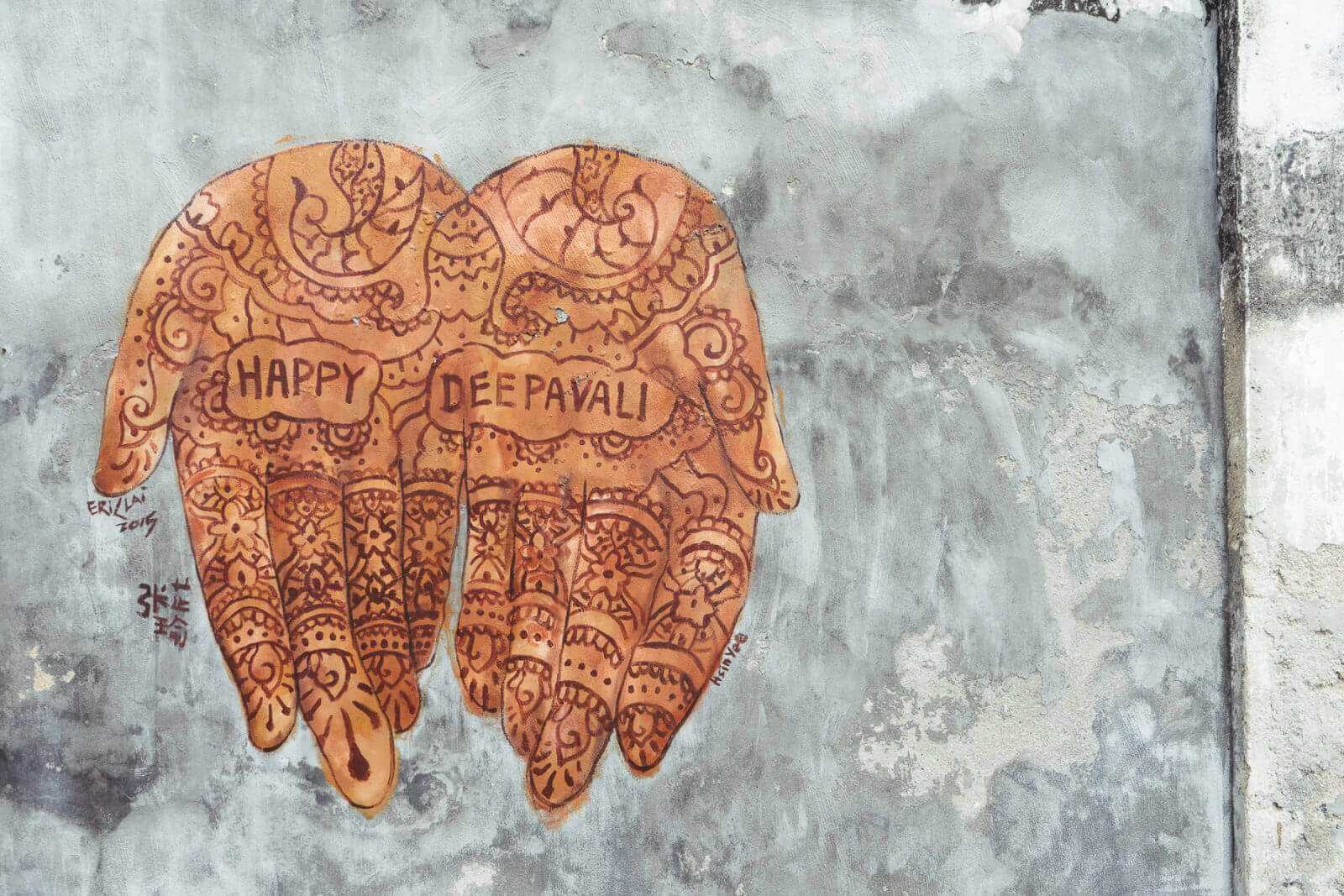
This is not yet the case in Ipoh. But street art can still be found everywhere. There is even next to the more famous Market Lane a complete alley only with street art, the Mural Arts Lane. Partly nice, partly less so, but in any case not as crowded as Georgetown. Since the old town is also very clear and many works are centrally located, you can actually look at all the interesting murals in just a short time.
Night Market: Exploring Ipoh’s Vibrant Nightlife
As is typical in Southeast Asia, Ipoh also has a night market. However, it’s located outside the old town, and if you really want to go there after dark, you’re better off taking a taxi. Uber or Grab (which is usually a bit cheaper than Uber and also more popular). It’s not far to walk, but the streets along the way are rather dim—and to me, the savings just weren’t worth it.
Unfortunately, the market itself isn’t particularly spectacular; it mainly sells counterfeit Chinese knickknacks and trivial trinkets. So if you’re looking for local handicrafts or other authentic souvenirs, you probably won’t find what you’re looking for here.
But there’s some exciting street food here: On a street corner, there’s a restaurant called Lou Wong, which is apparently known for its chicken with rice and soybean sprouts. In any case, it’s the biggest and busiest place far and wide, and there isn’t even a menu. That’s because they only serve one dish on simple orange plastic plates—you can choose between chicken or the vegetarian option (which is probably just the same dish without the chicken). You order using hand gestures—nobody speaks English. But that doesn’t matter. The main thing is that it’s delicious—and the place is definitely worth a visit for adventurous eaters.
I thought Ipoh was really quite pretty, and if I hadn’t had only three weeks in total for the entire trip, I probably would have stayed a little longer—also to explore the surrounding area. I think Ipoh is definitely a nice change of pace, especially for long-term travelers, offering a break from all the traveling and a chance to just relax for a few days.
How to Get There
Ipoh is located north of the Cameron Highlands on the way to Penang/Georgetown, making it the perfect stopover. Ipoh is also very well connected: There’s a train connection to Kuala Lumpur, an airport with flights within Malaysia and to Singapore, and a large bus terminal outside the city from which you can travel to all parts of the country. Traveling by bus in Malaysia is highly recommended—it’s affordable and much more comfortable than you might imagine!
Where to Stay in Ipoh
There are some nice places to stay in Ipoh. Individual, stylish and yet affordable:
M Boutique Hotel – It’s just outside the Old Town, but thanks to Uber—which works great in Ipoh, too—it’s absolutely easy to get to. De Café & Rest House – Not only a highly recommended café, but also a new capsule hotel. Ideal for solo travelers. Unfortunately, there are no private rooms, but it does have a unique location in the Old Town! The Happy 8 Retreat @ Old Town Ipoh – Also located in the heart of the old town, this is a beautiful boutique hotel with unique jungle-style interior design.
What to do with a day off in Linz, Austria? I landed in Linz for a day, but wanted to do something different! So I decided to spend the day in nearby Salzburg! It takes a good hour to get from Linz to Salzburg by train, so it’s perfect for a day trip. And I’ve always wanted to visit Salzburg. History. Culture. Mozart. Mountains. And anyway. Millions of tourists who are visiting Salzburg every year can’t be wrong. Besides, Salzburg is really good to explore in one day! In this article, I’ll show you what you can see in one day in Salzburg and share some helpful tips!
The man on the Golden Sphere in front of Hohensalzburg Fortress
Discover Salzburg in one day: Start in the Old Town
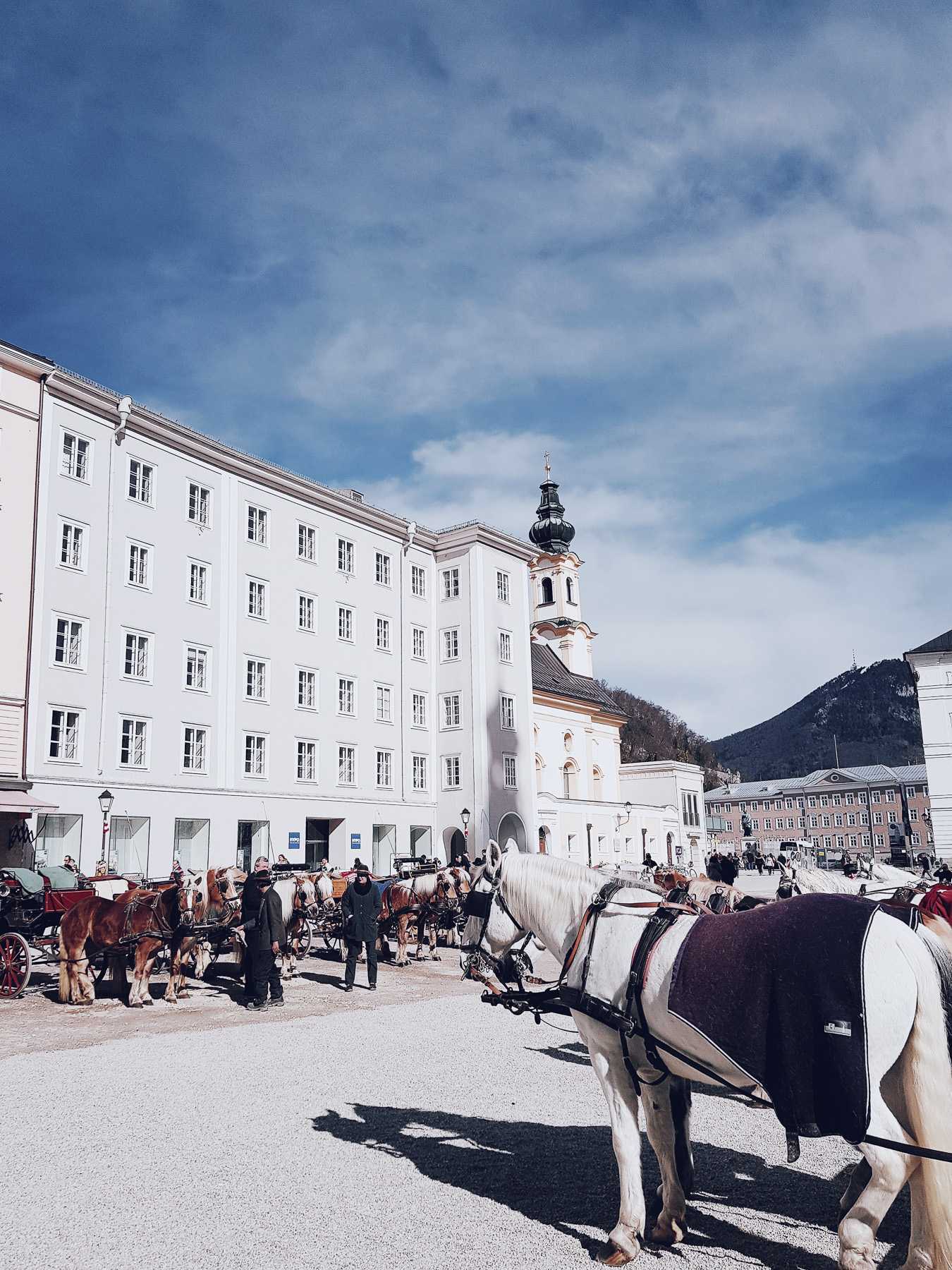
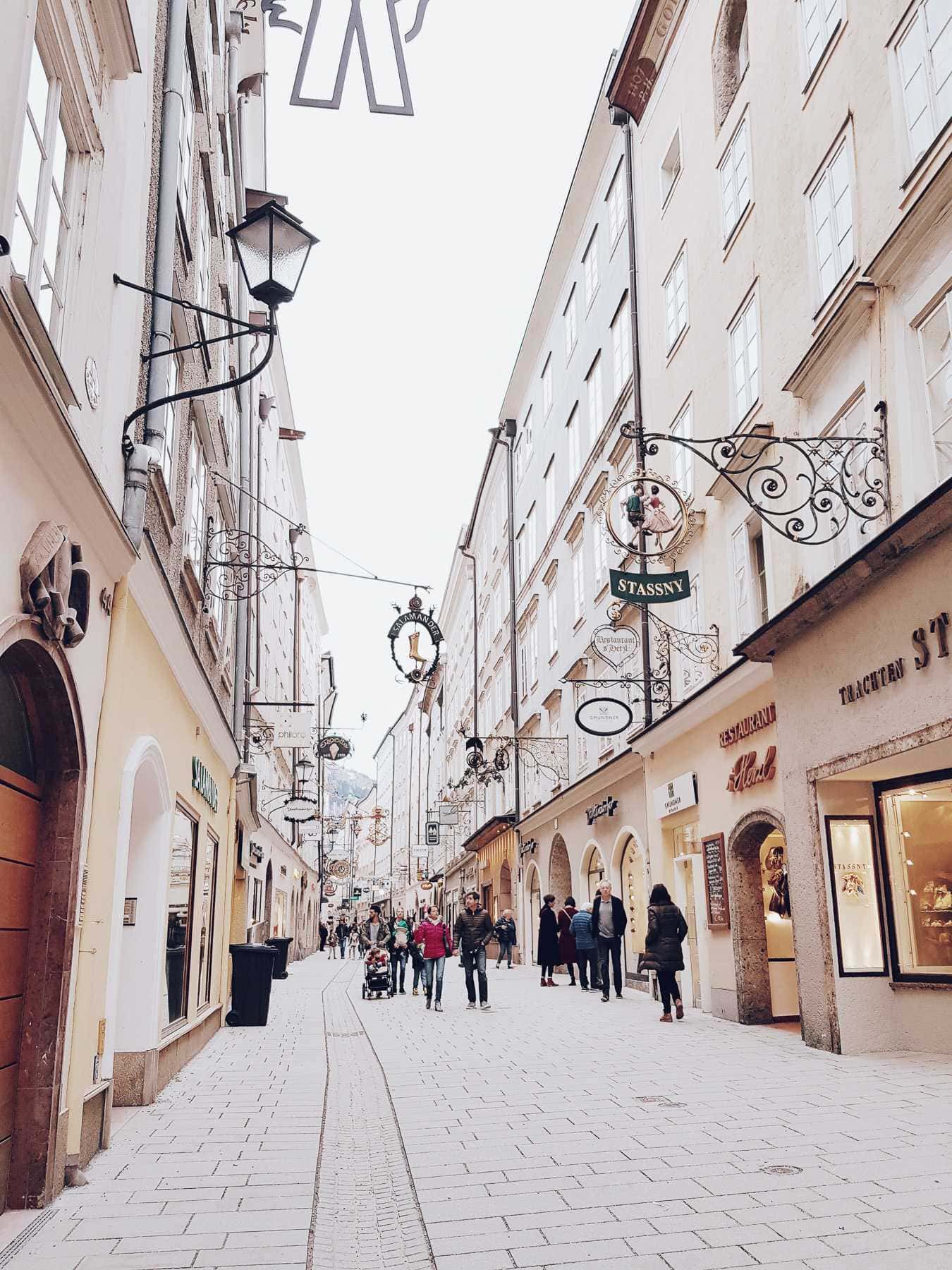
The nice thing about Salzburg for a day trip: everything is within walking distance. Perfect if you are traveling without a car and by train like me! The main train station is outside the old town on the other side of the Salzach River, but you’ll in the middle of town by bus in just 10 minutes . Right in the middle of this lovely old town dream in pastel colors. The alleys of the old town are small and narrow, sometimes crowded, sometimes surprisingly empty, but always neat and pretty to look at.
Tip: With the 24-hour Salzburg Card, you’ll save on admission to most attractions and can use public transportation, the Mönchsberg funicular, and the Festungsbahn (both of which take you to the best viewpoints over Salzburg) for free.
In the middle of the old town: Salzburg Cathedral
In the Old Town, you’ll find magnificent buildings like Salzburg Cathedral —which even if you’re not a fan of churches, you should see from the inside. The restored ceiling paintings are truly impressive.
Mozart. Mozart. Mozart everywhere. For those who have zero knowledge of classical music, Salzburg is perhaps only half as interesting. Salzburg lives from the most famous son of the city, the composer Wolfgang Amadeus Mozart, and at every corner you’ll see something with his name on it. There are Mozartkugeln, Mozart fridge magnets, Mozart postcards and all kind of Mozart souvenirs in every store, every pub, every supermarket.
So I also had to include a little bit of Mozart into my day as well. In Salzburg, both Mozart’s birthplace and his later home can be visited, and I opted for the former. Although I was worried I’d end up in a small museum with numerous tour groups, because Mozart’s birthplace is one of the must-sees in Salzburg and often very crowded.
More places in Salzburg for Mozart fans can be found here: Mozart in Salzburg
But it wasn’t like that in the end. The house/museum is quite spacious (the Mozart’s were a wealthy family) and it wasn’t as crowded as expected. With 11 euros, the entrance fee is also pretty expensive. But it’s a must-see in Salzburg. And the exhibition is really worth it.
With the Salzburg Card, however, you get free admission there, just like at many other attractions—unfortunately, I didn’t find that out until afterward. It’s worth taking the time to compare options—you can save a lot of money that way!
Salzburg from above: Is the view better from the Mönchsberg or the Fortress Hohensalzburg?
“You absolutely have to go up the Mönchsberg,” another friend gave me as the ultimate advice. It would probably be nicer than on top of the fortress Hohensalzburg, which is always well attended. Crowds are not my thing anyway, so I decided to up to the Mönchsberg. How convenient: To get to the top, you can just take an elevator. Which in my case was a good time saver, since I had to slowly make my way back to Linz.
But the view from Mönchsberg of the old town, the fortress and snow-capped mountains in the background is really worth it. In addition, there is a museum of modern art up there, the Museum der Moderne Salzburg, which is very impressive!
If you want to do both: Then it’s definitely worth buying the Salzburg Card—with it, you can ride the Festungsbahn up to Hohensalzburg Fortress for free, and you can use the elevator up the Mönchsberg for free!
Cafés in Salzburg
I still haven’t figured out how to order coffee in Austria. Kleiner Brauner, Einspänner, Verlängerter, Kapuziner, Fiaker… it’s a whole science! And I never get which one is which! I But I found a cozy café to satisfy my sudden hunger for original Austrian cuisine: Café Würfelzucker serves handmade apple strudel! You can also enjoy the perfect view of the Salzach in alpine flair.
Salzburg is really pretty. I couldn’t say otherwise. And I would definitely come back again if I get the chance. The surrounding countryside is also worth a visit! The alleys of Salzburg are really photogenic and the overall vibe is really one of kind. It definitely feels like being in a fairytale!
Where to stay in Salzburg
Do you want to spend more than just a day in Salzburg? Find the best hotels deals here: Best hotels in Salzburg
In Salzburg, there are also 6 accomodations operated by religious institutions. These places are often cheaper than others (Salzburg is otherwise rather expensive). You can learn more about these accommodations in my article Salzburg and its churches.
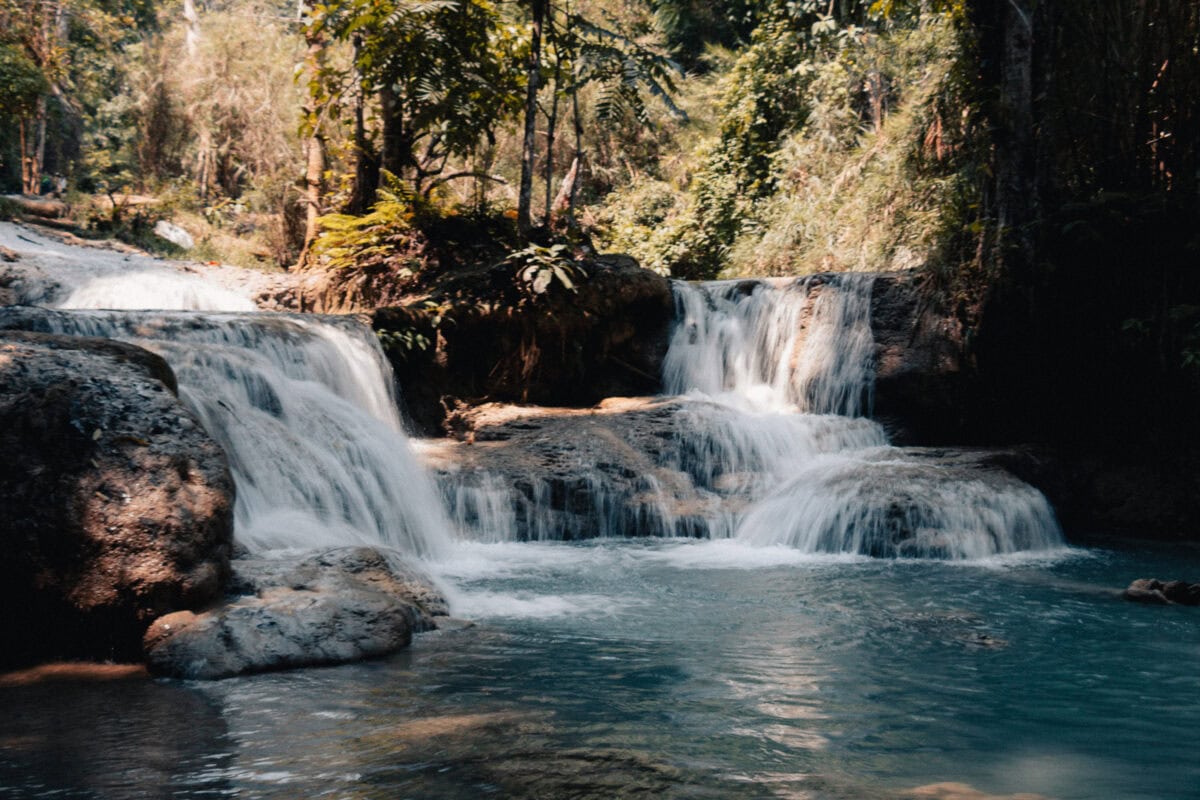
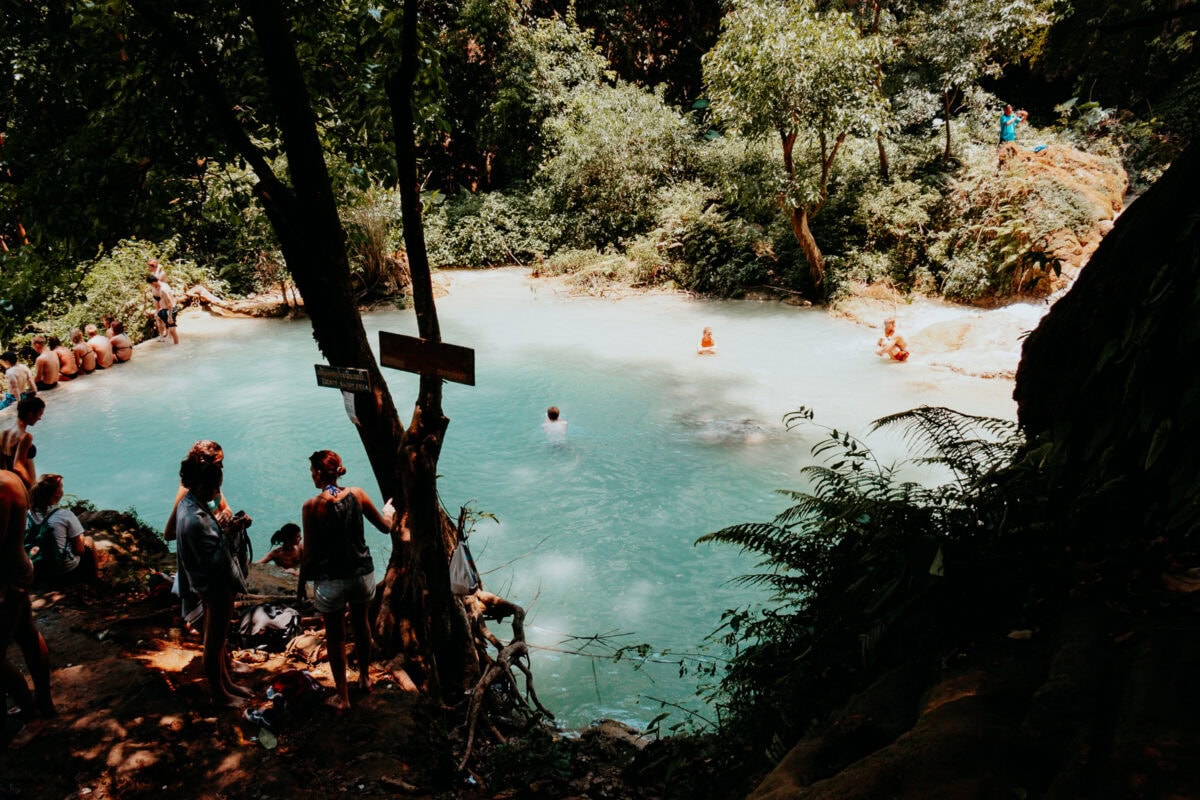
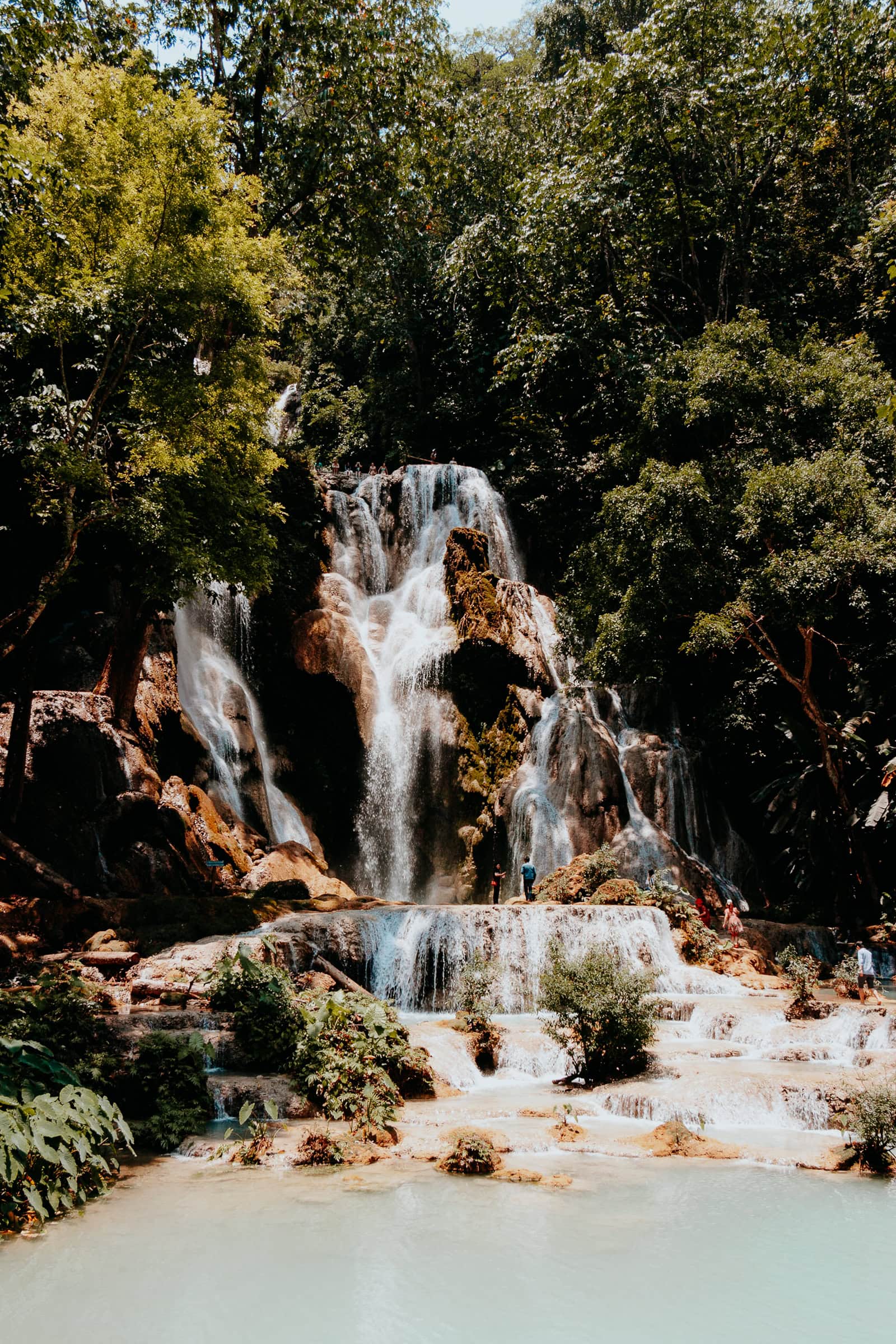
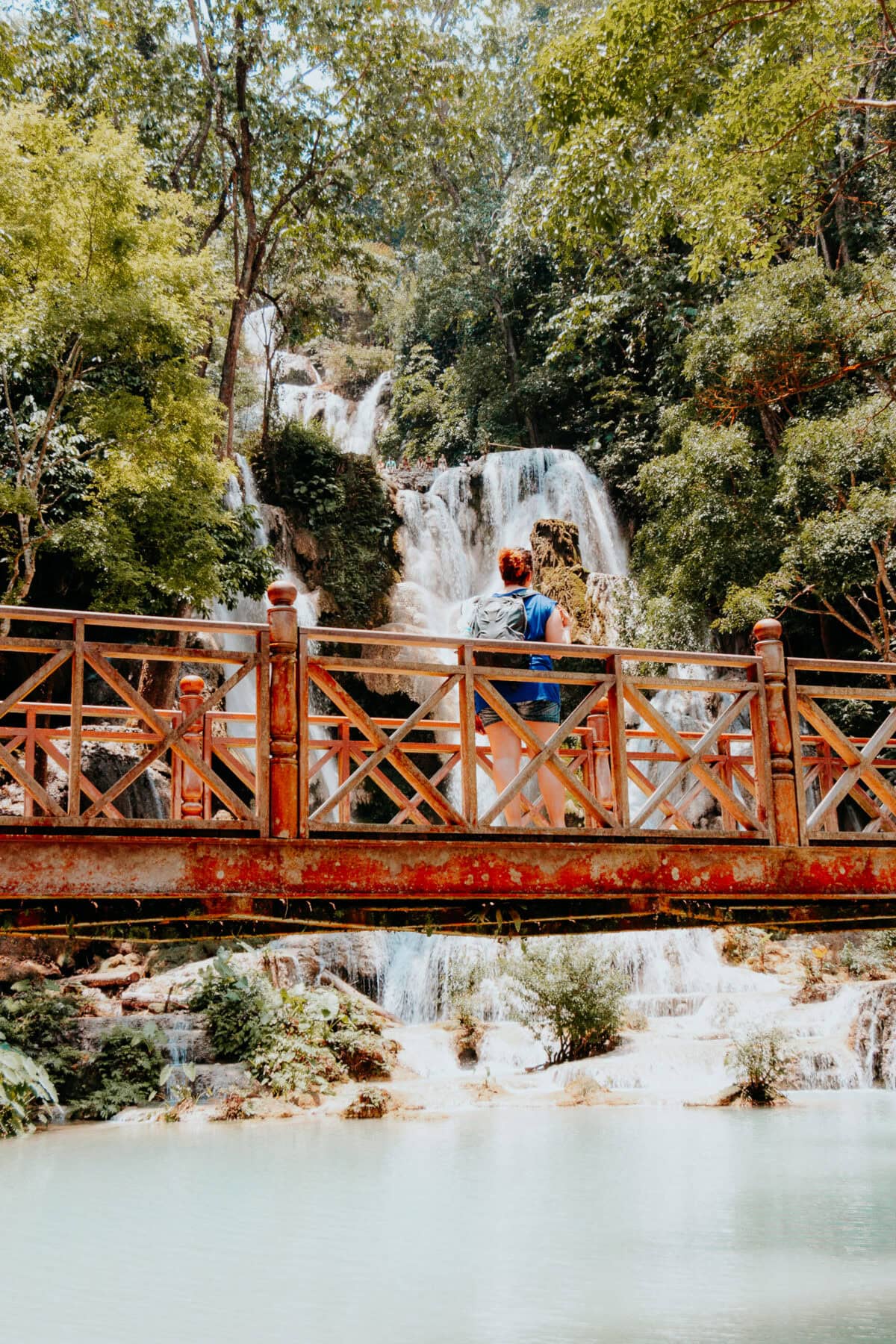
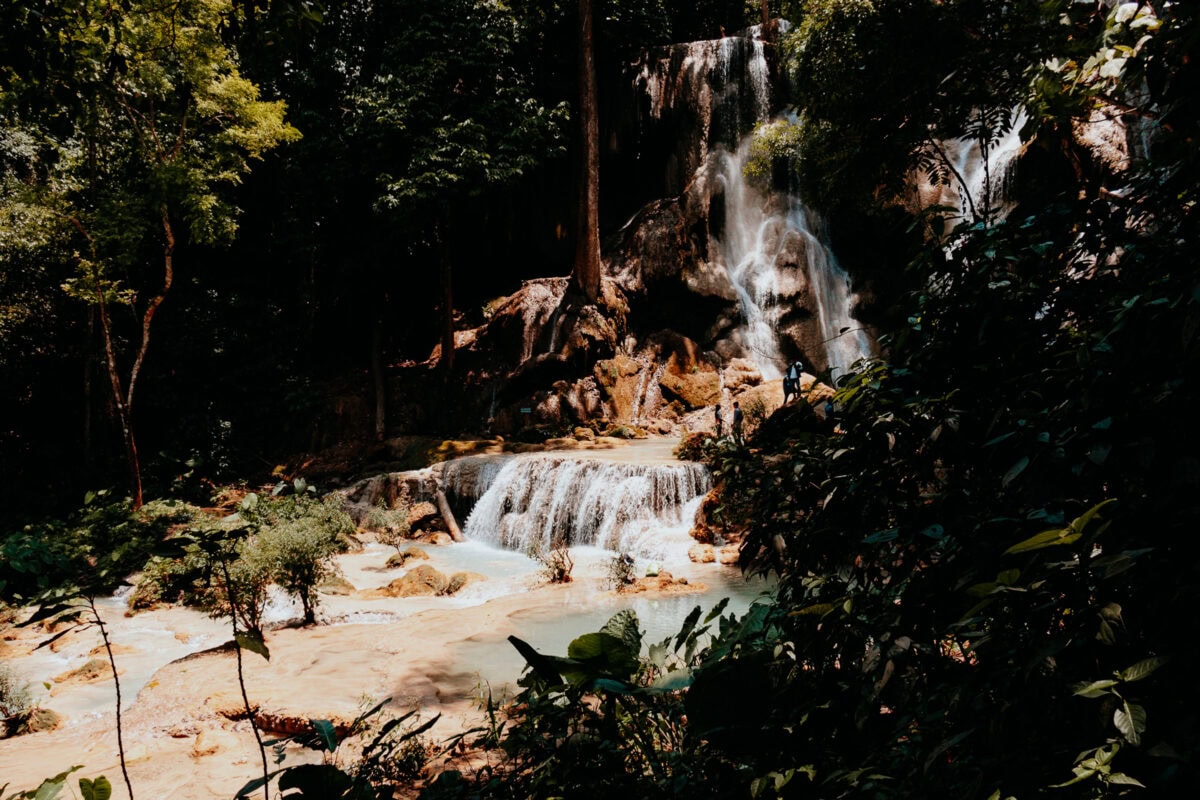
The 30 minutes on the back of a rattling tuktuk were worth it: near Luang Prabang are the Kuang Si waterfalls – and they are spectacularly beautiful. Clear turquoise water in small pools spread at the foot of the waterfall. And the waterfall itself, in the middle of a tropical forest. All breathtaking.
Waterfall for adventure lovers
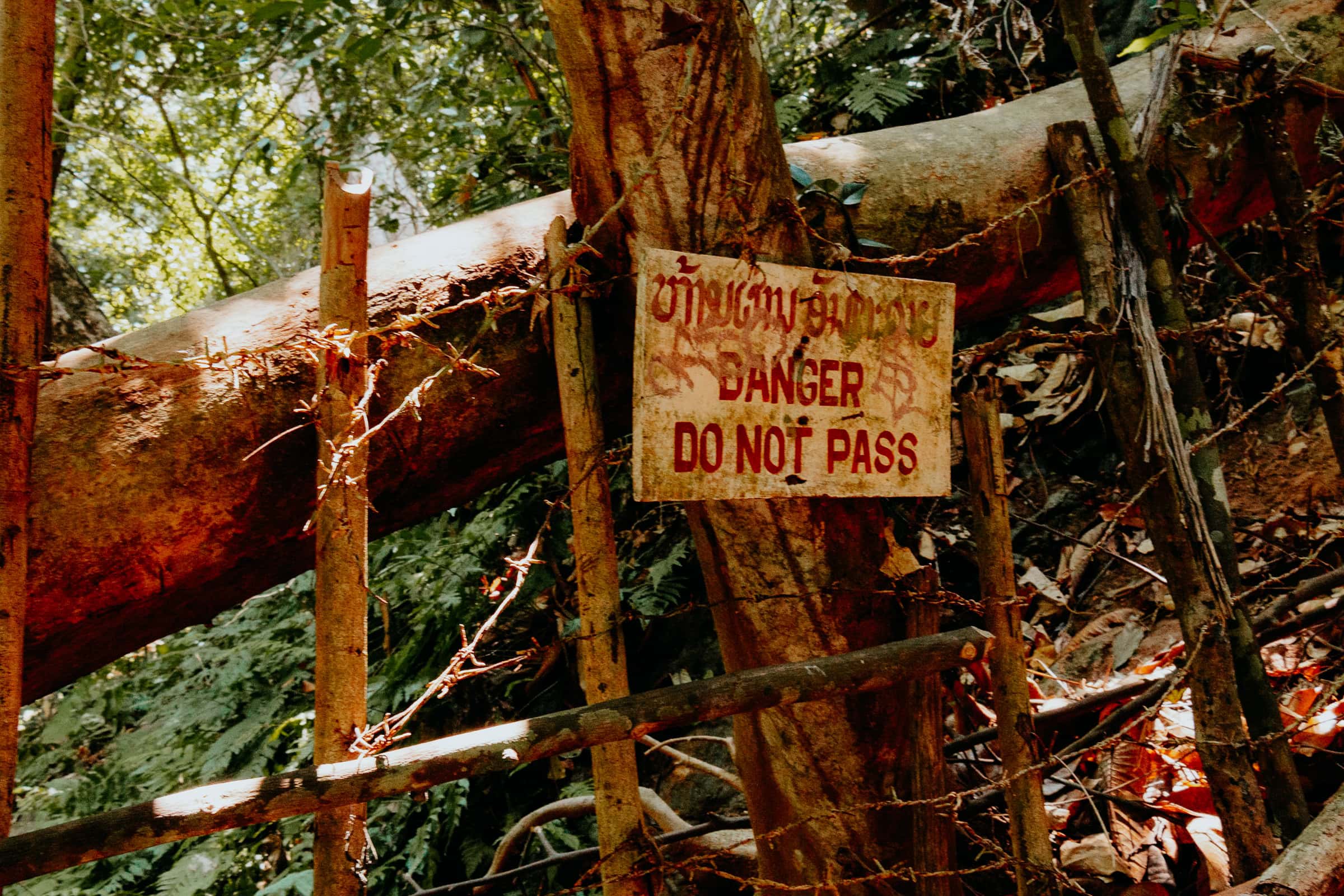
If you’re feeling particularly adventurous, you can also take a look at the waterfall from above. A small trail leads up the mountain – and right at the sign “Danger! Do not pass!” you do exactly the opposite: off through the hole next to it and further up to the waterfall. But be careful, already the regular hiking trail is sometimes not without due to the wet ground… and here it does not get better.
And even if thousands of backpackers show you how to do it, it’s better to swap your flip-flops for sturdy sneakers. If you still need the total kick, you can then, once at the top, sit right on the cliff of the waterfall!
In the Laos blog you will find many more tips for a great Laos round trip!
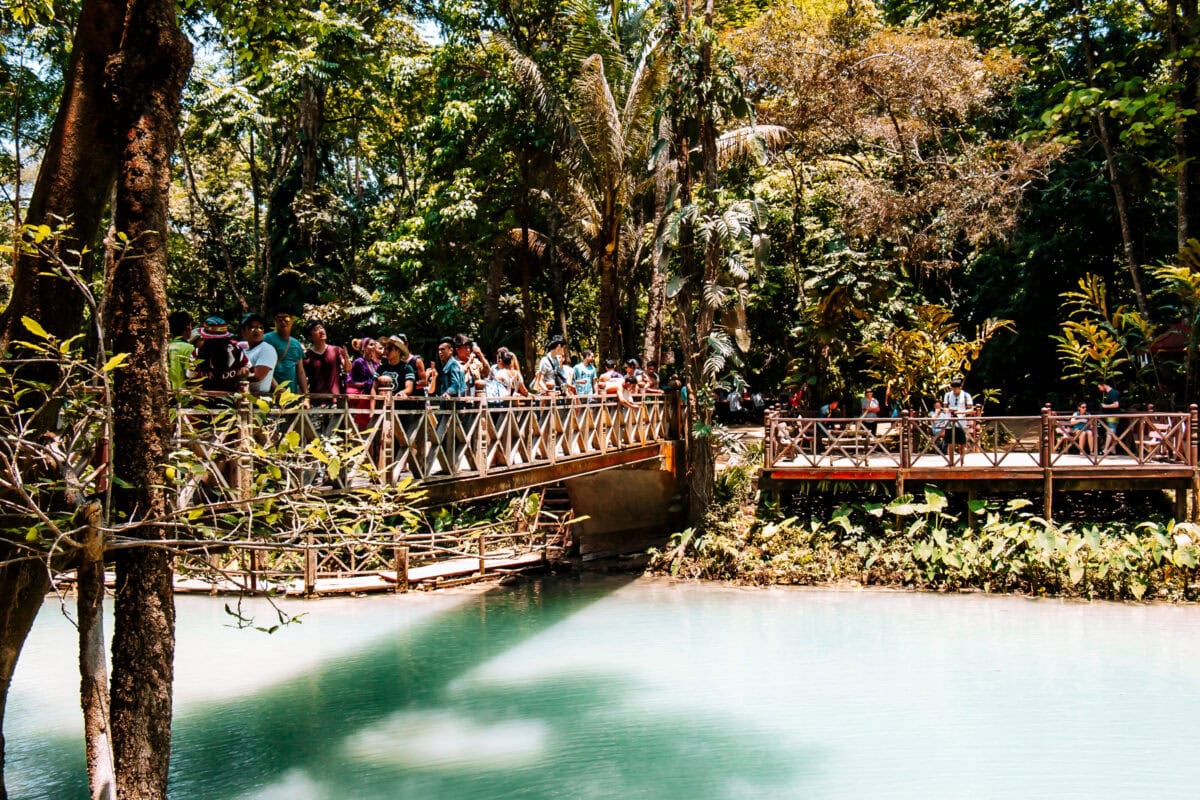
It is best to start early in the morning in the direction of the waterfalls, because from late morning the first tour groups slowly start to arrive, and then it gets really crowded. On weekends, the Kuang Si waterfalls are of course also a popular destination for the locals.
Many families spend the whole day there, picnicking, swimming and enjoying nature and family time. So if you prefer to travel more solitary, come during the week. However, the atmosphere is very nice on weekends so among locals, so is also a nice option.
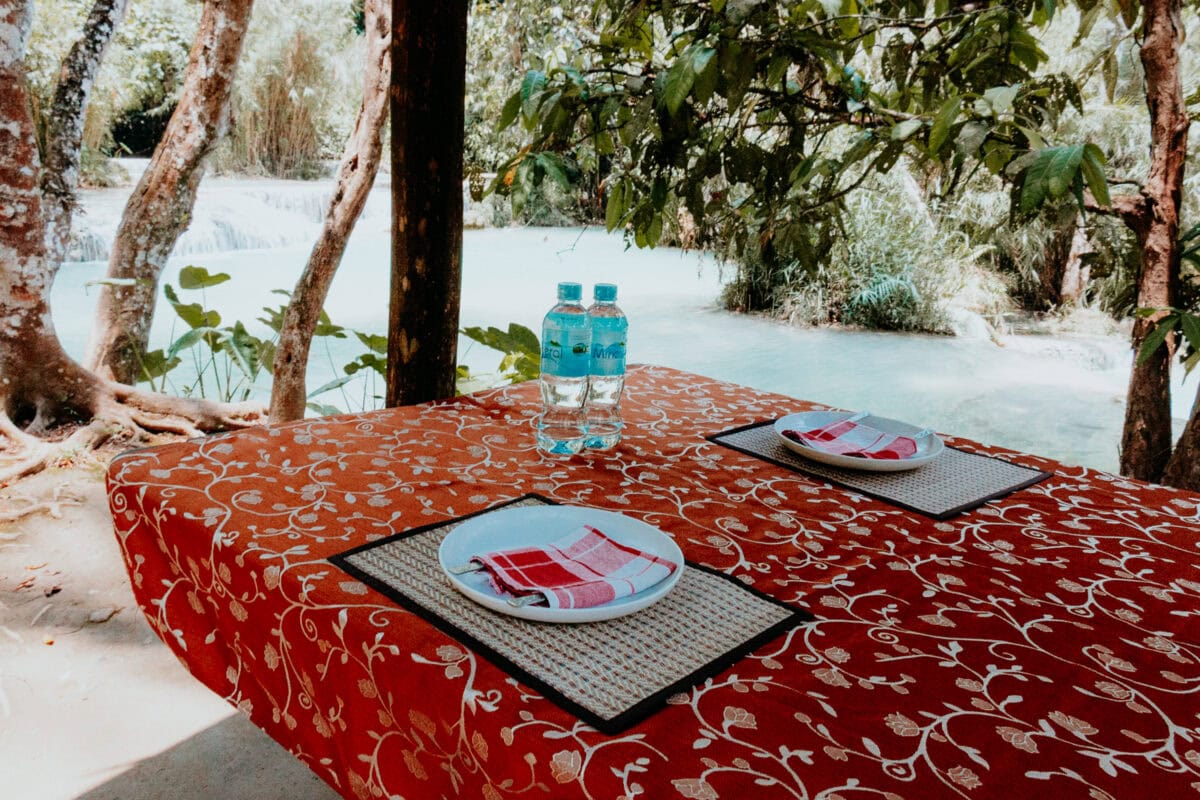
Some locals even bring their own secret pop-up restaurant and nicely set the available tables and serve lunch – in case you forgot your packed lunch, you won’t starve either!
Bears at Kuang Si waterfall
At the entrance to the waterfall is also the Bear Sanctuary, a sanctuary for bears, where you can watch them play and chill in their enclosure.
How to get to Kuang Si Waterfall?
There are two ways to get from Luang Prabang to Kuang Si Waterfall. Either book one of the many tours offered to Kuang Si or simply take a tuktuk from Luang Prabang, which is also waiting on site as long as you explore the waterfalls. Of course, this is a bit more expensive, but it’s definitely worth it to arrive before the crowds and have the flexibility to arrive and depart.
With illustrious cities such as Edinburgh and Glasgow, Aberdeen is a real underdog among Scotland’s cities. Why a visit is still worthwhile, I tell you in this article! And at the same time show you the Aberdeen sights that you should definitely see.
Aberdeen: The Silver City
On the flight to Aberdeen, a passenger warned me: “Aberdeen is really a very special city. Everything is gray, the entire city. I bet you’ve never seen so much gray in one place in your life!” Ha. No way. As a Ruhrpottkind, I am well acquainted with gray cities and depressing environments. Not that I am misunderstood, the Ruhrpott I love to this day hot and hearty – but beautiful… beautiful is watt different. So I grew up in the middle of the gray and Aberdeen is supposed to be even grayer? But Aberdeen had more to offer than expected…
It came as it had to come, our guest was actually right. Everything, but really everything was gray. Even the sky. Fifty shades of grey live, so to speak. Somehow, this high up in the north of Scotland, the sun doesn’t really come out in the fall. But it wasn’t bad at all, Aberdeen impresses as well.
Aberdeen’s Castlegate neighborhood is named after Aberdeen Castle, which once stood here. Today, the Salvation Army Citadel is located here.
Why is everything gray in Aberdeen?
All the gray that surrounds you in Aberdeen is actually not so pale gray. The vast majority of house facades are made of granite – if you get closer, you can see a slightly silvery shimmer, which becomes even more beautiful when the (admittedly rare) sun shines on it. Normally, you would never build such buildings with granite – it would be way too expensive! But near Aberdeen are large deposits of granite, which in the past provided much prosperity in the region.
Predominant house color in Aberdeen, Scotland: gray.
The Maritime Museum
No wonder Aberdeen has a huge maritime museum, the Aberdeen Maritime Museum. Besides granite, there’s also a lot of oil offshore in the area! And in the Maritime Museum you can learn a lot about ships, oil production and the history of Aberdeen.
Visitor magnet in Aberdeen: The Aberdeen Maritime Museum.A port city through and through: Huge ships are moored in the port of Aberdeen, which lives particularly from oil production in the North Sea.
Cemetery walk at St. Nicholas Church
Okay, I’m not usually a big fan of cemeteries. But this one is really special. Everything in this cemetery is overgrown with bright green moss – the only colorful thing in all the Aberdeen gray all around. By the way, the church is located in the middle of Union Street, the big shopping street in the center of the city. So if you’re out shopping anyway, you can take a little stroll here.
Eerily beautiful: The moss-covered graveyard of St. Nicholas Church in the center of Aberdeen.
Shopping in Aberdeen
In England in general, yes, I love shopping for clothes – if you’re not a normal size, the wide selection of petite sizes in pretty much all stores is a real dream! (And don’t even get me started on the gourmet department at Marks&Spencer…. ) It’s all available in Aberdeen, too. And for fans of Jamie Oliver: This.
Aberdeen food tip: Tea time – the Five O’Clock Tea!
I am an absolute tea drinker, so of course an original teatime is part of it. Best still with scones, jam and clotted cream. Mmh.
Also a must in Aberdeen: Afternoon Tea with scones, clotted cream and jam.
Have you ever been to Aberdeen? Do you have any suggestions for my next Aberdeen overnight? Keep it coming. (And if there are any Berliners reading along… where on earth can I get clotted cream for a real British five o’clock tea)?
***
More to read:
For more about the Brits and their tea, check out Britblog.
Want the ultimate shopping experience during your stay in Bangkok? Then you have to go to Chatuchak market. Cheap clothes and souvenirs can be found on almost every corner in Bangkok, but the Chatuchak market is really worth seeing just because of its size.
The Chatuchak market at the weekend
Here you can spend away the whole day, because the market is the world’s largest weekend market! Lose yourself in the narrow, crowded aisles of the covered market and indulge in the shopping frenzy.
What can you buy at Chatuchak market?
You’ll find almost everything you can imagine at the Chatuchak Market! From clothes to household goods to live pets, the choice is endless! To give you an impression of how big the market is – here is the location map (you can also get a free folding map at the market’s information booth – and yes, it’s helpful!):
Street food at the Chatuchak market
Fortunately, the entire market is neatly divided by industry, so if you’re looking for specifics like vintage clothes, art, soaps or something, you’ll know right where to go. Of course, you can also eat here – there is one street food stand after another on the outer sides.
On the Thailand Blog, you’ll find even more tips and tricks for your trip to Thailand
There are also some bars, such as Viva 8, where you can enjoy a live DJ and show cooking.
Chatuchak Market Hours
Chatuchak Market is open Saturdays and Sundays from 6 a.m. to 6 p.m. and is very easy to reach by bus or metro.
Tip: Get there early, because it can get really hot around noon, especially inside the market in the narrow aisles. And as always: Drink loooooads of water!