Every good backpacking trip through Thailand starts right here: Khao San Road is the gateway for anyone who wants to explore Thailand or the whole of Southeast Asia with a backpack. In this article, I’ll show you what the myth of Khao San Road is all about and give you a few insider tips if you want to experience more than morning hangovers from all-nighters and grilled scorpions on the side of the road.
Kilometer Zero: The Khao San Road is where many Thailand trips really got started.
Where is Khao San Road located?
Khao San Road is located in the Banglamphu district of Bangkok, the capital of Thailand. Although it is difficult to identify a real city center in the megacity of Bangkok, Khao San Road is relatively central and close to popular sights such as the Grand Palace with the famous Wat Phra Kaeo temple, the Wat Pho temple and the lesser-known Wat Suthat temple.
By the way, another beautiful temple in Bangkok is Wat Traimit with its Golden Buddha!
Loud music is part of the night on the Khao San.
Why Khao San Road is so famous
Somehow, Khao San Road has always been a major attraction in Bangkok. The mix of shops, street food stalls, bars, and restaurants keeps the street bustling around the clock. But Khao San Road didn’t really become a must-see for every backpacker until 1996, with the publication of Alex Garland’s novel “The Beach.” In the book, the protagonist begins his trip to Thailand right here, amid the hustle and bustle of cheap bars and the wild nightlife. The subsequent film adaptation starring Leonardo DiCaprio did the rest, and the legend of Khao San Road was born.
Are you also planning a trip to Southeast Asia? You can find all my articles about Bangkok and Thailand here
Especially for backpackers, Khao San Road used to be the first port of call in Bangkok.
Khao San Road: Now for everyone
Originally more of a meeting place for low-budget vacationers and backpackers, Khao San Road is now actually a must-see for any Bangkok visitor. In the evenings, the atmosphere ranges from parties to social gatherings, while during the day there are endless shopping opportunities. Street food is available around the clock anyway. Particularly popular photo motifs are snack stands with grilled insects, worms or scorpions, which are always used for culinary tests of courage. Even tattoo studios can be found here. I don’t want to know how many people wake up early in the morning with a tattoo as a souvenir: The nights on Khao San Road can get wild!
Nightlife on Khao San Road in Bangkok
If you’re not into dancing the night away, you can take it easy around Khao San Road. Between the bars, there are always individual massage parlors where you can have your feet massaged in comfortable armchairs right on the street, for example. Personally, I don’t find it particularly appealing and always somehow a bit unhygienic, but people seem to be into it!
Rambuttri Road: The laid-back alternative to Khao San
The parallel street, Rambuttri Road (or Rambuttri Alley), is much quieter. There you will find not only tourist hangouts, but also very cozy bars and unexpectedly hip food locations!
Worth seeing: Rambuttri Road is much more atmospheric than Khao San Road.
From the Molly Bar, you can watch the hustle and bustle on the street, listen to music and enjoy the nightlife with a cocktail. And Camp Burger has really good burgers if you’re not into Thai cuisine.
Insider Tip: Samsen Road
I’ve been to Bangkok several times and I’m not necessarily one of those people who has to start a Thailand trip compulsorily near Khao San Road. For many, this is simply part of a perfect trip to Bangkok. What I can also somehow understand is that the vibe around Khao San Road is very special. During my last stay in Bangkok, I also ended up there rather by chance, because I had booked a hotel so spontaneously that I didn’t really realize where it was. But it was still a 20-minute walk to Khao San Road. That way, I’ve discovered quite another insider tip!
If you’re in the mood for a cozy, tropical-warm evening with good food and want to escape the hustle and bustle of Khao San Road for a while, you only need to walk a few streets further in the direction of Samsen Road. Around Soi 2 (the side streets of a main street are often just numbered) you’ll find a cute little neighborhood with nice restaurants, like So Samsen, which is really nicely decorated. Along Samsen Road itself there are also some less touristy, exciting locations like Neighbourhood (address: 59, 61 Samsen Rd) for evening/nighttime or Ganja Café for daytime.
Insider Tip: Samsen Road
Shopping on Khao San Road
You can shop endlessly on Khao San Road and the surrounding area. However, the stores are very focused on tourists. So if you can no longer see the infamous Elephant Pants either, I recommend a visit to Chatuchak Market or The One Ratchada night market, which replaced the formerly popular Ratchada Train Night Market after the pandemic.
Shopping tip: Something about us
If you don’t have time to browse through the huge markets, I have a little shopping tip for you near Khao San Road: At something about us, you will find beautiful little things such as costume jewelry, accessories and fine stationery by local artists.
Where to stay near Khao San Road
In the immediate vicinity of Khao San Road, you will mainly find low-budget accommodation, but now also typical tourist hotels. If you want to stay in the middle of the party and tourist hustle and bustle, this is the place for you!
However, I find that there are so many great neighborhoods and exciting locations to stay in Bangkok that I tend to avoid the direct area around Khao San Road.
I was really happy with my hotel, which was located a little further away from Khao San on Samsen Road. Overall, I found the area surprisingly cool for staying overnight—very local and safe (though, to be honest, I rarely feel unsafe in Bangkok anyway). And I can highly recommend Lost in BKK, whether as a hotel or a hostel (they offer both private and shared rooms): friendly staff who go above and beyond!
There are direct bus connections to Khao San Road from both the major Suvarnabhumi Airport, where all long-haul flights land, and Don Mueang Airport, which is often served by low-cost airlines. Alternatively, you can take a cab or the Thai equivalent of Uber, Grab.
Suvarnabhumi Airport is also connected to the city by the Airport Rail Link, a skytrain. While this is super convenient and fast, it only has a few stations. To use it to get to Khao San Road, you would have to get off at Phaya Thai station, and then transfer to bus or cab.
Suzhou in eastern China, very close to Shanghai, is known for its picturesque gardens and picturesque old town with its many waterways. Suzhou is over 2500 years old and is known throughout the country as a place of poets and thinkers. But above all, Suzhou is one thing for me on this China trip: quite a surprise. I’ll tell you here which great sights in Suzhou are waiting for you!
Many houses along the canals in Suzhou are decorated with red lanterns: pure China.
The most beautiful sights in Suzhou
Because of its many small canals that run through the rather large old town center, Suzhou is also often and gladly referred to as the Venice of the East. And I shudder at this expression at the latest.
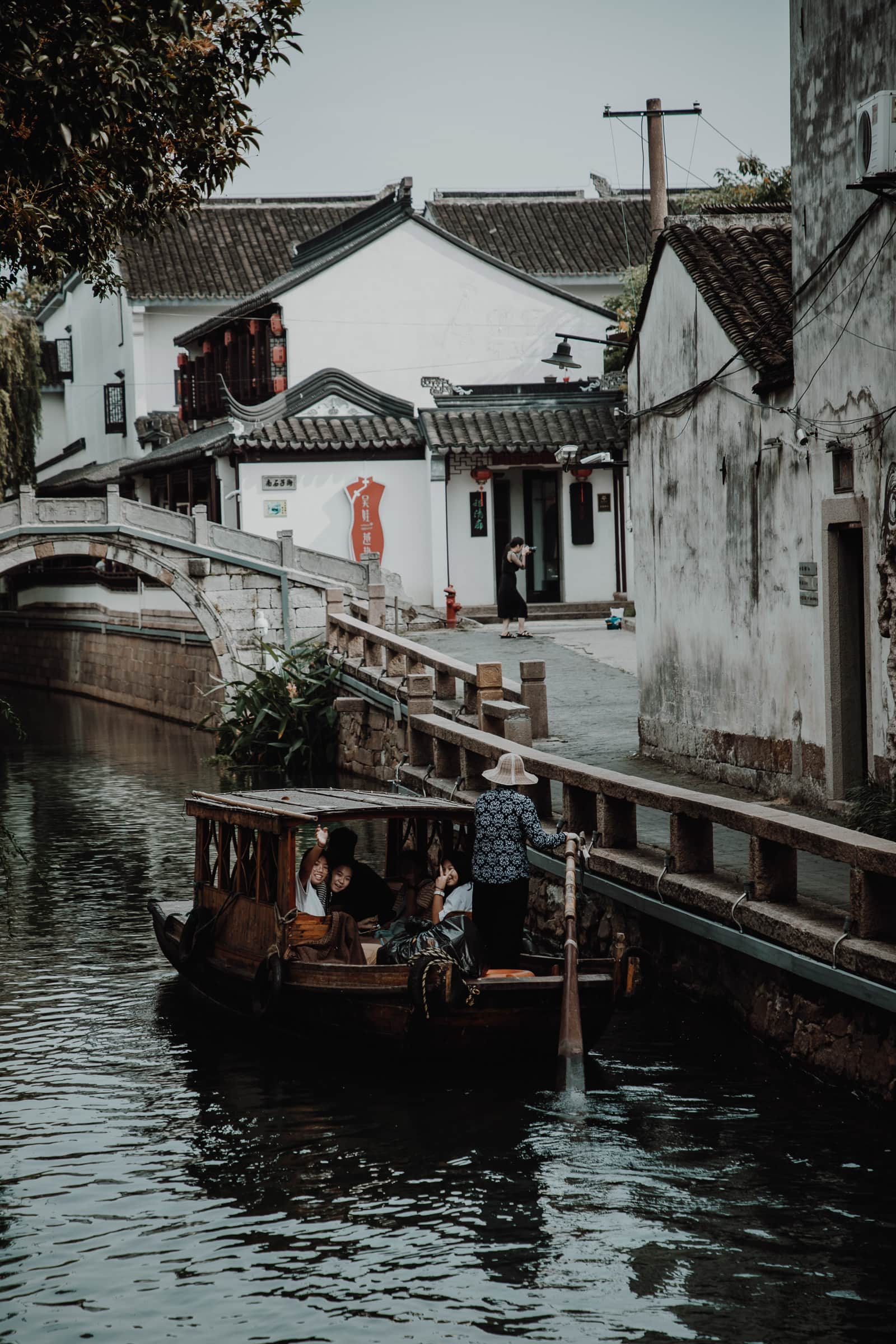
Suzhou: A boat trip through the romantic canals is a must.
Tip: In Suzhou you will find numerous large hotels of western chains with corresponding comfort. Unfortunately, these are often housed in uninspired high-rises or large complexes. For an authentic atmosphere, it’s best to look for accommodation near the old town, such as the Garden Hotel*.
“Venice of…” (as well as “Mecca of…” and “Paris of…”) – as an author or copywriter, you only ever write this when you really can’t think of any better comparisons. The main thing is a few boats, a few canals, and the analogy with Venice can be formed. As with the waterways in Suzhou in the Yangtze River Delta in eastern China near Shanghai.
All Venice, although nothing really compares to Venice, not even Suzhou. But anyone who has been there will wonder why Suzhou needs any comparison at all – because Suzhou is a true gold treasure.
By the way, Suzhou is easy to reach from Shanghai. And you don’t even need a visa for China. The trick: German citizens can enter China without a visa for stays of less than 72 hours in Shanghai and the surrounding area. And from Shanghai, you can reach Suzhou and the surrounding water towns worth seeing, such as Zhouzhuang and Tongli, in no time at all.
The nearby water town of Zhouzhuang is also well worth seeing. Read more in this article:
Suzhou and its gardens: The garden of the humble official
The garden of the humble official has a rather misleading name. Modesty is the last thing that comes to mind when you see what is probably the most famous garden in Suzhou. The garden is actually a huge park with secluded pavilions and thoughtfully landscaped lakes and trees.
One of the most popular gardens in Suzhou: the garden of the humble official.
According to Chinese horticulture, the main focus is not so much on flowers and colors, but on the harmonious interaction of the so-called “seven elements”: earth, sky, water, stones, buildings, living creatures and plants, although here rather trees and green plants are meant.
Otherwise, just a lot of green: lotus blossoms are among the few splashes of color in the garden of this modest official in Suzhou.
And it soon becomes clear how harmonious the garden of the modest civil servant is: although hopelessly overrun by tourists, an aura of peace and relaxation nevertheless shines over the garden. Very impressive. In many corners you can meet painters and draftsmen who give free rein to their creativity and are inspired by the atmosphere of the garden. I was briefly annoyed that I didn’t have my watercolor stuff with me – I would have loved to just sit next to it and paint along. But there was much more to see in Suzhou anyway, that time was short anyway.
Painters and draftsmen like to be inspired in the garden of the modest official.
How much history there is in Suzhou can also be seen here: For almost 900 years, a garden has existed on this site, which passed through many hands until a high-ranking official chose it as his retirement home in the 16th century and gave the garden its name. Today, the garden of the humble official is state-owned, a UNESCO World Heritage Site and one of the most beautiful gardens in China.
The garden of the humble official in Suzhou is also a real Instagram hotspot: Very instagrammable!
Shantang Street: Immersion in Ancient China
With temperatures around 35 degrees (yes, it can get very, very hot!) and what feels like 100 percent humidity, a boat trip is always a welcome change, especially in Suzhou with its picturesque canals. Clotheslines fluttering in the wind, children waving enthusiastically at the foreign tourists (as a Western visitor in Suzhou you are still something special) or sneak peeks into foreign kitchens: My eyes did not even know where to look first.
Suzhou’s canals can also be explored by boat.Some bridges are particularly ornate in the old city of Suzhou.Concentrated, our captain steers the boat through the canals of Suzhou.
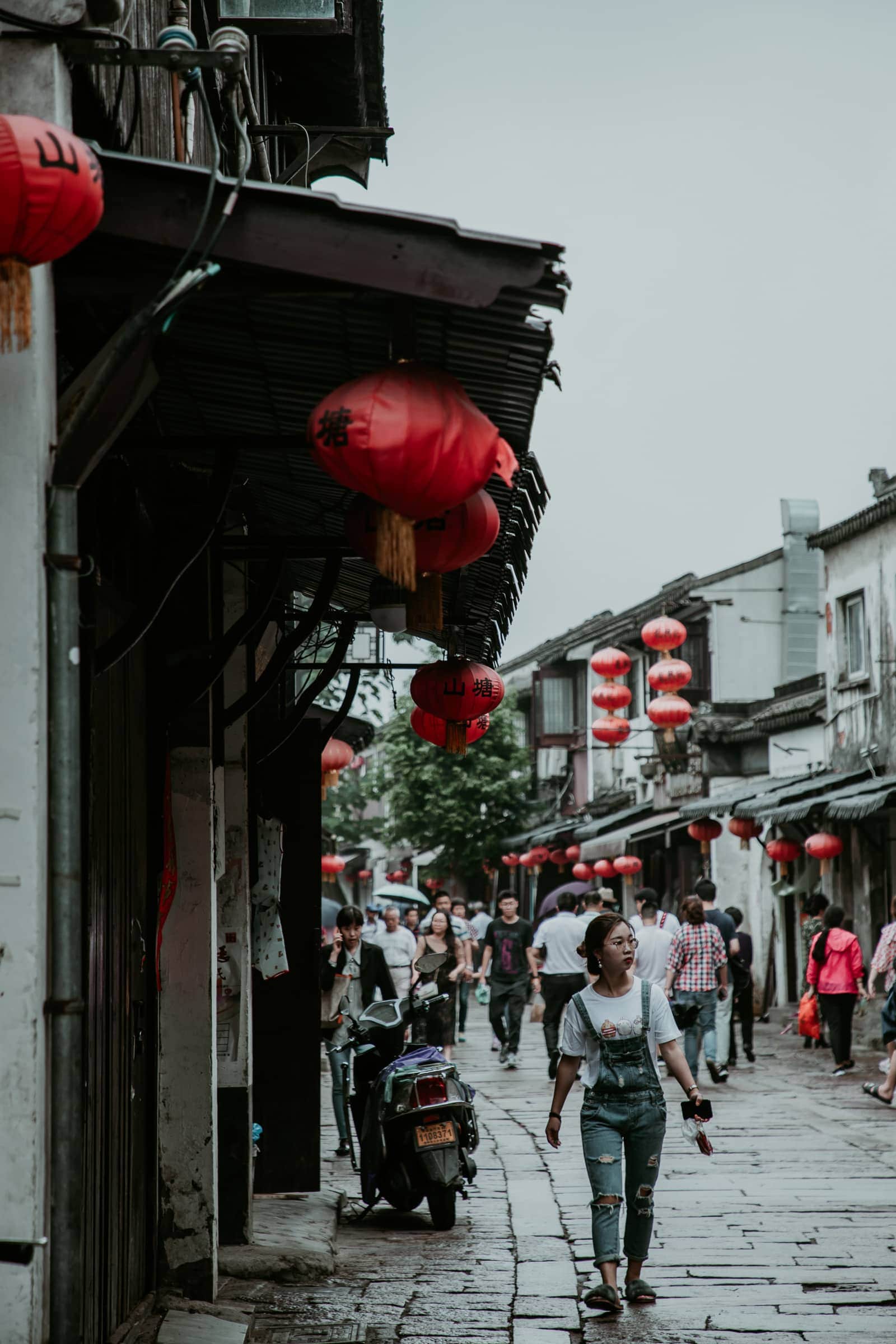
Even on foot, Shantang Street (Shāntáng Jiē) was the China I was looking for: red lanterns, small houses with old wooden beams – and relaxed, friendly faces everywhere. On 7 miles you can find everything at once: tourist stuff, culture, history, snack bars and cafes with all kinds of exotic delicacies and actually real street life. If you turn into the more deserted alleys, you will quickly find yourself in local hustle and bustle, without any touristy stuff. A real experience.
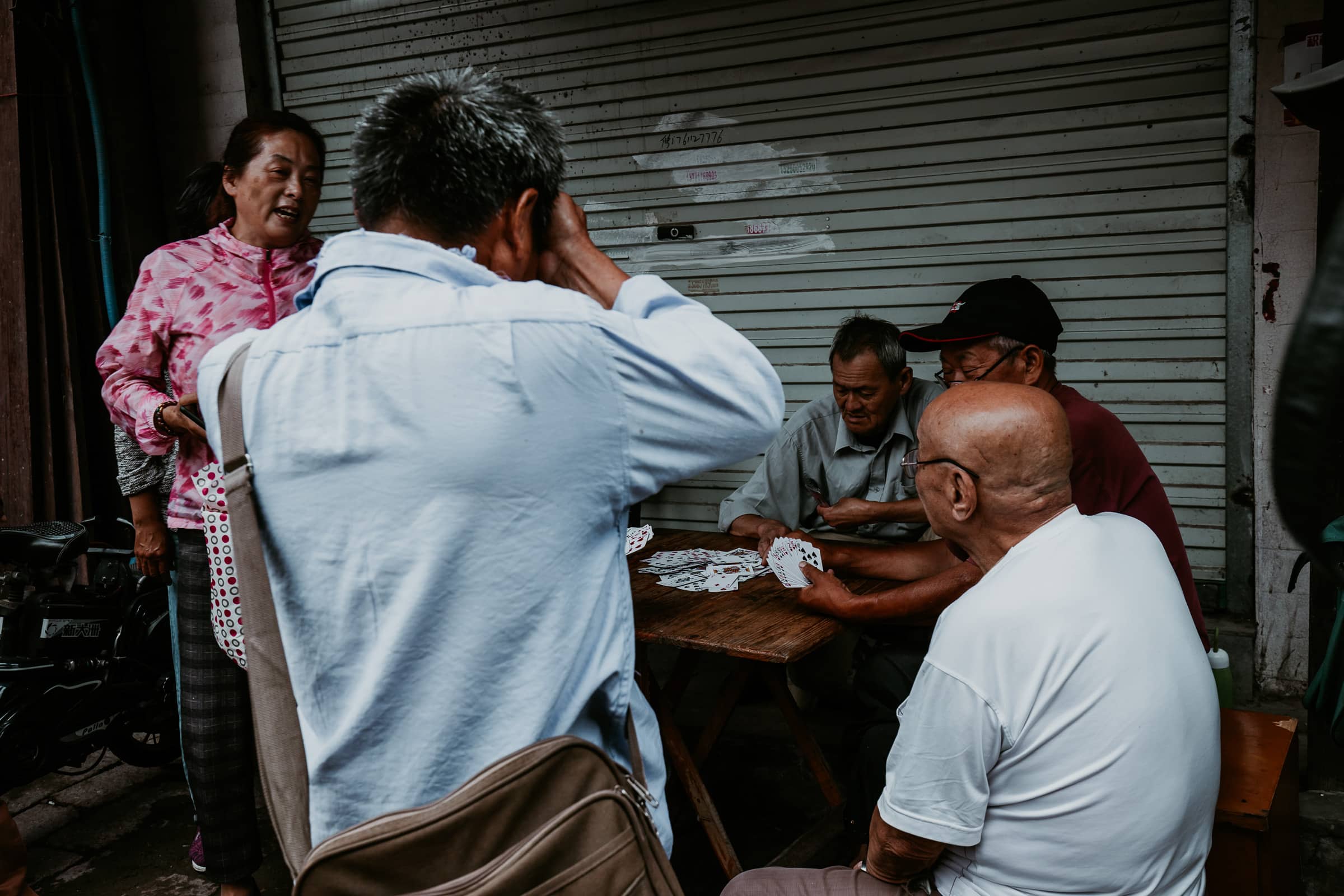
Shopping mile: Shantang Street in Suzhou.Colorful souvenirs in the tourist part of Shantang Street.In the middle of the street: Concentrated card game.
Street Food in Suzhou: No inhibitions, it’s worth trying!Fruit and vegetable vendors can also be found on Shantang Street.In the side streets of Shantang Street you can find authentic everyday life: a small cookshop is cooking breadcrumbs.
Pingjiang Road: tea houses, canal boats and nightlife
Even more authentic Chinese flair can be found on Pingjiang Road (Píngjiāng Lù), similar to Shantang Street a street with many stores and restaurants. Here it is even a little bit more cozy than on Shantang Street. The boats are smaller, the bridges even a little prettier.
Happy tourists on Pingjiang Road: a boat trip here is even more idyllic.
My highlight was the tea house, a small café by the canal, more wooden shack than house, where we listened to 80 year old(!) Mr. Wang playing original Pingtan music to us over a cup of tea. It could hardly get more Chinese! By the way, Pingjiang Road is also very busy in the evening and a nice nightlife spot in Suzhou.
Unusual creations: The many small cafés along Pingjiang Road serve the most curious drinks.
Suzhou Opera in the Garden of the Master of the Nets
In general, music, like all other arts, plays a major role in Suzhou. Somehow creativity and appreciation of art and culture are in the air here, so I wasn’t surprised to learn that Suzhou is considered a “very elegant” city in China. Found it apt – and I never thought before that I could find a place in China elegant. For me, China was big, crowded and rough at times – but this trip showed me once again how unfair prejudices can be. Suddenly China was small, picturesque and warm (oh, the people!).
I would even recommend an evening at the opera to anyone here, even if you are one of those people for whom operas are more likely to trigger flight impulses. Or where else do you watch an opera in one of the most beautiful gardens?
Colorfully illuminated at night: The garden of the Master of Nets in Suzhou.
In the garden of the Master of the Nets there is a performance of a Kunqu opera every evening. The opera consists of several parts: Comedy, song, music and dance. The special thing: Each part is performed in a different place within the garden, so you walk along the garden between each performance.
The performance in the garden of the Master of Nets consists of several parts: Drama, song, dance, music.
Real Chinese Silk: A Visit to the Silk Factory
Suzhou is famous for its silk – and the region has always formed one end of the Silk Road, from where the beautiful fabric found its way to the world. The silk factory, modestly named No.1, is therefore on the agenda of many tours of Suzhou. You should think about this carefully beforehand – because what many people don’t consider is that here you can observe the production process (at least part of it). That also means watching caterpillars crawl. And later it becomes even less something for the faint of heart, because the silk thread is obtained from the cocoon of silkworms. In order not to damage it, the cocoons including caterpillars are thrown into boiling water. Not for everybody.
Nicely draped in a basket: silkworms for silk production.From caterpillars to cocoons: the next phase of silk production at the silk factory in Suzhou.The cocoons later become silk.
Personally, I have an affinity for fabrics anyway (I actually used to have a fabric store in Berlin) and silk anyway (I always like to block out the boiled caterpillar part), so I found the visit interesting in itself. Unfortunately, the production process is shown only abbreviated (there is no weaving or dyeing here), and shortly after watching the spinning of the threads, you will find yourself standing in a huge sales hall with clothing made of silk for (almost) every taste. I didn’t like the clothes that much, but I was a bit sad afterwards not to have bought some fabric. So for all people who love to sew: In Suzhou, do not forget to buy silk!
On this machine the silk threads are spun.
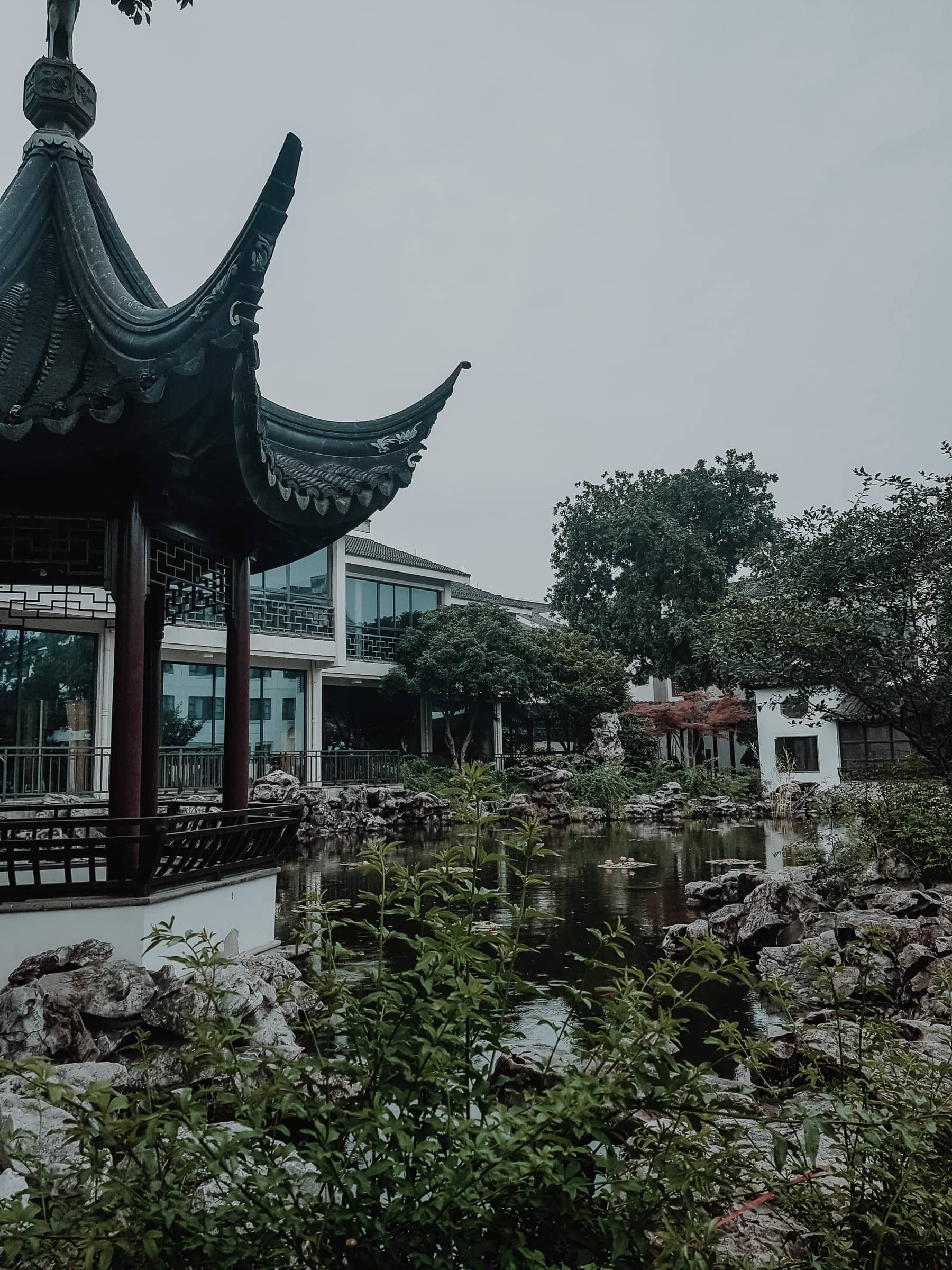
The Suzhou Museum
The Suzhou Museum is particularly striking because of its architecture – somehow angular and not at all traditional Chinese. It was designed by Chinese star architect Ieoh Ming Pei, who also planned the famous glass pyramid in the courtyard of the Louvre in Paris and the Museum of Islamic Art in Qatar – and he was born and raised in Suzhou.
Here you will find an overview of Suzhou’s long history in the form of works of art and artifacts, from calligraphy to porcelain to handicrafts. Worth seeing, but perhaps not necessarily interesting for everyone. But what is really fascinating is the way the mostly Chinese visitors interact with the exhibition: I have never seen so many young people in German museums who are so intensely interested in history and who press their noses against the display cases out of sheer thirst for knowledge.
Marvelled at: exhibits in the Suzhou Museum.
The modern part of Suzhou
Gate of the Orient & Jinji Lake
Outside the sprawling old city, Suzhou looks a bit more like how you’d imagine big Chinese cities to look. The city currently has over 10 million inhabitants and as well as Suzhou is developing, there is no end in sight. Large companies produce and conduct research here. The good transport links and proximity to Shanghai ensure that Suzhou is one of China’s up-and-coming cities. The spirit of optimism is also reflected in the bold architecture in the modern part: the landmark of the new Suzhou is the Gate of the Orient (Dongfang Zhimen) or Gate of the East, the second tallest skyscraper in Suzhou. Located on Lake Jinji, it is supposed to act as a gateway to the East – but locals affectionately nicknamed the building “the pants” due to its unusual shape.
Looks like a pair of pants: The Gate of the Orient in Suzhou.
Suzhou Supertower
The “pants” are topped by the Suzhou Supertower, 450 meters high – and that’s where it really starts to look futuristic. Every time we passed it, I could hardly believe that just a few kilometers away we were sailing on small wooden boats along romantic canals. The way the old and the futuristic are combined here is breathtaking.
Suzhou Industrial Park & Suzhou Culture and Arts Center
In the Suzhou Industrial Park there are further examples of modern Suzhou: The Suzhou Culture and Arts Centre is a gigantic cultural center with a (free) museum of modern art, various exhibition rooms, a musical theater and a small amusement park with a Ferris wheel, cafés and restaurants. In good weather, there is a fantastic view from here across Lake Jinji to the Suzhou skyline.
Shopping in Suzhou – shopping from silk to designer clothes
In Suzhou you can shop till you drop. I’ve long imposed a strict no-shopping policy on myself, which I usually stick to, because otherwise I’d be impoverished by now with all the traveling I do. My souvenirs are my photos – but in places like Suzhou, it’s pretty hard to contain yourself.
Popular souvenirs from Suzhou
Popular souvenirs from Suzhou are silk in all variations, green tea (Bi Leo Chun), fans in all shapes, and lots of handicrafts like embroidery and fruit core carvings. On Shantang Street and around Pingjiang Road there are also a lot of small stores selling pretty hip handicrafts – no more boring tourist stuff!
Tip for design lovers
I could have shopped myself to death in Chengpin Eslite, which is actually a huge bookshop. I have a thing for beautiful bookstores anyway, and this one is embedded in a state-of-the-art shopping center with countless small designer stores. I’m usually put off by shopping malls, but the Eslite reminded me a lot of trendy temples like Terminal 21 in Bangkok! Between the stores, there are always small snack bars and cafés, so you can sample all the delicacies of the region here if you don’t dare try street food.
Not only a huge bookstore, but also a shopping center with many innovative designer stores: Chengpin Eslite.
Food & Drink in Suzhou
Exotic dishes: What is one in Suzhou?
Food in general can be quite exotic in China. And it has nothing whatsoever to do with the Chinese restaurant from the German provinces. Vegetarians often have a hard time, somewhere there is meat in it or seasoned with fish sauce. Meat eaters like me have to deal with the most off-the-wall dishes like duck tongues or braised offal. Basically, Western tourists are already careful not to offer the most unusual dishes, but due to communication difficulties, you should be prepared for anything.
Jiangsu cuisine
However, Jiangsu cuisine (the name of the province in which Suzhou is located) is so sophisticated and varied that I often wished I could jump over my shadow even more and try dishes such as pork snouts or chicken feet – but unfortunately I’m really mean about it, as they say here in the Ruhrpott. After all, if you’re going to eat meat, it’s only logical to use every piece of it. Especially the cuisine in Suzhou is a true paradise for gourmets!
Vegetarian cuisine
Vegetarians don’t have to starve though, there are plenty of exotic ingredients to try like water asparagus, lotus roots or purple sweet potatoes. Not everything is spicy, but a lot is greasy and due to the foreign spices and the different climate, one or the other stomach needs some time to get used to the new cuisine. However, I have tried so many new and delicious things in the whole days that I can not even remember everything!
Dishes are always shared, which means if you sit in a big group, you can try a lot more!
Specialties of Suzhou cuisine
Mandarin fish
Sooner or later you will get it served in Suzhou, this specially prepared fish is THE dish in Suzhou. The fish is completely deboned, cleverly draped in the shape of a squirrel and then deep fried. Finally, a sweet and sour sauce is added on top, which took sweet and sour to another level for me!
Suzhou noodles
Noodle soup is noodle soup you could say. But the fresh noodles at Zhuhongxing in homemade broth with tender beef were so divine that I still think about them sometimes. Tip: Don’t spend too long marveling at the food and enjoying it, because the noodles soak up so much broth in the bowl that the mountain of noodles gets bigger and bigger instead of smaller. The professional slurps quickly! (Don’t be afraid of table manners: Hanging over the bowl and slurping loudly is not seen as closely in China as it is here).
Tangbao
Dumplings in all varieties can not be missing! The Tangbao are again a special variety, filled with broth in addition to the mostly meat content. This is slurped out beforehand with a straw, similar to the xiaolongbao that exists in neighboring Shanghai.
Street food in Suzhou
Always dare to try street food! Sometimes it can also be surprising, like the particle on the right, which I bought in a bakery. It looked delicious, so hairy breaded – but what I imagined was sweet ended up being a breading of finely ground pork. Wasn’t mine – but I still like to try strange things. The dumplings, however, were divine!
Accommodation in Suzhou
Our accommodation in Suzhou could not have been better. Centrally located, equipped with all the bells and whistles like a pool and tennis court, and with a breakfast buffet to die for, the Garden Hotel* was perfect. The hotel consists of several smaller guest houses and two main houses, nestled – it couldn’t be more fitting in the City of Gardens – in a beautiful, tranquil garden setting. If you want to treat yourself and stay in Suzhou in style: Absolutely recommended!
In the middle of a garden and yet central: The Garden Hotel in Suzhou.
Travel & Getting around Suzhou: How to plan your trip!
Location & Arrival
Suzhou is located only 80 kilometers from Shanghai, and is directly on the express train line that runs from Shanghai to Beijing. So if you are in Shanghai for a few days, Suzhou is definitely a good choice for a multi-day trip: by train you can be in Suzhou within 90 minutes.
Shanghai is very beautiful, but I personally find Suzhou much more appealing from a historical and cultural point of view – and always only mega big cities can also be very exhausting. By the way, train travel in China is a thousand times more organized than I thought. However, there may be communication problems here as well, since English is not widely spoken.
It takes 10 minutes to get down to the tracks, the tickets are personalized and the identity is checked at the access control: In China, everything is in order when riding a train.
Individual travel vs. group travel
We were traveling in a small tour group. Although I usually travel independently in Asia and plan everything myself, I was glad to have a tour guide with us who could explain many things and translate when necessary. Precisely because the region around Suzhou is not yet particularly familiar with Western tourists, not much English is spoken and most attractions do not provide information in English, meaning that you would otherwise miss out on a lot of interesting information.
Individual travel modules instead of a complete round trip
Complete China tours are often very expensive, and honestly, you can book a flight to Shanghai and spend a few days there on your own. For more “exotic” destinations like Suzhou, however, you can book individual modules with China Tours, which I can really only recommend.
We wore out three guides during our trip through several places around Shanghai, all of whom were highly professional, even spoke very good German (!) and had absolutely in-depth knowledge on every topic. Especially with such a complex destination as China with so much culture and history, about which I admittedly didn’t know very much beforehand, professional guidance was worth its weight in gold.
Getting around in Suzhou
If you prefer to travel independently, you can cover longer distances in Suzhou by taxi or take one of the tourist bus routes. There are rental bikes in many places. The subway network is being expanded.
Is Suzhou worth visiting?
I really liked Suzhou and often wondered why it is almost unknown among Western tourists. Especially when you visit Shanghai, a trip (sporty people can do it in one day) to Suzhou is a must. Shanghai is fascinating, but I always missed a little patina there. A detour to Suzhou is a great way to complement this. Also, the city is much more relaxed and everywhere you are warmly welcomed as an exotic tourist from the West, which showed me again a whole new side of China.
Disclaimer: I was invited on this trip by the Tourist Offices of Suzhou and Nanjing and China Tours.
Saigon Street Food – this has become a household name even back home in Berlin. So a street food tour in Saigon* or Ho Chi Minh City seemed pretty obvious! Vietnamese cuisine is so diverse, so fresh, so full of new flavors, and within Southeast Asia, it’s a flavor all its own. In Saigon in particular, the choice of street food stalls, small snack restaurants and roadside food stalls is almost endless.
Vietnamese are sociable and love food, people are constantly chewing on something somewhere, (unfortunately disposable) bowls filled with goodies change hands and you really wonder how the majority of the population here can still be so slim. Because Vietnamese cuisine is not always easy! In Vietnam, too, people fry for all they’re worth, and sugar is consumed just as excessively.
Street Food in Vietnam – a culinary adventure
One thing in advance: you might not want to try many dishes served in the streets of Saigon in general. Unless you’re really into experimenting. Vietnamese cuisine is often praised for its French influences and thus exciting combinations – and at the Vietnamese at home in Germany it is always delicious. But what is often overlooked: In Vietnam, people really do eat everything.
Advertising / *affiliate link
Vietnamese love meat, so much so that vegetarians sometimes have a hard time finding a vegetarian dish. Vegans even more so. And on the one hand very commendable, but for the European (or at least my) palate quite unusual, here really everything is eaten from beef, pork, chicken, fish, seafood, and even frog or snake: From fillet to the most bizarre offal.
At the really authentic stalls you don’t get far with English, there is no map even in Vietnamese. Often you don’t dare to try something – you never know… For this reason and because I still really wanted to try some (but not quite so) exotic street food in Saigon, I went on a street food tour in Saigon*– and it was great! Sam, who was traveling with me, showed me the wackiest corners of Saigon and let me sample fantastic food (with no unpleasant surprises).
What is the difference between summer rolls and spring rolls?
While in this country spring rolls are deep-fried rolls and called summer rolls rolled in soft, light rice paper, for Vietnamese everything is simply spring rolls! Summer rolls seem probably rather an invention of the West. So we started off with one of the freshest spring summer rolls to roll yourself that I have ever eaten. Fresh herbs and lettuce that it just cracked.
Bánh Tráng Nướng: Vietnamese pizza
Vietnamese have invented their very own version of pizza. It doesn’t really have anything to do with an Italian pizza except for the shape, but it’s still a popular snack. Rice paper, a cream that is supposed to represent cheese, various sauces and mayonnaises, sliced sausages – somehow all sorts of things end up on the Bánh Tráng Nướng Pizza. Which amazingly then even tastes! In addition, there was then Nem nướng, grilled sausages – garnished with the obligatory fresh herbs, which must not be missing anywhere.
Trứng Cút Nướng Phô Mai: Grilled quail eggs with cheese
Why quail eggs are so popular in Vietnam is for a very simple reason, Sam revealed to me. A whole hen’s egg would be far too much as a portion for a small cupcake like the ones in the mini bowls – and would be too filling. Slowly, I discovered the secret of the Vietnamese diet, which seemed to eat all the time: Always small portions instead of huge dishes.
In the pale glow of streetlights, we were now sitting somewhere in the middle of Saigon on the side of the road on our kindergarten stools, like those used in abundance at street food stalls in Vietnam, eating our quail egg muffins called Trứng Cút Nướng Phô Mai and Bánh Xèo, stuffed pancakes. And here again lots of fresh herbs, which Sam explained to me individually (and whose names I also immediately forgot again, because I was only busy with amazement).
Chè Bưởi: Dessert in Vietnamese
I have no idea what Sam was handing me – it was called Chè Bưởi and she translated it as “sweet grapefruit soup.” Somehow it was sweet, creamy, fruity and fresh at the same time; just the right thing at night 30 degrees air temperature.
Book Street Food Tour in Saigon
Street food tours like this take you to very remote corners of the city that I probably never would have gotten to see without Sam. They are usually advertised as “Students show you street food in Saigon” and in fact Sam was a student who knows a lot about street food mainly because she only lives in a small room and actually eats out all the time – just like many students in Ho Chi Minh City.
The spots are spread all over the city and you are driven from spot to spot on a scooter. Helmets are provided. A great opportunity to experience the crazy traffic in Ho Chi Minh City first hand! In addition, the tours are very individual and personal, because there is a guide or driver for every guest.
Are you planning a stopover in Ho Chi Minh City or Saigon during your trip to Vietnam? You’ve come to the right place: in this article, I’ll reveal my best Saigon tips and which Saigon sights you shouldn’t miss! Whether it’s the best street food, the coolest restaurants or the best accommodation: In this guide to Ho Chi Minh City (official name of Saigon!) you will find what you are looking for.
How to enjoy your stay in Saigon
Saigon may be the largest city in Vietnam, but it’s nowhere near as overwhelming as Bangkok or Hong Kong. The only thing that really takes some getting used to (and this applies to the whole of Vietnam in general) is the traffic with trillions of scooters, of which every Vietnamese seems to own at least one. Honking is a way of making yourself noticed in traffic, but you don’t flash your lights – so the traffic in a city like Saigon is simply a huge, loud wave of honking scooters.
Mototaxis, scooters that you simply hop on, are also popular. Grab, a cab service similar to Uber where you can choose between a scooter or a normal cab, is also popular. However, when it was 40 degrees I usually took the car – and enjoyed the air conditioning. In general, Grab is an ideal way to get from sight to sight, it is cheap and much easier than traveling by public transport.
Why Saigon should be on your bucket list for your trip to Vietnam
It has now been four years since I was last in Vietnam. I left the country feeling very ambivalent at the time – somehow I didn’t get the full enthusiasm. I had previously only known Thailand in Southeast Asia, a country that makes it very easy for Western tourists to feel at home straight away. I had a slightly different experience in Vietnam. But more on that later. As I had visited the most important places in northern Vietnam such as Halong Bay, Hanoi, Hoi An, Hue and Da Nang last time and didn’t have time for the south, this time I wanted to get to know Saigon, the Mekong Delta and a few other places and try Vietnam again.
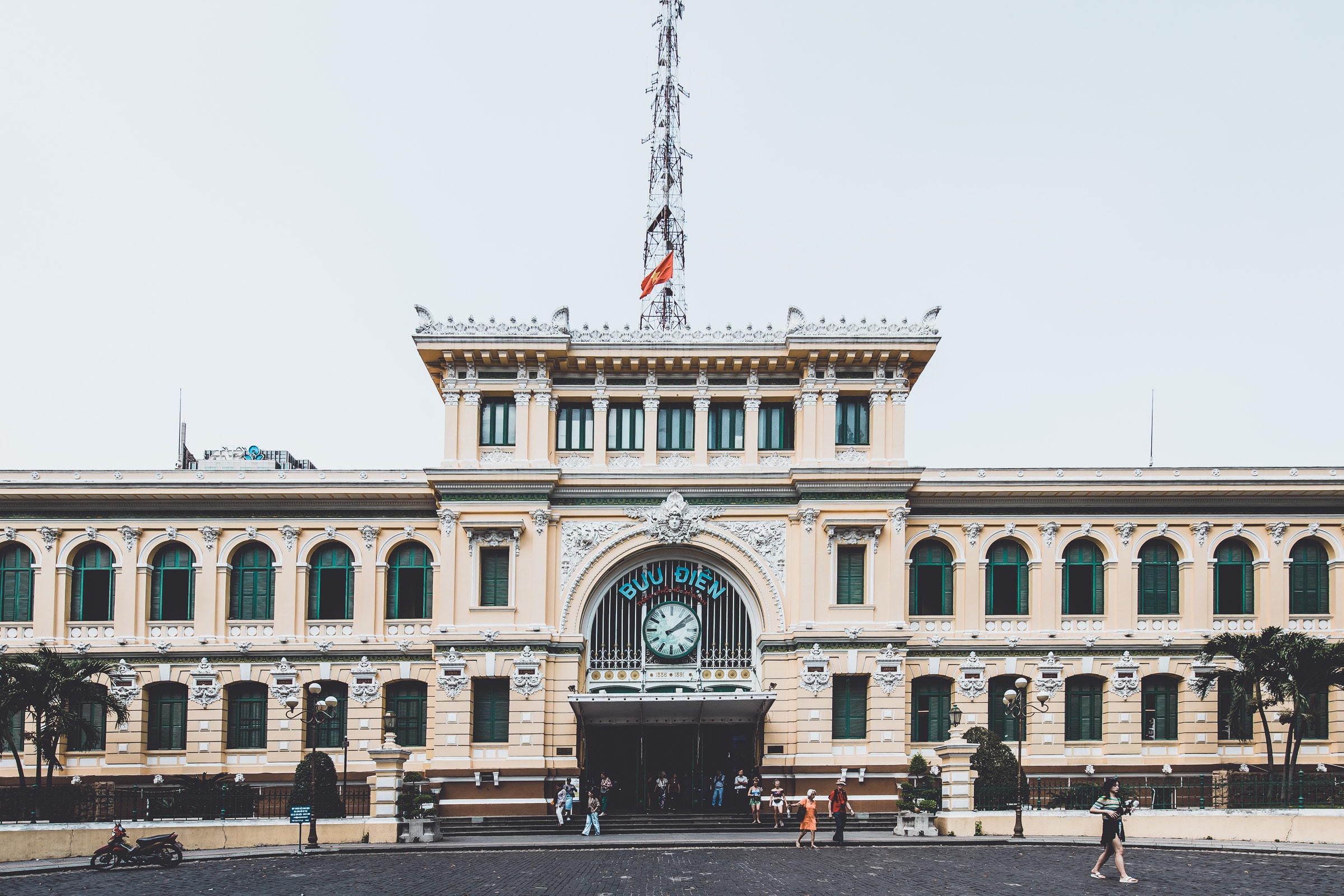
Saigon has few really spectacular sights, but many places are still interesting. The main post office, for example, was built during the French colonial era, and the steel structure inside was designed by Gustave Eiffel. A portrait of Ho Chi Minh hangs large at the head of the main hall. Quirky: Souvenir shops are located in the side wings and in the center of the hall, and the entire post office is filled with groups of tourists, while business as usual continues at the post office counters all around—with people buying stamps and picking up packages.
The main post office in Saigon dates back to the French colonial era.Regular operations in Saigon’s main post office under the oversized portrait of revolutionary leader Ho Chi Minh.French traces can be found everywhere in Saigon.
The great architectural influence of the French can also be seen in another of Saigon’s sights, Notre-Dame Cathedral (yes, there’s one here too!), just opposite the main post office. It is currently being renovated.
The Notre Dame Cathedral is also a relic from the French colonial era in Saigon.
2. Ho Chi Minh City People’s Committee and Saigon Opera House
Two other landmarks from the French colonial era are the Ho Chi Minh City People’s Committee—Saigon City Hall—and the Saigon Opera House. While City Hall is not open to the public, the Opera House can be visited during performances: the acrobatic show with South Vietnamese influences is said to be well worth seeing!
Could also be in California: Saigon City Hall.…except for the huge Ho Chi Minh statue in front of it, of course.Sometimes even with a red carpet: the Saigon Opera House.
3. Viewing platforms on the Bitexco Financial Tower Landmark 81
The Bitexco Financial Tower is Saigon’s second tallest skyscraper after the brand new Landmark 81 just outside the city. The large, protruding platform at the top of the tower is striking. However, this is not the viewing platform, but a helipad. It doesn’t seem to be used much – and it looks more like a prestige object. The Skydeck slightly below on the 49th floor is the publicly accessible viewing platform, where you can enjoy a view over Saigon for the equivalent of around 8 euros. Further up there is a restaurant/bar, which is free of charge, but understandably you have to consume something here.
The architectural contrast could hardly be greater. You can see the Bitexco Tower directly from an old backyard.
Landmark 81 also has an observation deck. However, I skipped the views from both locations because I was running out of time—and I’d already had a fantastic view of the city from the plane. The view of Saigon from the opposite bank is also spectacular!
The Saigon skyline at night: a bit like Shanghai.
Tip: In the evening, this is where the locals hang out. There are the usual street food stalls and makeshift cocktail bars, and it’s the perfect way to wind down the day here on one of the folding chairs with the best view of the Saigon skyline! And best of all: no tourist crowds!
4. Ben Thanh Market
I always love checking out markets in unfamiliar cities—getting lost in the hustle and bustle and discovering exotic things, especially in faraway countries; that’s right up my alley. The Ben Thanh Market is right in the heart of the city—a large, covered market hall with fruit, vegetables, clothes, souvenirs, and street food stalls. However, it’s also a huge tourist magnet; if you prefer a more local experience, you should check out a market like Tan Dinh Market or An Dong Market.
The Ben Thanh market has everything: food, handbags, tailor-made suits, false eyelashes in economy packs.Tailor-made suits in one day: no problem in Vietnam.
Right next to Ben Thanh Market, there’s also a well-known pho restaurant called Pho 2000. Pho is one of Vietnam’s national dishes—you absolutely have to try it! Pho is a noodle soup to which fresh herbs, chili, and lime juice are added at the table. It’s traditionally served with chicken or beef, and often with tofu as a vegetarian option. Pho 2000, a simple restaurant, became famous above all after Bill Clinton slurped down a bowl of pho here in 2000 during a state visit.
Pho 2000: Bill Clinton was here.Vietnamese pho: noodle soup with lots of fresh herbs. A specialty!
5. Reunification palace
Before the Vietnam War, the Reunification Palace was the seat of the South Vietnamese president. The Vietnam War came to an end with the fall of Saigon on April 30, 1975, at the hands of the Vietnam People’s Army and its tanks, which rolled over the fences here. Today, the grounds and some of the rooms are open to the public.
The end of the war is celebrated in a big way every year. There are posters everywhere in the city, as if from another era.
Ad / *affiliate links
6. War Remnants Museum
The War Museum was probably my biggest disappointment in Saigon. Many tourists I had spoken with beforehand were absolutely thrilled by the War Museum, which is considered one of the largest and best of its kind in Asia. I really took a thorough look at everything from top to bottom (the museum spans three floors), hoping to learn a little more about the historical context and background of the Vietnam War.
I found the possibility that the depictions might be biased quite intriguing, and in a way, I had actually expected it. Even though I’d heard many times that the exhibition was supposed to be completely neutral. In my experience, however, it’s anything but neutral! On top of that, the exhibition is very poorly designed from a technical standpoint. I was particularly interested in the photo exhibition featuring famous war photographers—but the images, which are actually quite impressive, are so poorly lit that you’re better off picking up a good photo book.
As expected, the exhibition is anti-American and completely omits the background of the opposing side. To a certain extent, this is understandable. But to pretend to be neutral in this context is very risky. Historical context is also only touched upon briefly, so that when I left the museum, I didn’t feel any wiser about the history of Vietnam.
I also found the matter-of-fact display of American military equipment—such as machine guns, bazookas, and bombs—at every turn to be very bellicose and unsettling. It’s part of the theme, but the way it was presented and the sheer volume of it were somehow too much.
My personal low point, however, was two other things: First, the gift shop, which sells completely out-of-place souvenirs ranging from card games to American Hollywood movie posters to a biography of Michelle Obama (even though everything else here is anti-American) —and second, the fact that visitors were beaming with joy as they had their pictures taken with the tanks in front of the museum. When I saw the two girls—obviously tourists from the West—having a friend film them as they performed a cheerful cheerleading dance routine among tanks and military helicopters, my jaw finally dropped.
7. Ho Thy Ky Flower Market
Vietnamese people love flowers. Flowers are often used as decorations at the numerous festivals held throughout the year or as religious offerings. At the Ho Thy Ky Flower Market, you can immerse yourself in a sea of flowers while sampling delicious street food. Most of the flowers here come from the mountainous region further north around Dalat or from the Mekong Delta. By the way, I tried in vain to figure out exactly what’s added to the flower water to keep them so incredibly fresh. Especially with air temperatures just shy of 40 degrees… I guess the chemicals are at work here. By the way, I read that you should stay away from apples in Vietnam because they’re sprayed with such incredibly strong pesticides there—so be careful.
8. Tan Dinh Church / Pink Church
What makes this church special—as the name suggests—is its color. Painted pink from top to bottom, even on the inside, this church is a sacred spot for all Asian Instagrammers. At least, that’s how it seems when you see the hordes of young girls posing in front of the church, all searching for the best photo spot. (Try searching for #pinkchurch on Instagram!) I would have liked to see the inside of the church, too—but unfortunately, a service was in progress.
The pink church in Saigon: quite beautiful.Selfie alert in front of the pink church in Saigon.
9. Sri Mariamman Temple
The Hindu community in Vietnam isn’t particularly large, so the Sri Mariamman Temple near Ben Thanh Market isn’t all that spectacular either. But if you’re in the area anyway, it’s worth a visit. Note: Take off your shoes!
10. Pham Ngu Lao – Backpacker Street with night market
Once darkness falls, the nightlife here really comes alive. Thumping bass, street food vendors with their little carts, local girls, Western tourists—from backpackers to those on Neckermann tours—and locals too— Pham Ngu Lao is a must-see.
During the Vietnam War, bars and lodging options—ranging from expensive to inexpensive—sprang up along this street. Here, American troops could stock up on everything they needed. In some ways, the Western influence has lingered to this day, and you can still find numerous bars and lodging options around Pham Ngu Lao.
Party every day: Pham Ngu Lao is quite reminiscent of Khao San Road in Bangkok.
Excursions from Saigon: What else can you see?
There are a number of excursions you can take from Saigon. A visit to the Cu Chi Tunnels is a popular choice. During the Vietnam War, the Viet Cong expanded the tunnel system—which had already existed since the colonial era—to create a complete infrastructure that included living quarters, hospitals, and schools.
What makes the connecting tunnels particularly remarkable is their size: 80 centimeters high and 60 centimeters wide. One section of the tunnel has been preserved to this day (and has even been slightly enlarged to accommodate the towering tourists from abroad) and is open to visitors.
Another popular excursion is a day trip to the Mekong Delta to visit the floating markets on the Mekong River. However, a day trip is really quite rushed, and there’s a high chance you’ll end up on a mass-market tour that feels like a sales pitch. I think it’s advisable to book a trip for several days.
Aside from the typical sights you’ll find in any Saigon travel guide, I discovered plenty more exciting things in Saigon! I found the many truly great and unique cafés and restaurants particularly interesting—they even impressed me, a Berliner who’s quite spoiled in this regard. And the delicious street food—which I probably would never have discovered without a fantastic street food tour.
But the best thing of all was the great locals, who immediately made me forget my bad experience last time and gave me lots of great tips. I often think that you should definitely visit a country a second time, even if the first time wasn’t particularly nice. Sometimes a country only reveals itself to you on a second visit.
There are countless cafés in Saigon – each one more beautiful than the next.
Practical tips for Saigon – information for your trip
From the airport to the city
When you arrive at the airport by plane, you can take either a regular taxi, Grab, or the public airport bus into the city. The airport is only 7 kilometers from downtown, so a taxi won’t be too expensive. I used Grab the whole time, since I’d read quite a bit about rigged taximeters and fake taxis. I preferred Grab because, like with Uber, the price is fixed from the start. From the city to the airport, I once paid about 90,000 dong, which is about €4.50. The only cheaper option is the airport bus, which goes via Ben Thanh Market to the bus station near Pham Ngu Lao: 20,000 dong, just under 1 euro.
Continue by bus
If you want to continue your journey by bus from Saigon, any hotel or travel agency can usually help you. The intercity buses operated by FUTA Travel—which are usually orange—are popular and reliable. They have offices throughout the city, including near Pham Ngu Lao. There, you can buy a ticket and will be taken by minibus to the bus station, which is located outside the city center. Fares are very affordable, and the comfort is decent—the sleeper buses, with their semi-reclining seats on two (!) decks, were perfectly adequate for me at 1.60 m tall. Full-grown European men might find it a bit more cramped.
Moving around the city
Within Saigon, I highly recommend Grab! Although there’s good Wi-Fi everywhere and you can use the app, I’d highly recommend buying a local SIM card, which you can pick up right at the airport. Or you can buy an eSIM in advance; I like to use eSIMs from Saily or Holafly.
Advertising / *affiliate link
Safety in Saigon: Is it dangerous?
I’ve been warned several times by locals about pickpocketing and cell phone theft. Apparently, pickpockets riding by on scooters often snatch cell phones right out of people’s hands. The same thing seems to happen with handbags or backpacks that are carried over just one shoulder. If you carry them on both shoulders, you’re probably safe. However, as a solo traveler, I’ve always felt relatively safe, even at night. That’s also one of the reasons why I always buy a local SIM card and keep my cell phone handy—if I start to feel uncomfortable, a Grab taxi will be there in a few minutes.
Best time to travel to Saigon: When is the best time to travel to South Vietnam?
Basically, the seasons in Vietnam are divided into a dry season (November through April) and a rainy season (May through October). For Europeans, this coincides with the European winter. Just before the rainy season begins, it gets really hot and humid again. From my own experience, I can say: This is only for the truly hardy! You’ll have to scale back on hardcore sightseeing itineraries—otherwise, frequent breaks are a must.
Accommodation in Saigon
Most tourist hotels are located around Pham Ngu Lao (which has many backpacker accommodations) or right in the city center. However, it can get very noisy around Pham Ngu Lao, so if you’re hoping for a peaceful night’s sleep, you might be better off choosing a different place to stay.
I chose a place to stay a little outside the hustle and bustle, but still very centrally located. The Common Room Project* is more of a housing project than a hotel—the staff are really nice, and all in all, it has a very warm and welcoming atmosphere. They offer both dorms and private rooms.
Once, when I came back very late, the receptionist jumped up from his chair, looking both relieved and excited—he had been worried about me because he hadn’t seen me the whole time. I’ve never experienced anything like that before.
The roof terrace is also legendary and is a popular venue for movie nights. And what made me even happier as a Brazilian: the caipirinha bar probably makes the best caipirinhas in Vietnam!
Do you say Saigon or Ho Chi Minh City?
The first question I asked myself was: Do I say Ho Chi Minh City or Saigon? After all, I don’t want to put my foot in my mouth. The last time I was in Vietnam, I noticed that political topics are often avoided (at least with tourists). Vietnam is a communist country, but as in China, the boundaries to capitalism are very blurred on the surface and with a Starbucks or H&M in front of your nose, you are quite confused as to what is supposed to be communist here.
After the end of the Vietnam War and the communist Viet Cong’s takeover of South Vietnam, Saigon lost its name—which dated back to the French colonial era—and was renamed in 1976 after the (communist) revolutionary leader Ho Chi Minh, who had already passed away by that time. So a tremendous piece of history is associated with that name.
I then asked around cautiously several times, but the locals still always say “Saigon”—“Ho Chi Minh City” is only used on official occasions. (Incidentally, Vietnam’s political history is very complex. I’m doing my best to present the facts here truthfully and accurately. After all, even a travel blogger who only visits places superficially should be mindful of historical context. But if anyone knows more about this or wants to point out corrections—please feel free to leave a comment. I’d really appreciate it.)
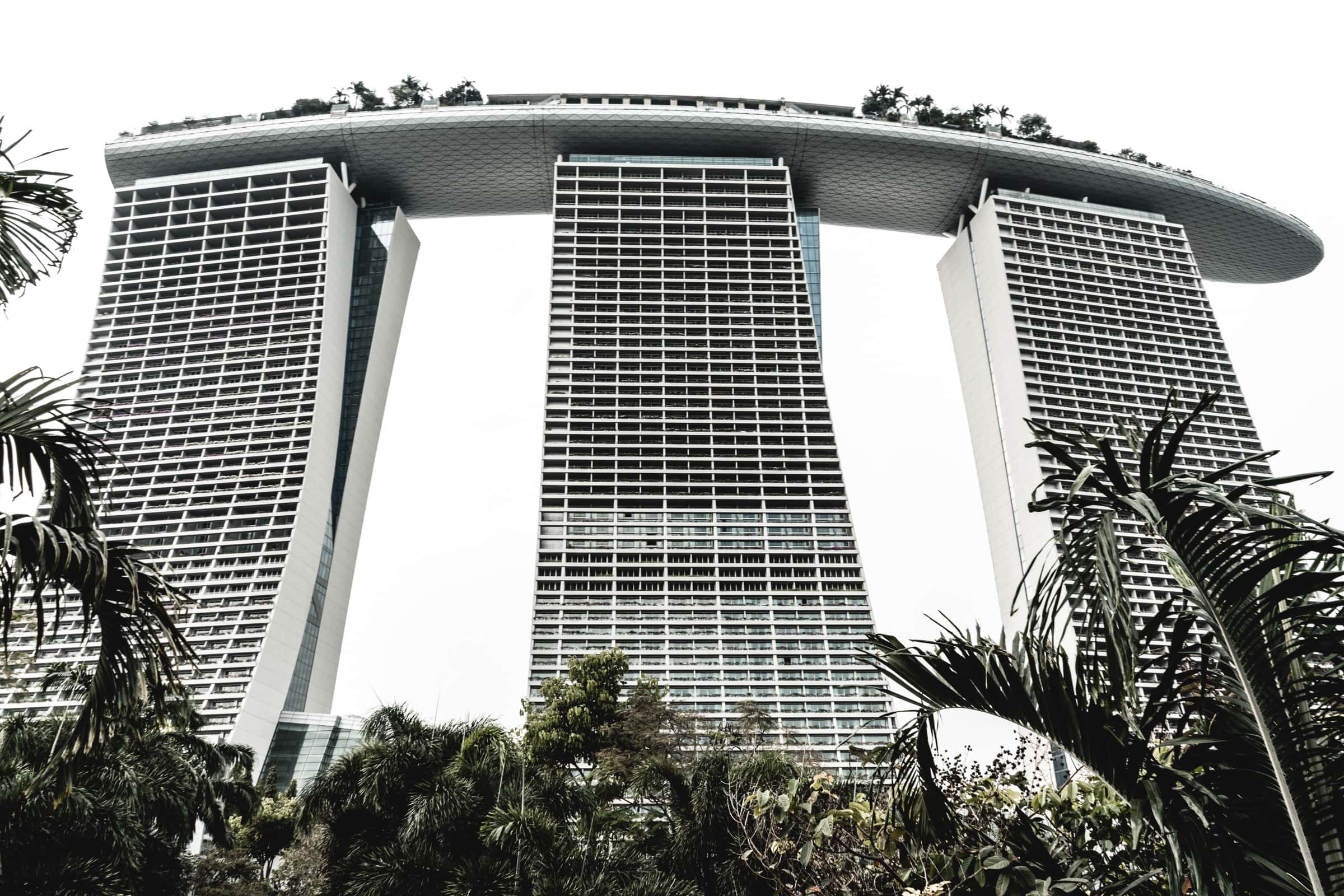
Singapore doesn’t always have to be expensive: The gardens surrounding Marina Bay Sands, Singapore’s famous hotel, are free! You can easily spend a few hours here at Gardens by the Bay and unwind from the stress of city life.
The gardens of Singapore
During the day, you can go into the adjacent greenhouses and marvel at the beautiful plants. At night, the famous trees in the Gardens by the Bay are illuminated. When the planted supertrees are really put in the limelight with the Gardens by the Bay light show, the gardens in Singapore are truly impressive. The lightshow is really a unique experience! No wonder many people just look for a quiet place and stare fascinated at the luminous sky.
Marina Bay Sands: The most famous infinity pool in the world
Next door, you will immediately notice this familiar futuristic building. Who doesn’t know the now world-famous postcard view from the infinity pool of the Marina Bay Sands in Singapore?
Opened in 2010, the Marina Bay Sands and the area around it have quickly become Singapore’s new attraction. There was nothing here before. Now a complete recreational resort has been built on the empty lot.
The hotel itself is not only a hotel, but also a shopping center and casino. The luxury shopping center houses brands from Dior to Louis Vuitton to Dolce&Gabbana.
I’m sure before the Marina Bay Sands, no one really knew what the term “infinity pool” meant. Until the first pictures of the pool on the roof of the ship-shaped Marina Bay Sands Hotel in Singapore appeared. After every self-respecting Instagrammer was hanging around the edge of the world’s highest pool, the term “infinity pool” became a household word. By the way, you can only get access as a hotel guest. Smuggling in is pointless. With luck, the cheapest room starts at about 350 euros a night. So that’s already a higher investment. It’s worth checking, the prices vary greatly.
If you don’t want to spend that, you can visit the viewing platform next door, which is open to the public for an entrance fee, and enjoy the view of Singapore without the pool.
Gardens by the Bay: the glowing trees of Singapore
Equally impressive are the Supertrees at night, when the light show kicks in. The show is well attended, but the area is relatively spacious and you don’t step on each other’s feet. Many simply lie down on blankets, jackets or just nothing on the bare floor and watch the lightshow so quite chilled – I’ve also done the same: you just can not get out of the amazement!
When is the light show at Gardens by the Bay?
The show is held twice a day: 19.45h and 20.45h. The OCBC Skyway that connects the various Supertrees at altitude can also be accessed during the light show.
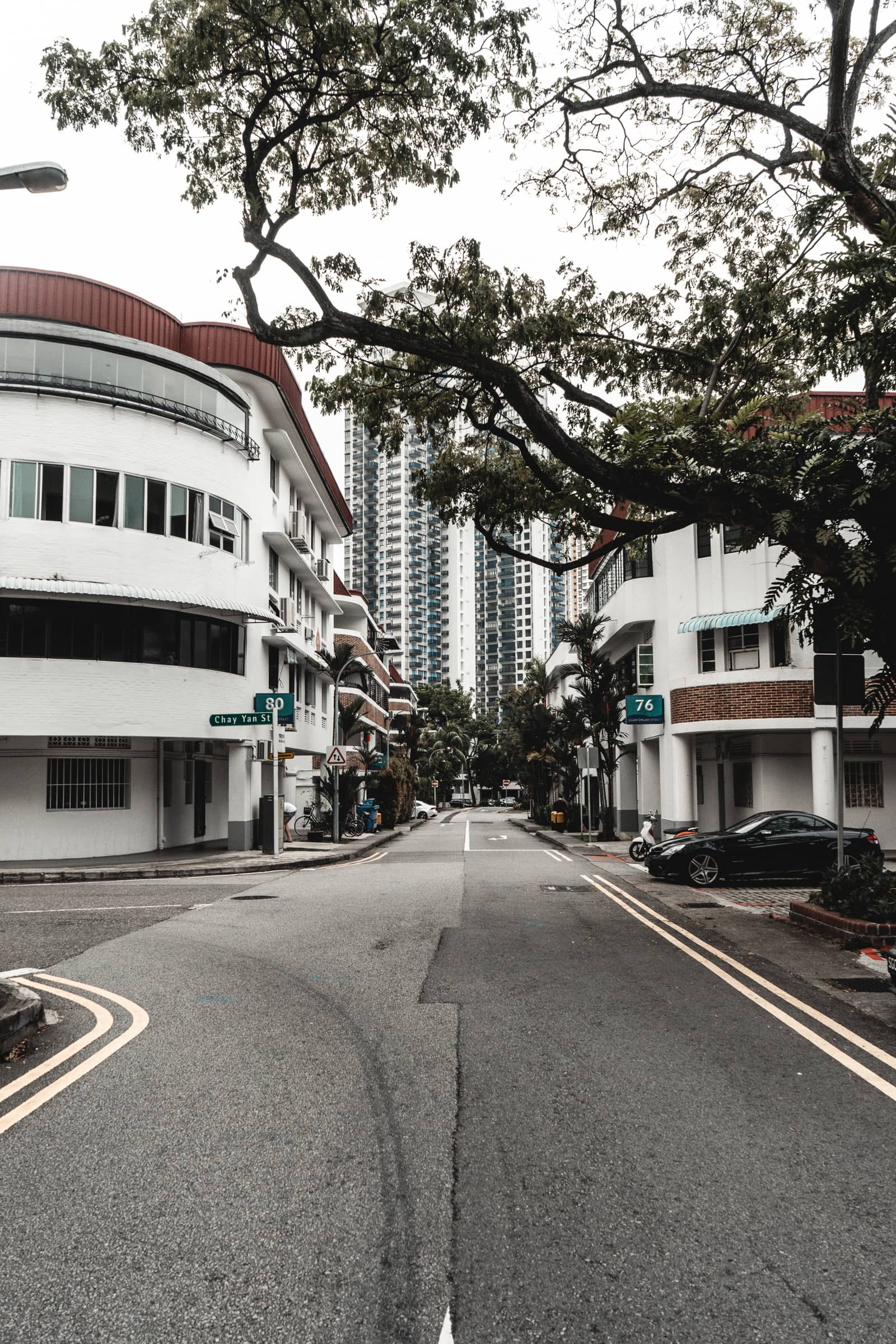
If you want to get to know a different side of Singapore, then I can highly recommend a walk through Tiong Bahru. I had already chosen accommodation in Tiong Bahru in advance for part of my trip to Singapore and didn’t regret spending two days a little off the beaten track.
Tiong Bahru in Singapore: a district for insiders
Singapore is a melting pot of diverse cultures. A bit like Hong Kong, only Singapore seemed to me even more diverse, even more crowded in the smallest space. Indians, Chinese, Malays, British, every culture has left something here and created this multicultural place that I still find difficult to categorize. The few days I spent in Singapore were probably not enough, I didn’t just visit the usual sights such as Chinatown and Marina Bay with its Gardens by the Bay, but also more unusual corners such as Tiong Bahru.
Tiong Bahru: residential district in Singapore with history
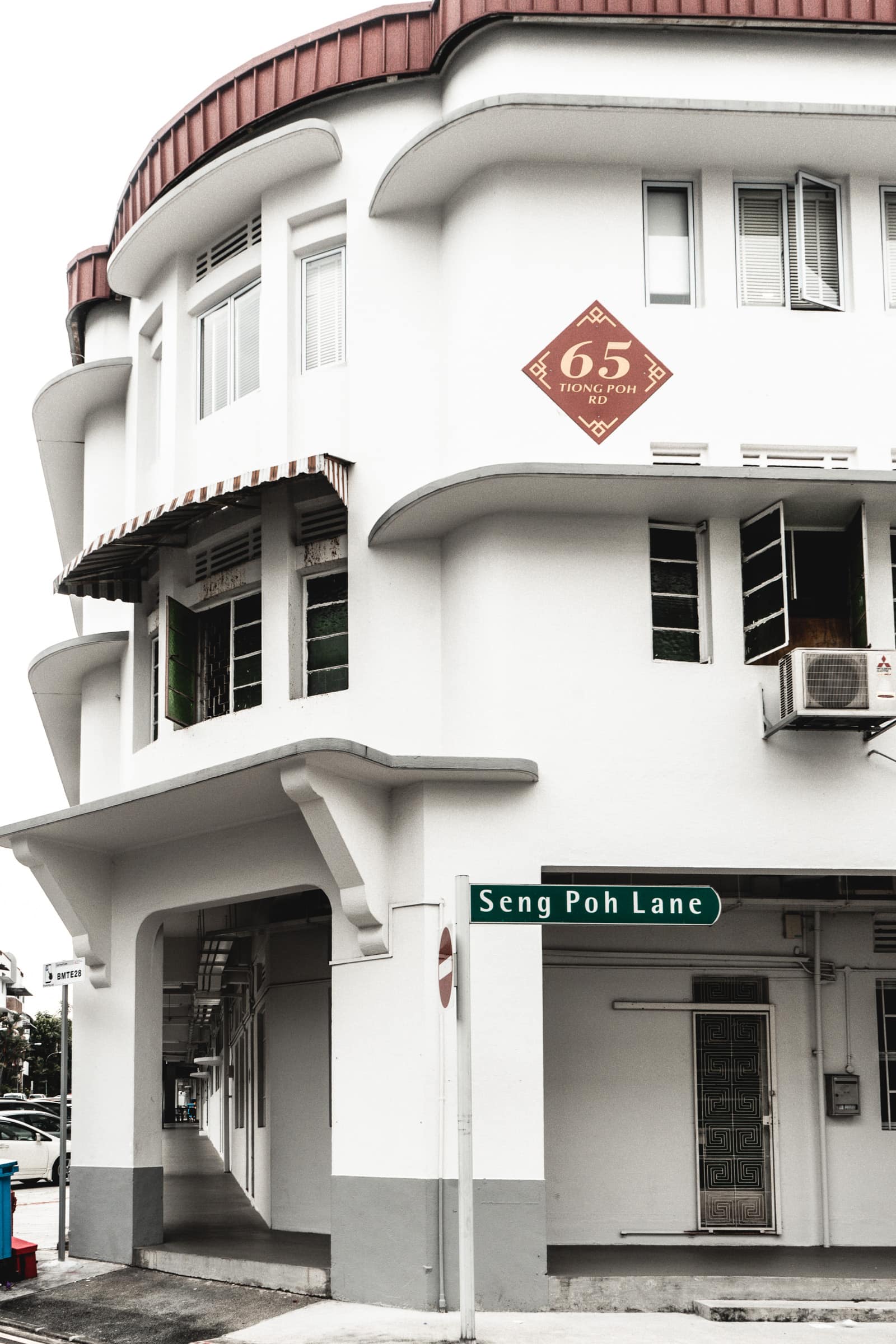
Strictly speaking, there are no real sights in Tiong Bahru, it’s just too residential for that. But a very special one. Tiong Bahru ist das erste soziale Wohnungsbauprojekt in Singapur und wurde schon in den 1930er Jahren erbaut. Da in Singapur wegen des Platzmangels oft Gebäude abgerissen werden, um neuen, besseren und höheren Wolkenkratzern zu weichen, ist Tiong Bahru heute das älteste Wohnviertel der Stadt.
Formerly a cemetery, then a purely residential area and now one of the trendiest districts in Singapore. Incidentally, social housing has a long tradition in Singapore. I was very surprised, because when you think of Singapore, you usually only think of big banks in tall skyscrapers and spectacular architecture such as the Marina Bay Sands Hotel in the Gardens by the Bay.
Without social housing, many Singaporeans would not be able to afford a home: Singapore has been very far-sighted in the past. The entire Tiong Bahru district with its residential buildings is now a listed building. And rightly so, because the Art Deco-style houses are truly special: rounded shapes characterize the design of the buildings and are reminiscent of Bauhaus or Miami South Beach.
The Tiong Bahru Heritage Trail also leads through Tiong Bahru and tells a little about the history of this special district with information boards. Here you will also pass the Tiong Bahru Air Raid Shelter , the last remaining bunker in Singapore from the Second World War. However, you can only get inside on a guided tour.
The new hipster district in Singapore
In recent years, hipsters have conquered the previously sleepy Tiong Bahru and breathed new life into the district. In any case, I was very surprised at the contrast to the other parts of Singapore that I had visited up to that point.
The atmosphere in Tiong Bahru is simply special. In the evening, for example, you can sit in one of the cozy bars or restaurants in sultry temperatures, half outside under arcades, with the ceiling fan humming peacefully above you. There is also good food or the best cocktails, all in a tropical ambience with lots of green plants and the bright houses all around: Tiong Bahru is a real insider tip.
During the day, we recommend a visit to the Tiong Bahru Market. Recently renovated, it is one of the most popular hawker centers in Singapore. And as you know, you can never go wrong in Singapore if you are looking for good, reasonably priced food.
Hawker centers are food courts in indoor shopping malls. You can find real culinary highlights there. There is even a stall in Singapore that is so good that it even has a Michelin star.
Tips for Tiong Bahru: shopping, cafés and restaurants
Tiong Bahru Bakery One of THE institutions in Tiong Bahru. Bakery with kitchen, for coffee or a snack in between.
Plain Vanilla Bakery Famous for its fantastic cupcakes, located in a small street with some other lovely cafés and stores such as Books Actually.
Café Pandan —Simple atmosphere, but very well-kept and affordable. The Char Siew Rice (Cantonese-style barbecue-marinated pork over rice) is divine. A must-try specialty in Singapore!
Hotel Tip | Tiong Bahru
I stayed at the COO Boutique Hostel* for two nights. Pretty hip, clean rooms, but unfortunately small and cramped – but that’s Singapore. However, I can still highly recommend it, especially if you’re looking for budget-friendly accommodation. The price level in Singapore is very high, especially for accommodation.
It’s often the places that no one really knows about that make the difference. Not that Kuala Lumpur wasn’t interesting on my trip through Malaysia last October. Or Singapore, where I was later. There’s a reason why thousands of tourists from all over the world make the pilgrimage there. But in the end you only see what you already know from several travel guides or recently more and more often from your Instagram feed. To see this live and in color is of course also exciting – but in the end, places like Ipoh in Malaysia also have their charm, precisely because they are not yet so well known.
So when I’m on the road for a longer period of time, I like to stop at places that aren’t quite as crowded. Simply to deviate from the usual stream of tourists. Ipoh is not that untouristy either – however, the vast majority of visitors are from China, western tourists hardly seem to know Ipoh. And this, although Ipoh is a really nice stopover for 1-2 days, if you are traveling in Malaysia.
On my Malaysia Blog you can learn much more about Malaysia
The Old Town of Ipoh
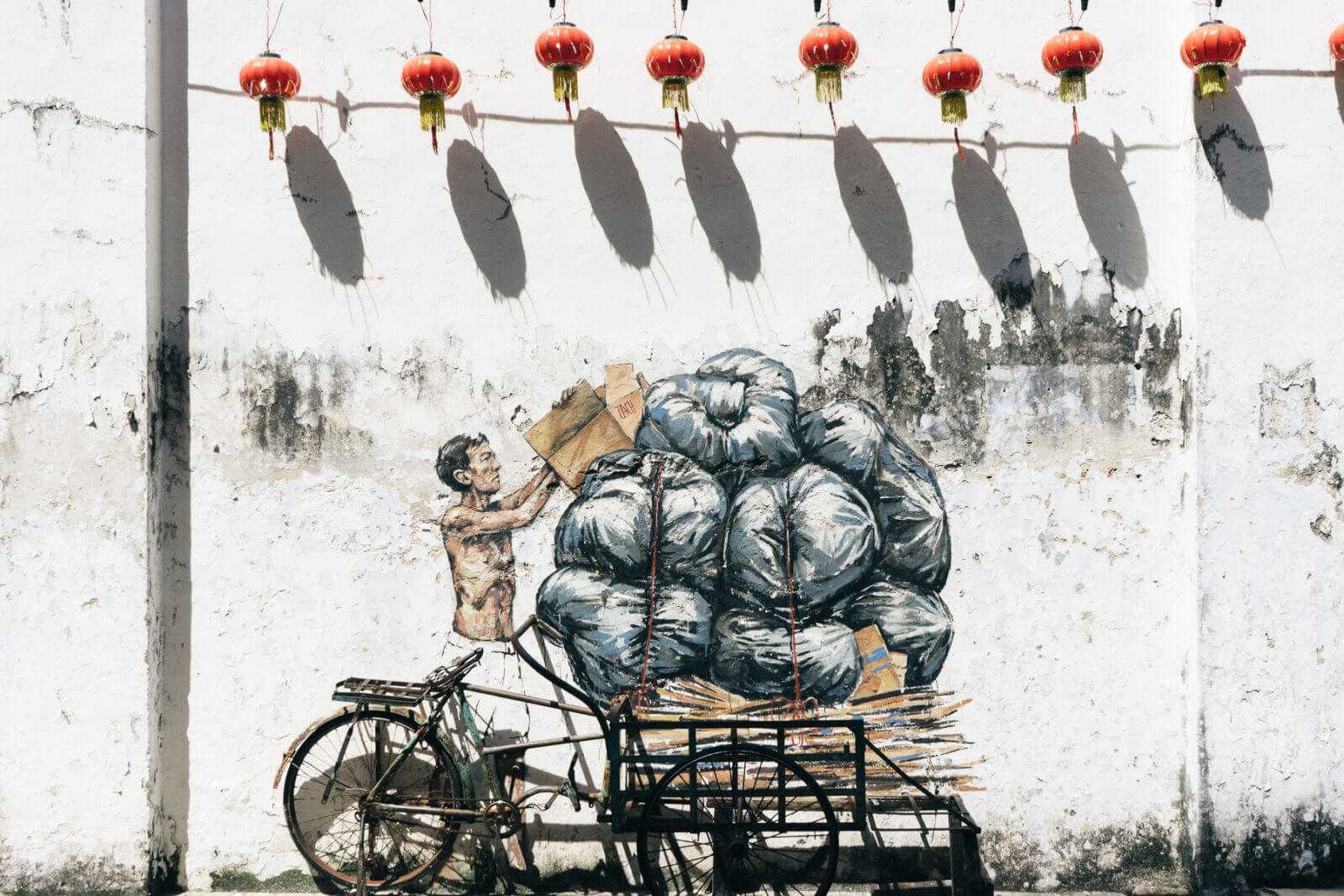
The Old Town is small but charming, with many buildings from the colonial era. And there’s quite a bit of street art—which is a nice way to get in the mood for Georgetown if you’re on your way there. Most of the murals are easy to find, even using Google Maps. Or you can pick up a map at the tourist office. They’re very well organized in Malaysia anyway—something I hadn’t expected.
The Ipoh Heritage Trail takes you past all the town’s buildings worth seeing – from a time when Ipoh was still so rich because of its nearby tin deposits that it was called the “City of Millionaires.” And again and again there are small alleys and beautiful details to explore and discover. It is precisely the fact that Ipoh is not so smoothly polished and still has a slightly morbid vintage charm in many places that makes the old town so special.
Concubine Lane
The tourist hub of Ipoh is Concubine Lane, a narrow alley lined with shops, restaurants, and street stalls. There are actually three Concubine Lanes; in ancient times, a tin baron gave each of his three wives a street and let them collect the rent there for their own pockets—hence the three Concubine Lanes. Today, the action takes place mainly on a single street, Lorong Paglima, which is commonly known as Concubine Lane.
On what is now Market Lane—formerly Second Concubine Lane—you won’t find any shops, but you can take your time admiring street art murals and, if you have a keen eye, the tastefully displayed accessories, such as a vintage Beetle. But the umbrellas… well, they’re kind of old news… in the truest sense of the word.
Probably the most intricately designed gem in Ipoh’s Old Town is Kong Heng Square, a small block of buildings lined with shops and cafés. And it’s really beautifully done. The trees, which have been growing in the courtyard for centuries and were simply integrated into the redesign of the buildings, make you feel like you’re at Angkor Wat.
It’s a little too geared toward the hipster crowd, but you can still enjoy shopping for handmade souvenirs in the small shops here and enjoy good food and drinks at the cafés and restaurants.
Street Art in Ipoh
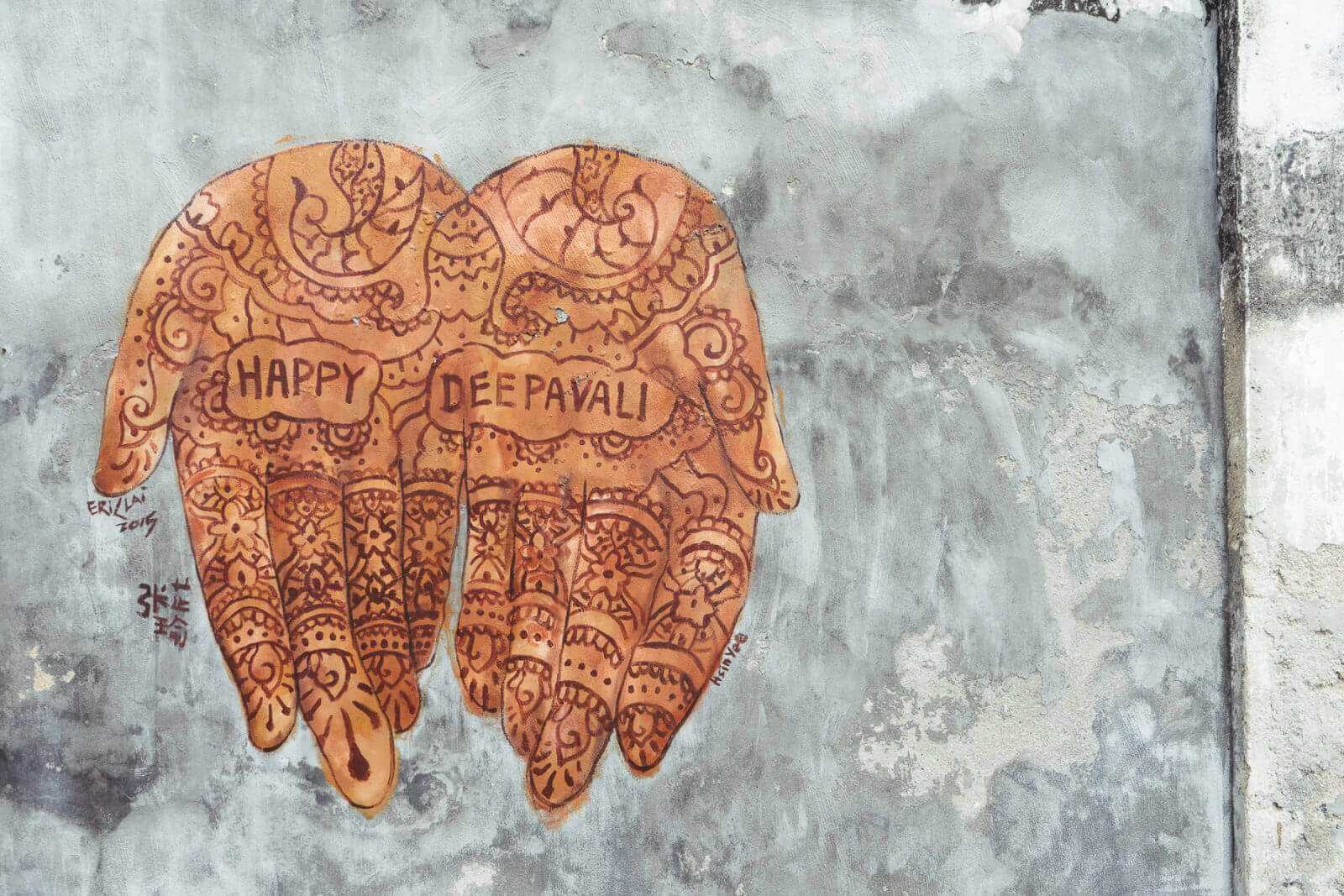
If it works in Georgetown on the Malaysian island of Penang, it must work in Ipoh, too. That’s probably what someone must have thought. Georgetown has become known for its largely interactive murals, which gained fame primarily through the Lithuanian artist Ernest Zacharevic. Thanks to some of his works in Penang, he’s even earned the nickname “the Banksy of Malaysia,” and tourists line up endlessly in front of his murals in Georgetown just to snap a photo.
This is not yet the case in Ipoh. But street art can still be found everywhere. There is even next to the more famous Market Lane a complete alley only with street art, the Mural Arts Lane. Partly nice, partly less so, but in any case not as crowded as Georgetown. Since the old town is also very clear and many works are centrally located, you can actually look at all the interesting murals in just a short time.
Night Market: Exploring Ipoh’s Vibrant Nightlife
As is typical in Southeast Asia, Ipoh also has a night market. However, it’s located outside the old town, and if you really want to go there after dark, you’re better off taking a taxi. Uber or Grab (which is usually a bit cheaper than Uber and also more popular). It’s not far to walk, but the streets along the way are rather dim—and to me, the savings just weren’t worth it.
Unfortunately, the market itself isn’t particularly spectacular; it mainly sells counterfeit Chinese knickknacks and trivial trinkets. So if you’re looking for local handicrafts or other authentic souvenirs, you probably won’t find what you’re looking for here.
But there’s some exciting street food here: On a street corner, there’s a restaurant called Lou Wong, which is apparently known for its chicken with rice and soybean sprouts. In any case, it’s the biggest and busiest place far and wide, and there isn’t even a menu. That’s because they only serve one dish on simple orange plastic plates—you can choose between chicken or the vegetarian option (which is probably just the same dish without the chicken). You order using hand gestures—nobody speaks English. But that doesn’t matter. The main thing is that it’s delicious—and the place is definitely worth a visit for adventurous eaters.
I thought Ipoh was really quite pretty, and if I hadn’t had only three weeks in total for the entire trip, I probably would have stayed a little longer—also to explore the surrounding area. I think Ipoh is definitely a nice change of pace, especially for long-term travelers, offering a break from all the traveling and a chance to just relax for a few days.
How to Get There
Ipoh is located north of the Cameron Highlands on the way to Penang/Georgetown, making it the perfect stopover. Ipoh is also very well connected: There’s a train connection to Kuala Lumpur, an airport with flights within Malaysia and to Singapore, and a large bus terminal outside the city from which you can travel to all parts of the country. Traveling by bus in Malaysia is highly recommended—it’s affordable and much more comfortable than you might imagine!
Where to Stay in Ipoh
There are some nice places to stay in Ipoh. Individual, stylish and yet affordable:
M Boutique Hotel – It’s just outside the Old Town, but thanks to Uber—which works great in Ipoh, too—it’s absolutely easy to get to. De Café & Rest House – Not only a highly recommended café, but also a new capsule hotel. Ideal for solo travelers. Unfortunately, there are no private rooms, but it does have a unique location in the Old Town! The Happy 8 Retreat @ Old Town Ipoh – Also located in the heart of the old town, this is a beautiful boutique hotel with unique jungle-style interior design.
Want the ultimate shopping experience during your stay in Bangkok? Then you have to go to Chatuchak market. Cheap clothes and souvenirs can be found on almost every corner in Bangkok, but the Chatuchak market is really worth seeing just because of its size.
The Chatuchak market at the weekend
Here you can spend away the whole day, because the market is the world’s largest weekend market! Lose yourself in the narrow, crowded aisles of the covered market and indulge in the shopping frenzy.
What can you buy at Chatuchak market?
You’ll find almost everything you can imagine at the Chatuchak Market! From clothes to household goods to live pets, the choice is endless! To give you an impression of how big the market is – here is the location map (you can also get a free folding map at the market’s information booth – and yes, it’s helpful!):
Street food at the Chatuchak market
Fortunately, the entire market is neatly divided by industry, so if you’re looking for specifics like vintage clothes, art, soaps or something, you’ll know right where to go. Of course, you can also eat here – there is one street food stand after another on the outer sides.
On the Thailand Blog, you’ll find even more tips and tricks for your trip to Thailand
There are also some bars, such as Viva 8, where you can enjoy a live DJ and show cooking.
Chatuchak Market Hours
Chatuchak Market is open Saturdays and Sundays from 6 a.m. to 6 p.m. and is very easy to reach by bus or metro.
Tip: Get there early, because it can get really hot around noon, especially inside the market in the narrow aisles. And as always: Drink loooooads of water!
Malaysia, where do you start? I am the best travel planner ever. Not. While others have thought out elaborate routes months in advance and planned whole days through, I know about three days in advance, with luck, in which direction I will set off at all. I hate planning. And so I knew about Malaysia also only what I could still read out in the fast passage from the travel guide. Was not much. Anyway, it is more exciting to experience with your own eyes and so I explored the most beautiful sights in Kuala Lumpur.
What to do in Kuala Lumpur a few facts
A few rough facts about Kuala Lumpur before I provide you with some really cool tips for your Kuala Lumpur visit:
Kuala Lumpur is the capital of Malaysia and is rather small for a major Asian city with a population of around 1.6 million
The Petronas Towers are THE landmark of the city and WERE once the tallest building in the world, but are still the tallest twin towers in the world for it
Multicultural: In Kuala Lumpur, as in the rest of Malaysia, a wide variety of cultures and religions live in a very small area: Chinese, Malays, Indians, Arabs, Buddhists, Muslims, Christians, Hindus – everyone finds their place here.
Petronas Twin Towers
In Kuala Lumpur, you can’t miss the Petronas Towers. Sparkling clean and featuring interesting design details, the twin towers are an extraordinary piece of architecture—not to mention their immense height. By the way, you can go up there, too.
Are you planning a trip to Malaysia? Then you should also check out my Malaysia blog with lots of information & inspiration!
Merdeka Square
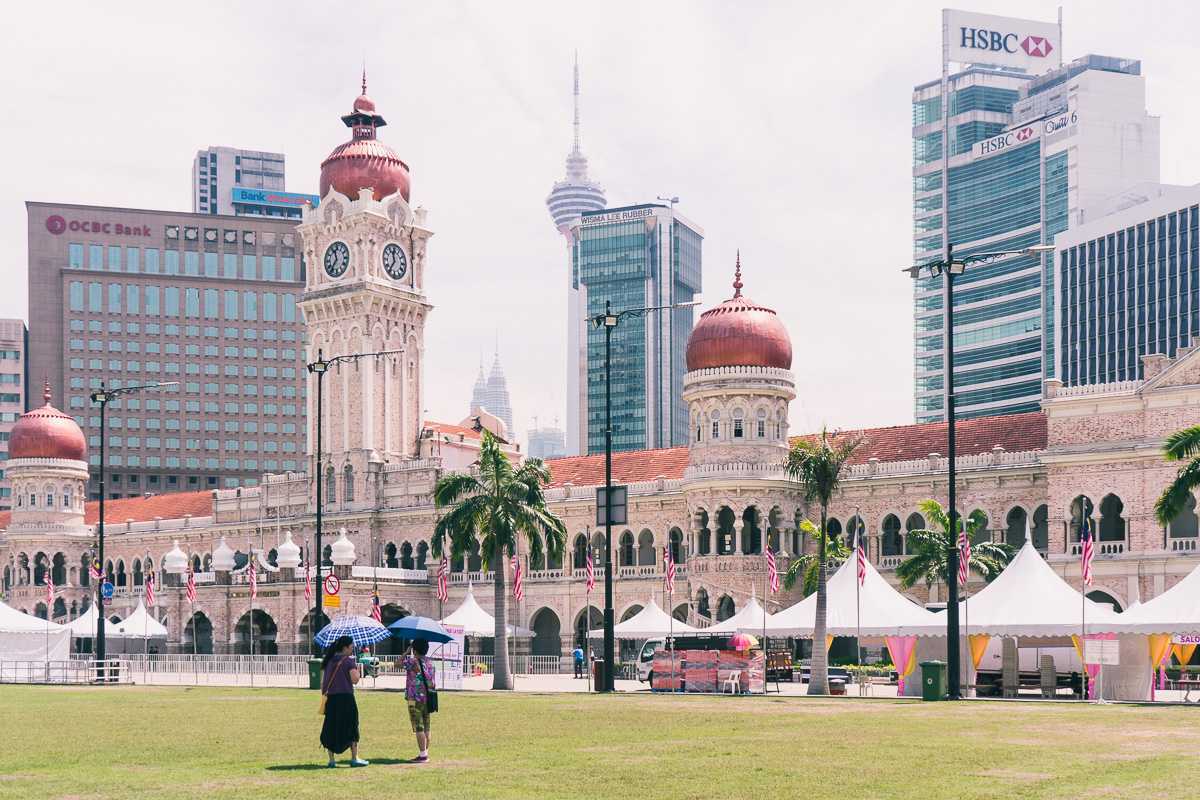
A little something for history buffs: This is where the Malaysian flag was first raised in 1957 and independence from Great Britain was celebrated. It’s really just a large lawn—it used to be a cricket field, after all. But the building on the square, the Sultan Abdul Samad Building, is well worth seeing with its huge clock tower, unusual spiral staircases, and arcades.
In addition, the two tourist information centers are a good reason to stop by here. One is the national tourist office for all of Malaysia, located in the Sultan Abdul Samad Building, and just a few meters away across the square is the Kuala Lumpur tourist information office. Here, you can pick up some really informative brochures, and the staff are consistently very friendly and happy to offer tips.
Chinatown
There are definitely more authentically Chinese and exciting Chinatowns around the world than the one in Kuala Lumpur. Still, there are some great temples and a lovely indoor market here that you shouldn’t miss:
Central Market
There are some nice souvenir stores and stalls here and a good and cheap food court on the upper floor.
Sri Mahamariamman Temple
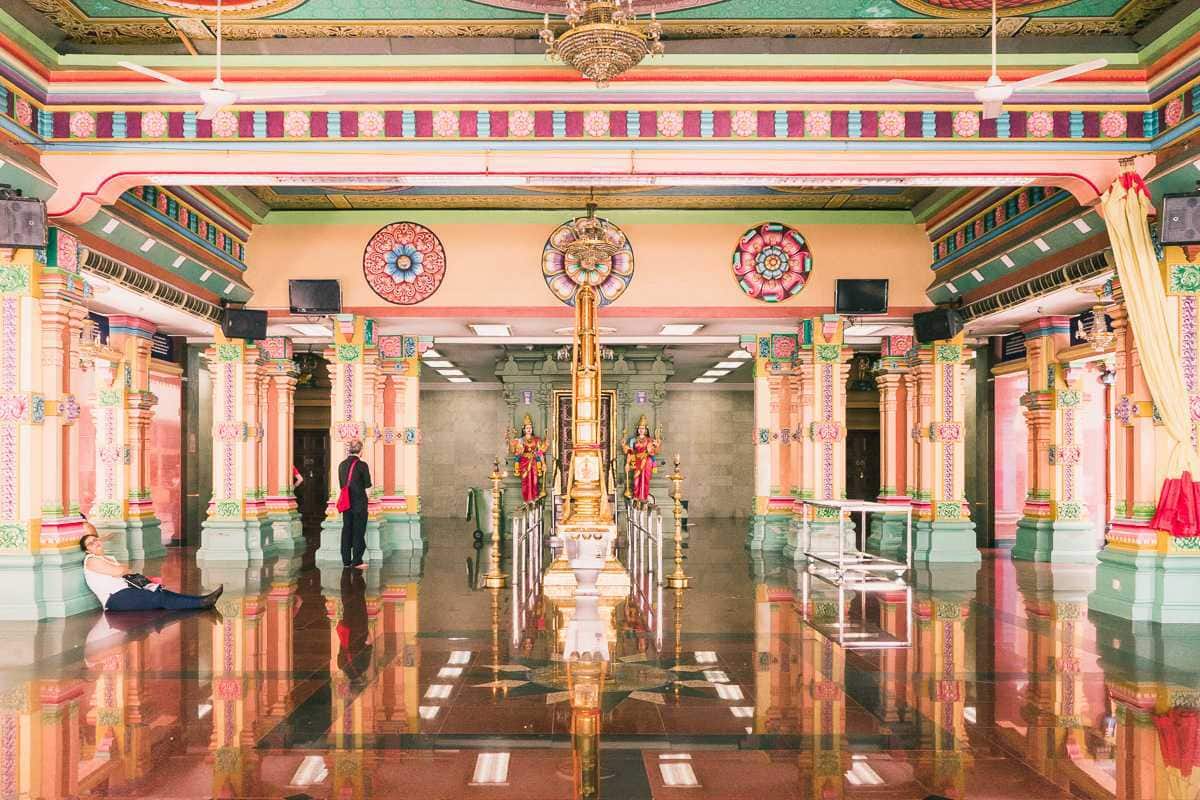
A Hindu temple right in the middle of Chinatown—that’s Malaysia for you. When it comes to multiculturalism, no one can outdo them. You take off your shoes at the entrance—just like in Hindu temples, where you walk around barefoot—and then you can explore the temple from the inside. The same rule applies here: it’s best to cover up those skin-tight hot pants. You can rent saris on site.
Guan Di Temple
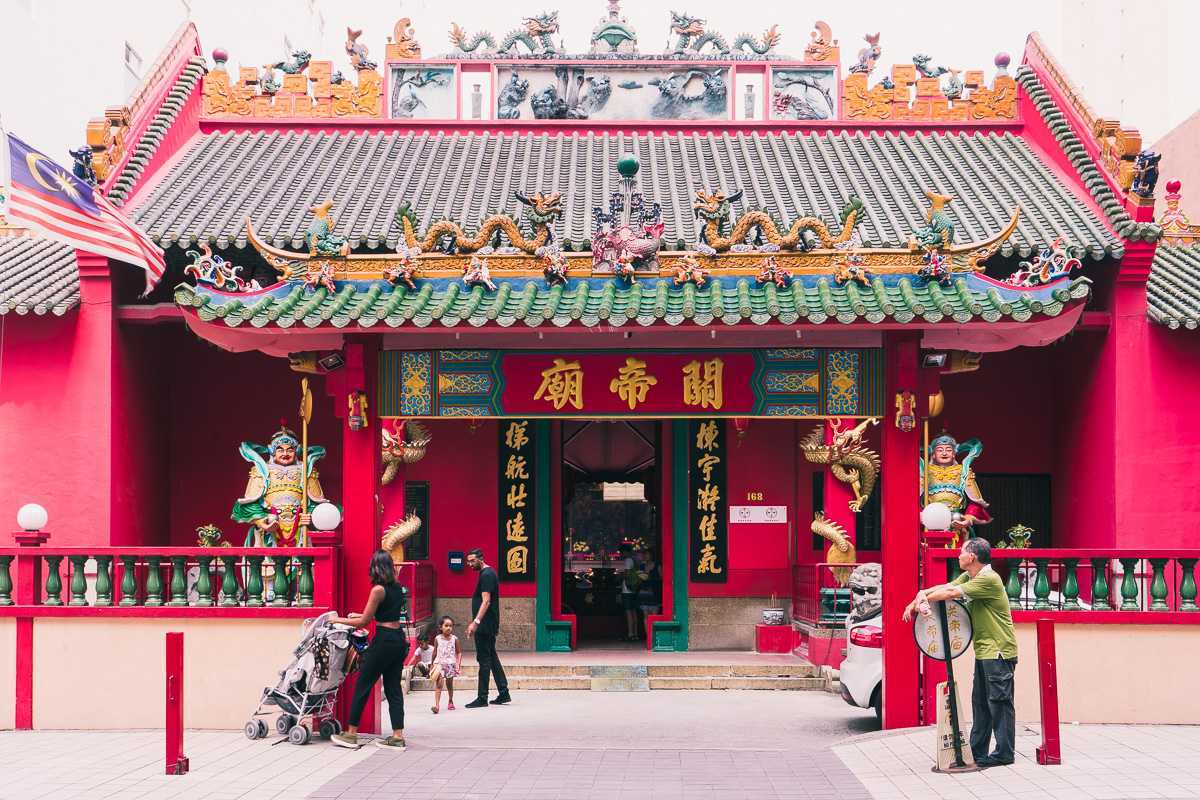
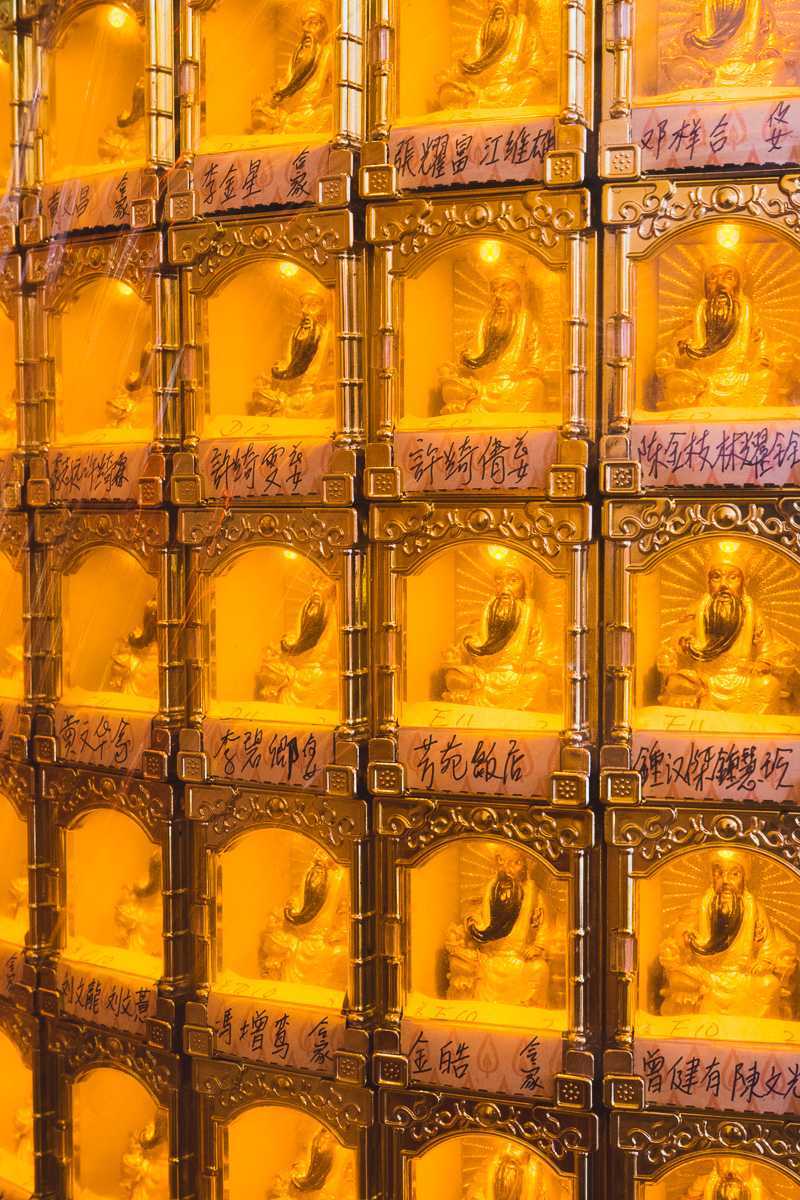
Just a few meters away from the Hindu temple, you find yourself immersed in a completely different world. Here in Malaysia, you can jump from one world religion to another in the blink of an eye. The Guan Di Temple is a Taoist shrine dedicated to the god Guan Di, the patron saint of martial arts. Police officers and triad members reportedly come here in equal measure to seek protection.
Petaling Street
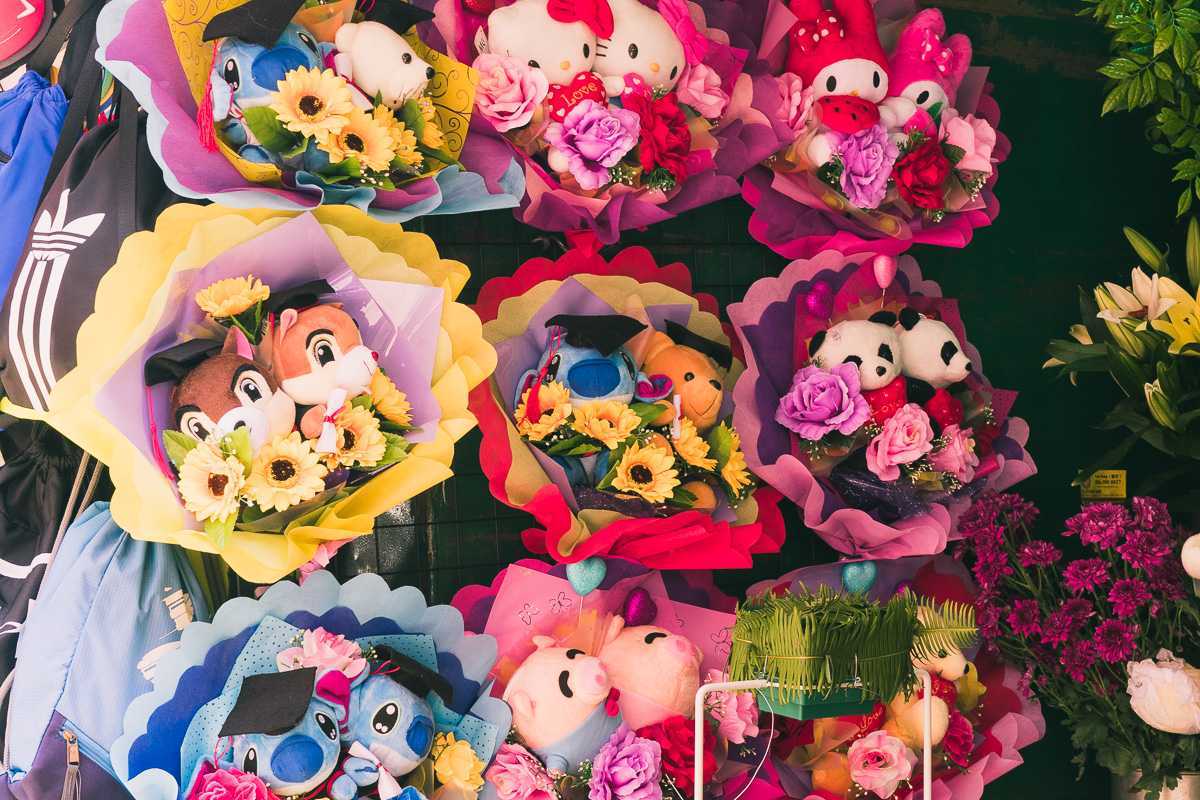
I didn’t find it all that spectacular, but anyone who wants to buy Chinese knickknacks, plastic teddy bear bouquets, and “authentic” counterfeit Louis Vuitton bags, should check out Petaling Street, a covered shopping mall right in the middle of Chinatown and at the heart of the neighborhood.
Jalan Alor Food Street
The best place for nighttime street food adventures is Jalan Alor. You’ll find everything here—but especially plenty of Chinese cuisine. There’s one restaurant after another, endless food stalls, and live music here and there.
Once you’ve had your fill of sampling the food, head over to Changkat Bukit Bintang —a nearby street with plenty of bars, music, and nightlife.
Batu Caves
The absolute highlight of the temples! A Hindu temple carved right into the middle of a huge rock crevice! The imposing statue at the entrance points the way: Steep stairs lead up into the heart of the Batu Caves. Along the stairs, among the trees, there are tons of monkeys: Don’t feed them, hold on tight to small items (cameras, etc.—monkeys are really good at stealing), and just enjoy watching them!
By the way, construction is currently underway at the temple, and the workers welcome any help, since the temple is funded by donations and there’s no admission fee—just grab a bucket of sand at the entrance upstairs, drop it off at the construction site, and take an empty bucket with you on your way out.
Rooftop bars are always a good idea. But the Heli Lounge Bar is really unique, not only for aviators. A REAL helipad (!) in the middle of Kuala Lumpur on top of a nondescript skyscraper with a spectacular, unobstructed view of the sparkling Petronas Twin Towers. Railing? There is no such thing. Free as a bird over Kuala Lumpur – plus drinks at their best. During the day, the helipad is actually used, but at night, the landing pad becomes the most unusual rooftop bar in Kuala Lumpur.
A bit more expensive, a bit difficult to find as there is hardly any signage at the entrance below – but definitely worth it. Downstairs is the lounge bar proper, but stairs and narrow metal staircases take you up to the helipad with the best view ever. It really doesn’t get any cooler than this.
Address: Menara KH Tower, 34th floor, Jalan Sultan Ismail; open Monday through Saturday starting at 6:00 p.m.
Practical tips for travel and transportation in Kuala Lumpur
Kuala Lumpur has two airports: Kuala Lumpur International Airport (KUL), called KLIA, and Sultan Abdul Aziz Shah Airport (also Subang Airport). The latter is the older of the two and is closer to the city, but is now served by only three smaller Malaysian airlines (Berjaya Air, Malindo Air, Firefly). There is no direct flight from Germany to Kuala Lumpur (KUL) – I flew from Berlin with Qatar Airways via Doha, which was the shortest connection.
The public transport system in Kuala Lumpur is very well equipped with subways and buses – but I really didn’t use it much, because in Kuala Lumpur I finally became a total Uber and Grab fan. The two services are unbeatably cheap and super convenient.
Traveling can be so exciting. Sometimes questions come to mind that you never thought of before. In Tokyo I made my way to the Meiji Shrine, and that’s where it all started. The Meiji Shrine is one of the most popular sights in Tokyo and is located in Yoyogi Park.
During the cherry blossom season, this park is one of the most important destinations for cherry blossom tourists. Everything is bathed in pink blossoms and Japanese and tourists alike go crazy over so much nature. I was hoping to catch a bit of the cherry blossom hype as well, but unfortunately the strong winds the night before had swept away pretty much all the remnants of the dwindling cherry blossoms.
Religions in Japan: What is Shinto?
Anyway, off to the shrine. Unprepared as I was once again, I knew nothing about it. Shrine? Had to be something religious, I guess. But what about religions in Japan? I rarely felt stupid because I had no idea at all. The Japanese were not influenced by Christianity, and everything that went in the direction of Asia was to me always somehow connected to Buddhism. But this didn’t look like a buddhist temple at all.
One look at Wikipedia, travel guides and a few signs later, I knew: The Meiji Shrine is dedicated to one of the last emperors, Emperor Meiji, and his wife. And: It’s a Shinto temple. Shinto is an ancient Japanese religion and cultural philosophy – and if I’m honest, even after visiting and reading about it for a long time, it was too complex for me to really understand what it’s all about.
But enjoying and marveling at the new impressions was more than enough for me. For example, upon entering the shrine area, worshippers must complete a certain hand-washing ritual, following a highly specified sequence.
Also the prayer is very special. You stand in line. Pray. Then toss a coin. Clap your hands firmly twice. Pray. And that’s it. It’s fascinating how accurate Japanese are!
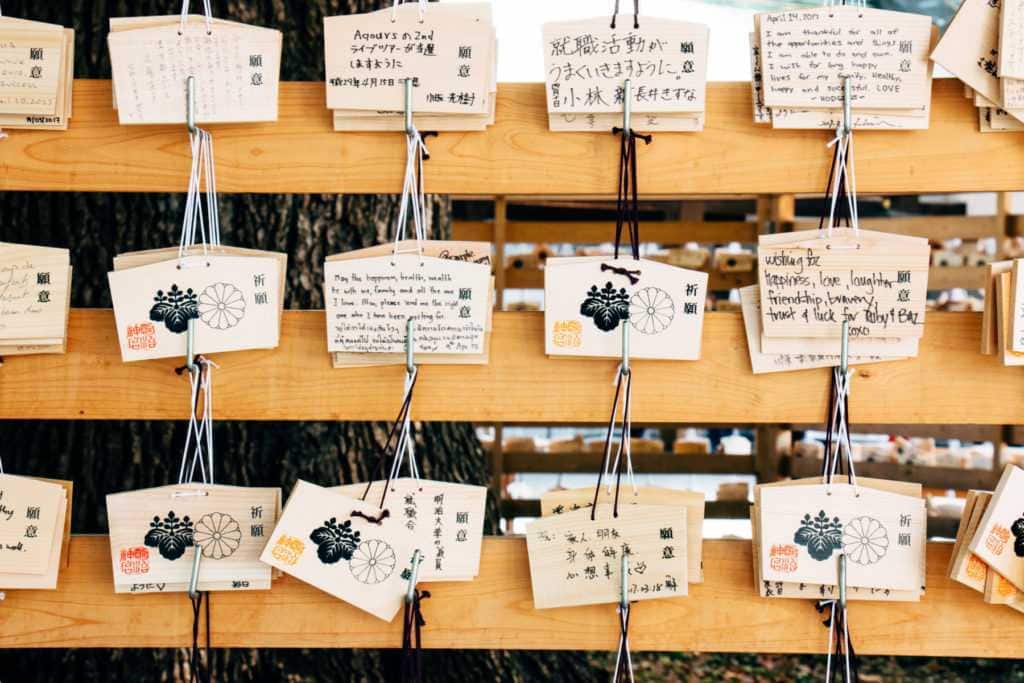
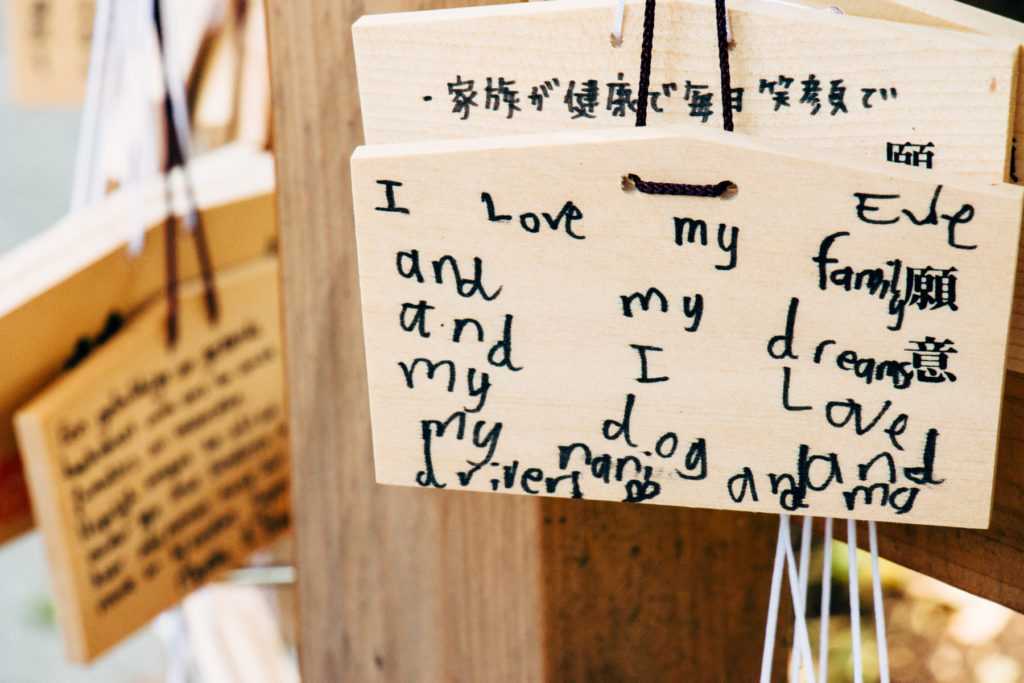
If you like, you can hang wooden boards with your personal wishes on a tree. And some of the messages on the other boards are just touching.
Getting married at a Shinto shrine
For an emotional memory on top, there were several original Shinto weddings that took place on site – and brides as well as wedding guests looked so beautiful, I would have loved to throw myself into a kimono right there and then.
Meiji Jing Gyoen – the Japanese garden
If you come from the direction of Harajuku to the Meiji Shrine, you should definitely visit the Meiji Jing Gyoen, a separate garden in the middle of the park. There’s an admission fee, but the sheer silence is so worth it. It’s hard to believe you’re in the middle of a huge metropolis.
The sake barrels at the Meiji Shrine
Also near the entrance to the garden is a huge wall of sake barrels – all are donations that are supposed to bring good luck. And to visitors it’s an amazing photo op!
The Shibuya district of Tokyo is home to one of the most fascinating intersections in the world. As if everything else in Tokyo wasn’t fascinating enough. There are flashes and lights everywhere, the Japanese are equally crazy about crazy things and then again try not to stand out in the crowd. But everyone probably thinks of this large intersection in Shibuya, which millions of people cross every day.
Everyone wants a photo: the Shibuya intersection is simply fascinating.
Shibuya intersection: probably the craziest intersection in the world
Tokyo doesn’t really have a city center. Nevertheless, the famous intersection in front of Shibuya Station feels like the epicenter of Tokyo. Many other tourists think the same and climb on flower boxes for a better photo perspective or try to get one of the window seats in the Starbucks on the second floor of a corner building, from where you have the perfect overhead view of the most blatant intersection in Tokyo, if not the world. (By the way: if you’re short on time, don’t even try the window seat at Starbucks).
Crowds of people wait every day at the famous Shibuya intersection.
Up to 15,000 people cross this intersection in Tokyo every traffic light phase
It all sounds ridiculous, but I also walked back and forth across the intersection a few times. Because Japanese people are simply fascinating. As if choreographed, everyone sets off at the green light, quickly but not frantically. Even diagonally, because the intersection is a so-called all-way intersection with diagonal crossings. Despite the crowds, there is no shoving, no jostling, no annoyance. Everything flows. None of the drivers honk or tailgate. And on red? The entire street is suddenly clear of pedestrians again, and cars whizz gently across the intersection. The Japanese are simply elegant.
Standing still for a photo while life rages at the intersection in Shibuya.
Where is the famous intersection in Tokyo?
You will find the intersection between the west side of Shibuya Station and the end of the equally exciting shopping street Center-Gai. This shopping street is also one of the most popular in Tokyo!
No crowds despite the large number of people: Japanese people remain polite and considerate, even at what is probably the world’s largest intersection in Shibuya, Tokyo.
Hachiko – the most famous dog in Japan
Shibuya station is just as gigantic, hundreds of train tracks on several levels, a veritable labyrinth. You should take a look at it. Like the dog Hachiko, a bronze statue that watches over the station forecourt. In the 1930s, Hachiko used to pick up his master from the train station until he died. However, Hachiko continued to come to the station every day for over ten years. True love for dogs.
My tips for Shibuya
Shopping in Shibuya
The most ingenious products come from Japan in all areas – as a big paper fan, for example, I stocked up on around twenty kilos of stationery. You won’t find such beautiful, high-quality paper anywhere else. And I’ve developed a real soft spot for 100-yen stores (100 yen is about 85 cents) in Tokyo, which stock pretty much everything you don’t need – but for 100 yen, and then from Japan, then again, absolutely. I could probably have spent days in Tokyo’s temples of consumption if it hadn’t been for my usual mission: to see Tokyo. In 24 hours.
Tokyu Hands – a huge department store, more for furnishings and handicrafts, but worth a visit for its size and huge range alone! Daiso – one of those bric-a-brac stores where you can always find something. There are also branches in many other parts of Tokyo. The largest branch is in Harajuku. Can Do – also a bric-a-brac chain with many Japanese products at a low price. Here too, quality is often better than you think!
Nightlife in Shibuya
A day in Tokyo can be very exhausting! All the impressions, the many people, the many colors – but Tokyo is just as worth seeing at night. If you don’t have the capacity to take care of the evening program on your own, you can join an organized bar-hopping tour through Shibuya:
Other sights in Shibuya: Nearby (15-20 minutes on foot or one stop further to Harajuku Station) is Yoyogi Park with the Meiji Shrine! ➜ More about the Meiji Shrine in Tokyo
Travel to North Korea once. Ever since I devoured a few documentaries about North Korea, I’ve wanted to go there. Well, one could argue about whether one should support a foolish regime with foreign currency while its leader keeps the world on edge with his nuclear projects. After all, traveling to North Korea is probably a bit like taking trips to the GDR back in the day. In reality, only the state really benefits from the Western money pouring in, and you yourself are bombarded with propaganda during the state-organized and monitored trip. It’s not far from Seoul to the North Korean border; the Demilitarized Zone (DMZ) on the border is, so to speak, just around the corner.
North Korean Border: The Demilitarized Zone near Seoul and Its Attractions
From Seoul, a few operators offer tours to the DMZ. Driving there yourself is rather difficult – the DMZ is a several kilometers wide border strip in front of the actual border and a restricted military area. But the term demilitarized is rather an euphemism. Exceptions are made only for tour groups. With all the pros and cons: We stopped several times at some stops on the trip to pick up or drop off other tour groups or both. A few “highlights” of the tour weren’t highlights either – for example, the stop at a supermarket with supposed local products. Among the Oreos, Pringles, and gum were a few dusty bottles of pickled ginseng. Not the kind of shopping experience you’ll need. Included was also a tour guide, who repeated each sentence a whopping five times, varying only a few words. What a surreal tour.
Ad / *affiliate links
How far is Seoul from the North Korean border?
Visiting the border between North and South Korea is quite easy from Seoul. The distance from Seoul to the border with North Korea is only about 50 kilometers. So an excursion can be conveniently planned in one day in Seoul – and is really recommended to get a feel for Korea’s history.
Imjingak Park has always been a gathering place for exiled North Koreans to commemorate their relatives who stayed behind. At some point, a folk festival atmosphere arose, and to crown it, a giant parking lot, a small permanent fair and a few memorial corners were set up in the middle of nowhere. I was particularly impressed by the many colorful inscribed bows tied to the chain-link fence to the restricted area. A sign of color and hope in this whimsical, barren environment.
Dora Observatory: War Through Music
Music resounds deafeningly loud from giant loudspeakers over the lookout point, in the direction of the border. I hear something by Frank Sinatra and then again something with “freedom” in the lyrics. Here, the position is not only taken with weapons and military. The North Koreans probably do a similar thing with music, and somehow I find it bizarre that two countries are fighting each other with music.
From the vantage point, the Dora Observatory, you can see the border and two showcase villages, one of North Korea, one of South Korea, of which the North Korean one, according to our tour guide, is only prettified for propaganda purposes, nobody lives in the settlement. The adjacent industrial park, which was supposed to be the first start of cooperation between North and South Korea, is now also lying fallow due to the resurgence of political tensions. Everything looks like a ghost town – even from a distance. It definitely creeped me out.
Dorasan: The Ghost Train Station to North Korea
The next stop is even more spooky – from Dorasan station, you could take a train straight through to Pyongyang from South Korean soil. Could. In reality, the brand-new station lies fallow in the middle of nowhere. Tickets can be bought anyway, and we do so, because that’s how you get to the deserted platform. And then we stand there, on the empty platform, for two minutes, because time is short. All very strange.
But some passengers really made our day. Inside there are stamps for free use, imitating real entry and exit stamps. As a souvenir. Not without the advice “Don’t stamp your passports!”… and some people stamped their own real passports full with the fake stamps. Wonder on what questions will arise when they present their passport back home.
Secret tunnels beneath the border between North and South Korea
In the course of the separation between North and South Korea, several tunnels were discovered on the South Korean side, which North Korea probably dug to smuggle in either troops for invasion or agents for infiltration purposes. You have to imagine! Kilometers of tunnels, just high enough for a slim Korean man to fit through upright! The North Koreans, of course, say that all this is not true at all, that the South Koreans dug the tunnels themselves. Pretty crazy. Photos inside are unfortunately forbidden, strictest border area, since one comes in the tunnel really very after the demarcation line. But with 300 meters of descent and ascent at a gradient of 11 percent, you have other worries anyway – nothing for heart patients. And also not for extreme claustrophobics, a quarter of an hour through a narrow tunnel so deep in the earth – you have to like.
The Tour to the DMZ in Korea—Is It Worth It?
The whole tour was very peppered with (of course South) Korean propaganda, which could be annoying at times, although the distribution of the roles of good and evil in this case are quite obvious anyway. And finally, we were dragged through a factory outlet for gemstones. No one wanted to go, but at least we were allowed to choose whether we should be talked into ginseng or amethysts.
Still, if you’re ever in Seoul, it’s definitely a great day trip!