Category: South Korea

South Korea totally surprised me with its unusual mix of deeply rooted traditions and super-modern present. In Seoul, you can move between historic temples, bright neon signs and countless food stalls that are open late into the night.

If you are in Seoul, you should also definitely visit the unusual border with North Korea – and experience contemporary history live. You can find lots of tips here on the blog!

  • Seoul: Tour to the Border with North Korea

    Seoul: Tour to the Border with North Korea

    Travel to North Korea once. Ever since I devoured a few documentaries about North Korea, I’ve wanted to go there. Well, one could argue about whether one should support a foolish regime with foreign currency while its leader keeps the world on edge with his nuclear projects. After all, traveling to North Korea is probably a bit like taking trips to the GDR back in the day. In reality, only the state really benefits from the Western money pouring in, and you yourself are bombarded with propaganda during the state-organized and monitored trip. It’s not far from Seoul to the North Korean border; the Demilitarized Zone (DMZ) on the border is, so to speak, just around the corner.

    Fence with colorful ribbons in the DMZ, South Korea

    North Korean Border: The Demilitarized Zone near Seoul and Its Attractions

    From Seoul, a few operators offer tours to the DMZ. Driving there yourself is rather difficult – the DMZ is a several kilometers wide border strip in front of the actual border and a restricted military area. But the term demilitarized is rather an euphemism. Exceptions are made only for tour groups. With all the pros and cons: We stopped several times at some stops on the trip to pick up or drop off other tour groups or both. A few “highlights” of the tour weren’t highlights either – for example, the stop at a supermarket with supposed local products. Among the Oreos, Pringles, and gum were a few dusty bottles of pickled ginseng. Not the kind of shopping experience you’ll need. Included was also a tour guide, who repeated each sentence a whopping five times, varying only a few words. What a surreal tour.

    How far is Seoul from the North Korean border?

    Visiting the border between North and South Korea is quite easy from Seoul. The distance from Seoul to the border with North Korea is only about 50 kilometers. So an excursion can be conveniently planned in one day in Seoul – and is really recommended to get a feel for Korea’s history.

    ➜ Book a tour from Seoul to the Demilitarized Zone* here

    Imjingak Park

    Imjingak Park has always been a gathering place for exiled North Koreans to commemorate their relatives who stayed behind. At some point, a folk festival atmosphere arose, and to crown it, a giant parking lot, a small permanent fair and a few memorial corners were set up in the middle of nowhere. I was particularly impressed by the many colorful inscribed bows tied to the chain-link fence to the restricted area. A sign of color and hope in this whimsical, barren environment.

    Dora Observatory: War Through Music

    Music resounds deafeningly loud from giant loudspeakers over the lookout point, in the direction of the border. I hear something by Frank Sinatra and then again something with “freedom” in the lyrics. Here, the position is not only taken with weapons and military. The North Koreans probably do a similar thing with music, and somehow I find it bizarre that two countries are fighting each other with music.
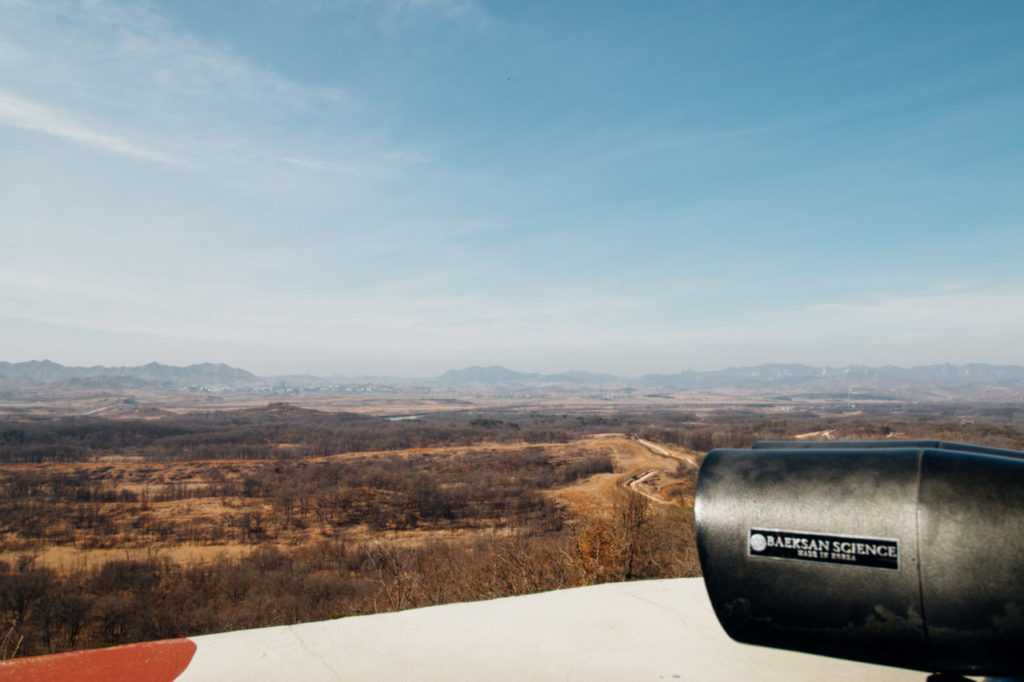
    Binoculars at the North Korean Border

    From the vantage point, the Dora Observatory, you can see the border and two showcase villages, one of North Korea, one of South Korea, of which the North Korean one, according to our tour guide, is only prettified for propaganda purposes, nobody lives in the settlement. The adjacent industrial park, which was supposed to be the first start of cooperation between North and South Korea, is now also lying fallow due to the resurgence of political tensions. Everything looks like a ghost town – even from a distance. It definitely creeped me out.

    Dorasan: The Ghost Train Station to North Korea

    The next stop is even more spooky – from Dorasan station, you could take a train straight through to Pyongyang from South Korean soil. Could. In reality, the brand-new station lies fallow in the middle of nowhere. Tickets can be bought anyway, and we do so, because that’s how you get to the deserted platform. And then we stand there, on the empty platform, for two minutes, because time is short. All very strange.

    But some passengers really made our day. Inside there are stamps for free use, imitating real entry and exit stamps. As a souvenir. Not without the advice “Don’t stamp your passports!”… and some people stamped their own real passports full with the fake stamps. Wonder on what questions will arise when they present their passport back home.

    Secret tunnels beneath the border between North and South Korea

    In the course of the separation between North and South Korea, several tunnels were discovered on the South Korean side, which North Korea probably dug to smuggle in either troops for invasion or agents for infiltration purposes. You have to imagine! Kilometers of tunnels, just high enough for a slim Korean man to fit through upright! The North Koreans, of course, say that all this is not true at all, that the South Koreans dug the tunnels themselves. Pretty crazy. Photos inside are unfortunately forbidden, strictest border area, since one comes in the tunnel really very after the demarcation line. But with 300 meters of descent and ascent at a gradient of 11 percent, you have other worries anyway – nothing for heart patients. And also not for extreme claustrophobics, a quarter of an hour through a narrow tunnel so deep in the earth – you have to like.
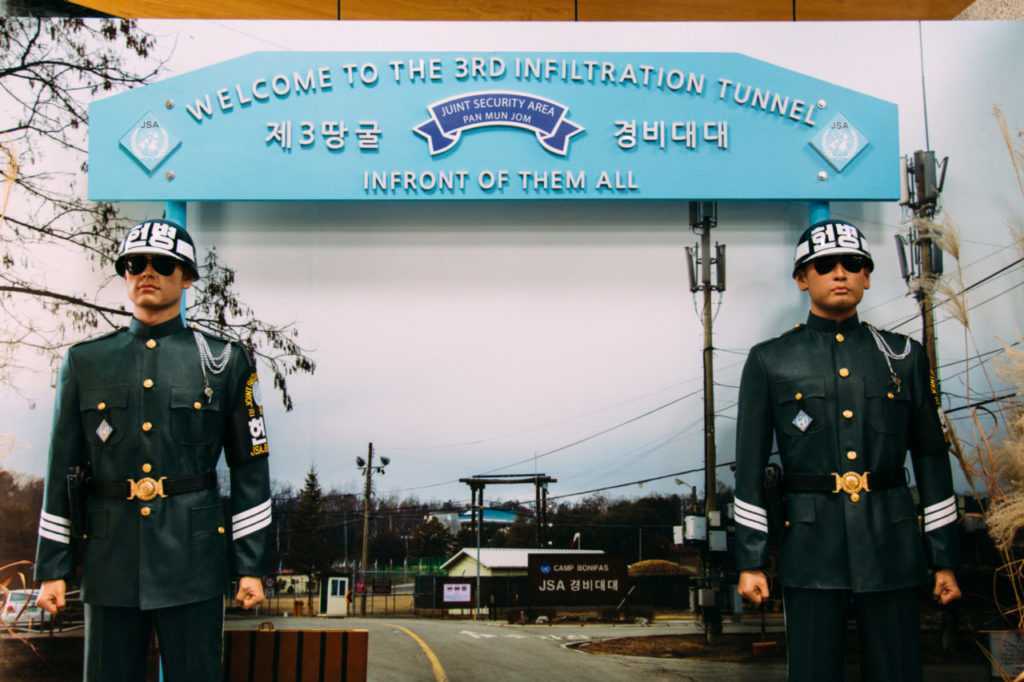
    Soldiers at the third tunnel to North Korea

    The Tour to the DMZ in Korea—Is It Worth It?

    The whole tour was very peppered with (of course South) Korean propaganda, which could be annoying at times, although the distribution of the roles of good and evil in this case are quite obvious anyway. And finally, we were dragged through a factory outlet for gemstones. No one wanted to go, but at least we were allowed to choose whether we should be talked into ginseng or amethysts.

    border with North Korea

    Still, if you’re ever in Seoul, it’s definitely a great day trip!

    Here you can book a tour to the DMZ from Seoul that doesn’t feel like a sales pitch*

    ***

    Other things to experience in Seoul:
    6 Must-See Attractions in Seoul!
    Seoul: Free Admission to Gyeongbokgung Palace

    If you’d like to visit North Korea across the border, you can get a first glimpse here:
    Blog post on Movin’ Groovin’

  • 6 Crazy Things to Do in Seoul

    6 Crazy Things to Do in Seoul

    Seoul is truly a special travel destination: on the other side of the world, and in many ways similar to—yet different from—Europe. Honestly, you don’t even know where to start looking and marveling. And for those who are as fascinated as they are bewildered, I’ve brought back a little personal list from Seoul of things you really should see in person and in all their glory. You’ll find my very own list of the top sights in Seoul in this article.

    #1 N Seoul Tower / Namsan Tower

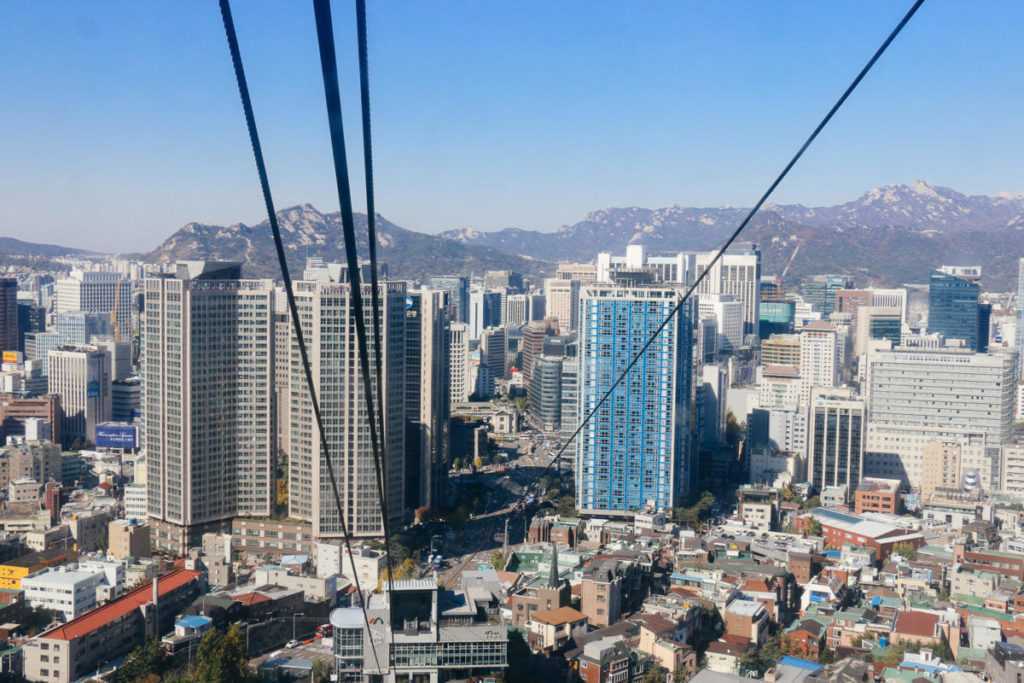
    The N Seoul Tower is located on the top of the highest mountain in Seoul, Mount Namsan. This makes the view from the tower even more fascinating, on clear days you have an incomparable view over the entire city.

    Seoul sightseeing view from Namsan mountain

    You’ll go up first with an elevator, then with a cable car. Or you can hike up in about an hour. The area around the tower is a recreational area with beautifully landscaped gardens, some cafes and stores and a changing cultural program.

    And the N Seoul Tower seems to be the place of pilgrimage for all newlyweds; railings and fences around the tower are covered all over with love locks, creating a fascinating colorful carpet of love locks. So crazy! 98% of the world’s production of padlocks probably ends up near the N Seoul Tower.

    Love locks at Namsan Tower, Seoul
    The railing is no longer recognizable: Decorated by thousands of love locks.

    #2 Gwangjang Market: Seoul’s Famous Street Food Market

    Not for the faint of heart. Mainly a fabric market, there’s also a small but effective street food corner here that will test even the toughest stomach. From dog meat soup to pigs’ feet and snouts, from live squid ready for slaughter to indefinable blood sausages, there’s everything you need to train for your next adventure in the jungle. Personally, it turned my stomach at the live sea worms, a marine animal without eyes looking like guts – that’s nothing for me, not even to look at.

    Otherwise, there are also much more tolerable dishes, soy pancakes made from freshly ground soybeans (very tasty!) or freshly rolled noodles in broth.

    #3 The Palaces

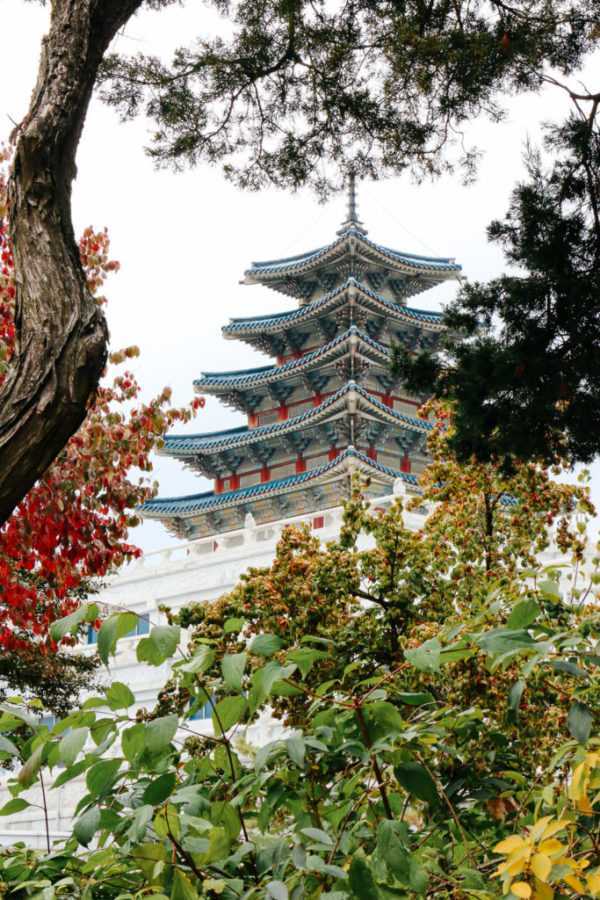
    Seoul has several palaces from the times of the Joseon Dynasty – be sure to visit one of them. The largest is the Gyeongbokgung Palace.

    Gyeongbokgung Palace, Seoul Sightseeing, Korea

    #4 Whimsical Theme Cafés

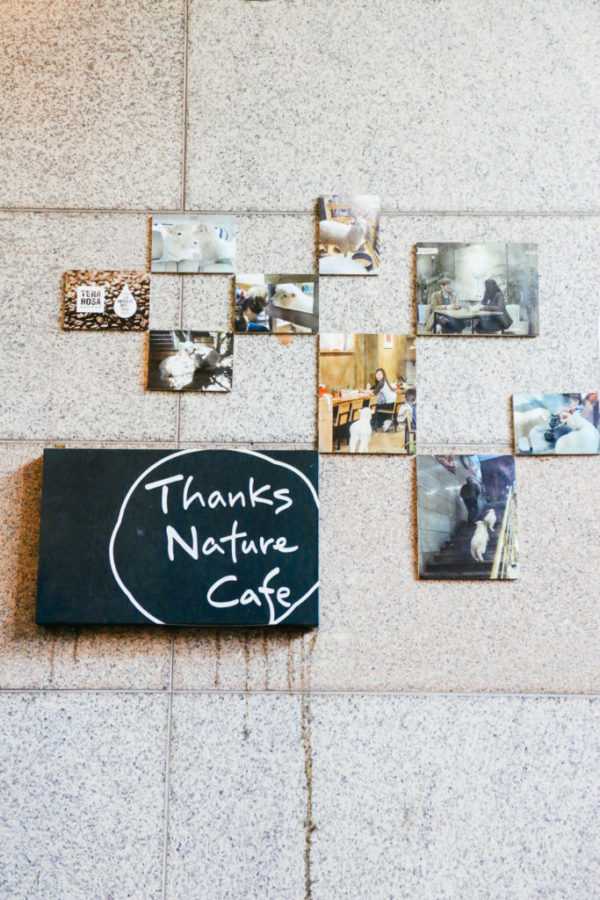
    Koreans seem to love cafés. (Note: bring time, usually the service is rather slow). And quirky cafes in particular. Like the sheep cafe Thanks Nature.

    The two sheep belonging to the café are probably intended to bring alienated city dwellers closer to nature again. Whether the way of keeping is animal-loving and lifelike enough, so on bare concrete in a dark concrete, let’s see.

    Or the Poop Café in Insadong. In this café, everything revolves around poop! Poop piles. Poop piles as a pillow, as a notepad or as a table decoration. Soups are served in small toilet bowls. Yum.

    More travel reports from exciting South Korea

    #5 Seoul’s Public Transportation

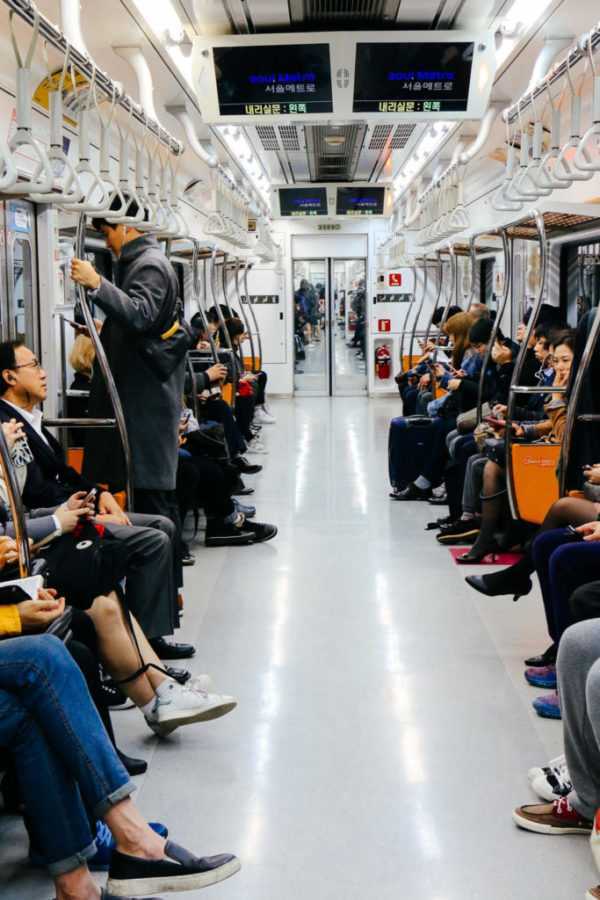
    Admittedly, the Berlin subway is no benchmark. But in any subway in Seoul, it’s so much cleaner than at home in my beloved-hated U7. Floors so smooth as glass you could eat off them. And even during rush hour, everyone is calm and disciplined, no crowding, no pushing, no bad vibes. So impressive!

    Metro in Seoul, Korea

    #6 Food: From Bibimbap to Korean Barbecue

    There are two dishes you have to try in Seoul! No visit to Korea without Bibimbap or Korean Barbecue.

    Bibimbap is really just a bowl of rice with fresh vegetables and optional meat on top. Put some hot sauce in, stir it – and in addition, as with everything in Korea: Kimchi. Pickled, fermented white cabbage. Some people swear by it, but I don’t like it. But what the heck, trying is part of it.

    The second famous dish: Korean Barbecue. I have to admit it didn’t blow me away either. At a Korean Barbecue you’ll grill the meat by yourself at the table, and you’ll be served a few varieties of – of course – kimchi and the whole thing is then rolled up with rice together in a thin lettuce leaf(!). In my case, it was a mess! I definitely need some more practice! So I wasn’t that impressed by the Korean Barbecue, but still the experience was worth it! And the atmosphere, which ranged from neon-lit canteen to noisy market hall, was also worth seeing.

    * * *

    More articles about South Korea:

  • Seoul: Gyeongbokgung Palace in autumn

    Seoul: Gyeongbokgung Palace in autumn

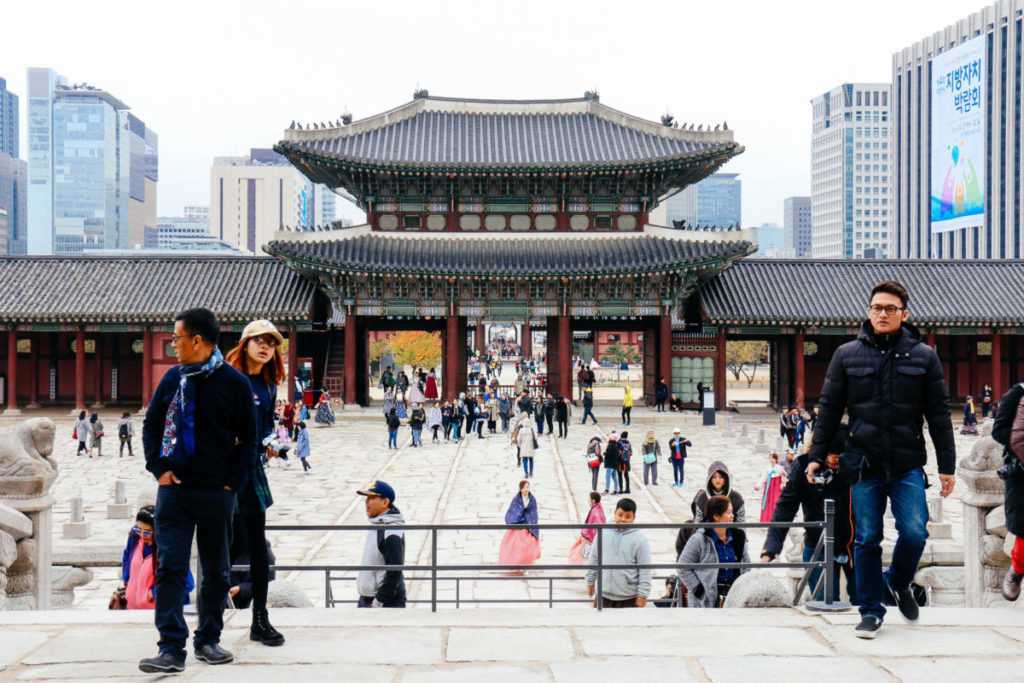
    In the right place at the right time. It is freezing cold, but the day is sunny. And it is just the right, unfortunately far too short phase, when the autumn leaves still shine from the trees in their full color splendor. I wonder if the gardeners of Gyeongbokgung Palace in Seoul planted the trees after that? It almost looks like it, because this cheerful warm mixture of all imaginable leaf colors is unique and too beautiful to be just a coincidence. Or it may simply be because the palace complex itself is very plain. No pomp, no gold, no flaunted wealth. And quite a lot of gray. Modesty is probably something original to Korea.

    Main entrance, Gyeongbokgung Palace, Seoul, Korea

    Tradition at Gyeongbokgung Palace in Seoul – or: how to get in for free!

    But not only the sea of leaves around the palace is colorful, but also its visitors: Many young Koreans in the most amazing traditional costumes buzz through the complex, taking selfies or draping themselves giggling in front of their cameras for the most beautiful photo. They also proudly let themselves be photographed with strangers, because Koreans are really happy from the bottom of their hearts when tourists are interested in their culture.

    Girl in traditional costume, Gyeongbokgung Palace, Seoul, Korea

    You can find all the South Korea travelogues here

    No one really knows who came up with the idea of dressing up or what it’s really all about. But everyone’s having fun. And admission is free. Because if you show up in traditional dress, you don’t have to pay to get in! That said, the money saved is usually spent beforehand on a rental fee at one of the nearby costume rental shops—but who cares.

    By the way, I didn’t pay any admission either—I wasn’t even in costume. On my way to the ticket booth, a Korean woman came up to me and pressed a ticket she’d bought by mistake into my hand. Why? Just because. “Take it as a gift. You look so nice. And enjoy Korea!” she said, and ran off happily. What a nice, cheerful people. Seriously.

    Gyeongbokgung Palace, Seoul, Korea

    Information about Gyeongbokgung Palace

    Closed on Tuesdays
    Subway line 3 Gyeongbokgung
    Admission 3000 won (approx. €2.50)
    Free guided tours in English 11.00, 13.30, 15.30 (highly recommended, as otherwise little information is available on site)
    more info here

    Bukchon Hanok Village – an ancient village from the Joseon Dynasty

    Near the palace is also Bukchon Hanok Village, a small, hilly neighborhood with well-preserved houses that dates back 600 years. Despite the crowds of tourists, it’s actually quite peaceful here. There’s a sign on just about every front door asking for quiet—and, fascinatingly, everyone obeys it, moving silently and deliberately through the narrow alleys.

    Downhill view, Bukchon Hanok Village, Seoul, Korea

    In the alleys themselves, there are few, if any, restaurants, shops, or similar establishments. But a little further down, you’ll find charming little streets with the most idyllic cafés. Stop in, have some tea, and lose track of time.

    Information about Bukchon Hanok Village

    About a 15- to 20-minute walk from the main entrance of Gyeongbokgung Palace (
    ) or Anguk Station on Subway Line 3

This site is registered on wpml.org as a development site. Switch to a production site key to remove this banner.