Rio de Janeiro is really an impressive city. The mixture of tropical nature in the middle of the city and Brazilian joie de vivre always fascinates me. Here you will find helpful tips for the metropolis with the famous beaches Cocacabana and Ipanema, as well as great excursion tips for the surrounding area.
Copacabana, Sugarloaf Mountain, beaches —these are probably the first images that come to mind when you think of Rio de Janeiro. And rightly so, because no trip to Rio is complete without visiting these places! However, Rio de Janeiro is so much more than that: the artistic neighborhood of Santa Teresa, for example. Perched on a hill, Santa Teresa feels almost like a completely different world. Santa Teresa has always been a magnet for artists and creative types in Rio de Janeiro. In this article, I’ll tell you what else makes Santa Teresa so interesting.
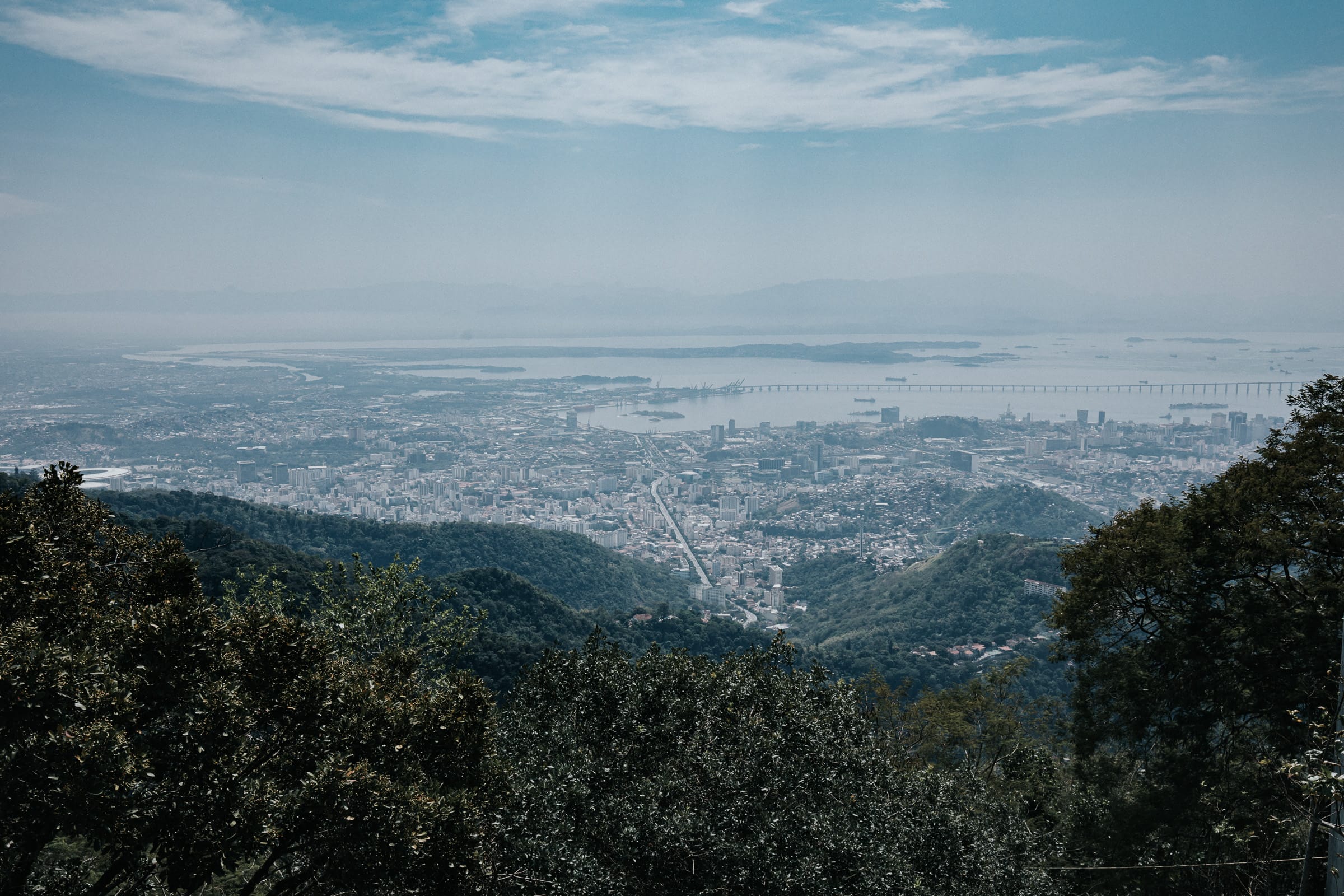
View from Santa Teresa
Santa Teresa: The creative hotspot in Rio de Janeiro
Santa Teresa is one of the older districts of Rio de Janeiro. The European immigrants who settled here at the beginning of the last century also brought their different architectural styles: There are impressive city villas in all kinds of styles all over the place. Santa Teresa is also located on one of the many hills in Rio. Therefore, from many houses, you have a great view over the city. For a long time, Santa Teresa was a neglected part of Rio de Janeiro – until it was rediscovered by many creative people and artists in the last years! Today I consider Santa Teresa to be one of the most exciting parts of Rio de Janeiro!
Santa Teresa’s historical streetcar: O bonde de Santa Teresa
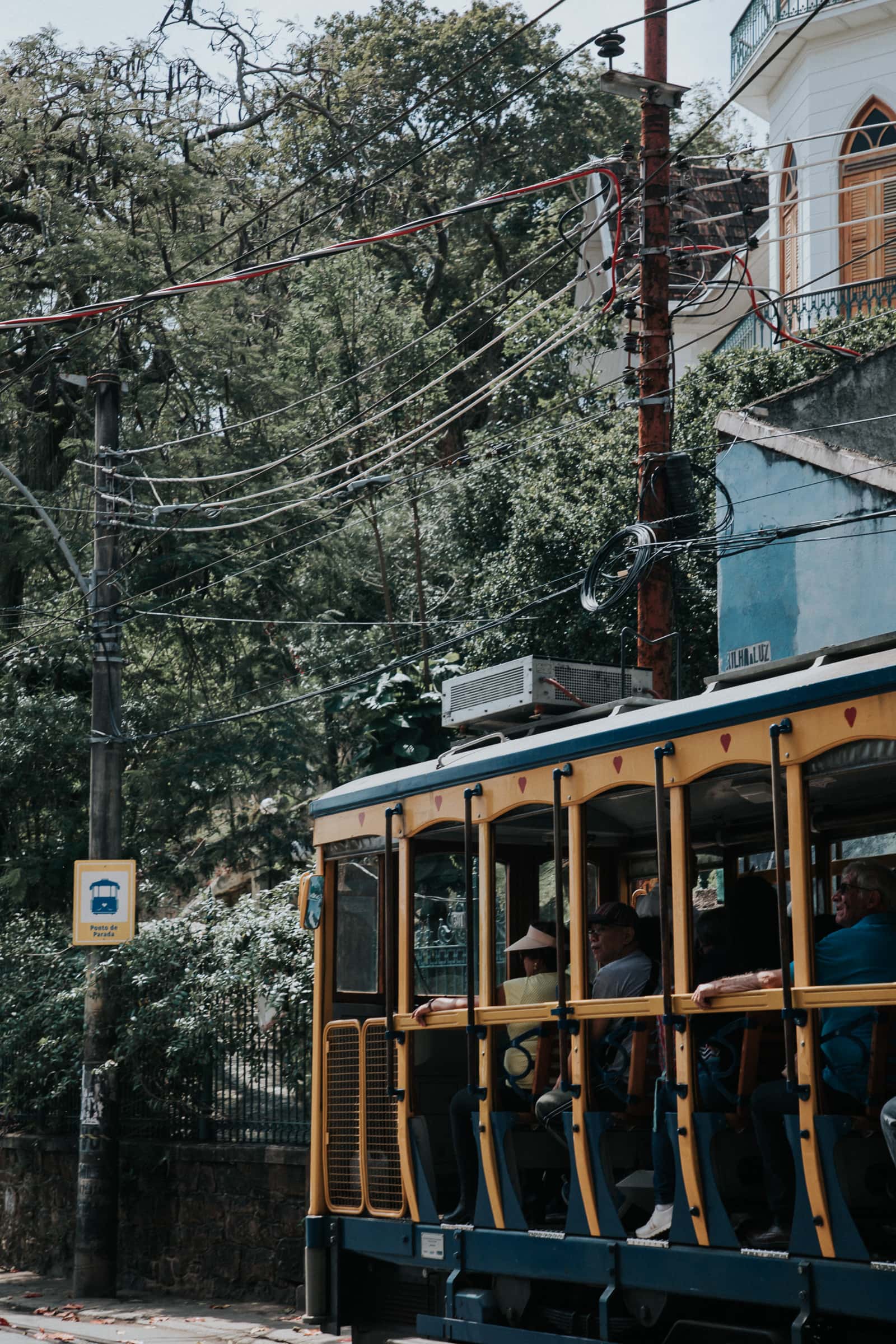
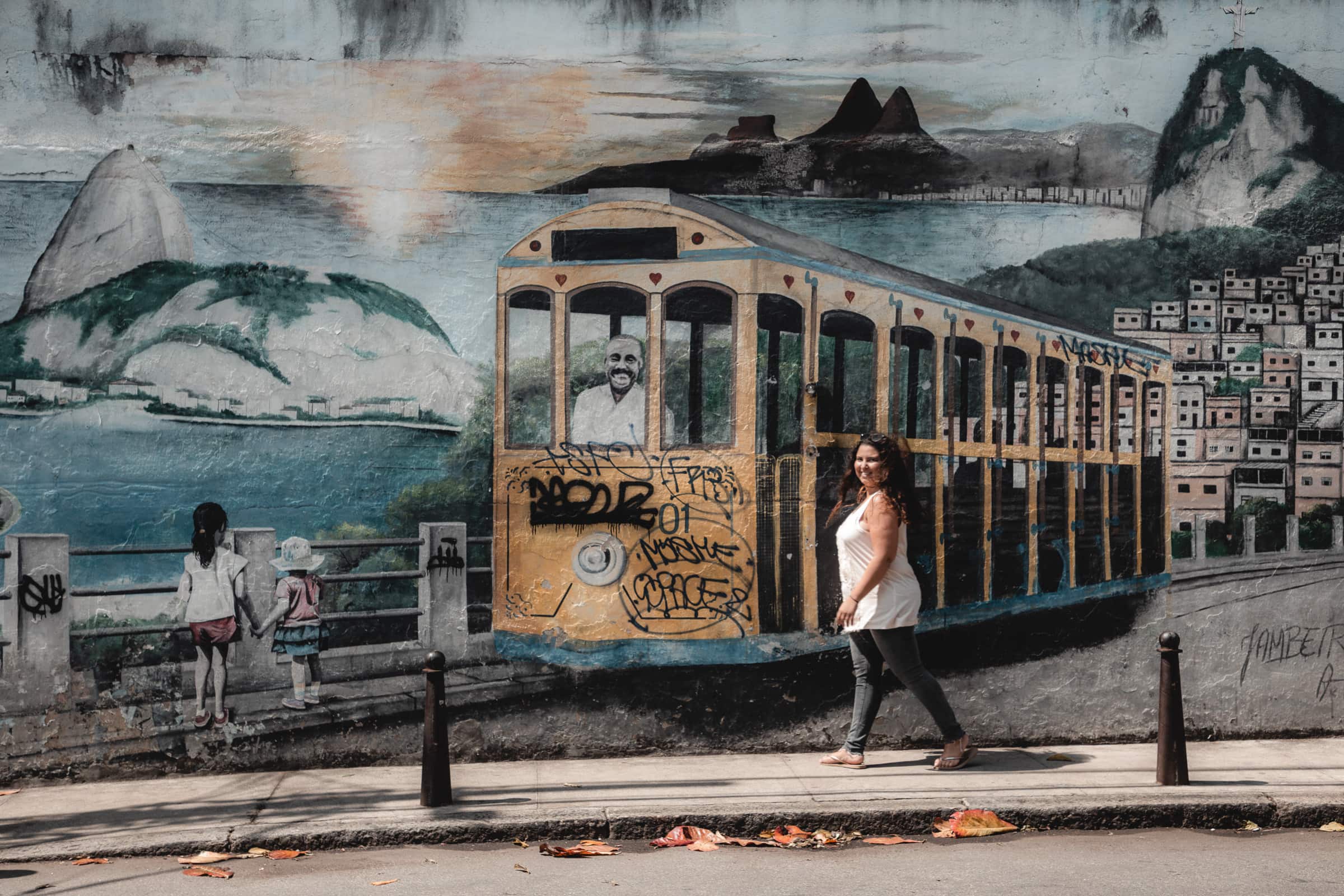
The nostalgic tram is the landmark of Santa Teresa (called “bonde” in Portuguese). You can ride up and down through Santa Teresa to the famous Arcos da Lapa. The Arcos da Lapa are a narrow aqueduct and the tram runs on top! A true experience! After there was a serious accident some years ago, the tramways are however not that crowded anymore: In former times, you could take the train for free if you just jumped up and held on outside.
One ride costs 20 Reais (about 5€), but it’s worth it! It is best to get on at the beginning of the line at the Estaçao Carioca. From there, the train goes up the Arcos da Lapa to Santa Teresa. Unfortunately, there is no day ticket, so either you have to buy a new ticket every time you want to get off the tram and on again. Or you can change to Uber or Bus. Therefore, I recommend to drive up to the terminal station first and then to work your way down again.
The Santa Teresa tram is one of Rio’s landmarks. You can find out more about even more famous sights, such as the Christ the Redeemer statue and Sugarloaf Mountain, in this article: The Most Beautiful Sights in Rio de Janeiro
Tips for Santa Teresa in Rio de Janeiro
The Largo dos Guimaraes is the heart of Santa Teresa! Especially on weekends, restaurants and bars are well filled! Here you can enjoy typical Brazilian cuisine, even Cariocas come here to the traditional Feijoada lunch (bean stew with rice) on Saturday. Some nice addresses:
Bars, Restaurants und Cafés
Explorer Bar
A small bar near Largo dos Guimaraes with fantastic cocktails (the caipirinha is great here, but the rest of the menu is highly recommended!) serving Israeli-Brazilian cuisine with many original vegetarian and vegan dishes. There’s also a small boutique hotel attached to the bar. Click here for prices and info*
Livraria Largo das Letras
Bookstore with café in a romantic courtyard directly at Largo dos Guimaraes! Good for a short break from sightseeing!
Adega do Pimenta
German cuisine may not be your first choice when in Brazil, but the atmosphere at the Adega do Pimenta is so bizarre that you might change your mind. One of the institutions in Santa Teresa which has been around forever!
Bar do Mineiro
Another classic in Santa Teresa: The perfect address for a Brazilian feijoada, Brazil’s national dish. If you aren’t that hungry will also find typical snacks like Salgadinhos, which are traditionally served with an ice-cold beer.
Accomodation
Santa Teresa has a lot of great airbnbs. Especially if you are into cool design and a creative environment! I stayed in a small house that belongs to an artist collective; very nice and definitely an unusual place to stay.
If you prefer more hotel-like accommodations, this is perfectly situated with the Explorer Bar on the first floor and close to Largo dos Guimaraes: Discovery Suites Rio*
If you want to spoil yourself a little bit I’ll recommend this place: MGallery Santa Teresa*
Safety in Santa Teresa und Rio de Janeiro in general
Santa Teresa is not a super unsafe part of the city due to the many tourist attractions. But you have to be very careful here as well. In the evenings, it can get a little more deserted here and not all streets are so busy that you might feel uncomfortable. As a solo traveller (and half-Brazilian, who is familiar with local habits), I didn’t always consider Santa Teresa the best place to stay overnight.
I had booked a nice Airbnb, which was centrally located, but in a quieter street. In the evening, I always took an Uber, when I left my place. But I’ve heard from many drivers that Santa Teresa isn’t a popular destination for some drivers due to its remote location and because there are some shady people around, especially at night.
During the day, I felt safe in Santa Teresa. Just be cautious and don’t talk longer walks around the neighbourhood at night.
Rio de Janeiro is one of the most impressive cities in the country and should not be missed on any trip to Brazil, even as a half-Brazilian, the beauty of Rio knocks me off my feet every time. And I’m not alone in this. Everyone knows the famous sights in Rio de Janeiro, such as Sugar Loaf Mountain and the Christ the Redeemer statue! In this article, I’ll tell you what you shouldn’t miss in Rio. So off to the best Rio sights! By the way: At the end of the article you will find some very helpful tips for your stay in Rio, read them carefully!
#1 Cristo Redentor / Christ the Redeemer
From here you have the perfect view of the Cidade Maravilhosa, the great city, as Rio de Janeiro is often called. You can get to the Corcovado by car (or coach), the Corcovado train or even on foot via a hiking trail.
An excursion to the Cristo Redentor is only worthwhile in good weather, in Rio the weather can change quickly and on cloudy days you really can’t see anything. But when the sun shines, you have the complete Rio panorama: breathtaking! It’s worth coming early as it’s a little emptier then.
It’s worth arriving early to avoid the crowds on the Cristo Redentor viewing platform.The world-famous Rio landmark: Jesus with outstretched arms.
#2 Tijuca National Park / Floresta da Tijuca
Rio de Janeiro is surrounded by lush nature, vast forests, and green mountains. Right in the heart of the city lies Tijuca National Park, known as the Floresta da Tijuca. Corcovado, home to the Cristo Redentor statue, is also part of the national park. In the past, almost the entire area was cleared by coffee farmers; in the mid-18th century, the clearing was halted and the land was reforested. Today, it is home to dense forest with many waterfalls and beautiful hiking trails. It’s hard to believe you’re in the middle of a major city!
In the middle of Rio: pure nature in the Tijuca National Park.
Unfortunately, I had a bit of bad luck with the weather this time: In the pouring rain, it’s not worth taking the cable car up to Pão de Açúcar (Sugar Loaf). However, I’ve already been up there twice on previous visits. The best time to go up is at sunset! Down below, at the foot of Pão de Açúcar, in the Urca neighborhood, is Praia Vermelha, a beautiful little city beach.
Easy to see from Cristo Redentor: The Sugar Loaf Mountain with cable car.
#4 Escadaria Selarón
Jorge Seláron, a Chilean artist, began renovating the dilapidated staircase in front of his house in the 1990s. Not just like that, he covered them with thousands of pieces of tile, mainly in the colors yellow, green, red, white and blue, the national colors of Brazil and Chile. His small work of art grew in size and popularity, and many tourists brought back tiles with motifs from their hometowns, which Selarón then also used.
Selarón died a few years ago, but his staircase is now one of Rio de Janeiro’s visitor magnets. Incidentally, the Escadaria Selarón can also be seen in a fairly well-known music video: “Beautiful” by Pharell Williams feat. Snoop Dogg.
#5 Arcos da Lapa
Near the Escadaria Selarón are the Arcos da Lapa, an imposing white aqueduct. At the top of the narrow Arcos da Lapa, after a long period of restoration (there was a serious accident years ago), the old streetcar, “o bonde”, is running again, and you shouldn’t miss a ride on it! It’s best to take it straight up to Santa Teresa!
Ad / *affiliate links
#6 Santa Teresa
Santa Teresa is the neighborhood of creatives and bohemians in Rio de Janeiro! The historic streetcar (called bonde or bondinho) also runs along this route. In Santa Teresa, you can stroll through the streets around Largo do Guimarães, discover small stores and studios and enjoy a pleasant meal in the surrounding restaurants and bars.
The old streetcar is the landmark of Santa Teresa.
#7 Rocinha, Vidigal, Complexo do Alemão & Co.
Rocinha, Vidigal, Complexo do Alemao—you’ll come across these names of favelas from time to time. However, never, ever go into a favela on your own! If you’re interested in what life is like there, join a favela tour*. You’ll be safe there. Some people may see this as “poverty tourism,” but the favelas are part of Rio’s cityscape, and a tour like this can also help you understand the lives of the local people a little better.
Many favelas also showcase the ingenuity and improvisational skills of Brazilians. Since these are illegal settlements, the entire infrastructure is maintained by the residents themselves. Electricity, water, cable TV, internet access, trash collection, streets, and paths: everything is organized by the residents themselves. And all of this on the steepest slopes!
Part of everyday life in Rio de Janeiro: the many favelas on the hillsides.
#8 Copacabana, Ipanema, Leblon: the beaches of Rio
Rio is also mega famous for its wonderful beaches in the middle of the city! Copacabana and Ipanema are the top addresses for swimming. The hip Cariocas meet at Posto 9 in Ipanema. Unfortunately, for once it wasn’t beach weather when I visited. Beach life in Rio is definitely something special: the whole city meets here, the beach belongs to everyone! Be careful with the strong currents: They are not without! Tip: It’s best to go to the beach with just a towel and a few reais for a guaraná (Brazilian soda), a coconut or a caipirinha and enjoy the hustle and bustle!
No beach weather this time: Posto 9 in Ipanema is usually the meeting place for Rio de Janeiro’s It crowd.
#9 Catedral Metropolitana
Not particularly beautiful, but special: Rio’s cathedral, which was only built in 1979, can hold 20,000 people standing up. If you don’t have that much time and aren’t particularly religious, this is a location that you can skip if necessary. Nearby, however, is the Confeitaria Colombo!
Standing fit into the cathedral of Rio 20,000 people.
#10 Confeitaria Colombo
The Confeitaria Colombo is the oldest coffee house in Rio de Janeiro! Founded in 1894, it is reminiscent of European coffee houses – a total contrast to tropical Rio. Cariocas find the prices overpriced, but as Europeans they are okay – the ambience is worth it. It’s also a great opportunity to sample Brazilian specialties! In addition to sweet pastries and cakes, there is also typically a large selection of salgadinhos (small balls, croquettes or pastry pockets – salty, hence the name), which are also eaten in Brazil with coffee or as a snack between meals.
The café institution in Rio de Janeiro: the Confeitaria Colombo in the city center.
You can explore the locations mentioned above on your own (except for the favelas, of course, which only require a tour! You can easily get around the city with Uber, buses and the metro. However, I wanted to take carefree photos with my flashy camera, so this time I decided to go on a day trip.
The downside, of course, is that you often end up at a location at the same time as other tour groups, which can be a bit stressful. However, everything is planned out, so you can completely relax when it comes to safety and organization.
One-Day Sightseeing Tour of Rio*(Full itinerary—the expensive tickets for Sugarloaf Mountain and Christ the Redeemer are included!)
Safety in Rio de Janeiro
Unfortunately, crime is always an issue in Rio de Janeiro and one that does not go unnoticed by tourists. Increased caution is required! However, the Cariocas are always very nice and helpful, often giving you spontaneous tips on where you should pay a little more attention. Even if no danger is immediately visible, take all the advice from the locals to heart, it’s no coincidence.
Rio de Janeiro has two airports: Galeão, which is farther away, primarily handles international flights, while Santos Dumont Airport, located closer to the city, is reserved for domestic flights within Brazil. Many European airlines offer direct flights to Rio de Janeiro. Tip: Take an Uber into the city (there’s a separate Uber pickup area where you can meet your driver) or a regular taxi. Although there is a bus service, I wouldn’t recommend taking public transportation with luggage for safety reasons.
Best time to visit Rio de Janeiro
During the Brazilian summer, from December through March/April, Rio de Janeiro is a hive of activity. Weather-wise, you might experience summer downpours, but they usually pass quickly. It can get very hot! But on the other hand, you get to experience Rio in full summer mode! The other months are just as great, though: It can be a bit cooler in the winter, but in Rio that still means 25 degrees—perfect for sightseeing and hiking. Unfortunately, I happened to visit in September when it rained a few days.
Perfect for colder temperatures: hiking in the Tijuca National Park.
Accommodation in Rio de Janeiro
Rio de Janeiro has some of the highest accommodation prices in Brazil! Prices rise dramatically, especially during the Brazilian high summer from December through March/April. Not to mention events like New Year’s Eve and Carnival: You’ll need to book well in advance for those dates!
In addition, many accommodations require a minimum stay during these times. The Copacabana neighborhood is the most popular among tourists; this is where most of the hotels are located. It’s very touristy there, but you’re also staying in a very central location. Recently, however, locations like the artistic neighborhood of Santa Teresa and some accommodations in pacified favelas have also become trendy. In both cases, though, I wouldn’t necessarily recommend these places to every visitor to Rio. I’ve written more about my experiences in Santa Teresa in my article on safety in Rio.
Among other places, I stayed at the B+B Copacabana Hotel: It’s in a perfect location near the beach and right between Copacabana and Ipanema!
Excursions from Rio de Janeiro
From Rio, you can also take a number of great day trips to the surrounding areas of Rio de Janeiro! Beaches, islands, nature, culture—you could actually spend two weeks in Rio and still have things left to see. If you’re planning a longer trip, you can, of course, travel directly to places like Paraty or Búzios instead of taking day trips. Many intercity buses depart from the bus station in Rio to all parts of the country.
“Take good care of yourself! Rio de Janeiro is so dangerous!” My otherwise always cheerful mother and the rest of my family were really concerned who I told them that I would travel to Rio on my own. I tried not to laugh too much. After all, I’m living in Berlin-Neukölln, according to the media reports one of the worst corners in all of Germany!
How unsafe is Rio de Janeiro?
I’ve traveled halfway around the world, often alone, sometimes arriving in strange cities at night, without a plan, but also fearless, because hey, some cab will get me to my destination – but Rio de Janeiro? Rio, that’s apparently too dangerous. Dark favelas, drug gangs, shootouts and an eternal war between special forces of the military, police and gangsters, where good and evil are not necessarily always who they seem to be. Rising crime everywhere. Safety? A foreign word in Rio de Janeiro. Every day the news are full of muggings, flash kidnappings in the open street and tourists being robbed blind.
View from the Cristo Redentor: The Sugar Loaf with cable car.
Rio de Janeiro and Safety: Is it all scaremongering?
At the same time, it seems to me that a certain carelessness in Rio de Janeiro with regards to crime is out of place. I remembered the story of some fellow crew member in Mexico City. (Can’t really say if this story is true, but you’ll get the point.) The aforementioned colleague was sitting in a sidewalk café in a chic district of Mexico City, and poof… the Rolex was gone. Just like that someone pulled it of his wrist. May be one of our legends in aviation, but still: You get the advice all the time to wear as little jewelry as possible or better, no jewelry at all.
That’s also one of the reasons why I prefer to travel alone in Southeast Asia; where—as long as you take the usual precautions (like not walking around in the middle of the night in a train station district waving a wad of cash and the latest Chanel handbag—a fake one, of course)—you’re largely free from street crime and shady characters.
Crime in Rio de Janeiro: Should we be afraid?
I wish I could write here that there is nothing at all to worry about in Rio, and that everything is pure exaggeration if you are not wandering the favelas on your own. However, I can remember a moment when I was walking in the evening through Santa Teresa, the new in district for creative people in Rio de Janeiro.
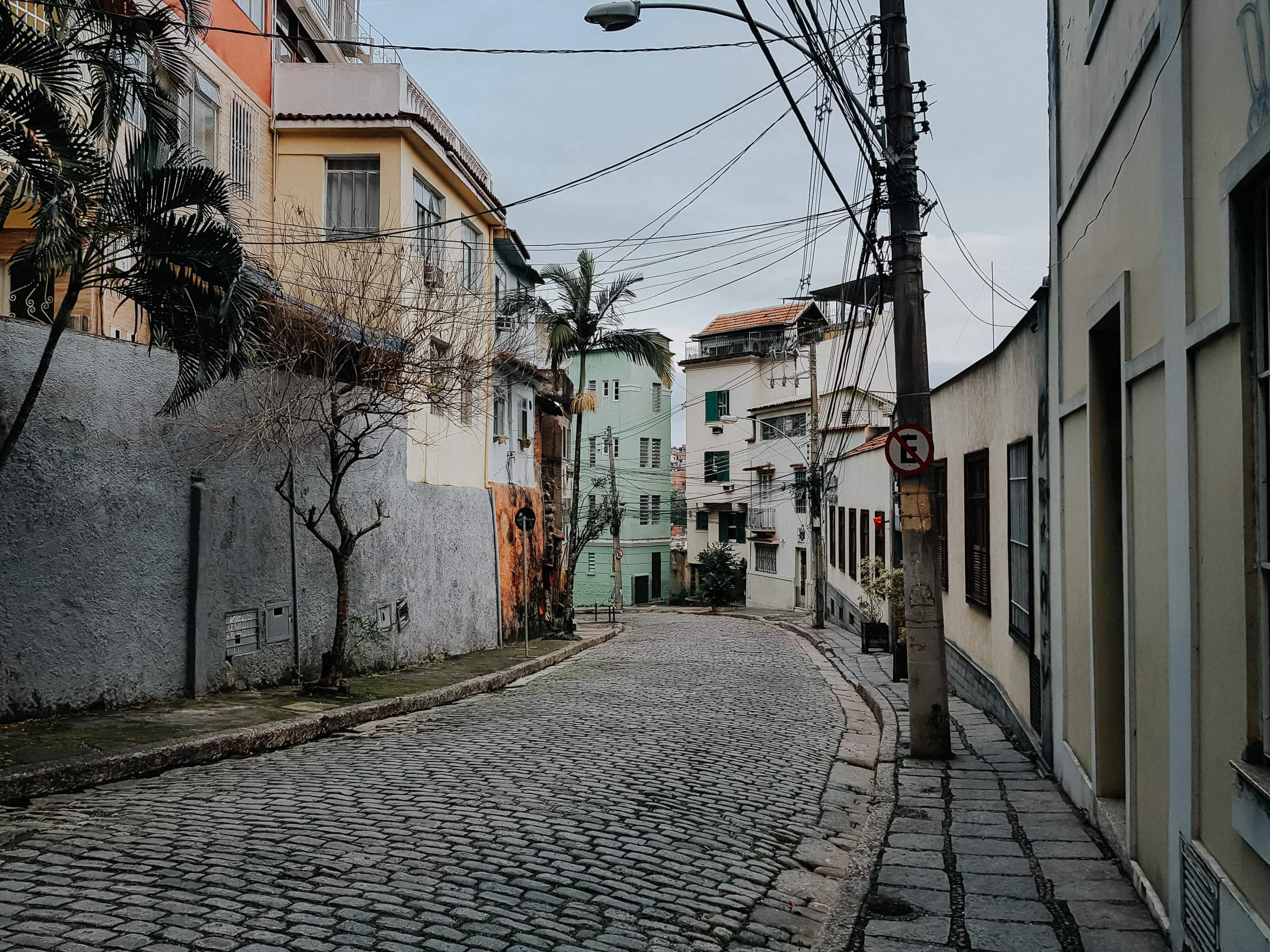
Santa Teresa by day: An artists’ quarter with many studios, restaurants and small stores – and quiet.
I had booked an Airbnb there, right next to the German consulate, which is guarded around the clock—that did put my mind at ease a bit in this situation. A few Uber drivers had already warned me that I might have to wait longer for a ride—Santa Teresa isn’t exactly a popular spot, since it’s outside the typical tourist areas like Copacabana and Ipanema. Not many drivers were eager to crawl up and down the winding mountain roads, and besides, well, it could get a little weird there from time to time…
Dangerous places in Rio de Janeiro (examples)
Copacabana: Centrally located, many hotels and the famous beach are here. Copacabana looks relatively safe, especially during the day, due to everyday city life. Nevertheless, you should beware of pickpockets here around the clock. In the evening, as everywhere else, don’t walk along the beach even if it’s tempting. Stay on the promenade, have a drink in one of the bars and enjoy the night. Don’t be tempted to dip your feet in the water at night: Beaches aren’t illuminated and you might get robbed.
Corcovado: At Corcovado there is a hiking trail up to the statue of Christ the Redeemer. Attention: Tourists are often being assaulted here. At the bottom of the climb, the police is present from time to time, but along the trail you are on your own. Better take alternative means of transportation up here.
Favelas: Do not enter favelas on your own! As a non-resident, you’ll immediately stand out here. Join a guided tour if you are interested in life in a favela: for example, there are tours in Rocinha*, Vidigal* or Santa Marta*.
Centro: After business hours, it gets shady pretty quickly in the center of Rio! Avoid the centro after the shop are closed or on Sundays at all costs! The streets are empty and there are some shady characters on the road.
An evening in Santa Teresa – and an incisive experience
Santa Teresa is a very nice district at first sight. Once upon a time it was gloomier here, but now many artists and creatives have settled here, a pleasant vibe runs through the neighborhood, and somehow during the day it looks like the post-reunification Prenzlauer Berg under palm trees. The streets are lined with old villas of various types; the European immigrants who came here in the early 20th century brought a diverse range of architectural styles.
And yet, the short five minutes I had to walk from my accommodation to the bar where I had an appointment had a certain tension in it. It was eight o’clock, already dark, in the middle of the week, and the streets were mostly deserted. I was on my to the Explorer Bar and suddenly two boys walked towards me. Just walking! I didn’t know if maybe they weren’t just on their way home or something.
So my panic level raised and I wasn’t even able to control myself anymore. I got sacred and suddenly I was running as fast as I could up the street on the other side. With slippery sneakers! It must have been a bizarre picture. Me, stumbling up the hill in panic, even though there was no danger all around. No question I took an Uber for the five minute walk at the end of the evening. And the driver was remarkably understanding: “Of course I’ll take you even if it’s just the few meters!” Better be safe than sorry.
Precautions are important
I definitelylost my nerves that evening. But it wasn’t that unreasonable. In my opinion, the only reason why there aren’t even more robberies and assaults happening in Brazil, but also especially in Rio, is because the population is used to take precautions all the time. You will see massive metal fences around apartment building entrances, hotel lobbies locked after dark or police checkpoints at tourist hotspots. Often, however, they are also corresponding behaviors; a certain caution that has crept into all areas of everyday life.
My Airbnb hostess, for example, said that the area in Santa Teresa wasn’t dangerous on one hand, but on the other she also advised me to only carry a copy of my ID (in Brazil, ID is mandatory at all times) and just little money, in case I get mugged. Or when I left the house with two pieces of luggage and left one suitcase briefly for a few minutes at the leaning gate in the middle of broad daylight, a neighbor warned me: “I’d better close it up, not that anyone gets any stupid ideas.” By the way, only hundred meters away and in sight was the German consulate, heavily guarded with security and everything.
4a0b7f5cff0b55481aaa085c85afa485
Evenings in Copacabana: Watch out!
Copacabana, the neighborhood where most tourists end up—because of the beach, Rio, and all that—isn’t any better, by the way. Here, too, you have to exercise a certain amount of caution after dark. It’s not for nothing that the concierge at my hotel in Copacabana* quickly locked the door every time a guest went in or out. Once, I was still chatting with a German acquaintance outside the door (which made me a little uncomfortable—my “Rio panic” kicked in again)—two female tourists in the bright glow of a hotel on an otherwise dimly lit street—oh-oh, he didn’t unlock the door until I made a move to go inside. As if, in an emergency, he’d just stand by and watch from the safety of his post. Because, well, who stands around in the dark in front of the door for that long? It’s not exactly safe around here.
Nevertheless, there are certain rules in Brazil as well, and Brazilians are by no means as open and liberal as you might think. For example, topless bathing is frowned or sometimes even forbidden in Brazil, depending on the location? Also, Brazilian men can be very flirtacious. My simple advice: be alert, but also relaxed, maybe your counterpart really just wants to have a nice conversation or flirt a bit. If it gets too much for you or you can’t assess the situation, however, you’d better be careful and follow your instincts!
Rio de Janeiro is incredibly green: In Rio’s national parks you can go for endless hikes
Rio de Janeiro is an experience in itself, I’ve been there several times and the city always gets me. I don’t want to scare anyone into going, but a few safety tips are worth their weight in gold. As a woman alone, I think it is feasible, but I always advise not to choose Brazil or even Rio if you have never traveled alone before.
Personally, I don’t see much difference between traveling to Rio solo as a woman or as a man. Probably the only thing you are more likely to encounter as a woman are numerous flirting attempts – which I personally don’t mind that much. Brazilians are very communicative by nature, and Brazilian men just like to try their luck. Still, no means no, and there are other places in the world where I have felt much worse than in Brazil (e.g. in Marrakech). In general, just be aware that Brazilians might seem a bit more touchy than people in other cultures, but also in a non-sexual way.
Safety tips for a trip to Rio de Janeiro (not only for solo travelers)
Here are a few golden rules for your stay in Rio: (Much of this goes without saying and isn’t anything new, but in Rio, it’s best to just err on the side of caution!)
Don’t wear flashy jewelry (think about the Rolex story!), clothing or accessories.
If you’re going to the beach take only with a cheap towel with you and at most a few Reais for a drink. Nothing else. Leave everything else like cell phone, camera, etc. in your accommodation. Even if you are traveling with several people and one person always stays with your stuff. You will quickly notice: no one, but really no Brazilian goes to the beach with huge luggage. Food and drinks are usually purchased on site at booths, beach bars or from passing vendors.
Especially with flashy camera equipment: pay attention to where you are! I actually used my camera, a Canon 5D Mark IV, in Rio, which gave me a lot of bellyache, since it is very expensive after all. However, I had already prepared it for travel anyway, so that it wouldn’t look conspicuous: I never use the enclosed camera strap, which, at least for Canon and Nikon, not only indicates the brand, but also the exact model. These straps are really noticeable. Most of the time I’ll put the camera on my cross-body strap, or I use old straps from analog cameras. I also cover model numbers etc. on the camera and lenses with black masking tape. Especially the red ring of Canon’s L lenses is quite eye-catching and immediately gives away professional equipment.
I finally booked a tour, so I was able to use my camera without any worries. By the way, these kinds of bus tours in small vans are also very popular with Brazilian tourists—a great atmosphere is guaranteed! I always recommend them to solo travelers, too—you can easily strike up conversations, and you can really relax when it comes to safety.
Always keep an eye on your purse! Stow away your wallet that no one can easily access it! Avoid backpacks or carry them mainly in front of the body.
Always take only one copy of your ID with you (ID is mandatory in Brazil) and leave your passport at your accommodation.
Only ever withdraw money during the day and in monitored bank vestibules. Keep an eye out for strange characters in the vicinity. Tip: You can safely withdraw money in shopping malls.
If you’re arriving in the city with luggage, you should definitely take an Uber instead of public transportation. If you want to be on the safe side—perhaps because it’s your first time in Rio or you’re tired from a long-haul flight—make sure to arrange for a ride in advance.
Always make sure you get into the right car when you call an Uber. Check the license plate!
When you go out in the evening: always watch your drink. Be careful with Caipirinha: It’s tasty, but it’s also pure alcohol and you’re likely to pay less attention when tipsy.
Avoid public transportation in the evening! Uber is cheap and safer.
Avoid the center of Rio after business or office hours and on weekends: This part of Rio is then completely deserted and there are many shady characters on the streets! Even in daylight, it’s very dangerous here on sundays!
Also be careful on lonely hiking trails in Rio’s national parks and up to Corcovado. Walk in groups and ask locals about the current situation.
Don’t even think about exploring a favela on your own! If you’re interested in life in the favela, you can book a favela tour*, for example. I’ve never been on one myself, but they’re supposed to be very interesting and often benefit the community as well.
If the worst should happen to you: In the event of a assault, no resistance, no discussion, give up everything, then go to the police.
Conclusion: In general, I wouldn’t discourage anyone from traveling to Rio. However, especially as a Central European, you should be aware that you need to be more vigilant when traveling in Rio. In any case, you’ll love Rio!
This site is registered on wpml.org as a development site. Switch to a production site key to remove this banner.





 Rio de Janeiro is incredibly green: In Rio’s national parks you can go for endless hikes
