Are you looking for inspiration for destinations in Germany? There are so many beautiful corners in Germany! Even though I love long-distance travel, I am just as happy to travel within Germany. Whether cities like Dresden or my hometown Berlin, whether nature like at Lake Constance, I am always enthusiastic about destinations within Germany. On my blog you will therefore also find some tips for trips within Germany.
In Nuremberg, I didn’t have time for sights like the Kaiserburg – because I got lost in the picturesque old town. It is also a sight in itself! I haven’t been there for years – and somehow not much has changed: I still quite like the city. And since I’ve decided to share more of my travels (business and private) here, I’ll start with my very personal Nuremberg sights!
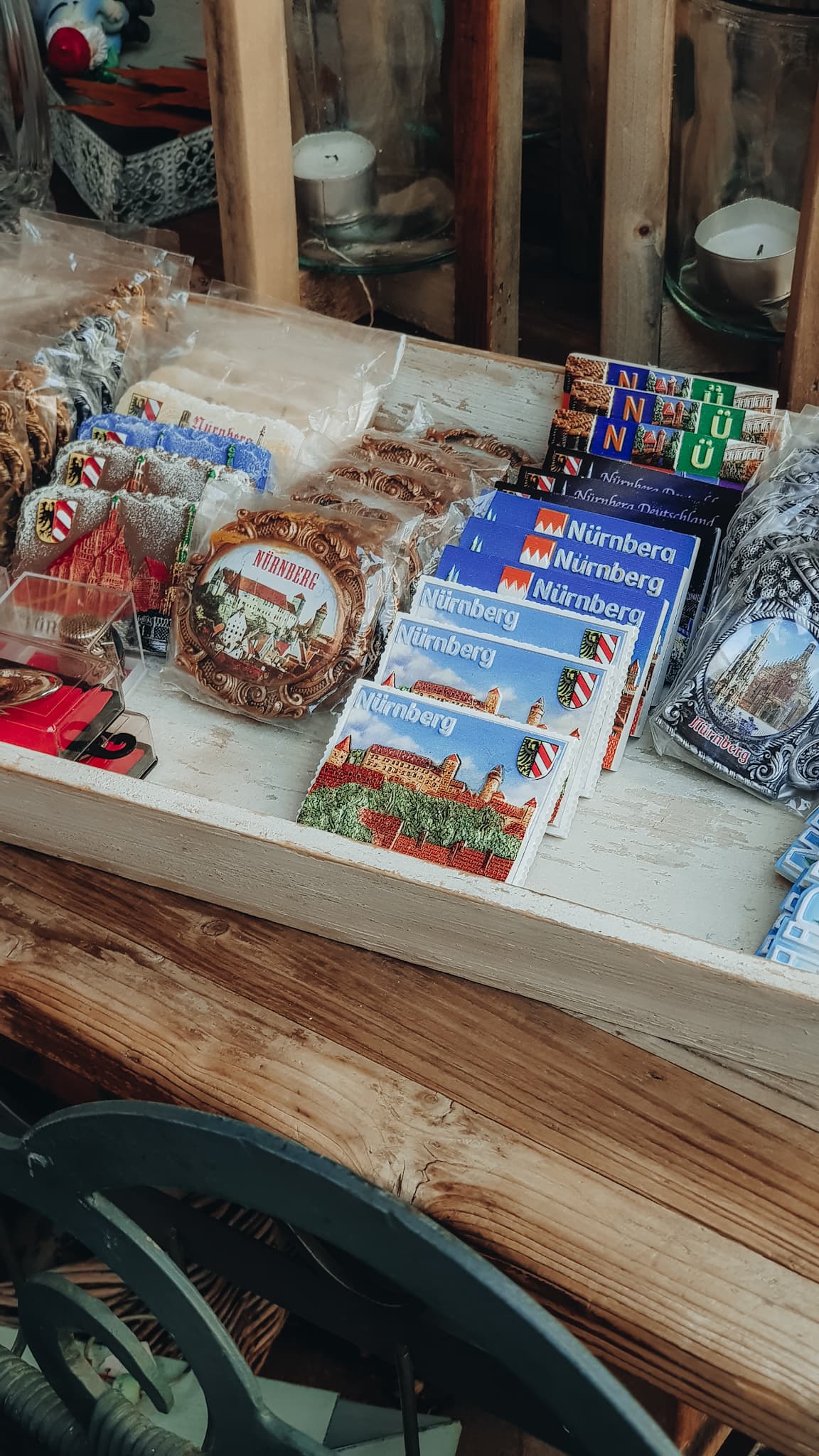
I discovered this beautiful little corner not far from our hotel by chance. It’s funny how you can be in a city so often and simply overlook the most obvious spots. The Handwerkerhof is not particularly large. In the 1970s, small half-timbered houses were built in a small courtyard area next to the original town wall and turned into a small tourist attraction. Sounds like a tourist trap, and it kind of is – but it’s also super cute and cozy! (And it also looks very authentic: If I hadn’t found out afterwards that the half-timbered houses had been rebuilt – I would never have guessed!)
The Handwerkerhof in Nuremberg: Favorite place.
Food: The famous Nürnberger Rostbratwürstchen
There are a few small stores with arts and crafts, workshops and studios in the Handwerkerhof. And really, really cozy pubs! In the middle of the city center, you immediately feel a rustic medieval flair. And in the Bratwurstglöcklein you can get the most delicious grilled sausages in a bell-shaped plate ever! A little overpriced, of course – but the ambience and sausages are worth it.
Art in the Neues Museum Nuremberg
Nuremberg also has some interesting museums, and although this is something I’d rather do in the colder winter months, I decided to take an arty detour. Mainly because I had seen that the exhibition at the Neues Museum in Nuremberg also included paintings by Gerhard Richter – who I really like. But the permanent and temporary exhibitions at the Neues Museum are also well worth seeing if you like modern art and design. The architecture of the Neues Museum alone, with its huge white spiral staircase, is impressive!
Impressive: Gerhard Richter at the Neues Museum Nuremberg.
Art in Nuremberg: More museums in Nuremberg
If you are more interested in the Middle Ages and the history of Nuremberg, the Germanisches Nationalmuseum is the place to go.
Otherwise, a visit to the following museums in Nuremberg is also worthwhile, depending on your interests:
Nuremberg and its past: Nuremberg Nazi Party Rally Grounds and Documentation Center
Nuremberg not only played an important role in the Middle Ages as a trading center and center of craftsmanship – unfortunately, Nuremberg was also the scene of events during the Nazi era. From 1933 to 1938, the National Socialists held their annual Reich Party Rally here on a huge site. It’s scary how many people allowed themselves to be mobilized back then and marched and waved flags at these events, which were staged like folk festivals.
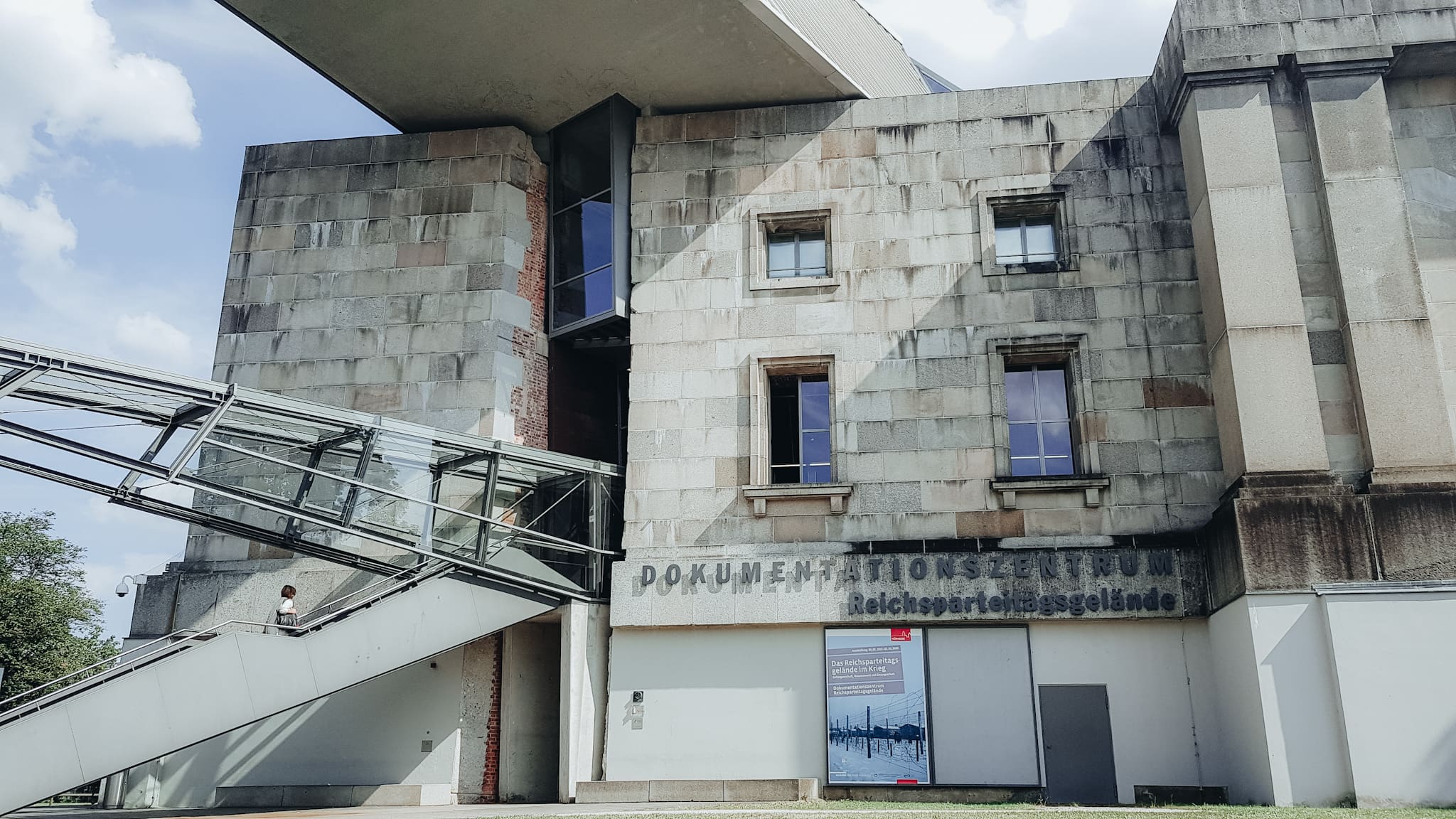
Oppressive exhibition at the Documentation Center Nazi Party Rally Grounds.
The former Congress Hall, which was never completed, is now home to the Reichsparteigelände Documentation Center, which not only covers Nuremberg and the Nazi Party Rallies, but also contains a very good exhibition on the entire National Socialist era. You should definitely watch the film at the end of the exhibition, in which contemporary witnesses from Nuremberg talk about how they experienced this time in the city. Not a light subject – but it is always important to remember this dark chapter of German history so that something similar never happens again!
Converted into the Documentation Center Nazi Party Rally Grounds: the former Congress Hall.The Documentation Center Nazi Party Rally Grounds is located in the old Congress Hall, which was never completed.
Near the documentation center you’ll find the Zeppelin field with the associated Zeppelin main grandstand, which can also be visited, as well as the Große Straße, the central axis of the site. The area is very extensive, so you should bring time with you to take in the oppressive history of the place.
After the end of the Second World War, the Nuremberg Trials, in which leading National Socialists were put on trial, also took place in Nuremberg. The jury courtroom can be visited on trial-free days (usually Friday to Monday) together with the permanent exhibition “Memorium Nuremberg Trials” in the Nuremberg Palace of Justice.
I hope to come back to Nuremberg in the near future, there is so much more to discover! (Not to mention the romantic Christmas market in December!)
***
You can also find more inspiration for short trips within Germany here:
I was in Dresden recently. And then I remembered that I’d always wanted to see the Semperoper Dresden from the inside instead of just from the outside – I’ve been to Dresden several times, both professionally and privately, but I’ve only ever walked past the Semperoper. Not that I’m normally a big opera-goer. Somehow it’s one of those things you have to get from home – but nobody in my family was really interested in opera. It wasn’t bad either. Going to the opera was only for high earners.
Semperoper Dresden with King Johann monument on Theaterplatz
Semperoper Dresden: Best seats for little money
Actually nonsense. Opera is for everyone. Even for little money. And it doesn’t have to be a fine tux or the most beautiful evening gown. It also makes you look a little prettier – you always have something black in your wardrobe. Then you need a bit of luck: At the Semperoper Dresden, tickets are available at the box office for every (even sold-out!) performance. For the cheap seats. In the truest sense of the word. 22 euros, in the top right corner – and with a bit of stretching, they were really good seats. I only roughly knew the story of Carmen, but it didn’t matter, it was still impressively beautiful. The stage design, the music, the costumes, the singing. I was fascinated. Classical music doesn’t have to be boring.
Ranks and seats in the Semperoper Dresden
You can find even more ideas for travel destinations within Germany here
Guided tour of the Semperoper Dresden
Not to mention the surroundings: The Semperoper is one of the most striking buildings in Dresden. And the colonnades inside are gorgeous! The ceilings are completely painted in filigree and it is hard to imagine how long it must have taken to create the decorations.
If you want to explore the Semperoper even better, you can take part in a guided tour before the performance – but then it will be tight if you want to get one of the cheap seats at the box office. But you can also visit the Semperoper without the opera; there are also guided tours during the day. It’s really worth seeing the inside of the Semperoper!
It wasn’t far from our hotel on the Altmarkt to the Semperoper, which I can highly recommend: It couldn’t be more central. Otherwise, there are always good offers on sites like booking.com – if there are no major events like the Dresden Striezelmarkt before Christmas.
Save money & benefit from many advantages with the Dresden City Card*! With the City Card you get a number of discounts at museums, exhibitions & for tours. And the best thing is: you can travel free on all public transport and explore the whole of Dresden to your heart’s content! For 1 to 3 days.
Who can’t immediately relax at the sight of such beautiful North Sea beaches? I’ve brought you some really cool tips from Sylt and will show you the most important sights on Sylt!
The best Sylt sights for a weekend
Only a weekend to spare? No problem on Sylt. The island is easily and quickly accessible: by train, plane or car on the train. On Sylt itself, the public island bus is a great way to get from A to B. And let’s be honest: longer stays on Sylt will blow your travel budget anyway. (But more on that later.) So a weekend on Sylt is all you need: as soon as you set foot on Sylt soil, you’ll feel like you’re on vacation.
Tip: With a bus tour, you can get to know all the important points on Sylt without having to squeeze into public transport! ➜ Book your tour of the island here*
It was too fresh for the beach sauna, I’m a wimp. But I definitely have to try it out next time: A sauna in the middle of the beach, how cool is that!
#1 Westerland & the spa promenade
There is also a ferry connection to the north of Sylt in List – but the majority of visitors to Sylt actually arrive in Westerland. By train or car train or by plane. Westerland as a place in itself may disappoint some people – charming thatched-roof houses and a dune feeling are few and far between.
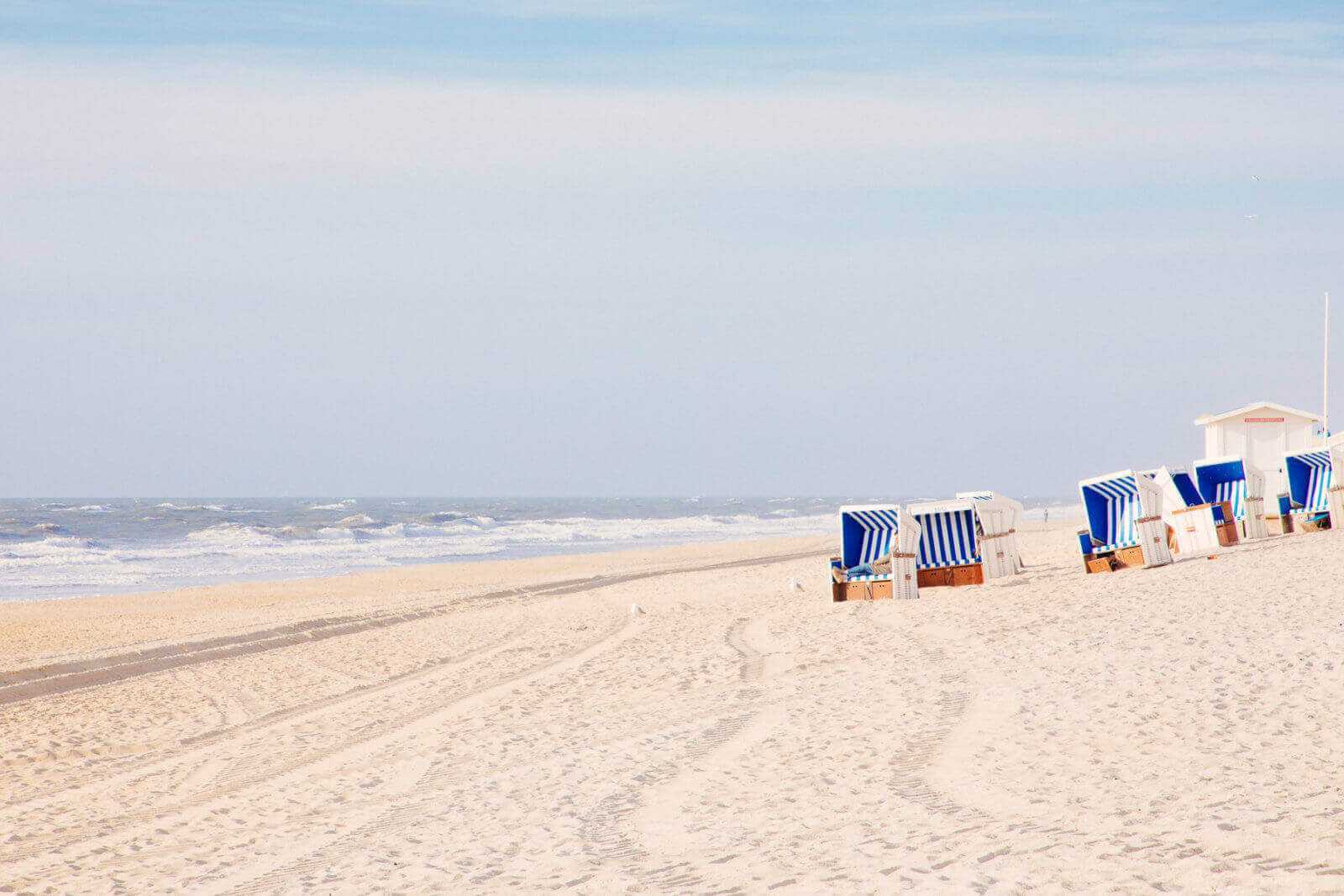
Even if Westerland is not exactly the most beautiful place on Sylt, the beach here is also impressive.
Instead, there are plenty of architectural sins in the form of apartment buildings from the sixties in the form of shabby shoeboxes – above all the new spa center directly on the beach in Westerland. Nevertheless, Westerland is a good starting point for excursions around the island – and is perfect for visitors with little time. It is easy to get anywhere from here and accommodation can be found quickly. And all in all, Westerland is a relaxed spa town with some nice restaurants and a really outstandingly high density of well-stocked, inviting bookshops! (Something I really miss in Amazon-Prime-spoiled Berlin – there’s nothing like cozy bookstores with a nice selection).
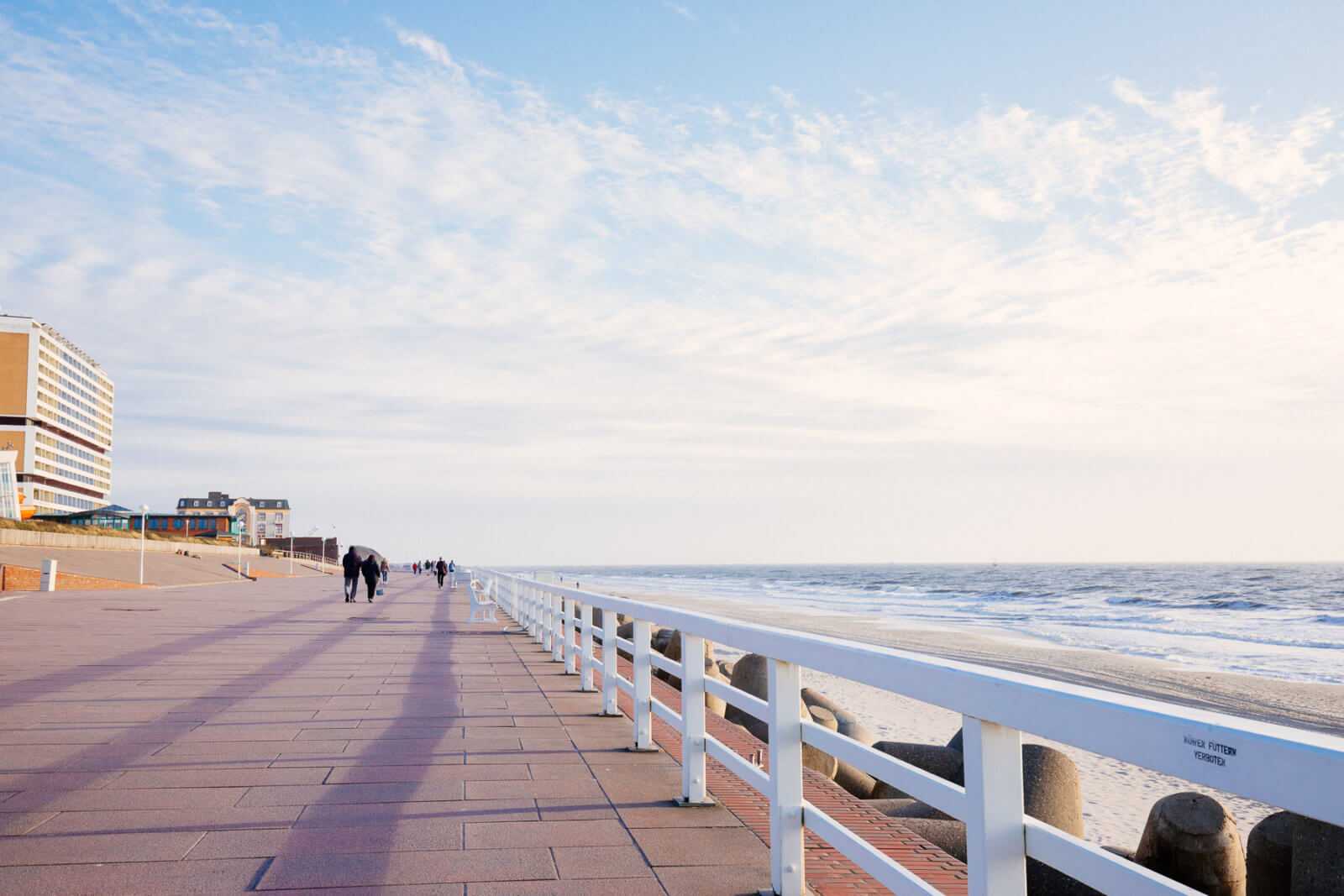
Strolling along the promenade in the evening: Favorite activity in Westerland.
#2 The Uwe Dune
To the north of Westerland lies the Uwe dune, the highest point on the island – and that’s not much for an island like Sylt, which is in constant danger of disappearing into the North Sea. A narrow wooden staircase leads up to the Uwe dune and once at the top, you can enjoy the complete panorama of Sylt from the viewing platform. On one side is Kampen with its pretty thatched-roof houses nestling snugly in the hilly dune landscape, and on the other is the roaring North Sea. Pure nature all around. And so soothing and beautiful for a city kid like me.
The highest point on the island: the Uwe dune.
Incidentally, Kampen is the hotspot for the rich and famous (actually, it’s already the whole island, but here the concentration seems to be many times higher) – and if you need something from Gucci, Prada, Louis Vuitton or whatnot, you’re guaranteed to find it in the well-stocked village boutiques on Strömwai. Kampen is also home to some of Sylt’s most famous bars and restaurants, which have contributed to the island’s reputation as a jet-set meeting place. But low-budget vacationers like me prefer not to get used to such places in the first place 😉
#3 The Red Cliff
Instead, you can take a walk from the Uwe dune over or around the red cliff, which glows red in the evening sun, especially at sunset, and is one of the island’s landmarks. You also have such a great view of the beach below from above that I had the feeling that I had taken the photos with a drone – drone photography without a drone, so to speak.
Best view: The view of the North Sea from the Red Cliff is unique.
The view is truly unique – even if every pore of your body is once again blown through by the stiff North Sea breeze. But on Sylt, the saying goes: there is no such thing as bad weather, only bad clothing.
➜ You can find more cool destinations for a short break in Germany here on the blog!
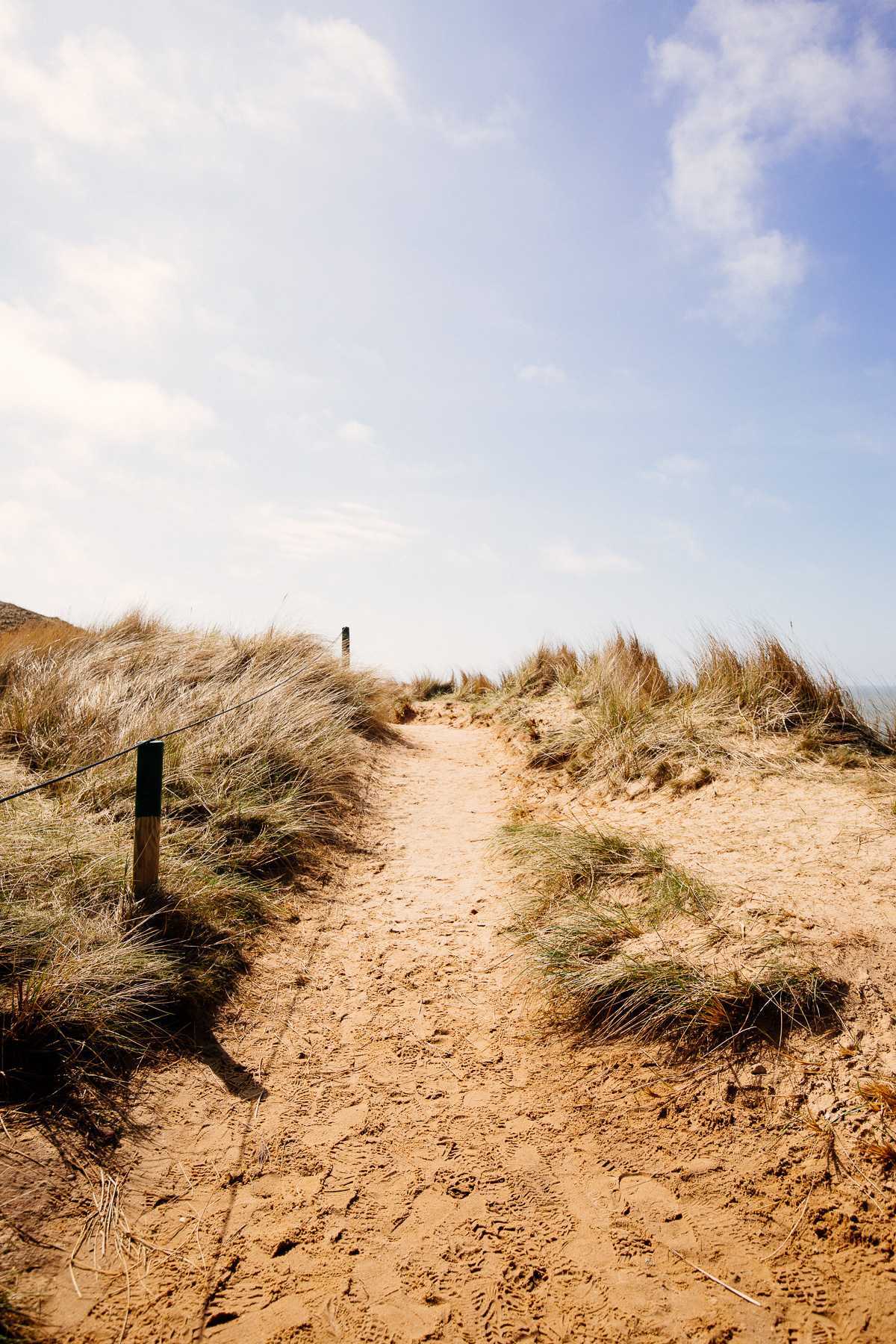
There are also beautiful dune paths on the red cliff.
#4 Stage 16 – Old hipsters, champagne and dunes
Buhne 16 is just a stone’s throw away from Kampen when you’re out and about by bike. At least on the way there, on the way back you often get caught by the headwind, which reminded me to think about an e-bike the next time I hire a bike. But you have to park your bike on the cycle path anyway. It’s a good walk through the dunes to Buhne 16.
On the way to stage 16.
In the middle of the solitude, I used my guest card for the first time, which every tourist receives after paying the tourist tax at their accommodation. This means that admission to the beach is free, otherwise it costs a few euros. You can then pay the fee on site.
In the middle of the dunes: The famous Buhne 16 in Kampen.
Buhne 16 itself is hidden in the middle of a dune and is actually nothing more than a beach kiosk with a wild history as a lively party venue for prominent beach guests. But Sylt wouldn’t be Sylt if this simple beach hut wasn’t a bit more refined. Unfortunately not the food, the potato salad, for example, also comes from a plastic bucket. No matter, Buhne 16 still exudes the flair of the uncomplicated jet-set beach life of the sixties: there’s plenty of champagne, but on the beach in swimwear everyone is almost the same. And the panorama with dunes, white powdery sandy beach and fresh sea air makes up for the record-breaking prices.
Actually inconspicuous, but pure Sylt atmosphere!
#5 Cunning and the elbow
Further north is List, which is only recommended for real cycling enthusiasts when cycling from Westerland – because the route is long. However, public transport is well organized: if you lose your strength on the way, the frequent island buses have a bike rack at the back so that you can simply charge your bike and make yourself comfortable on the bus (which also has free Wi-Fi, it’s incredible!). Incidentally, the northern tip of Sylt is called Ellenbogen because that’s exactly what it looks like.
The popular beach chairs are also located in List.
Incidentally, List is less glamorous, more sea, more dunes, more nature. In addition to a permanent exhibition, the Erlebniszentrum Naturgewalten also offers guided nature tours: Hiking through the mudflats, through the dunes or a visit to Germany’s only oyster farm.
#6 The northernmost fish stall in Germany
And a must in List: eating fish sandwiches! This is where Gosch, the famous Sylt fish cave chain, has its origins – this is where it all began. The Old Boat Hall also has a maritime flair. Unfortunately, the prices here are also steep, especially for self-service (who would have thought it), the food is okay, but not sensational, and on the whole a little too touristy. Nevertheless: Gosch must be on Sylt.
#7 Rantum
Rantum is not that far from Westerland, exactly at the narrowest point of the island. Here you will find powdery, extensive North Sea sandy beaches! If you are traveling with a camper van or tent, you can sleep on the campsite between the dunes in Rantum. Incidentally, the Sansibar, another famous beach bar on Sylt, is also located on the Rantum beach section. But you’ve known them at least since the legendary Air Berlin Zanzibar currywurst in-flight menus. Even one of Sylt’s beach saunas is located here!
Almost a bit like California: The beaches of Rantum are breathtakingly beautiful.
#8 Rantum bird sanctuary
On one side is a fine sandy beach, while on the other side of Rantum the Rantum Basin bird sanctuary is within sight. Here you can observe a wide variety of bird species. And: there are plenty of sheep – a pure natural idyll! Sylt is not particularly wide, so you have a wonderful view from the dunes on the beach to the other side of the island, where the bird sanctuary is located.
Sheep keep the grass in good shape around the Rantum bird sanctuary.
#9 Lighthouses like in Hörnum
Probably the most famous lighthouse on Sylt is located at the southern tip of the island: you can even get married in the Hörnum lighthouse! A circular walk around Hörnum-Odde is also a popular activity in Hörnum: here you can see with your own eyes how much Sylt has unfortunately been struggling with the erosion that has plagued the island for decades.
#10 The Hindenburgdamm
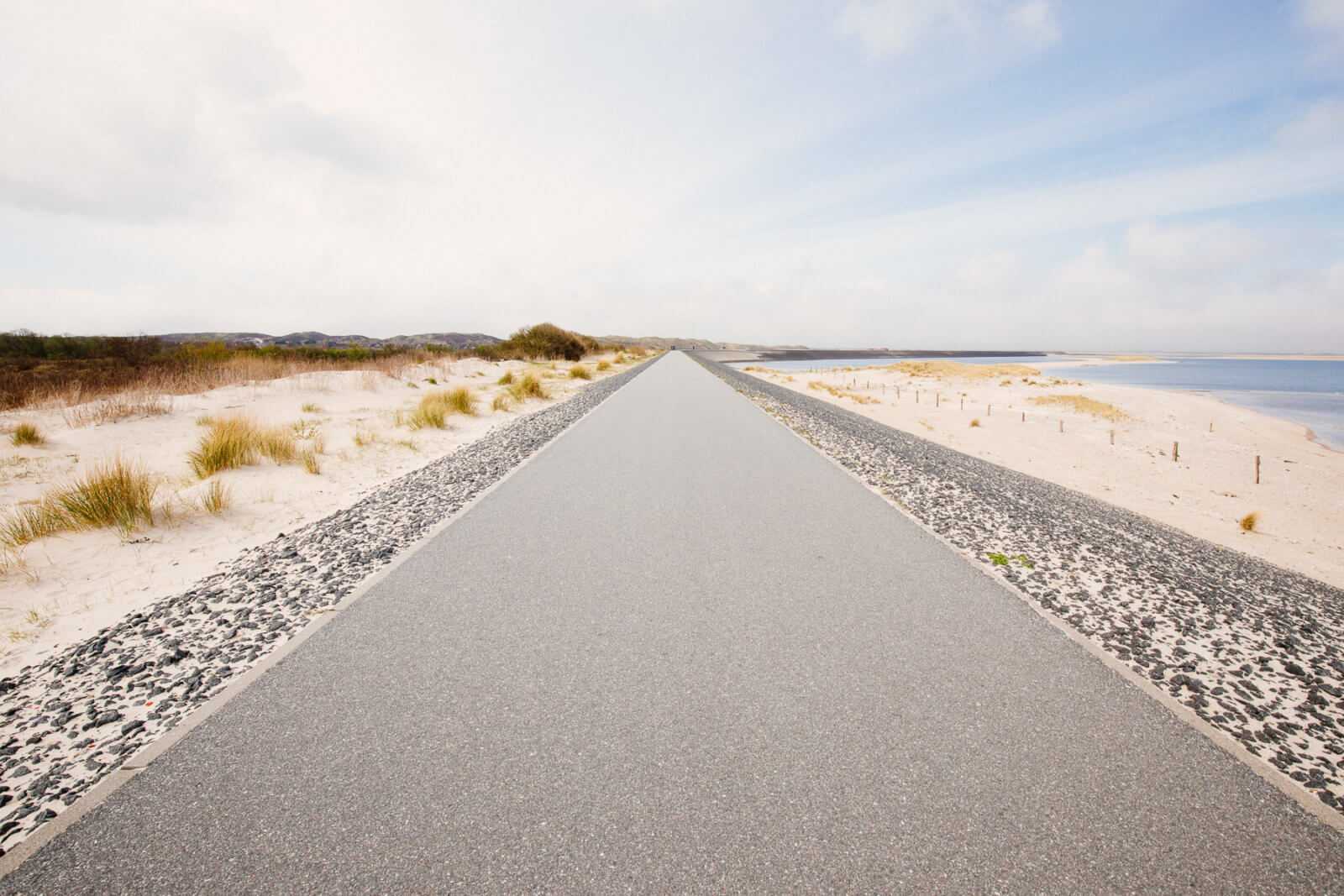
The last sight is also the first: most visitors to Sylt arrive via Hindenburgdamm. Meanwhile, Sylt also has a busy air traffic via Westerland Airport, even Airbuses land here now. And you can take the Sylt ferry from the Danish island of Rømø to List. But arriving by train via the Hindenburgdamm is still the proper way to arrive in Sylt!
The most important Sylt tip? On Sylt, people drink all day long, not just at the weekend, but every day of the week too. A glass of champagne or two in the morning, then a white wine at lunchtime with the obligatory fish; in the afternoon, depending on the weather, a tote Tante (yes, it really is called that – it’s cocoa with rum) to warm you up or a refreshing Aperol Spritz in the Sylt sun. Sylt is an island of indulgence, but the high prices sometimes make it difficult to find something suitable.
The best time to visit Sylt for most people is probably in the summer from June to August. The weather is more stable and warm enough for swimming in the rather cool North Sea. However, Sylt is particularly popular at this time of year, so it’s a good idea to book your accommodation in good time!
But Sylt can also be very beautiful in spring and fall! As everywhere else on the North Sea, you just need to be prepared for the weather with the right clothing: a rain or wind jacket is a must in your suitcase, as well as several layers for an onion look!
Sylt in the low season
While masses of tourists arrive in the high season, the low season is also becoming increasingly popular. It’s not enough to go swimming, but with a bit of luck you’ll get a few good days and have more Sylt and fewer tourists. And the hardiest of surfers simply wrap themselves in neoprene from toe to nose and plunge into the ice-cold North Sea waves anyway. Wouldn’t be anything for me. I love water, I love the sea, but I only go into the water when the air temperature is 28 degrees and above. Maybe that will change – after all, I was never really a North Sea fan. Too cold, too windy, too few palm trees. But after a few days on Sylt, I think I need to revise my opinion: It can be so beautiful on the North Sea!
Standard drink on Sylt: a cool glass of white wine.
Sylt in one weekend
Yes, Sylt is expensive. And the fact that you can find an excellent selection of the finest champagnes in even the most humble corner shop suggests that some prejudices are confirmed on Sylt. But never mind. Because the island itself, with its dunes, heathland and Wadden Sea landscape, is beautiful. A real nature experience. And you can somehow cope with the sometimes horrendous prices for food, accommodation and other things for a short stay – after all, you get something for it.
Arrival by train
What is also practical is that the island is easy to reach by train, and although you can also take your car with you on the car train, this is not absolutely necessary. All places on the island can be easily reached by bike or public bus. The buses also have bike racks so that you can load your bike in the back for more distant destinations. In midsummer, however, the train connection sometimes becomes a bottleneck and delays are not uncommon.
You might be better off taking a plane – many airlines fly to Sylt, and the airport is actually almost in the middle of Westerland. Incidentally, it’s one of the cutest little airports I’ve ever seen – with two fabulous check-in desks and an airport restaurant with the freshest crab sandwiches you’ll ever see in an airport terminal.
Nevertheless, I find the journey by train over the Hindenburgdamm nicer: the best way to get in the mood for Sylt. The Wadden Sea to the right and left. In front of you, the anticipation of the beach, sea, dunes and lots of white wine. Cheers!
“There are so many beautiful places around Berlin” is always the saying. But most of the time I’m drawn further away. Berlin’s (and Brandenburg’s) most beautiful corners always have to wait. But this month I was tired of traveling. Or rather: Berlin was too beautiful with clear skies and summer temperatures. And with a bike tour around the Müggelsee, even a city like Berlin feels like a natural paradise.
Hard to believe: Berlin can also do nature quite well.
Bike tour Müggelsee: Vacation in Berlin
I like to travel: the further away, the better. After all, I also write this blog, which is mainly about traveling. I was born with a love of travel: my mother emigrated from Brazil to Germany in the late seventies because she wanted to see the world. What sounds only moderately exciting today was a huge feat back then, and one that only the very daring decided to undertake. Emigrating – halfway around the world. Unimaginable for many people. In terms of travel, I am genetically predisposed, and I always flirt with the claim that I have a gypsy gene. After all, my parents later emigrated together again, and at a young age I chose a career that could no longer have anything to do with traveling. Then I also live in Berlin. A city that can feel like a cozy, warm nest one minute and like an exotic country two streets away. The whole world in a single city.
In the forests around the Müggelsee and the Dahme, there is one thing above all: peace and quiet.
But after almost 18 years of continuous travel, there are sometimes phases when you can only recharge your batteries at home – without living out of a suitcase, without constantly changing locations. And so this time my Vacations became Staycations: in search of the beautiful corners of Berlin.
Out of Berlin by bike: off to the Dahme
I really enjoy cycling again anyway, and I’ve recently discovered cycling tours for myself. In Berlin itself, cycling is more about getting around than having fun; sticking to the exhaust pipe of cars and crashing into spontaneously opening passenger doors simply diminishes the pleasure of cycling. Fortunately, you can get out into the countryside quickly on the S-Bahn and taking your bike on the train is often no problem.
Lots of greenery and fresh air in the forests of Berlin.
Cycle tour through Köpenick and Müggelheim / Cycle tour to Müggelsee lake
In the east and south-east of Berlin, the Große and Kleine Müggelsee lakes and the Dahme are the nearest destinations if you fancy a trip to the lake and forest. Yes, that’s right, there are large contiguous forest areas and numerous bathing spots. Perfect for a trip into the countryside. And you can’t believe that you’re really still in Berlin.
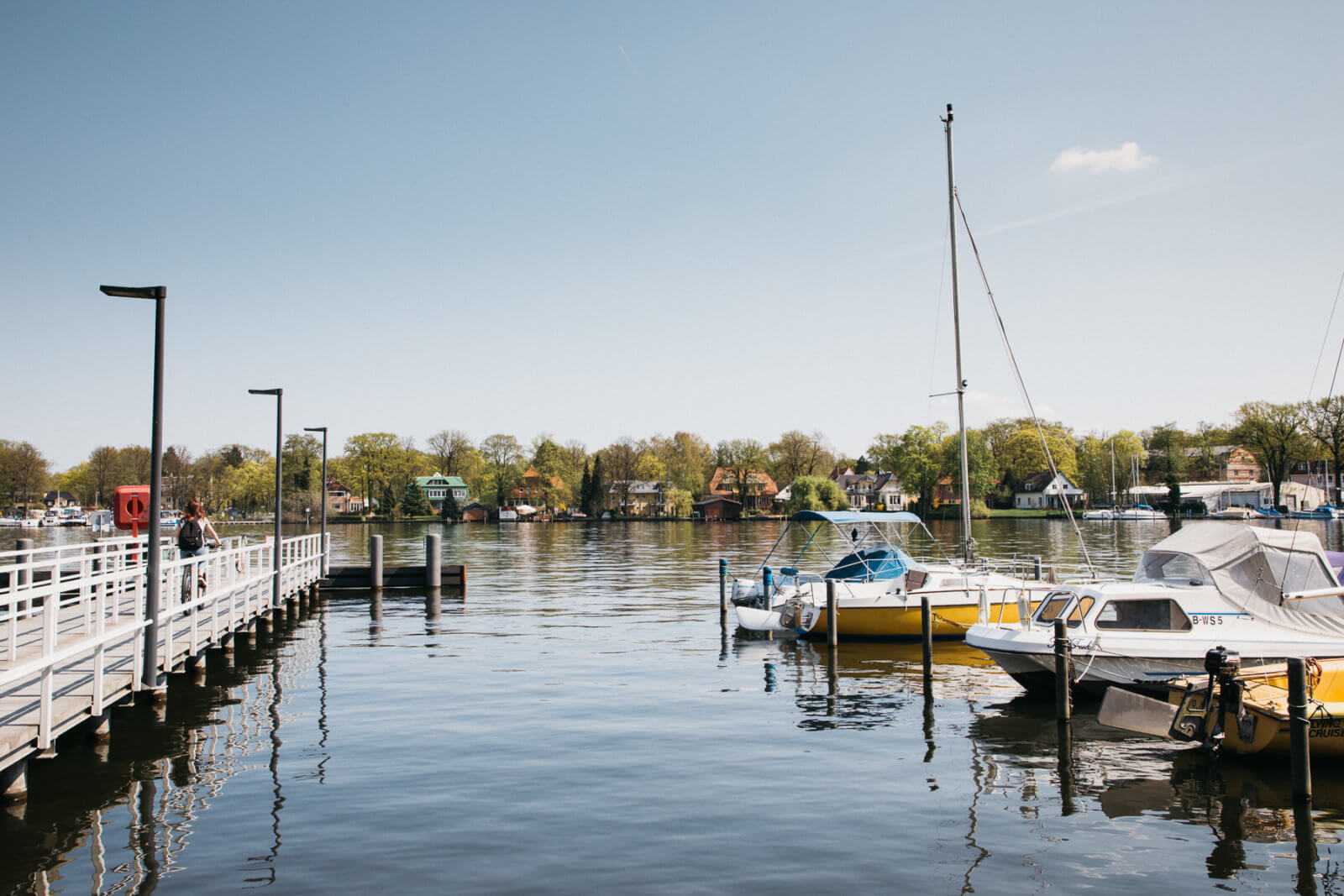
The BVG ferry stops at the end of the footbridge, allowing you to cross the Dahme.
Tour suggestion for a bike tour around the Müggelsee
Take the S-Bahn to Grünau station. (Line S8/9/45/46/47/85)
Then straight ahead down Wassersportallee towards Dahme.
(If you just want to swim and don’t feel like cycling, just follow the signs to Bammelecke and you’ll find one of the best swimming spots in Berlin, which is not overcrowded even in the height of summer).
You can even take your bike with you on the BVG ferry.
Special feature of this tour: at the end of Wassersportallee you take one of the small ferries operated by BVG – the S-Bahn ticket is still valid here! I love these little BVG ferries, which can be found in a few other places in Berlin – a totally brilliant service.
Once on the other side, simply follow the shore to the right, crossing beautiful woodland and passing secluded bathing spots. Don’t be alarmed, some bathing spots are unofficial nudist beaches.
You can go swimming in the Dahme as well as in the Müggelsee.
You can simply follow the shore and at some point you will come to a headland where another ferry stops. You can either take the ferry here or continue along the cycle path towards Müggelheim.
Here you can take a short break in the cozy village inn or ice cream parlor.
The route continues across Müggelheim along Odernheimer Straße to Kleiner Müggelsee.
If you follow the shore to the left here, you will come to the Kleiner Müggelsee lido, a large sandy beach surrounded by forest. Here you can swim or sunbathe very well.
If you prefer to continue, keep to the shore and you will automatically reach the southern shore of the Großer Müggelsee.
From here, walk halfway around the Großer Müggelsee until you reach the Spree Tunnel, which leads under the Müggelspree. (Please note: there are long flights of stairs up and down – although there is a ramp for bikes, it is still a bit of a challenge).
Now you are in Friedrichshagen. The renovated Art Nouveau houses and the beach promenade complete the vacation flair.
The harbor bar is a wonderful place to end the day with a view of the lake before heading back into the city from Friedrichshagen S-Bahn station (5 minutes away by bike and signposted).
This tour can be completed in a few hours (with plenty of breaks to enjoy the surroundings) – but you can also spend a whole day in the region and make up your own tour. The cycle paths along the Dahme and the Müggelsee are well signposted and with a day ticket you can use all BVG ferries (also by bike) for free.